REVIEW 4 major objections 4 minor 48 references
Reversible photo-switching optical functionality in two-dimensional mixed-halide hybrid perovskites
T0 review · 4 major / 4 minor · reviewed 2026-08-01 · deepseek-v4-flash
Pith's one-line read Light-lattice coupling alone can reversibly swap halide ions in 2D mixed-halide perovskites, without defects or irreversible migration.
desk verdict Plausible mechanism, but the central photo-work quantity is computed with an unstated excited-state model, and the paper repeatedly conflates a higher-energy ground-state isomer with 'light'—as submitted, the claim doesn't hold. read the letter →
The pith
A machine-rendered reading of the paper's core claim, the machinery that carries it, and where it could break.
The reading
What carries the argument
The central object is the halide-exchange path constructed with the nudged elastic band (NEB) method, parameterized by a reaction coordinate r. The photo-induced force, defined as the difference between excited-state and ground-state ionic forces, is projected onto the NEB tangent to compute the cumulative photo-work W_photo(r). The soft zone-center IR-active phonon modes (oscillator strength about -0.14 e/(amu)^1/2) are the microscopic origin of the light-lattice coupling. The sign reversal of W_photo at large r, coinciding with the disappearance of the soft modes, is what produces the transient, self-resetting ionic motion.
What would settle it
Simulate the excited-state dynamics from the ground-state geometry: if the halide ions cross the transition state and stay in the swapped configuration after the excitation is turned off, the self-resetting mechanism is falsified; if they stop before the barrier and return when the light is removed, the claim holds.
Extended reading notes
Core claim
The central claim is that halide-ion swapping in BA2PbBr2I2 is driven by intrinsic light-lattice coupling rather than by defects. Combining nudged-elastic-band energy profiles with photo-force calculations, the authors find that photoexcited forces perform cumulative non-equilibrium work of magnitude 0.31 eV along the exchange path, partially overcoming the 0.78 eV ground-state activation barrier (effective barrier 0.47 eV). Since the cumulative work turns positive beyond the transition state, the fully swapped configuration is not stabilized under illumination; instead, ions settle at a transient displaced configuration and revert when light is removed. Four soft phonon modes appear at the
Load-bearing premise
The conclusion rests on assuming that under illumination the ions move exactly along the dark-state minimum-energy exchange path, with the photo-work evaluated at those fixed geometries; if the true excited-state trajectory leaves that path, the 0.31 eV work and the sign reversal that makes the process self-resetting could change.
Editorial extensions
If this is right
- If this mechanism holds, 2D mixed-halide perovskites can serve as intrinsic, defect-free photoswitches that reset themselves when illumination stops.
- The effective barrier of about 0.47 eV implies the full swap requires additional thermal energy, explaining why experiments see partial switching and a temperature threshold.
- The light-induced redshift and enhanced absorption are predicted spectroscopic signatures of the swapped lattice, providing a direct experimental test.
- The soft IR-active modes identify a specific phonon fingerprint that could be used to screen other 2D halide perovskites for similar photo-switchable behavior.
Reading between the lines
- The mechanism implies a general design rule: materials whose soft IR-active phonon modes disappear along a symmetry-related exchange path should show the same transient, self-resetting photo-response; this could be tested computationally in other mixed-halide compositions.
- A full non-equilibrium excited-state dynamics simulation would test whether the actual trajectory stays on the ground-state exchange path; the paper's photo-work integral assumes it does, and that assumption is the load-bearing premise.
- The paper does not specify the excited-state electronic-structure model used to compute the photo-forces; an independent calculation with a different excited-state ansatz could confirm whether the 0.31 eV value and the sign reversal are robust.
Signed reviews
Editorial analysis
A structured set of objections, weighed in public.
Referee Report
Summary. The manuscript claims to establish a defect-free, reversible photo-switching mechanism in the 2D mixed-halide perovskite BA2PbBr2I2. Ground-state NEB gives an activation barrier of 0.78 eV for halide-ion exchange. The authors introduce a photo-induced force ΔF(r) = F_excited(r) − F_ground(r), project it onto the NEB tangent, and integrate to obtain a cumulative photo-work with |W_photo(r_ts)| = 0.31 eV. They argue that 0 < E_eff = 0.78 − 0.31 eV, so light assists but does not complete the swap, and that positive photo-work beyond r ≈ 7 Å prevents stabilization of the fully swapped configuration, giving self-resetting behavior. Supporting claims are made from phonon calculations (soft IR-active modes), band-edge-selective electron-phonon coupling, and GW+BSE optical spectra showing a redshift under illumination. The paper concludes that halide-ion swapping is intrinsic, photo-assisted, reversible, and driven by light-lattice coupling rather than defects.
Significance. If the central photo-work result were backed by a clearly defined, validated excited-state force calculation, the proposed mechanism would be of considerable interest: it would offer a concrete microscopic route to reversible, defect-free photoswitching in 2D halide perovskites and connect phonon softness, band-edge coupling, and optical response. The GW+BSE reproduction of the experimental absorption spectrum in the dark is a genuine strength, and the NEB barrier and phonon analysis are useful data. However, the credibility of the entire mechanism rests on the 0.31 eV cumulative photo-work and its sign reversal, and the manuscript does not disclose how the excited-state forces were computed. Moreover, several figures and the SI explicitly identify the fully halide-swapped ground-state isomer as the 'presence of light' configuration, which makes the headline optical redshift and the photo-work interpretation circular. These are not cosmetic issues; they undermine the central claim as presented.
major comments (4)
- [Methods; Results, Eq. following 'photo-induced force' and Fig. 1d] The central quantity ΔF(r) = F_excited(r) − F_ground(r) is introduced and integrated to give W_photo(r_ts) = −0.31 eV (Fig. 1d), but the excited-state electronic-structure model used to compute F_excited is never specified. Methods describes only PBE, G0W0, and BSE settings and NEB parameters; none of these standard ground-state or quasiparticle/gap calculations yield excited-state ionic forces at arbitrary NEB images. Without the method, the 0.31 eV value and the sign reversal at r ≈ 7 Å are not verifiable. This is load-bearing: the effective barrier E_eff = 0.78 − 0.31 eV and the entire self-resetting scenario depend on this number.
- [Fig. 2b, Fig. 3c, Fig. 5a, SI Note after Table S1] The manuscript repeatedly labels the fully halide-swapped configuration (BA2PbI2Br2) as 'in the presence of light'. The SI states that the swapped structure is 'an excited state corresponding to the structure under illumination.' But a distinct halide arrangement at the ground-state PES minimum is not a photoexcited electronic state. Consequently, the claimed 'light-induced bandgap renormalization' and the redshift in Fig. 5a reduce, by construction, to the bandgap difference between two ground-state isomers. If F_excited in the photo-work definition was taken from the swapped structure, then ΔF is not a photo-induced force, and the sign reversal is an artifact. This conflation affects Figs. 2, 3, and 5 and the central interpretation.
- [Results, Eq. for W_photo and Fig. 1d] The cumulative photo-work is obtained by projecting ΔF(r) onto the ground-state NEB tangent T(r) and integrating along the ground-state minimum-energy path. This assumes the light-driven non-equilibrium trajectory remains on the ground-state NEB path. No dynamics is simulated, and no justification is given. Since the ground state has soft modes (negative frequencies), the actual excited-state trajectory could easily leave this path, changing the work integral and its sign. The paper presents no test of this assumption, despite the claim of 'non-equilibrium work'.
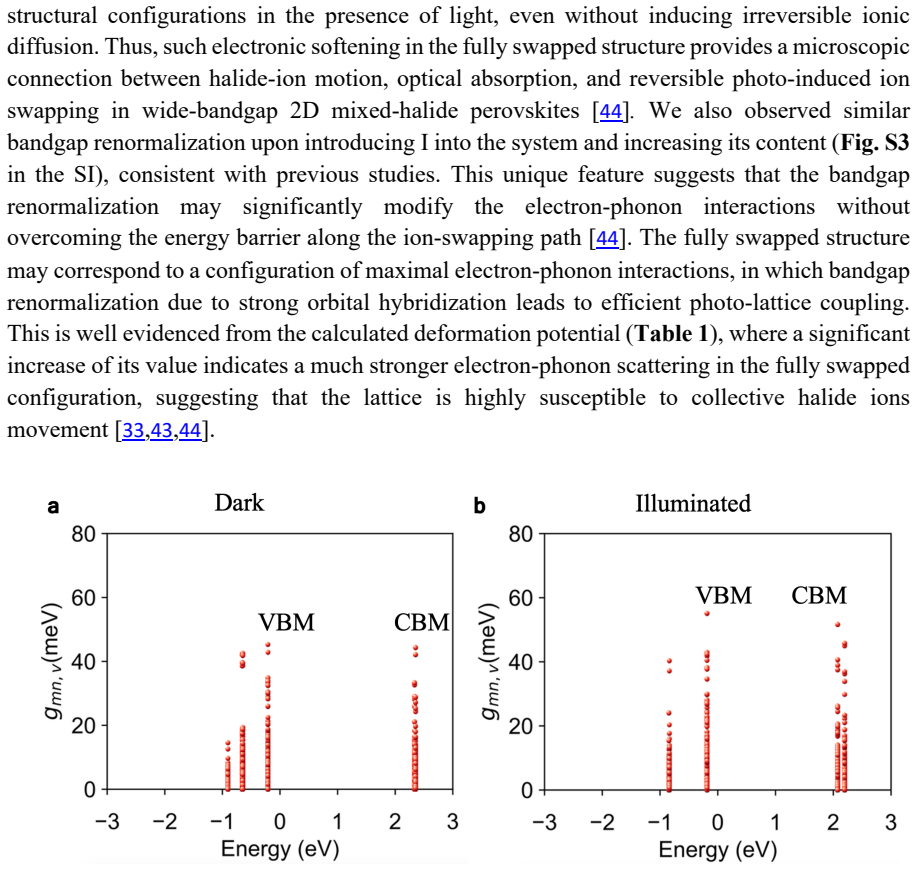
- [Abstract; Conclusions; Fig. 2a caption] There are internal inconsistencies in the phonon summary: the abstract and text state 'two of which are IR-active with oscillator strength ≈ −0.14 e/(amu)^{1/2}', while the Conclusions say 'four soft phonon modes—three of them are acoustic modes, among which two modes are anisotropic IR active'. Also, a negative oscillator strength is unusual and its sign convention is not defined. These claims are used as the 'microscopic origin' of light-matter coupling, but the derivation is absent.
minor comments (4)
- [Fig. 1b caption] 'in the absence of dark' should be 'in the absence of light'.
- [Results, para 2] 'Br cations' should be 'Br anions'.
- [Results, Fig. 5 text] The text says 'As shown in Fig. 4a, the optical absorption spectrum...' but the absorption spectra are in Fig. 5; the reference appears to be misnumbered.
- [Table 1 and SI Table S1] BA2PbI4* is described as 'structure at low temperature' in Table 1 and as 'structure at 200 K' and 'structure at 293 K' in different places; the temperature label should be consistent. Also, Table 1 footnote says BSE+SOC optical bandgaps 'severely underestimates the experimental values' but values are still listed without explanation of their use.
Circularity Check
The headline light-induced redshift and the central photo-work quantity reduce, by the paper's own labeling, to the ground-state properties of the fully halide-swapped isomer.
-
self definitional
[Fig. 5a caption; Abstract/results statement of redshift]
"Optical absorption spectra of BA2PbBr2I2 in the absence of light and in the presence of light (labelled as BA2PbI2Br2 for a fully halide ion swapped configuration). ... We demonstrate a clear redshift in the optical spectra in the presence of light, which is due to light-induced bandgap renormalization."
"In the presence of light" is operationally defined as the fully halide-swapped ground-state isomer BA2PbI2Br2, not as a photoexcited electronic state at a fixed nuclear geometry. The predicted "light-induced" redshift is therefore the ground-state bandgap difference between the two isomers, which is fixed by the NEB endpoint and requires no photoexcited-state calculation. The paper itself later says the redshift "serves as a spectroscopic signature of the fully halide-ion-swapped lattice," confirming that the light-induced optical change is a renamed ground-state isomer comparison.
-
self definitional
[Results, definition of ΔF(r); Fig. 2b caption; SI Note to Supplementary Table 1]
"For a fixed ionic configuration R(Q), the photo-induced force can be defined as ΔF(r)=F_excited(r)−F_ground(r), where F_excited and F_ground represent the ionic forces computed in the presence of light (excited state) and under dark (ground state) conditions, respectively. ... The calculated formation energy indicates that the swapped structure (BA2PbI2Br2 labeled in red) is less energetically stable than the original structure, suggesting that it is in an excited state corresponding to the structure under illumination."
The only excited-state object the manuscript identifies is the fully swapped ground-state isomer BA2PbI2Br2: Fig. 2b labels the phonons of this swapped structure as "in the presence of light," and the SI Note calls the swapped structure "an excited state corresponding to the structure under illumination." No method for computing excited-state ionic forces at fixed NEB images is supplied in Methods (only PBE, G0W0, BSE, and NEB settings). Thus F_excited in the photo-force definition is conflated with the ground-state force of the swapped isomer, and the cumulative work W_photo and its sign reversal are inherited from a ground-state energy/force difference between two isomers rather than from a non-equilibrium light-driven trajectory. The 0.31 eV value and the self-resetting sign change are
full rationale
The paper does contain independent first-principles content: the NEB ground-state barrier (0.78 eV), the soft phonon modes, and the GW+BSE absorption benchmark in the dark are legitimate calculations, and the experimental confirmation from Ref. [14] is external evidence rather than a circularity per se. However, the manuscript repeatedly identifies "the presence of light" with the fully halide-swapped ground-state isomer BA2PbI2Br2. The headline optical prediction—a redshift "in the presence of light"—is therefore just the ground-state bandgap difference between BA2PbBr2I2 and BA2PbI2Br2, and the central photo-work quantity inherits the same conflation: F_excited is not defined by any excited-state force method, and the only "excited state" described is the swapped isomer. The redshift and the sign reversal of W_photo reduce by construction to the properties of the swapped endpoint, so the light-driven mechanism is partially circular. Score 7: the central claims are substantially forced by the paper's own definitional labeling, while some surrounding calculations remain non-circular.
Assumptions & free parameters
free parameters (3)
- Excited-state (photo-force) electronic-structure model
- Bracketed exciton binding energies =
referenced to experimental values (Table 1, footnote **)
- BSE+SOC optical gaps =
excluded
assumptions (5)
- ad hoc to paper The photo-driven halide motion follows the ground-state NEB path; photo-forces are projected onto the ground-state NEB tangent T(r) and integrated as work.
- ad hoc to paper An ill-defined excited electronic state exists for which ionic forces can be evaluated at each NEB geometry.
- domain assumption PBE-computed negative-frequency (imaginary) phonons at Γ reflect physical lattice softness rather than numerical artifacts.
- domain assumption GW+BSE agreement with the dark absorption spectrum transfers to the photoexcited regime.
- domain assumption Causality from soft-mode disappearance and e-ph enhancement to the sign reversal of photo-work.
Cite this review
Pith. "Pith review of Reversible photo-switching optical functionality in two-dimensional mixed-halide hybrid perovskites." pith.science (2026). https://pith.science/paper/PPVZ4L23
@misc{pith2026260722476,
  author       = {Pith},
  title        = {Pith review of: Reversible photo-switching optical functionality in two-dimensional mixed-halide hybrid perovskites},
  year         = {2026},
  howpublished = {\url{https://pith.science/paper/PPVZ4L23}},
  note         = {Machine review of arXiv:2607.22476}
}
abstract
Ion migration in halide perovskites is often associated with defects, irreversible processes, and structural instability, making them largely impractical for photo-switching applications. Here, we demonstrate a physical mechanism for reversible, defect-free light-induced halide-ion swapping in two-dimensional mixed-halide perovskites. We find that the halide-ion swapping process arises from strong light-lattice coupling rather than defects. By combining nudged elastic band and photo-force calculations, we show that photo-induced forces perform non-equilibrium work that drives halide ions along the halide-exchange path without reaching the fully swapped configuration. Thus, the cumulative light-induced work can only partially overcome the ground-state activation energy barrier in the presence of light. Analysis of lattice dynamics identifies a few soft phonon modes, two of which are IR-active with oscillator strength $\approx -0.14$ e/(amu)$^{1/2}$, which may be considered the microscopic origin of light-induced halide-ion swapping. This microscopic origin is further supported by band-edge-selective electron-phonon coupling, which amplifies interactions among excited carriers under illumination and with halide-ion motion without inducing a uniform dynamical instability. Using GW (G-Green's function and W-screened Coulomb interaction) calculations, we accurately reproduce the experimentally observed optical absorption spectra in the absence of light, enabling us to describe the light-induced excited state reliably. We demonstrate a clear redshift in the optical spectra in the presence of light, which is due to light-induced bandgap renormalization. Overall, these findings not only establish an intrinsic, defect-free mechanism for photoswitchable optical functionality in 2D mixed-halide perovskites but also demonstrate an intrinsic self-resetting feature in the absence of light.
Figures


Reference graph
Works this paper leans on
-
[1]
X. Li, J. M. Hoffman, and M. G. Kanatzidis, Chemical reviews 121, 2230–2291 (2021)
2021
-
[2]
L. Mao, C. C. Stoumpos, and M. G. Kanatzidis, Journal of the American Chemical Society 141, 1171–1190 (2018)
2018
-
[3]
Zheng and T
K. Zheng and T. Pullerits, (ACS Publications, 2019), pp. 5881–5885
2019
-
[4]
J. M. Hoffman, C. D. Malliakas, S. Sidhik, I. Hadar, R. McClain, A. D. Mohite, and M. G. Kanatzidis, Chemical science 11, 12139–12148 (2020)
2020
-
[5]
ERDF/EU,
Calculated optical absorption spectra of BA2PbBrxI4-x and one fully swapped configuration. (a) Optical absorption spectra of BA2PbBr2I2 in the absence of light and in the presence of light (labelled as BA2PbI2Br2 for a fully halide ion swapped configuration). (b) Optical absorption spectra of BA2PbBr4, BA2PbBr3I, BA2PbBrI3, and BA2PbI4 (This structure cor...
-
[6]
Liu et al., ACS nano 15, 7811–7820 (2021)
T. Liu et al., ACS nano 15, 7811–7820 (2021)
2021
-
[7]
Ortiz‐Cervantes, P
C. Ortiz‐Cervantes, P. Carmona‐Monroy, and D. Solis‐Ibarra, ChemSusChem 12, 1560–1575 (2019)
2019
-
[8]
C. Huo, B. Cai, Z. Yuan, B. Ma, and H. Zeng, Small Methods 1, 1600018 (2017)
2017
Show all 48 references
-
[9]
A. Z. Chen, M. Shiu, J. H. Ma, M. R. Alpert, D. Zhang, B. J. Foley, D.-M. Smilgies, S.-H. Lee, and J. J. Choi, Nature communications 9, 1336 (2018)
2018
-
[10]
H. Li, T. Luo, S. Zhang, Z. Sun, X. He, W. Zhang, and H. Chang, Energy & environmental materials 4, 46–64 (2021)
2021
-
[11]
Chakkamalayath, N
J. Chakkamalayath, N. Hiott, and P. V. Kamat, ACS Energy Letters 8, 169–171 (2022)
2022
-
[12]
X.-K. Liu, W. Xu, S. Bai, Y. Jin, J. Wang, R. H. Friend, and F. Gao, Nature materials 20, 10–21 (2021)
2021
-
[13]
Datta et al., ACS Energy Letters 8, 1662–1670 (2023)
K. Datta et al., ACS Energy Letters 8, 1662–1670 (2023)
2023
-
[14]
G. Vats, B. Hodges, A. J. Ferguson, L. M. Wheeler, and J. L. Blackburn, Advanced Materials 35, 2205459 (2023)
2023
-
[15]
Mao et al., Journal of the American Chemical Society 148, 3051–3062 (2026)
W. Mao et al., Journal of the American Chemical Society 148, 3051–3062 (2026)
2026
-
[16]
J. Cho, P. S. Mathew, J. T. DuBose, and P. V. Kamat, Advanced Materials 33, 2105585 (2021)
2021
-
[17]
W. Mao, C. R. Hall, S. Bernardi, Y.-B. Cheng, A. Widmer-Cooper, T. A. Smith, and U. Bach, Nature materials 20, 55–61 (2021)
2021
-
[18]
H. Lee, P. Boonmongkolras, S. Jun, D. Kim, Y. Park, J. Koh, Y.-H. Cho, B. Shin, and J. Y. Park, ACS Applied Energy Materials 6, 1565–1574 (2023)
2023
-
[19]
Schleusener, M
A. Schleusener, M. Faraji, M. Borreani, S. Lauciello, L. Pasquale, S. Khabbaz Abkenar, G. Divitini, and R. Krahne, Advanced Materials 36, 2402924 (2024)
2024
-
[20]
Kostopoulou, I
A. Kostopoulou, I. Konidakis, and E. Stratakis, Nanophotonics 12, 1643–1710 (2023)
2023
-
[21]
R. L. Milot, R. J. Sutton, G. E. Eperon, A. A. Haghighirad, J. Martinez Hardigree, L. Miranda, H. J. Snaith, M. B. Johnston, and L. M. Herz, Nano Letters 16, 7001–7007 (2016)
2016
-
[22]
Hafner, Journal of computational chemistry 29, 2044–2078 (2008)
J. Hafner, Journal of computational chemistry 29, 2044–2078 (2008)
-
[23]
D. C. Langreth and J. P. Perdew, Physical Review B 21, 5469 (1980)
1980
-
[24]
J. P. Perdew, K. Burke, and M. Ernzerhof, Physical review letters 77, 3865 (1996)
1996
-
[25]
Hedin and S
L. Hedin and S. Lundqvist, New York: Academic (1969)
1969
-
[26]
M. S. Hybertsen and S. G. Louie, Physical Review B 34, 5390 (1986)
1986
-
[27]
Hedin, Physical review 139, A796 (1965)
L. Hedin, Physical review 139, A796 (1965)
1965
-
[28]
E. E. Salpeter and H. A. Bethe, Physical review 84, 1232 (1951)
1951
-
[29]
Hanke and L
W. Hanke and L. Sham, Physical review letters 43, 387 (1979)
1979
-
[30]
Sander, E
T. Sander, E. Maggio, and G. Kresse, Physical Review B 92, 045209 (2015)
2015
-
[31]
V. Wang, N. Xu, J.-C. Liu, G. Tang, and W.-T. Geng, Computer Physics Communications 267, 108033 (2021)
2021
-
[32]
A. M. Ganose, J. Park, A. Faghaninia, R. Woods-Robinson, K. A. Persson, and A. Jain, Nature communications 12, 1–9 (2021)
2021
-
[33]
Momma and F
K. Momma and F. Izumi, Journal of Applied crystallography 41, 653–658 (2008)
2008
-
[34]
Jónsson, G
H. Jónsson, G. Mills, and K. W. Jacobsen, in Classical and quantum dynamics in condensed phase simulations (World Scientific, 1998), pp. 385–404
1998
-
[35]
Henkelman and H
G. Henkelman and H. Jónsson, The Journal of Chemical Physics 113, 9978–9985 (2000)
2000
-
[36]
S. Toso, I. Gushchina, A. G. Oliver, L. Manna, and M. Kuno, ACS Energy Letters 7, 4242–4247 (2022)
2022
-
[37]
M. A. Hope, M. Cordova, A. Mishra, U. Gunes, A. Caiazzo, K. Datta, R. A. Janssen, and L. Emsley, Angewandte Chemie International Edition 63, e202314856 (2024)
2024
-
[38]
Li et al., Journal of the American Chemical Society 140, 11085–11090 (2018)
J. Li et al., Journal of the American Chemical Society 140, 11085–11090 (2018)
2018
-
[39]
Tavernelli, Accounts of chemical research 48, 792–800 (2015)
I. Tavernelli, Accounts of chemical research 48, 792–800 (2015)
2015
-
[40]
Marx and J
D. Marx and J. Hutter, Ab initio molecular dynamics: basic theory and advanced methods (Cambridge University Press, 2009)
2009
-
[41]
Zwanzig, Nonequilibrium statistical mechanics (Oxford university press, 2001)
R. Zwanzig, Nonequilibrium statistical mechanics (Oxford university press, 2001)
2001
-
[42]
Jarzynski, Physical review letters 78, 2690 (1997)
C. Jarzynski, Physical review letters 78, 2690 (1997)
1997
-
[43]
A. M. Glazer, Structural Science 28, 3384–3392 (1972)
1972
-
[44]
Katan, N
C. Katan, N. Mercier, and J. Even, Chemical reviews 119, 3140–3192 (2019)
2019
-
[45]
B. J. Berne, G. Ciccotti, and D. F. Coker, Classical and quantum dynamics in condensed phase simulations: Proceedings of the International School of Physics (World Scientific, 1998)
1998
-
[46]
Bredas, Materials Horizons 1, 17–19 (2014)
J.-L. Bredas, Materials Horizons 1, 17–19 (2014)
2014
-
[47]
Baroni, P
S. Baroni, P. Giannozzi, and A. Testa, Physical review letters 58, 1861 (1987)
1987
-
[48]
Giannozzi et al., Journal of physics: Condensed matter 21, 395502 (2009)
P. Giannozzi et al., Journal of physics: Condensed matter 21, 395502 (2009). Reversible photo-switching optical functionality in two-dimensional mixed-halide hybrid perovskites Enamul Haque1, Wenxin Mao2, and Javier Cerrillo1 1Área de Física Aplicada, Universidad Politécnica d...
2009
Reviewed August 1, 2026 · model on record in the stance chip above.
Discussion (0). Continue with ORCID to comment.