REVIEW 3 major objections 6 minor 44 references
CARA: Concept-Aware Risk Attention for Interpretable Collision Anticipation
T0 review · 3 major / 6 minor · reviewed 2026-08-01 · deepseek-v4-flash
Pith's one-line read CARA builds collision anticipation on evolving semantic risk concepts, and reports that letting those concepts steer attention improves accuracy and warning earliness together.
desk verdict CARA's concept-trajectory mechanism is genuinely new and the interpretability evidence is unusually thorough, but the headline DAD gain evaporates under adjacent hyperparameter settings and the 'CLIP is not predictive' claim contradicts Eq. (10). read the letter →
The pith
A machine-rendered reading of the paper's core claim, the machinery that carries it, and where it could break.
The reading
What carries the argument
The central object is the concept trajectory: a per-frame vector of 210 calibrated, EMA-smoothed CLIP cosine similarities between a frozen CLIP image embedding and 210 concept phrases (e.g., 'unsafe following distance', 'failure to yield') mined from 804 incident reports. A Concept Risk Assessment module maps each trajectory to a scalar risk score, and a risk modulation factor scales both a concept-conditioned spatial attention bias and a temporal risk convolution over a sliding window; the trajectory is also concatenated into the GRU input at each step. This triple route — spatial, temporal, and recurrent — is the mechanism by which semantic evidence is claimed to control prediction.
What would settle it
Evaluate CARA on clips whose collision causes are absent from the 804 source reports (e.g., e-scooter swarms, wrong-way highway driving) using the same frozen 210-concept bank; if both AP and concept AUC fall to near-baseline on those clips, the semantic-grounding claim fails to transfer beyond the mined vocabulary.
Extended reading notes
Core claim
CARA treats collision anticipation as concept-mediated sequential reasoning: risk concepts like 'tailgating or insufficient following distance' or 'failure to yield at an intersection' are scored per frame as CLIP cosine similarities, calibrated, and EMA-smoothed into concept trajectories; those trajectories are then aggregated into a frame-level risk score that amplifies spatial attention on concept-consistent objects and temporal attention on sustained risk escalation, and are concatenated into the GRU's input at every step. The paper's central empirical claim is that this design simultaneously improves discrimination (AP) and warning earliness (mTTA, R80) across three benchmarks, and that
Load-bearing premise
The load-bearing premise is that the cosine similarity between a video frame and a short concept phrase, after a per-concept scalar and exponential smoothing, truthfully indicates whether that risk factor is present in the scene.
Editorial extensions
If this is right
- If the central claim holds, collision warning systems can be both more accurate and earlier, since CARA reports simultaneous gains in AP, mTTA, and R80 rather than trading one off against the other.
- Each warning carries a semantic trace: a failure can be traced to a specific concept (or its under-activation), pointing fixes to the concept bank, the visual grounding, or the temporal smoothing rather than to an opaque latent state.
- Post-hoc concept bottlenecks appear structurally inferior; concept models for temporal risk need native integration into attention and recurrence, not output-side attachment.
- Accident narrative mining becomes a viable way to build interpretable risk vocabularies without dense manual video annotation, provided the source reports cover the target risk space.
Reading between the lines
- A stricter test than the paper's sanity checks would hold the pipeline and capacity fixed while replacing concept semantics with a non-semantic but distribution-matched projection (e.g., random phrases with identical CLIP-score marginals); if the accuracy gap shrinks, part of the gain is structural rather than semantic.
- The 0.871 macro-AUC faithfulness figure rests on 8 to 10 concepts and 150 clips; extrapolating to the full 210-concept bank across varied weather and traffic conditions is a natural, untested scaling step.
- The alignment–TTA correlation (r=0.58) is correlational; intervening on concept activations (e.g., clamping a risk trajectory to zero and observing whether warnings shift) would test whether concepts cause earliness rather than just accompany it.
- Real-world deployment would require re-testing on accidents whose risk factors are absent from the 804 source reports; the paper's own limitation statement acknowledges concept-bank coverage as the main constraint.
Editorial analysis
A structured set of objections, weighed in public.
Referee Report
Summary. The paper proposes CARA, an intrinsically interpretable collision-anticipation framework. From 804 California DMV accident reports, the authors derive 210 risk concepts using NLP and GPT-5.1, score each video frame by frozen CLIP cosine similarity (Eq. 1), calibrate and EMA-smooth these scores (Eqs. 2–3), and convert the resulting concept trajectories into spatial and temporal attention weights (Eqs. 4–9). The concept activations are also concatenated into the GRU predictor (Eq. 10). On DAD, A3D, and CCD, CARA is reported to outperform five baselines in AP, mTTA, and R80 (Table 1), with the headline result being DAD AP 75.37 vs. 70.51 for CRASH and mTTA 1.97 s vs. 1.78 s. The paper also reports ablations (Table 4), concept sanity checks (Fig. 6), human-annotated concept faithfulness (Sec. 4.4.3), and hyperparameter sensitivity analyses (Appendix F).
Significance. If the reported results hold, CARA is a useful step toward making semantic risk concepts active participants in spatio-temporal anticipation rather than post-hoc explanations. The paper has real strengths: multi-seed repeats (Table 18), threshold sensitivity for mTTA (Table 17), concept shuffling/randomization controls (Fig. 6), human-annotated concept AUC (Tables 20–22), robustness to different CLIP anchors (Table 23), and modest computational overhead (5–8%). However, the headline DAD accuracy margin sits on a sharp hyperparameter peak, and the interpretability claim is weakened by the fact that the concept activations are simultaneously predictive inputs. The contribution is therefore significant but conditional on addressing these robustness and attribution concerns.
major comments (3)
- [Appendix F, Tables 14–16; Sec. 4.2] Tables 14–16 report DAD AP at the chosen operating point as 75.37, but a one-step change in any of the three main hyperparameters drops AP to roughly 67–70. Specifically, λ1=0.1/λ2=0.001 gives 70.18, λ1=0.01/λ2=0.01 gives 70.32, λ1=1.0/λ2=0.01 gives 67.23; γ=1.0 gives 69.85 and γ=3.0 gives 70.23; η=0.5 gives 69.87 and η=0.9 gives 69.45. Since CRASH AP is 70.51, the claimed +4.9 AP advantage vanishes or reverses for most adjacent settings. The multi-seed std (±0.04) is reported only at the optimum, and hyperparameters were selected on the validation set, so this does not address selection-overfitting. To support the Sec. 4.2 claim of consistent improvement, the authors should report sensitivity for the baselines, show a robust region or median over the grid, or justify the chosen peak as principled rather than an isolated favorable point.
- [Secs. 3.4–3.5, Eqs. (4), (8), (10); Sec. 4.4] Concept activations are not merely an explanation; they enter the prediction pathway through Eq. (4) (attention mapping), Eq. (8) (spatial bias), and Eq. (10) (GRU input). Hence "concepts guide prediction" is true by construction, and the comparison with CBM baselines is partly structural because CARA is not forced through a concept bottleneck. Table 4 ablations remove whole modules and parameters, not semantic content. The random/shuffled concept controls (Sec. 4.5) are helpful but were run at the tuned operating point and without retuning; a capacity-matched non-semantic control (e.g., 210-dimensional learned features replacing concept scores in the same architecture) is needed to attribute the accuracy gain to semantics. Without it, the "intrinsically interpretable" claim should be stated as "the prediction is a function of these variables" rather than "these variables are causally me
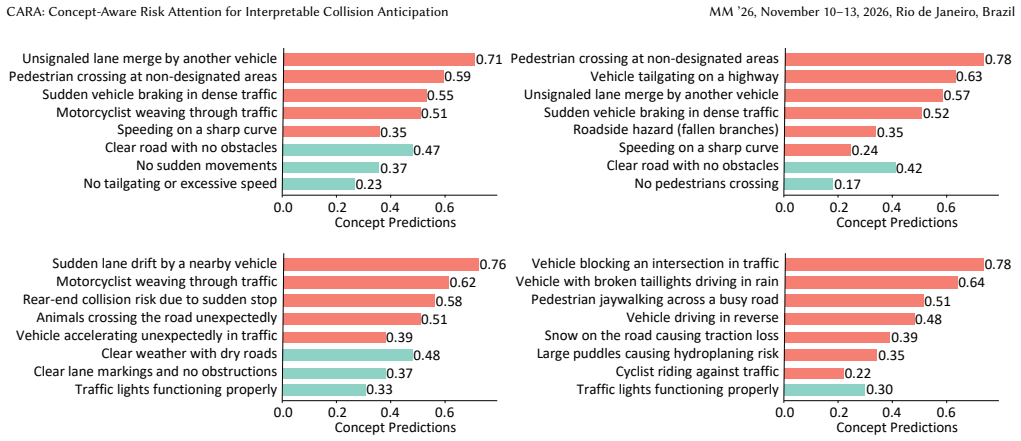
- [Sec. 4.4.3; Appendix G.4] The human-grounded faithfulness evidence is limited to 150 clips and 8 (plus 2) concepts from a 210-concept bank that was itself filtered by a CLIP-grounding threshold (Appendix B.3). Macro-AUC 0.871 is encouraging, but it does not support statements about the entire concept library, and action/context concepts are harder (Tables 21–22). I ask for per-concept AUC over a random or complete subset of the 210 concepts, or at least an explicit acknowledgment of the selection bias and a discussion of how representative the 8 concepts are.
minor comments (6)
- [Table 1 vs. Table 25] The CCD R80 value differs: Table 1 reports 4.87 s for CARA, while Table 25 reports 4.81 s. Please reconcile.
- [Eq. (13)] Equation (13) has ambiguous summation notation; the mean over the 1,000 images should be written explicitly.
- [Fig. 3 and Appendix I] The radar-chart values are min-max normalized across methods with no error bars; presenting raw values or confidence intervals would make the comparison more interpretable.
- [Appendix A.3] Hyperparameters are selected on the validation set, but no nested validation or multiple random splits are described. Reporting the validation-selection procedure more explicitly would strengthen the robustness argument.
- [Table 14] Table 14 reports AP but not mTTA/R80 for the λ1/λ2 grid, making it impossible to assess early-warning sensitivity to these weights.
- [Reproducibility] The paper promises only the concept list and scripts upon acceptance; for a framework whose central claim rests on a specific concept library, releasing the full extraction pipeline and training code would substantially aid reproducibility.
Circularity Check
No material circularity; only a minor by-construction coupling in the alignment-TTA analysis and non-load-bearing self-citations.
-
other
[Sec. 4.4.2, Fig. 4; Appendix J]
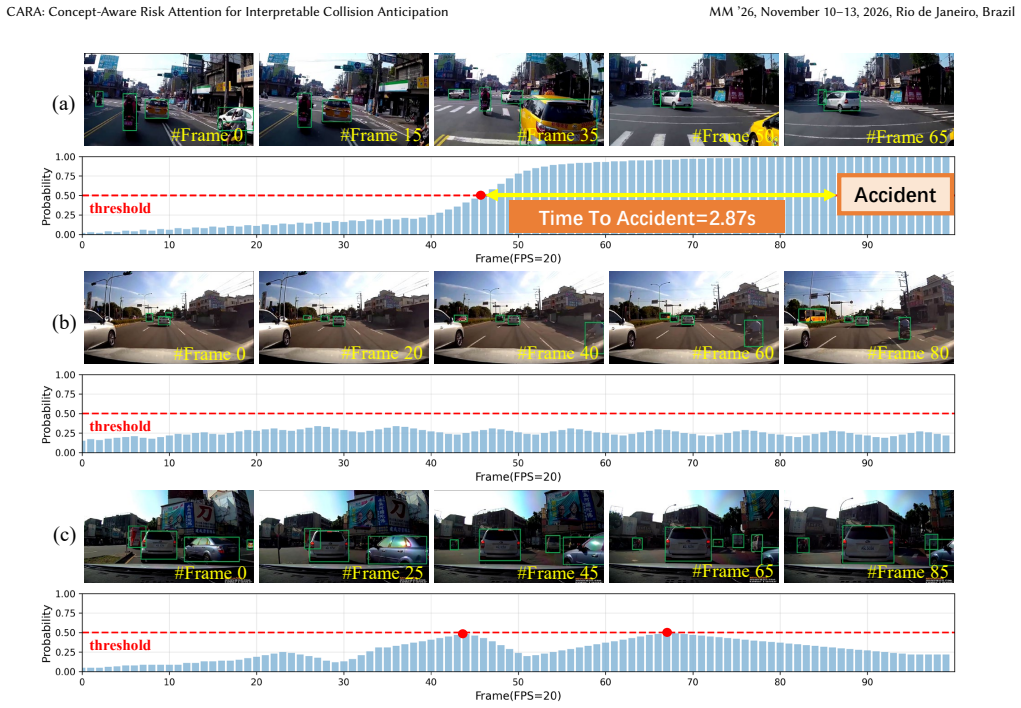
"Clips with better CLIP alignment generally exhibit longer warning lead time, and CARA shifts the joint distribution toward the upper-right region, where both properties are strong. Quantitatively, CARA yields the strongest alignment–TTA correlation (Pearson 𝑟= 0.58vs.0.42 for CRASH+CBM). Although this analysis is correlational, the consistent joint and marginal trends suggest that better semantic grounding supports earlier evidence accumulation rather than serving as a descriptive output after prediction."
The alignment axis in Fig. 4 is computed from the same CLIP similarity stream that produces concept activations: Eqs. (1)-(3) define a_t from s_t = cos(E_I(V_t), E_T(c_i)), and Eqs. (4)-(10) feed a_t directly into spatial/temporal attention and the GRU that yields p_t and hence TTA. Thus alignment and TTA are both functions of the same a_t/s_t stream; their positive association is substantially a design consequence of the architecture, not independent evidence that semantic grounding causes earlier warnings. The paper's own admission that the analysis is correlational limits the weight of this step.
full rationale
The central accuracy claim is empirical: Table 1 reports AP/mTTA/R80 against five baselines on three public benchmarks, and Table 18 reports multi-seed stability. Concept grounding is tested independently of the model via manual annotation (Sec. 4.4.3, macro-AUC 0.871), and the RQ4 perturbations (shuffling/randomizing concepts, removing EMA/TRA) are controlled empirical interventions rather than circular reductions. The self-citations (refs. [7]-[9], [35]) are confined to related-work context and are not load-bearing for the main derivation. The only self-referential element is architectural: concept activations are both the interpretability output and a predictive input (Eqs. 4-10). This is the paper's stated design, not a hidden reduction; however, the alignment-TTA correlation in Sec. 4.4.2 is an output-output association within the same model and is explicitly admitted as correlational. That weakens an ancillary interpretive claim but does not reduce the central AP/mTTA result. The hyperparameter sensitivity highlighted by the skeptic (Tables 14-16) concerns operating-point robustness and is a validity/correctness matter, not circularity.
Assumptions & free parameters
free parameters (6)
- gamma (risk amplification factor) =
2.0 (grid search over {0.5,1,2,3,5})
- eta (EMA smoothing factor) =
0.7 (grid search)
- lambda_1, lambda_2 (loss weights) =
0.1, 0.01 (grid search)
- per-concept calibration scalars w_i (K=210) =
learned
- CLIP grounding threshold for concept retention =
0.25 'selected empirically on held-out validation frames'
- proposal budget N, temporal window M, conv kernel k =
N=10, M=15, k=3
assumptions (5)
- domain assumption CLIP ViT-B/32 embeddings align dashcam frame content with short concept phrases well enough for frame-level risk scoring
- domain assumption 804 California DMV accident reports (Jan 2019-Mar 2025) contain risk semantics that transfer to the visual content of DAD/A3D/CCD dashcam videos
- domain assumption GPT-5.1-generated safe paraphrases preserve traffic context while producing a balanced, semantically parallel concept space
- domain assumption DAD/A3D/CCD ground-truth labels are correct and the five re-implemented baselines are faithfully and fairly tuned
- domain assumption EMA smoothing (eta=0.7) and the learned CRA MLP preserve genuine risk evolution rather than distorting warning timing
invented entities (1)
-
temporally evolving concept trajectories presented as decision-relevant risk evidence
independent evidence
Cite this review
Pith. "Pith review of CARA: Concept-Aware Risk Attention for Interpretable Collision Anticipation." pith.science (2026). https://pith.science/paper/I6JXU4F6
@misc{pith2026260722494,
  author       = {Pith},
  title        = {Pith review of: CARA: Concept-Aware Risk Attention for Interpretable Collision Anticipation},
  year         = {2026},
  howpublished = {\url{https://pith.science/paper/I6JXU4F6}},
  note         = {Machine review of arXiv:2607.22494}
}
read the original abstract
Collision anticipation in autonomous driving requires not only accurate early warnings but also interpretable reasoning about what risk factors are being tracked and how risk evolves over time. Existing methods fall short in this regard: feature-driven models are opaque, post-hoc explanations often lack fidelity, and concept-based methods are mostly designed for static recognition rather than dynamic driving scenes. We propose CARA (Concept-Aware Risk Attention), an intrinsically interpretable spatio-temporal framework for collision anticipation. CARA derives domain-grounded risk concepts from accident narratives, aligns them with video frames via vision-language similarity, and organizes them into evolving concept trajectories. These trajectories provide explicit risk evidence that guides spatial attention, temporal attention, and anticipation, allowing semantic concepts to directly influence both where the model attends and how it predicts risk over time. By treating semantic risk factors as dynamic intermediate evidence rather than auxiliary post-hoc explanations, CARA tightly couples interpretability with the predictive process. Extensive experiments on three benchmarks show that CARA consistently improves anticipation accuracy and warning earliness over strong baselines, while providing sparse and semantically grounded concept evidence.
Figures


Figures from the paper (6 more)


Reference graph
Works this paper leans on
-
[1]
Alejandro Barredo Arrieta, Natalia Rodríguez, Javier Del Ser, Adrien Ben- netot, Siham Tabik, Alberto Barbado, Salvador García, Sergio Gil-López, Daniel Molina, Richard Benjamins, Raja Chatila, and Francisco Herrera. 2020. Ex- plainable Artificial Intelligence (XAI): Concepts, Taxonomies, Opportunities and Challenges toward Responsible AI.Information Fusi...
-
[2]
Shahin Atakishiyev, Mohammad Salameh, Hengshuai Yao, and Randy Goebel
-
[3]
Wentao Bao, Qi Yu, and Yu Kong. 2020. Uncertainty-based Traffic Accident Anticipation with Spatio-Temporal Relational Learning. InProceedings of the 28th ACM International Conference on Multimedia. ACM, 2682–2690. doi:10.1145/ 3394171.3413827
arXiv 2020
-
[4]
Sourav Biswas, Sergio Casas, Quinlan Sykora, Ben Agro, Abbas Sadat, and Raquel Urtasun. 2024. QuAD: Query-based Interpretable Neural Motion Planning for Autonomous Driving.arXiv preprint arXiv:2404.01486(2024)
arXiv 2024
-
[5]
Fu-Hsiang Chan, Yu-Ting Chen, Yu Xiang, and Min Sun. 2017. Anticipating Acci- dents in Dashcam Videos. InComputer Vision – ACCV 2016. Springer International Publishing, Cham, 136–153
2017
-
[6]
Li Chen, Penghao Wu, Kashyap Chitta, Bernhard Jaeger, Andreas Geiger, and Hongyang Li. 2024. End-to-End Autonomous Driving: Challenges and Frontiers. IEEE Transactions on Pattern Analysis and Machine Intelligence(2024). doi:10. 1109/TPAMI.2024.3435937
arXiv 2024
-
[7]
Enjun Du, Xunkai Li, Tian Jin, Zhihan Zhang, Rong-Hua Li, and Guoren Wang
-
[8]
Enjun Du, Siyi Liu, and Yongqi Zhang. 2025. Mixture of Length and Pruning Experts for Knowledge Graphs Reasoning. InProceedings of the 2025 Conference on Empirical Methods in Natural Language Processing (EMNLP). 432–453. doi:10. 18653/v1/2025.emnlp-main.23 Oral
2025
Show all 44 references
-
[9]
Enjun Du, Siyi Liu, and Yongqi Zhang. 2026. GraphOracle: Efficient Fully- Inductive Knowledge Graph Reasoning via Relation-Dependency Graphs. In Proceedings of the AAAI Conference on Artificial Intelligence, Vol. 40. 19055–19063. doi:10.1609/aaai.v40i23.38978 Oral
2026 doi
-
[10]
Yanchen Guan, Haicheng Liao, Chengyue Wang, Bonan Wang, Jiaxun Zhang, Jia Hu, and Zhenning Li. 2025. Domain-Enhanced Dual-Branch Model for Efficient and Interpretable Accident Anticipation.arXiv preprint arXiv:2507.12755(2025)
2025 arXiv
-
[11]
Fisac, and Marco Pavone
Kai-Chieh Hsu, Karen Leung, Yuxiao Chen, Jaime F. Fisac, and Marco Pavone. 2023. Interpretable Trajectory Prediction for Autonomous Vehicles via Counterfactual Responsibility. In2023 IEEE/RSJ International Conference on Intelligent Robots and Systems (IROS). 5918–5925
2023
-
[12]
Le, Yun-Hsuan Sung, Zhen Li, and Tom Duerig
Chao Jia, Yinfei Yang, Ye Xia, Yi-Ting Chen, Zarana Parekh, Hieu Pham, Quoc V. Le, Yun-Hsuan Sung, Zhen Li, and Tom Duerig. 2021. Scaling Up Visual and Vision-Language Representation Learning With Noisy Text Supervision. InPro- ceedings of the 38th International Conference on ...
2021
-
[13]
Muhammad Monjurul Karim, Yu Li, Ruwen Qin, and Zhaozheng Yin. 2022. A Dynamic Spatial-Temporal Attention Network for Early Anticipation of Traffic Accidents.IEEE Transactions on Intelligent Transportation Systems23, 7 (2022), 9590–9600. doi:10.1109/TITS.2022.3155613
2022
-
[14]
Heesoo Kim, Hyorim Han, Yongsik You, Min-Je Cho, Junho Hong, Tai-Jin Song, and Ren-Yong Guo. 2024. A Comprehensive Traffic Accident Investi- gation System for Identifying Causes of the Accident Involving Events with Autonomous Vehicle.Journal of Advanced Transportation2024 (20...
2024 doi
-
[15]
Jinkyu Kim, Suhong Moon, Anna Rohrbach, Trevor Darrell, and John Canny
-
[16]
Jinkyu Kim, Anna Rohrbach, Trevor Darrell, John Canny, and Zeynep Akata. 2018. Textual Explanations for Self-driving Vehicles. InProceedings of the European Conference on Computer Vision. 563–578
2018
-
[17]
Pang Wei Koh, Thao Nguyen, Yew Siang Tang, Stephen Mussmann, Emma Pier- son, Been Kim, and Percy Liang. 2020. Concept Bottleneck Models. InProceedings of the 37th International Conference on Machine Learning, Vol. 119. 5338–5348
2020
-
[18]
Philip Koopman and Michael Wagner. 2016. Challenges in Autonomous Vehicle Testing and Validation.SAE International Journal of Transportation Safety4, 1 (2016), 15–24. doi:10.4271/2016-01-0128
2016 doi
-
[19]
Junnan Li, Dongxu Li, Caiming Xiong, and Steven Hoi. 2022. BLIP: Bootstrap- ping Language-Image Pre-training for Unified Vision-Language Understanding and Generation. InProceedings of the 39th International Conference on Machine Learning. 12888–12900
2022
-
[20]
Haicheng Liao, Yongkang Li, Chengyue Wang, Yanchen Guan, KaHou Tam, Chunlin Tian, Li Li, Chengzhong Xu, and Zhenning Li. 2024. When, Where, and What? A Benchmark for Accident Anticipation and Localization with Large Language Models. InProceedings of the 32nd ACM International ...
2024
-
[21]
Haicheng Liao, Yongkang Li, Chengyue Wang, Songning Lai, Zhenning Li, Zilin Bian, Jaeyoung Lee, Zhiyong Cui, Guohui Zhang, and Chengzhong Xu. 2024. Real-time Accident Anticipation for Autonomous Driving Through Monocular Depth-Enhanced 3D Modeling.arXiv preprint arXiv:2409.01256(2024)
2024 arXiv
-
[22]
Haicheng Liao, Haoyu Sun, Huanming Shen, Chengyue Wang, Chunlin Tian, Kahou Tam, Li Li, Chengzhong Xu, and Zhenning Li. 2024. Crash: Crash Recog- nition and Anticipation System Harnessing with Context-aware and Temporal Focus Attentions. InProceedings of the 32nd ACM Internati...
2024
-
[23]
Lundberg and Su-In Lee
Scott M. Lundberg and Su-In Lee. 2017. A Unified Approach to Interpreting Model Predictions. InAdvances in Neural Information Processing Systems. 4765–4774
2017
-
[24]
Jiageng Mao, Yuxi Qian, Junjie Ye, Hang Zhao, and Yue Wang. 2023. GPT-Driver: Learning to Drive with GPT.arXiv preprint arXiv:2310.01415(2023)
2023 arXiv
-
[25]
Nguyen, and Tsui-Wei Weng
Tuomas Oikarinen, Subhro Das, Lam M. Nguyen, and Tsui-Wei Weng. 2023. Label-free Concept Bottleneck Models. InThe Eleventh International Conference on Learning Representations
2023
-
[26]
Sangmin Park, Sungho Park, Harim Jeong, Ilsoo Yun, and Jaehyun So. 2021. Scenario-Mining for Level 4 Automated Vehicle Safety Assessment from Real Accident Situations in Urban Areas Using a Natural Language Process.Sensors 21, 20 (2021), 6929. doi:10.3390/s21206929
2021 doi
-
[27]
Alec Radford, Jong Wook Kim, Chris Hallacy, Aditya Ramesh, Gabriel Goh, Sandhini Agarwal, Girish Sastry, Amanda Askell, Pamela Mishkin, Jack Clark, Gretchen Krueger, and Ilya Sutskever. 2021. Learning Transferable Visual Models from Natural Language Supervision. InProceedings ...
2021
-
[28]
Why Should I Trust You?
Marco Tulio Ribeiro, Sameer Singh, and Carlos Guestrin. 2016. “Why Should I Trust You?”: Explaining the Predictions of Any Classifier. InProceedings of the 22nd ACM SIGKDD International Conference on Knowledge Discovery and Data Mining. 1135–1144. doi:10.1145/2939672.2939778
2016
-
[29]
Cynthia Rudin. 2019. Stop Explaining Black Box Machine Learning Models for High Stakes Decisions and Use Interpretable Models Instead.Nature Machine Intelligence1 (2019), 206–215. doi:10.1038/s42256-019-0048-x
2019 doi
-
[30]
Mark Ryan and Bernd Carsten Stahl. 2021. Artificial Intelligence Ethics Guidelines for Developers and Users: Clarifying Their Content and Normative Implications. Journal of Information, Communication and Ethics in Society19, 1 (2021), 61–86
2021
-
[31]
Selvaraju, Michael Cogswell, Abhishek Das, Ramakrishna Vedan- tam, Devi Parikh, and Dhruv Batra
Ramprasaath R. Selvaraju, Michael Cogswell, Abhishek Das, Ramakrishna Vedan- tam, Devi Parikh, and Dhruv Batra. 2017. Grad-CAM: Visual Explanations from Deep Networks via Gradient-based Localization. InProceedings of the IEEE Interna- tional Conference on Computer Vision (ICCV...
2017 doi
-
[32]
Waslander, Yu Liu, and Hongsheng Li
Hao Shao, Yuxuan Hu, Letian Wang, Guanglu Song, Steven L. Waslander, Yu Liu, and Hongsheng Li. 2024. LMDrive: Closed-loop End-to-End Driving with Large Language Models. InProceedings of the IEEE/CVF Conference on Computer Vision and Pattern Recognition. 15120–15130
2024
-
[33]
Nupur Thakur, Prasanthsai Gouripeddi, and Baoxin Li. 2024. Graph(Graph): A Nested Graph-Based Framework for Early Accident Anticipation. InProceedings of the IEEE/CVF Winter Conference on Applications of Computer Vision (W ACV). 7518–7526. doi:10.1109/WACV57701.2024.00736
2024
-
[34]
Tianhang Wang, Kai Chen, Guang Chen, Bin Li, Zhijun Li, Zhengfa Liu, and Changjun Jiang. 2024. GSC: A Graph and Spatio-Temporal Continuity Based Framework for Accident Anticipation.IEEE Transactions on Intelligent Vehicles9, 1 (2024), 2249–2261. doi:10.1109/TIV.2023.3257169
2024
-
[35]
Shixiao Yang, Zhida Qin, Enjun Du, Pengzhan Zhou, and Tianyu Huang. 2025. Dual Social View Enhanced Contrastive Learning for Social Recommendation. IEEE Transactions on Computational Social Systems12, 5 (2025), 2156–2170. doi:10. 1109/TCSS.2024.3496774
2025
-
[36]
Yue Yang, Artemis Panagopoulou, Shenghao Zhou, Daniel Jin, Chris Callison- Burch, and Mark Yatskar. 2023. Language in a Bottle: Language Model Guided Concept Bottlenecks for Interpretable Image Classification. InProceedings of the IEEE/CVF Conference on Computer Vision and Pat...
2023
-
[37]
Crandall, and Ella M
Yu Yao, Mingze Xu, Yuchen Wang, David J. Crandall, and Ella M. Atkins. 2019. Unsupervised Traffic Accident Detection in First-Person Videos. In2019 IEEE/RSJ International Conference on Intelligent Robots and Systems (IROS). 273–280. doi:10. 1109/IROS40897.2019.8967828
2019
-
[38]
Inouye, and Pradeep K
Chih-Kuan Yeh, Cheng-Yu Hsieh, Arun Suggala, David I. Inouye, and Pradeep K. Ravikumar. 2019. On the (In)fidelity and Sensitivity of Explanations. InAdvances in Neural Information Processing Systems, Vol. 32
2019
-
[39]
Mert Yuksekgonul, Maggie Wang, and James Zou. 2023. Post-hoc Concept Bottle- neck Models. InThe Eleventh International Conference on Learning Representations. https://openreview.net/forum?id=nA5AZ8CEyow
2023
-
[40]
Éloi Zablocki, Hédi Ben-Younes, Patrick Pérez, and Matthieu Cord. 2022. Ex- plainability of Deep Vision-Based Autonomous Driving Systems: Review and Challenges.International Journal of Computer Vision130, 10 (2022), 2425–2452. doi:10.1007/s11263-022-01657-x MM ’26, November 10...
2022 doi
-
[41]
due to”, “caused by
Jiaxun Zhang, Haicheng Liao, Yumu Xie, Chengyue Wang, Yanchen Guan, Bin Rao, and Zhenning Li. 2025. Eyes on the Road, Mind Beyond Vision: Context- Aware Multi-modal Enhanced Risk Anticipation. InProceedings of the 33rd ACM International Conference on Multimedia. doi:10.1145/37...
2025
-
[2020]
InProceedings of the IEEE/CVF Conference on Computer Vision and Pattern Recognition
Advisable Learning for Self-driving Vehicles by Internalizing Observation- to-Action Rules. InProceedings of the IEEE/CVF Conference on Computer Vision and Pattern Recognition. 9661–9670
-
[2024]
doi:10.1109/ACCESS.2024.3431437
Explainable Artificial Intelligence for Autonomous Driving: A Comprehen- sive Overview and Field Guide for Future Research Directions.IEEE Access12 (2024), 101603–101625. doi:10.1109/ACCESS.2024.3431437
2024
-
[2025]
InAdvances in Neural Information Processing Systems (NeurIPS)
GraphMaster: Automated Graph Synthesis via LLM Agents in Data-Limited Environments. InAdvances in Neural Information Processing Systems (NeurIPS). Spotlight
Reviewed August 1, 2026 · model on record in the stance chip above.
Discussion (0). Sign in to comment.