REVIEW 4 major objections 6 minor 12 references
Keyword Matters: Unveiling the Energy Sensitivity of On-Device LLM Prompting
T0 review · 4 major / 6 minor · reviewed 2026-08-02 · deepseek-v4-flash
Pith's one-line read Choosing a different verb in a prompt shifts on-device LLM energy draw by up to 103 percent, with 'label' saving over 60% in sentiment tasks.
desk verdict Genuine measurement effort, but the sentiment results are confounded by template changes and the whole study lacks repeats, so the headline savings figures are not yet trustworthy. read the letter →
The pith
A machine-rendered reading of the paper's core claim, the machinery that carries it, and where it could break.
The reading
What carries the argument
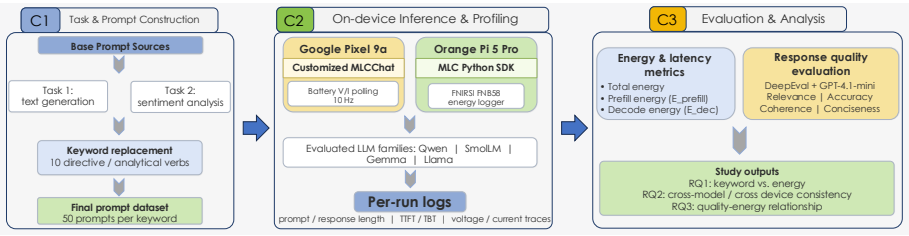
The central object is the keyword-replacement prompt set: 50 prompts per task differing only in the imperative verb (10 verbs per task). The measurement chain is the energy decomposition into prefill and decode phases, with decode energy computed from 10 Hz battery voltage/current samples on a phone and an FNIRSI power logger on a single-board computer. The analysis metric is the percentage deviation of each keyword's mean decode energy from the model's overall mean, plus Spearman rank correlations to test cross-model and cross-device consistency.
What would settle it
Run the same 1,000 prompt–model pairs multiple times (at least 10) on the same devices and compute per-keyword energy distributions with confidence intervals; if the mean differences among verbs shrink to within noise, the claimed sensitivity fails. Also, if controlling for response length (e.g., early stopping at equal token counts) removes the keyword–energy correlation, then the effect is entirely length-mediated rather than a distinct 'keyword' effect.
Extended reading notes
Core claim
On the paper's own terms, the central discovery is that keyword choice alone—with the same prompt structure, model, device, and decoding settings—shifts decode-phase energy consumption, with the variance stemming largely from changes in response length and reasoning depth that different verbs trigger. Measured deviations range from −62.6% to +103% relative to each model's mean; 'label' is consistently efficient in sentiment analysis, 'create' in text generation, while 'analyze' and 'craft' are consistently inefficient. These differences appear stable within model families (Qwen models show Spearman correlation 0.867 in sentiment) and across devices for closed-ended tasks (Qwen sentiment ρ=0.
Load-bearing premise
That each keyword's mean energy is reliably estimated from a single run per prompt with no error bars or statistical tests; if the 10 Hz energy traces are noisy, the reported savings and rankings could be artifacts.
Editorial extensions
If this is right
- If the findings generalize, replacing 'analyze' with 'label' in sentiment prompts could cut decode energy by roughly half on existing devices with no retraining.
- Energy-optimal keywords are task- and model-family-dependent: 'create' leads in text generation, 'label' in sentiment, so energy-aware prompt rewriting must be per-task.
- Because text-generation energy and response quality were uncorrelated, energy optimization in that setting is nearly free; in sentiment, the relation is inverse, so efficiency and accuracy align.
- Consistency within model families (Qwen sentiment ρ=0.867, text ρ=0.588) suggests a 'green prompt' lookup can be built once per model family rather than per device.
Reading between the lines
- Single-run measurements at 10 Hz sampling make the magnitude claims fragile; a repetition study with error bars might shrink or shift the rankings, though the direction—verbs that cut response length save energy—is plausible.
- The likely mechanism is response length: energy scales almost linearly with output length, so keywords that make models stop sooner (like 'label' vs 'analyze') save energy; a testable extension is to control for response length and see if keyword-specific energy differences persist beyond length.
- The proposed 'green prompt engine' implies a practical on-device rewriter that preserves meaning via entailment checks, but it would need to validate against the paper's limited prompt diversity (Alpaca-GPT4 and Yelp only).
- All models share the same q4f16 quantization, so it is unknown how the effect interacts with different bit-widths, quantization schemes, or non-instruction-tuned models.
Editorial analysis
A structured set of objections, weighed in public.
Referee Report
Summary. This paper reports an empirical measurement study of how replacing the imperative verb in an instruction prompt affects the decode-phase energy consumption of on-device LLMs. Using 1,000 prompts (50 per keyword, 10 keywords per task) across two tasks (text generation, sentiment analysis), five small models, and two edge devices (Orange Pi 5 Pro, Pixel 9a), the authors report per-keyword percentage deviations from each model's mean decode energy, ranging from -18.5% to +26.5% for text generation and -62.6% to +103% for sentiment analysis. They also examine cross-model and cross-device rank-order consistency and correlate accuracy with energy.
Significance. If the results were reliable, they would provide a useful, low-cost lever for energy-efficient prompt engineering and one of the first real-hardware measurements of keyword-level energy sensitivity. Strengths include actual power traces on two platforms with a documented CPU/GPU frequency-locking procedure, a prompt-complexity check for the text-generation set, and an explicit limitations section. However, as reported, the headline numbers are not stable estimates: each prompt is run once, no uncertainty intervals are given, and the sentiment-analysis prompts do not isolate the keyword. The cross-model consistency metric is low and sits uneasily with the abstract. The direction is promising, but the evidence is not yet conclusive.
major comments (4)
- [§4.3 and Appendix C] The sentiment-analysis prompt set does not isolate the keyword. The sample prompts show that keyword replacement also changes the instruction template: 'Classify the sentiment of the following Yelp review as positive or negative:' versus 'Decide whether the sentiment expressed in this Yelp review is positive or negative:' differ in sentence length, word order, and phrasing, not only in the verb. Consequently, the -62.6% to +103% deviations in Figure 4 and the strong cross-device correlation in Figure 6 may reflect template-level differences (including prompt length) rather than keyword semantics. The statement in §4.3 that 'this was also done to isolate the impact of keywords' is contradicted by the appendix. Repeats alone would not fix this; the sentiment prompts must be re-designed so only the verb changes.
- [Limitations and §4.3] The paper explicitly states that each test was conducted only once. With energy sampled at 10 Hz, a single run gives at most a few samples for short sentiment responses and no estimate of measurement noise. None of the figures or tables reports error bars, confidence intervals, or significance tests. As a result, the reported per-keyword deviations (e.g., 'label' -32.1% to -62.6%; 'analyze' +103% on Gemma) cannot be distinguished from random variation. This is load-bearing for RQ1 and for the practical savings claims. Please repeat each prompt at least several times and report uncertainty (e.g., bootstrapped CIs) and pairwise tests.
- [§5.2.1 vs Abstract] The abstract claims 'consistent energy differences across verbs and tasks,' but the paper's own consistency analysis reports average pairwise Spearman coefficients of 0.153 for text generation and 0.388 for sentiment across models, which the text describes as 'very little correlation.' Cross-device text generation is also weak (ρ=0.261 for Qwen, 0.697 for SmolLM). Only sentiment analysis on Qwen shows strong cross-device consistency (ρ=0.939). The claim of consistency needs to be substantially qualified, or the abstract and conclusions revised.
- [§3.1 and §5.1] The paper states that total energy scales almost linearly with output length and decode latency, but it does not report per-keyword response lengths or any length-controlled analysis. The 'keyword sensitivity' shown in Figures 3 and 4 may therefore be almost entirely a restatement of the known sensitivity of energy to generated tokens. Presenting response-length statistics and a regression or stratified analysis would clarify whether keyword choice has any effect beyond making the model more or less verbose.
minor comments (6)
- [§4.2] The average prefill time of 87,000 ms on Pixel 9a seems implausible for a short prompt; if correct, please explain, otherwise correct the unit/value.
- [Appendix C] The 'NOTE: The following prompts produced biased results in the original experiment' is ambiguous. Specify whether these prompts were excluded from the final dataset and why.
- [Figure 4] Some extreme values (e.g., Gemma 'analyze' +103%, 'assess' +59.5%) are not annotated; if these correspond to degenerate responses or token-limit hits, state so in text.
- [§4.4] The claim that criterion overlap 'has minimal effect on the significance of the overall score' is asserted without supporting analysis; either provide evidence or remove.
- [References] References with incomplete author lists (e.g., 'Chenxi Liu and 1 others') should be completed.
- [Reproducibility] The paper does not release the final prompt sets or raw energy traces; providing these would materially strengthen reproducibility.
Circularity Check
No significant circularity: energy values are measured, not derived from keywords; the only author self-citation is a future-work aside and not load-bearing.
full rationale
The paper's central quantities are hardware measurements: total energy is computed from logged current/voltage traces (E = sum I_i V_i dt), and per-keyword deviations are averages of measured decode-phase energies over repeated prompts. There is no fitted parameter that is later renamed as a prediction, and no equation reduces a claimed output to an input by construction. The paper even describes a design correction in text generation: after noticing that the original multi-prompt-per-keyword dataset gave 'results that were suspiciously consistent across environments,' it switched to the same 50 prompts per keyword so the prompts 'only differ from each other by keyword, isolating its impact.' This is an attempt to remove a confound, not to build the result into the input. The energy–length relation is acknowledged in Section 3.1 ('total energy scales almost linearly with output length and decoding latency') and used in Section 5.1.2 to explain why sentiment-analysis percentage savings are larger ('sentiment analysis generates shorter responses, so small changes in response length can lead to large percentage changes'). That is a mediational explanation of measured data, not a definitional identity: the keyword-condition energy values are still independently measured, and the length effect does not make the keyword comparison circular. The only self-citation is Section 6.3's mention of PlatformX (Tu et al., 2025) as future-work inspiration; it is not load-bearing and no uniqueness theorem is imported. Appendix C does show that sentiment prompts vary instruction wording beyond the verb (e.g., 'Classify the sentiment of the following Yelp review...' vs. 'Decide whether the sentiment expressed in this Yelp review...'), which weakens the claim that keyword impact is isolated in that task, but this is a methodological confound/validity threat, not a circularity of derivation. The appended Limitations section also honestly flags single-run measurements, no repetition, and potential judge conflation; these are reliability concerns, not circularity. Overall, the empirical claims are self-contained and externally falsifiable, so the circularity score is minimal.
Assumptions & free parameters
assumptions (4)
- domain assumption Total energy of on-device LLM inference is dominated by the decode phase and scales almost linearly with output length.
- domain assumption The 50 prompts per keyword form a representative sample and, for sentiment analysis, the keyword is the only meaningful difference.
- domain assumption The GPT-4.1-mini judge provides a reliable measure of response quality.
- ad hoc to paper A single run per prompt yields a reliable estimate of the keyword mean.
Cite this review
Pith. "Pith review of Keyword Matters: Unveiling the Energy Sensitivity of On-Device LLM Prompting." pith.science (2026). https://pith.science/paper/DPZTURH3
@misc{pith2026260722568,
  author       = {Pith},
  title        = {Pith review of: Keyword Matters: Unveiling the Energy Sensitivity of On-Device LLM Prompting},
  year         = {2026},
  howpublished = {\url{https://pith.science/paper/DPZTURH3}},
  note         = {Machine review of arXiv:2607.22568}
}
read the original abstract
Large Language Models (LLMs) are increasingly deployed on mobile and embedded devices to improve privacy and reduce network latency. Yet on-device inference faces a fundamental constraint: high energy consumption on battery-powered, resource-limited hardware. While model compression and runtime acceleration have been widely studied, the effect of \emph{prompt design} on energy efficiency remains underexplored. This paper presents an empirical study of the relationship between prompt wording and energy consumption for on-device LLMs. Using real power measurements collected on a smartphone, we quantify how linguistic features, particularly imperative keywords and instruction structure, affect decoding length and total energy. Our results show consistent energy differences across verbs and tasks, indicating that prompt engineering is a lightweight lever for improving energy efficiency.
Figures


Figures from the paper (3 more)


Reference graph
Works this paper leans on
-
[3]
Yaniv Leviathan, Matan Kalman, and Yossi Matias
Ef- ficient memory management for large language model serving with pagedattention.arXiv preprint arXiv:2309.06180. Yaniv Leviathan, Matan Kalman, and Yossi Matias
-
[5]
InProceedings of the 2023 Conference on Empirical Methods in Natural Language Processing, pages 2511–2522, Singapore
G-eval: NLG evaluation using gpt-4 with better human align- ment. InProceedings of the 2023 Conference on Empirical Methods in Natural Language Processing, pages 2511–2522, Singapore. Association for Com- putational Linguistics. Alexandra Sasha Luccioni, Thomas Viguier, Alex Hernández-García, and 1 others
2023
-
[6]
https: //ai.meta.com/research/publications/the-l lama-3-herd-of-models/
The llama 3 herd of models. https: //ai.meta.com/research/publications/the-l lama-3-herd-of-models/. Accessed 2025-11-01. Microsoft Research
2025
-
[7]
https://github.com/mlc- ai/mlc- llm
Mlc-llm: Universal deployment of llms. https://github.com/mlc- ai/mlc- llm . Accessed 2025-11-01. NVIDIA
2025
-
[8]
https://github.com /NVIDIA/TensorRT-LLM
Tensorrt-llm. https://github.com /NVIDIA/TensorRT-LLM. Accessed 2025-11-01. NVIDIA
2025
-
[9]
https://github.com/tatsu-lab /stanford_alpaca
Stanford alpaca: Code and data. https://github.com/tatsu-lab /stanford_alpaca. Accessed 2025-11-01. Xiaolong Tu, Dawei Chen, Kyungtae Han, Onur Alt- intas, and Haoxin Wang
2025
-
[11]
https://busine ss.yelp.com/data/resources/open-dataset/
Yelp open dataset. https://busine ss.yelp.com/data/resources/open-dataset/ . Accessed 2025-11-01. Yongchao Zhou, Andrei Ioan Muresanu, Ziwen Han, Keiran Paster, Silviu Pitis, Harris Chan, and Jimmy Ba
2025
-
[12]
Large language models are human-level prompt engineers.arXiv preprint arXiv:2211.01910. A GEval Metric Definitions 1GEval( 2name="Relevance", 3criteria="Evaluate whether the actual output meaningfully attempts to address the questions, tasks, or instructions expressed in the input prompt.", 4evaluation_steps=[ 5"Decompose the input prompt into all explici...
Show all 12 references
-
[2020]
Carbontracker: Tracking and predicting the carbon footprint of training deep learning models.arXiv preprint arXiv:2007.03051. Baryluk
2007 arXiv
-
[2022]
Yelp, Inc
Chain-of-thought prompting elicits reasoning in large language models.arXiv preprint arXiv:2201.11903. Yelp, Inc
-
[2023]
arXiv preprint arXiv:2302.12246
Active prompt- ing with chain-of-thought for large language models. arXiv preprint arXiv:2302.12246. Song Han, Huizi Mao, and William J. Dally
-
[2024]
Yang Liu, Dan Iter, Yichong Xu, Shuohang Wang, Ruochen Xu, and Chenguang Zhu
Mobilellm: Optimizing sub-billion parameter language models for on-device use.arXiv preprint arXiv:2402.14905. Yang Liu, Dan Iter, Yichong Xu, Shuohang Wang, Ruochen Xu, and Chenguang Zhu
Reviewed August 2, 2026 · model on record in the stance chip above.
Discussion (0). Sign in to comment.