REVIEW 3 major objections 6 minor 24 references
Learning-based Hierarchical Tracheal Anatomy Understanding from Sparse Surgical Demonstration Annotations for Ultrasound Robots
T0 review · 3 major / 6 minor · reviewed 2026-08-01 · deepseek-v4-flash
Pith's one-line read A detector-plus-foundation-model pipeline holds tracheal segmentation at 0.777 Mean Dice under domain shift while training on just 7.5% labeled frames.
desk verdict The claimed consistent DSC 0.777 across domains is compromised by train/test overlap; the paper's only clean generalization result is 0.013. read the letter →
The pith
A machine-rendered reading of the paper's core claim, the machinery that carries it, and where it could break.
The reading
What carries the argument
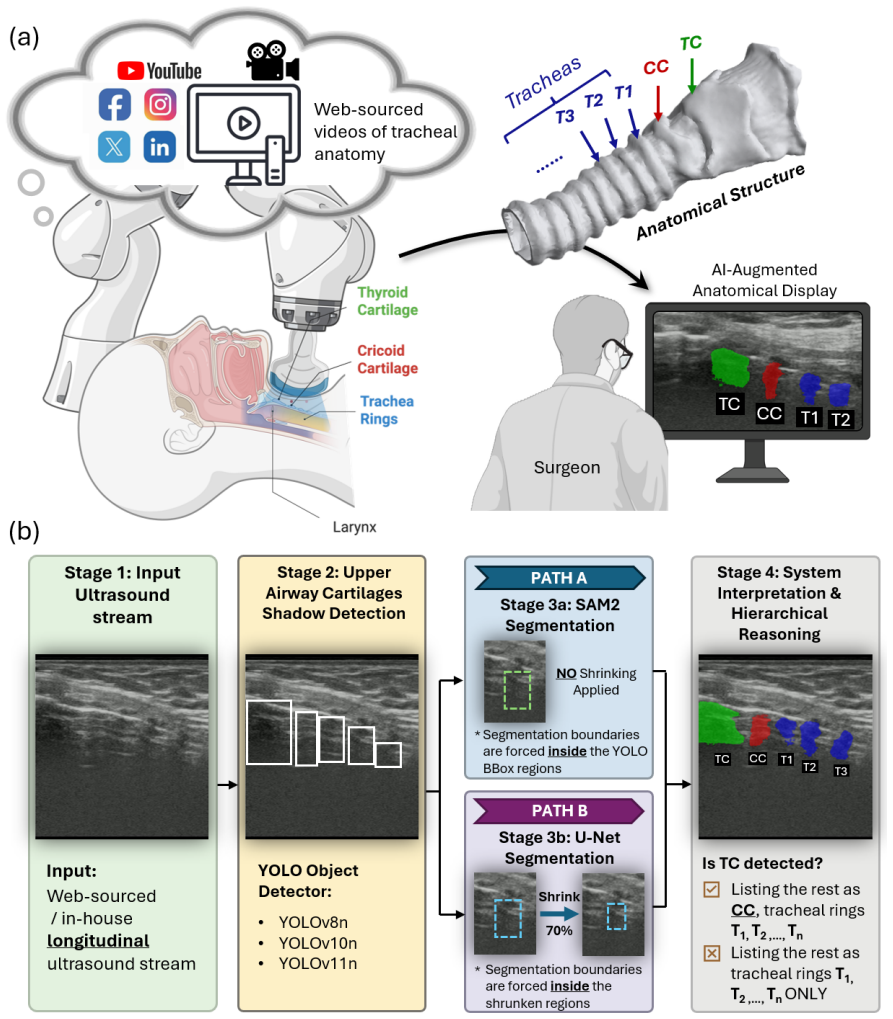
The load-bearing mechanism is the decoupled two-stage pipeline: YOLOv8n acts as a fast prompt generator that converts each ultrasound frame into bounding boxes for the thyroid cartilage (TC) and cartilage rings (CR); the SAM2 (Segment Anything Model 2) streaming-memory decoder then takes those boxes as spatial prompts and restricts its attention to the corresponding regions, skipping dense full-frame decoding. On top of this, a small anatomical reasoning rule—the TC anchor and directional sorting of rings—turns detections into named structures, cricoid cartilage and tracheal rings T1...Tn, so that intercartilaginous spaces can be measured. The sparse annotation protocol (only 90 of 1,205 fra
What would settle it
Identify which web-sourced videos appear in the hybrid training set and which appear in the generalization test set, recompute the Generalization DSC with a strictly disjoint split, and compare it to the reported 0.777; a large drop would falsify the domain-generalization claim.
Extended reading notes
Core claim
The central discovery is that tracheal cartilage structures, which look nearly identical under ultrasound, can be tracked by the acoustic shadows they cast rather than by their tissue texture. The paper's architecture encodes an anatomical hierarchy: once the thyroid cartilage is detected, its position relative to the frame edge sets a direction, and the first ring adjacent to it is labelled the cricoid cartilage, with subsequent rings becoming T1, T2, ...; if the thyroid anchor is absent, the system falls back to left-to-right ring numbering. Combined with this rule, the paper finds that YOLOv8n+SAM2 trained on hybrid data achieves a consistent Mean DSC of 0.777 in both the controlled labor
Load-bearing premise
The web-sourced videos used for training (Videos a–f) are assumed to be different from the web-sourced videos used for the generalization test (refs 18–23); the paper never states the train/test split, and if the sets overlap the claimed out-of-distribution score of 0.777 would instead be in-distribution performance.
Editorial extensions
If this is right
- If the 0.777 Mean DSC holds, a robotic ultrasound system can locate the recommended tracheal incision site (between tracheal rings) quantitatively, rather than relying on manual palpation.
- Hybrid training with unconstrained web-sourced ultrasound is what rescues generalization: in-house-only training collapses to near-zero DSC on out-of-distribution videos, so collecting varied public videos is an effective data strategy.
- The two-stage design reaches about 6.7–6.9 FPS, which is fast enough for closed-loop teleoperation guidance, though the paper states this remains below the 500 Hz–1 kHz needed to prevent haptic chatter in the mechanical control loop.
- A standalone U-Net, even with hybrid training, fragments anatomy and overshoots a Generalization DSC of 0.494; the YOLOv8n+SAM2 decoupling is the only tested configuration that keeps individual tracheal cartilages distinct.
- The fallback rule (numbering tracheal rings left-to-right when the thyroid cartilage is out of view) means the system can continue providing anatomical labels under partial occlusion, as long as the transducer's cranial orientation marker is respected.
Reading between the lines
- If this generalizes beyond the tested airways, the same anchor-and-sort scheme could be applied to other periodic hypoechoic structures—for example, intervertebral spaces or vascular landmarks—by swapping the anchor object and direction rule.
- The paper does not state an explicit train/test split between the web-sourced training videos (a–f) and the six web-sourced test videos; an independent replication should verify these sets are disjoint before treating 0.777 as proof of out-of-distribution generalization.
- Because the system relies on acoustic shadows rather than tissue texture, it may inherit a hidden dependency on transducer angle and gain settings; a stress test with rotated probes or altered gain curves would probe the true boundary of the claimed robustness.
- The sparse annotation protocol (7.5% of frames) suggests a transferable annotation strategy for other surgical ultrasound tasks: label periodic keyframes, train a detector on those, and let a foundation model segment the intervening frames.
Editorial analysis
A structured set of objections, weighed in public.
Referee Report
Summary. The paper proposes a two-stage pipeline for tracheal ultrasound anatomy understanding: a YOLOv8n detector localizes thyroid cartilage and cartilage rings, and SAM2 performs sparse-prompt segmentation within the detected boxes. Training uses sparse annotations from seven in-house videos and six web-sourced YouTube videos ('hybrid training'). The abstract and §3.2 claim a consistent Mean DSC of 0.777 on both a 'Controlled Domain' and a 'Generalization Domain', with the hybrid-trained YOLOv8n+SAM2 outperforming U-Net baselines (Generalization DSC ≤ 0.494) and achieving ~6.9 FPS. The central contribution is presented as robust cross-domain generalization from only 7.5% labeled frames.
Significance. If the generalization claim were valid, the result would be practically interesting for robotic ultrasound-guided tracheostomy: a lightweight detector plus a foundation-model segmenter, trained on very sparse labels, could track tracheal cartilage across different ultrasound sources. The paper also explicitly acknowledges throughput limits for haptic closed-loop control and frames the contribution as a perceptual layer. However, the evaluation protocol as written does not support the central claim. The apparent overlap between web-sourced training videos and the 'Generalization Domain' test set makes the reported 0.777 likely an in-domain rather than out-of-distribution score. The U-Net baseline comparison is also confounded by mismatched training and test preprocessing. These issues are load-bearing for the paper's main conclusions, so the current manuscript cannot be accepted.
major comments (3)
- [§2.4, Table 1, §3.1, Table 2] The 'Generalization Domain' test set appears to be the same six web-sourced videos used in hybrid training. §3.1 defines the generalization test set as 'web-sourced ultrasound sequences [18–23]' — exactly six YouTube videos. Table 1 labels six videos 'a–f' as the 'Web-sourced Dataset (Generalization Environment)' with 35 sparse annotated frames. §2.4 states that sparse annotations were created 'across both the web-sourced and in-house laboratory datasets (Videos 1–7) to form a complete hybrid training matrix,' and Table 2 labels the hybrid training set 'Web-sourced (YouTube) and In-house data.' The paper gives no video-level or frame-level train/test split. Under the natural reading, the hybrid training set includes the same 35 web-sourced frames used in the Generalization test column, so the reported Mean DSC of 0.777 is not an out-of-distribution result. The in-house-only rows (General
- [§2.2, §2.3, Table 3] The U-Net baseline comparison is confounded by a train/test input mismatch. §2.2 says the standalone U-Net is trained on ROI patches 'dynamically scaled down to a 70% shrunk spatial domain' and then evaluated 'on full-frame ultrasound streams without regional cropping or prior localization guidance.' That means U-Net sees a different input distribution at test time than at training time, which alone can explain poor generalization. Meanwhile, YOLOv8n+SAM2 receives full-resolution frames by design, and YOLOv8n+U-Net receives dynamically cropped boxes at inference. Table 3 therefore does not compare architectures on equal terms. The authors should train and test U-Net under matched preprocessing — either full-frame training and full-frame inference, or ROI-cropped training and ROI-cropped inference — and report those results.
- [§3.1, §3.2, Table 2] The experimental setup never specifies the exact train/test splits for either domain. It is unclear whether the Controlled Domain test frames come from the same in-house videos (Videos 1–7) used in the hybrid training matrix, and whether the web-sourced test frames are disjoint from Videos a–f. The paper only reports domain-level aggregates. Without explicit splits, every reported DSC — including the Controlled Domain 0.777 — could be partly or wholly in-sample. The authors must provide per-video train/test assignments, report per-video DSC, and clarify how the 90 labeled frames are partitioned into training and evaluation sets. This is essential not only for the generalization claim but for the basic validity of the benchmark.
minor comments (6)
- [§3.2, Table 2] The exact equality of 0.777 for YOLOv8n+SAM2 in both Controlled and Generalization domains looks suspicious as a rounded value. Report DSC with additional decimal places, per-video standard deviations, or confidence intervals.
- [Table 1 vs §3.1] The mapping between Videos a–f and references [18–23] is not shown. Please add a column or footnote making the correspondence explicit so the reader can verify overlap.
- [References [19], [22], [23]] These references have publication year 2025 but 'accessed: 2024-05-03.' Please correct the access dates or publication years.
- [§2.2] The phrase '70% shrunk spatial domain' is ambiguous. Specify whether this is 70% of width, height, area, or a scaled bounding box, and state the exact crop coordinates used for training.
- [§2.4] The text says the sampling interval was set 'proportionally to its duration and visual complexity' but no quantitative rule is given. Please state the criterion used to choose every 4th vs 20th frame.
- [§3.4] The statement that standalone SAM2 'cannot work' in this domain is asserted without supporting experiments. Since SAM2 is the proposed segmentation engine, a quantitative comparison of standalone SAM2 versus YOLO+SAM2 on a few test frames would strengthen the justification.
Circularity Check
Generalization claim collapses: the web-sourced videos used to build the hybrid training matrix are, by the paper's own description, the same six videos defining the Generalization test domain; no split is reported.
-
fitted input called prediction
[§2.4 Partial-Label Strategy and Sparse Annotation Protocol; §3.1 Experimental Setup and Evaluation Metrics; Table 2 footnote]
"The training data sequence involves a two-stage domain alignment. First, structural profiles and structural variance properties were extracted from a varied set of uncurated web-sourced sequences (Videos a–f). This was followed by highly targeted sparse annotations across both the web-sourced and in-house laboratory datasets (Videos 1–7) to form a complete hybrid training matrix capable of cross-domain validation. | Generalization Domain: An unconstrained collection of web-sourced ultrasound sequences [18, 19, 20, 21, 22, 23]. | † Hybrid: Web-sourced (YouTube) and In-house data."
The hybrid training matrix is explicitly built from sparse annotations on all six web-sourced Videos a–f, while the Generalization Domain is explicitly defined as six web-sourced sequences referenced by [18–23]. The paper never reports a train/test split between these web videos. Table 2 confirms the hybrid training set is 'Web-sourced (YouTube) and In-house data.' Thus the reported Generalization DSC (0.777) is computed on sequences that are already in the training set by the paper's own account. The 'prediction' of out-of-distribution generalization is therefore an in-sample evaluation by construction, not an independent generalization test. The conclusion's limitation that 'the robustness of our framework is tied to the current dataset' does not repair the missing disjointness.
full rationale
The central claimed result is that YOLOv8n+SAM2 achieves a consistent Mean DSC of 0.777 across both controlled and generalized domains, and that this demonstrates cross-domain robustness. That claim depends critically on the test domain being disjoint from the training domain. The paper's own description instead identifies the same body of web-sourced videos as both (a) the source of sparse annotations in the hybrid training matrix (§2.4, Videos a–f) and (b) the Generalization Domain test set (§3.1, references [18–23]). No video-level or frame-level split is specified, so the natural reading is that the web videos used for training are the same web videos used for evaluation. Under that reading, the 0.777 Generalization DSC is in-domain performance, and the 'prediction' reduces by construction to fitting and evaluating on the same data. This is the one load-bearing circular step; it is not rescued by the paper's concluding caveat that robustness is tied to the current dataset. Other aspects of the paper are not circular: the DSC/FPS metrics are conventional, the YOLO+SAM2 architecture comparison is an empirical benchmark, and the hierarchical sorting logic in §2.1 is a deterministic rule rather than a fitted prediction. The paper's self-citations [2–4] are background clinical/robotics context and are not load-bearing. No uniqueness theorem or ansatz-via-citation chain is invoked. Because the central generalization claim reduces to an in-sample evaluation by construction, the score is 7 rather than 2; some independent content remains in the controlled-domain results and the system-engineering measurements, but the headline cross-domain validity is not established.
Assumptions & free parameters
free parameters (3)
- U-Net ROI shrink factor =
0.70
- per-video annotation sampling interval =
every 4th to 25th frame by video
- YOLO detection confidence/NMS thresholds =
not reported
assumptions (6)
- domain assumption Acoustic shadows under cartilage are reliable structural proxies for the cartilages themselves.
- domain assumption Longitudinal-plane acquisition with the transducer marker oriented cranially makes left-to-right image position correspond to superior-to-inferior anatomy.
- domain assumption TC is a reliable global anchor whose detected side determines the direction of anatomical sequencing.
- ad hoc to paper YouTube ultrasound videos are an adequate proxy for the clinical 'generalization' domain.
- ad hoc to paper SAM2 cannot work standalone in this domain, so it is excluded from comparison.
- standard math The generic attention equation describes the SAM2 sparse-prompt mechanism.
Cite this review
Pith. "Pith review of Learning-based Hierarchical Tracheal Anatomy Understanding from Sparse Surgical Demonstration Annotations for Ultrasound Robots." pith.science (2026). https://pith.science/paper/ZYMPATAB
@misc{pith2026260722789,
  author       = {Pith},
  title        = {Pith review of: Learning-based Hierarchical Tracheal Anatomy Understanding from Sparse Surgical Demonstration Annotations for Ultrasound Robots},
  year         = {2026},
  howpublished = {\url{https://pith.science/paper/ZYMPATAB}},
  note         = {Machine review of arXiv:2607.22789}
}
abstract
Tracheostomy requires precise localization of the tracheal incision site; however, conventional manual palpation is subjective and often unreliable, while ultrasound utility remains operator-dependent. This work presents a learning-based framework for hierarchical tracheal anatomy understanding, designed specifically for ultrasound-guided robotic systems. We propose a two-stage perception pipeline integrating a YOLOv8n localization backbone with a sparse, prompt-optimized SAM2 decoder to achieve high-fidelity segmentation from sparse surgical annotations. Our hybrid training strategy, bridging curated laboratory data with unconstrained sequences, ensures clinical robustness. Experimental benchmarks demonstrate that this decoupled architecture effectively balances generalization, precision, and efficiency. The YOLOv8n and SAM2 framework achieves a consistent Mean Dice Similarity Coefficient (DSC) of 0.777 across both controlled and generalized domains. This significantly outperforms U-Net baselines, which often suffer from anatomical fragmentation and performance degradation (Generalization DSC $\le$ 0.494). By constraining mask decoding to targeted, sparse regions of interest, our model achieves a throughput of 6.92 FPS, which is vital for closed-loop robotic teleoperation. This study confirms that a robust hierarchical understanding of tracheal anatomy can be derived by coupling lightweight localization with foundation-scale visual models. Our framework establishes a scalable foundation for standardized, autonomous surgical assistance, effectively navigating the variability of real-world ultrasound to enhance the safety and precision of robotic-assisted tracheostomy.
Figures


Figures from the paper (5 more)


Reference graph
Works this paper leans on
-
[1]
Outcome of mechanically ventilated patients who require a tracheostomy,
F. Frutos-Vivar, A. Esteban, C. Apezteguía, A. Anzueto, P. Nightingale, M. González, L. Soto, C. Rodrigo, J. Raad, C. M. Davidet al., “Outcome of mechanically ventilated patients who require a tracheostomy,”Critical care medicine, vol. 33, no. 2, pp. 290–298, 2005
2005
-
[2]
Pilot study of trans-oral robotic- assisted needle direct tracheostomy puncture in patients requiring prolonged mechanical ventilation,
X. Xiao, H. Poon, C. M. Lim, M. Q.-H. Meng, and H. Ren, “Pilot study of trans-oral robotic- assisted needle direct tracheostomy puncture in patients requiring prolonged mechanical ventilation,”Frontiers in Robotics and AI, vol. 7, p. 575445, 2020
2020
-
[3]
Rasec: Rescaling acquisition strategy with energy constraints under fusion kernel for active incision recom- mendation in tracheotomy,
W. Yue, F. Bai, J. Liu, F. Ju, M. Q.-H. Meng, C. M. Lim, and H. Ren, “Rasec: Rescaling acquisition strategy with energy constraints under fusion kernel for active incision recom- mendation in tracheotomy,”IEEE Transactions on Automation Science and Engineering, vol. 22, pp. 5501–5515, 2024
2024
-
[4]
Multimodal augmented reality assisted incision guidance for preoperative tracheostomy planning,
W. Yue, Y. Wang, S. Chen, H. Gao, and H. Ren, “Multimodal augmented reality assisted incision guidance for preoperative tracheostomy planning,” in2024 IEEE International Conference on Robotics and Biomimetics (ROBIO). IEEE, 2024, pp. 14–19
2024
-
[5]
Comprehensive review of reinforcement learning for medical ultrasound imaging,
H. Elmekki, S. Islam, A. Alagha, H. Sami, A. Spilkin, E. Zakeri, A. M. Zanuttini, J. Ben- tahar, L. Kadem, W.-F. Xieet al., “Comprehensive review of reinforcement learning for medical ultrasound imaging,”Artificial Intelligence Review, vol. 58, no. 9, p. 284, 2025
2025
-
[6]
Ultralytics yolov8,
G. Jocher, A. Chaurasia, and J. Qiu, “Ultralytics yolov8,” 2023. [Online]. Available: https://github.com/ultralytics/ultralytics
2023
-
[7]
Yolov10: Real-time end-to-end object detection,
A. Wang, H. Chen, L. Liu, K. Chen, Z. Lin, J. Han, and G. Ding, “Yolov10: Real-time end-to-end object detection,”Advances in neural information processing systems, vol. 37, pp. 107984–108011, 2024
2024
-
[8]
Ultralytics yolo11,
G. Jocher, A. Chaurasia, and J. Qiu, “Ultralytics yolo11,” 2024, accessed: 2026-05-11. [Online]. Available: https://github.com/ultralytics/ultralytics
2024
Show all 24 references
-
[9]
Sam 2: Segment anything in images and videos,
N. Ravi, V. Gabeur, Y.-T. Hu, R. Hu, C. Ryali, T. Ma, H. Khedr, R. Rädle, C. Rolland, L. Gustafsonet al., “Sam 2: Segment anything in images and videos,”arXiv preprint arXiv:2408.00714, 2024
2024 arXiv
-
[10]
Self- prompting polyp segmentation in colonoscopy using hybrid yolo-sam2 model,
M. Mansoori, S. Shahabodini, J. Abouei, K. N. Plataniotis, and A. Mohammadi, “Self- prompting polyp segmentation in colonoscopy using hybrid yolo-sam2 model,” inICASSP 2025-2025 IEEE International Conference on Acoustics, Speech and Signal Processing (ICASSP). IEEE, 2025, pp. 1–5
2025
-
[11]
Toward grounded yolo-sam: Unified detection–segmentation framework for agricultural intelligence,
P. Verma, A. Paul, R. Machavaram, and M. Bhattacharya, “Toward grounded yolo-sam: Unified detection–segmentation framework for agricultural intelligence,” in2026 Interna- tional Conference on Artificial Intelligence, Computer, Data Sciences and Applications (ACDSA). IEEE, 2026...
2026
-
[12]
Validating yolov8 and sam foundation models for robust point-of-care ultrasound aorta segmentation,
S. Pandey, C.-W. Lu, C.-M. Tan, P.-H. Tsui, E. B. Dam, and K.-F. Chen, “Validating yolov8 and sam foundation models for robust point-of-care ultrasound aorta segmentation,” 2024
2024
-
[13]
U-net: Convolutional networks for biomedi- cal image segmentation,
O. Ronneberger, P. Fischer, and T. Brox, “U-net: Convolutional networks for biomedi- cal image segmentation,” inInternational Conference on Medical image computing and computer-assisted intervention. Springer, 2015, pp. 234–241
2015
-
[14]
Identification of nerve in ultrasound images using u-net archi- tecture,
A. Kakade and J. Dumbali, “Identification of nerve in ultrasound images using u-net archi- tecture,” in2018 International conference on communication information and Computing Technology (ICCICT). IEEE, 2018, pp. 1–6
2018
-
[15]
U-net in medical image segmentation: A review of its applications across modalities,
F. Neha, D. Bhati, D. K. Shukla, S. M. Dalvi, N. Mantzou, and S. Shubbar, “U-net in medical image segmentation: A review of its applications across modalities,”arXiv preprint arXiv:2412.02242, 2024
2024 arXiv
-
[16]
Artificial intelligence for medical imaging: a review of u-net technology for anatomical feature analysis,
V. Asadpour and F. Xie, “Artificial intelligence for medical imaging: a review of u-net technology for anatomical feature analysis,”Intelligent Medicine, 2025
2025
-
[17]
Fine-tuning u-net for ultrasound image segmentation: different layers, different outcomes,
M. Amiri, R. Brooks, and H. Rivaz, “Fine-tuning u-net for ultrasound image segmentation: different layers, different outcomes,”IEEE Transactions on Ultrasonics, Ferroelectrics, and Frequency Control, vol. 67, no. 12, pp. 2510–2518, 2020
2020
-
[18]
Airway US,
Maine Medical Center Emergency Medicine Ultrasound, “Airway US,” https://youtu.be/ 89-pwCg25GI?si=GqRWL4dtaGbfTOnH, 2022, accessed: 2024-05-03. [Online]. Available: https://youtu.be/89-pwCg25GI?si=GqRWL4dtaGbfTOnH
2022
-
[19]
Cricothyroid Membrane Identification with Ultrasound,
Emergency Ultrasound Cases, “Cricothyroid Membrane Identification with Ultrasound,” https://youtu.be/oxehOj-NVB0?si=UM4G0o-Y2JOFKOYt, 2025, accessed: 2024-05-03. [Online]. Available: https://youtu.be/oxehOj-NVB0?si=UM4G0o-Y2JOFKOYt
2025
-
[20]
Chapter 13final using ultrasound to identify the cricothyroid membrane,
AirwayOnDemand from Dr. Will Rosenblatt, “Chapter 13final using ultrasound to identify the cricothyroid membrane,” https://youtu.be/CtohATQr9IU?si=Gtq41mOHNicbucLV, 2015, accessed: 2024-05-03. [Online]. Available: https://youtu.be/CtohATQr9IU?si= Gtq41mOHNicbucLV
2015
-
[21]
Endotracheal tube retraction under ultrasound guidance before percutaneous tracheostomy,
Neurocritical Care Ultrasound, “Endotracheal tube retraction under ultrasound guidance before percutaneous tracheostomy,” https://youtu.be/dt3Ctr8T6nE?si= yro4O4xzhNGQqNr4, 2013, accessed: 2024-05-03. [Online]. Available: https: //youtu.be/dt3Ctr8T6nE?si=yro4O4xzhNGQqNr4
2013
-
[22]
AIRWAY BLOCKS,
Vicente Roques Escolar, “AIRWAY BLOCKS,” https://youtu.be/rGtQ9rQ7RdA?si= nhndS66WekT85s5a, 2025, accessed: 2024-05-03. [Online]. Available: https://youtu.be/ rGtQ9rQ7RdA?si=nhndS66WekT85s5a
2025
-
[23]
Ultrasound of the trachea. Courtesy of Dr. Mi-Sun Hur,
Universal Anatomical Organization (UAO), “Ultrasound of the trachea. Courtesy of Dr. Mi-Sun Hur,” https://youtu.be/AtUZK1QGVGI?si=rnlHV_PNOAh31BQO, 2025, accessed: 2024-05-03. [Online]. Available: https://youtu.be/AtUZK1QGVGI?si=rnlHV_ PNOAh31BQO
2025
-
[24]
Role of haptic feedback technologies and novel engineering developments for surgical training and robot-assisted surgery,
I. Laga Boul-Atarass, M. Rubio Manzanares Dorado, A. Padillo-Eguía, J. Racero-Moreno, I. Eguía-Salinas, S. Pereira-Arenas, R. M. Jiménez-Rodríguez, and J. Padillo-Ruiz, “Role of haptic feedback technologies and novel engineering developments for surgical training and robot-ass...
2025
Reviewed August 1, 2026 · model on record in the stance chip above.
Discussion (0). Sign in to comment.