REVIEW 2 major objections 4 minor 59 references
DY-LUT: Depth-Aware YCbCr Lookup Tables for Real-Time Underwater Image Enhancement
T0 review · 2 major / 4 minor · reviewed 2026-08-01 · deepseek-v4-flash
Pith's one-line read Underwater image enhancement can be reduced to a depth-conditioned lookup in YCbCr space: a 3.56M-parameter network built from 4D lookup tables matches the restoration quality of far heavier models while running 9–304× faster and processing
desk verdict Solid engineering contribution with a real test-set selection problem and an unfair baseline comparison; the core LUT design is novel and worth refereeing. read the letter →
The pith
A machine-rendered reading of the paper's core claim, the machinery that carries it, and where it could break.
The reading
What carries the argument
The engine of the method is a bank of K=3 learnable 4D lookup tables, each of size 25×25×25×25 with a three-channel YCbCr residual in the final dimension. For every pixel, quadrilinear interpolation with separable weights collects 16 neighboring table entries; the query coordinates are luminance Y, normalized depth D, and two learned degradation indices CDI1 and CDI2, predicted by a dual-branch encoder from the concatenation of YCbCr, depth, and luminance gradient. A weight branch produces image-level fusion coefficients α_k that mix the three tables, and a lightweight local-refinement network accounts for spatial consistency. Keeping the lookup 4D—rather than adding depth as a fifth axis—li
What would settle it
A concrete test: take a benchmark of turbid or textureless underwater images, run DY-LUT with a monocular depth estimator known to fail on such scenes, and compare against the paper's own depth-free YCbCr baseline (21.73 dB PSNR from its ablation). If the depth-conditioned variant fails to beat that baseline on the turbid subset, the claim that depth conditioning is the mechanism behind the improvement would be falsified.
Extended reading notes
Core claim
On the paper's own terms, the central discovery is that depth-conditioned lookup in YCbCr space can absorb most of the work of a heavyweight restoration network. Three 25^4 lookup tables, predicted by no more than 3.56M parameters, store YCbCr residuals; each pixel queries them with coordinates (Y, D, CDI1, CDI2), where Y is luminance, D is normalized depth, and the two CDI channels are latent indices produced by a dual-branch encoder from the image and depth. Image-level fusion weights mix the three tables, and a small local-refinement module corrects edge inconsistencies. The ablation evidence shows each ingredient matters: adding depth raises PSNR by roughly 1.5–1.7 dB in both RGB and YCb
Load-bearing premise
The load-bearing assumption is that the externally supplied depth map is a reliable proxy for true scene distance; in textureless or highly turbid regions the paper's own limitation statement concedes enhancement quality depends on that reliability, and if the depth is wrong the depth-conditioned lookup loses the spatial adaptivity that drives most of the quality gain.
Editorial extensions
If this is right
- Real-time underwater enhancement becomes feasible on constrained platforms: the same 3.56M-parameter network exceeds 141 FPS at 4K with adaptive inference and stays above 1 FPS even on a CPU-only configuration, while retaining competitive full-reference quality.
- Depth does not have to come from an expensive source: the paper shows retraining for different monocular depth estimators recovers to at least 23.235 dB PSNR on UIEB-90, and switching the depth source without retraining keeps the drop within 0.763 dB.
- The representation rather than the depth cue alone carries the gain: YCbCr lookup outperforms RGB lookup with and without depth, and the two learned latent indices add ~1.5 dB over fixed chrominance coordinates, suggesting the lookup structure itself is part of the explanation.
- Efficiency does not appear to trade away structure needed by downstream tasks: with all else fixed, DY-LUT raises detector mAP@0.5 by 1.42 points over the strongest common baseline and increases the number of verified feature-matching correspondences by 126.
- Adaptive downsampling offers a tunable speed–quality lever: at 4K it cuts latency from 145 ms to ~7 ms at the cost of 0.336 UIQM and 1.180 UISM, giving deployers a per-platform choice between maximum enhancement score and maximum throughput.
Reading between the lines
- A natural extension the paper leaves implicit is confidence-aware depth conditioning: instead of treating the depth channel as equally reliable everywhere, a future variant could weight the lookup by an uncertainty estimate from the depth estimator, which would directly address the turbid-region failure mode named in the paper's limitation statement.
- The non-identifiability of the two latent indices suggests they may be learning a compressed encoding of physical degradation parameters such as backscatter and attenuation coefficient; probing them on synthetic underwater scenes with known water types could reveal whether they align with those quantities.
- If the depth-conditioned lookup transfers to other wavelength-dependent scattering problems—haze, murky water, atmospheric turbidity—the same 4D table structure could become a general real-time restoration primitive, using whatever depth or range sensor the platform already carries.
- The modular depth interface means the same enhanced network can consume stereo disparity, lidar range, or a monocular estimate without redesign, which could simplify deployment across heterogeneous underwater vehicles.
Editorial analysis
A structured set of objections, weighed in public.
Referee Report
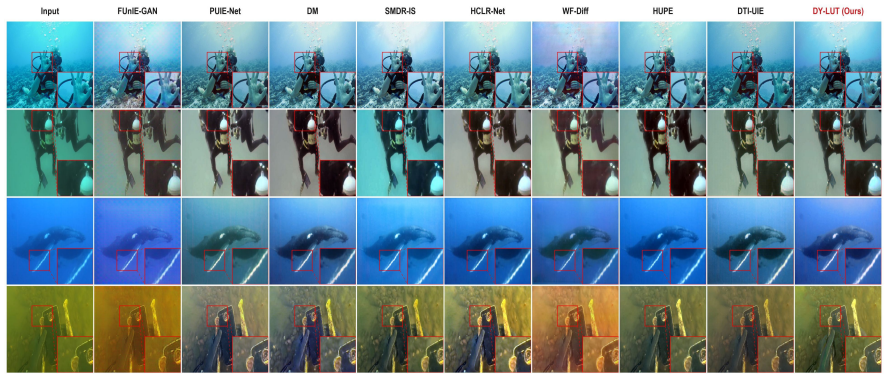
Summary. The paper introduces DY-LUT, a 3.56M-parameter enhancement network that converts the input to YCbCr, combines it with an external depth map and a Sobel gradient, predicts image-level LUT fusion weights and a two-channel per-pixel degradation-index field, and uses these to query three learnable 4D LUTs with quadrilinear interpolation, followed by local refinement. It is trained on UIEB-800 and evaluated on UIEB-90 and LSUI for full-reference quality, U45 and UIEB-C60 for zero-shot no-reference quality, UIQAD for 1080P/4K latency, RUOD for detection, and FLSea for SIFT matching. The paper reports 23.245 dB PSNR on UIEB-90, best PSNR/SSIM on zero-shot LSUI, 9–304× speedups over high-capacity baselines, and ~7 ms adaptive 4K inference.
Significance. If the reported numbers hold in a properly controlled evaluation, the paper would make a useful contribution: it demonstrates that a compact, depth-conditioned LUT formulation can approach heavyweight restoration models at interactive rates, and the evaluation goes beyond a single benchmark (zero-shot, high-resolution, depth-source robustness, downstream tasks). The supplement's exact quadrilinear interpolation, pseudocode, and capacity sweeps are a strength. The central evidence, however, has two load-bearing gaps: model selection is performed on the same test set used for the headline numbers, and the main comparison gives DY-LUT a depth modality not available to baselines. These must be addressed before the quality-competitiveness claim can be accepted.
major comments (2)
- [Sec. 4.6; Supplement D; Eq. (6)] Design selection is circular with the headline evaluation. UIEB-90 is used as the full-reference test set, and all design choices are validated on UIEB-90: K and N are chosen from PSNR on UIEB-90 (Supplement Tables 9 and 10); architecture and loss components are ablated on UIEB-90 (Table 8); the coordinate representation, including the depth and CDI axes, is selected on UIEB-90 (Table 7); and the loss coefficients in Eq. (6) are fixed without a held-out set. Moreover, no multiple-seed variance is reported. Thus the 23.245 dB PSNR, and the margins over HCLR-Net and WF-Diff, are best-case numbers obtained after repeated looks at the test set. This is load-bearing for the central claim of 'competitive quality.' Please introduce a proper validation split (or cross-validation), report mean±std over seeds, and either re-report or clearly qualify the headline results.
- [Sec. 4.2, Table 1; Sec. 3.2; Table 7] The main comparison is not input-equivalent. DY-LUT receives an additional depth channel, X = cat[Y,Cb,Cr,D,Γ], while all baselines in Table 1 are RGB-only methods. Table 7 shows that adding depth is worth 1.69 dB in RGB and 0.86 dB in YCbCr (fixed chroma coordinates), and the final learned-coordinate design reaches 23.245 dB. Therefore part of the reported advantage over RGB-only baselines may be attributable to the extra modality rather than to the proposed LUT mechanism. Please include a no-depth DY-LUT row in the main tables (e.g., the YCbCr row of Table 7, 20.87 dB on UIEB-90) or provide depth-conditioned baselines, and phrase the quality comparison in terms of a fair protocol. The speed comparison is unaffected, but the quality claim needs this controlled comparison.
minor comments (4)
- [Supplement F.2] The text says the averages are reported in 'Tab. 5 of the main paper,' but the downstream results are in Table 6 of the main paper.
- [Sec. 4.3, Fig. 1 caption] The caption of Figure 1 says 'RGB-only end-to-end cost is reported in Sec. 4.3,' but Section 4.3 reports latency with Lite-Mono rather than an RGB-only quality number. Clarify early on that the main quality tables use externally supplied depth and that no-depth quality is available only in Table 7.
- [Algorithm 2, line 14] The gradient loss is written as ||∇Y − ∇Ygt||1; the first Y should be Ŷ to match the reconstruction-loss notation. Minor notation issue.
- [General] For reproducibility, state explicitly whether code and trained checkpoints will be released. The supplement says 'all checkpoints, datasets, and evaluation settings follow Sec. 4.1,' but no release link is given.
Circularity Check
UIEB-90 is used both to select the design (capacity, architecture, losses, coordinate representation) and to report the final quality number, so the headline 23.245 dB is a selected best case; zero-shot LSUI/U45 results provide independent grounding, limiting the circularity.
-
other
[Supplement D, Tables 9/10; Sec. 4.6; Tab. 1]
"With N=25, performance peaks at K=3, and adding more LUTs provides no further gain. Increasing the resolution to N=33 improves PSNR by 0.611 dB but raises the total parameter count from 3.56M to 10.72M; still larger resolutions degrade performance despite substantially higher costs. We therefore select (K,N)=(3,25) as the quality–efficiency trade-off."
The LUT-capacity parameters (K,N) are chosen by comparing PSNR values measured on UIEB-90, since Sec. 4.6 states that all ablations follow the UIEB-90 full-reference protocol. The same UIEB-90 set is then used to report the headline quality result of 23.245 dB in Tab. 1. Thus the reported quality number is not an independent evaluation of a fixed design; it is the result of selecting the design after multiple looks at the benchmark being scored. This is test-set-driven model selection rather than a definitional identity, but it makes the UIEB-90 claim partially self-referential.
-
other
[Sec. 4.6, Tabs. 7/8; Sec. 3.6]
"All ablations follow the UIEB-90 full-reference protocol. ... DY-LUT (Ours) – 23.245 0.8994"
The coordinate representation (Tab. 7), the architectural modules (Tab. 8: Weight Branch, Local Refine, Gradient Cue), and the loss terms (L_MN, L_VGG, L_grad) are retained or removed based on their UIEB-90 PSNR scores. The final configuration is then evaluated on the same UIEB-90 set to produce the reported 23.245 dB. Consequently, the final model is effectively the argmax over the ablated variants on the benchmark used to assert the main quality claim. The zero-shot LSUI, U45, and UIEB-C60 results are evaluated without retraining and provide independent generalization evidence, which is why the circularity is partial rather than total.
full rationale
The paper does not rely on load-bearing self-citation, uniqueness theorems, or ansatz-smuggled-via-citation; the depth cue is an external input, and the LUT queries are trained end-to-end on UIEB-800. The main circularity is in the evaluation protocol: UIEB-90 serves simultaneously as the model-selection criterion and as the final full-reference test set. Supplement D selects (K,N) by UIEB-90 PSNR, Tab. 7 selects the coordinate representation by UIEB-90 PSNR, and Tab. 8 selects architecture and loss components by UIEB-90 PSNR, with no validation split or multi-seed variance reported. The headline 23.245 dB is therefore a selected best case, not a fixed-design measurement on unseen data. The independent zero-shot results on LSUI and U45, plus the depth-source robustness study, show that the method generalizes beyond the selection loop, so the score is 4 rather than 6+. No definitional equivalence was found: the model is not trained on UIEB-90, and the output does not reduce to the input by construction.
Assumptions & free parameters
free parameters (4)
- LUT bank entries T_k =
3,515,625 entries (3 × 25^4 × 3), learned on UIEB-800
- Encoder and refinement network weights =
learned on UIEB-800
- Design choices K=3, N=25 =
K=3, N=25
- Loss coefficients =
beta_Cb=1.5, beta_Cr=1.5, beta_SSIM=1.0, beta_TV=5e-5, beta_MN=2.0, beta_VGG=0.1, beta_grad=0.05
assumptions (5)
- domain assumption Beer-Lambert direct-transmission model t(lambda,D)=exp(-mu(lambda)D)
- domain assumption DAv2-Small monocular depth is a usable proxy for physical scene depth in underwater images
- domain assumption YCbCr separation organizes luminance and chrominance degradation better than RGB
- standard math Quadrilinear interpolation with 16 neighbors is the correct lookup scheme
- domain assumption UIEB-800 ground-truth references are correct and representative
invented entities (1)
-
CDI = (CDI_1, CDI_2) degradation-index field
Cite this review
Pith. "Pith review of DY-LUT: Depth-Aware YCbCr Lookup Tables for Real-Time Underwater Image Enhancement." pith.science (2026). https://pith.science/paper/APIGVOXE
@misc{pith2026260722801,
  author       = {Pith},
  title        = {Pith review of: DY-LUT: Depth-Aware YCbCr Lookup Tables for Real-Time Underwater Image Enhancement},
  year         = {2026},
  howpublished = {\url{https://pith.science/paper/APIGVOXE}},
  note         = {Machine review of arXiv:2607.22801}
}
abstract
Underwater image enhancement is challenged by spatially non-uniform, wavelength-dependent attenuation. Propagation distance and wavelength govern this degradation, while YCbCr separates luminance from chrominance for restoration. We propose DY-LUT, a depth-aware YCbCr lookup-table framework for real-time enhancement. A dual-branch encoder predicts image-level fusion weights and a joint pair of pixel-wise degradation indices from image and depth features. These quantities condition learnable 4D LUTs, followed by lightweight local refinement. DY-LUT preserves traditional LUT efficiency while enabling depth-conditioned, spatially adaptive restoration. With externally supplied depth, its 3.56M-parameter enhancement network achieves competitive quality on UIEB-90 and LSUI and runs $9$--$304\times$ faster than representative high-capacity baselines. Adaptive inference further maintains real-time performance ($\sim7$ ms) for 4K UIQAD images. DY-LUT also benefits downstream detection and feature matching. Ablations show that YCbCr is a more effective basis than RGB for depth-conditioned lookup, while the jointly learned indices further improve adaptive querying. These results provide a physically grounded route to efficient UIE on practical platforms.
Figures


Figures from the paper (11 more)




Reference graph
Works this paper leans on
-
[1]
Sensors , volume=
INAM-based image-adaptive 3D LUTs for underwater image enhancement , author=. Sensors , volume=. 2023 , publisher=
2023
-
[2]
IEEE Journal of Oceanic Engineering , volume=
Recovery of underwater visibility and structure by polarization analysis , author=. IEEE Journal of Oceanic Engineering , volume=. 2006 , publisher=
2006
-
[3]
Proceedings of the IEEE Conference on Computer Vision and Pattern Recognition , pages=
A revised underwater image formation model , author=. Proceedings of the IEEE Conference on Computer Vision and Pattern Recognition , pages=
-
[4]
IEEE Access , volume=
Seeing through the haze: A comprehensive review of underwater image enhancement techniques , author=. IEEE Access , volume=. 2024 , publisher=
2024
-
[5]
IEEE Transactions on Image Processing , volume=
4D LUT: Learnable context-aware 4D lookup table for image enhancement , author=. IEEE Transactions on Image Processing , volume=. 2023 , publisher=
2023
-
[6]
European Conference on Computer Vision , pages=
SepLUT: Separable image-adaptive lookup tables for real-time image enhancement , author=. European Conference on Computer Vision , pages=. 2022 , organization=
2022
-
[7]
Proceedings of the IEEE/CVF International Conference on Computer Vision , pages=
Real-time image enhancer via learnable spatial-aware 3D lookup tables , author=. Proceedings of the IEEE/CVF International Conference on Computer Vision , pages=
-
[8]
Proceedings of the IEEE/CVF Conference on Computer Vision and Pattern Recognition , pages=
AdaInt: Learning adaptive intervals for 3D lookup tables on real-time image enhancement , author=. Proceedings of the IEEE/CVF Conference on Computer Vision and Pattern Recognition , pages=
Show all 59 references
-
[9]
Information Fusion , volume=
LGT: Luminance-guided transformer-based multi-feature fusion network for underwater image enhancement , author=. Information Fusion , volume=. 2025 , publisher=
2025
-
[10]
IEEE Transactions on Pattern Analysis and Machine Intelligence , volume=
Learning image-adaptive 3D lookup tables for high performance photo enhancement in real-time , author=. IEEE Transactions on Pattern Analysis and Machine Intelligence , volume=. 2020 , publisher=
2020
-
[11]
IEEE Transactions on Image Processing , volume=
An underwater image enhancement benchmark dataset and beyond , author=. IEEE Transactions on Image Processing , volume=. 2019 , publisher=
2019
-
[12]
IEEE Robotics and Automation Letters , volume=
Fast underwater image enhancement for improved visual perception , author=. IEEE Robotics and Automation Letters , volume=. 2020 , publisher=
2020
-
[13]
Proceedings of the 31st ACM International Conference on Multimedia , pages=
Underwater image enhancement by transformer-based diffusion model with non-uniform sampling for skip strategy , author=. Proceedings of the 31st ACM International Conference on Multimedia , pages=
-
[14]
International Journal of Computer Vision , volume=
HUPE: Heuristic underwater perceptual enhancement with semantic collaborative learning , author=. International Journal of Computer Vision , volume=. 2025 , publisher=
2025
-
[15]
Proceedings of the AAAI Conference on Artificial Intelligence , volume=
Synergistic multiscale detail refinement via intrinsic supervision for underwater image enhancement , author=. Proceedings of the AAAI Conference on Artificial Intelligence , volume=
-
[16]
European Conference on Computer Vision , pages=
Uncertainty inspired underwater image enhancement , author=. European Conference on Computer Vision , pages=. 2022 , organization=
2022
-
[17]
IEEE Transactions on Multimedia , volume=
Underwater image enhancement with cascaded contrastive learning , author=. IEEE Transactions on Multimedia , volume=. 2024 , publisher=
2024
-
[18]
Proceedings of the IEEE/CVF Conference on Computer Vision and Pattern Recognition , pages=
Wavelet-based Fourier information interaction with frequency diffusion adjustment for underwater image restoration , author=. Proceedings of the IEEE/CVF Conference on Computer Vision and Pattern Recognition , pages=
-
[19]
European Conference on Computer Vision , pages=
Osmosis: RGBD diffusion prior for underwater image restoration , author=. European Conference on Computer Vision , pages=. 2024 , organization=
2024
-
[20]
Proceedings of the IEEE/CVF Conference on Computer Vision and Pattern Recognition , pages=
Sea-thru: A method for removing water from underwater images , author=. Proceedings of the IEEE/CVF Conference on Computer Vision and Pattern Recognition , pages=
-
[21]
IEEE International Conference on Robotics and Automation , pages=
Enhancing underwater imagery using generative adversarial networks , author=. IEEE International Conference on Robotics and Automation , pages=. 2018 , organization=
2018
-
[22]
Pattern Recognition , volume=
Underwater scene prior inspired deep underwater image and video enhancement , author=. Pattern Recognition , volume=. 2020 , publisher=
2020
-
[23]
IEEE Transactions on Image Processing , volume=
U-shape transformer for underwater image enhancement , author=. IEEE Transactions on Image Processing , volume=. 2023 , publisher=
2023
-
[24]
IEEE Transactions on Image Processing , volume=
SGUIE-Net: Semantic attention guided underwater image enhancement with multi-scale perception , author=. IEEE Transactions on Image Processing , volume=. 2022 , publisher=
2022
-
[25]
Proceedings of the AAAI Conference on Artificial Intelligence , volume=
NILUT: Conditional neural implicit 3D lookup tables for image enhancement , author=. Proceedings of the AAAI Conference on Artificial Intelligence , volume=
-
[26]
Proceedings of the IEEE/CVF Conference on Computer Vision and Pattern Recognition , pages=
Depth Anything: Unleashing the power of large-scale unlabeled data , author=. Proceedings of the IEEE/CVF Conference on Computer Vision and Pattern Recognition , pages=
-
[27]
Advances in Neural Information Processing Systems , year=
Depth Anything V2 , author=. Advances in Neural Information Processing Systems , year=
-
[28]
arXiv preprint arXiv:2407.04230 , year=
A physical model-guided framework for underwater image enhancement and depth estimation , author=. arXiv preprint arXiv:2407.04230 , year=
-
[29]
IEEE Transactions on Image Processing , volume=
Underwater image enhancement via medium transmission-guided multi-color space embedding , author=. IEEE Transactions on Image Processing , volume=. 2021 , publisher=
2021
-
[30]
Proceedings of the IEEE/CVF Conference on Computer Vision and Pattern Recognition , pages=
Atlantis: Enabling underwater depth estimation with stable diffusion , author=. Proceedings of the IEEE/CVF Conference on Computer Vision and Pattern Recognition , pages=
-
[31]
arXiv preprint arXiv:2405.08419 , year=
WaterMamba: Visual state space model for underwater image enhancement , author=. arXiv preprint arXiv:2405.08419 , year=
-
[32]
arXiv preprint arXiv:2404.13884 , year=
MambaUIE&SR: Unraveling the ocean's secrets with only 2.8 GFLOPs , author=. arXiv preprint arXiv:2404.13884 , year=
-
[33]
IEEE Transactions on Image Processing , volume=
An underwater color image quality evaluation metric , author=. IEEE Transactions on Image Processing , volume=. 2015 , publisher=
2015
-
[34]
IEEE Journal of Oceanic Engineering , volume=
Human-visual-system-inspired underwater image quality measures , author=. IEEE Journal of Oceanic Engineering , volume=. 2015 , publisher=
2015
-
[35]
Proceedings of the 30th ACM International Conference on Multimedia , pages=
CLUT-Net: Learning adaptively compressed representations of 3DLUTs for lightweight image enhancement , author=. Proceedings of the 30th ACM International Conference on Multimedia , pages=
-
[36]
Wang, Yudong and Guo, Jichang and Gao, Huan and Yue, Huihui , journal=. UIEC. 2021 , publisher=
2021
-
[37]
IEEE Journal of Oceanic Engineering , volume=
Multicolor light attenuation modeling for underwater image restoration , author=. IEEE Journal of Oceanic Engineering , volume=. 2023 , publisher=
2023
-
[38]
European Conference on Computer Vision , pages=
Perceptual losses for real-time style transfer and super-resolution , author=. European Conference on Computer Vision , pages=. 2016 , organization=
2016
-
[39]
IEEE Transactions on Image Processing , volume=
Image quality assessment: From error visibility to structural similarity , author=. IEEE Transactions on Image Processing , volume=. 2004 , publisher=
2004
-
[40]
Proceedings of the IEEE Conference on Computer Vision and Pattern Recognition , pages=
The unreasonable effectiveness of deep features as a perceptual metric , author=. Proceedings of the IEEE Conference on Computer Vision and Pattern Recognition , pages=
-
[41]
Chu, Xiaohui and Hu, Runze and Liu, Yutao and Cao, Jingchao and Xu, Lijun , journal=
-
[42]
Neurocomputing , volume=
Rethinking General Underwater Object Detection: Datasets, Challenges, and Solutions , author=. Neurocomputing , volume=
-
[43]
Expert Systems with Applications , volume=
Underwater Variable Zoom: Depth-Guided Perception Network for Underwater Image Enhancement , author=. Expert Systems with Applications , volume=
-
[44]
arXiv preprint arXiv:1906.06819 , year=
A Fusion Adversarial Underwater Image Enhancement Network with a Public Test Dataset , author=. arXiv preprint arXiv:1906.06819 , year=
1906 arXiv
-
[45]
IEEE Transactions on Image Processing , volume=
Underwater Image Restoration Based on Image Blurriness and Light Absorption , author=. IEEE Transactions on Image Processing , volume=
-
[46]
Randall, Yelena , school=
-
[47]
Zhou, Jingchun and Sun, Jiaming and Li, Chongyi and Jiang, Qiuping and Zhou, Man and Lam, Kin-Man and Zhang, Weishi and Fu, Xianping , journal=
-
[48]
International Journal of Computer Vision , volume=
Distinctive Image Features from Scale-Invariant Keypoints , author=. International Journal of Computer Vision , volume=
-
[49]
Talk at the Stanford Artificial Project , pages=
A 3x3 Isotropic Gradient Operator for Image Processing , author=. Talk at the Stanford Artificial Project , pages=. 1968 , note=
1968
-
[50]
Bradski, Gary , journal=. The
-
[51]
International Conference on Learning Representations , year=
Decoupled Weight Decay Regularization , author=. International Conference on Learning Representations , year=
-
[52]
2011 , url=
Studio Encoding Parameters of Digital Television for Standard 4:3 and Wide-Screen 16:9 Aspect Ratios , author=. 2011 , url=
2011
-
[53]
Ultralytics
Jocher, Glenn and Qiu, Jing , year=. Ultralytics
-
[54]
International Conference on Learning Representations , year=
Very Deep Convolutional Networks for Large-Scale Image Recognition , author=. International Conference on Learning Representations , year=
-
[55]
IEEE Transactions on Pattern Analysis and Machine Intelligence , volume=
Towards Robust Monocular Depth Estimation: Mixing Datasets for Zero-Shot Cross-Dataset Transfer , author=. IEEE Transactions on Pattern Analysis and Machine Intelligence , volume=
-
[56]
Lite-Mono: A Lightweight
Zhang, Ning and Nex, Francesco and Vosselman, George and Kerle, Norman , booktitle=. Lite-Mono: A Lightweight
-
[57]
arXiv preprint arXiv:2603.01767 , year=
Downstream Task Inspired Underwater Image Enhancement: A Perception-Aware Study from Dataset Construction to Network Design , author=. arXiv preprint arXiv:2603.01767 , year=
-
[58]
Proceedings of the AAAI Conference on Artificial Intelligence , volume=
Adaptive Dual-Domain Learning for Underwater Image Enhancement , author=. Proceedings of the AAAI Conference on Artificial Intelligence , volume=. 2025 , doi=
2025
-
[59]
Proceedings of the AAAI Conference on Artificial Intelligence , volume=
Underwater Ranker: Learn Which Is Better and How to Be Better , author=. Proceedings of the AAAI Conference on Artificial Intelligence , volume=. 2023 , doi=
2023
Reviewed August 1, 2026 · model on record in the stance chip above.
Discussion (0). Sign in to comment.