REVIEW 3 major objections 4 minor 282 references
A neural network trained on known, mostly emission-line CVs and applied to every DESI science spectrum finds 1,029 cataclysmic variables — 221 new, ten of them AM CVn.
Reviewed by Pith at T0; open to challenge. T0 means a machine referee read the full paper against a public rubric. the ladder, T0–T4 →
T0 review · deepseek-v4-flash
2026-08-01 04:22 UTC pith:ZTRFWGXL
load-bearing objection Big, useful CV catalogue from DESI DR2; the catalog itself is solid, but the ~99% completeness claim doesn't survive the paper's own missed-AM-CVn example. the 3 major comments →
1000 cataclysmic variables identified from DESI spectroscopy
The pith
A machine-rendered reading of the paper's core claim, the machinery that carries it, and where it could break.
Core claim
A CNN trained on known, mostly emission-line CVs and applied to every DESI science spectrum finds 1,029 cataclysmic variables — 221 new, ten of them AM CVn. The CNN flagged 293,670 candidates; cross-matching, a redshift cut, and visual inspection of 41,500 spectra yielded 1,014 CVs, with six more from validation. The CNN's per-spectrum reliability is 97.2 per cent and the sample completeness is claimed at ~99 per cent. Of the 171 new CVs with ZTF light curves, only 43 show outbursts — evidence that spectroscopic selection offsets the bias toward outbursting systems. Twelve new members of the peculiar state-change class and five evolved-donor CVs complete the catalogue.
What carries the argument
The load-bearing tool is a convolutional neural network (CNN) trained on 5,484 DESI spectra matched from SDSS samples: 623 known CVs plus galaxies, quasars, stars, white dwarfs, and detached white-dwarf binaries. Trained 200 times on random 80/20 splits, the best model is error-free on the held-out test set. Its job is to shrink 81 million spectra to 293,670 candidates; a catalogue cross-match and redshift cut (Z < 0.01185) then trim the list to ~41,500 spectra for human inspection. Completeness rests on inspecting random and targeted samples of discarded spectra, including the 1.6 < Z < 1.7 spike where DESI's redshift pipeline is fooled — yielding the ~99 per cent estimate.
Load-bearing premise
The completeness argument stands or falls on the premise that the CNN's training spectra — previously known CVs, nearly all with emission lines — cover every spectral shape a CV can present in DESI; the paper itself shows this premise fails for at least one absorption-dominated AM CVn system that was absent from the training set.
What would settle it
Inspect a random sample of the roughly 238,000 spectra the CNN flagged but the paper never manually examined (those with Z > 0.01 and no catalogue counterpart). If CVs appear there at a rate well above the assumed ~1 per cent — or if retraining the CNN with absorption-dominated AM CVn spectra added to the training set causes it to flag many additional systems — the claimed ~99 per cent completeness and the space densities built on it would be overestimates.
If this is right
- The DESI sample is the deepest CV census to date, about two magnitudes fainter than previous spectroscopic surveys, and it contains the largest fraction of short-period systems; the sharp edges of the 2–3 hour period gap fade in such untargeted samples.
- Revised space densities for SU UMa and WZ Sge subtypes agree with earlier estimates, but the values for every subtype are lower bounds because 156 unclassified CVs — many of them non-outbursting, hence likely short-period — are not counted.
- With twelve new members added to the eight previously known examples, roughly one per cent of all CVs belong to the peculiar state-change class, and their scatter across orbital period and HR-diagram position argues against a single evolutionary stage as the cause.
- Almost all 1,029 CVs — 709 of them — were observed serendipitously by DESI's galaxy and quasar programs rather than by CV-specific targeting, showing that deep multi-object surveys harvest CVs as a by-product.
- Five CVs whose spectra mimic F-type stars but whose absolute magnitudes are too faint for F-type donors are likely systems with highly evolved helium-core donors, a population previously found mainly by targeted variability searches.
Where Pith is reading between the lines
- If the ~99 per cent completeness holds, the implied conclusion is that the known CV census is far from finished at faint magnitudes: the serendipitous detection rate inside DESI's deep but non-CV-focused targeting is high enough that future wide-field spectroscopic surveys will keep uncovering substantial new populations.
- The CNN's demonstrated blind spot — an absorption-dominated AM CVn prototype missed because the training set contained no such spectrum — suggests that other spectral classes absent from the training sample are silently underrepresented; true completeness for rare or unusual CVs may be below 99 per cent even if the overall claim survives.
- The near-total reliance on serendipity implies a cheap, testable strategy: deliberately reserving survey fibers for white-dwarf-binary candidates would multiply CV yields, and a future far-UV space survey of the kind the paper highlights would make such targeting efficient.
- The blurring of the period-gap edges in an unbiased sample sharpens a specific prediction-check for binary evolution models: models that reproduce a sharp gap in outburst-selected samples but not in deep spectroscopic samples would be consistent with these data, whereas models predicting a sharp gap here would not.
Editorial analysis
A structured set of objections, weighed in public.
Referee Report
Summary. The paper reports a systematic search for cataclysmic variables in DESI DR2, analysing 80,767,382 science spectra. Three shortlisting routes are used: coordinate cross-match with 16,277 known/candidate CVs, a CNN trained on SDSS CV spectra, and a redshift cut; the resulting candidates are manually inspected with the aid of Gaia, GALEX, ZTF, and archival databases. The authors identify 1,029 CVs, of which 221 are new, including ten AM CVn systems and twelve members of a peculiar state-change class; they add 84 new or improved orbital periods and derive revised CV subtype space densities. The catalogue is supported by an independent validation set of 580 DESI CV spectra from a white-dwarf-targeted programme and by a detailed comparison with the Hou et al. (2026) DESI DR1 CV sample.
Significance. If the completeness and space-density claims hold, this is the largest spectroscopically selected CV sample to date, roughly two magnitudes deeper than SDSS, and would provide a largely outburst-unbiased sample for population studies. The paper is commendably transparent: it releases the full catalogue, per-CV spectra, and training/test lists; it documents an independent validation set with only two non-detections (with stated causes); and it explicitly re-examines and reclassifies 13 objects from Hou et al. (2026). The identification of twelve new peculiar state-change CVs and five 'highly evolved donor' candidates are interesting scientific results in their own right. These strengths are partly offset by an overstated completeness statement and by an apparent inconsistency in the completeness corrections used for the space-density estimates.
major comments (3)
- [§4.5, §6] The claim 'the sample is ≃99 per cent complete' is not supported by the tests described. The random sample of 9,954 spectra is drawn from the 293,670 CNN-selected spectra that were not otherwise inspected, so it bounds false positives among the selected set, not false negatives among the 80,767,382 unselected science spectra. The 234-spectrum TARGETID check measures the CNN's flagging rate for spectra of CVs that were already identified by another route, not its sensitivity to unfamiliar CV spectral types. Section 6 supplies a concrete false negative: the AM CVn prototype J1234+3737 was missed because its helium-absorption spectrum was not represented in the training set. The validation sample of §4.3.4 is drawn from a white-dwarf-targeted programme and did not include such systems. Therefore the 99% completeness statement is unsubstantiated, and the §10 space densities—which depend on c
- [§4.3.3, Fig. 2] The 'perfect' confusion matrix in Fig. 2 is an optimistic selection artifact. The model was chosen among 200 retrainings on the basis of the test-set confusion matrix, so the quoted zero false-positive/zero false-negative result is not an honest out-of-sample evaluation. The independent validation set of 580 spectra in §4.3.4 is better evidence and should be reported as the primary sensitivity estimate. Please report the distribution of test metrics across the 200 splits, or use a validation split during model selection, and state the final CNN sensitivity using the held-out validation sample.
- [§10, Eq. (2)] There is an internal inconsistency between the claimed completeness and the completeness corrections used in the space-density calculation. Section 4.5 states the sample is ≃99 per cent complete, but Section 10 adopts completeness values of 0.6 for short-period subtypes and 0.2 for long-period subtypes, and Eq. (2) applies the inverse of these as a correction factor to N_obs. These two statements cannot both describe the same selection pipeline. Clarify what the 99% statement refers to (e.g., contamination among the selected spectra) and justify the 0.6/0.2 values independently of that claim, or recalculate the space densities consistently.
minor comments (4)
- [§5.1] 'We found 1029 CVs among the DESI DR1 spectra' should read DR2; the analysis covers DESI DR2 (Section 4.1).
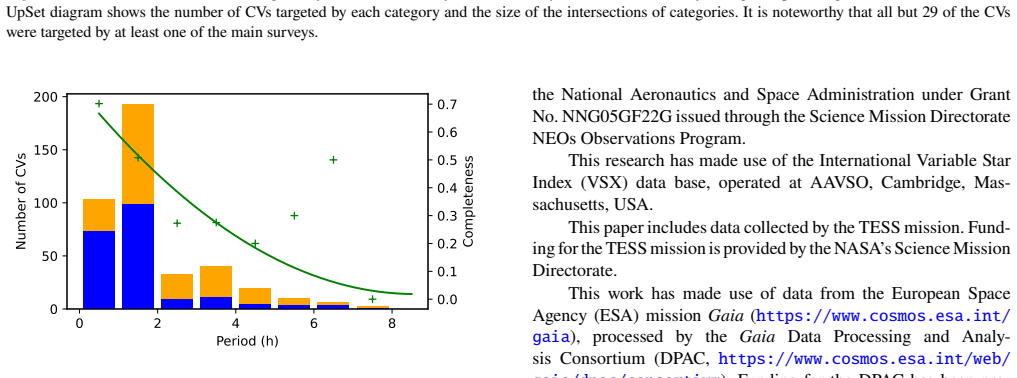
- [Fig. 33 caption] The caption says the 150-pc 'All CVs' bar suffers from only seven CVs, whereas Table 7 lists N=8 for that row; please reconcile.
- [§4.5] The term 'sample' is ambiguous in the completeness discussion: it is not clear whether '≃99 per cent complete' refers to the final CV list, the CNN-selected set, or the manually inspected set. Please define it explicitly.
- [References] Swan et al. (submitted) is cited without a year or arXiv number; please give a fuller reference or state its status.
Circularity Check
No circular reduction: the DESI CV catalogue is produced by an externally anchored pipeline; the 99% completeness claim is a validation gap, not a by-construction circularity.
full rationale
The paper's derivation chain is: train a CNN on SDSS CV spectra (Section 4.3), apply it to all 80,767,382 DESI science spectra, supplement with coordinate cross-matches and a redshift filter, visually inspect the shortlist, then use the resulting sample to estimate completeness and space densities. No step in this chain is equivalent to its inputs by construction. The CNN is a fitted classifier, but its outputs are not relabelled training values; they are tested against an external catalogue (Hou et al. 2026) in Section 6, which reports a 409/412 recovery rate. The three misses are explicitly disclosed, including the AM CVn prototype J1234+3737 whose absorption-dominated spectrum was absent from the CNN training set. That disclosure is a genuine limitation for the paper's 'sample is ≃99 per cent complete' statement in Section 4.5: the random-sample check of 9,954 already-selected spectra only bounds false positives among selected spectra and cannot constrain false negatives among unselected ones. However, this is an evidential/correctness gap, not a circular argument. Likewise, the space-density completeness correction in Section 10 uses the authors' own SDSS CV catalogue from Inight et al. (2023a, 2025) as a reference sample; this is standard practice for an external reference, and the catalogue is independently grounded in SDSS spectroscopy. Self-citations are frequent, but the CNN architecture, training set, and validation are described in this paper, and the central catalogue claim is anchored to DESI spectra and an external comparison. No fitted parameter is renamed as a prediction, and no uniqueness theorem or ansatz is imported from the authors' prior work to force the result. The circularity score is therefore low; the substantive concerns belong to completeness validation and selection representativeness, not to circular derivation.
Axiom & Free-Parameter Ledger
free parameters (4)
- Completeness correction C_corr (short-period subtypes) =
0.6
- Completeness correction C_corr (long-period subtypes) =
0.2
- Limiting magnitude m_G for DESI CV detection =
22.5
- UV selection cut coefficients (Eq. A1) =
slope = 1.5, intercept = -0.3
axioms (5)
- domain assumption Practically all CVs exhibit Balmer and/or He emission lines, so spectral selection can find CVs regardless of outburst behaviour.
- domain assumption The SDSS CV training sample is representative of the spectral diversity of CVs in DESI, including faint, low-accretion-rate and absorption-dominated systems.
- domain assumption The Galactic CV population is vertically exponential with adopted scale heights, and DESI's effective volume can be approximated by HEALPix exposures ignoring bright/dark time and duplicate passes.
- ad hoc to paper Completeness measured by re-detecting the authors' SDSS CV catalogues (Inight et al. 2023a, 2025) applies to the DESI CV sample.
- domain assumption Subtype classifications from VSX/literature are reliable, and the 156 unclassified CVs can be neglected in subtype space densities (with a ~20% understatement).
read the original abstract
Most cataclysmic variables (CVs) are discovered when they have an outburst generating an inherent selection bias against CVs that rarely, or never, outburst. CVs discovered by virtue of their spectroscopic characteristics are particularly valuable to offset this bias and we have used an established machine-learning technique to assist in searching 98 966 000 spectra obtained by the Dark Energy Spectroscopic Survey (DESI) to find such CVs. DESI observations are much deeper than previous spectroscopic surveys and we have identified 1029 CVs, 221 of which are new including ten of the AM CVn subtype. We have spectroscopically confirmed 441 CV candidates and obtained 84 new or improved orbital periods. We present revised space density estimates based upon this new data. We have also added ten more to the eight known examples of an intriguing class of CVs which exhibit peculiar changes in accretion.
Figures







Reference graph
Works this paper leans on
-
[1]
Compact white dwarf binaries in the combined SRG/eROSITA/SDSS eFEDS survey. , keywords =. doi:10.1051/0004-6361/202348426 , archivePrefix =. 2401.17304 , primaryClass =
-
[2]
Optical Studies of Seven Bright Southern Cataclysmic Variable Stars. , keywords =. doi:10.3847/1538-3881/ace7bf , archivePrefix =. 2307.07630 , primaryClass =
-
[3]
Tilted discs in six poorly studied cataclysmic variables. , keywords =. doi:10.1093/mnras/stad259 , archivePrefix =. 2301.08581 , primaryClass =
-
[4]
Discovery of Two Polars from a Crossmatch of ZTF and the SRG/eFEDS X-Ray Catalog. , keywords =. doi:10.3847/1538-4357/acbb6f , archivePrefix =. 2206.04714 , primaryClass =
-
[5]
On the orbital period of the dwarf nova CW Mon
On the orbital period of the dwarf nova CW Mon. arXiv e-prints , keywords =. doi:10.48550/arXiv.2302.09782 , archivePrefix =. 2302.09782 , primaryClass =
work page internal anchor Pith review Pith/arXiv arXiv doi:10.48550/arxiv.2302.09782
-
[6]
Transient Name Server Discovery Report , keywords =
GaiaAlerts Transient Discovery Report for 2023-02-07. Transient Name Server Discovery Report , keywords =
2023
-
[7]
TESS light curves of cataclysmic variables - II - Superhumps in old novae and novalike variables. , keywords =. doi:10.1093/mnras/stac3493 , archivePrefix =. 2212.04424 , primaryClass =
-
[8]
Comprehensive listing of 156 reliable orbital periods for novae, including 49 new periods. , keywords =. doi:10.1093/mnras/stac2089 , archivePrefix =. 2207.02932 , primaryClass =
-
[9]
Optical Characterization of Two Cataclysmic Variables: RBS 0490 and SDSS J075939.79+191417.3. , keywords =. doi:10.3847/1538-3881/ac6026 , archivePrefix =. 2203.17198 , primaryClass =
-
[10]
Romanov V48: unusual intermediate polar in the period gap
Romanov V48: unusual intermediate polar in the period gap. arXiv e-prints , keywords =. doi:10.48550/arXiv.2204.02598 , archivePrefix =. 2204.02598 , primaryClass =
work page internal anchor Pith review Pith/arXiv arXiv doi:10.48550/arxiv.2204.02598
-
[11]
WFI J161953.3+031909: eclipsing ER UMa-type and Z Cam-type star in the period gap
WFI J161953.3+031909: eclipsing ER UMa-type and Z Cam-type star in the period gap. arXiv e-prints , keywords =. doi:10.48550/arXiv.2203.06785 , archivePrefix =. 2203.06785 , primaryClass =
work page internal anchor Pith review Pith/arXiv arXiv doi:10.48550/arxiv.2203.06785
-
[12]
A Catalog of 323 Cataclysmic Variables from LAMOST DR6. , keywords =. doi:10.3847/1538-4365/ac283a , archivePrefix =. 2111.13049 , primaryClass =
-
[13]
Gaia photometric science alerts
Gaia Early Data Release 3. Gaia photometric science alerts. , keywords =. doi:10.1051/0004-6361/202140735 , archivePrefix =. 2106.01394 , primaryClass =
-
[14]
Research Notes of the American Astronomical Society , keywords =
Discovery of 13 New Orbital Periods for Classical Novae. Research Notes of the American Astronomical Society , keywords =. doi:10.3847/2515-5172/ac0d5b , archivePrefix =. 2106.13907 , primaryClass =
-
[15]
Multi-band variability characterization
Large-amplitude variables in Gaia Data Release 2. Multi-band variability characterization. , keywords =. doi:10.1051/0004-6361/202039450 , archivePrefix =. 2009.07746 , primaryClass =
Pith/arXiv arXiv 2009
-
[16]
Life after eruption VIII: The orbital periods of novae. , keywords =. doi:10.1093/mnras/staa3482 , archivePrefix =. 2011.02889 , primaryClass =
Pith/arXiv arXiv 2011
-
[17]
Transient Name Server Discovery Report , keywords =
GaiaAlerts Transient Discovery Report for 2021-02-24. Transient Name Server Discovery Report , keywords =
2021
-
[18]
Optical Studies of Eight AM Herculis-type Cataclysmic Variable Stars. , keywords =. doi:10.3847/1538-3881/ab9d1b , archivePrefix =. 2006.08078 , primaryClass =
Pith/arXiv arXiv 2006
-
[19]
Transient Name Server Discovery Report , keywords =
GaiaAlerts Transient Discovery Report for 2020-06-16. Transient Name Server Discovery Report , keywords =
2020
-
[20]
Cataclysmic Variables in the First Year of the Zwicky Transient Facility. , keywords =. doi:10.3847/1538-3881/ab7cce , archivePrefix =. 2002.08447 , primaryClass =
Pith/arXiv arXiv 2002
-
[21]
Transient Name Server Discovery Report , keywords =
GaiaAlerts Transient Discovery Report for 2020-03-10. Transient Name Server Discovery Report , keywords =
2020
-
[22]
Exploratory Spectroscopy of Magnetic Cataclysmic Variables Candidates and Other Variable Objects. II. , keywords =. doi:10.3847/1538-3881/ab6ded , archivePrefix =. 2001.10582 , primaryClass =
Pith/arXiv arXiv 2001
-
[23]
Survey of period variations of superhumps in SU UMa-type dwarf novae. X. The tenth year (2017). , keywords =. doi:10.1093/pasj/psz134 , archivePrefix =. 1911.04645 , primaryClass =
Pith/arXiv arXiv 2017
-
[24]
Transient Name Server Discovery Report , keywords =
GaiaAlerts Transient Discovery Report for 2019-11-29. Transient Name Server Discovery Report , keywords =
2019
-
[25]
Transient Name Server Discovery Report , keywords =
GaiaAlerts Transient Discovery Report for 2019-10-18. Transient Name Server Discovery Report , keywords =
2019
-
[26]
Transient Name Server Discovery Report , keywords =
GaiaAlerts Transient Discovery Report for 2019-09-23. Transient Name Server Discovery Report , keywords =
2019
-
[27]
Precise measures of orbital period, before and after nova eruption for QZ Aurigae. , keywords =. doi:10.1093/mnras/stz1252 , archivePrefix =. 1905.00974 , primaryClass =
Pith/arXiv arXiv 1905
-
[28]
Astrophysical Bulletin , keywords =
Spectroscopic and Photometric Study of the Polar 1RXS J152506.9-032647. Astrophysical Bulletin , keywords =. doi:10.1134/S1990341319030088 , adsurl =
-
[29]
The Astronomer's Telegram , keywords =
Echelle spectroscopy of TCP J21040470+4631129. The Astronomer's Telegram , keywords =
-
[30]
Transient Name Server Discovery Report , keywords =
GaiaAlerts Transient Discovery Report for 2019-06-14. Transient Name Server Discovery Report , keywords =
2019
-
[31]
Targets from multiple transient surveys
High-speed photometry of faint cataclysmic variables - IX. Targets from multiple transient surveys. , keywords =. doi:10.1093/mnras/stz1018 , archivePrefix =. 1903.11643 , primaryClass =
Pith/arXiv arXiv 1903
-
[32]
A small survey of UV-bright stars around the northern ecliptic pole: seeking new p-mode sdB variables for the TESS mission. Open Astronomy , keywords =. doi:10.1515/astro-2019-0005 , adsurl =
-
[33]
Transient Name Server Discovery Report , keywords =
GaiaAlerts Transient Discovery Report for 2019-03-21. Transient Name Server Discovery Report , keywords =
2019
-
[34]
Transient Name Server Discovery Report , keywords =
GaiaAlerts Transient Discovery Report for 2019-03-18. Transient Name Server Discovery Report , keywords =
2019
-
[35]
Transient Name Server Discovery Report , keywords =
GaiaAlerts Transient Discovery Report for 2019-02-13. Transient Name Server Discovery Report , keywords =
2019
-
[36]
The Zwicky Transient Facility: Data Processing, Products, and Archive. , keywords =. doi:10.1088/1538-3873/aae8ac , archivePrefix =. 1902.01872 , primaryClass =
Pith/arXiv arXiv 1902
-
[37]
Research Notes of the American Astronomical Society , year = 2018, month = dec, volume =
Spectroscopic Observations of Nine Candidate Cataclysmic Variables with the Liverpool Telescope. Research Notes of the American Astronomical Society , year = 2018, month = dec, volume =. doi:10.3847/2515-5172/aaf50d , adsurl =
-
[38]
Physical properties of AM CVn stars: New insights from Gaia DR2. , keywords =. doi:10.1051/0004-6361/201834261 , archivePrefix =. 1810.06548 , primaryClass =
-
[39]
Transient Name Server Discovery Report , keywords =
GaiaAlerts Transient Discovery Report for 2018-11-25. Transient Name Server Discovery Report , keywords =
2018
-
[40]
A First Catalog of Variable Stars Measured by the Asteroid Terrestrial-impact Last Alert System (ATLAS). , keywords =. doi:10.3847/1538-3881/aae47f , archivePrefix =. 1804.02132 , primaryClass =
-
[41]
Transient Name Server Discovery Report , keywords =
GaiaAlerts Transient Discovery Report for 2018-09-04. Transient Name Server Discovery Report , keywords =
2018
-
[42]
VizieR Online Data Catalog: LAMOST DR4 catalogs (Luo+, 2018)
2018
-
[43]
The ASAS-SN catalogue of variable stars I: The Serendipitous Survey. , keywords =. doi:10.1093/mnras/sty838 , archivePrefix =. 1803.01001 , primaryClass =
-
[44]
The Astronomer's Telegram , keywords =
Optical Spectroscopy of TCP J04432130+4721280 (V392 Per) Confirms a Nova Eruption. The Astronomer's Telegram , keywords =
-
[45]
The Astronomer's Telegram , keywords =
Palomar 60-inch SEDM classification of optical transients. The Astronomer's Telegram , keywords =
-
[46]
The Astronomer's Telegram , keywords =
ASAS-SN Discovery of a Possible Galactic Nova ASASSN-18cs. The Astronomer's Telegram , keywords =
-
[47]
Follow-up Observations of SDSS and CRTS Candidate Cataclysmic Variables II. , keywords =. doi:10.3847/1538-3881/aa9ede , archivePrefix =. 1712.03284 , primaryClass =
-
[48]
Transient Name Server Discovery Report , keywords =
ASAS-SN Transient Discovery Report for 2017-11-26. Transient Name Server Discovery Report , keywords =
2017
-
[49]
Transient Name Server Discovery Report , keywords =
GaiaAlerts Transient Discovery Report for 2017-11-09. Transient Name Server Discovery Report , keywords =
2017
-
[50]
Transient Name Server Discovery Report , keywords =
GaiaAlerts Transient Discovery Report for 2017-11-07. Transient Name Server Discovery Report , keywords =
2017
-
[51]
The All-Sky Automated Survey for Supernovae (ASAS-SN) Light Curve Server v1.0. , keywords =. doi:10.1088/1538-3873/aa80d9 , archivePrefix =. 1706.07060 , primaryClass =
-
[52]
Survey of period variations of superhumps in SU UMa-type dwarf novae. IX. The ninth year (2016-2017). , keywords =. doi:10.1093/pasj/psx058 , archivePrefix =. 1706.03870 , primaryClass =
Pith/arXiv arXiv 2016
-
[53]
Quiescent photometric modulations of two low-inclination cataclysmic variables <ASTROBJ>KZ Geminorum</ASTROBJ> and <ASTROBJ>TW Virginis</ASTROBJ>. , keywords =. doi:10.1051/0004-6361/201731310 , archivePrefix =. 1708.04948 , primaryClass =
-
[54]
The Astronomer's Telegram , keywords =
MASTER-OAFA detection: QSO or CV. The Astronomer's Telegram , keywords =
-
[55]
Transient Name Server Discovery Report , keywords =
GaiaAlerts Transient Discovery Report for 2017-08-30. Transient Name Server Discovery Report , keywords =
2017
-
[56]
Transient Name Server Discovery Report , keywords =
GaiaAlerts Transient Discovery Report for 2017-08-28. Transient Name Server Discovery Report , keywords =
2017
-
[57]
Transient Name Server Discovery Report , keywords =
GaiaAlerts Transient Discovery Report for 2017-08-16. Transient Name Server Discovery Report , keywords =
2017
-
[58]
The Astronomer's Telegram , keywords =
MASTER: high amplitude OT. The Astronomer's Telegram , keywords =
-
[59]
Transient Name Server Discovery Report , keywords =
GaiaAlerts Transient Discovery Report for 2017-05-13. Transient Name Server Discovery Report , keywords =
2017
-
[60]
Transient Name Server Discovery Report , keywords =
GaiaAlerts Transient Discovery Report for 2017-05-05. Transient Name Server Discovery Report , keywords =
2017
-
[61]
The Astronomer's Telegram , keywords =
MASTER-SAAO, MASTER-IAC: new OT, dwarf nova outburst and UVCet flare. The Astronomer's Telegram , keywords =
-
[62]
The Astronomer's Telegram , keywords =
MASTER: optical transients. The Astronomer's Telegram , keywords =
-
[63]
The Astronomer's Telegram , keywords =
MASTER: optical transients detection. The Astronomer's Telegram , keywords =
-
[64]
Exploratory Spectroscopy of Magnetic Cataclysmic Variables Candidates and Other Variable Objects. , keywords =. doi:10.3847/1538-3881/aa610d , archivePrefix =. 1608.00650 , primaryClass =
-
[65]
Transient Name Server Discovery Report , keywords =
GaiaAlerts Transient Discovery Report for 2017-03-31. Transient Name Server Discovery Report , keywords =
2017
-
[66]
Transient Name Server Discovery Report , keywords =
GaiaAlerts Transient Discovery Report for 2017-03-16. Transient Name Server Discovery Report , keywords =
2017
-
[67]
Hunting for eclipses: high-speed observations of cataclysmic variables. , keywords =. doi:10.1093/mnras/stw3051 , archivePrefix =. 1611.07885 , primaryClass =
-
[68]
Exploring the SDSS Data Set with Linked Scatter Plots. I. EMP, CEMP, and CV Stars. , keywords =. doi:10.3847/1538-4365/228/2/19 , archivePrefix =. 1705.01233 , primaryClass =
-
[69]
The Astronomer's Telegram , keywords =
MASTER: dwarf novae outbursts. The Astronomer's Telegram , keywords =
-
[70]
The Astronomer's Telegram , keywords =
Spectroscopic classification of ASASSN-16ow, a cataclysmic variable in outburst. The Astronomer's Telegram , keywords =
-
[71]
1RXS J161935.7+524630: New Polar with the Varying Accretion Modes on two Magnetic Poles
1RXS J161935.7+524630: New Polar with the Varying Accretion Modes on two Magnetic Poles. arXiv e-prints , keywords =. doi:10.48550/arXiv.1609.08511 , archivePrefix =. 1609.08511 , primaryClass =
work page internal anchor Pith review Pith/arXiv arXiv doi:10.48550/arxiv.1609.08511
-
[72]
Survey of period variations of superhumps in SU UMa-type dwarf novae. VIII. The eighth year (2015-2016). , keywords =. doi:10.1093/pasj/psw064 , archivePrefix =. 1605.06221 , primaryClass =
Pith/arXiv arXiv 2015
-
[73]
ASASSN-15jd: WZ Sge-type star with intermediate superoutburst between single and double ones. , keywords =. doi:10.1093/pasj/psw054 , archivePrefix =. 1604.06344 , primaryClass =
-
[74]
Extensive photometry of the intermediate polar MU Cam: detection of a spin period change. , keywords =. doi:10.1007/s10509-016-2859-0 , archivePrefix =. 1607.02577 , primaryClass =
-
[75]
Transient Name Server Discovery Report , keywords =
GaiaAlerts Transient Discovery Report for 2016-07-22. Transient Name Server Discovery Report , keywords =
2016
-
[76]
The Astronomer's Telegram , keywords =
MASTER: QSO flare and dwarf novae. The Astronomer's Telegram , keywords =
-
[77]
The Astronomer's Telegram , keywords =
5 MASTER OT in GAGARIN day. The Astronomer's Telegram , keywords =
-
[78]
The Astronomer's Telegram , keywords =
MASTER-SAAO and MATER-Net OTs detection. The Astronomer's Telegram , keywords =
-
[79]
Survey of period variations of superhumps in SU UMa-type dwarf novae. VII. The seventh year (2014-2015). , keywords =. doi:10.1093/pasj/psv072 , archivePrefix =. 1507.05610 , primaryClass =
Pith/arXiv arXiv 2014
-
[80]
Optical Studies of 13 Hard X-Ray Selected Cataclysmic Binaries from the Swift-BAT Survey. , keywords =. doi:10.1088/0004-6256/150/6/170 , archivePrefix =. 1510.00703 , primaryClass =
discussion (0)
Sign in with ORCID, Apple, or X to comment. Anyone can read and Pith papers without signing in.