REVIEW 2 major objections 5 minor 79 references
From Local Structure to Thermodynamics and Transport of Water with Machine Learning Force Fields
T0 review · 2 major / 5 minor · reviewed 2026-08-03 · deepseek-v4-flash
Pith's one-line read The density functional used to train a machine-learning water model controls whether the simulated liquid is ice-like or realistic; among seven functionals, dispersion-corrected RPBE-D3 comes closest to experiment across structure, entropy,
desk verdict A practical functional benchmark for water ML-FFs; the ranking is probably right but needs a held-out DFT check before it can be trusted. read the letter →
The pith
A machine-rendered reading of the paper's core claim, the machinery that carries it, and where it could break.
The reading
What carries the argument
The central object is the full six-dimensional molecular pair correlation function g(r,ω), which records how the relative position and five orientational degrees of freedom of two water molecules are correlated. From it the paper obtains the oxygen-oxygen radial distribution function and the conditional orientational distribution; these are integrated into translational and orientational excess entropy using pair-correlation entropy expressions. The key identities are the linear excess-entropy relation and the excess-entropy scaling law D* = A exp(β stot/R) for the reduced diffusivity, which together connect measurable structure to viscosity and diffusion. A supporting diagnostic is the comp
What would settle it
Compare each trained machine-learning force field to direct density-functional single-point energies and forces on a held-out set of water configurations drawn from the production runs; if the model with the best structural agreement (RPBE-D3) is not also the most accurate surrogate, the functional ranking is at least partly a training artifact.
Extended reading notes
Core claim
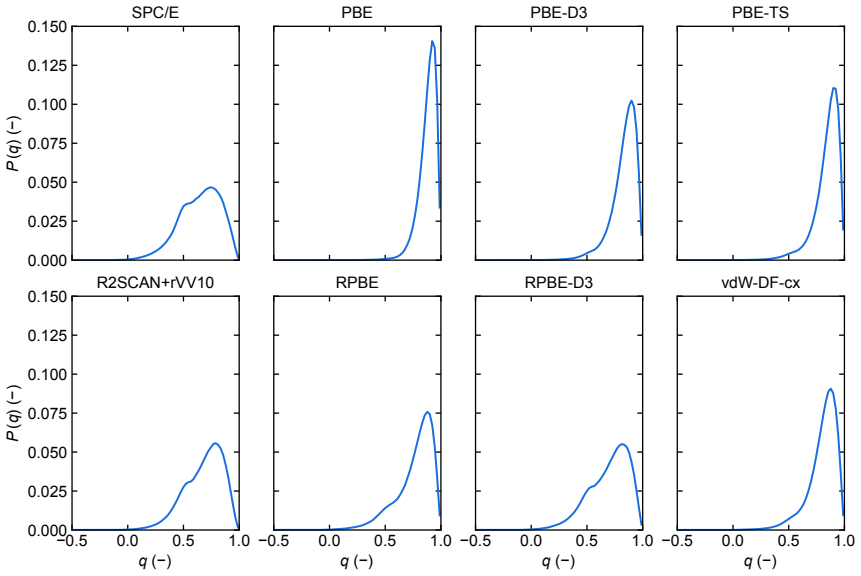
The paper's central claim is that the exchange-correlation functional used to generate training data propagates through a machine-learned water potential and controls whether the simulated liquid reproduces experiment. Evaluated through the full six-dimensional molecular pair correlation function, the predicted water structure varies strongly with functional: PBE-class functionals without dispersion over-structure water into an almost tetrahedral, ice-like network, whereas dispersion-corrected RPBE-D3 reproduces the measured radial and orientational correlations, including the population of interstitial, non-tetrahedral water molecules. The paper further claims a linear coupling between orie
Load-bearing premise
The ranking of the seven functionals assumes that each 50-picosecond, 64-molecule training run (with heavy hydrogen atoms and a 100–400 K ramp) converged to a reliable potential for its functional; if some models are undertrained, the comparison reflects training protocol, not the physics of the functional.
Editorial extensions
If this is right
- Neglecting dispersion in the training functional over-structures water and produces ice-like hydrogen-bond networks; adding D3 or TS corrections moves the predicted radial and orientational structure toward experiment.
- RPBE-D3 yields the closest density, oxygen-oxygen radial distribution function, excess entropy, viscosity, and self-diffusion to experiment among the seven functionals, while plain RPBE only appears accurate through cancellation of a low density against an over-structured liquid.
- Orientational excess entropy dominates the total for every model, and it scales linearly with translational excess entropy, so the radial distribution function alone is a practical proxy for how well a water model captures structure.
- Across all models, reduced self-diffusion follows the excess-entropy scaling law, so a model's diffusion and viscosity errors are directly traceable to its structural ordering.
- The near-agreement of SPC/E and RPBE-D3 arises from similar effective electrostatics and similar long-range dispersion, not from identical construction.
Reading between the lines
- Editorial inference: the linear translational-orientational entropy relation, if it holds for other hydrogen-bonded or tetrahedral liquids, would turn the cheaply computed radial distribution function into a screening tool for force-field quality, without requiring expensive six-dimensional sampling.
- Editorial inference: because the ranking rests on 50-picosecond training runs with only 64 molecules, an untested possibility is that some functionals simply train harder; a held-out DFT validation of each surrogate would separate functional physics from training error.
- Editorial inference: the RPBE-D3/SPC/E coincidence suggests a practical design rule for classical models — matching the Born effective charges of a dispersion-corrected functional may reproduce its liquid behavior without machine learning; this could be tested by re-parameterizing a classical model to RPBE-D3 charges.
Signed reviews
Editorial analysis
A structured set of objections, weighed in public.
Referee Report
Summary. The paper trains seven machine-learned force fields (ML-FFs) for water, each derived from a different DFT exchange-correlation functional (PBE, PBE-D3, PBE-TS, RPBE, RPBE-D3, R2SCAN+rVV10, vdW-DF-cx), then compares their predicted structure, excess entropy, and transport against experiment and against the classical SPC/E model. Using the six-dimensional pair correlation function, three-body angular distributions, tetrahedral order, and H-bond statistics, the authors report that RPBE-D3 gives the most consistent agreement with experiment, that translational and orientational excess entropies are linearly related, and that reduced diffusivity follows an exponential excess-entropy scaling relation. The paper also argues that SPC/E and RPBE-D3 converge to similar effective electrostatics and dispersion physics. The computational pipeline includes on-the-fly training in VASP, 512-molecule production runs, finite-size correction of diffusion, Green-Kubo viscosity with biexponential extrapolation, and entropy extrapolation to infinite sampling.
Significance. If the conclusions hold, the paper provides a practically useful benchmark of DFT-based ML-FFs for water and advances the use of structural/entropic descriptors to diagnose ML-FF quality. The study is well posed and mostly clearly executed: transport properties carry error bars, entropy is extrapolated to infinite sampling, and the authors explicitly discuss error cancellation. The data and analysis scripts are made available, which is a real strength. The central claim, however, rests on the assumption that each ML-FF faithfully represents its parent DFT functional. That assumption is not independently validated in the main text, and one of the functionals (R2SCAN+rVV10) produces a physically implausible loss of the second hydration shell, which could indicate a training artifact. Because the functional ranking is the paper's main conclusion, this issue is load-bearing and should be addressed before publication.
major comments (2)
- [Computational Details, Machine learning force fields; Fig. 3] The central claim that the differences among the seven models reflect the underlying XC functional requires each ML-FF to be a converged surrogate for its parent DFT method. The training protocol is very short (64 molecules, 50 ps, H mass 8 amu, 100–400 K ramp) relative to the production state (512 molecules, 300 K, physical masses), and the main text does not report held-out force/energy RMSEs or a comparison against DFT test configurations in the production region. The complete absence of a second hydration shell for R2SCAN+rVV10 in Fig. 3 is difficult to attribute to the functional itself and is more plausibly the signature of a fitting or sampling failure. Without per-functional train/test errors and a convergence check (e.g., retraining with longer on-the-fly sampling and comparing the resulting RDFs), the RPBE-D3 ranking and the fitted entropy–transport correlations may be artifact
- [Results & Discussion, Coupled Translational and Orientational Excess Entropy; Fig. 7(b); Fig. 8(c)] The linear sor–str relation and the exponential D*–stot relation are fitted to eight models with two empirical parameters each, and no uncertainty is reported for the fit parameters or R² values. The text states that the D*–stot agreement 'confirms' the excess-entropy scaling link. Since these are in-sample fits, they are empirical correlations, not independent validations. Adding bootstrap or leave-one-out errors and stating explicitly that the relations are fitted would make the claim proportionate. This is especially important because the abstract and conclusion present the linear sor–str relation as a central finding.
minor comments (5)
- [Fig. 2(a)] The dashed line is labeled as the experimental density, but the x-axis is a temperature ramp from 100 to 400 K. The experimental density is temperature-dependent; please either show the full experimental curve or restrict the label to the 300 K point.
- [Fig. 3; Table 1] The RDF RMSE values (ε) and H-bond numbers are reported without uncertainties across the independent trajectories, unlike the transport and entropy values. Since three independent NVT runs were used for the PCFs, error bars or a statement that the values are pooled single estimates would improve clarity.
- [Computational Details, ML-FFs] The text says 'V ASPs on-the-fly-training scheme' and 'V ASP MD engine'; these are likely typographical artifacts of the VASP name. Also, the sentence about the Nosé-Hoover thermostat gives 'a Nosé-mass of 5 in VASP and 0.1 ps damping parameter in LAMMPS'; please specify the units and which thermostat the SPC/E runs used.
- [Results & Discussion, Classical and ML-FFs Converge through Effective Interactions; Table 2] The Born effective charges are described as 'isotropic' but the averaging procedure is not defined. Please state whether the values are the average of the diagonal components or an isotropic projection of the Born charge tensor.
- [Supporting Information / Excess entropy] The entropy extrapolation to infinite sampling is essential to the reported values but is only mentioned in one sentence. If the SI is the only source, this is acceptable; otherwise, please add one sentence summarizing the extrapolation procedure in the main text.
Circularity Check
No significant circularity: main benchmark is against external experiment, and the fitted entropy–transport relations are explicitly fits, not predictions.
full rationale
The paper's central claim (RPBE-D3 gives the most consistent agreement with experiment) is established by direct comparison with external experimental data — Soper's RDFs, IAPWS excess entropy, experimental viscosity and NMR self-diffusion coefficients — none of which entered the ML-FF training labels. The two correlations highlighted in the paper, sor = 5.79 str + 25.24 and D* = 0.40 exp(0.41 stot/R), are explicitly presented as fits: the text states that reduced diffusivities were 'fitted to' Eq. (1) with 'A and beta are empirical fitting parameters', and the figures report R^2 values. They are therefore not disguised predictions of quantities already contained in the fit. The entropy calculations follow established Lazaridis–Karplus formulas from the simulated pair-correlation functions, and the transport properties are computed from independent MSD and stress autocorrelation data; no equation reduces to its own input by construction. The self-citations (refs. 5, 38, 60, 61) support peripheral points such as ion-adsorption context, water-model choice for slip-length studies, finite-size corrections, and data availability; none is load-bearing for the main conclusion. Concerns about the short 50 ps training runs, the 8 amu hydrogen mass, and absent held-out DFT validation are legitimate correctness and convergence risks, but they are not circularity: they question whether each ML-FF represents its parent functional, not whether the paper's conclusions are equivalent to its inputs.
Assumptions & free parameters
free parameters (3)
- A and beta in D* = A exp(beta stot/R) =
A = 0.40, beta = 0.41
- slope and intercept of sor-str linear fit =
5.79 and 25.24
- viscosity biexponential fit parameters =
A, alpha, tau1, tau2 per model
assumptions (4)
- domain assumption Pair-correlation excess entropy (Lazaridis-Karplus) captures the relevant excess entropy of liquid water
- domain assumption Each ML-FF faithfully reproduces its parent DFT XC functional after on-the-fly training on 64 molecules for 50 ps
- domain assumption Bulk liquid water at 300 K and 1 bar is represented by 512 molecules in NVT production runs
- domain assumption Experimental references (Soper RDF, IAPWS entropy, Holz diffusion, Korson viscosity) are accurate
Cite this review
Pith. "Pith review of From Local Structure to Thermodynamics and Transport of Water with Machine Learning Force Fields." pith.science (2026). https://pith.science/paper/RZ6VVFP7
@misc{pith2026260722903,
  author       = {Pith},
  title        = {Pith review of: From Local Structure to Thermodynamics and Transport of Water with Machine Learning Force Fields},
  year         = {2026},
  howpublished = {\url{https://pith.science/paper/RZ6VVFP7}},
  note         = {Machine review of arXiv:2607.22903}
}
read the original abstract
We evaluate machine learning force fields derived from different density functional theory exchange correlation functionals using the full six-dimensional pair correlation function of liquid water, three-body structural descriptors, excess entropy, and transport properties. The predicted microscopic structure and dynamics depend strongly on the underlying functional: neglecting dispersion produces pronounced overstructuring, overly negative excess entropy, and suppressed diffusion. Translational and orientational entropy contributions are tightly coupled and together exhibit a clear relationship with the reduced selfdiffusion coefficient. Among the tested models, RPBE-D3 provides the most consistent agreement with experiment across structural, thermodynamic, and transport properties. The classical SPC/E model serves as an additional reference and displays notable similarities to RPBE-D3, consistent with the comparable Born effective and partial charges of the two models.
Figures


Figures from the paper (5 more)




Reference graph
Works this paper leans on
-
[1]
TU Wien Research Data , author =
From. TU Wien Research Data , author =. 2026 , keywords =. doi:10.48436/8J5E2-JX429 , urldate =
-
[2]
The Journal of Chemical Physics , author =
Perspective:. The Journal of Chemical Physics , author =. 2016 , pages =. doi:10.1063/1.4944633 , abstract =
-
[3]
Journal of Chemical Theory and Computation , author =
Data-. Journal of Chemical Theory and Computation , author =. 2023 , pages =. doi:10.1021/acs.jctc.2c01203 , language =
-
[4]
The Journal of Chemical Physics , author =
The structure of water at a. The Journal of Chemical Physics , author =. 2016 , pages =. doi:10.1063/1.4948638 , abstract =
-
[5]
Journal of Computational Physics , author =
Numerical integration of the cartesian equations of motion of a system with constraints: molecular dynamics of n-alkanes , volume =. Journal of Computational Physics , author =. 1977 , pages =. doi:10.1016/0021-9991(77)90098-5 , language =
-
[6]
Excess-entropy and freezing-temperature scalings for transport coefficients:. Physical Review E , author =. 2000 , pages =. doi:10.1103/PhysRevE.62.7524 , language =
-
[7]
Journal of Engineering for Gas Turbines and Power , author =
The. Journal of Engineering for Gas Turbines and Power , author =. 2000 , pages =. doi:10.1115/1.483186 , abstract =
doi:10.1115/1.483186 2000
-
[8]
The Journal of Physical Chemistry B , author =
Solvent. The Journal of Physical Chemistry B , author =. 2000 , pages =. doi:10.1021/jp994261a , language =
Show all 79 references
-
[9]
The Journal of Chemical Physics , author =
The role of water models on the prediction of slip length of water in graphene nanochannels , volume =. The Journal of Chemical Physics , author =. 2019 , pages =. doi:10.1063/1.5123713 , abstract =
2019 doi
-
[11]
Journal of Physics: Condensed Matter , author =
Diffusion coefficient and shear viscosity of rigid water models , volume =. Journal of Physics: Condensed Matter , author =. 2012 , pages =. doi:10.1088/0953-8984/24/28/284117 , number =
2012 doi
-
[12]
Molecular Simulation , author =
Finite-size effects of diffusion coefficients computed from molecular dynamics: a review of what we have learned so far , volume =. Molecular Simulation , author =. 2021 , pages =. doi:10.1080/08927022.2020.1810685 , language =
2021
-
[13]
The Journal of Chemical Physics , author =
Perspective:. The Journal of Chemical Physics , author =. 2018 , pages =. doi:10.1063/1.5055064 , abstract =
2018 doi
-
[14]
Reviews in Mineralogy and Geochemistry , author =
Mixing and. Reviews in Mineralogy and Geochemistry , author =. 2019 , pages =. doi:10.2138/rmg.2018.85.5 , language =
2019 doi
-
[15]
Diffusion-controlled reaction rates , volume =
Collins, Frank C and Kimball, George E , month = aug, year =. Diffusion-controlled reaction rates , volume =. doi:https://doi.org/10.1016/0095-8522(49)90023-9 , number =
-
[16]
The Journal of Physical Chemistry Letters , author =
Water. The Journal of Physical Chemistry Letters , author =. 2022 , pages =. doi:10.1021/acs.jpclett.2c00825 , language =
2022 doi
-
[17]
Accounts of Chemical Research , author =
Water. Accounts of Chemical Research , author =. 1999 , pages =. doi:10.1021/ar970161g , language =
1999 doi
-
[18]
Annalen der Physik , author =
Über die von der molekularkinetischen. Annalen der Physik , author =. 1905 , pages =. doi:10.1002/andp.19053220806 , language =
1905 doi
-
[19]
Journal of Chemical Information and Modeling , author =
Systematic. Journal of Chemical Information and Modeling , author =. 2021 , pages =. doi:10.1021/acs.jcim.1c00794 , language =
2021 doi
-
[20]
and Madura, Jeffry D
Dick, Thomas J. and Madura, Jeffry D. , year =. Chapter 5. Annual. doi:10.1016/S1574-1400(05)01005-4 , pages =
-
[21]
WIREs Computational Molecular Science , author =
Advanced models for water simulations , volume =. WIREs Computational Molecular Science , author =. 2018 , pages =. doi:10.1002/wcms.1355 , abstract =
2018 doi
-
[22]
The Journal of Physical Chemistry A , author =
Toward. The Journal of Physical Chemistry A , author =. 2022 , pages =. doi:10.1021/acs.jpca.2c00601 , language =
2022 doi
-
[23]
Chemical Reviews , author =
Effect of. Chemical Reviews , author =. 2009 , pages =. doi:10.1021/cr8003828 , language =
2009 doi
-
[24]
Nature Communications , author =
Impact of hierarchical water dipole orderings on the dynamics of aqueous salt solutions , volume =. Nature Communications , author =. 2023 , pages =. doi:10.1038/s41467-023-40278-x , abstract =
2023 doi
-
[25]
Proceedings of the National Academy of Sciences , author =
Machine learning potentials for complex aqueous systems made simple , volume =. Proceedings of the National Academy of Sciences , author =. 2021 , pages =. doi:10.1073/pnas.2110077118 , abstract =
2021 doi
-
[26]
Proceedings of the National Academy of Sciences , author =
How van der. Proceedings of the National Academy of Sciences , author =. 2016 , pages =. doi:10.1073/pnas.1602375113 , abstract =
2016 doi
-
[27]
Nature Communications , author =
The structural origin of anomalous properties of liquid water , volume =. Nature Communications , author =. 2015 , pages =. doi:10.1038/ncomms9998 , abstract =
2015 doi
-
[28]
The Journal of Physical Chemistry B , author =
Correlation of. The Journal of Physical Chemistry B , author =. 2013 , pages =. doi:10.1021/jp404478y , language =
2013 doi
-
[29]
The Journal of Physical Chemistry B , author =
Picosecond. The Journal of Physical Chemistry B , author =. 2018 , pages =. doi:10.1021/acs.jpcb.8b00118 , language =
2018 doi
-
[30]
The Journal of Physical Chemistry B , author =
Kinetics of. The Journal of Physical Chemistry B , author =. 2003 , pages =. doi:10.1021/jp020857d , language =
2003 doi
-
[31]
Science Advances , author =
Entropic-dielectric interplay governs ion adsorption in inner electric double layers , volume =. Science Advances , author =. 2026 , pages =. doi:10.1126/sciadv.aee9469 , abstract =
2026 doi
-
[32]
Chemical Reviews , author =
How. Chemical Reviews , author =. 2017 , pages =. doi:10.1021/acs.chemrev.7b00259 , language =
2017 doi
-
[33]
Nature , author =
Relationship between structural order and the anomalies of liquid water , volume =. Nature , author =. 2001 , pages =. doi:10.1038/35053024 , language =
2001 doi
-
[34]
The Journal of Physical Chemistry , author =
The missing term in effective pair potentials , volume =. The Journal of Physical Chemistry , author =. 1987 , pages =. doi:10.1021/j100308a038 , language =
1987 doi
-
[35]
The Journal of Chemical Physics , author =
Decoding signatures of structure, bulk thermodynamics, and solvation in three-body angle distributions of rigid water models , volume =. The Journal of Chemical Physics , author =. 2019 , pages =. doi:10.1063/1.5111545 , abstract =
2019 doi
-
[36]
and Tildesley, Dominic J
Allen, Michael P. and Tildesley, Dominic J. , month = jun, year =. Computer. doi:10.1093/oso/9780198803195.001.0001 , abstract =
-
[37]
The Journal of Physical Chemistry B , author =
Transport. The Journal of Physical Chemistry B , author =. 2006 , pages =. doi:10.1021/jp062885s , number =
2006 doi
-
[38]
The Journal of Physical Chemistry B , author =
System-. The Journal of Physical Chemistry B , author =. 2004 , pages =. doi:10.1021/jp0477147 , number =
2004 doi
-
[39]
Living Journal of Computational Molecular Science , author =
Best. Living Journal of Computational Molecular Science , author =. 2018 , pages =. doi:10.33011/livecoms.1.1.6324 , abstract =
2018 doi
-
[40]
The Journal of Chemical Physics , author =
Viscosity calculations of n-alkanes by equilibrium molecular dynamics , volume =. The Journal of Chemical Physics , author =. 1997 , pages =. doi:10.1063/1.474002 , abstract =
1997 doi
-
[41]
The Journal of Chemical Physics , author =
Comparison of constant pressure and constant volume nonequilibrium simulations of sheared model decane , volume =. The Journal of Chemical Physics , author =. 1994 , pages =. doi:10.1063/1.466970 , abstract =
1994 doi
-
[42]
2022 , keywords =
Computer Physics Communications , author =. 2022 , keywords =. doi:https://doi.org/10.1016/j.cpc.2021.108171 , abstract =
2022
-
[43]
The Journal of Physical Chemistry , author =
Viscosity of water at various temperatures , volume =. The Journal of Physical Chemistry , author =. 1969 , pages =. doi:10.1021/j100721a006 , language =
1969 doi
-
[44]
Physical Chemistry Chemical Physics , author =
Temperature-dependent self-diffusion coefficients of water and six selected molecular liquids for calibration in accurate. Physical Chemistry Chemical Physics , author =. 2000 , pages =. doi:10.1039/b005319h , number =
-
[45]
The Journal of Physical Chemistry B , author =
Entropy of. The Journal of Physical Chemistry B , author =. 2011 , pages =. doi:10.1021/jp204981y , abstract =
2011 doi
-
[46]
The Journal of Chemical Physics , author =
Dielectric constant of water at high electric fields:. The Journal of Chemical Physics , author =. 1999 , pages =. doi:10.1063/1.478698 , abstract =
1999 doi
-
[47]
The Journal of Physical Chemistry Letters , author =
Force. The Journal of Physical Chemistry Letters , author =. 2018 , pages =. doi:10.1021/acs.jpclett.8b01131 , abstract =
2018 doi
-
[48]
Chemical Reviews , author =
Machine. Chemical Reviews , author =. 2021 , pages =. doi:10.1021/acs.chemrev.0c01111 , abstract =
2021 doi
-
[49]
ISRN Physical Chemistry , author =
The. ISRN Physical Chemistry , author =. 2013 , pages =. doi:10.1155/2013/279463 , abstract =
2013 doi
-
[50]
The Journal of Chemical Physics , author =
Comparing machine learning potentials for water:. The Journal of Chemical Physics , author =. 2024 , pages =. doi:10.1063/5.0197105 , abstract =
2024 doi
-
[51]
Berendsen, H. J. C. and Postma, J. P. M. and Van Gunsteren, W. F. and Hermans, J. , editor =. Interaction. Intermolecular. 1981 , note =. doi:10.1007/978-94-015-7658-1_21 , abstract =
1981 doi
-
[52]
The Journal of Physical Chemistry A , author =
Structure and. The Journal of Physical Chemistry A , author =. 2001 , pages =. doi:10.1021/jp003020w , language =
2001 doi
-
[53]
Journal of Chemical Theory and Computation , author =
Effects of. Journal of Chemical Theory and Computation , author =. 2013 , pages =. doi:10.1021/ct400109a , language =
2013 doi
-
[54]
Chemical Physics , author =
On the electronic structure of liquid water:. Chemical Physics , author =. 1997 , pages =. doi:10.1016/S0301-0104(97)00213-9 , language =
1997 doi
-
[55]
The Journal of Physical Chemistry B , author =
Two-. The Journal of Physical Chemistry B , author =. 2008 , pages =. doi:10.1021/jp7103837 , language =
2008 doi
-
[56]
The Journal of Chemical Physics , author =
Orientational correlations and entropy in liquid water , volume =. The Journal of Chemical Physics , author =. 1996 , pages =. doi:10.1063/1.472247 , abstract =
1996 doi
-
[57]
Journal of Physics: Condensed Matter , author =
Density anomaly of water at negative pressures from first principles , volume =. Journal of Physics: Condensed Matter , author =. 2018 , pages =. doi:10.1088/1361-648X/aac4f4 , number =
2018 doi
-
[58]
Physical Chemistry Chemical Physics , author =
The accurate calculation of the band gap of liquid water by means of. Physical Chemistry Chemical Physics , author =. 2015 , pages =. doi:10.1039/C4CP04202F , abstract =
2015 doi
-
[59]
Physical Review Research , author =
Band gaps of liquid water and hexagonal ice through advanced electronic-structure calculations , volume =. Physical Review Research , author =. 2021 , pages =. doi:10.1103/PhysRevResearch.3.023182 , language =
2021 doi
-
[60]
Chemical Physics , author =
Photoionization of aqueous indole:. Chemical Physics , author =. 1979 , pages =. doi:10.1016/0301-0104(79)80064-6 , language =
1979 doi
-
[61]
The Journal of Chemical Physics , author =
Using cluster studies to approach the electronic structure of bulk water:. The Journal of Chemical Physics , author =. 1997 , pages =. doi:10.1063/1.474271 , abstract =
1997 doi
-
[62]
Journal of Chemical Theory and Computation , author =
Entropy from. Journal of Chemical Theory and Computation , author =. 2010 , pages =. doi:10.1021/ct900627q , language =
2010 doi
-
[63]
Physical Review B , author =
Efficient iterative schemes for. Physical Review B , author =. 1996 , pages =. doi:10.1103/PhysRevB.54.11169 , language =
1996 doi
-
[64]
The Journal of Chemical Physics , author =
Insights into lithium manganese oxide–water interfaces using machine learning potentials , volume =. The Journal of Chemical Physics , author =. 2021 , pages =. doi:10.1063/5.0073449 , abstract =
2021 doi
-
[65]
Physical Chemistry Chemical Physics , author =
Structure of aqueous. Physical Chemistry Chemical Physics , author =. 2017 , pages =. doi:10.1039/C6CP06547C , abstract =
2017 doi
-
[66]
The Journal of Physical Chemistry Letters , author =
On-the-. The Journal of Physical Chemistry Letters , author =. 2020 , pages =. doi:10.1021/acs.jpclett.0c01061 , abstract =
2020 doi
-
[67]
The Journal of Chemical Physics , author =
Perspective:. The Journal of Chemical Physics , author =. 2024 , pages =. doi:10.1063/5.0201241 , abstract =
2024 doi
-
[68]
Physical Review B , author =
Improved adsorption energetics within density-functional theory using revised. Physical Review B , author =. 1999 , pages =. doi:10.1103/PhysRevB.59.7413 , language =
1999 doi
-
[69]
The Journal of Chemical Physics , author =
A consistent and accurate. The Journal of Chemical Physics , author =. 2010 , pages =. doi:10.1063/1.3382344 , abstract =
2010 doi
-
[70]
Computational Materials Science , author =
Efficiency of ab-initio total energy calculations for metals and semiconductors using a plane-wave basis set , volume =. Computational Materials Science , author =. 1996 , pages =. doi:10.1016/0927-0256(96)00008-0 , language =
1996 doi
-
[71]
Physical Review B , author =
". Physical Review B , author =. 1977 , pages =. doi:10.1103/PhysRevB.16.1748 , language =
1977 doi
-
[72]
Physical Review Letters , author =
Generalized. Physical Review Letters , author =. 1996 , pages =. doi:10.1103/PhysRevLett.77.3865 , language =
1996 doi
-
[73]
Physical Review B , author =
Workhorse minimally empirical dispersion-corrected density functional with tests for weakly bound systems: r 2. Physical Review B , author =. 2022 , pages =. doi:10.1103/PhysRevB.106.075422 , language =
2022 doi
-
[74]
Physical Review B , author =
Exchange functional that tests the robustness of the plasmon description of the van der. Physical Review B , author =. 2014 , pages =. doi:10.1103/PhysRevB.89.035412 , language =
2014 doi
-
[75]
Physical Review Letters , author =
Accurate. Physical Review Letters , author =. 2009 , pages =. doi:10.1103/PhysRevLett.102.073005 , language =
2009 doi
-
[76]
Physical Review B , author =
From ultrasoft pseudopotentials to the projector augmented-wave method , volume =. Physical Review B , author =. 1999 , pages =. doi:10.1103/PhysRevB.59.1758 , language =
1999 doi
-
[77]
Physical Review B , author =
Projector augmented-wave method , volume =. Physical Review B , author =. 1994 , pages =. doi:10.1103/PhysRevB.50.17953 , language =
1994 doi
-
[78]
Journal of Computational Chemistry , author =
P. Journal of Computational Chemistry , author =. 2009 , pages =. doi:10.1002/jcc.21224 , abstract =
2009 doi
- [79]
-
[80]
Structure and dynamics of the magnetite(001)/water interface from molecular dynamics simulations based on a neural network potential , url =
Romano, Salvatore and Hijes, Pablo Montero de and Meier, Matthias and Kresse, Georg and Franchini, Cesare and Dellago, Christoph , month = sep, year =. Structure and dynamics of the magnetite(001)/water interface from molecular dynamics simulations based on a neural network po...
Reviewed August 3, 2026 · model on record in the stance chip above.
Discussion (0). Continue with ORCID to comment.