REVIEW 4 major objections 5 minor 13 references
Standard win statistics for hierarchical endpoints are secretly reach-weighted; the paper proposes PSNB, a prespecified-charter estimand that makes each layer's influence independent of how often pairs reach it.
Reviewed by Pith at T0; open to challenge. T0 means a machine referee read the full paper against a public rubric. the ladder, T0–T4 →
T0 review · deepseek-v4-flash
2026-08-01 04:02 UTC pith:YV6R4FW6
load-bearing objection A well-built estimand paper with a real gap between its headline invariance claim and the evidence: the stage-conditional effects it conditions on are themselves reach-dependent. the 4 major comments →
Priority-Standardized Net Benefit: A Stage-Normalized Estimand for Hierarchical Composite Endpoints
The pith
A machine-rendered reading of the paper's core claim, the machinery that carries it, and where it could break.
Core claim
The core discovery is a decomposition and a replacement. The standard net benefit Δ equals Σ_k r_k Δ_k, where r_k is the probability that a treated–control pair reaches layer k and Δ_k is the win–loss imbalance among pairs that do reach it; a fixed weighted win–loss summary is merely Σ_k β_k r_k Δ_k, so it remains reach-weighted (Proposition 1). The proposed PSNB estimand, Δ_PS(α)=Σ_k α_k Δ_k, recombines those same stage-conditional effects using a prespecified charter α, making layer influence independent of reach. The paper establishes reach-invariance as a corollary, derives a layer-influence cap (|α_k Δ_k| ≤ α_k), gives a large-sample influence-function estimator with Wald and bootstrap
What carries the argument
The central object is the stage-conditional net benefit Δ_k = E[c_k(Y_1,Y_0) | R_k=1], the average win-minus-loss score at layer k among treated–control pairs that are tied on all higher-priority layers. The PSNB estimand weights these Δ_k by a prespecified charter α, a probability vector over layers fixed before unblinding, instead of by the empirical reach probabilities r_k as in the standard decomposition Δ=Σ r_k Δ_k. The estimator plugs in U-statistic estimates Δ̂_k = Û_k/r̂_k, with influence-function projection variance; the charter, together with the layer-influence cap, is what converts 'layer credibility' from a vague concern into a formal bound on each layer's contribution.
Load-bearing premise
The estimator divides each weighted stage's contribution by the estimated probability that pairs reach that stage, so it collapses if a weighted stage is extremely rarely reached, which the simulations do not stress; secondarily, reach-invariance presumes the stage-conditional effects Δ_k themselves do not change when reach changes, which tie-rule shifts can violate.
What would settle it
A direct falsifier is a single simulation cell: hold the stage-conditional effects fixed, set the weighted final-layer reach to roughly 0.001, and compute the PSNB estimate and its projection variance. If the point estimate moves materially beyond Monte Carlo tolerance, or the Wald interval stops covering at the nominal rate, then the claims of approximate reach-invariance and of Assumption 3 both fail. A second check is to fix Δ_k and switch an upstream tie margin from zero to a large value: if PSNB's estimate drifts by more than simulation noise, the reach-invariance corollary is empirically
If this is right
- If PSNB is adopted, a layer's maximum possible contribution to the primary estimand is known before the trial: its charter weight α_k, regardless of how often pairs reach that layer.
- Upstream tie-rule choices—margins, thresholds, censoring conventions—can no longer silently reroute the entire composite to a frequently reached lower layer; PSNB's value is insensitive to those choices when stage effects are fixed.
- Late-layer measurement bias and differential missingness no longer enter the primary summary proportional to reach; their influence is set by the chosen last-layer weight, which can be capped from a prespecified bias budget.
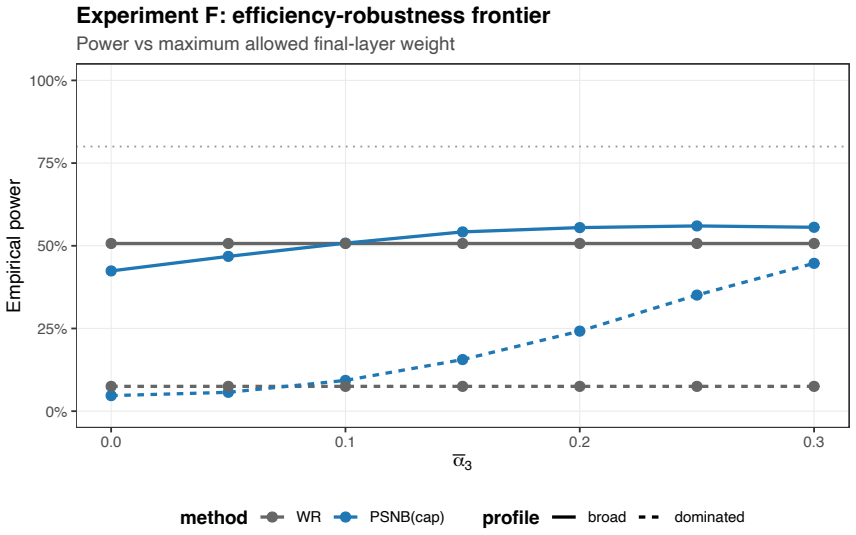
- At a sample size giving the standard Win Ratio about 90% power under broad benefit, PSNB with the paper's baseline charters keeps pace; under final-layer-dominated benefit, power is a charter decision—larger last-layer caps restore sensitivity, smaller caps deliberately trade it away.
- PSNB and its ratio-scale companion PSWR can be prespecified and reported as primary and secondary summaries, with stage-conditional effects and reach probabilities reported alongside so the reader can see exactly how each layer contributed.
Where Pith is reading between the lines
- I infer that the same aggregation logic could generalize beyond win statistics—for instance, to stage-conditional win odds or threshold-based comparisons—because the reach-weighting problem is a property of the summary functional, not of one specific win statistic.
- A testable extension the paper does not run: vary the intermediate-layer tie margin with fixed Δ_k but drive a weighted stage's reach close to zero; the claim implies PSNB's point estimate stays stable, while its variance behavior under near-zero reach remains the key stress case for Assumption 3.
- Reach-invariance requires care: because Δ_k conditions on the pair-reach event, changing event rates or tie rules can change the composition of pairs that reach a layer, and if Δ_k itself drifts, PSNB will move. A sharper formulation might define reach-invariance as invariance of the estimand's definition rather than of the numerical effects.
- I infer that a practical decision-support use would be to choose the last-layer charter cap by combining the paper's analytical bias budget with its simulated calibration, which the authors themselves present as a design starting point rather than a universal rule.
Editorial analysis
A structured set of objections, weighed in public.
Referee Report
Summary. The paper proposes a new estimand, Priority-Standardized Net Benefit (PSNB), for hierarchical composite endpoints. The key idea is to decompose the standard net benefit into stage-conditional win-loss imbalances and recombine them using a prespecified 'priority/credibility charter' weight vector α, rather than the data-dependent reach probabilities r_k used by standard win statistics. The authors show (Eq. (1), Proposition 1) that standard summaries, including fixed weighted win-loss statistics, remain mechanically reach-weighted, while PSNB replaces those weights by α. They develop a U-statistic estimator, an influence-function variance estimator, and a ratio companion (PSWR), and provide design tools: a layer influence cap, a tipping-point analysis, and a convex charter-envelope sensitivity analysis. An extensive simulation study covers type I error, reach invariance, upstream tie-rule spillover, open-label bias, differential missingness, efficiency-robustness frontiers, and a bias-budget calibration.
Significance. If the methodological claims hold, this is a useful and well-motivated contribution to the estimand literature on hierarchical composites. The decomposition in Eq. (1) and Proposition 1 are crisp and correct, and the proposed replacement of implicit reach weights by a prespecified charter is clinically interpretable. The design tools (Corollary 2, Propositions 2 and 3) are simple and potentially practical for protocol development. The simulation program is thoughtfully structured around the cases where PSNB differs from standard summaries, and the authors are candid about what PSNB does not solve (bias, missingness, censoring). The central limitation is that the empirical demonstration of 'reach invariance' depends on holding stage-conditional effects fixed, which is not actually verified in one of the core experiments; the main theorem is also given as a sketch. The paper is not accompanied by code or a full parameter specification, which limits reproducibility.
major comments (4)
- [§6.6, Table 5 (Experiment C)] The paper claims that PSNB is stable under upstream tie-rule changes, but Corollary 1 shows invariance only when the stage-conditional effects Δ_k are the same across mechanisms. Since Δ_k is defined conditional on R_k=1, changing m_H changes the conditioning event, and with a common latent severity S the distribution of S among pairs with R_3=1 can change; Δ_3 may move even if the structural effect is unchanged. Table 5 does not report Δ̂_1, Δ̂_2, Δ̂_3, so the flat PSNB could reflect stable Δ_k or small/offsetting changes in Δ_k. The claim in §7.3 that PSNB is 'not at the mercy of the tie rule' is therefore under-supported. Please report stage-conditional estimates across the sweep, or recalibrate the DGP as in Experiment B to hold Δ_k fixed, so the experiment isolates the aggregation rule.
- [§5.4, Theorem 1] The asymptotic normality result is stated with a one-sentence justification ('standard two-sample U-statistic projection arguments combined with a delta-method expansion') and the projection variance estimator is used for all Wald inference and bootstrap calibration. For a new functional involving ratios of U-statistics and a charter-weighted sum, this is a load-bearing result. Please provide a complete proof or citation of the exact theorem used, including regularity conditions (positive reach bounded away from zero, finite variance positivity, and treatment-arm sample fractions bounded away from 0 and 1), and clarify why the plug-in variance estimator is consistent when the denominators r̂_k are estimated.
- [§6.2 and §7 (simulation reproducibility)] The simulation DGP constants are not fully specified: the baseline hazards λ0z, severity coefficients η1, η2, Poisson means μz, late-layer variance σ_K^2, horizon τ, margins δ and m_H, missingness logistic coefficients, and the exact coordinate-wise bisection calibration used in Experiment B are not enumerated. Without these values and the calibration tolerance, the tables and figures cannot be reproduced from the text. Please provide a complete parameter table and, ideally, code or a supplement.
- [Assumption 3 (§5.2) and simulation coverage] Assumption 3 requires r_k positive and bounded away from zero for all weighted stages, but the simulations only exercise r3 ≥ 0.079 and never stress near-zero reach for an intermediate or upper layer. Since PSNB divides by r̂_k, a rare, highly tied layer can produce unstable or undefined estimates. The motivating setting includes such layers, so the paper should either include a simulation/numerical study at small r_k, or discuss the resulting precision loss and potential remedies (e.g., excluding or down-weighting stages with negligible reach).
minor comments (5)
- [§4.5, Eq. (3)] The definition of PSWR requires ℓ̄ > 0, but the text only says 'whenever the denominator is positive.' Since ℓ_k can be zero for all k, a slightly more formal domain statement would avoid ambiguity.
- [§5.4, PSWR inference] The log-scale delta-method inference for PSWR is asserted without even a sketch. Since PSWR is secondary this is acceptable, but a one-line reference or expression for the asymptotic variance would help.
- [§6.2, bias-budget formula] The normal working approximation d3(b) = Φ((b−δ)/σ√2) − Φ((−b−δ)/σ√2) is introduced as an analytical heuristic; later it is checked in simulation. The paper should be explicit that this is only an approximation for the pairwise net benefit under normality and does not account for ties from other layers, even if it is used only for design calibration.
- [§7.3, Table 5] The last-layer share U3/Δ values slightly exceed 1 in two rows (1.038, 1.014). This is possible because Δ also includes negative contributions from other layers, but a footnote explaining why U3/Δ can be greater than 1 would aid reader interpretation.
- [§7.1, Table 3] The bootstrap validation block reports median half-widths but not the full distribution (e.g., percentile intervals or MC variance); a small addition would strengthen the claim of agreement with the Wald interval.
Circularity Check
No significant circularity: PSNB is a new defined estimand; its reach-invariance is a mathematical corollary of its definition, and all simulation/design claims are self-contained.
full rationale
The derivation chain is self-contained. Equation (1) is an exact algebraic decomposition of the standard net benefit into reach-weighted stage-conditional effects; Proposition 1 follows by linearity from E{R_k c_k} = r_k Δ_k. Definition 1 (Eq. 2) then defines PSNB as a charter-weighted sum of the same stage-conditional effects, and Corollary 1 is a direct substitution: if the Δ_k are equal across mechanisms, Σ α_k Δ_k is equal. This is a mathematical consequence of the definition, not a fitted parameter recycled as a prediction, so it does not constitute circularity. The estimator, projection variance, and Theorem 1 are standard two-sample U-statistic and delta-method results with explicit assumptions. All simulations use explicit DGPs; Experiment B calibrates Δ_k and then demonstrates the algebraic property, while the bias-budget charters in Experiments D and G are analytic design heuristics that are subsequently checked against simulated operating characteristics, not fitted to the headline result. No load-bearing self-citations appear. The one substantive caveat—Experiment C (Table 5) sweeps the intermediate tie margin without reporting Δ̂_1, Δ̂_2, Δ̂_3, so it does not by itself prove that the stage-conditional effects remained fixed as reach changed—is a limitation in the evidentiary support for the stated mechanism, not a circular reduction: PSNB's value is not being used to predict itself, and no estimated target quantity is reused as an input.
Axiom & Free-Parameter Ledger
free parameters (3)
- priority/credibility charter α =
user-specified; examples (0.50,0.30,0.20), (0.60,0.30,0.10), (0.57,0.38,0.05), (0.588,0.392,0.02)
- within-layer comparison margins/thresholds (e.g., m_H, δ) =
m_H ∈ {0,...,5}; δ = 5 in bias-budget examples
- DGP calibration constants for simulations (λ0z, η1, μz, η2, σK, severity parameters) =
not reported exactly
axioms (5)
- domain assumption Assumption 1: consistency, no interference, and randomization identify arm-specific distributions.
- domain assumption Assumption 2: independent sampling within arm and independence between arms.
- domain assumption Assumption 3: positive reach probability for every layer with nonzero charter weight.
- standard math Standard two-sample U-statistic projection and delta-method asymptotics.
- ad hoc to paper Normal working approximation for bias-induced late-layer net benefit d3(b).
read the original abstract
Hierarchical composite endpoints analyzed with win statistics are increasingly used when outcomes differ in clinical importance and hard events are too rare to support a single-component primary endpoint. Their appeal is that the analysis respects a prespecified priority order; their less-stated vulnerability is that standard win summaries aggregate layer-specific information using reach probabilities, the fraction of treated-control pairs still tied at each layer. When upper layers are rare or highly tied, a frequently reached last layer can dominate the composite even if it is lowest priority and more vulnerable to bias or missingness, such as an open-label patient-reported outcome. We propose the Priority-Standardized Net Benefit (PSNB), an estimand that decomposes a hierarchical comparison into stage-conditional net benefits and recombines them with a prespecified priority/credibility charter rather than data-determined reach weights. We identify the methodological gap as across-layer aggregation, not within-layer comparison, and show that fixed weighted win-loss statistics remain mechanically reach-weighted; we develop an influence-function-based estimator and large-sample inference, with a ratio-scale companion (the Priority-Standardized Win Ratio); and we give design tools (a layer influence cap, tipping-point analysis, and charter-envelope sensitivity analysis) usable before unblinding. Simulations confirm nominal type I error, show PSNB is approximately invariant to large changes in reach when stage-conditional effects are held fixed, and show that late-layer bias and missingness sensitivity is governed by the charter rather than the reach distribution. At a sample size where the Win Ratio has about 90% power under broad benefit, PSNB with the baseline charters keeps pace, while power under final-layer-dominated benefit depends on the permitted last-layer weight.
Figures




Reference graph
Works this paper leans on
-
[1]
I. Bebu and J. M. Lachin. Large sample inference for a win ratio analysis of a composite outcome based on prioritized components. Biostatistics, 17(1):178--187, 2016. https://doi.org/10.1093/biostatistics/kxv032
-
[2]
E. Brunner, M. Vandemeulebroecke, and T. M \"u tze. Win odds: An adaptation of the win ratio to include ties. Statistics in Medicine, 40(14):3367--3384, 2021. https://doi.org/10.1002/sim.8967
-
[3]
M. Buyse. Generalized pairwise comparisons of prioritized outcomes in the two-sample problem. Statistics in Medicine, 29(30):3245--3257, 2010. https://doi.org/10.1002/sim.3923
-
[4]
G. Dong, D. C. Hoaglin, J. Qiu, R. A. Matsouaka, Y.-W. Chang, J. Wang, and M. Vandemeulebroecke. The win ratio: On interpretation and handling of ties. Statistics in Biopharmaceutical Research, 12(1):99--106, 2020. https://doi.org/10.1080/19466315.2019.1575279
arXiv 2020
-
[5]
M. Even and J. Josse. Rethinking the win ratio: A causal framework for hierarchical outcome analysis. arXiv:2501.16933, 2025. https://arxiv.org/abs/2501.16933
arXiv 2025
-
[6]
D. M. Finkelstein and D. A. Schoenfeld. Combining mortality and longitudinal measures in clinical trials. Statistics in Medicine, 18(11):1341--1354, 1999. https://doi.org/10.1002/(SICI)1097-0258(19990615)18:11
-
[7]
ICH E9(R1) addendum on estimands and sensitivity analysis in clinical trials to the guideline on statistical principles for clinical trials
International Council for Harmonisation (ICH). ICH E9(R1) addendum on estimands and sensitivity analysis in clinical trials to the guideline on statistical principles for clinical trials. Step 4 guideline, dated 20 November 2019. https://www.ich.org/page/efficacy-guidelines
2019
-
[8]
X. Luo, J. Qiu, S. Bai, and H. Tian. Weighted win loss approach for analyzing prioritized outcomes. Statistics in Medicine, 36(15):2452--2465, 2017. https://doi.org/10.1002/sim.7284
-
[9]
L. Mao, K.-M. Kim, and X. Miao. Sample size formula for general win ratio analysis. Biometrics, 78(3):1257--1268, 2022. https://doi.org/10.1111/biom.13501
-
[10]
L. Mao. Defining estimand for the win ratio: separate the true effect from censoring. Clinical Trials, 21(5):584--594, 2024. https://doi.org/10.1177/17407745241259356
-
[11]
Y. Mou, T. Kyriakides, S. Hummel, F. Li, and Y. Huang. Generalizing the Finkelstein--Schoenfeld test to incorporate multiple alternating thresholds. arXiv:2407.18341, 2024. https://arxiv.org/abs/2407.18341
arXiv 2024
-
[12]
S. J. Pocock, C. A. Ariti, T. J. Collier, and D. Wang. The win ratio: a new approach to the analysis of composite endpoints in clinical trials based on clinical priorities. European Heart Journal, 33(2):176--182, 2012. https://doi.org/10.1093/eurheartj/ehr352
-
[13]
S. J. Pocock, J. Gregson, T. J. Collier, J. P. Ferreira, and G. W. Stone. The win ratio in cardiology trials: lessons learnt, new developments, and wise future use. European Heart Journal, 45(44):4684--4699, 2024. https://doi.org/10.1093/eurheartj/ehae647
discussion (0)
Sign in with ORCID, Apple, or X to comment. Anyone can read and Pith papers without signing in.