REVIEW 4 major objections 5 minor 99 references
Deep multi-band JWST images can be read as a low-resolution integral field unit: in three galaxies at z ≈ 1.3–3.7, regions tied to outflows and extended ionized emission occupy distinct parts of the resolved stellar-population and ISM-prope
Reviewed by Pith at T0; open to challenge. T0 means a machine referee read the full paper against a public rubric. the ladder, T0–T4 →
T0 review · deepseek-v4-flash
2026-08-01 03:49 UTC pith:XPBSELNO
load-bearing objection A well-documented pilot of a useful idea, but the central claim is not yet clean of selection and PSF artifacts; worth refereeing with a request for robustness tests. the 4 major comments →
PhotoIFU: NIRCam as a Photometric Integral Field Unit for Mapping Feedback in Galaxies
The pith
A machine-rendered reading of the paper's core claim, the machinery that carries it, and where it could break.
Core claim
The paper's central claim is that gas signatures of feedback are spatially associated with distinguishable stellar-population and ISM properties within their host galaxies. By fitting the coarse spectrum of every resolved pixel in point-spread-function-matched NIRCam images, it maps projected stellar-mass density, specific star formation rate, dust attenuation, gas-phase metallicity, and the ratio of star formation in the last 30 million years to the preceding 30–65 million years. In all three galaxies studied, pixels inside gas-selected apertures sit in distinct regions of this property distribution: the extended ionized-emission regions are generally less dusty, and the post-starburst gala
What carries the argument
PhotoIFU is the central mechanism: a workflow that treats each 0.03-arcsecond pixel of PSF-matched multi-band NIRCam imaging as an independent coarse spectral energy distribution. Each pixel's fluxes in thirteen filters from F090W to F444W are fit with a Bayesian SED model that includes a flexible non-parametric star-formation history, nebular emission, dust attenuation, and gas-phase metallicity; the resulting per-pixel posterior medians become maps of physical properties. Because all filters are blurred to the same point-spread function before fitting, these maps are used only for differential comparisons within a target. The workflow completes with two comparisons: an unsupervised cluster
Load-bearing premise
After all filters are blurred to a common resolution, each pixel's remaining color differences reflect true variations in stars and interstellar matter rather than artifacts of that blurring — the paper itself notes one target shows a radial pattern tied to the point-spread function.
What would settle it
Construct a synthetic galaxy with a constant stellar population and dust-free ISM, put it through the same PSF matching, pixel SED fitting, and aperture comparison; if gas-shaped apertures still show the same offsets from the host distribution, the result is an artifact of the point-spread function rather than a physical association.
If this is right
- Resolved stellar-population and ISM maps can be produced for entire galaxies from deep imaging alone, extending feedback studies to samples far larger than spectroscopic integral-field surveys can reach.
- Extended ionized emission in high-redshift galaxies marks dust-poor, low-column-density channels, not simply the densest star-forming gas.
- A post-starburst galaxy can show compact, recent star formation alongside a fossil neutral outflow, consistent with a rejuvenation episode after an earlier quenching event.
- The same maps can identify where physical contrasts are strongest, providing a target list for follow-up spectroscopy.
- The imaging-based maps reproduce the main dust, star-formation, and metallicity patterns of a galaxy that already has NIRSpec IFU maps.
Where Pith is reading between the lines
- If dust-poor channels are what make extended line emission visible, then samples of galaxies with extended ionized emission are biased toward low-attenuation sight lines; population statistics of ionizing-photon escape would inherit that bias.
- A natural next test is to run the same region-versus-host comparison on archival multi-band imaging of a larger galaxy sample; if offsets do not appear for most outflow hosts, the association may not be universal.
- Forward modeling or deconvolution of the point-spread function, which the paper leaves to future work, would reveal whether the radial artifact seen in one target contributes to the measured region offsets.
Editorial analysis
A structured set of objections, weighed in public.
Referee Report
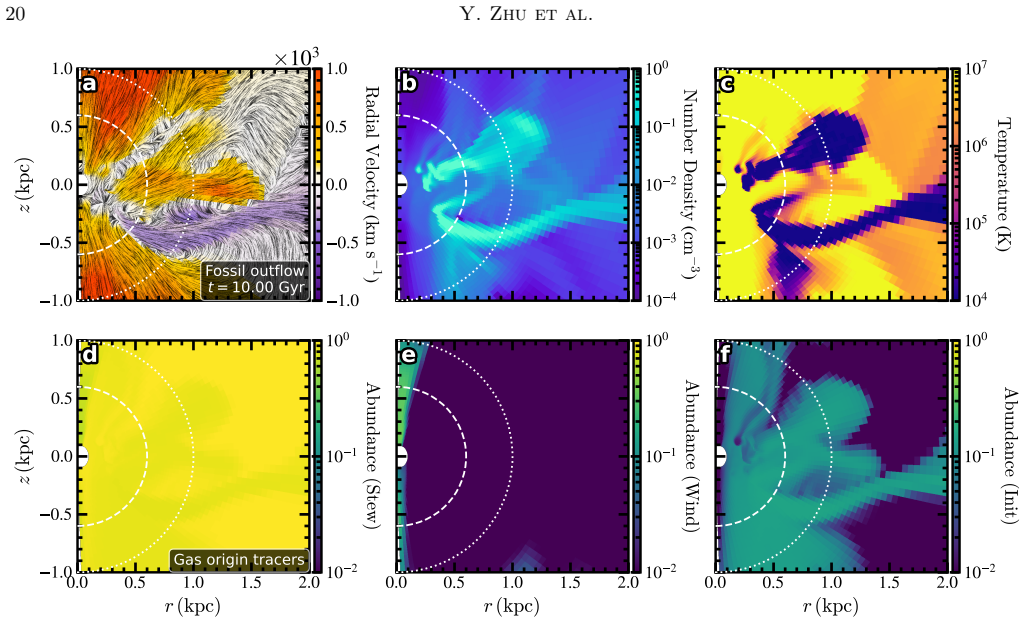
Summary. The paper presents PhotoIFU, a workflow that treats PSF-matched JWST/NIRCam multi-band imaging as a low-resolution photometric integral field unit. Each spatial pixel is fit independently with Prospector (accelerated by the Parrot emulator), producing resolved maps of stellar-mass surface density, sSFR, Dust2, gas-phase metallicity, and the recent-to-past star-formation ratio. The method is applied to three z=1.3–3.7 JADES galaxies with known gas signatures: two systems with extended ionized emission (Cosmic Cigar and Cosmic Rose) and one post-starburst galaxy with a strong NaD neutral outflow (Cosmic Ember). The central empirical claim is that manually selected regions associated with the gas signatures occupy distinct parts of the resolved SED-property distribution compared with the full host. A Gaussian-mixture clustering analysis is included as a descriptive check, and an external benchmark against NIRSpec IFU maps of GS5001 is presented in Appendix A. An illustrative MACER simulation is used to argue that a fossil outflow and compact central rejuvenation can coexist, providing a qualitative scenario for the Cosmic Ember.
Significance. If the central differential claim survives scrutiny, the paper delivers a practical, broadly applicable method for connecting feedback-related gas signatures to resolved stellar-population and ISM properties in samples far larger than those accessible to NIRSpec IFU. The manuscript is commendably explicit about several limitations: the pixels are PSF-correlated, the p-values are descriptive, and the maps are differential rather than deconvolved. The external benchmark in Appendix A and the planned public release of the workflow are strengths. However, the main astrophysical conclusion — that gas-selected regions are physically distinct in dust, recent star formation, and metallicity — is not yet isolated from two measurement channels: the line-sensitive bands used for region selection also enter the SED fits, and the sole neutral-outflow case has its key aperture in the PSF/light-concentration pattern the authors themselves flag. The benchmark validates broad spatial structure but does not test either artifact channel for the region-comparison analysis.
major comments (4)
- [§3.1, §3.2, §4.4] Circularity between region selection and SED fitting is load-bearing for the 'less dusty along extended emission' claim. The detection filters for the Cosmic Cigar and Cosmic Rose are F210M and F300M, respectively — the same line-sensitive bands used to identify the extended emission in Zhu et al. (2025). These bands enter the Prospector fits, whose nebular-emission component maps line excess into Dust2, Zgas, SFR0, and SFR1. A pixel selected because F210M/F300M is elevated is therefore driven toward lower dust and more recent star formation even with an identical continuum population; the reported A-region offsets (ΔDust2 = −0.24 and −0.07) point in exactly that direction. Please demonstrate with a control — e.g., refitting with the detection/line-sensitive bands excluded, or injecting a line-excess-only signal into identical continuum SEDs and showing the region offsets disappear — or
- [§3.2, Figure 2 caption, §4.3] The Cosmic Ember's A region is the only neutral-outflow constraint and its centroid is at 0.4 kpc from the adopted center. The paper states that the F444W-matched PSF and strong central light concentration produce a weak radial pattern and that compact gradients are upper limits. The reported A-region offsets (ΔDust2 = +1.04, Δlog sSFR = +0.68) lie in the region where this artifact is largest. A PSF-convolved null test is needed: e.g., fit a smooth radial profile to the galaxy, PSF-match it to F444W, run the same pixel SED fits, and compare an aperture-matched radial baseline to the observed A-region offsets. Without such a test, the Cosmic Ember result cannot yet be distinguished from a central light-concentration artifact.
- [§4.4] The Mann–Whitney U p-values are explicitly descriptive and the text correctly notes that PSF-correlated pixels are not independent. However, the paper's central claim is that regions 'occupy distinct parts' of the distribution, and the only quantitative support offered is these p-values plus median offsets. Please add a statistic that accounts for the PSF correlation — e.g., a spatial block bootstrap, a test on independent resolution elements after binning to the F444W beam, or a covariance-aware effect size. This is needed to distinguish a genuine distributional offset from oversampling of a few correlated structures.
- [Appendix A] The GS5001 benchmark demonstrates that PhotoIFU reproduces broad spatial structure seen by NIRSpec IFU (dust lane, SFR peaks, metallicity gradients). It does not test the gas-selected-region comparison, the manual apertures, or the shared-band circularity described above. Please state this limitation explicitly in the main text, and consider adding a benchmark region comparison on GS5001's known IFU features if possible. The current wording ('broad spatial consistency') is accurate but may lead readers to over-interpret the benchmark as validating the paper's central differential claim.
minor comments (5)
- [Title / throughout] The title has a typo ('F eedback') and there are missing spaces in the text ('Prospectorto', 'Parrotemulator'). A full proofreading pass is needed.
- [§3.2] The priors for the Prospector parameters are not stated. Since the paper emphasizes that the same model and priors are applied to every pixel, please list or reference the prior definitions (e.g., the Prospector-α style priors) so that the differential interpretation is reproducible.
- [Figure 3 / §4.2] The GMM uses a fixed K=6 for all targets. A brief sensitivity check (K=4–8) or a statement of why K=6 is robust would strengthen the descriptive clustering claim.
- [§4.3 / Figures 4–5] The manual apertures are shown in figures but their exact boundaries and sizes are not tabulated. For reproducibility, please provide an aperture coordinate/size table or machine-readable region files.
- [§5.3] The MACER comparison is explicitly illustrative, but the choice of ν=0.55 is not discussed. A sentence on how the fiducial run was selected among the MACER viscosity suite would help place the qualitative match in context.
Circularity Check
Gas-selected-region offsets are partly contaminated by shared line-sensitive input bands; no formal derivation reduces to its inputs otherwise.
specific steps
-
fitted input called prediction
[§3.1–3.2 (detection filters and SED-fitting bands) feeding §4.3–4.4 (region comparisons)]
"The detection filters are F210M for the Cosmic Cigar, F300M for the Cosmic Rose, and F150W for the Cosmic Ember. F210M and F300M are line-sensitive filters for the extended-emission structures used in the medium-band selection of Y. Zhu et al. (2025) ... The spatially resolved SED fitting uses the available PSF-matched NIRCam imaging in ... F210M ... F300M ... The gas-phase metallicity is constrained through the nebular-emission model and the sensitivity of the NIRCam filters, especially medium bands, to strong rest-frame optical line complexes."
Pixels in the Cosmic Cigar and Cosmic Rose A regions are selected because F210M or F300M are elevated. Those same filters are inputs to the per-pixel Prospector fits, and the nebular-emission component maps the resulting line/medium-band excess into SFR0, Dust2, and Zgas. The reported A-region offsets (Cosmic Cigar ΔDust2=−0.24; Cosmic Rose ΔDust2=−0.07, plus sSFR/Zgas shifts) therefore at least partly reproduce the selection signal encoded in the data: a pixel selected for line excess is driven toward lower dust and more recent star formation by the fitting model itself. The region comparison is not an independent readout of the host properties; the two extended-emission cases have no control that avoids shared input bands.
full rationale
The main observational claim—that gas-selected regions occupy distinct parts of the resolved SED-property distribution—is partially circular for the two extended-emission systems. The same line-sensitive photometry (F210M/F300M) used to define the regions is also part of the pixel SEDs fit by Prospector, and the paper itself notes that the gas-phase metallicity and related properties are constrained through the nebular-emission model and the medium-band line sensitivity. Thus the Dust2/sSFR offsets in the Cosmic Cigar and Cosmic Rose are not cleanly separable from the line-excess selection that defines the A regions. The Cosmic Ember case is less affected by this shared-band issue because its neutral-outflow selection comes from NIRSpec NaD absorption, not a line-sensitive photometric filter; however, its sole A-region aperture lies at 0.4 kpc from the center, inside the radial PSF/light-concentration pattern the authors themselves flag in the Figure 2 caption. That PSF-related concern is a measurement-artifact confound rather than a definitional circularity, so it does not by itself raise the circularity score, but it further weakens the independent content of the one neutral-outflow comparison. The GS5001 NIRSpec-IFU benchmark and MACER simulation provide external or illustrative support but do not test the gas-selected-region comparison or the shared-band degeneracy. Self-citations to Zhu et al. (2025) and Zhu et al. (2026d) are used for source identification and fitting setup, respectively, and are not load-bearing in a way that forces the central result. Overall, the paper has partial shared-input circularity, but the analysis retains independent content in the Cosmic Ember and in properties less directly tied to the line-sensitive bands; hence a moderate score rather than a higher one.
Axiom & Free-Parameter Ledger
free parameters (5)
- Prospector SED model parameters (per-pixel stellar mass, stellar metallicity, gas-phase metallicity, Dust2, SFH bin ampl =
posterior medians per pixel
- GMM component number K=6 =
6
- Source detection threshold (2σ after 1-pixel Gaussian smoothing) =
2σ
- Manual region apertures A/B/C =
rectangles in Figure 4
- MACER viscosity ν=0.55 =
0.55
axioms (6)
- domain assumption FSPS stellar-population synthesis models and Chabrier IMF
- domain assumption Prospector dust attenuation prescription with Dust2 normalization
- domain assumption Nebular emission tied to gas-phase metallicity in the SED model
- domain assumption PSF matching to F444W preserves the spatial signal
- domain assumption Systemic redshifts from SMILES and JOF spectroscopy are correct
- domain assumption MACER simulation is a relevant analog for post-starburst fossil-outflow evolution
read the original abstract
We present PhotoIFU, a workflow that uses deep multi-band imaging as a low-resolution photometric integral field unit. Applied to PSF-matched JWST/NIRCam imaging, PhotoIFU treats each spatial pixel as a coarse SED element and fits the pixel SEDs with Prospector to map resolved stellar-population and ISM-related properties. We apply this approach to three galaxies at $z=1.3$--3.7 in JADES: two systems with extended ionized line emission and one post-starburst galaxy with an exceptionally strong neutral outflow. Pixel-by-pixel SED fitting gives maps of stellar-mass surface density, specific star formation rate, dust attenuation, gas-phase metallicity, and recent star-formation history. We find that regions selected from the extended-emission or outflow geometry occupy distinct parts of the resolved SED-property distribution compared with the full host. In the systems with extended ionized emission, these regions are generally less dusty, consistent with ionized emission being observed along dust-poor, low-column-density pathways through the host. In the neutral-outflow system, the selected regions show enhanced recent star formation, suggesting that compact rejuvenation may mark the aftermath of an earlier energetic phase. These results show that galactic outflows and extended emission-line structures can be spatially associated with measurable differences in resolved host-galaxy stellar populations and ISM-related properties. PhotoIFU provides an imaging-based method for resolved SED mapping of feedback-related structures in larger galaxy samples where full spectroscopic integral-field mapping is unavailable.
Figures


Reference graph
Works this paper leans on
-
[1]
Abdurro'uf , Lin, Y.-T., Wu, P.-F., & Akiyama, M. 2021, title Introducing piXedfit : A Spectral Energy Distribution Fitting Code Designed for Resolved Sources , The Astrophysical Journal Supplement Series, 254, 15, 10.3847/1538-4365/abebe2
-
[2]
Alberts, S., Williams, C. C., Helton, J. M., et al. 2024 a , title To High Redshift and Low Mass : Exploring the Emergence of Quenched Galaxies and Their Environments at 3 z 6 in the Ultra -deep JADES MIRI F770W Parallel , The Astrophysical Journal, 975, 85, 10.3847/1538-4357/ad66cc
-
[3]
Alberts, S., Lyu, J., Shivaei, I., et al. 2024 b , title SMILES Initial Data Release : Unveiling the Obscured Universe with MIRI Multiband Imaging , The Astrophysical Journal, 976, 224, 10.3847/1538-4357/ad7396
-
[4]
M., D'Eugenio, F., Maiolino, R., et al
Baker, W. M., D'Eugenio, F., Maiolino, R., et al. 2025, title Zapped then napped? A rapidly quenched remnant leaker candidate with a steep spectroscopic β UV slope at z = 8.5, Astronomy and Astrophysics, 697, A90, 10.1051/0004-6361/202553766
-
[5]
Behroozi, P., Wechsler, R. H., Hearin, A. P., & Conroy, C. 2019, title UNIVERSEMACHINE : The correlation between galaxy growth and dark matter halo assembly from z = 0-10, Monthly Notices of the Royal Astronomical Society, 488, 3143, 10.1093/mnras/stz1182
-
[6]
Bertola, E., Cresci, G., Venturi, G., et al. 2025, title GA - NIFS : Mapping z ≃ 3.5 AGN -driven ionized outflows in the COSMOS field, Astronomy and Astrophysics, 699, A220, 10.1051/0004-6361/202554281
-
[7]
Bischetti, M., Choi, H., Fiore, F., et al. 2024, title Multiphase Black Hole Feedback and a Bright [ C II ] Halo in a LoBAL Quasar at z ∼ 6.6, The Astrophysical Journal, 970, 9, 10.3847/1538-4357/ad4a77
-
[8]
Bunker, A. J., Cameron, A. J., Curtis-Lake, E., et al. 2024, title JADES NIRSpec initial data release for the Hubble Ultra Deep Field : Redshifts and line fluxes of distant galaxies from the deepest JWST Cycle 1 NIRSpec multi-object spectroscopy, Astronomy and Astrophysics, 690, A288, 10.1051/0004-6361/202347094
-
[9]
Butler, K. M., van der Werf, P. P., Topkaras, T., et al. 2023, title Molecular Outflows in z 6 Unobscured QSO Hosts Driven by Star Formation , The Astrophysical Journal, 944, 134, 10.3847/1538-4357/acad03
-
[10]
Carreira, C., Robertson, B. E., Danhaive, A. L., et al. 2026, title JWST Advanced Deep Extragalactic Survey ( JADES ) Data Release 5: Catalogs of inferred morphological properties of galaxies from JWST / NIRCam imaging in GOODS - N and GOODS - S , arXiv, 10.48550/arXiv.2601.15957
-
[11]
Ceverino, D., Mandelker, N., Snyder, G. F., et al. 2023, title Effects of feedback on galaxies in the VELA simulations: elongation, clumps, and compaction, Monthly Notices of the Royal Astronomical Society, 522, 3912, 10.1093/mnras/stad1255
-
[12]
Chabrier, G. 2003, title Galactic Stellar and Substellar Initial Mass Function , Publications of the Astronomical Society of the Pacific, 115, 763, 10.1086/376392
doi:10.1086/376392 2003
-
[13]
Conroy, C., & Gunn, J. E. 2010, title The Propagation of Uncertainties in Stellar Population Synthesis Modeling . III . Model Calibration , Comparison , and Evaluation , The Astrophysical Journal, 712, 833, 10.1088/0004-637X/712/2/833
-
[14]
Conroy, C., Gunn, J. E., & White, M. 2009, title The Propagation of Uncertainties in Stellar Population Synthesis Modeling . I . The Relevance of Uncertain Aspects of Stellar Evolution and the Initial Mass Function to the Derived Physical Properties of Galaxies , The Astrophysical Journal, 699, 486, 10.1088/0004-637X/699/1/486
-
[15]
Covelo-Paz, A., Meuwly, C., Oesch, P. A., et al. 2026, title A systematic search for dormant galaxies at z ∼ 5−7 from the JWST NIRSpec archive, Astronomy and Astrophysics, 705, A155, 10.1051/0004-6361/202556119
-
[16]
Crain, R. A., Schaye, J., Bower, R. G., et al. 2015, title The EAGLE simulations of galaxy formation: calibration of subgrid physics and model variations, Monthly Notices of the Royal Astronomical Society, 450, 1937, 10.1093/mnras/stv725
-
[17]
Davies, R. L., Förster Schreiber, N. M., Lutz, D., et al. 2020, title From Nuclear to Circumgalactic : Zooming in on AGN -driven Outflows at z ∼ 2.2 with SINFONI , The Astrophysical Journal, 894, 28, 10.3847/1538-4357/ab86ad
-
[18]
L., Belli, S., Park, M., et al
Davies, R. L., Belli, S., Park, M., et al. 2024, title JWST reveals widespread AGN -driven neutral gas outflows in massive z 2 galaxies, Monthly Notices of the Royal Astronomical Society, 528, 4976, 10.1093/mnras/stae327
-
[19]
Dekel, A., & Birnboim, Y. 2006, title Galaxy bimodality due to cold flows and shock heating, Monthly Notices of the Royal Astronomical Society, 368, 2, 10.1111/j.1365-2966.2006.10145.x
arXiv 2006
-
[20]
Dekel, A., Birnboim, Y., Engel, G., et al. 2009, title Cold streams in early massive hot haloes as the main mode of galaxy formation, Nature, 457, 451, 10.1038/nature07648
-
[21]
D'Eugenio, F., Pérez-González, P. G., Maiolino, R., et al. 2024, title A fast-rotator post-starburst galaxy quenched by supermassive black-hole feedback at z = 3, Nature Astronomy, 8, 1443, 10.1038/s41550-024-02345-1
-
[22]
Dome, T., Tacchella, S., Fialkov, A., et al. 2024, title Mini-quenching of z = 4-8 galaxies by bursty star formation, Monthly Notices of the Royal Astronomical Society, 527, 2139, 10.1093/mnras/stad3239
-
[23]
J., Willott, C., Alberts, S., et al
Eisenstein, D. J., Willott, C., Alberts, S., et al. 2023, title Overview of the JWST Advanced Deep Extragalactic Survey ( JADES ), arXiv. http://arxiv.org/abs/2306.02465
Pith/arXiv arXiv 2023
-
[24]
Eisenstein, D. J., Johnson, B. D., Robertson, B., et al. 2025, title The JADES Origins Field : A New JWST Deep Field in the JADES Second NIRCam Data Release , The Astrophysical Journal Supplement Series, 281, 50, 10.3847/1538-4365/ae1137
-
[25]
Fluetsch, A., Maiolino, R., Carniani, S., et al. 2019, title Cold molecular outflows in the local Universe and their feedback effect on galaxies, Monthly Notices of the Royal Astronomical Society, 483, 4586, 10.1093/mnras/sty3449
-
[26]
Förster Schreiber, N. M., Genzel, R., Newman, S. F., et al. 2014, title The Sins / zC - Sinf Survey of z 2 Galaxy Kinematics : Evidence for Powerful Active Galactic Nucleus - Driven Nuclear Outflows in Massive Star - Forming Galaxies , The Astrophysical Journal, 787, 38, 10.1088/0004-637X/787/1/38
-
[27]
Förster Schreiber, N. M., Übler, H., Davies, R. L., et al. 2019, title The KMOS3D Survey : Demographics and Properties of Galactic Outflows at z = 0.6-2.7, The Astrophysical Journal, 875, 21, 10.3847/1538-4357/ab0ca2
-
[28]
Gardner, J. P., Mather, J. C., Abbott, R., et al. 2023, title The James Webb Space Telescope Mission , Publications of the Astronomical Society of the Pacific, 135, 068001, 10.1088/1538-3873/acd1b5
-
[29]
Genzel, R., Förster Schreiber, N. M., Rosario, D., et al. 2014, title Evidence for Wide -spread Active Galactic Nucleus -driven Outflows in the Most Massive z 1-2 Star -forming Galaxies , The Astrophysical Journal, 796, 7, 10.1088/0004-637X/796/1/7
-
[30]
Ginolfi, M., Jones, G. C., Béthermin, M., et al. 2020, title The ALPINE - ALMA [ C II ] survey: Star -formation-driven outflows and circumgalactic enrichment in the early Universe , Astronomy and Astrophysics, 633, A90, 10.1051/0004-6361/201936872
-
[31]
Guo, Y., Bacon, R., Bouché, N. F., et al. 2023, title Bipolar outflows out to 10 kpc for massive galaxies at redshift z ≈ 1, Nature, 624, 53, 10.1038/s41586-023-06718-w
-
[32]
G., Alvarez-Marquez, J., et al
Harikane, Y., Perez-Gonzalez, P. G., Alvarez-Marquez, J., et al. 2026, title A UV - Luminous Galaxy at z=11 with Surprisingly Weak Star Formation Activity , arXiv, 10.48550/arXiv.2601.21833
-
[33]
F., Kereš, D., Oñorbe, J., et al
Hopkins, P. F., Kereš, D., Oñorbe, J., et al. 2014, title Galaxies on FIRE ( Feedback In Realistic Environments ): stellar feedback explains cosmologically inefficient star formation, Monthly Notices of the Royal Astronomical Society, 445, 581, 10.1093/mnras/stu1738
-
[34]
Ji, Z., Alberts, S., Zhu, Y., et al. 2025, title The Importance of Dust Distribution in Ionizing -photon Escape : NIRCam and MIRI Imaging of a Lyman Continuum -emitting Galaxy at z ∼ 3.8, The Astrophysical Journal, 988, L69, 10.3847/2041-8213/adf194
-
[35]
D., Leja, J., Conroy, C., & Speagle, J
Johnson, B. D., Leja, J., Conroy, C., & Speagle, J. S. 2021, title Stellar Population Inference with Prospector , The Astrophysical Journal Supplement Series, 254, 22, 10.3847/1538-4365/abef67
-
[36]
Johnson, B. D., Robertson, B. E., Eisenstein, D. J., et al. 2026, title JWST Advanced Deep Extragalactic Survey ( JADES ) Data Release 5: NIRCam Imaging in GOODS - S and GOODS - N , arXiv, 10.48550/arXiv.2601.15954
-
[37]
Ju, M., Wang, X., Jones, T., et al. 2025, title MSA - 3D : Metallicity Gradients in Galaxies at z ∼ 1 with JWST / NIRSpec Slit -stepping Spectroscopy , The Astrophysical Journal, 978, L39, 10.3847/2041-8213/ada150
-
[38]
Lamperti, I., Arribas, S., Perna, M., et al. 2024, title GA - NIFS : JWST / NIRSpec IFS view of the z 3.5 galaxy GS5001 and its close environment at the core of a large-scale overdensity, 10.48550/arXiv.2406.10348
-
[39]
Lange, J. U. 2023, title NAUTILUS : boosting Bayesian importance nested sampling with deep learning, Monthly Notices of the Royal Astronomical Society, 525, 3181, 10.1093/mnras/stad2441
-
[40]
JWST NIRCam simulations and observations of AGN ionization cones in cosmic noon galaxies
Lebowitz, S., Hainline, K., Juneau, S., et al. 2025, title JWST NIRCam simulations and observations of AGN ionization cones in cosmic noon galaxies, arXiv, 10.48550/arXiv.2501.05512
work page internal anchor Pith review Pith/arXiv arXiv doi:10.48550/arxiv.2501.05512 2025
-
[41]
Lebowitz, S., Hainline, K. N., Juneau, S., et al. 2026, title Spatially Resolved AGN Ionization and Star Formation at Cosmic Noon with JWST / JEMS , arXiv, 10.48550/arXiv.2604.01271
-
[42]
Leja, J., Carnall, A. C., Johnson, B. D., Conroy, C., & Speagle, J. S. 2019, title How to Measure Galaxy Star Formation Histories . II . Nonparametric Models , The Astrophysical Journal, 876, 3, 10.3847/1538-4357/ab133c
-
[43]
Liu, W., Veilleux, S., Rupke, D. S. N., et al. 2022, title Galactic Winds across the Gas -rich Merger Sequence . II . Lyα Emission and Highly Ionized O VI and N V Outflows in Ultraluminous Infrared Galaxies , The Astrophysical Journal, 934, 160, 10.3847/1538-4357/ac7a46
-
[44]
Liu, W., Fan, X., Li, H., et al. 2025, title Frequent Extreme Galaxy -scale Outflows among Luminous Early Quasars , arXiv, 10.48550/arXiv.2509.08793
-
[45]
Loiacono, F., Talia, M., Fraternali, F., et al. 2019, title A multiwavelength study of a massive, active galaxy at z ∼ 2: coupling the kinematics of the ionized and molecular gas, Monthly Notices of the Royal Astronomical Society, 489, 681, 10.1093/mnras/stz2170
-
[46]
J., D'Eugenio, F., Maiolino, R., et al
Looser, T. J., D'Eugenio, F., Maiolino, R., et al. 2024, title A recently quenched galaxy 700 million years after the Big Bang , Nature, 629, 53, 10.1038/s41586-024-07227-0
-
[47]
J., D'Eugenio, F., Maiolino, R., et al
Looser, T. J., D'Eugenio, F., Maiolino, R., et al. 2025, title JADES : Differing assembly histories of galaxies: Observational evidence for bursty star formation histories and (mini-)quenching in the first billion years of the Universe , Astronomy and Astrophysics, 697, A88, 10.1051/0004-6361/202347102
-
[48]
Markov, V., Bradač, M., Estrada-Carpenter, V., et al. 2026, title Resolving dust and Lyman α emission in a lensed galaxy at the epoch of reionization with JWST / CANUCS , Astronomy and Astrophysics, 708, A236, 10.1051/0004-6361/202558580
-
[49]
Mathews, E. P., Leja, J., Speagle, J. S., et al. 2023, title As Simple as Possible but No Simpler : Optimizing the Performance of Neural Net Emulators for Galaxy SED Fitting , The Astrophysical Journal, 954, 132, 10.3847/1538-4357/ace720
-
[50]
Mawatari, K., Costantin, L., Usui, M., et al. 2025, title RIOJA . Merger -induced Clumps in a Galaxy at Redshift 6.81 Revealed by JWST , arXiv, 10.48550/arXiv.2507.02053
-
[51]
McClymont, W., Tacchella, S., Smith, A., et al. 2025, title The THESAN - ZOOM project: central starbursts and inside-out quenching govern galaxy sizes in the early Universe , Monthly Notices of the Royal Astronomical Society, 544, 1732, 10.1093/mnras/staf1861
-
[52]
H., Burkhart, B., Somerville, R
Menon, S. H., Burkhart, B., Somerville, R. S., Thompson, T. A., & Sternberg, A. 2025, title Bursts of Star Formation and Radiation -driven Outflows Produce Efficient LyC Leakage from Dense Compact Star Clusters , The Astrophysical Journal, 987, 12, 10.3847/1538-4357/add2f9
-
[53]
Morrison, J. E., Law, D. R., Mulcahey, C., et al. 2025, title Creating Spectral Cubes from NIRSpec MSA Slitlet Stepped Observations , 541, 122, 10.26624/JPKJ9985
-
[54]
L., Kereš, D., Faucher-Giguère, C.-A., et al
Muratov, A. L., Kereš, D., Faucher-Giguère, C.-A., et al. 2015, title Gusty, gaseous flows of FIRE : galactic winds in cosmological simulations with explicit stellar feedback, Monthly Notices of the Royal Astronomical Society, 454, 2691, 10.1093/mnras/stv2126
-
[55]
Naab, T., & Ostriker, J. P. 2017, title Theoretical Challenges in Galaxy Formation , Annual Review of Astronomy and Astrophysics, 55, 59, 10.1146/annurev-astro-081913-040019
-
[56]
Nakazato, Y., Matsumoto, K., Inoue, A. K., et al. 2026, title Clump- Scale Dust Attenuation in Epoch of Reionization Galaxies : Spatially Resolved Properties from FirstLight Simulations , arXiv, 10.48550/arXiv.2602.07347
-
[57]
Nelson, D., Pillepich, A., Springel, V., et al. 2019, title First results from the TNG50 simulation: galactic outflows driven by supernovae and black hole feedback, Monthly Notices of the Royal Astronomical Society, 490, 3234, 10.1093/mnras/stz2306
-
[58]
2024, title \ ChatGPT \ : Chat -based Language Model , https://openai.com/chatgpt
OpenAI. 2024, title \ ChatGPT \ : Chat -based Language Model , https://openai.com/chatgpt
2024
-
[59]
Pasha, I., & Miller, T. B. 2023, title pysersic: A Python package for determining galaxy structural properties via Bayesian inference, accelerated with jax, The Journal of Open Source Software, 8, 5703, 10.21105/joss.05703
-
[60]
Pedregosa, F., Varoquaux, G., Gramfort, A., et al. 2011, title Scikit-learn: Machine Learning in Python , Journal of Machine Learning Research, 12, 2825, 10.48550/arXiv.1201.0490
-
[61]
Peng, B., Arrigoni Battaia, F., Vishwas, A., et al. 2025, title Direct high-resolution observation of feedback and chemical enrichment in the circumgalactic medium at redshift z ∼ 2.8, Astronomy and Astrophysics, 694, L1, 10.1051/0004-6361/202452610
-
[62]
Perrotta, S., Coil, A. L., Rupke, D. S. N., et al. 2023, title Kinematics, Structure , and Mass Outflow Rates of Extreme Starburst Galactic Outflows , The Astrophysical Journal, 949, 9, 10.3847/1538-4357/acc660
-
[63]
Pillepich, A., Nelson, D., Hernquist, L., et al. 2018, title First results from the IllustrisTNG simulations: the stellar mass content of groups and clusters of galaxies, Monthly Notices of the Royal Astronomical Society, 475, 648, 10.1093/mnras/stx3112
-
[64]
G., Barro, G., Annunziatella, M., et al
Pérez-González, P. G., Barro, G., Annunziatella, M., et al. 2023, title CEERS Key Paper . IV . A Triality in the Nature of HST -dark Galaxies , The Astrophysical Journal, 946, L16, 10.3847/2041-8213/acb3a5
-
[65]
Ren, Y. W., Inoue, A. K., Álvarez Márquez, J., et al. 2025, title RIOJA . Young Starburst and Ionized Gas Outflows in a \ z = 7.212\ Galaxy Uncovered by JWST NIRCam and NIRSpec Observations , arXiv, 10.48550/arXiv.2510.25721
-
[66]
2024, title The SMILES Mid - Infrared Survey , 10.48550/arXiv.2406.03518
Rieke, G., Alberts, S., Shivaei, I., et al. 2024, title The SMILES Mid - Infrared Survey , 10.48550/arXiv.2406.03518
-
[67]
Rieke, G. H., Sun, Y., Lyu, J., et al. 2025, title Confirming Near - to Mid - IR Photometrically - Identified Obscured AGNs in the JWST era, arXiv, 10.48550/arXiv.2510.07303
-
[68]
Rieke, M. J., Kelly, D. M., Misselt, K., et al. 2023 a , title Performance of NIRCam on JWST in Flight , Publications of the Astronomical Society of the Pacific, 135, 028001, 10.1088/1538-3873/acac53
-
[69]
J., Robertson, B., Tacchella, S., et al
Rieke, M. J., Robertson, B., Tacchella, S., et al. 2023 b , title JADES Initial Data Release for the Hubble Ultra Deep Field : Revealing the Faint Infrared Sky with Deep JWST NIRCam Imaging , The Astrophysical Journal Supplement Series, 269, 16, 10.3847/1538-4365/acf44d
-
[70]
Robertson, B. E., Johnson, B. D., Tacchella, S., et al. 2026, title JWST Advanced Deep Extragalactic Survey ( JADES ) Data Release 5: Photometric Catalog , arXiv, 10.48550/arXiv.2601.15956
-
[71]
Rodríguez Del Pino, B., Arribas, S., Perna, M., et al. 2026, title GA - NIFS : high prevalence of dusty and metal-enriched outflows in massive and luminous star-forming galaxies at \ z sim3-9\ , arXiv, 10.48550/arXiv.2601.06255
-
[72]
Scholtz, J., Harrison, C. M., Rosario, D. J., et al. 2020, title KASHz : No evidence for ionised outflows instantaneously suppressing star formation in moderate luminosity AGN at z ∼ 1.4-2.6, Monthly Notices of the Royal Astronomical Society, 492, 3194, 10.1093/mnras/staa030
-
[73]
Somerville, R. S., & Davé, R. 2015, title Physical Models of Galaxy Formation in a Cosmological Framework , Annual Review of Astronomy and Astrophysics, 53, 51, 10.1146/annurev-astro-082812-140951
-
[74]
Strait, V., Brammer, G., Muzzin, A., et al. 2023, title An Extremely Compact , Low -mass Galaxy on its Way to Quiescence at z = 5.2, The Astrophysical Journal, 949, L23, 10.3847/2041-8213/acd457
-
[75]
Sun, F., Eisenstein, D. J., D'Eugenio, F., et al. 2026, title JADES : Discovery of Large Reservoirs of Small Dust Grains in the Circumgalactic Medium of Massive Galaxies at \ z sim3.5\ through Deep JWST / NIRCam Imaging and Grism Spectroscopy , arXiv, 10.48550/arXiv.2601.15961
-
[76]
Sun, Y., Ji, Z., Rieke, G. H., et al. 2025, title Extreme Neutral Outflow in an Inactive Quenching Galaxy at z\ sim\ 1.3, arXiv, 10.48550/arXiv.2504.14682
-
[77]
2026, title A Census of Na D -traced neutral ISM and outflows at \ 0.6, arXiv
Sun, Y., Ji, Z., D'Eugenio, F., et al. 2026, title A Census of Na D -traced neutral ISM and outflows at \ 0.6, arXiv. https://ui.adsabs.harvard.edu/abs/2026arXiv260418522S
2026
-
[78]
Tacchella, S., Dekel, A., Carollo, C. M., et al. 2016 a , title Evolution of density profiles in high-z galaxies: compaction and quenching inside-out, Monthly Notices of the Royal Astronomical Society, 458, 242, 10.1093/mnras/stw303
-
[79]
Tacchella, S., Dekel, A., Carollo, C. M., et al. 2016 b , title The confinement of star-forming galaxies into a main sequence through episodes of gas compaction, depletion and replenishment, Monthly Notices of the Royal Astronomical Society, 457, 2790, 10.1093/mnras/stw131
-
[80]
Ulivi, L., Perna, M., Arribas, S., et al. 2026, title GA - NIFS : The interplay between feedback and star formation at 3 z 9 probed by JWST / NIRSpec IFU , arXiv, 10.48550/arXiv.2606.13819
discussion (0)
Sign in with ORCID, Apple, or X to comment. Anyone can read and Pith papers without signing in.