REVIEW 4 major objections 4 minor 74 references
Quasi-two-body decays $B_c^+ \to \chi_{c0,c1} [\rho(K^*) \to] \pi\pi(K\pi)$ in the PQCD approach
T0 review · 4 major / 4 minor · reviewed 2026-08-01 · deepseek-v4-flash
Pith's one-line read B_c decays through a resonant ρ are predicted to produce χ_{c0,c1}ππ at the 10^{-3} level, with the χ_{c1}-to-χ_{c0} ratio near 1.3, far from the two-body prediction of ≈4.7.
desk verdict Genuinely new PQCD predictions for Bc→χcJππ(Kπ), but the headline ratio R≈1.30 has no quoted uncertainty and rests on a twist-3 cancellation that needs a stability check before the 'reshaping' claim is taken at face value. read the letter →
The pith
A machine-rendered reading of the paper's core claim, the machinery that carries it, and where it could break.
The reading
What carries the argument
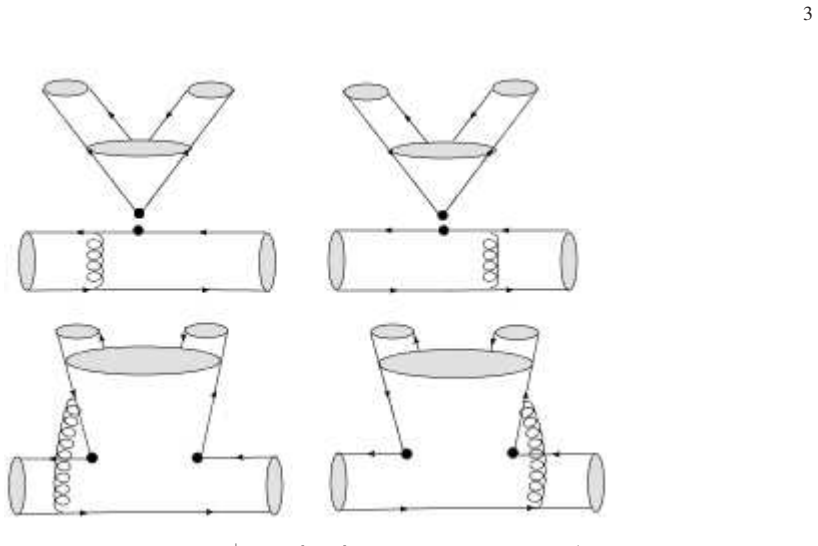
The central machinery is the quasi-two-body PQCD factorization with two-meson P-wave distribution amplitudes (DAs) for the ππ and Kπ pairs. The time-like form factors F^{∥}_{ππ}, F^{⊥}_{ππ}, F^{∥}_{Kπ}, F^{⊥}_{Kπ} are parametrized by the Gounaris-Sakurai model for ρ(770), ρ(1450), ρ(1700) and the relativistic Breit-Wigner for K*(892), with measured normalization factors N_ρ≈1.05 and N_{K*}≈1.48 and the approximation F^{⊥}/F^{∥}≈f^{V}_{T}/f^{V}. For the χ_{cJ} mesons, both twist-2 and twist-3 light-cone DAs are included; the twist-3 contributions grow with the pair invariant mass, which drives the decrease of f_L from 94% (ρ(770)) to 65% (ρ(1700)) and controls the χc1-to-χc0 ratio. The hard k
What would settle it
Measure B(B_c^+→χ_{c0}π^+π^0) and B(B_c^+→χ_{c1}π^+π^0) at LHCb in the χ_{cJ}→J/ψγ chain. The central claim predicts their ratio R≈1.30; if the measured ratio instead approaches the two-body PQCD value ≈4.7, then the hypothesis that resonant ρ production reshapes the P-wave charmonium yields through factorizable emission is falsified.
Extended reading notes
Core claim
On the authors' own terms: in B_c^+→χ_{c0,c1}(ρ→ππ), the intermediate ρ couples to both charmonia through factorizable emission diagrams, so the two states share one production path. The calculation gives B(B_c^+→χ_{c0}π^+π^0)=3.24×10^{-3} and B(B_c^+→χ_{c1}π^+π^0)=4.19×10^{-3}, hence R^{ππ}_{χc1/χc0}≈1.30. The two-body transitions, by contrast, have R≈4.7 because χ_{c0} production is color-singlet suppressed and χ_{c1} suffers from a vanishing leading-twist decay constant. The paper concludes that the near-unity resonant ratio signals the bypassing of those suppressions, and predicts that a measurement of R>1 at LHCb would confirm the mechanism. For Kπ, the predicted branching ratios are ~1
Load-bearing premise
The calculation rests on the quasi-two-body factorization ansatz: all non-perturbative ππ/Kπ physics, including final-state interactions, is absorbed into two-meson distribution amplitudes with channel-independent form-factor normalizations; if those normalizations (or the F⊥/F∥≈f_T/f approximation) depend on the decaying meson or the charmonium partner, the predicted branching ratios shift, and the decisive ratio could move back toward the two-body value.
Editorial extensions
If this is right
- If the predictions hold, B_c^+→χ_{c0}π^+π^0 and B_c^+→χ_{c1}π^+π^0 have branching ratios near 10^{-3}, comparable to B_c→J/ψπ, and should be accessible in the full LHCb dataset through χ_{cJ}→J/ψγ.
- The ratio R^{ππ}_{χc1/χc0}≈1.30 (versus ≈4.7 for the two-body transition) gives a clean, systematic-cancelling test of whether resonant ρ production changes the relative P-wave charmonium yields.
- The predicted f_L≈94% for χ_{c1} modes, decreasing to ~65% at ρ(1700), offers an angular-analysis discriminator for the two-meson DA model.
- The Kπ channels, suppressed to ~10^{-6} with R_{K/π}≈2×10^{-3} independent of the charmonium spin, provide an SU(3)-breaking check.
- Under the narrow-width approximation, the two-body estimates B(B_c→χ_{c0}ρ^+)≈3.24×10^{-3} and B(B_c→χ_{c1}ρ^+)≈4.19×10^{-3} disagree with the existing two-body PQCD numbers (2.97×10^{-4} and 1.40×10^{-3}), sharpening the question of why resonant production would be so much larger.
Reading between the lines
- Inference: A measurement of R^{ππ}_{χc1/χc0} significantly above ~1.5 would argue that non-factorizable or final-state-interaction effects differ for the two charmonia, pointing to the need to go beyond the simple factorizable-emission picture.
- Inference: The predicted 25% constructive interference from ρ(1450) and ρ(1700) is testable by Dalitz-plot analysis; seeing destructive interference instead would require revising the GS-model weight factors.
- Inference: Because the two normalization constants N_ρ and N_{K*} largely cancel in R_{K/π} but not in absolute rates, the ratio predictions are more robust than the individual branching ratios; experiments should prioritize measuring R_{K/π} and R_{χc1/χc0} before absolute branching fractions.
- Inference: The same two-meson DA machinery should predict the corresponding B_s or B_c decays involving ω and φ resonances; if the fitted normalizations are truly universal, comparable signals should appear there, offering an independent cross-check.
Editorial analysis
A structured set of objections, weighed in public.
Referee Report
Summary. The paper computes quasi-two-body B_c^+→χ_{c0},χ_{c1}[ρ(K^*)→]ππ(Kπ) branching ratios in the leading-order PQCD framework. The ππ and Kπ systems are treated through P-wave two-meson distribution amplitudes with Gounaris-Sakurai and relativistic Breit-Wigner time-like form factors, normalized by factors N_ρ=1.05 and N_{K^*}=1.48 imported from Ref. [42]. For the χ_{cJ} mesons, twist-2 and twist-3 LCDA models from Refs. [6,16] are used. The main numerical outputs are B(B_c^+→χ_{c0}π^+π^0)=3.24×10^{-3}, B(B_c^+→χ_{c1}π^+π^0)=4.19×10^{-3}, f_L≈94% for χ_{c1}, and the central ratio R^{ππ}_{χ_{c1}/χ_{c0}}≈1.30, which is contrasted with the two-body PQCD value ≈4.7. The Kπ channels are predicted at the 10^{-6} level. The paper also extracts two-body B_c^+→χ_{cJ}ρ^+(K^{*+}) branching fractions under the narrow-width approximation and compares them with earlier calculations.
Significance. If the predictions are correct, the paper provides a sharp, falsifiable test of quasi-two-body PQCD factorization in B_c decays into P-wave charmonia. The ratio R^{ππ}_{χ_{c1}/χ_{c0}}≈1.30 versus the direct two-body value ≈4.7 is a genuinely interesting qualitative claim, and the predicted large longitudinal polarization fraction f_L≈94% offers an independent experimental handle. The manuscript is also transparent in presenting the analytic amplitudes and a detailed error decomposition for the branching ratios; no target branching ratio is fitted, which is a strength. However, the headline ratio itself is not assigned an uncertainty, and the central claim rests on a twist-2/twist-3 cancellation that is not stress-tested. The absolute rates also inherit fitted normalization factors whose transferability is not quantitatively examined. These issues are fixable, but they must be addressed before the main claim can be considered established.
major comments (4)
- [Eq. (81); Tables I, II, V] The headline ratio R^{ππ}_{χ_{c1}/χ_{c0}}≈1.30 is quoted without an uncertainty, although the underlying amplitudes are subject to the errors listed in Tables I and II. The χ_{c1} longitudinal amplitude is a difference of twist-2 and twist-3 contributions (Eqs. (60)–(61)); the twist-3 DA φ^t_{χ_{c1}} (Eq. (31)) is a model input with no assigned error. The separate hard-scale variations, +9.11/−8.21×10^{-4} for χ_{c1} and +6.57/−5.96×10^{-4} for χ_{c0}, are large compared with the central rates and cannot be assumed to cancel in the ratio. Since the contrast between 1.30 and the two-body value 4.7 is the paper's main claim, the ratio needs a fully propagated uncertainty and a stability test (e.g., varying the coefficients in φ^t_{χ_{c1}}, the parameter v^2 in Eq. (24), and the hard scale in a correlated way). Without this, the qualitative 'reshaping' conclusion is not established.
- [Sec. II.B, Eqs. (48), (51); Tables I, II] The normalization factors N_ρ=1.05 and N_{K^*}=1.48 are fitted in Ref. [42] for other PQCD quasi-two-body analyses. The paper imports them without a quantitative discussion of channel dependence. They cancel in the ratio R, but they directly set the absolute branching ratios, which are central outputs at the 10^{-3} level. Given that the quoted uncertainties on N_ρ and N_{K^*} are only 3–4%, while the theoretical inputs vary by 20–30%, the authors should either justify transferability within the same PQCD framework or conservatively inflate the normalization uncertainty. A concrete check would be to recompute Tables I and II with N_ρ=1 and N_ρ=1.10, and analogously for N_{K^*}, reporting the shifts separately.
- [Table IV and accompanying text] The narrow-width extraction uses the total coherent ρ sum (32.37×10^{-4} for χ_{c0} and 41.92×10^{-4} for χ_{c1}, Tables I and II) as B(B_c^+→χ_{cJ}ρ^+). But for the ρ(770) resonance, the NWA should use the ρ(770)-only entries, 25.86×10^{-4} and 32.62×10^{-4}. Including ρ(1450) and ρ(1700) and their constructive interference inflates the χ_{c0} two-body value by about 25% relative to ρ(770) alone. The comparison with Ref. [16] in Table V is therefore not on a like-for-like basis. Please correct this or explicitly define the Table IV quantity as the coherent ρ-series NWA and compare with correspondingly defined two-body predictions.
- [Sec. II.B after Eq. (53)] The prescription F^∥(ω²)/F^⊥(ω²) ≈ f_V/f_T^V fixes the normalization of all perpendicular two-meson DAs, but no uncertainty is assigned to this relation. These DAs enter the χ_{c0} amplitude through φ^s_{ππ} (Eq. (36)) and hence the χ_{c0} rate and the ratio R. Because the central claim depends on the relative χ_{c1}/χ_{c0} normalization, this assumption needs a quantitative error estimate or a sensitivity scan. A short paragraph reporting the shift in R when f_T^V/f_V is varied by, say, ±10% would suffice.
minor comments (4)
- [Abstract; Table I] The abstract states that the dominant ρ(770) channels yield B(B_c^+→χ_{c0}π^+π^0)=3.24×10^{-3}, but Table I lists the ρ(770)-only value as 25.86×10^{-4}; the quoted number is the coherent ρ(770)+ρ(1450)+ρ(1700) sum. Please disambiguate the wording.
- [Eq. (79)] The numerical chain 0.053 → 0.055 → 0.110 → 2.0×10^{-3} is not self-explanatory. Please state explicitly which factor is included in each step; the final drop from 0.110 to 2.0×10^{-3} is particularly nontrivial.
- [Table IV] The 'Other predictions' columns use footnote letters a–d with references at the end of the table, but no legend is given in the table caption. Add an explicit mapping between the letters and Refs. [72], [17], [73], [74].
- [General notation] Some distribution amplitudes are written with a b-dependence, e.g., φ^L_{χ_{c1}}(x_3,b_3) in Eqs. (60)–(61), while the defining equations in Sec. II.B list only x. Please clarify the convention or add a remark that the b-dependence is implicit through the Sudakov factor.
Circularity Check
No significant circularity: the branching ratios and ratios are derived from explicit PQCD amplitudes and externally stated inputs; no fitted target is renamed as a prediction.
full rationale
The paper's target observables are computed, not assumed. The branching fractions follow from the phase-space integral Eq. (14) applied to the explicit amplitudes in Eqs. (54)-(65), and the headline ratio R_{χc1/χc0}^{ππ} ≈ 1.30 is formed by dividing two independently computed branching fractions (Eq. (81)). No branching ratio used in the paper is fitted to data for B_c^+ → χ_{c0,c1}ππ(Kπ). The form-factor normalizations N_ρ and N_{K*} (Eqs. (48), (51)) are imported from Ref. [42] as external inputs with stated uncertainties; they multiply the amplitudes and cancel in the central χ_{c1}/χ_{c0} ratio, so the key comparative claim is not a renamed fit. The comparison value 4.7 from Ref. [16] is an external two-body PQCD result by a different set of authors, so it is not a self-citation chain. The two self-citations by coauthor Yu ([53], [55]) are contextual references to earlier applications of the quasi-two-body PQCD framework and are not load-bearing for the present derivation. The paper's limitations, such as the unquantified twist-2/twist-3 cancellation in the χ_{c1} amplitude and the reliance on imported N factors for absolute normalization, are robustness or input-uncertainty concerns rather than circularity: the outputs are not identical to any input by construction, and the derivation does not reduce to an identity or to a previously fitted value of the same observable.
Assumptions & free parameters
free parameters (5)
- N_ρ =
1.05 ± 0.04
- N_K* =
1.48 ± 0.03
- β_Bc =
1.0 ± 0.1 GeV
- Gegenbauer moments for ππ/Kπ DAs =
see Eq. (47) (10 coefficients)
- v² =
0.3
assumptions (6)
- domain assumption Quasi-two-body factorization for B_c three-body decays: a collimated meson pair plus a recoiling bachelor meson allows the amplitude to factor as Φ_B ⊗ H ⊗ Φ_P1P2 ⊗ Φ_P3.
- domain assumption The leading-order hard kernel with a single hard gluon and Sudakov resummation is sufficient; NLO QCD corrections are not included.
- domain assumption Watson theorem: elastic rescattering in the meson pair can be absorbed into time-like form factors, justifying the GS/RBW parameterizations.
- ad hoc to paper The χcJ twist-2/twist-3 LCDA models of Refs. [6,16] are correct, including numerical coefficients such as 53.74, 2.12, 12.60, 23.16, 1.59, and the function C(x) with v²=0.3.
- ad hoc to paper F⊥(ω²)/F∥(ω²) ≈ f_T^V/f_V for the ππ and Kπ form factors.
- domain assumption Narrow-width approximation: B(B_c→χcJ V) ≃ B(B_c→χcJ [V→]P1P2)/B(V→P1P2) with B(ρ→ππ)≈100% and B(K*→Kπ)≈100%.
Cite this review
Pith. "Pith review of Quasi-two-body decays $B_c^+ \to \chi_{c0,c1} [\rho(K^*) \to] \pi\pi(K\pi)$ in the PQCD approach." pith.science (2026). https://pith.science/paper/SC2DXY7S
@misc{pith2026260723163,
  author       = {Pith},
  title        = {Pith review of: Quasi-two-body decays $B_c^+ \to \chi_c0,c1 [\rho(K^*) \to] \pi\pi(K\pi)$ in the PQCD approach},
  year         = {2026},
  howpublished = {\url{https://pith.science/paper/SC2DXY7S}},
  note         = {Machine review of arXiv:2607.23163}
}
abstract
We study the quasi-two-body decays $B_c^+ \to \chi_{c0,c1} [\rho(K^*) \to] \pi^+\pi^0(K^0\pi^+)$ in the perturbative QCD framework at leading order. The $\pi\pi$ and $K\pi$ pairs are produced via the P-wave resonances $\rho(770)$, $\rho(1450)$, $\rho(1700)$, and $K^*(892)$, parametrized by the Gounaris-Sakurai and relativistic Breit-Wigner models. The dominant $\rho(770)$ channels yield $\mathcal{B}(B_c^+ \to \chi_{c0} \pi^+\pi^0) = 3.24 \times 10^{-3}$ and $\mathcal{B}(B_c^+ \to \chi_{c1} \pi^+\pi^0) = 4.19 \times 10^{-3}$, with constructive $\rho$ interference contributing $\sim 25\%$ of the total. The $K\pi$ channels are Cabibbo-suppressed to $10^{-6}$. For $\chi_{c1}$ modes, $f_L \approx 94\%$ dominates and decreases with increasing resonance mass. The ratio $R_{\chi_{c1}/\chi_{c0}}^{\pi\pi} \approx 1.30$ contrasts with the two-body result $\sim 4.7$, showing that resonant $\rho$ production dramatically reshapes the relative yields of P-wave charmonia. The ratio $R_{K/\pi} \approx 2\times10^{-3}$ is consistent across $\chi_{c0}$ and $\chi_{c1}$.
Figures
Reference graph
Works this paper leans on
-
[42]
Y . Li, A. J. Ma, W. F. Wang, and Z. J. Xiao, Phys. Rev. D 96, 036014 (2017)
2017
-
[16]
X. Liu, H. nan Li, and Z.-J. Xiao, arXiv:2505.20605 [hep -ph] (2025)
arXiv 2025
-
[1]
F. A. et al. [CDF Collaboration], Phys. Rev. D 58, 112004 (1998)
1998
-
[2]
C. H. Chang and Y . Q. Chen, Phys. Rev. D 49, 3399 (1994)
1994
-
[3]
R. A. et al. [LHCb Collaboration], JHEP 09, 153 (2016)
2016
-
[4]
R. A. et al. [LHCb Collaboration], JHEP 07, 198 (2023)
2023
-
[5]
Li and C
Y . Li and C. D. Lu, Sci. Bull. 63, 267 (2018)
2018
-
[6]
X. Liu, H. n. Li, and Z. J. Xiao, Phys. Rev. D 97, 113001 (2018)
2018
Show all 74 references
-
[7]
R. A. et al. [LHCb Collaboration], JHEP 02, 173 (2024)
2024
-
[8]
R. A. et al. [LHCb Collaboration], Phys. Rev. D 94, 091102 (2016)
2016
-
[9]
Y . Y . Keum, H. N. Li, and A. I. Sanda, Phys. Rev. D 63, 054008 (2001)
2001
-
[10]
C. D. Lu, K. Ukai, and M. Z. Yang, Phys. Rev. D 63, 074009 (2001)
2001
-
[11]
H. n. Li, Prog. Part. Nucl. Phys. 51, 85 (2003)
2003
-
[12]
Z. J. Xiao and X. Liu, Chin. Sci. Bull. 59, 3748 (2014)
2014
-
[13]
Beneke, G
M. Beneke, G. Buchalla, M. Neubert, and C. T. Sachrajda, Phys. Rev. Lett. 83, 1914 (1999)
1914
-
[14]
Beneke, G
M. Beneke, G. Buchalla, M. Neubert, and C. T. Sachrajda, Nucl. Phys. B 591, 313 (2000)
2000
-
[15]
Liu, Phys
X. Liu, Phys. Rev. D 108, 096006 (2023)
2023
-
[17]
Z. Q. Zhang, Z. J. Sun, Y . C. Zhao, Y . Y . Yang, and Z. Y . Zhang, Eur. Phys. J. C 83, 477 (2023)
2023
-
[18]
C. H. Chen and H. n. Li, Phys. Lett. B 561, 258 (2003)
2003
-
[19]
R. H. Dalitz, Phil. Mag. 44, 1068 (1953)
1953
-
[20]
R. H. Dalitz, Phys. Rev. 94, 1046 (1954)
1954
-
[21]
M¨ uller, D
D. M¨ uller, D. Robaschik, B. Geyer, F. M. Dittes, and J. Hoˇ reˇ si, Fortsch. Phys.42, 101 (1994)
1994
-
[22]
Diehl, T
M. Diehl, T. Gousset, B. Pire, and O. Teryaev, Phys. Rev. Lett. 81, 1782 (1998)
1998
-
[23]
Diehl, T
M. Diehl, T. Gousset, and B. Pire, Phys. Rev. D 62, 073014 (2000)
2000
-
[24]
Pire and L
B. Pire and L. Szymanowski, Phys. Lett. B 556, 129 (2003)
2003
-
[25]
Gronau, Phys
M. Gronau, Phys. Lett. B 727, 136 (2013)
2013
-
[26]
Gronau and J
M. Gronau and J. L. Rosner, Phys. Rev. D 72, 094031 (2005)
2005
-
[27]
Engelhard, Y
G. Engelhard, Y . Nir, and G. Raz, Phys. Rev. D 72, 075013 (2005)
2005
-
[28]
Imbeault and D
M. Imbeault and D. London, Phys. Rev. D 84, 056002 (2011)
2011
-
[29]
D. Xu, G. N. Li, and X. G. He, Phys. Lett. B 728, 579 (2014)
2014
-
[30]
X. G. He, G. N. Li, and D. Xu, Phys. Rev. D 91, 014029 (2015)
2015
-
[31]
H. Y . Cheng, C. K. Chua, and A. Soni, Phys. Rev. D 76, 094006 (2007)
2007
-
[32]
Furman, R
A. Furman, R. Kaminski, L. Le´ sniak, and B. Loiseau, Phy s. Lett. B 622, 207 (2005)
2005
-
[33]
El-Bennich, A
B. El-Bennich, A. Furman, R. Kaminski, L. Le´ sniak, and B. Loiseau, Phys. Rev. D 74, 114009 (2006)
2006
-
[34]
J. P . Dedonder, A. Furman, R. Kaminski, L. Le´ sniak, andB. Loiseau, Acta Phys. Polon. B 42, 2013 (2011)
2013
-
[35]
H. Y . Cheng and C. K. Chua, Phys. Rev. D 88, 114014 (2013)
2013
-
[36]
H. Y . Cheng, C. K. Chua, and Z. Q. Zhang, Phys. Rev. D 94, 094015 (2016)
2016
-
[37]
Klein, T
R. Klein, T. Mannel, J. Virto, and K. K. V os, JHEP 10, 117 (2017)
2017
-
[38]
Z. H. Zhang, X. H. Guo, and Y . D. Yang, Phys. Rev. D 87, 076007 (2013)
2013
-
[39]
J. J. Qi, Z. Y . Wang, X. H. Guo, Z. H. Zhang, and C. Wang, Phy s. Rev. D 99, 076010 (2019)
2019
-
[40]
A. Ali, G. Kramer, Y . Li, C. D. Lu, Y . L. Shen, W. Wang, and Y. M. Wang, Phys. Rev. D 76, 074018 (2007)
2007
-
[41]
Y . Li, A. J. Ma, W. F. Wang, and Z. J. Xiao, Phys. Rev. D 95, 056008 (2017)
2017
-
[43]
A. J. Ma, Y . Li, W. F. Wang, and Z. J. Xiao, Phys. Rev. D 96, 093011 (2017)
2017
-
[44]
W. F. Wang and H. n. Li, Phys. Lett. B 763, 29 (2016)
2016
-
[45]
Z. Rui, Y . Li, and H. n. Li, Phys. Rev. D 98, 113003 (2018)
2018
-
[46]
Z. T. Zou, Y . Li, and X. Liu, Eur. Phys. J. C 80, 517 (2020). 17
2020
-
[47]
Y . Li, D. C. Yan, J. Hua, Z. Rui, and H. n. Li, Phys. Rev. D 104, 096014 (2021)
2021
-
[48]
D. C. Yan, Z. Rui, Z. J. Xiao, and Y . Li, Phys. Rev. D 105, 093001 (2022)
2022
-
[49]
Wang et al., arXiv:2601.01305 [hep-ph] (2026)
R.-X. Wang et al., arXiv:2601.01305 [hep-ph] (2026)
2026 arXiv
-
[50]
D. C. Yan, Z. Rui, Y . Yan, and Y . Li, Eur. Phys. J. C 83, 974 (2023)
2023
-
[51]
D. C. Yan, Y . Yan, and Z. Rui, Eur. Phys. J. C 84, 754 (2024)
2024
-
[52]
D. C. Yan, H. n. Li, Z. Rui, Z. J. Xiao, and Y . Li, Eur. Phys. J. C 85, 444 (2025)
2025
-
[53]
H. Q. Liang and X. Q. Y u, Phys. Rev. D 105, 096018 (2022)
2022
-
[54]
K. M. Watson, Phys. Rev. 88, 1163 (1952)
1952
-
[55]
Zhao and X.-Q
Y . Zhao and X.-Q. Y u, arXiv:2509.21779 [hep-ph] (2025)
2025
-
[56]
R. A. et al. [LHCb Collaboration], Eur. Phys. J. C 78, 1019 (2018)
2018
-
[57]
Buchalla, A
G. Buchalla, A. J. Buras, and M. E. Lautenbacher, Rev. Mo d. Phys. 68, 1125 (1996)
1996
-
[58]
Cabibbo, Phys
N. Cabibbo, Phys. Rev. Lett. 10, 531 (1963)
1963
-
[59]
Kobayashi and T
M. Kobayashi and T. Maskawa, Prog. Theor. Phys. 49, 652 (1973)
1973
-
[60]
Z. J. Xiao, W. F. Wang, and Y . Y . Fan, Phys. Rev. D85, 094003 (2012)
2012
-
[61]
Breit and E
G. Breit and E. Wigner, Phys. Rev. 49, 519 (1936)
1936
-
[62]
G. J. Gounaris and J. J. Sakurai, Phys. Rev. Lett. 21, 244 (1968)
1968
-
[63]
J. P . L. et al. [BaBar Collaboration], Phys. Rev. D 86, 032013 (2012)
2012
-
[64]
H. n. Li, Phys. Lett. B 622, 63 (2005)
2005
-
[65]
Botts and G
J. Botts and G. Sterman, Nucl. Phys. B 325, 62 (1989)
1989
-
[66]
H. n. Li and G. Sterman, Nucl. Phys. B 381, 129 (1992)
1992
-
[67]
X. Liu, H. n. Li, and Z. J. Xiao, Phys. Lett. B 811, 135892 (2020)
2020
-
[68]
H. N. Li, Y . L. Shen, and Y . M. Wang, JHEP 02, 008 (2013)
2013
-
[69]
H. N. Li, Y . L. Shen, and Y . M. Wang, JHEP 01, 004 (2014)
2014
-
[70]
H. n. Li and Y . M. Wang, JHEP 06, 013 (2015)
2015
-
[71]
S. N. et al. [Particle Data Group], Phys. Rev. D 110, 030001 (2024)
2024
-
[72]
Rui, Phys
Z. Rui, Phys. Rev. D 97, 033001 (2018)
2018
-
[73]
M. A. Ivanov, J. G. K¨ orner, and P . Santorelli, Phys. Rev. D 73, 054024 (2006)
2006
-
[74]
Ebert, R
D. Ebert, R. N. Faustov, and V . O. Galkin, Phys. Rev. D 82, 034019 (2010)
2010
Reviewed August 1, 2026 · model on record in the stance chip above.
Discussion (0). Sign in to comment.