REVIEW 3 major objections 5 minor 28 references
The Gate Always Closes: On Injecting Auxiliary Signals into Frozen Vision-Language Models
T0 review · 3 major / 5 minor · reviewed 2026-07-31 · deepseek-v4-flash
Pith's one-line read Across five injection designs, every learnable gate that controls an auxiliary signal pathway in a frozen vision-language model closes behaviourally, so the paper argues auxiliary signals should be injected non-optionally; geometric losses
desk verdict The gate-closure result is the real finding worth engaging; the VSR attribution to geometric losses rests on one confounded ablation (G2) and should not be taken as settled. read the letter →
The pith
A machine-rendered reading of the paper's core claim, the machinery that carries it, and where it could break.
The reading
What carries the argument
The central objects are (1) the learnable gate—a scalar parameter (softplus or tanh parameterised) that controls how much of an auxiliary signal enters the frozen LLM—and (2) the geometric auxiliary losses: hyperbolic entailment cones (IoA-driven) and angular repulsion on the Lorentz manifold, which act as structural regularisers for LoRA. The key mechanism is forward coupling: the geometric computation must participate in the forward pass at training time to influence LoRA, but can be dropped at inference. The paper also uses behavioural ablation—removing the pathway at inference and measuring accuracy change—as the operational test of whether a pathway is actually doing anything.
What would settle it
A reproducible run of the G2 ablation with the exact same number of epochs and wall-clock time as the RMS-prefix recipe; if the VSR drop shrinks or vanishes, the geometric-loss attribution fails. Alternatively, a text-coupled auxiliary pathway whose gate remains open under task loss would falsify the claim that all caption-invariant gated pathways close.
Extended reading notes
Core claim
The paper's central claim is that any auxiliary signal pathway controlled by a learnable gate under a task loss that does not directly reward its contribution will be suppressed by the optimiser—behaviourally closed even when the gate parameter would nominally pass 30–45% of the signal. It identifies two regimes: a dead-gradient regime where caption-invariance of image-derived signals nulls the first-order gradient, and a negative-utility regime where the signal actively hurts the loss and drives the gate toward zero. Rather than fight suppression, the paper exploits it by using geometric losses (hyperbolic entailment and angular repulsion) as regularisers for LoRA, coupled only through the
Load-bearing premise
The claim that removing the geometric losses (G2) isolates their contribution assumes the G2 run is a clean ablation, but the supplement shows G2 needed more epochs and took 18h versus 14h, so training duration differs between the conditions being compared.
Editorial extensions
If this is right
- Learnable gates on auxiliary pathways should be replaced with fixed, non-optional injection at matched scale for any structured signal, since the optimiser will otherwise close the pathway.
- Geometric auxiliary losses regularise LoRA only when the geometric computation participates in the forward pass; detaching it eliminates the regularisation benefit.
- Soft-prompt fine-tuning trades relational accuracy for attribute accuracy, whereas geometric training avoids this trade-off and preserves vanilla-level relational accuracy.
- RMS normalisation of prefix tokens to the text-embedding scale restores generation quality while preserving the compositional signal, at a small hallucination cost (1–2pp POPE).
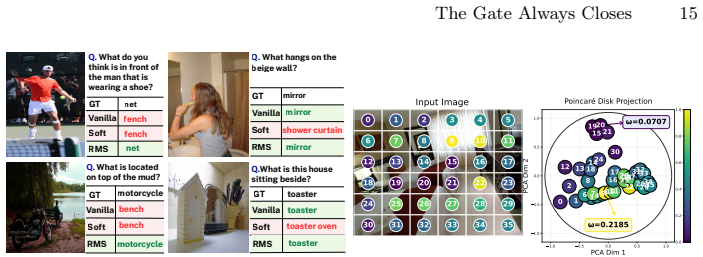
- Out-of-distribution spatial reasoning (VSR) is preserved only when the geometric losses are active in the coupled forward pass; removing them collapses VSR by 4.6pp.
Reading between the lines
- The suppression mechanism should generalise to any caption-invariant auxiliary signal—adapters, side-networks, external-memory injection—not just geometric ones; a text-coupled injection that depends on the caption would be the direct test.
- The G2 ablation's attribution of the VSR drop to geometric losses is weakened by the differing training duration reported in the supplement (18h vs 14h); a matched-training-duration ablation would settle it.
- The behavioural-closure criterion suggests evaluating auxiliary pathways by inference-time ablation rather than by gate parameter value, which could change how the field reports gate-based injection results.
- The norm-mismatch story implies that other VLM adapter architectures with silent norm mismatches may have hidden generation degradations; RMS scaling to text-embedding statistics is a cheap universal check.
Editorial analysis
A structured set of objections, weighed in public.
Referee Report
Summary. The paper studies learnable gated pathways for injecting auxiliary signals (attention biases and prefix tokens derived from a hyperbolic relational graph) into frozen VLMs. It reports that across five injection designs, every gated pathway becomes behaviorally closed: task accuracy is nearly invariant to ablating the pathway at inference even when the gate parameter would nominally pass 30–45% of the signal. The authors propose a two-regime explanation (dead-gradient and negative-utility) and, instead of fighting suppression, exploit it by using geometric losses (entailment and angular repulsion on the Lorentz manifold) as forward-coupled regularizers for LoRA. Main results include a task-selectivity dissociation on GQA (relational vs. attribute questions) and an out-of-distribution evaluation on VSR. A secondary contribution is an analysis of embedding-norm mismatch, with RMS normalization as a fix for generation-safe prefix injection.
Significance. The suppression phenomenon, if robust, is a genuinely useful empirical finding: it challenges the common design assumption that learnable gates will admit beneficial auxiliary signals, and it offers a concrete recommendation to inject signals non-optionally at matched scales. The norm-mismatch analysis and the RMS fix are clear and well demonstrated. The forward-coupling idea for geometric losses is also interesting. However, the paper's most load-bearing causal claim—that the geometric losses, not the hyperbolic architecture or generic perturbation, carry the out-of-distribution spatial signal on VSR—rests on an ablation (G2) that the paper's own supplement shows is confounded by a different training budget. The manuscript also contains an internal contradiction about the fixed-random-prefix control. These issues undermine the central OOD attribution, though the suppression and norm-matching results are likely salvageable with additional experiments or softened claims.
major comments (3)
- [Sec. 6.1, Table 5, Supp. Sec. 3] The OOD claim that geometric losses are the source of VSR preservation depends entirely on the G2 ablation: RMS-prefix (60.01%) vs. G2 (55.37%) is described as a 'diagnostic' ablation that 'isolates the contribution of the geometric losses from that of the hyperbolic architecture and dropout schedule.' However, Supp. Sec. 3 states that G2 took 18h versus 14h for RMS-prefix because 'more epochs were needed to converge.' This changes two variables at once: the presence of the geometric losses and the amount of GQA fine-tuning. Since all fine-tuned configurations lose 6–12pp to vanilla on VSR, additional GQA epochs could independently erode OOD performance. The paper does not list this training-budget mismatch as a limitation in Supp. Sec. 9, nor does it control for epochs. A matched-budget ablation (e.g., early stopping G2 at 14h or training both to the same epoch count) is required to jus
- [Related Work (Sec. 2), Supp. Sec. 1, Supp. Sec. 9] The paper claims to control for the NEFTune-style noise-regularisation hypothesis with a 'fixed-random prefix baseline (Sec. 6, G2)' in Related Work, and Supp. Sec. 1 repeats 'fixed-random prefix baseline (G2).' But G2 is not a fixed-random prefix: it is the hyperbolic prefix with geometric losses removed, retaining the hyperbolic graph, Einstein midpoint aggregation, and the rest of the training recipe. Supp. Sec. 9 then admits that a fixed-random-prefix control 'was not run within the sprint budget.' This is an internal contradiction. The statement overstates the degree of control and should be corrected; without an actual fixed-random-prefix run, the geometric-loss effect is not distinguished from generic input-embedding perturbation. Either add the control or explicitly remove the claim from both the Related Work and Supp. Sec. 1.
- [Table 4, Sec. 6.1] The 'clean dissociation' between geometric and no-geometric configurations on GQA-rel is stated as a headline finding, but the statistical support is limited. The paper itself notes that CI comparisons are unpaired and defers a paired bootstrap test. Two of the four key comparisons (Attn. bias vs. soft prompt / Euclidean) have overlapping CIs, and every configuration is a single training seed. The conclusion that the three no-geometric configurations lose relative to vanilla is supported (their CIs are disjoint from vanilla), as is the claim that geometric configurations overlap vanilla. However, the stronger claim of a dissociated trade-off—geometric configurations are significantly better than no-geometric ones on relational accuracy—is not established by these unpaired, single-seed comparisons. The 'clean' language should be softened unless the paired test is performed and training-se
minor comments (5)
- [Table 1] The term 'essentially invariant' is used for ablation deltas up to 1.25pp on a 2,000-question subset where the standard error is roughly 1.1pp. Reporting bootstrap CIs for the ablation deltas, at least for S4 and S5, would make the behavioural-closure claim more precise.
- [Proposition 1, Sec. 4.2] The proposition is stated as 'First-order gradient vanishes under caption-invariance,' but Eq. (5) gives a non-zero expression in general. The vanishing conclusion relies on the additional noise-assumption about the difference in ∂ℓ/∂h between captions. Suggest rephrasing to 'first-order gradient is dominated by noise' to avoid overclaiming.
- [Sec. 6.3, Supp. Table 4] The text says the RMS-prefix POPE cost is '1–2pp,' but Supp. Table 4 shows a 2.33pp drop on the random split (86.30 vs. 83.97). Please reconcile the numbers.
- [Table 6] Row 3, 'Forward + gradient (raw prefix, geo losses on),' is attributed to [4] in the caption, but the table itself does not mark it clearly as a value from another paper. For consistency with Table 3, add an explicit 'reported in [4]' marker to the row.
- [Supp. Fig. S1 vs. Fig. 2] The gate-trajectory figure appears twice (Fig. 2 in the main text and Supp. Fig. S1), with slightly different panel labels. Consider using a single figure to avoid duplication and ensure the left/right panels are described consistently.
Circularity Check
No derivation reduces to its inputs by construction; the suppression finding is directly measured. Self-citations to [4]/[21] are material but not load-bearing, and the main weakness (G2 training-budget confound) is a correctness issue rather than a circular step.
full rationale
The central suppression finding is an empirical measurement, not a derived prediction: Tables 1 and 2 directly compare accuracy with/without the auxiliary pathway at inference, and the gate trajectories in Fig. 2 are observed, so no step defines the finding into existence. The geometric-regularisation claim is supported by this paper's own control transitions (frozen→detach +1.75pp GQA, Table 6) and by RMS-prefix runs (60.75/61.25, Tables 3 and 6), so it does not reduce to the self-cited [4] rows, which are labelled 'reference only.' The paper does inherit the Lorentz/entailment architecture and angle-loss terms from [4] and [21] (both sharing authors), but those are experimental inputs, not conclusions; no uniqueness theorem is imported, and the cosh/rescaling choices are explicit rather than hidden. The most serious validity concern is the G2 control: main text Sec. 6.1 calls it 'diagnostic' and says it 'isolates the contribution of the geometric losses from that of the hyperbolic architecture and dropout schedule,' but Supp. Sec. 3 reports 'G2 ablation 18h (longest because it inherits the RMS-prefix architecture without benefit of the geometric-loss regularisation, so more epochs were needed to converge)' versus 14h for RMS-prefix. That is a training-budget mismatch, so the 4.6pp VSR drop changes two variables at once. This is an experimental-confounds/correctness issue, not a definitional reduction: the VSR number is not equal to any fitted parameter or prior result by construction. Similarly, Related Work claims a fixed-random-prefix control ('We control for this confound with a fixed-random prefix baseline (Sec. 6, G2)') that Supp. Sec. 9 says was not run ('We did not run it within the sprint budget for this submission'), an internal inconsistency in the control story, but again not a circular equation. On the circularity axis, the paper's derivations are self-contained enough that no 'prediction' is equivalent to its inputs; the score reflects the material, though not load-bearing, self-citations.
Assumptions & free parameters
free parameters (5)
- alpha_max (geometric loss ramp ceiling) =
0.05 (S1) / 0.01 (S2)
- lambda_ang, lambda_ent, lambda_kappa =
not stated in main text
- IoA thresholds =
containment IoA>0.8; disjoint IoA<0.05
- K_omega (cone aperture constant) =
0.1
- Curvature kappa =
learnable, init 1.0, clamped [0.1, 5.0]
assumptions (6)
- domain assumption The auxiliary signal b(I) is image-only/caption-invariant
- ad hoc to paper Additive linearisation h(I,c;gamma) ≈ h0(I,c) + gamma*g(b(I))
- domain assumption Attention bias affects only image-patch self-attention positions disjoint from caption tokens
- domain assumption RMSNorm equalises per-token key magnitudes in every layer, so the 36x input-norm gap cannot saturate softmax through Q/K norms
- domain assumption GQA rel/attr semantic labels are a reliable division for the dissociation analysis
- standard math Einstein midpoint, exponential map, and entailment cone definitions are correct as inherited from prior hyperbolic geometry work
Cite this review
Pith. "Pith review of The Gate Always Closes: On Injecting Auxiliary Signals into Frozen Vision-Language Models." pith.science (2026). https://pith.science/paper/C2I2QO45
@misc{pith2026260723335,
  author       = {Pith},
  title        = {Pith review of: The Gate Always Closes: On Injecting Auxiliary Signals into Frozen Vision-Language Models},
  year         = {2026},
  howpublished = {\url{https://pith.science/paper/C2I2QO45}},
  note         = {Machine review of arXiv:2607.23335}
}
read the original abstract
Auxiliary signal pathways in VLMs are routinely fitted with learnable gates so the optimiser can decide how much of the signal to admit. We find that the optimiser almost always decides on zero: across five injection designs, every gated pathway becomes behaviourally closed, with accuracy invariant to ablating the pathway at inference even when the gate parameter would nominally pass 30-45% of the signal. We attribute this suppression phenomenon to two regimes, a dead-gradient regime formalised through the caption-invariance of image-derived signals, and a negative-utility regime in which the auxiliary signal actively hurts the loss. Rather than fight suppression, we exploit it: we regularise LoRA fine-tuning with geometric auxiliary losses from hyperbolic visual relational graphs (IoA-driven entailment cones and angular repulsion on the Lorentz manifold), coupled only through the forward pass at training time and dropped at inference. Disaggregating GQA by question type exposes a clean dissociation. Three configurations without geometric losses at inference lose 2.85-3.39pp on relational questions while gaining ~1pp on attribute questions; a fourth that trains with the losses but infers through a soft prompt loses 5.14pp on rel for only +0.23pp on attr, so training-time regularisation alone does not protect relational accuracy without a geometric inference pathway. Configurations that keep the geometric pathway at inference preserve vanilla-level relational accuracy and match the attribute gain. Out of distribution on VSR, the RMS-prefix recipe preserves the spatial signal; stripping the geometric losses (G2) collapses VSR by 4.6pp, isolating them as the OOD source. A secondary result: embedding-norm alignment is necessary for generation-safe prefix injection, and learnable gates should be replaced with fixed, non-optional injection at matched scales.
Figures


Figures from the paper (4 more)



Reference graph
Works this paper leans on
-
[1]
In: ICLR (2026) 3, 20
Dalal, H.S., Kashiani, H., Afghah, F.: Constructive distortion for vision-language models via attention-guided image warping. In: ICLR (2026) 3, 20
2026
-
[2]
In: ICML (2023) 3, 20
Desai, K., Nickel, M., Rajpurohit, T., Johnson, J., Vedantam, R.: Hyperbolic image-text representations. In: ICML (2023) 3, 20
2023
-
[3]
In: NeurIPS D&B (2024) 3, 13, 20
Dumpala, S.H., et al.: SugarCrepe++: Fixing compositionality benchmarks with hard positives. In: NeurIPS D&B (2024) 3, 13, 20
2024
-
[4]
arXiv:2606.06100 (2026) 2, 3, 4, 9, 11, 12, 15, 20, 27
Farazi,M.,Ramasinghe,S.,Turza,M.A.,Rahman,S.:HyperVis:Continuouslatent visual relational graphs on the Lorentz hyperboloid for compositional reasoning. arXiv:2606.06100 (2026) 2, 3, 4, 9, 11, 12, 15, 20, 27
arXiv 2026
-
[5]
In: ICML (2018) 3, 4, 20
Ganea, O.E., Bécigneul, G., Hofmann, T.: Hyperbolic entailment cones for learning hierarchical embeddings. In: ICML (2018) 3, 4, 20
2018
-
[6]
Gao, P., Han, J., Zhang, R., et al.: LLaMA-Adapter V2: Parameter-efficient visual instruction model. arXiv:2304.15010 (2023) 3, 19
arXiv 2023
-
[7]
SIGKDD (2025) 3, 20
He, M., et al.: Hyperbolic deep learning for foundation models: A survey. SIGKDD (2025) 3, 20
2025
-
[8]
In: EMNLP (2023) 3, 20
Herzig, R., et al.: Incorporating structured representations into pretrained vision & language models using scene graphs. In: EMNLP (2023) 3, 20
2023
Show all 28 references
-
[9]
In: NeurIPS (2023) 3, 20
Hsieh, C.Y., Zhang, J., Ma, Z., et al.: SugarCrepe: Fixing hackable benchmarks for vision-language compositionality. In: NeurIPS (2023) 3, 20
2023
-
[10]
In: ICLR (2024) 3, 20, 28
Jain, N., Chiang, P.y., Wen, Y., Kirchenbauer, J., Chu, H.M., Somepalli, G., Bar- toldson, B.R., Kailkhura, B., Schwarzschild, A., Saha, A., Goldblum, M., Geiping, J., Goldstein, T.: NEFTune: Noisy embeddings improve instruction finetuning. In: ICLR (2024) 3, 20, 28
2024
-
[11]
In: ECCV (2022) 3, 19
Jia, M., Tang, L., Chen, B.C., et al.: Visual prompt tuning. In: ECCV (2022) 3, 19
2022
-
[12]
Kochurov, M., Karimov, R., Kozlukov, S.: Geoopt: Riemannian optimization in PyTorch (2020),https://github.com/geoopt/geoopt6, 23
2020
-
[13]
Transactions of the Association for Computational Linguistics11, 635–651 (2023) 13
Liu, F., Emerson, G., Collier, N.: Visual spatial reasoning. Transactions of the Association for Computational Linguistics11, 635–651 (2023) 13
2023
-
[14]
In: CVPR (2024) 1
Liu, H., Li, C., Li, Y., Lee, Y.J.: Improved baselines with visual instruction tuning. In: CVPR (2024) 1
2024
-
[15]
In: ICCV (2025) 3, 20
Mishra, S., Saenko, K., Saligrama, V.: SCRAMBLe: Preference-tuned vision- language models for visio-linguistic compositionality. In: ICCV (2025) 3, 20
2025
-
[16]
In: CVPR (2024) 3, 20 18 Authors Suppressed Due to Excessive Length
Mitra, C., Huang, B., Darrell, T., Herzig, R.: Compositional chain-of-thought prompting for large multimodal models. In: CVPR (2024) 3, 20 18 Authors Suppressed Due to Excessive Length
2024
-
[17]
In: NeurIPS (2017) 3, 20
Nickel, M., Kiela, D.: Poincaré embeddings for learning hierarchical representa- tions. In: NeurIPS (2017) 3, 20
2017
-
[18]
In: ICLR (2025) 3, 20
Pal, A., et al.: Compositional entailment learning for hyperbolic vision-language models. In: ICLR (2025) 3, 20
2025
-
[19]
In: NeurIPS (2025) 3, 20
Peng, L., Xu, M., Liu, C., Yang, Y., Shen, Z.: Efficient training in hyperbolic space for multi-modal large language models. In: NeurIPS (2025) 3, 20
2025
-
[20]
In: ICLR (2022) 3, 20
Press, O., Smith, N.A., Lewis, M.: Train short, test long: Attention with linear biases enables input length generalization. In: ICLR (2022) 3, 20
2022
-
[21]
In: CVPR (2024) 2, 3, 4, 5, 20
Ramasinghe, S., Khan, S., Barnes, N., et al.: Accept the modality gap: An explo- ration in the hyperbolic space. In: CVPR (2024) 2, 3, 4, 5, 20
2024
-
[22]
Neurocomputing (2024) 3, 20
Su, J., Lu, Y., Pan, S., Murtadha, A., Liu, B., Liu, Y.: RoFormer: Enhanced transformer with rotary position embedding. Neurocomputing (2024) 3, 20
2024
-
[23]
In: CVPR (2022) 3, 20
Thrush,T.,Jiang,R.,Bartolo,M.,etal.:Winoground:Probingvisionandlanguage models for visio-linguistic compositionality. In: CVPR (2022) 3, 20
2022
-
[24]
World Scientific (2005) 5, 21
Ungar, A.A.: Analytic Hyperbolic Geometry: Mathematical Foundations and Ap- plications. World Scientific (2005) 5, 21
2005
-
[25]
In: ICASSP (2025) 3, 20
Wang, H., et al.: Enhancing visual grounding and generalization: A multi-task learning approach with scene graph expressions. In: ICASSP (2025) 3, 20
2025
-
[26]
In: NeurIPS (2025) 3, 20
Wu, Y., et al.: FlashBias: Fast computation of attention with bias. In: NeurIPS (2025) 3, 20
2025
-
[27]
In: ICML (2026) 3, 20
Yang, C., et al.: Scene graph thinking: Reinforcing structured visual reasoning for multimodal large language models. In: ICML (2026) 3, 20
2026
-
[28]
The Gate Always Closes: On Injecting Auxiliary Signals into Frozen Vision-Language Models
Yüksekgonul, M., Bianchi, F., Kalluri, P., Jurafsky, D., Zou, J.: When and why vision-language models behave like bags-of-words, and what to do about it? In: ICLR (2023) 3, 20 Supplementary Material: “The Gate Always Closes: On Injecting Auxiliary Signals into Frozen Vision-La...
2023
Reviewed July 31, 2026 · model on record in the stance chip above.
Discussion (0). Sign in to comment.