REVIEW 5 major objections 8 minor 61 references
Fractional Holographic Dark Energy Wormholes: A Comprehensive Geometrical, Physical, and Thermodynamic Investigation
T0 review · 5 major / 8 minor · reviewed 2026-07-30 · grok-4.5
Pith's one-line read Fractional holographic dark energy can source traversable Morris–Thorne wormholes that need less exotic matter as the fractional order rises.
desk verdict Solid checklist construction once you accept their working density, but eq. (2) does not match what they integrate, and asymptotic flatness only holds for γ>2—not the full range they advertise and plot. read the letter →
The pith
A machine-rendered reading of the paper's core claim, the machinery that carries it, and where it could break.
The reading
What carries the argument
The fractional holographic density ρ_FHDE=3d² L^{2−3γ}/γ (recovered as ordinary holographic dark energy when γ=2), identified with the wormhole energy density μ(r) and integrated once to give the explicit shape function Ψ(r)=r₀+12π d² γ (r^{2/γ}−r₀^{2/γ}). That shape function carries every subsequent geometric, physical and thermodynamic claim.
What would settle it
Compute or measure whether the radial null-energy-condition violation and the volume-integral quantifier of exotic matter actually decrease with rising γ for the derived shape function; if they do not, or if the Kretschmann scalar diverges at the throat, the central claim fails.
Extended reading notes
Core claim
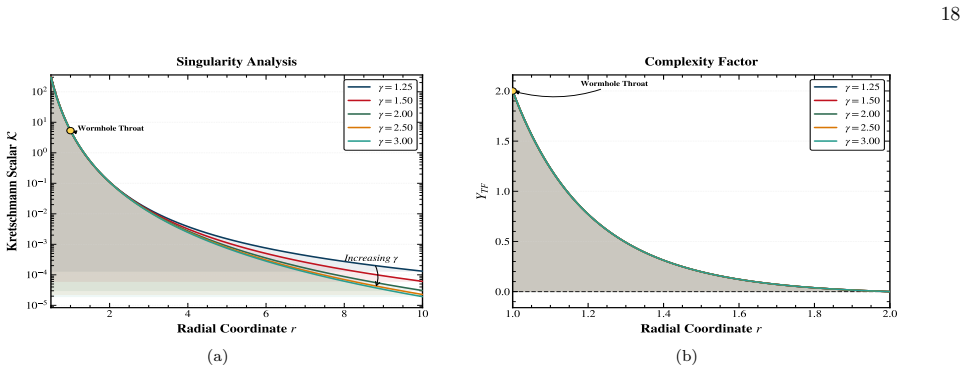
A new class of Morris–Thorne wormholes sourced by fractional holographic dark energy, with redshift φ(r)=−0.1/r, satisfies the throat, flare-out and asymptotic-flatness conditions, remains free of curvature singularities, and becomes progressively less exotic and more thermodynamically regular as the fractional parameter γ is increased.
Load-bearing premise
The cosmological infrared cutoff that defines holographic dark energy is simply replaced by the static radial coordinate of the wormhole, with no derivation that justifies using a horizon-scale bound as a local radial density.
Editorial extensions
If this is right
- Larger fractional order γ yields traversable wormholes that require a smaller finite amount of exotic matter while still flaring out.
- The same solutions remain curvature-nonsingular and hydrostatically balanced for the explored range of γ.
- Thermodynamic quantities (temperatures, internal energy, specific heat) stay positive and smooth, indicating local thermal stability near the throat.
- The fractional parameter acts as a continuous regulator that softens phantom behaviour without destroying traversability.
- The construction supplies an explicit analytic bridge between fractional cosmology and static wormhole geometry inside Einstein gravity.
Reading between the lines
- If the radial-cutoff identification can be derived from a proper holographic screen in static spherical symmetry, the same fractional density could be ported to other modified-gravity wormhole models with less ad-hoc input.
- Observational signatures proposed in the outlook (shadows, photon rings, gravitational-wave echoes) would scale with γ, offering a concrete target for future imaging or ringdown searches.
- The reduction of exoticity with γ suggests a broader pattern: non-integer calculus corrections may systematically lower the energy-condition price of other exotic spacetimes.
Editorial analysis
A structured set of objections, weighed in public.
Referee Report
Summary. The authors construct Morris–Thorne wormhole solutions in GR by inserting a fractional holographic dark energy (FHDE) density into the (t,t) Einstein equation with redshift function ϕ(r) = −0.1/r, obtaining the closed-form shape function Ψ(r) = r0 + 12πd²γ(r^{2/γ} − r0^{2/γ}) (Eq. 22). They then survey throat/flare-out conditions, embeddings, energy conditions, EoS parameters, active mass, compactness, exoticity, volume-integral quantifier, TOV equilibrium, Kretschmann scalar, complexity factor, and a thermodynamic analysis (Hawking/wormhole temperature, first law with S = 4πr², specific heat), concluding that increasing the fractional parameter γ yields less exotic, more regular, thermodynamically stable wormholes over the plotted range γ = 1.25–3 with d = 0.05, r0 = 1.
Significance. If the solution were internally sound, the work would be a competent example of the "DE-sourced wormhole" genre: the integration yielding Eq. (22) is elementary and given in closed form, the throat and flare-out checks are explicit, and the survey of diagnostics is unusually complete, so the parameter dependence of NEC violation is cleanly falsifiable within the model. However, as detailed below, the derivation contains an internal algebraic break at its starting point (Eq. 2 vs. Eq. 17), and the asymptotic-flatness and finite-exotic-matter claims fail in closed form for most of the advertised parameter range. As written, the central conclusions of the abstract, Summary, and §VII do not hold for three of the five γ values plotted. The results as stated are therefore not currently reliable; a corrected version restricted to the genuinely asymptotically flat regime (γ > 2) might still be of modest interest to the wormhole-phenomenology community.
major comments (5)
- [§II, Eqs. (2), (16)–(18)] The derivation is internally inconsistent at its starting point. Eq. (2) defines ρ_FHDE = 3d²L^{2−3γ}/γ, so under the paper's own identification L → r (Eq. 16) the source density should scale as r^{2−3γ}. But Eq. (17) instead inserts μ = 3d²r^{−3+2/γ}. The exponents agree only where 2−3γ = −3+2/γ, i.e. γ = 1 or γ = 2/3 — none of the plotted values (γ = 1.25…3). Everything downstream (Ψ in Eq. 22, all figures, NEC/SEC, thermodynamics, complexity) is sourced by Eq. 17, not by the advertised Eq. 2. Furthermore Eq. (2) fails its own stated consistency check: at γ = 2 it gives (3d²/2)L^{−4}, not the standard HDE density 3d²M_p²L^{−2} of Eq. (1) which the text claims is recovered; note that Eq. 17's density r^{2/γ−3} does reduce to r^{−2} at γ = 2, suggesting Eq. (2) may be a transcription error for the actual model of Ref. [33] (Trivedi et al.). The authors must (i) state the FHDE density exa
- [§III.A–C, Fig. 1, Eq. (6) vs. Eq. (22)] The asymptotic-flatness claim fails in closed form for three of the five plotted γ values. From Eq. (22), Ψ/r = r0/r + 12πd²γ(r^{2/γ−1} − r0^{2/γ}/r). The limit as r→∞ is 0 only for γ > 2; at γ = 2 it tends to 24πd² ≈ 0.19 (d = 0.05), and for γ < 2 it diverges. Consequently, for γ = 1.25 and 1.5 the function 1 − Ψ/r acquires a second zero at finite r (for γ = 1.25, d = 0.05, r0 = 1, near r ≈ 34), beyond which g_rr changes sign and the spacetime is not Lorentzian in the advertised way — there is no second asymptotic region at all. The figures only extend to r ≈ 3 (Fig. 1) and r ≈ 7 (Fig. 3), so the failure is invisible in the plots, but the claims in §III.A ('monotonically grows up to unity… spacetime becomes asymptotically flat'), §III.C ('two asymptotically flat universes'), and the Summary are false for γ ≤ 2. Related quantities inherit the failure: the active mass M(r) ~ r^{2/γ} and c
- [§V.D, Eq. (51), Fig. 9(b)] The volume-integral quantifier claim ('finite amount of exotic matter', §V.D, Fig. 9b) is contradicted by the asymptotics of the solution itself. Using Eqs. (9)–(10) with Eq. (22), μ + p_rd ~ r^{2/γ−3} at large r (the ϕ′ term is subleading), so the integrand of Eq. (51) behaves as r^{2/γ−1} and the integral to ∞ diverges for every γ ≥ 1 — i.e., for the entire plotted range. The finite-looking curves in Fig. 9(b) are artifacts of truncating the integral at r = 3. Either the VIQ must be computed and reported as divergent (removing the 'finite exotic matter' selling point), or the model must be changed. Note this point is logically tied to Major Comment 2: for γ > 2 the VIQ still diverges (2/γ − 1 > −1 requires γ < 1 for convergence), so no value of γ in the advertised family yields a convergent VIQ.
- [§II, Eq. (16)] The replacement of the cosmological IR cutoff L by the static radial coordinate r (Eq. 16) is load-bearing and unjustified. In HDE, L is a horizon scale (e.g., the future event horizon) of a cosmological spacetime; in a static MT geometry there is no such horizon, and no argument is given for why a local radial coordinate should play that role. At minimum the authors should (i) acknowledge this is an ad hoc identification following (and citing) prior literature that does the same, and (ii) discuss sensitivity: e.g., whether L = r vs. L = proper radial distance ∫dr/√(1−Ψ/r) changes the conclusions. As it stands the identification is presented as definition rather than assumption.
- [§IV.A–D, Eqs. (31), (36)–(37), (42)] The thermodynamic section imports black-hole identities into a horizonless spacetime without justification, and one result is internally inconsistent. Eq. (31) defines a 'Hawking temperature' T_HK = √(1−Ψ/r)ϕ′/(2π); for a wormhole with no horizon there is no Hawking radiation, and the cited source (Ref. [37], an undergraduate research journal) does not establish the formula. Moreover, since 1−Ψ/r = 0 at the throat, Eq. (31) gives T_HK(r0) = 0, contradicting the text's claim that the temperature 'attains its maximal value close to the WH throat' (Fig. 4a shows the maximum at r ≈ 1.2, off the throat). Similarly, S = 4πr² (Eq. 37) is an area law imported without argument, and C_v via Eq. (42) inherits both issues. The authors should either provide a derivation of these identifications for horizonless geometries (there is literature on wormhole thermodynamics that could be engaged, e.g., Ref
minor comments (8)
- [§II, Eq. (11)] Eq. (11) mixes notation: it contains both Ψ (used elsewhere) and b ('b′r−b' terms) for the shape function; also the last term −b′r−b/2r²(r−b) appears dimensionally/structurally inconsistent with the standard MT tangential-pressure equation. Please rewrite in uniform Ψ notation.
- [§III.C] §III.C, first sentence after Eq. (30): 'The integration of Eq. (1)' should read Eq. (30).
- [§IV.A–B, Fig. 4] Eq. (34) and the Fig. 4 caption write the holographic parameter as 'c' (12πc²γ…, 'c = 0.05') whereas everywhere else it is d = 0.05.
- [§I, §III, §IV.C, Fig. 7] Typos: 'fractonal' (§I roadmap and §IV.C), 'density of HFR' (opening of §III) presumably meaning FHDE, 'paramtric' (Fig. 7 caption), 'SEC is quite happy with the given domain' (§V.A) is informal for a journal article.
- [§II, Eq. (2)] Eq. (2) omits the factors of M_p present in Eq. (1); even after the exponent issue in Major Comment 1 is fixed, units and the γ = 2 limit should be made explicit.
- [Figs. 1–11] All figures are confined to r ≤ 3 (or r ≤ 7 for embeddings); given the closed-form solution, extending the radial range (e.g., to r ~ 50) would immediately reveal the γ ≤ 2 pathology of Major Comment 2 and should be standard practice.
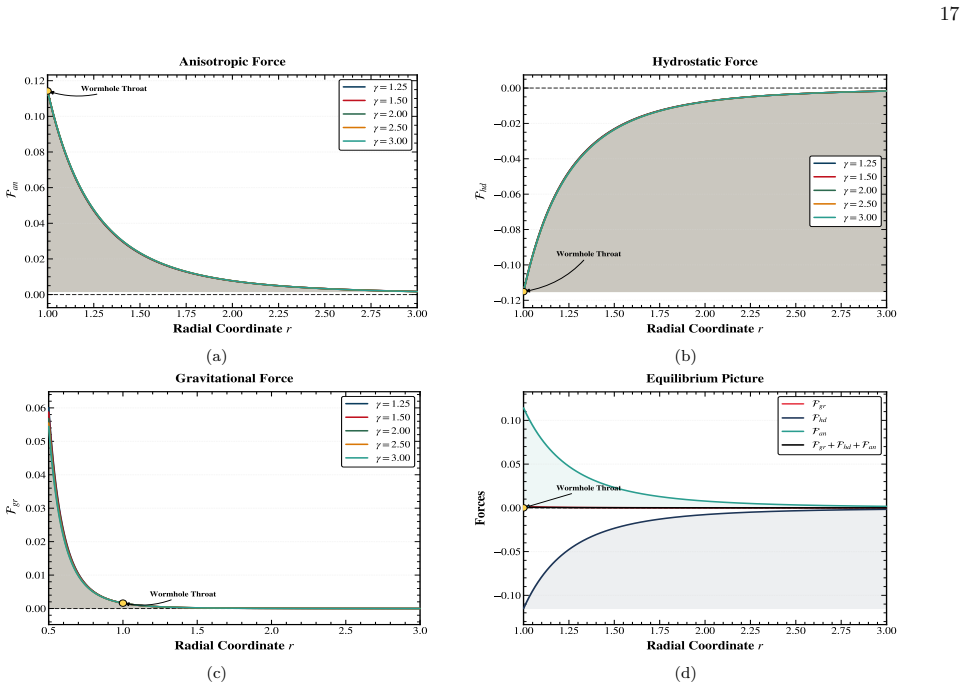
- [§V.E, Fig. 10] Fig. 10(d) plots the force balance for a single (unspecified) γ while panels (a)–(c) show all γ; please state which curve is shown, or show the sum for each γ.
- [Data Availability] The data-availability statement says no data exist, yet the paper's results are entirely numerical plots from a 'reliable Python library' (§III.C); depositing the plotting scripts would materially improve reproducibility at negligible cost.
Circularity Check
No circularity: standard assume-density-then-integrate model building; free parameters are chosen, not fitted-then-predicted.
full rationale
The load-bearing chain is: adopt fractional HDE density (eq. 2, citing Trivedi/Bidlan), identify μ(r)=ρ_FHDE with L→r (eq. 16), insert into G_tt to get Ψ'(r) (eqs. 17–18), integrate with throat condition to obtain Ψ(r) (eq. 22), then evaluate flare-out, embedding, NEC/SEC, thermodynamics, Kretschmann, and complexity on that solution. That is ordinary GR model construction, not a prediction forced by its inputs. Parameters (d, γ, r0, φ amplitude −0.1/r) are fixed by hand and plotted; nothing is fitted to external data and re-reported as confirmation. Self-citations to the authors’ prior wormhole papers supply motivation and context only; the shape-function algebra and subsequent diagnostics do not rest on a self-cited uniqueness theorem or ansatz smuggled in as external fact. Algebraic inconsistency between the written ρ_FHDE (eq. 2) and the exponent actually integrated (eq. 17), and failures of asymptotic flatness/finite IV for parts of the γ range, are correctness defects, not circular reductions. No self-definitional loop, fitted-input-as-prediction, or load-bearing self-citation chain is present.
Assumptions & free parameters
free parameters (4)
- fractional parameter γ =
1.25–3.0 (scan)
- holographic parameter d =
0.05
- throat radius r0 =
1
- redshift amplitude in φ(r)=−0.1/r =
0.1
assumptions (6)
- domain assumption Einstein equations G_βζ=8πT_βζ in geometrized units with anisotropic fluid source on the MT metric
- ad hoc to paper Fractional HDE density ρ_FHDE∝L^{(2−3γ)/γ} (recovering ordinary HDE at γ=2) is a valid local energy density for a static wormhole when L is replaced by r
- ad hoc to paper Redshift φ(r)=−0.1/r is finite, horizon-free, and adequate to capture tidal gravity
- domain assumption Morris–Thorne throat, flare-out Ψ'(r0)<1, and asymptotic flatness are the criteria for traversability
- ad hoc to paper Black-hole-style thermodynamic identities (Hawking temperature from surface gravity-like formula, first law dE=T dS+W dV with S=4πr²) apply to these horizonless wormholes
- standard math Integration and differentiation under standard real analysis on r≥r0
invented entities (1)
-
Fractional-holographic-dark-energy Morris–Thorne wormhole family with φ=−0.1/r
Cite this review
Pith. "Pith review of Fractional Holographic Dark Energy Wormholes: A Comprehensive Geometrical, Physical, and Thermodynamic Investigation." pith.science (2026). https://pith.science/paper/4WCBQRC3
@misc{pith2026260723403,
  author       = {Pith},
  title        = {Pith review of: Fractional Holographic Dark Energy Wormholes: A Comprehensive Geometrical, Physical, and Thermodynamic Investigation},
  year         = {2026},
  howpublished = {\url{https://pith.science/paper/4WCBQRC3}},
  note         = {Machine review of arXiv:2607.23403}
}
read the original abstract
The discovery of the accelerated expansion of the cosmos has sparked great interest in studying the nature of the mysterious force behind this effect, often called dark energy. Several theories were proposed to study the nature of dark energy, and holographic dark energy stands out among them due to the relation between dark energy density and the principles of quantum gravity and holography. Recent progress made in fractional cosmology has led to the addition of fractional correction terms to the definition of holographic dark energy. Based on such progress, in this study, we investigate the behavior of fractional holographic dark energy in forming exotic spacetimes, especially traversable wormholes, which represent intriguing solutions of Einstein's field equations connecting distinct regions of spacetime. In the present article, a new class of Morris--Thorne wormhole solutions is obtained under the consideration of fractional holographic dark energy as the source of the gravitational field with a varying redshift function in the context of Einstein gravity. To study the nature of wormholes, their geometry, viability, and thermodynamic behavior, a shape function is obtained, and the wormholes are analyzed in detail via embedding diagrams, throat geometry, active gravitational mass, compactness, exoticity factor, energy conditions, conservation law, volume integral quantifier, Kretschmann invariant, and complexity factor. Moreover, thermodynamic properties of the wormholes are studied via the examination of several parameters, including Hawking temperature, wormhole temperature, entropy, energy, work density, and heat flux, aiming to understand the influence of fractional holographic corrections on the stability and evolution of traversable wormhole structures.
Figures


Figures from the paper (8 more)


Reference graph
Works this paper leans on
-
[33]
De Falco, E
V. De Falco, E. Battista, S. Capozziello, and M. De Laurentis, Phys. Rev. D101, 104037 (2020)
2020
-
[37]
Li, X.-D
M. Li, X.-D. Li, S. Wang, and Y. Wang, Communications in theoretical physics56, 525 (2011)
2011
-
[1]
The description of fractional HDE and WH field equations are provided in Section II
-
[2]
To understand the geometric structure of the models, the nature of the shape function, throat geometry, and embedded surfaces are analyzed in Section III
-
[3]
The thermodynamics is developed by investigating Hawking, WH temperatures, entropy, energy, work density, and heat flux of the solution in Section IV. 3
-
[4]
In Section V, the physical nature of the models is explored by examining energy conditions, the equation-of- state (EoS) parameters, compactness, active gravitational mass, and the exoticity parameter, the conservation equations, and the volume integral quantifiers
-
[5]
Finally, in Section VI, the nature of regularity and structural stability has been investigated via Kretschmann and complexity factors, and Section VII provides the concluding arguments. The results obtained in this research provide new insight into the nature of the role of fractional HDE in forming traversable WH geometry and developing a link between q...
-
[6]
R. M. Wald,General relativity(University of Chicago press, 2010)
2010
Show all 61 references
-
[7]
A. G. Riess, A. V. Filippenko, P. Challis, A. Clocchiatti, A. Diercks, P. M. Garnavich, R. L. Gilliland, C. J. Hogan, S. Jha, R. P. Kirshner,et al., Astron. J.116, 1009 (1998)
1998
-
[8]
S. P. e. a. Supernova Cosmology Project collaboration, Astrophys. J.517, 565 (1999)
1999
-
[9]
Aghanimet al., Astron
N. Aghanimet al., Astron. Astrophys.641, A6 (2020)
2020
-
[10]
D. N. Spergel, L. Verde, H. V. Peiris, E. Komatsu, M. Nolta, C. L. Bennett, M. Halpern, G. Hinshaw, N. Jarosik, A. Kogut, et al., Astrophys. J. Suppl. Ser.148, 175 (2003)
2003
-
[11]
Yousaf, Phys
Z. Yousaf, Phys. Dark Universe48, 101884 (2025)
2025
-
[12]
A. G. Cohen, D. B. Kaplan, and A. E. Nelson, Phys. Rev. Lett.82, 4971 (1999)
1999
-
[13]
Li, Phys
M. Li, Phys. Lett. B603, 1 (2004)
2004
-
[14]
Pavon and W
D. Pavon and W. Zimdahl, Phys. Lett. B628, 206 (2005)
2005
-
[15]
C. Gao, F. Wu, X. Chen, and Y.-G. Shen, Phys. Rev. D79, 043511 (2009)
2009
-
[16]
Granda and A
L. Granda and A. Oliveros, Phys. Lett. B671, 199 (2009)
2009
-
[17]
M. S. Morris and K. S. Thorne, Am. J. Phys.56, 395 (1988)
1988
-
[18]
De Falco, E
V. De Falco, E. Battista, S. Capozziello, and M. De Laurentis, Eur. Phys. J. C81, 157 (2021)
2021
-
[19]
Di Grezia, E
E. Di Grezia, E. Battista, M. Manfredonia, and G. Miele, Eur. Phys. J. Plus132, 537 (2017)
2017
-
[20]
G. G. L. Nashed, arXiv preprint gr-qc/0508079 (2005)
2005 arXiv
-
[21]
G. G. L. Nashed, Grav. Cosmol.15, 256 (2009)
2009
-
[22]
Battista, S
E. Battista, S. Capozziello, and A. Errehymy, Eur. Phys. J. C84, 1314 (2024)
2024
-
[23]
H. Asad, M. Yousaf, U. Zafar, J. Rayimbaev, and A. Dauletov, Fortschr. Phys.73, e70034 (2025)
2025
-
[24]
O. A. Almatroud, M. Rizwan, M. Alshammari, M. Bhatti, S. Alshammari, and Z. Yousaf, Eur. Phys. J. C85, 1285 (2025)
2025
-
[25]
Alshammari, M
M. Alshammari, M. Rizwan, O. A. Almatroud, M. Bhatti, S. Alshammari, and Z. Yousaf, Phys. Dark Universe52, 102219 (2026)
2026
-
[26]
A. H. Alblowy, M. Rizwan, N. Iqbal, W. W. Mohammed, and H. Asad, Eur. Phys. J. C86, 45 (2026)
2026
-
[27]
G. G. L. Nashed and W. E. Hanafy, arXiv preprint arXiv:2505.20331 (2025)
2025
-
[28]
Yousaf, M
Z. Yousaf, M. Bhatti, M. Rizwan, J. Rayimbaev, I. Ibragimov, and I. Davletov, Nucl. Phys. B1019, 117128 (2025)
2025
-
[29]
A. M. Albalahi, Z. Yousaf, M. Rizwan, A. E. Hamza, and A. Ali, Eur. Phys. J. C86, 142 (2026)
2026
-
[30]
Yousaf, M
Z. Yousaf, M. Rizwan, M. Alshammari, O. A. Almatroud, S. Alshammari, and M. M. Al-sawalha, Phys. Dark Universe 50, 102082 (2025)
2025
-
[31]
Yousaf, G
M. Yousaf, G. Mustafa, A. Ditta, A. Alimova, and F. Atamurotov, Eur Phys. J. C86, 186 (2026)
2026
-
[32]
S. Khan, J. Rayimbaev, J. Kurbanov, M. Matyoqubov, and Z. Yousaf, Phys. Dark Universe52, 102354 (2026)
2026
- [34]
-
[35]
Susskind, J
L. Susskind, J. Math. Phys.36, 6377 (1995)
1995
-
[36]
B. Wang, E. Abdalla, F. Atrio-Barandela, and D. Pavon, Rep. Prog. Phys.79, 096901 (2016)
2016
-
[38]
Trivedi, A
O. Trivedi, A. Bidlan, and P. Moniz, Phys. Lett. B858, 139074 (2024)
2024
-
[39]
Bidlan, P
A. Bidlan, P. Moniz, and O. Trivedi, Eur. Phys. J. C85, 520 (2025)
2025
-
[40]
M. S. Morris, K. S. Thorne, and U. Yurtsever, Phys. Rev. Lett.61, 1446 (1988)
1988
-
[41]
H. G. Ellis, J. Math. Phys.14, 104 (1973)
1973
-
[42]
J. W. Keathley, PANDION: Osprey J. Res. Ideas3, 4 (2022). 21
2022
-
[43]
P. F. Gonzalez-Diaz, Phys. Rev. D85, 105026 (2012)
2012
-
[44]
Hong and S.-W
S.-T. Hong and S.-W. Kim, Mod. Phys. Lett. A21, 789 (2006)
2006
-
[45]
Ma and R
M.-S. Ma and R. Zhao, Phys. Lett. B751, 278 (2015)
2015
-
[46]
Saiedi, Mod
H. Saiedi, Mod. Phys. Lett. A27, 1250220 (2012)
2012
-
[47]
Martın-Moruno and P
P. Martın-Moruno and P. F. Gonz´ alez-Dıaz, Thermodynamics , 133 (2011)
2011
-
[48]
Martin-Moruno and P
P. Martin-Moruno and P. F. Gonzalez-Diaz, Phys. Rev. D80, 024007 (2009)
2009
-
[49]
Thermostatistics,
H. B. Callen, “Thermostatistics,” (1985)
1985
-
[50]
Ditta, G
A. Ditta, G. Mustafa, and A. Mahmood, J. High Energy Astrophys.45, 350 (2025)
2025
-
[51]
Visser, Woodbury (1995)
M. Visser, Woodbury (1995)
1995
-
[52]
Hochberg and M
D. Hochberg and M. Visser, Phys. Rev. Lett.81, 746 (1998)
1998
-
[53]
Herrera and N
L. Herrera and N. O. Santos, Phys. Rep.286, 53 (1997)
1997
-
[54]
R. L. Bowers and E. Liang, Astrophys. J.188, 657 (1974)
1974
-
[55]
Visser, S
M. Visser, S. Kar, and N. Dadhich, Phys. Rev. Lett.90, 201102 (2003)
2003
-
[56]
R. C. Tolman, Phys. Rev.55, 364 (1939)
1939
-
[57]
Kretschmann, Ann
E. Kretschmann, Ann. Phys.358, 575 (1918)
1918
-
[58]
Herrera, Phys
L. Herrera, Phys. Rev. D97, 044010 (2018)
2018
-
[59]
Herrera, A
L. Herrera, A. Di Prisco, and J. Ospino, Phys. Rev. D98, 104059 (2018)
2018
-
[60]
Herrera, A
L. Herrera, A. Di Prisco, and J. Carot, Phys. Rev. D99, 124028 (2019)
2019
-
[61]
Herrera, A
L. Herrera, A. Di Prisco, and J. Ospino, Phys. Rev. D99, 044049 (2019)
2019
Reviewed July 30, 2026 · model on record in the stance chip above.
Discussion (0). Continue with ORCID to comment.