REVIEW 5 major objections 7 minor 15 references
Multimodal LLMs can flag misleading YouTube thumbnails at over 93% accuracy without task-specific training.
Reviewed by Pith at T0; open to challenge. T0 means a machine referee read the full paper against a public rubric. the ladder, T0–T4 →
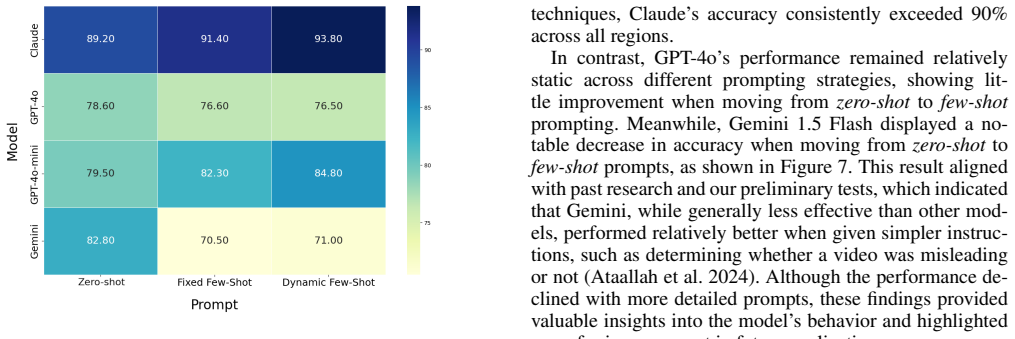
Claude 3.5 Sonnet with dynamic few-shot multi-modal prompts detects misleading YouTube thumbnails at 93.8% accuracy on a balanced cross-country dataset, outperforming CHECKER and open-weight VLMs.
T0 review reviewed 2026-07-30 challenge →
load-bearing objection Useful multi-country dataset and solid multi-model bake-off showing prompt-only VLMs can flag misleading thumbnails; the 93.8% and CHECKER “win” are overstated by a no-holdout, agreement-filtered protocol. the 5 major comments →
Separating Clicks from Baits: Using Large Language Models to Detect Misleading YouTube Thumbnails
The pith
A machine-rendered reading of the paper's core claim, the machinery that carries it, and where it could break.
The reading
Core claim
When given a thumbnail, subtitles, and a generated video description, Claude 3.5 Sonnet under dynamic few-shot prompting detects misleading YouTube thumbnails at 93.8% accuracy (precision above 92%, recall above 94% in reported settings) on a new 2,843-video cross-country dataset and exceeds the best F1 of the prior supervised CHECKER pipeline on CHECKER’s own test set, all without any task-specific training.
What carries the argument
A multi-modal detection pipeline that feeds the thumbnail image, subtitle transcript, and a concise video-to-text description into an LLM, guided by zero-shot, fixed few-shot, or dynamic few-shot (SBERT-retrieved) chain-of-thought prompts that define “misleading” as exaggeration, false promise, or thematic mismatch.
Load-bearing premise
Machine-generated video descriptions (sometimes written by the same model family that later classifies) are faithful enough proxies for the full video that thumbnail–content mismatch can be judged from them alone.
What would settle it
Re-run the identical prompts on the same videos but replace every generated description with a human-written scene-by-scene summary (or full untruncated video input) and check whether Claude’s 93.8% accuracy and the open-model gains collapse or hold.
If this is right
- Platforms can insert a lightweight pre-upload check that blocks or queues thumbnails whose semantic claim diverges from the video description and subtitles.
- Dynamic few-shot retrieval with culturally matched examples shrinks cross-country accuracy gaps to under three points, supporting region-aware moderation.
- Open-weight vision-language models improve substantially with the same retrieval prompts yet still lag proprietary systems by roughly 20 points, setting a clear target for open multimodal progress.
- Cost estimates place full daily YouTube-scale screening at a fraction of one percent of platform revenue, making deployment economically plausible.
Where Pith is reading between the lines
- If description quality is the hidden bottleneck, cheaper open models may close most of the gap once paired with stronger, model-agnostic video captioners.
- The same thumbnail–description–subtitle triple could transfer to short-form platforms (Reels, TikTok) where titles are even weaker signals.
- Failure modes concentrated on “full movie” claims and celebrity recognition suggest entity-linked visual grounding as the next concrete research lever.
Editorial analysis
A structured set of objections, weighed in public.
Referee Report
Summary. The paper studies whether multimodal LLMs can detect misleading YouTube thumbnails. The authors build a dataset of 2,843 videos from eight countries (1,359 misleading, 1,484 not), annotated by two trained annotators with only full-agreement items retained. They construct a classification pipeline that feeds each model the thumbnail image, subtitles, and a machine-generated video-to-text description, and evaluate four proprietary LLMs (Claude 3.5 Sonnet, GPT-4o, GPT-4o Mini, Gemini 1.5 Flash) and two open-weight VLMs (LLaVA-1.5, Qwen2.5-VL-7B) under zero-shot, fixed few-shot, and dynamic (SBERT-retrieved) few-shot prompting. Claude 3.5 Sonnet with dynamic few-shot prompting achieves 93.8% accuracy and is compared against the supervised CHECKER pipeline on CHECKER's 197-video test set (F1 0.7227 vs 0.7153). The paper also includes modality ablations, per-category and per-country breakdowns, a small human baseline (71.6% accuracy), and a deployment cost analysis.
Significance. If the results hold, this is a useful contribution to the content-integrity literature: misleading-thumbnail detection has a thin prior literature (CHECKER is essentially the only direct comparator), and the paper supplies (i) a publicly released, balanced, cross-country dataset with a codebook — a genuinely scarce resource; (ii) a systematic comparison of six models across three prompting regimes with modality ablations; (iii) an honest failure analysis and per-country/per-category slices showing where the method degrades; and (iv) a concrete cost model showing platform-scale feasibility. The qualitative findings — frontier proprietary LLMs substantially outperform open-weight VLMs, dynamic few-shot prompting helps most models, and prompt-based detection is competitive with a supervised pipeline without task-specific training — are supported by consistent model ordering across configurations and are plausible. However, the headline quantitative claims (93.8% accuracy; "surpassed CHECKER on all metrics") rest on an evaluation protocol with no held-out data and a comparator gap within sampling noise, so the magnitude of the contribution depends on revisions to the evaluation rathera
major comments (5)
- [§2.4, §4.2, Table 1] No held-out evaluation anywhere; the dynamic few-shot setting is transductive. §2.4 describes retrieving, for every test video, one labeled MTV and one labeled NMTV from the same 2,843-video dataset being scored, and the prompt design (CoT structure, 200-word truncation, example template) was iteratively refined while observing accuracy on this same data (§2.3–2.4, §4.3). The 93.8% headline figure (Table 1, abstract) is therefore a development-set number: labeled neighbors of each test point are in the prompt, and prompt hyperparameters were selected on the evaluation set. This is load-bearing for Contribution 5 ('state-of-the-art accuracy'). The fix is feasible within the paper's scope: e.g., a held-out split frozen before prompt tuning, or leave-one-country-out retrieval pools, which would also strengthen the cross-cultural claim in §4.5.
- [§2.2, §4.9] Ground truth is filtered to annotator-consensus items only, and the human baseline contradicts the headline number. §2.2 reports κ=0.9633 and retains only videos with full agreement (3,200 → 2,843 after disagreements and availability losses), so models are scored only on unambiguous cases. Meanwhile §4.9 reports that five humans given exactly the model's inputs (thumbnail + subtitles + description) achieve only 71.6% accuracy. A 22-point gap between Claude and humans on identical inputs, on consensus-only labels, suggests the labels encode judgments not recoverable from the model's input modalities — e.g., mismatch evidence visible only by watching the full video, which neither annotators' inputs at labeling time nor the model's truncated/20-frame description fully capture. The paper should (i) report how many items were dropped for disagreement, (ii) characterize model performance on or
- [§5] The CHECKER comparison is a 0.007 F1 gap on n=197 with no significance testing. §5 reports Claude F1 0.7227 vs CHECKER's best 0.7153 on CHECKER's 197-video test set. On ~197 samples, the standard error of an F1 difference of this size is far larger than the gap; a paired bootstrap or McNemar test would almost certainly show no significant difference. As written, the claim 'Claude surpassed CHECKER on all metrics' (Contribution 5, abstract) is not supported. The correct framing is parity with a supervised pipeline at zero training cost — which is still a meaningful result and should be claimed as such, with a significance test or confidence intervals added.
- [§4.1, §4.2, Table 5] Models are evaluated on different subsets of the data, so Table 1's cross-model ranking is not on identical inputs. Table 5 (Appendix A.5) shows Gemini processed 2,135 videos, Claude 2,759, GPT-4o-mini 2,769, GPT-4o 2,749, due to model-specific safety filters and the Twelve Labs 360p exclusion (§4.1). Accuracy differences of a few points (e.g., Gemini 82.8% vs GPT-4o-mini 84.8%) could be entirely explained by which videos each model was allowed to see — plausibly Gemini's stricter filters removed a non-random (more extreme, possibly easier) slice. §7 acknowledges this, but the main-text comparison in §4.2 and Figure 6 presents the numbers as directly comparable. At minimum, the paper should report all metrics on the intersection of processed videos.
- [§2.4–2.5, §7] Claude both generates descriptions/explanations and is the top classifier; the self-reinforcement confound is acknowledged but not bounded. Claude wrote the video descriptions used by the open-weight models (§2.5), generated all thumbnail descriptions and the rationales embedded in every dynamic few-shot example (§2.4, Figure 3), and classified using its own descriptions. §7 concedes this 'may bias results in favor of Claude-based pipelines,' but no experiment quantifies the effect. A simple cross-ablation — classify Claude's outputs with Twelve Labs or Gemini descriptions, and classify with GPT-4o using Claude descriptions — would bound how much of Claude's 9–15-point lead is genuine reasoning ability versus representation alignment. Given that Contribution 3's model ranking depends on this, at least one such cell should be run.
minor comments (7)
- [§4.9] §4.9: the human baseline uses 5 annotators × 50 videos (250 labels). State whether the 50-video samples overlapped across annotators (enabling agreement statistics) or were disjoint, and report per-annotator variance. Also clarify whether these annotators were the same trained graduates from §2.2.
- [§4.4, Table 2] Table 2: the per-category evaluation subsamples to min(MTV, NMTV) per category. Report the actual n per category and confidence intervals; categories like Film & Animation at 0.9000 accuracy look like n≈20, where a handful of flips moves the number by 5 points.
- [§2.2] §2.2: κ=0.9633 should be reported on all 3,200 annotated items before exclusion, and the number of disagreement cases dropped should be stated explicitly (currently only inferable from the 3,200 → 2,843 funnel, which also includes availability losses).
- [§1, Checklist] Paper checklist item 4(a) and §1: the repository is described as 'anonymized' but the URL (github.com/wajihanaveed) contains an author's name — fix for any double-blind venue.
- [Throughout] Typos/formatting: 'LLaV A' appears with a stray space throughout (§1, §2.5, §4.8, references); Figure 11 in the appendix appears to duplicate Figure 7; §4.6 average accuracies (91.5/74.8/77.3/82.2) are cited to external benchmarks in a way that conflates this paper's numbers with prior-work averages — clarify provenance.
- [§4.7] §4.7: the $25.1M/month platform-scale estimate assumes every uploaded video gets the full pipeline; noting a triage design (e.g., cheap model first, Claude only on uncertain cases) would make the cost argument more realistic.
- [§3.3] The 'full stop' search phenomenon (§3.3, item 6) is interesting but anecdotal; either cite supporting documentation or soften the claim.
Circularity Check
Empirical LLM evaluation with only mild Claude self-reinforcement in few-shot construction; no definitional or fitted-prediction circularity.
specific steps
-
other
[§2.4 Dynamic Few-Shot; Figures 2–3]
"In the dynamic few-shot approach, we automatically selected two examples—one MTV and one NMTV—from the dataset that were semantically similar to the input video. ... Next, we generated explanations for why a video’s thumbnail was categorized as misleading or not using Claude. With the thumbnail descriptions, ground truth labels, and truncated video descriptions and subtitles ... the model produced concise rationales for each classification."
Few-shot exemplars are drawn from the same labeled pool later scored, and their rationales/thumbnail glosses are Claude-written. This is transductive leakage plus mild self-alignment of explanation style, which can inflate Claude’s dynamic few-shot accuracy relative to a true held-out split; it does not, however, make the classification equal the input by definition.
-
other
[§2.5 Models and Pipelines; §7 Limitations]
"Due to resource constraints, video descriptions generated using claude-3-5-sonnet@20240620 were used to ensure high-quality inputs. ... Our pipeline relies on Claude-generated video descriptions for open source models and uses Claude for downstream classification. Although this does not introduce direct leakage, it may create a self-reinforcement effect, where the model is advantaged when reasoning over representations it produced."
Open-weight models are scored on Claude-produced video descriptions while Claude is also the top proprietary classifier; the paper itself flags a possible self-reinforcement advantage. This biases cross-model comparison slightly toward Claude-aligned representations but is not a definitional loop for the main Claude-with-own-description pipeline, nor a fitted parameter renamed as a prediction.
full rationale
This paper is an empirical multimodal classification study, not a first-principles derivation that equates outputs to fitted constants. Ground-truth labels come from independent human annotators (κ=0.963 on agreed items), and the CHECKER comparison is run on CHECKER’s external 197-video test set. Headline accuracies are measured performance under stated prompts, not quantities forced by construction from parameters fit to the target. The only mild circularity-adjacent issues are (1) Claude-authored thumbnail descriptions and rationales baked into the few-shot example templates that Claude (and other models) later consume, and (2) dynamic few-shot retrieval of labeled neighbors from the same 2,843-video pool used for scoring—transductive leakage that can inflate accuracy relative to a held-out inductive split, but does not make the label equal the input by definition. Section 7 candidly notes possible self-reinforcement when open models receive Claude-generated descriptions. None of the load-bearing patterns (self-definitional equations, uniqueness imported from author self-citation, ansatz smuggled via citation, or renaming a known result) apply. Score 2 reflects minor non-load-bearing self-alignment in prompt construction, not a circular derivation of the central claim.
Axiom & Free-Parameter Ledger
free parameters (6)
- few_shot_example_count =
2
- subtitle_and_description_truncation =
200 words
- claude_frame_sample_count =
20 frames
- video_length_and_resolution_caps =
≤29:55 @ 360p
- SBERT_cosine_retrieval =
SBERT + cosine top-1 each class
- default_decoding_hyperparameters =
API defaults, max_tokens=4800
axioms (5)
- domain assumption A thumbnail is misleading iff it substantially misrepresents main topic via exaggeration, false promises, or thematic mismatch per YouTube policy and the authors’ codebook; minor exaggeration without thematic mismatch is non-misleading.
- domain assumption Thumbnail image + subtitles + generated video-to-text description (without titles, descriptions, likes, comments) suffice to judge pre-hoc thumbnail honesty.
- domain assumption Frontier multimodal LLMs can perform reliable zero/few-shot semantic alignment between image and text without task-specific fine-tuning.
- domain assumption Two-annotator full agreement after codebook training yields usable ground truth (disagreements discarded).
- standard math Standard prompt-engineering and retrieval practices (CoT-style steps, SBERT nearest neighbors) are valid experimental controls.
Cite this review
Pith. "Pith review of Separating Clicks from Baits: Using Large Language Models to Detect Misleading YouTube Thumbnails." pith.science (2026). https://pith.science/paper/TD5G4RBS
@misc{pith2026260723739,
  author       = {Pith},
  title        = {Pith review of: Separating Clicks from Baits: Using Large Language Models to Detect Misleading YouTube Thumbnails},
  year         = {2026},
  howpublished = {\url{https://pith.science/paper/TD5G4RBS}},
  note         = {Machine review of arXiv:2607.23739}
}
read the original abstract
Misleading video thumbnails on platforms like YouTube are a pervasive problem, undermining user trust and platform integrity. This paper proposes a novel multi-modal detection pipeline that uses Large Language Models (LLMs) to flag misleading thumbnails. We first construct a comprehensive dataset of 2,843 videos from eight countries, including 1,359 misleading thumbnail videos that collectively amassed over 7.6 billion views, providing a unique cross-cultural perspective on this global issue. Our detection pipeline integrates video-to-text descriptions, thumbnail images, and subtitle transcripts to holistically analyze content and flag misleading thumbnails. Through extensive experimentation and prompt engineering, we evaluate the performance of four frontier-level LLMs, including GPT-4o, GPT-4o Mini, Claude 3.5 Sonnet, and Gemini-1.5 Flash. We further evaluate open-weight vision-language models, LLaVA-v1.5 and Qwen2.5-VL-7B-Instruct, to assess the generalizability of our approach beyond proprietary systems. Our findings show the effectiveness of LLMs in identifying misleading thumbnails, with Claude 3.5 Sonnet consistently showing strong performance, achieving an accuracy of 93.8%, precision over 92%, and recall exceeding 94% in certain scenarios. Beyond evaluating detection performance, we conducted a careful failure analysis to understand when LLMs fail in identifying misleading thumbnails. We discuss the implications of our findings for content moderation, user experience, and the ethical considerations of deploying such systems at scale. Our findings pave the way for more transparent, trustworthy video platforms and stronger content integrity for audiences worldwide.
Figures




Reference graph
Works this paper leans on
-
[1]
For most authors... (a) Would answering this research question advance sci- ence without violating social contracts, such as violat- ing privacy norms, perpetuating unfair profiling, exac- erbating the socio-economic divide, or implying disre- spect to societies or cultures?Yes. The work advances understanding of visual misinformation and platform behavio...
-
[2]
Sinha, N.; Jain, V .; and Chadha, A
Towards reliable online clickbait video detection: A content-agnostic approach.Knowledge-Based Systems, 182: 104851. Sinha, N.; Jain, V .; and Chadha, A. 2024. Guiding Vision- Language Model Selection for Visual Question-Answering Across Tasks, Domains, and Knowledge Types.arXiv preprint arXiv:2409.09269. Srinivasan, C.; Smith, J.; and Johnson, E. 2021. T...
Pith/arXiv arXiv 2024
-
[3]
(a) Did you state the full set of assumptions of all theoret- ical results?Not Applicable
Additionally, if you are including theoretical proofs... (a) Did you state the full set of assumptions of all theoret- ical results?Not Applicable. (b) Did you include complete proofs of all theoretical re- sults?Not Applicable
-
[4]
(a) Did you clearly state the assumptions underlying all theoretical results?Not applicable
Additionally, if your study involves hypotheses testing... (a) Did you clearly state the assumptions underlying all theoretical results?Not applicable. (b) Have you provided justifications for all theoretical re- sults?Not applicable. (c) Did you discuss competing hypotheses or theories that might challenge or complement your theoretical re- sults?Not app...
-
[5]
(a) If your work uses existing assets, did you cite the cre- ators?No external datasets were used
Additionally, if you are using existing assets (e.g., code, data, models) or curating/releasing new assets,without compromising anonymity... (a) If your work uses existing assets, did you cite the cre- ators?No external datasets were used. (b) Did you mention the license of the assets?Not appli- cable. (c) Did you include any new assets in the supplementa...
-
[6]
(a) Did you include the code, data, and instructions needed to reproduce the main experimental results (ei- ther in the supplemental material or as a URL)?Yes
Additionally, if you ran machine learning experiments... (a) Did you include the code, data, and instructions needed to reproduce the main experimental results (ei- ther in the supplemental material or as a URL)?Yes. Code, datasets, and instructions are provided via an anonymized repository. (b) Did you specify all the training details (e.g., data splits,...
-
[7]
Misleading
Provide a brief explanation for your decision. Analyze the provided information and categorize the thumbnail as “Misleading” or “Not Misleading”, fol- lowed by a brief explanation for your decision. Inputs: Video Description:{video description} Video Subtitles:{video subtitles} A.2 Fixed Few-shot Examples Example 1: Thumbnail:A person holding a stack of $...
-
[8]
Additionally, if you used crowdsourcing or conducted research with human subjects,without compromising anonymity... (a) Did you include the full text of instructions given to participants and screenshots?Yes, we had 2 annotators which were provided a codebook and sample thumb- nails which are uploaded on our anonymized GitHub repo. The 5 survey takers wer...
-
[9]
Carefully examine the thumbnail
-
[10]
Read through the video subtitles and content de- scription
-
[11]
Compare the thumbnail to the actual video content
-
[12]
Determine if the thumbnail accurately represents the video’s main topic or content
-
[13]
Assess whether the thumbnail uses exaggeration, false promises, or clickbait tactics
-
[14]
Misleading
Categorize the thumbnail as either“Misleading”or “Not Misleading”
-
[2019]
Misleading metadata detection on YouTube. InAd- vances in Information Retrieval: 41st European Conference on IR Research, ECIR 2019, Cologne, Germany, April 14– 18, 2019, Proceedings, Part II 41, 140–147. Springer. Paudel, P.; Ling, C.; Blackburn, J.; and Stringhini, G. 2024. {PIXELMOD}: Improving Soft Moderation of Visual Mis- leading Information on Twit...
Pith/arXiv arXiv 2019
This paper was first reviewed by grok-4.5 on July 30, 2026.
discussion (0)
Sign in with ORCID, Apple, or X to comment. Anyone can read and Pith papers without signing in.