REVIEW 3 major objections 7 minor 102 references
Spectroscopy shows NGC 7492 has real tidal tails that only look mixed with the Sagittarius stream.
Reviewed by Pith at T0; open to challenge. T0 means a machine referee read the full paper against a public rubric. the ladder, T0–T4 →
T0 review · grok-4.5
2026-07-30 11:02 UTC pith:4XRQRUWW
load-bearing objection Solid spectroscopic confirmation of NGC 7492’s tidal tails and clean separation from Sgr; the ~17-star extra-tidal sample is real enough, but purity is unquantified. the 3 major comments →
Neighbors, Not Kin: Kinematic evidence for tidal tails from NGC 7492 along the Sagittarius stream
The pith
A machine-rendered reading of the paper's core claim, the machinery that carries it, and where it could break.
Core claim
Cluster and extra-tidal stars selected jointly on proper motion, radial velocity, and metallicity extend at least about 1.8 degrees from NGC 7492, confirming the tidal tails previously seen only in photometry. Their sky positions match particle-spray models of the cluster’s disruption. The Sagittarius stream is recovered in the same fields through different proper motions, different radial velocities, and a more metal-rich population, so the two structures overlap in projection but are physically unrelated.
What carries the argument
Blind-ish multi-parameter membership: loose proper-motion windows, a wide radial-velocity cut around the cluster mean, CMD proximity to a cluster isochrone, and metallicity consistency for higher-S/N spectra, then compared with particle-spray debris models and Sagittarius stream models.
Load-bearing premise
The claim assumes that stars passing those wide simultaneous cuts are mostly true cluster debris, not chance halo interlopers at the low surface density of the tails.
What would settle it
A control field off the proposed tails, or a larger sample with precise distances or high-resolution abundances, that shows a similar density of stars passing the same velocity, proper-motion, and metallicity cuts without following the spray-model track.
If this is right
- Faint tidal tails around outer-halo clusters can be confirmed kinematically even when they sit on top of a major stream like Sagittarius.
- The Sagittarius and NGC 7492 populations at this sky position are separable in 6D phase space and chemistry despite similar distance.
- Particle-spray models that match the confirmed stars can guide searches at larger angular extent and fainter magnitudes.
- The dataset supplies public radial velocities and metallicities for cluster and Sagittarius candidates for follow-up work.
- Broad tail morphology and an eccentric polar orbit remain consistent with an accreted outer-halo origin rather than an in-situ or Sagittarius origin.
Where Pith is reading between the lines
- If similar multi-parameter spectroscopy is applied to other photometrically claimed outer-halo tails on stream sightlines, some disputed features may split into true debris versus stream or field contaminants.
- The recovered velocity and distance gradients along the tails offer a practical prior for targeting main-sequence stars too faint for the present metallicity sample.
- A confirmed extra-tidal RRc candidate, if verified as a cluster member, would be a rare variable tracer of debris beyond the Jacobi radius for this system.
Editorial analysis
A structured set of objections, weighed in public.
Referee Report
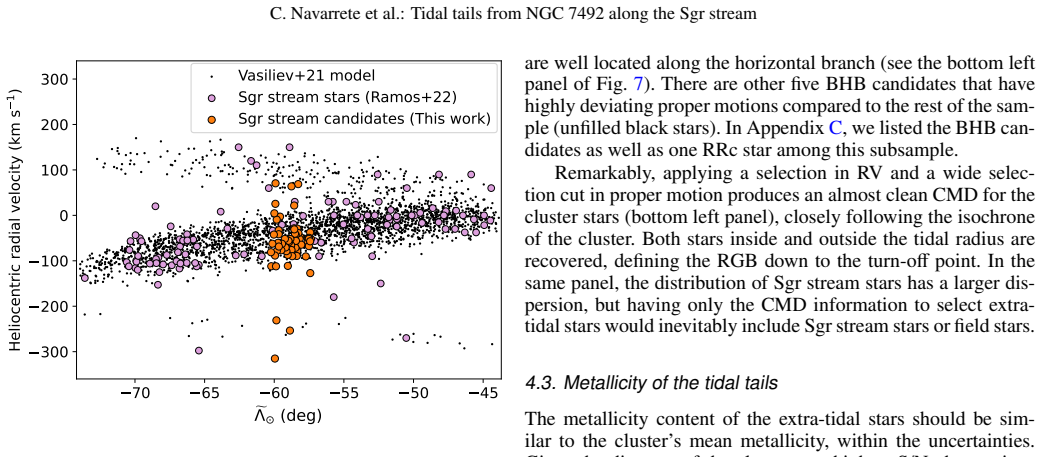
Summary. The authors present a GIRAFFE/FLAMES spectroscopic campaign of ten fields along the photometrically claimed tidal tails of the outer-halo globular cluster NGC 7492, obtaining radial velocities for 718 stars and FERRE-based metallicities (calibrated to the Gaia-ESO scale) for 484 of them. Applying simultaneous cuts in radial velocity (±35 km/s around the cluster mean), proper motion (a loose ±2 mas/yr window), and position in the color–magnitude diagram (±0.2 mag about a 12 Gyr, [M/H]=−1.7 isochrone), they identify 20 cluster stars inside the Jacobi radius and ~17–18 extra-tidal candidates extending to 1.78 deg from the cluster center. They cleanly separate the Sagittarius stream population, which overlaps the tails on the sky and in distance, via its distinct proper motions, radial velocities (trailing arm at ≈−80 km/s, leading arm at ≈+80 km/s, matching Vasiliev et al. 2021), and more metal-rich chemistry (median [M/H]≈−1.03 vs −1.89 for the cluster). The extra-tidal candidates follow the N17 photometric track and the locus of particle-spray models (Chen et al. 2025b), with a measured RV gradient (12.1 km/s/deg vs 16.7 km/s/deg in the model) and a model-derived distance gradient of 1.08 kpc/deg. The authors conclude the tails are real, kinematically confirmed, and physically unrelated to Sgr.
Significance. If the result holds, this is the first spectroscopic confirmation of tidal tails around NGC 7492 and a clean demonstration that globular-cluster debris can be disentangled from a major overlapping halo substructure using 6D phase-space plus chemistry — a relevant proof of concept for stream work in crowded regions of the halo. The manuscript has concrete technical strengths: the RV pipeline is validated against Gaia DR3 and Keck/DEIMOS (median offset 0.85 km/s, robust MAD 2.4 km/s, App. A.1); the metallicity scale is calibrated to GES with null bias and 0.106 dex scatter (Fig. 3); the Sgr stream is recovered in PM–RV space in quantitative agreement with Vasiliev et al. (2021), including the trailing-to-leading arm ratio (Fig. 5); the cluster's own median RV (−174.9±0.5 km/s) and velocity dispersion (1.6±0.3 km/s) agree with and improve on literature values (App. E); and the extra-tidal structure is independently corroborated by astrometric samples (Ibata et al. 2024; 8 overlapping candidates from Chen et al. 2025a) and by one extra-tidal star with a consistent Gaia DR3 RV. The model comparison makes falsifiable predictions (RV gradient amplitude, ±2 kpc distance gradient), and the
major comments (3)
- [§4.2, Fig. 7] The central claim — spectroscopic confirmation of the tidal tails — rests on only ~17 stars beyond the Jacobi radius passing three simultaneous cuts (RV ±35 km/s; PM ±2 mas/yr, i.e. 10× the bound-cluster ellipse; CMD ±0.2 mag). No control field, shifted-window test, or contamination model is presented, so the expected number of chance halo interlopers passing all three cuts is unknown. This is feasible with the data in hand: the 766-star parent sample covers the full PM–RV–CMD space, and applying the identical selection at RV centers offset from the cluster (e.g., ±70, ±105 km/s, avoiding the Sgr peaks at ∓80 km/s) or at PM centers offset from (0.7, −2.3) mas/yr would directly bound the interloper rate as a function of angular separation. Given the small sample, if even 4–6 of the 17 are interlopers the 'kinematic signature clearly detected' language (Abstract; §6) needs to be softened a
- [§4.3, Fig. 8, Table D.1] The claim that extra-tidal metallicities are 'consistent' with the cluster is not uniformly supported by the authors' own table. The extra-tidal dispersion is 0.39 dex versus 0.18 dex for the inner sample, and Table D.1 retains extra-tidal candidates at [M/H] = −0.77, −0.94, −1.33, and −1.42, near the Sgr/field mean rather than the cluster's −1.89. Most of these have large individual errors and are excluded from Fig. 8 by the σ[M/H]≤0.1 dex cut, but the star at r=72.9′ (source 2406438363126723968) has [M/H]=−1.42±0.01 at S/N=116: it cannot be attributed to low S/N and sits ~0.5 dex above the cluster median. Only the single [M/H]=−0.73 outlier was excised (§4.3). The authors should either (i) apply an explicit, uniform metallicity-membership criterion and report how many extra-tidal candidates it removes, or (ii) discuss the metal-rich retained stars individually (e.g., are they consisten
- [§5.1, App. H] The RV window of ±35 km/s was explicitly chosen to accommodate the ±30 km/s gradient predicted by the simulation (§4.2), so the amplitude of the recovered RV gradient (Fig. 10; App. H) is partially bounded by construction — candidates cannot display ΔRV outside the window. The sign and fitted slope (12.1 vs 16.7 km/s/deg from the model) remain informative, and the distance-gradient argument is independent, but the text should state clearly that the gradient amplitude comparison is conditioned on a window sized from the same model. A useful robustness test would be to refit the gradient excluding stars within, say, 5 km/s of the window edges, or to verify the gradient is significant within an inner RV sub-window that does not reference the model amplitude.
minor comments (7)
- [App. G vs §5.1/Fig. 10] The stream-aligned coordinate definitions appear swapped relative to their use: Appendix G states that 'ϕ1 measures the perpendicular displacement from the stream, and ϕ2 increases along the stream,' yet the stream extends ±2 deg in ϕ1 in Figs. 10 and H.1, and the RV and distance gradients are measured along ϕ1 (dD/dϕ1 = 1.08 kpc/deg). Please reconcile the definitions with the usage.
- [§4.3, §6, Table D.1] The extra-tidal star count is inconsistent across the text: §4.3 refers to 18 stars outside the tidal radius ('eleven stars out of 18'), §6 reports 17, and Table D.1 contains 18 rows beyond the tidal radius (38 total). Presumably 17 reflects the excision of the [M/H]=−0.73 star, but please state this explicitly and reconcile. Related: the excised star is given as [M/H]=−0.73 with source ID 2410110457085084288 (§4.3 and footnote 6), but that source ID does not appear in Table D.1, which instead lists a star at [M/H]=−0.77 (2409598183450835584, r=34.3′). Clarify which star was removed and whether Table D.1 includes the excised star.
- [§4.2 vs App. E] The selection window is centered on the Baumgardt & Hilker (2018) mean RV of −176.7 km/s, but the paper's own cluster measurement is −174.9±0.5 km/s (App. E). The 1.8 km/s offset is harmless given the ±35 km/s window, but the choice should be stated in one place with the rationale (e.g., consistency with the literature prior to this analysis).
- [Fig. 4, §5.1, §4.2, §1, §6] Typographical/notation items: '12 Gry' twice in the Fig. 4 caption (should be Gyr); 'galav1.9.1' (§5.1) presumably means 'gala v1.9.1'; 'To asses' (§5.1); 'the same are of the sky' (§4.2, should be 'area'); 'in Chen et al. (2025a) were more than 90 stars' (§1, should be 'where'); 'for 766 of stars' (§6).
- [Fig. 5] Fig. 5, middle panel: the boxcar smoothing is applied only to the Carballo-Bello et al. (2018) histogram and not to this work's; the caption should say so explicitly (the text does, but the caption is silent). Also, the normalization factors (×5, ×0.2) differ between panels and deserve a one-line justification.
- [App. B] Table B.2 is described in the text as listing 'three stars' from Ramos et al. (2022) not passing the PM cut, but the preceding sentence says four; one (2409573650597520512) is reassigned to the cluster sample. Please make the accounting explicit.
- [§5.1, Fig. 9] Fig. 9 states there are no stars in common with Ibata et al. (2024) because the three apparent overlaps are separated by >1 arcsec; given Gaia astrometric precision, stating the actual separations (or a cross-match radius) would strengthen this. The eight confirmed overlaps with Chen et al. (2025a) are a genuinely useful independent check and could be highlighted in the abstract or conclusions.
Circularity Check
Observational membership selection and external-model comparison; no derivation that forces the tails by construction.
specific steps
-
self citation load bearing
[Sec. 2.1 / Fig. 1; Aims and Introduction (N17)]
"To trace the potential tidal tails emerging from NGC 7492, we followed the contours outlined in N17 and selected several fields along the tails to obtain spectra for as many stars as possible in each field."
Field placement and the photometric structure being “confirmed” are taken from Navarrete et al. (2017a) by the same lead author. This is minor and not load-bearing: the new claim rests on independent GIRAFFE RVs, metallicities, Gaia PMs, and external spray/Sgr models, not on N17 alone. Flagged only as ordinary self-citation that guided targeting.
full rationale
The paper’s central claim is spectroscopic confirmation of extra-tidal stars around NGC 7492 and their kinematic separation from the Sagittarius stream. Membership is obtained by wide supervised windows centered on the known cluster mean PM, mean RV, and a fixed isochrone (Sec. 4.2; Fig. 7), then checked against metallicity, spatial alignment with N17’s photometric contour, and independent particle-spray (Chen et al. 2025b) and Sgr (Vasiliev et al. 2021) models. That is standard catalog selection, not a self-definitional or fitted-input “prediction.” Field placement followed the lead author’s prior photometric map (N17), which is ordinary self-citation and not load-bearing for the new RV/metallicity evidence. The RV window (±35 km s⁻¹) was chosen wide enough to admit an expected stream gradient; recovering a gradient inside that window is weakly assisted by the cut size but is not equivalent to the input by construction (slope and spatial locus remain independent). No uniqueness theorem, ansatz smuggling, or renaming of a known result appears. Score 1 reflects only the minor N17 self-reference for targeting; the kinematic confirmation chain is self-contained against external benchmarks.
Axiom & Free-Parameter Ledger
free parameters (5)
- RV membership window half-width =
±35 km/s
- Proper-motion membership ellipse scale =
10× ellipse (~±2 mas/yr)
- CMD isochrone tolerance =
±0.2 mag
- S/N and [M/H] error thresholds =
S/N≥10, σ≤0.1 dex
- MilkyWayPotential / cluster Plummer parameters in spray model =
M_h=5.4e11 M⊙, M_GC=2e4 M⊙, etc.
axioms (5)
- domain assumption Gaia DR3 astrometry and parallaxes sufficiently separate foreground dwarfs when parallax>0.5 mas and extreme PMs are cut.
- domain assumption FERRE full-spectrum fits on HR21 CaT spectra, after quadratic calibration to GES, yield [M/H] on an astrophysical scale to ~0.1 dex for S/N≥10.
- domain assumption Vasiliev et al. (2021) Sgr particle model and Chen et al. (2025b) spray DF correctly predict local PM/RV structure for comparison.
- domain assumption Literature cluster mean distance, tidal/Jacobi radii, and mean PM/RV are accurate enough to center membership windows.
- standard math Standard cross-correlation and spectrum-fitting mathematics (CCF, χ² template matching, spline normalization).
read the original abstract
The formation, extension, and morphology of extra-tidal stars around globular clusters depend on the internal kinematics of the host cluster and the Galactic potential. Tracing the kinematics of faint tidal tails sheds light on their formation and contribution to the Milky Way halo. NGC 7492 is an outer halo globular cluster with conflicting evidence regarding the presence of tidal tails. If present, the tails are expected to be faint and overlap on the sky with the Sagittarius stream, located at a similar heliocentric distance but with distinct kinematics. We carried out a GIRAFFE spectroscopic follow-up of ten fields covering the expected tidal tails of NGC 7492. Gaia parallaxes were used to remove foreground contaminants, while only loose proper-motion constraints were applied in the target selection. Radial velocities and metallicities were derived for more than 700 stars, from the red giant branch to the upper main sequence. Cluster and extra-tidal stars were identified from their proper motions, radial velocities, and metallicities. This population extends at least 1.8 deg from the cluster center, confirming the tidal tails previously detected only photometrically, with positions consistent with particle-spray models of the cluster disruption. The Sagittarius stream is clearly identified through its distinct proper motions, radial velocities, and more metal-rich population. Despite the low spatial density of the extra-tidal stars, their kinematic signature is clearly detected, demonstrating that the tidal tails overlap on the sky with the Sagittarius stream but are physically unrelated. This spectroscopic dataset provides a robust basis for future studies of the tails at larger angular extents and fainter magnitudes.
Figures




Reference graph
Works this paper leans on
-
[1]
Overview of the DESI Legacy Imaging Surveys. , keywords =. doi:10.3847/1538-3881/ab089d , archivePrefix =. 1804.08657 , primaryClass =
-
[2]
Exploring the formation mechanisms of tidal structures in globular clusters of extragalactic origin. , keywords =. doi:10.1051/0004-6361/202557628 , archivePrefix =. 2601.01110 , primaryClass =
-
[3]
Globular Cluster Streams as Galactic High-Precision Scales the Poster Child Palomar 5. , keywords =. doi:10.1088/0004-637X/803/2/80 , archivePrefix =. 1502.02658 , primaryClass =
-
[4]
The devil is in the tails: the role of globular cluster mass evolution on stream properties. , keywords =. doi:10.1093/mnras/stx2708 , archivePrefix =. 1702.02543 , primaryClass =
-
[5]
The structure of accreted stellar streams. , keywords =. doi:10.1093/mnras/stac238 , archivePrefix =. 2201.11045 , primaryClass =
-
[6]
Butterfly in a Cocoon, Understanding the Origin and Morphology of Globular Cluster Streams: The Case of GD-1. , keywords =. doi:10.3847/1538-4357/ab2e07 , archivePrefix =. 1903.08141 , primaryClass =
Pith/arXiv arXiv 1903
-
[7]
The outer envelopes of globular clusters. II. NGC 1851, NGC 5824 and NGC 1261 ^ *. , keywords =. doi:10.1093/mnras/stx2353 , archivePrefix =. 1709.02915 , primaryClass =
-
[8]
Characterization and history of the Helmi streams with Gaia DR2. , keywords =. doi:10.1051/0004-6361/201834769 , archivePrefix =. 1812.00846 , primaryClass =
-
[9]
Tidal tails of star clusters. , keywords =. doi:10.1111/j.1365-2966.2009.15690.x , archivePrefix =. 0909.2619 , primaryClass =
arXiv 2009
-
[10]
Destruction of the Galactic Globular Cluster System. , keywords =. doi:10.1086/303441 , archivePrefix =. astro-ph/9603042 , primaryClass =
-
[11]
Internal dynamics of globular clusters. , keywords =. doi:10.1007/s001590050008 , archivePrefix =. astro-ph/9610076 , primaryClass =
-
[12]
Stellar Escape from Globular Clusters. I. Escape Mechanisms and Properties at Ejection. , keywords =. doi:10.3847/1538-4357/acbcc1 , archivePrefix =. 2211.16523 , primaryClass =
-
[13]
Dynamical evolution of star clusters in tidal fields. , keywords =. doi:10.1046/j.1365-8711.2003.06286.x , archivePrefix =. astro-ph/0211471 , primaryClass =
arXiv 2003
-
[14]
The Keck/DEIMOS Stellar Archive. I. Uniform Velocities and Metallicities for 78 Milky Way Dwarf Galaxies and Globular Clusters. , keywords =. doi:10.3847/1538-4357/ae290d , archivePrefix =. 2602.10200 , primaryClass =
-
[15]
Dynamical Masses and Metallicities for a Uniform Sample of Milky Way Satellites
The Keck/DEIMOS Stellar Archive: II. Dynamical Masses and Metallicities for a Uniform Sample of Milky Way Satellites. arXiv e-prints , keywords =. doi:10.48550/arXiv.2602.10202 , archivePrefix =. 2602.10202 , primaryClass =
-
[16]
Galactic Globular Cluster Metallicity Scale from the Ca II Triplet I. Catalog. , keywords =. doi:10.1086/133958 , archivePrefix =. astro-ph/9707067 , primaryClass =
-
[17]
Specific processing and validation of all-sky RR Lyrae and Cepheid stars: The RR Lyrae sample
Gaia Data Release 3. Specific processing and validation of all-sky RR Lyrae and Cepheid stars: The RR Lyrae sample. , keywords =. doi:10.1051/0004-6361/202243964 , archivePrefix =. 2206.06278 , primaryClass =
-
[18]
The Galactic bulge exploration - I. The period–absolute magnitude–metallicity relations for RR Lyrae stars for GBP, V, G, GRP, I, J, H, and Ks passbands using Gaia DR3 parallaxes , DOI= "10.1051/0004-6361/202347338", url= "https://doi.org/10.1051/0004-6361/202347338", journal =
-
[19]
The PGPUC horizontal branch evolutionary tracks. , keywords =. doi:10.1051/0004-6361/202555099 , archivePrefix =. 2506.16562 , primaryClass =
-
[20]
Variable Stars in Galactic Globular Clusters. , keywords =. doi:10.1086/323719 , archivePrefix =. astro-ph/0108024 , primaryClass =
-
[21]
Clean catalogues of blue horizontal-branch stars using Gaia EDR3. , keywords =. doi:10.1051/0004-6361/202040074 , archivePrefix =. 2108.05172 , primaryClass =
-
[23]
S ^ 5 : New insights from deep spectroscopic observations of the tidal tails of the globular clusters NGC 1261 and NGC 1904. , keywords =. doi:10.1051/0004-6361/202451930 , archivePrefix =. 2411.08991 , primaryClass =
Pith/arXiv arXiv 1904
-
[24]
Astropy: A community Python package for astronomy. , keywords =. doi:10.1051/0004-6361/201322068 , archivePrefix =. 1307.6212 , primaryClass =
-
[25]
The Astropy Project: Building an Open-science Project and Status of the v2.0 Core Package. , keywords =. doi:10.3847/1538-3881/aabc4f , archivePrefix =. 1801.02634 , primaryClass =
-
[26]
The Astropy Project: Sustaining and Growing a Community-oriented Open-source Project and the Latest Major Release (v5.0) of the Core Package. , keywords =. doi:10.3847/1538-4357/ac7c74 , archivePrefix =. 2206.14220 , primaryClass =
-
[28]
A geometric distance measurement to the Galactic center black hole with 0.3\. , keywords =. doi:10.1051/0004-6361/201935656 , archivePrefix =. 1904.05721 , primaryClass =
Pith/arXiv arXiv 1904
-
[29]
Vertical waves in the solar neighbourhood in Gaia DR2. , keywords =. doi:10.1093/mnras/sty2813 , archivePrefix =. 1809.03507 , primaryClass =
-
[30]
Local kinematics and the local standard of rest. , keywords =. doi:10.1111/j.1365-2966.2010.16253.x , archivePrefix =. 0912.3693 , primaryClass =
arXiv 2010
-
[31]
arXiv e-prints , keywords =
StarStream on Gaia: Stream discovery and mass loss rate of globular clusters. arXiv e-prints , keywords =
-
[32]
Robust Data-driven Metallicities for 175 Million Stars from Gaia XP Spectra. , keywords =. doi:10.3847/1538-4365/acd53e , archivePrefix =. 2302.02611 , primaryClass =
-
[33]
Probing the nature of dark matter with accreted globular cluster streams. , keywords =. doi:10.1093/mnras/staa3597 , archivePrefix =. 2005.12919 , primaryClass =
Pith/arXiv arXiv 2005
-
[34]
New Constraints on the Dark Matter Density Profiles of Dwarf Galaxies from Proper Motions of Globular Cluster Streams. , keywords =. doi:10.3847/2041-8213/aca6e5 , archivePrefix =. 2201.03571 , primaryClass =
Pith/arXiv arXiv 2041
-
[35]
The chemo-dynamical groups of Galactic globular clusters. , keywords =. doi:10.1093/mnras/stac1145 , archivePrefix =. 2202.00591 , primaryClass =
-
[36]
The DECam Local Volume Exploration Survey Data Release 2. , keywords =. doi:10.3847/1538-4365/ac78eb , archivePrefix =. 2203.16565 , primaryClass =
-
[37]
An all-sky proper-motion map of the Sagittarius stream using Gaia DR2. , keywords =. doi:10.1051/0004-6361/201937145 , archivePrefix =. 2001.10012 , primaryClass =
Pith/arXiv arXiv 2001
-
[38]
A fork in the Sagittarius trailing debris. , keywords =. doi:10.1093/mnras/stw3255 , archivePrefix =. 1612.06829 , primaryClass =
-
[39]
Precession of the Sagittarius stream. , keywords =. doi:10.1093/mnras/stt1862 , archivePrefix =. 1301.7069 , primaryClass =
-
[40]
The Sagittarius Streams in the Southern Galactic Hemisphere. , keywords =. doi:10.1088/0004-637X/750/1/80 , archivePrefix =. 1111.7042 , primaryClass =
-
[41]
The Field of Streams: Sagittarius and Its Siblings. , keywords =. doi:10.1086/504797 , archivePrefix =. astro-ph/0605025 , primaryClass =
-
[42]
A Two Micron All Sky Survey View of the Sagittarius Dwarf Galaxy. I. Morphology of the Sagittarius Core and Tidal Arms. , keywords =. doi:10.1086/379504 , archivePrefix =. astro-ph/0304198 , primaryClass =
-
[43]
Galactic Halo Substructure in the Sloan Digital Sky Survey: The Ancient Tidal Stream from the Sagittarius Dwarf Galaxy. , keywords =. doi:10.1086/318894 , archivePrefix =. astro-ph/0004255 , primaryClass =
-
[44]
Globular cluster number density profiles using Gaia DR2. , keywords =. doi:10.1093/mnras/stz651 , archivePrefix =. 1901.08072 , primaryClass =
Pith/arXiv arXiv 1901
-
[45]
Chemical Cartography of the Sagittarius Stream with Gaia. , keywords =. doi:10.3847/1538-4357/ad187b , archivePrefix =. 2307.08730 , primaryClass =
-
[46]
First CaT metallicities for twenty clusters
Homogeneous metallicities and radial velocities for Galactic globular clusters. First CaT metallicities for twenty clusters. , keywords =. doi:10.1051/0004-6361/201118138 , archivePrefix =. 1202.1304 , primaryClass =
-
[47]
Using the Ca ii triplet to trace abundance variations in individual red giant branch stars in three nearby galaxies. , keywords =. doi:10.1046/j.1365-8711.2001.04785.x , archivePrefix =. astro-ph/0107022 , primaryClass =
arXiv 2001
-
[48]
Photometric content and validation
Gaia Early Data Release 3. Photometric content and validation. , keywords =. doi:10.1051/0004-6361/202039587 , archivePrefix =. 2012.01916 , primaryClass =
Pith/arXiv arXiv 2012
-
[49]
Proper motions and dynamics of the Milky Way globular cluster system from Gaia DR2. , keywords =. doi:10.1093/mnras/stz171 , archivePrefix =. 1807.09775 , primaryClass =
-
[50]
Research in Astronomy and Astrophysics , keywords =
Orbits of 152 globular clusters of the MilkyWay galaxy constructed from Gaia DR2. Research in Astronomy and Astrophysics , keywords =. doi:10.1088/1674-4527/21/7/173 , archivePrefix =. 2008.13624 , primaryClass =
Pith/arXiv arXiv 2008
-
[51]
The orbital evolution of UFDs and GCs in an evolving Galactic potential. , keywords =. doi:10.1093/mnras/staa3391 , archivePrefix =. 2011.12535 , primaryClass =
Pith/arXiv arXiv 2011
-
[52]
DELVE-ing into the Milky Way's Globular Clusters: Assessing Extratidal Features in NGC 5897, NGC 7492, and Testing Detectability with Deeper Photometry. , keywords =. doi:10.3847/1538-3881/ae07e0 , adsurl =
-
[53]
Outer density profiles of 19 Galactic globular clusters from deep and wide-field imaging. , keywords =. doi:10.1111/j.1365-2966.2011.19663.x , archivePrefix =. 1108.4018 , primaryClass =
arXiv 2011
-
[54]
PARSEC: stellar tracks and isochrones with the PAdova and TRieste Stellar Evolution Code. , keywords =. doi:10.1111/j.1365-2966.2012.21948.x , archivePrefix =. 1208.4498 , primaryClass =
arXiv 2012
-
[55]
A survey for dwarf galaxy remnants around 14 globular clusters in the outer halo. , keywords =. doi:10.1093/mnras/sty539 , archivePrefix =. 1802.09255 , primaryClass =
-
[56]
A search for stellar tidal debris of defunct dwarf galaxies around globular clusters in the inner Galactic halo. , keywords =. doi:10.1093/mnras/stu1949 , archivePrefix =. 1409.7390 , primaryClass =
-
[57]
A catalogue of masses, structural parameters, and velocity dispersion profiles of 112 Milky Way globular clusters. , keywords =. doi:10.1093/mnras/sty1057 , archivePrefix =. 1804.08359 , primaryClass =
-
[58]
Gaia EDR3 view on galactic globular clusters. , keywords =. doi:10.1093/mnras/stab1475 , archivePrefix =. 2102.09568 , primaryClass =
-
[59]
Was the progenitor of the Sagittarius stream a disc galaxy?. , keywords =. doi:10.1111/j.1745-3933.2010.00921.x , archivePrefix =. 1007.1485 , primaryClass =
arXiv 2010
-
[60]
The Sagittarius Dwarf Galaxy: A Model for Evolution in a Triaxial Milky Way Halo. , keywords =. doi:10.1088/0004-637X/714/1/229 , archivePrefix =. 1003.1132 , primaryClass =
-
[61]
Tango for three: Sagittarius, LMC, and the Milky Way. , keywords =. doi:10.1093/mnras/staa3673 , archivePrefix =. 2009.10726 , primaryClass =
Pith/arXiv arXiv 2009
-
[62]
The Sagittarius stream in Gaia Early Data Release 3 and the origin of the bifurcations. , keywords =. doi:10.1051/0004-6361/202142830 , archivePrefix =. 2112.02105 , primaryClass =
-
[63]
Analysis and calibration of Ca II triplet spectroscopy of red giant branch stars from VLT/FLAMES observations. , keywords =. doi:10.1111/j.1365-2966.2007.12532.x , archivePrefix =. 0710.0798 , primaryClass =
arXiv 2007
-
[64]
Existence of tidal tails for the globular cluster NGC 5824. , keywords =. doi:10.1051/0004-6361/202243976 , archivePrefix =. 2208.05197 , primaryClass =
-
[65]
The eye of Gaia on globular clusters structure: tidal tails. , keywords =. doi:10.1093/mnras/staa1209 , archivePrefix =. 2004.13754 , primaryClass =
Pith/arXiv arXiv 2004
-
[66]
Using Gaia DR2 to detect extratidal structures around the Galactic globular cluster NGC 362. , keywords =. doi:10.1093/mnras/stz962 , archivePrefix =. 1904.02177 , primaryClass =
Pith/arXiv arXiv 1904
-
[67]
The tidal tails of Milky Way globular clusters. , keywords =. doi:10.1051/0004-6361/202037994 , archivePrefix =. 2004.11747 , primaryClass =
Pith/arXiv arXiv 2004
-
[68]
Variations in the Width, Density, and Direction of the Palomar 5 Tidal Tails. , keywords =. doi:10.3847/1538-4357/ab5afe , archivePrefix =. 1910.00592 , primaryClass =
Pith/arXiv arXiv 1910
-
[69]
Feeling the Pull: a Study of Natural Galactic Accelerometers. I. Photometry of the Delicate Stellar Stream of the Palomar 5 Globular Cluster. , keywords =. doi:10.3847/0004-637X/819/1/1 , archivePrefix =. 1512.03054 , primaryClass =
-
[70]
The Extended Tails of Palomar 5: A 10 Arc of Globular Cluster Tidal Debris. , keywords =. doi:10.1086/378601 , archivePrefix =. astro-ph/0307446 , primaryClass =
-
[71]
Detection of Massive Tidal Tails around the Globular Cluster Palomar 5 with Sloan Digital Sky Survey Commissioning Data. , keywords =. doi:10.1086/319095 , archivePrefix =. astro-ph/0012311 , primaryClass =
-
[72]
A search for stellar structures around nine outer halo globular clusters in the Milky Way. , keywords =. doi:10.1093/mnras/stac751 , archivePrefix =. 2111.09072 , primaryClass =
-
[73]
The outer envelopes of globular clusters - I. NGC 7089 (M2). , keywords =. doi:10.1093/mnras/stw1561 , archivePrefix =. 1606.05949 , primaryClass =
-
[74]
A 500 Parsec Halo Surrounding the Galactic Globular NGC 1851. , keywords =. doi:10.1088/0004-6256/138/6/1570 , archivePrefix =. 0909.1755 , primaryClass =
-
[75]
Properties of globular clusters formed in dark matter mini-halos. , keywords =. doi:10.1051/0004-6361/202244530 , archivePrefix =. 2112.01265 , primaryClass =
-
[76]
Embedding globular clusters in dark matter minihaloes solves the cusp-core and timing problems in the Fornax dwarf galaxy. , keywords =. doi:10.1093/mnras/staa011 , archivePrefix =. 1909.07404 , primaryClass =
Pith/arXiv arXiv 1909
-
[77]
Development of multiple tidal tails around globular clusters and dwarf satellite galaxies. , keywords =. doi:10.1093/mnras/stu2318 , archivePrefix =. 1409.2157 , primaryClass =
-
[78]
Tidal Tails around Globular Clusters: Are They a Good Tracer of Cluster Orbits?. , keywords =. doi:10.1086/512114 , archivePrefix =. astro-ph/0611204 , primaryClass =
-
[79]
New discoveries and physical parameter determination
Variable stars in the globular cluster NGC 7492. New discoveries and physical parameter determination. , keywords =. doi:10.1051/0004-6361/201220824 , archivePrefix =. 1305.4837 , primaryClass =
-
[80]
Charting the Galactic Acceleration Field. II. A Global Mass Model of the Milky Way from the STREAMFINDER Atlas of Stellar Streams Detected in Gaia DR3. , keywords =. doi:10.3847/1538-4357/ad382d , archivePrefix =. 2311.17202 , primaryClass =
-
[81]
galpy: A python Library for Galactic Dynamics. , keywords =. doi:10.1088/0067-0049/216/2/29 , archivePrefix =. 1412.3451 , primaryClass =
-
[82]
Gala: A Python package for galactic dynamics. JOSS , keywords =. doi:10.21105/joss.00388 , adsurl =
discussion (0)
Sign in with ORCID, Apple, or X to comment. Anyone can read and Pith papers without signing in.