REVIEW 3 major objections 5 minor 42 references
Pound-Drever-Hall Feedforward for Trapped-Ion Optical Qubits
T0 review · 3 major / 5 minor · reviewed 2026-07-31 · deepseek-v4-flash
Pith's one-line read PDH feedforward suppresses servo-bump noise by 15 dB and lifts optical-qubit Rabi coherence sixfold.
desk verdict First demonstration of PDH feedforward on a trapped-ion optical-qubit laser: the 15 dB bump suppression and 6x T2 improvement are direct and credible; the ΔF≈0.22 fidelity estimate is model-bound and not yet supported. read the letter →
The pith
A machine-rendered reading of the paper's core claim, the machinery that carries it, and where it could break.
The reading
What carries the argument
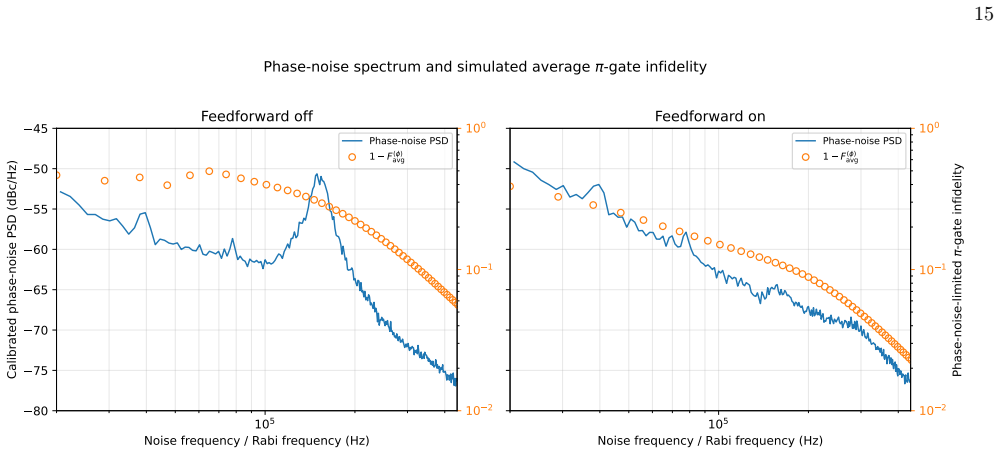
The load-bearing object is the PDH error signal, which after tight locking is proportional to the residual instantaneous phase noise ϕ(t), including components beyond feedback bandwidth. Recycling it with inverted gain and matched delay into a fiber EOM gives ϕ_out≈ϕ(t)+G_ff ϕ(t−τ); with G_ff=−1 and τ tuned to the 132 kHz bump, the bump noise cancels. The setup uses a 325 m BNC delay line and 20 m fiber; DSHI with 15 m fiber resolves the bump spectrum and a 5 km fiber measures the linewidth. The qubit model is a second-order time-convolutionless expansion of the toggling-frame Bloch equation, yielding a finite-time Pauli-transfer matrix M_I(t), the infidelity ϵ=(3−Tr[M_I(t)])/6, and a scalar
What would settle it
Run a positivity-preserving Monte-Carlo simulation of the stochastic Bloch equation (rather than the second-order truncation) using the measured DSHI phase-noise spectrum, and compare its predicted π-pulse infidelity versus Rabi frequency to the paper's Fig. 5 curves; disagreement near f_R≈63 kHz, where the second-order estimate reaches the unital-channel ceiling of about 0.5, would show the calibrated infidelity model is unreliable in that regime.
Extended reading notes
Core claim
The central claim is that PDH feedforward—applying the locked laser's own residual error signal, after matched delay and inverted gain, to a fast fiber EOM—cancels the servo-bump phase noise of the PDH lock beyond feedback bandwidth. The authors verify this on a 138Ba+ S1/2↔D5/2 optical qubit: DSHI spectra show up to 15 dB suppression at the bump peak with no linewidth broadening, Rabi oscillations driven near the bump show a roughly sixfold increase in T2, and a calibrated finite-time dynamical map translates the measured spectrum into a phase-noise-limited π-gate fidelity improvement of about 0.22. They present this as the first experimental demonstration that PDH feedforward is compatible
Load-bearing premise
The quantitative bridge from spectra to qubit claims—specifically the ΔF≈0.22 fidelity gain—assumes the second-order time-convolutionless expansion is valid at the strong-noise operating points, even though the paper's Appendix A warns that the truncated map may lose complete positivity for stronger noise and the spectral scale factor is fitted to the very decay it explains.
Editorial extensions
If this is right
- Single-qubit optical gates can be operated at Rabi frequencies inside the servo-bump band, removing a constraint on gate-speed choice imposed by PDH lock noise.
- Because the technique recycles the already-available error signal, it adds no optical loss; it is a power-preserving alternative to high-finesse cleanup cavities when transmitted cavity power is only microwatts.
- The measured log-linear relation (≈1.21× in T2 per dB of bump suppression) gives a quantitative rule for predicting coherence gain from spectral noise reduction.
- The method is presented as readily transferable to other optical qubits and transitions, with the main hardware caveat being the power handling of the phase actuator at the operating wavelength.
- For two-qubit gates, suppressing servo bumps near motional frequencies should mitigate fidelity loss in Mølmer–Sørensen gates, which the authors identify as a motivation for future work.
Reading between the lines
- One could use the same feedforward loop to suppress bumps at multiple or higher frequencies by choosing delay lines matched to several bump harmonics, effectively widening the usable gate-speed window beyond the single peak demonstrated here.
- The finite-time Rabi-filter formalism suggests a design heuristic: to predict the coherence impact of a given locking servo, evaluate the overlap between the phase-noise PSD and the Rabi filter for the target pulse time, rather than simply reading the PSD at the Rabi frequency.
- A direct extension would be to apply PDH feedforward to Mølmer–Sørensen two-qubit gates and measure the entangling-gate fidelity as a function of motional frequency; the single-qubit results imply a measurable improvement when a motional sideband coincides with the bump.
- The model's reliance on a single spectral calibration factor could be sharpened by measuring Rabi decay at several Rabi frequencies and checking whether the predicted log-linear T2 scaling across the whole bump region is borne out independently of the fitted decay.
Signed reviews
Editorial analysis
A structured set of objections, weighed in public.
Referee Report
Summary. The manuscript reports an experimental demonstration of Pound-Drever-Hall (PDH) feedforward phase-noise suppression for the 1762 nm laser driving the S1/2↔D5/2 optical-qubit transition in 138Ba+. The authors recycle the residual PDH error signal through a delay-matched electrical path to a fiber EOM, and measure, via delayed self-heterodyne interferometry, a ~15 dB suppression of the servo-bump phase noise near 132 kHz without measurable linewidth broadening (160±15 Hz by DSHI versus 156±16 Hz by ion spectroscopy, App. H). They then present a theoretical model of a resonantly driven qubit under stochastic detuning noise, based on a second-order time-convolutionless expansion and a Pauli-transfer-matrix average gate infidelity, and use DSHI spectra plus a spectral calibration factor to estimate a phase-noise-limited π-gate fidelity improvement ΔF_avg ≈ 0.22 near the servo-bump region. Trapped-ion Rabi measurements show that enabling feedforward increases the extracted coherence time from 3.69±0.35 µs to 21.73±0.87 µs for Rabi frequencies near the bump, and the D-state population at the first π time increases from 0.641±0.014 to 0.870±0.009. The paper also reports a log-linear relation between T2 and servo-bump suppression in dB.
Significance. If the direct measurements stand, the work has clear practical value: it provides a power-efficient alternative to cavity filtering that extends the usable Rabi-frequency range of optical-qubit gates without sacrificing optical throughput, and it is the first experimental integration of PDH feedforward with trapped-ion optical-qubit control. The 15 dB suppression, the unchanged linewidth, and the ~6x improvement in Rabi coherence time are direct, cross-checked measurements and are the strongest parts of the paper. However, the specific quantitative gate-fidelity gain (ΔF_avg ≈ 0.22) and the Fig. 5 infidelity curves depend on a perturbative finite-time model that the paper itself warns may lose complete positivity, and the model is calibrated using the very Rabi-decay observable it is used to explain. These issues do not invalidate the direct measurements, but they mean the gate-fidelity headline is not yet quantitatively supported. The paper includes detailed appendices and a clear discussion of the model's limitations, which is helpful, but the limitations are not reflected in the strength of the central fidelity claim.
major comments (3)
- [App. A, App. F, Fig. 5, Sec. V.B] The phase-noise-limited gate-fidelity estimate ΔF_avg ≈ 0.22 is produced by the second-order time-convolutionless generator of App. A. Appendix A explicitly warns (after Eq. A13) that for stronger noise or longer evolution times the truncated map 'may lose complete positivity' and that Monte-Carlo propagation should be used as the reference. The paper's own Fig. 5/App. F shows an un-stabilized infidelity of 1−F_avg ≈ 0.498 at f_R ≈ 63 kHz, which is essentially the maximum possible average infidelity for a unital single-qubit channel. No error bound, no comparison with Monte-Carlo simulation, and no finite-size check is given to establish that the second-order expansion is controlled in this regime. Therefore the quantitative fidelity improvement and the Fig. 5 curves are not reliably supported. The direct 15 dB and T2 measurements stand independently, but the gate-fidelity claim should b
- [Sec. V.B, App. F] The model is calibrated using the measured Rabi decay: App. F states that 'a single spectral calibration factor, determined from the feedforward-off Rabi-decay measurement, is used for all Rabi frequencies and both feedforward conditions.' The same observable (Rabi decay / T2) is thus used both to fix the noise scale and to validate the model's predictions. This makes the ΔF_avg ≈ 0.22 estimate, and the per-dB T2 scaling in Fig. 4, model-dependent rather than independent predictions. I would like to see an out-of-sample check — e.g., calibrating on one Rabi frequency and predicting another, or predicting the feedforward-on data using only feedforward-off calibration — or a sensitivity analysis showing how the inferred fidelity gain changes with the calibration factor.
- [App. G, Fig. 4] There is an unexplained quantitative discrepancy in the log-linear relation. Appendix G derives that if the dephasing rate is proportional to the phase-noise PSD at the Rabi frequency, then log10(T2) should increase with slope 0.100 per dB of suppression. The measured fit in Fig. 4 gives a slope of 0.084 per dB with R² = 0.992 — a 16% deviation. This discrepancy is not discussed in the text, yet the abstract and discussion quote the empirical '1.21x per dB' factor. Since the per-dB improvement is a central quantitative claim, the origin of this deviation (finite-time filter effects, non-Lorentzian noise shape, non-exponential decay, or fitting choices) should be addressed, or the theoretical slope should not be presented as the expected behavior without comment.
minor comments (5)
- [Fig. 3b] The caption states 'pi time used: 22.1 us,' which corresponds to a Rabi frequency of approximately 22.6 kHz, not the 132 kHz servo-bump frequency discussed elsewhere in the text. Please clarify whether the frequency scan was performed at a Rabi frequency away from the bump, and state explicitly how the off-resonant excitation shoulder at ±132 kHz is produced in that case.
- [Sec. V.B / Conclusion] The improvement in D-state probability at the first π time (0.641→0.870) is a single-state transfer measurement, not an average gate fidelity. The authors acknowledge this distinction in Sec. V.B, but the Conclusion states that the results show 'clear improvements in the coherence time and gate fidelity.' I recommend reserving 'gate fidelity' language for actual randomized or state-tomography-based fidelity measurements, or for the model-based estimate after it has been properly validated.
- [Abstract / Introduction] There are several typographical errors and slightly awkward phrasings, e.g., 'supressing' in the Conclusion, 'an qubit' in the Introduction, and 'without limited by the transmission optical power' in Sec. II.A. A careful proofread would improve clarity.
- [Data Availability] The statement 'available from the corresponding author upon reasonable request' is weaker than current best practice. Since the Figs. 2–5 and the calibration procedure are central to the quantitative claims, I encourage depositing the data and analysis scripts in a permanent repository (e.g., Zenodo or figshare) so that the DSHI spectra, Rabi fits, and calibration factor can be independently checked.
- [Fig. 4] The text says the red points at ≈345 kHz are 'shown for comparison' and are not included in the fit. It would be helpful to state this directly in the figure caption and to report the confidence interval on the fitted slope, not only R².
Circularity Check
Direct 15 dB suppression and T2 improvement are measured; the model-based ΔF≈0.22 fidelity estimate is transparently calibrated and not used to support the central experimental claims.
full rationale
The principal claims—15 dB servo-bump suppression by DSHI and the T2 improvement from 3.69±0.35 µs to 21.73±0.87 µs from Rabi oscillations—are direct interferometric and qubit measurements and do not depend on the cumulant model. The model in App. A is used to convert measured phase-noise spectra and a calibrated noise scale into an estimated phase-noise-limited π-gate fidelity improvement (Sec. V.B, App. F). This is a transparent calibration: 'A single spectral calibration factor, determined from the feedforward-off Rabi-decay measurement, is used for all Rabi frequencies and both feedforward conditions.' Fitting a noise scale to one measured decay and then using the measured on/off spectral ratio to estimate a different metric (fidelity) is a normal model-calibration procedure, not a derivation where the input is renamed as the output. App. A's warning that the truncated map 'may lose complete positivity' for stronger noise is a validity caveat relevant to the absolute infidelity numbers, but it is a correctness risk, not circularity. There is no load-bearing self-citation chain: references to the authors' earlier work are for ion-trap setup details and amplifier characterization. Thus no circular step meets the required standard.
Assumptions & free parameters
free parameters (4)
- Spectral calibration factor =
not stated
- Log-linear T2 fit parameters =
slope 0.084, intercept 0.741
- Feedforward delay cable length =
325 m RG-58 (optimized)
- Servo gain setting =
bump at ≈132 kHz
assumptions (5)
- domain assumption Residual locked-laser phase noise is small enough that sin φ(t) ≈ φ(t) in the PDH error signal (Eq. 4)
- domain assumption Detuning noise β(t) is zero-mean, stationary, and Gaussian (Eq. 18)
- domain assumption Second-order time-convolutionless expansion is adequate (O(β⁴) terms dropped, Eq. A6)
- domain assumption TDFA amplification preserves the seed's phase-noise structure (adds intensity, not phase, noise)
- domain assumption Dephasing during Rabi drive is dominated by laser phase noise; SPAM, intensity noise, magnetic-field fluctuations, and pulse-area errors are negligible
Cite this review
Pith. "Pith review of Pound-Drever-Hall Feedforward for Trapped-Ion Optical Qubits." pith.science (2026). https://pith.science/paper/XQUIOQTR
@misc{pith2026260724050,
  author       = {Pith},
  title        = {Pith review of: Pound-Drever-Hall Feedforward for Trapped-Ion Optical Qubits},
  year         = {2026},
  howpublished = {\url{https://pith.science/paper/XQUIOQTR}},
  note         = {Machine review of arXiv:2607.24050}
}
read the original abstract
Laser phase noise is one of the limiting factors that dictate gate fidelities and coherence times in trapped-ion quantum systems. Previous studies have reported that when the Rabi frequency of an ion qubit is close to the servo-bump phase-noise frequency, the driving laser limits the fidelity and coherence time. This issue has typically been mitigated by choosing a Rabi frequency outside the servo-bump region. However, this constrains the usable range of gate speeds and can limit the achievable fidelity. To address this issue, we developed an active phase-noise stabilization system for a barium-ion optical-qubit laser at 1762 nm, employing a fiber electro-optic modulator (EOM) with an electrical feedforward servo. Our results demonstrate that this setup, based on the Pound-Drever-Hall (PDH) feedforward method, can suppress servo-bump phase noise by 15 dB near the bump peak frequency in our locking system. The laser phase noise is analyzed using delayed self-heterodyne interferometry (DSHI). We further tested the stabilized laser on an optical qubit and observed a clear improvement in coherence time based on the measured amplitude decay of Rabi oscillations, even when the Rabi frequency lies within the servo-bump bandwidth. This technique can be readily adapted to other optical qubits with minimal modifications.
Figures


Figures from the paper (2 more)

Reference graph
Works this paper leans on
-
[1]
S. Y.-C. Chen, C.-H. H. Yang, J. Qi, P.-Y. Chen, X. Ma, and H.-S. Goan, IEEE access8, 141007 (2020)
2020
-
[2]
Mitarai, M
K. Mitarai, M. Negoro, M. Kitagawa, and K. Fujii, Phys- ical Review A98, 032309 (2018)
2018
-
[3]
C.-H. Nguyen, K.-W. Tseng, G. Maslennikov, H. Gan, and D. Matsukevich, arXiv preprint arXiv:2104.04168 (2021)
arXiv 2021
-
[4]
Dutta, A
T. Dutta, A. P´ erez-Salinas, J. P. S. Cheng, J. I. La- torre, and M. Mukherjee, Physical Review A106, 012411 (2022)
2022
-
[5]
Lim and P
D. Lim and P. Rebentrost, Quantum Information Pro- cessing23, 63 (2024)
2024
-
[6]
Dutta and M
T. Dutta and M. Mukherjee, npj Quantum Information 6, 3 (2020)
2020
-
[7]
J. I. Cirac and P. Zoller, Physical review letters74, 4091 (1995)
1995
-
[8]
Monroe, D
C. Monroe, D. M. Meekhof, B. E. King, W. M. Itano, and D. J. Wineland, Physical review letters75, 4714 (1995)
1995
Show all 42 references
-
[9]
Wang, C.-Y
P. Wang, C.-Y. Luan, M. Qiao, M. Um, J. Zhang, Y. Wang, X. Yuan, M. Gu, J. Zhang, and K. Kim, Nature communications12, 233 (2021)
2021
-
[10]
M. L. Day, P. J. Low, B. White, R. Islam, and C. Senko, npj Quantum Information8, 72 (2022)
2022
-
[11]
Jiang, J
X. Jiang, J. Scott, M. Friesen, and M. Saffman, Physical Review A107, 042611 (2023)
2023
-
[12]
Nakav, R
H. Nakav, R. Finkelstein, L. Peleg, N. Akerman, and R. Ozeri, Physical Review A107, 042622 (2023)
2023
-
[13]
Soare, H
A. Soare, H. Ball, D. Hayes, J. Sastrawan, M. Jarratt, J. McLoughlin, X. Zhen, T. Green, and M. Biercuk, Na- ture Physics10, 825 (2014)
2014
-
[14]
Hald and V
J. Hald and V. Ruseva, JOSA B22, 2338 (2005)
2005
-
[15]
Krinner, K
L. Krinner, K. Dietze, L. Pelzer, N. Spethmann, and P. Schmidt, Optics Express32, 15912 (2024)
2024
-
[16]
Semenin, I
N. Semenin, I. Zalivako, V. Smirnov, I. Semerikov, A. Borisenko, A. Korolkov, P. Sidorov, K. Galstyan, K. Khabarova, and N. Kolachevsky, Physical Review Ap- plied23, 034080 (2025)
2025
-
[17]
Akerman, N
N. Akerman, N. Navon, S. Kotler, Y. Glickman, and R. Ozeri, New Journal of Physics17, 113060 (2015)
2015
-
[18]
Avalos, X
V. Avalos, X. Nie, A. Yang, C. He, S. Kumar, and K. Dieckmann, Review of Scientific Instruments94 (2023)
2023
-
[19]
Kim and F
J. Kim and F. P. Dos Santos, Optics Communications 282, 977 (2009)
2009
-
[20]
Bagheri, F
M. Bagheri, F. Aflatouni, A. Imani, A. Goel, and H. Hashemi, Optics letters34, 2979 (2009)
2009
-
[21]
Aflatouni and H
F. Aflatouni and H. Hashemi, Optics letters37, 196 (2012)
2012
-
[22]
R. T. Watts, S. G. Murdoch, and L. P. Barry, IEEE Pho- tonics Journal8, 1 (2016)
2016
-
[23]
Lintz, D.-H
M. Lintz, D.-H. Phung, J.-P. Coulon, B. Faure, and T. L´ ev` eque, Review of Scientific Instruments88(2017)
2017
-
[24]
J. Chen, Q. Liu, and Z. He, Journal of Lightwave Tech- nology37, 4657 (2019)
2019
-
[25]
Scharnhorst, J
N. Scharnhorst, J. B. W¨ ubbena, S. Hannig, K. Jakob- sen, J. Kramer, I. D. Leroux, and P. O. Schmidt, Optics express23, 19771 (2015)
2015
-
[26]
Zhang, Y
Z. Zhang, Y. Dai, P. Ou, F. Yin, Y. Zhou, J. Li, and K. Xu, IEEE Photonics Journal8, 1 (2016)
2016
-
[27]
Huang, T
S. Huang, T. Zhu, M. Liu, and W. Huang, Scientific Re- ports7, 41988 (2017)
2017
-
[28]
Y. Li, Z. Fu, L. Zhu, J. Fang, H. Zhu, J. Zhong, P. Xu, X. Chen, J. Wang, and M. Zhan, Optics communications 435, 244 (2019)
2019
-
[29]
Parniak, I
M. Parniak, I. Galinskiy, T. Zwettler, and E. S. Polzik, Optics Express29, 6935 (2021)
2021
-
[30]
D. Li, C. Qian, Y. Li, and J. Zhao, Optics express25, 9071 (2017)
2017
-
[31]
L. Li, W. Huie, N. Chen, B. DeMarco, and J. P. Covey, Physical Review Applied18, 064005 (2022)
2022
-
[32]
Chao, Z.-X
Y.-X. Chao, Z.-X. Hua, X.-H. Liang, Z.-P. Yue, L. You, and M. Khoon Tey, Optica11, 945 (2024)
2024
-
[33]
B. P. Maddox, J. M. Mortlock, T. R. Hepworth, A. P. Raghuram, P. D. Gregory, A. Guttridge, and S. L. Cor- nish, Physical review letters133, 253202 (2024)
2024
-
[34]
Okoshi, K
T. Okoshi, K. Kikuchi, and A. Nakayama, Electronics letters16, 630 (1980)
1980
-
[35]
Ahmadi, T
M. Ahmadi, T. Dutta, and M. Mukherjee, Optics Express 32, 17879 (2024)
2024
-
[36]
D. Yum, D. De Munshi, T. Dutta, and M. Mukherjee, JOSA B34, 1632 (2017)
2017
-
[37]
Chao, Z.-X
Y.-X. Chao, Z.-X. Hua, X.-H. Liang, Z.-P. Yue, C. Jia, L. You, and M. K. Tey, Physical Review Applied23, L011005 (2025)
2025
-
[38]
Levine, A
H. Levine, A. Keesling, A. Omran, H. Bernien, S. Schwartz, A. S. Zibrov, M. Endres, M. Greiner, V. Vuleti´ c, and M. D. Lukin, Physical review letters121, 123603 (2018)
2018
-
[39]
Nazarova, C
T. Nazarova, C. Lisdat, F. Riehle, and U. Sterr, JOSA B 25, 1632 (2008)
2008
-
[40]
Labaziewicz, P
J. Labaziewicz, P. Richerme, K. R. Brown, I. L. Chuang, and K. Hayasaka, Optics letters32, 572 (2007)
2007
-
[41]
Fl¨ uhmann,Encoding a qubit in the motion of a trapped ion using superpositions of displaced squeezed states(ETH Zurich, 2019)
C. Fl¨ uhmann,Encoding a qubit in the motion of a trapped ion using superpositions of displaced squeezed states(ETH Zurich, 2019)
2019
-
[42]
Walasik, R
W. Walasik, R. E. Tench, G. Rivas, J.-M. Delavaux, and I. Farley, Journal of Lightwave Technology41, 3916 (2023)
2023
Reviewed July 31, 2026 · model on record in the stance chip above.
Discussion (0). Continue with ORCID to comment.