REVIEW 3 major objections 5 minor 13 references
Earthquake Aftershock Forecasting using Conditional Generative Models
T0 review · 3 major / 5 minor · reviewed 2026-07-31 · deepseek-v4-flash
Pith's one-line read A single diffusion model, trained once on seismic catalogs, can forecast aftershock fields that beat the operational USGS Reasenberg-Jones model globally and match region-tuned ETAS on daily regional seismicity.
desk verdict A promising diffusion-based aftershock forecaster, but the global comparison with USGS-RJ is contaminated because the first 1.6 h of scored aftershocks are also conditioning inputs; the clean regional result is what should carry the paper. read the letter →
The pith
A machine-rendered reading of the paper's core claim, the machinery that carries it, and where it could break.
The reading
What carries the argument
A conditional denoising diffusion model with a U-Net denoiser. The forward process gradually corrupts the forecast field to noise; the reverse process learns to denoise it conditioned on stacked log-count and maximum-magnitude maps over nested time windows, the forecast horizon as a scalar embedding, and optional physical fields. Ensemble sampling via DDIM produces multiple plausible future fields whose mean and spread form the probabilistic forecast. This machinery lets the model learn the Omori-like time decay, sequence-dependent productivity, and anisotropic fault-aligned geometry from data rather than from prescribed functional forms.
What would settle it
Re-score the global 3-hour and 12-hour forecasts using only events that occur after the conditioning cutoff of 1.6 hours, or retrain QuakeGen without the post-anchor conditioning windows. If its spatial advantage over USGS-RJ disappears, the claimed fault-aligned anisotropy gain is largely an artifact of the overlap rather than a learned forecasting skill.
Extended reading notes
Core claim
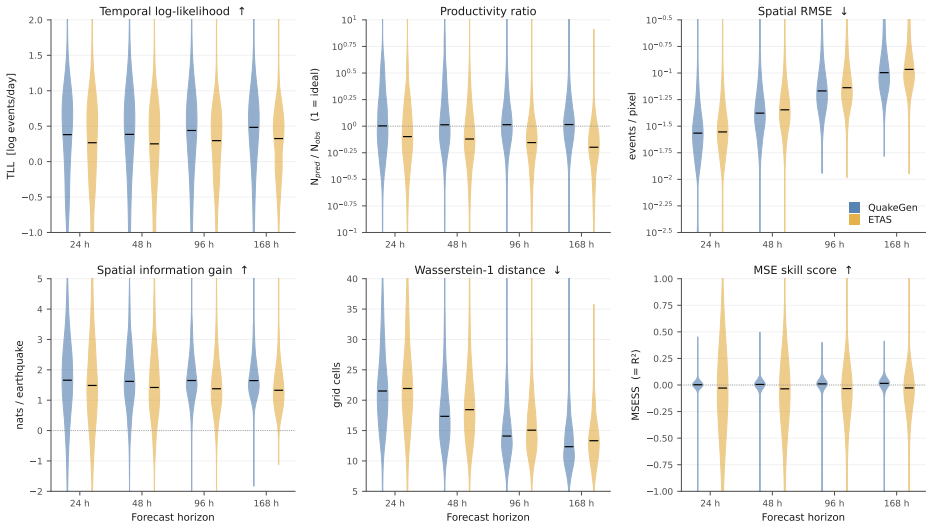
QuakeGen treats a future aftershock sequence as a two-channel spatial field - event count and maximum magnitude per grid cell - and learns its conditional distribution with a denoising diffusion model. Conditioned only on observed seismicity over nested past windows, the first 1.6 hours of early aftershocks, and the forecast horizon, one trained model generates an ensemble of future fields. On the held-out global test set it leads USGS-RJ on spatial information gain, Wasserstein-1 distance, and mean-squared-error skill score at every horizon scored, and on the regional daily benchmark it matches ETAS tuned separately for each region. The load-bearing claim is that the fixed isotropic spatial
Load-bearing premise
The short-horizon comparison is fair only if scoring QuakeGen on aftershocks that were already visible to it before the forecast starts does not inflate its apparent skill; 53% of the 3-hour window and 13% of the 12-hour window overlap its conditioning.
Editorial extensions
If this is right
- On 80 held-out global mainshocks of 2024-2025, QuakeGen beats the operational USGS Reasenberg-Jones forecast on spatial skill at every horizon, with larger gains at short horizons.
- A single QuakeGen model trained once over all of southern California matches ETAS models tuned separately for the Salton Sea and San Jacinto regions at all daily forecast horizons.
- The model reproduces Omori-like decay and Gutenberg-Richter magnitude statistics without being given these laws, and one trained network serves all forecast horizons from hours to a month.
- The generative ensemble provides spread as a measure of forecast uncertainty, and the joint maximum-magnitude channel forecasts where the largest expected aftershocks will fall.
- Applied without retraining to an enhanced template-matching catalog of southern California, the global model matches region-specific ETAS, suggesting it has learned sequence evolution rather than catalog-specific statistics.
Reading between the lines
- Editorial extension: the author leaves implicit that the short-horizon comparison can be confounded - 53% of the 3-hour window and 13% of the 12-hour window are already inside the conditioning windows, so QuakeGen can partly copy the fields it was conditioned on while Reasenberg-Jones cannot. A clean test would score only events after the 1.6-hour conditioning cutoff.
- Editorial extension: because the model is field-based rather than point-process-based, it should transfer to fluid-driven swarms, induced sequences, and slow-slip-driven activity, where pattern migration rather than a single mainshock controls the sequence; this is directly testable with injection-rate or geodetic conditioning fields.
- Editorial extension: adding finite-fault geometry, mapped fault traces, or InSAR/GPS deformation as extra conditioning channels would likely sharpen the earliest hours after a mainshock, where aftershock observations are sparse and the current model is least constrained.
- Editorial extension: making the forecast autoregressive - re-conditioning on newly arrived events after each horizon - would let the same model track a sequence continuously and align better with operational updating practice.
Signed reviews
Editorial analysis
A structured set of objections, weighed in public.
Referee Report
Summary. The paper introduces QuakeGen, a conditional denoising diffusion model that recasts aftershock forecasting as generation of gridded log-count and maximum-magnitude fields. The model is trained once on global mainshock–aftershock sequences (1990–2023, tested on 2024–2025) and on the QTM southern California catalog (2009–2015, tested on 2016–2017), and is compared with the operational USGS Reasenberg–Jones model and with regionally tuned ETAS. The central claims are that QuakeGen outperforms USGS-RJ on global sequences, recovers fault-aligned anisotropic structure that isotropic kernels cannot express, and matches ETAS on regional daily forecasting without per-sequence or per-region refitting. The paper also presents a cross-catalog experiment in which the global model is applied to the enhanced QTM catalog without retraining.
Significance. If the global result is confirmed, this is a meaningful contribution: a single generative model, trained without per-sequence or per-region refitting, producing probabilistic spatial forecasts and beating an operational baseline on held-out years. The evaluation design has genuine strengths: a strictly held-out global test period (2024–2025), held-out regional years (2016–2017), public code and archived forecast outputs, and a regional comparison against benchmark-tuned ETAS. However, the global evaluation has a scoring/conditioning overlap: events in the first 1.6 h after the mainshock are both conditioning inputs and part of the scored target for every horizon, so QuakeGen can partially copy the target while USGS-RJ cannot. This contaminates the headline global comparison in Table 2 and Fig. 6. The regional result is unaffected by this overlap and provides independent support for the framework. The paper is also honest about its main limitation—reliance on large training catalogs—and shows a clear failure case (Kamchatka).
major comments (3)
- [§3.1, Table 1, Eq. (1)] The global target in Eq. (1) is all events in (t0, t0+T], while the conditioning includes post-anchor windows ending at tc = 1.6 h (Table 1). For the 3 h and 12 h horizons, 53% and 13% of the scored window are also input channels; for longer horizons, the early high-rate interval still contains a large fraction of the scored events. Because QuakeGen receives per-cell log-count and max-magnitude fields over (0, 1.6 h], it can reproduce those events nearly exactly, whereas USGS-RJ uses the same early aftershocks only as smoothed kernel sources. This inflates the QuakeGen advantage in Table 2 and Fig. 6 at every horizon. The stress-test concern lands. Re-score with the target truncated to (t0+tc, t0+T] or, equivalently, move the issue time to t0+tc and report all metrics on that clean target. Also report sensitivity to tc.
- [§2.3, global dataset construction] The text says that when USGS and ISC both record the same earthquake, the authors 'keep both records as separate sequences rather than choosing between them.' If the same mainshock appears in both catalogs, it can be scored twice as two of the 80 test sequences, and its aftershocks can be duplicated in the observed and predicted fields. This would bias the per-event metrics in Table 2 and Fig. 6 and make the 80 test sequences non-independent. Please clarify the de-duplication procedure, and if duplicates exist, merge or remove them and recompute the global comparison.
- [§S1.2, §3.1] The global comparison is also confounded by an input asymmetry: QuakeGen conditions on 768 h of pre-mainshock seismicity and on the first 1.6 h of aftershocks, whereas USGS-RJ starts at the mainshock and uses only the first 1.6 h of aftershocks as kernel sources. This is acknowledged in S1.2 but not controlled. To attribute the gain to learned spatiotemporal structure rather than to additional input information, the paper should include an ablation—e.g., QuakeGen without the pre-mainshock windows, or an RJ variant with a background term—or otherwise qualify the causal claim.
minor comments (5)
- [§2.1/Table 1] The scaling constants (α, β, γ), the conditioning-window schedule, and the cutoff tc are chosen ad hoc, as the paper states for tc. The paper should explicitly list these as hyperparameters and, if possible, give a small sensitivity analysis; otherwise the 'no prescribed functional form' claim should be softened.
- [§3.2/Fig. 10/Table 2] The text says QuakeGen 'matches' ETAS regionally, but Table 2 and Fig. 10 show QuakeGen consistently higher in TLL and IG and closer to a productivity ratio of 1. Consider saying 'slightly outperforms' or 'is competitive with' rather than 'matches.'
- [§3.1/Figs. 7, S7–S29] The maximum-magnitude channel is a claimed output of the model but is only shown qualitatively. If it is part of the contribution, add a quantitative evaluation (e.g., MAE or rank histogram for the P90 field, or a proper score for the magnitude channel). Otherwise state that the field is illustrative.
- [§3.3/Fig. S18] The M 4.4 San Jacinto sequence used in the cross-catalog experiment is below the global model's M ≥ 4.5 training range. This should be mentioned in the main text when drawing conclusions about generalization to enhanced catalogs.
- [Acknowledgements] The acknowledgements contain a personal memorial and a passage in another language. This is unusual for a journal article and should be moved to a footnote or removed. The AI-use declaration is appropriate and should stay.
Circularity Check
Global short-horizon benchmark leaks the first 1.6 h of target aftershocks into QuakeGen's conditioning, partially forcing the reported spatial advantage by construction.
-
self definitional
[Section 2.1 Eq. (1), Table 1, Section 3.1]
"the forecast target over the window (t0, t0 + T ) is the pair of fields Nij = # { e : te ∈ (t0, t0 + T ), xe ∈ Ωij } ... Post-anchor windows (end) 0.1, 0.2, 0.4, 0.8, 1.6 h ... score five fixed horizons from 3 to 720 hours"
The scored target defined in Eq. 1 includes all events in (t0, t0+T], while the global conditioning includes post-anchor windows ending at tc = 1.6 h. For the 3 h horizon 1.6/3 = 53% of the target window is also part of the input; for 12 h it is 13%, and even longer horizons contain the early aftershocks that dominate the scored count. QuakeGen receives per-cell log-count and max-magnitude fields over these windows, so it can reproduce those events almost exactly, whereas the USGS-RJ baseline only smooths the same early aftershocks through a kernel. Hence the reported spatial gains (IG, W1, MSESS, and partly TLL) are partly forced by construction rather than by predictive skill.
full rationale
The core modeling pipeline is not circular: the global model is trained on 1990-2023 and evaluated on held-out 2024-2025 mainshocks, and the regional model is trained on 2009-2015 and tested on 2016-2017, so the central empirical comparison has genuine temporal out-of-sample grounding. No fitted parameter is renamed as a prediction, and the self-citations (e.g., Zhu & Beroza 2018 for PhaseNet, Zhu et al. 2023 for DAS picking) are contextual and not load-bearing for the claim that QuakeGen outperforms the baselines. The one significant circularity is the global evaluation design: Eq. (1) scores a target that begins at t0, while Table 1 and Section 3.1 give QuakeGen post-anchor conditioning windows extending to tc = 1.6 h. Every event in the first 1.6 hours is therefore both an input channel and part of the scored target at every horizon. QuakeGen can copy those per-cell counts and maximum magnitudes essentially exactly, while the Reasenberg-Jones model, which also uses early aftershocks as sources, still spreads them through an isotropic kernel. This inflates the global spatial metrics most at the 3 h and 12 h horizons and contaminates all horizons to some degree. The regional daily experiment has no post-anchor conditioning and is unaffected, and the long-horizon global results are less contaminated, so the paper is not wholly circular; nevertheless the headline global advantage is partially forced by this target/conditioning overlap.
Assumptions & free parameters
free parameters (4)
- Output-channel scaling (alpha, beta, gamma) =
Table 1: alpha=1 (global)/0.01 (regional); gamma=6 (regional); beta set per setting
- Early-aftershock conditioning cutoff tc =
1.6 h
- Conditioning window schedule =
Global: -768/-192/-48/-12/-3 h plus 0.1-1.6 h; regional: -768 to -24 h plus two static maps
- Forecast-horizon sampling and inference hyperparameters =
LogUniform horizons (global 0.1-768 h; regional 24-168 h); batch 128; Adam lr 1e-4; DDIM 250 steps; K=50-100
assumptions (6)
- domain assumption Per-cell count and maximum-magnitude fields summarize the information needed for aftershock forecasting.
- domain assumption USGS ComCat/ISC and QTM catalogs are sufficiently complete and accurate to learn the past-future mapping, with no global completeness correction.
- domain assumption Mainshock filtering (largest event in 100 km, 8-day window; >=100 aftershocks) defines independent, representative sequences.
- domain assumption Wells-Coppersmith rupture-length scaling sizes the forecast domain adequately for every test mainshock.
- domain assumption A U-Net diffusion model with v-prediction and FiLM conditioning can represent p_theta(·|c) for sparse, heavy-tailed count fields.
- domain assumption A model trained on routine global catalogs transfers to an enhanced template-matching catalog without retraining.
Cite this review
Pith. "Pith review of Earthquake Aftershock Forecasting using Conditional Generative Models." pith.science (2026). https://pith.science/paper/SWU7SM75
@misc{pith2026260724109,
  author       = {Pith},
  title        = {Pith review of: Earthquake Aftershock Forecasting using Conditional Generative Models},
  year         = {2026},
  howpublished = {\url{https://pith.science/paper/SWU7SM75}},
  note         = {Machine review of arXiv:2607.24109}
}
read the original abstract
Forecasting how aftershocks evolve in space and time after a large earthquake is a central problem in statistical seismology and underpins operational earthquake forecasting. Existing forecasting methods rest on statistical point-process models such as the epidemic-type aftershock sequence (ETAS) and Reasenberg-Jones models, which prescribe a fixed decay in time and an isotropic kernel in space. They match the average Omori-Utsu and Gutenberg-Richter statistics well but do not capture the fault-controlled spatial patterns of real sequences or the productivity that varies among sequences. Neural point-process models relax these fixed forms but keep the event-by-event view and have not consistently surpassed ETAS on common benchmarks. Rather than modeling individual events as a point process, we recast aftershock forecasting as conditional generation of a spatiotemporal field. We develop QuakeGen, a diffusion model that generates the evolving fields of aftershock rate and maximum magnitude conditioned on recent seismicity and the forecasting horizon. The same conditional generative framework can be trained on rich seismic catalogs to forecast global aftershock sequences and regional daily seismicity, and could further condition on physical fields such as fault geometry or geodetic deformation. On global sequences, the data-driven approach outperforms the operational USGS Reasenberg-Jones forecast, recovering the fault-controlled, anisotropic spatial structure that fixed kernels cannot express. On daily forecasting, QuakeGen also matches the well-tuned ETAS baselines, which neural point-process models have yet to surpass on the regional benchmark. Conditional generative modeling, which has transformed prediction in fields as diverse as weather forecasting and protein structure prediction, holds the potential to forecast more accurately how earthquake sequences unfold in space and time.
Figures


Figures from the paper (14 more)




Reference graph
Works this paper leans on
-
[1]
Abramson, J., Adler, J., Dunger, J., Evans, R., Green, T., Pritzel, A., … Jumper, J. M. (2024). Accurate structure prediction of biomolecular interactions with AlphaFold
2024
-
[3]
Allen, R
Nature, 630(8016), 493–500. Allen, R. V. (1978). Automatic earthquake recognition and timing from single traces. Bulletin of the Seismological Society of America , 68(5), 1521–1532. Bakun, W. H., Aagaard, B., Dost, B., Ellsworth, W. L., Hardebeck, J. L., Harris, R. A., … Wald- hauser, F. (2005). Implications for prediction and hazard assessment from the 2...
1978
-
[1069]
H., Chen, Y.-T., Gasparini, P., Madariaga, R., Main, I., Marzocchi, W., … Zschau, J
Jordan, T. H., Chen, Y.-T., Gasparini, P., Madariaga, R., Main, I., Marzocchi, W., … Zschau, J. (2011). Operational earthquake forecasting. State of knowledge and guidelines for utilization. Annals of Geophysics , 54(4). Kagan, Y. Y., & Jackson, D. D. (1991). Seismic gap hypothesis: Ten years after. Journal of Geophysical Research: Solid Earth , 96(B13), ...
2011
-
[1250]
Chen, R. T. Q., Amos, B., & Nickel, M. (2021). Neural spatio-temporal point processes. In International conference on learning representations (ICLR). Cicerone, R. D., Ebel, J. E., & Britton, J. (2009). A systematic compilation of earthquake precursors. Tectonophysics, 476(3–4), 371–396. Dascher-Cousineau, K., Brodsky, E. E., Lay, T., & Goebel, T. H. (202...
2021
-
[1421]
Langenbruch, C., & Zoback, M. D. (2016). How will induced seismicity in Oklahoma respond to decreased saltwater injection rates? Science Advances, 2(11). Li, J., Biondi, E., Heimisson, E. R., Puel, S., Zhai, Q., Zhang, S., … Zhan, Z. (2025). Minute-scale dynamics of recurrent dike intrusions in Iceland with fiber-optic geodesy. Science, 388(6752), 1189–11...
2016
-
[2301]
Peng, Z., & Lei, X. (2024). Physical mechanisms of earthquake nucleation and foreshocks: Cascade triggering, aseismic slip, or fluid flows? Earthquake Research Advances, 5(2), 100349. Peng, Z., & Zhao, P. (2009). Migration of early aftershocks following the 2004 Parkfield earthquake. Nature Geoscience, 2(12), 877–881. Perez, E., Strub, F., de Vries, H., D...
2024
-
[2457]
Ho, J., Jain, A., & Abbeel, P. (2020). Denoising diffusion probabilistic models. In Advances in neural information processing systems (Vol. 33, pp. 6840–6851). 61 Ho, J., Salimans, T., Gritsenko, A., Chan, W., Norouzi, M., & Fleet, D. J. (2022). Video diffusion models. In Advances in neural information processing systems (NeurIPS) (Vol. 35). Huang, Y., Su...
2020
-
[2901]
E., Trugman, D
Ross, Z. E., Trugman, D. T., Hauksson, E., & Shearer, P. M. (2019). Searching for hidden earthquakes in southern California. Science, 364(6442), 767–771. Rouet-Leduc, B., Hulbert, C., & Johnson, P. A. (2019). Continuous chatter of the Cascadia subduction zone revealed by machine learning. Nature Geoscience, 12(1), 75–79. Rouet-Leduc, B., Hulbert, C., Lubb...
2019
Show all 13 references
-
[4021]
Rombach, R., Blattmann, A., Lorenz, D., Esser, P., & Ommer, B. (2022). High-resolution image synthesis with latent diffusion models. In Proceedings of the ieee/cvf conference on computer vision and pattern recognition (CVPR) (pp. 10684–10695). Ronneberger, O., Fischer, P., & B...
2022
-
[4024]
Kato, A., & Ben-Zion, Y. (2021). The generation of large earthquakes. Nature Reviews Earth & Environment, 2(1), 26–39. Kato, A., Obara, K., Igarashi, T., Tsuruoka, H., Nakagawa, S., & Hirata, N. (2012). Propagation of slow slip leading up to the 2011 Mw 9.0 Tohoku-Oki earthqua...
2021
-
[4051]
Shelly, D. R. (2020). A high-resolution seismic catalog for the initial 2019 Ridgecrest earthquake sequence: Foreshocks, aftershocks, and faulting complexity. Seismological Research Letters, 91(4), 1971–1978. Sohl-Dickstein, J., Weiss, E., Maheswaranathan, N., & Ganguli, S. (2...
2020
-
[5778]
E., & Shearer, P
Vidale, J. E., & Shearer, P. M. (2006). A survey of 71 earthquake bursts across southern California: Exploring the role of pore fluid pressure fluctuations and aseismic slip as drivers. Journal of Geophysical Research: Solid Earth , 111(B5), B05312. Wang, F., Huang, X., & Alkh...
2006
-
[8192]
M., & Beroza, G
Zhu, W., Mousavi, S. M., & Beroza, G. C. (2019). Seismic signal denoising and decomposition using deep neural networks. IEEE Transactions on Geoscience and Remote Sensing , 57 (11), 9476–9488. Zhu, W., Mousavi, S. M., & Beroza, G. C. (2020). Seismic signal augmentation to impr...
2019
Reviewed July 31, 2026 · model on record in the stance chip above.
Discussion (0). Continue with ORCID to comment.