REVIEW 4 major objections 5 minor 33 references
Face Age Verification Vulnerabilities Under Simple Appearance Manipulations
T0 review · 4 major / 5 minor · reviewed 2026-07-31 · grok-4.5
Pith's one-line read Simple drawn facial cues can flip underage age checks into age-eligible decisions for most vision models.
desk verdict Clean offline measurement of age-verification flips under kid-feasible face edits; the 61% headline is real in the tables but rests on proxy models and simulated overlays. read the letter →
The pith
A machine-rendered reading of the paper's core claim, the machinery that carries it, and where it could break.
The reading
What carries the argument
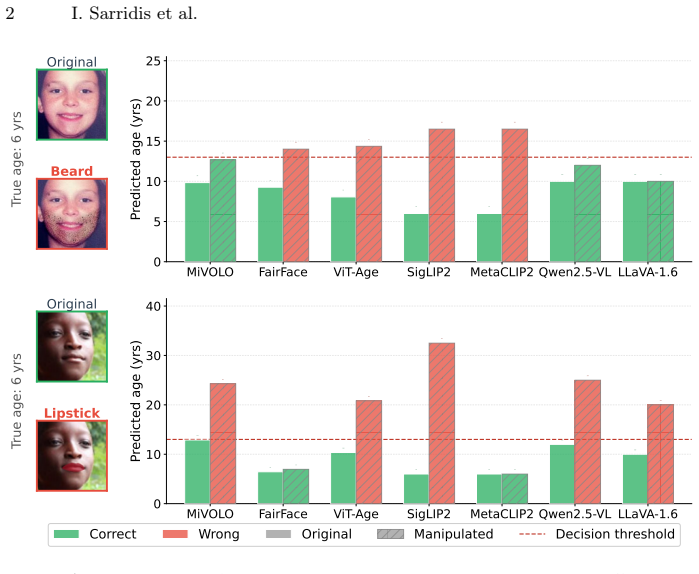
The flip rate on a robustness set of underage faces: the share of samples correctly marked underage before a fixed manipulation that become marked age-eligible after it, at the binary threshold τ=13. Paired original/manipulated landmark-aligned overlays isolate the cue’s effect on the verification decision.
What would settle it
Run the same models on real underage subjects who physically apply marker stubble, lipstick, eye makeup, or a fake mustache under production capture conditions, and check whether true-negative-to-false-positive flip rates still match the large digital effects (especially beard stubble near 60% for the weakest models).
Extended reading notes
Core claim
Most evaluated age-verification models, despite reasonable error on original images, systematically raise predicted age under simple landmark-aligned appearance manipulations that do not change true age. Drawn beard stubble is the strongest effect, with average flip rates near 21% and peaks around 61% true-negative-to-false-positive flips; lipstick is next. Vulnerability differs by race and gender, and lightweight bias-mitigation probes on frozen features can recover high worst-group true-negative rate with as little as 1% manipulated underage training data.
Load-bearing premise
The study treats simple digital face overlays (and a generative inpainting ablation) as a good enough stand-in for what an underage person would actually show a live camera, so offline decision flips measure real bypass risk.
Editorial extensions
If this is right
- Face-only age gates at common thresholds like 13 should report manipulation flip rates, not only MAE or clean accuracy.
- Drawn facial hair is a higher-priority failure mode than mustache or eye makeup for current estimators.
- Demographic gaps in flip rate mean some groups face systematically higher bypass risk under the same cues.
- Frozen-backbone linear probes plus a few percent manipulated underage samples can harden models without full retraining.
- More photorealistic edits amplify the same failure modes, so the problem is not limited to crude overlays.
Reading between the lines
- Multi-signal age assurance that still trusts the face head as a hard gate may inherit these flips unless the fusion layer down-weights face scores under makeup or facial-hair cues.
- Training pipelines that treat adult facial hair as a strong adulthood feature are likely teaching the exact shortcut attackers exploit.
- Vendors could add a cheap pre-check for cosmetic or drawn-hair overlays before accepting an age-eligible face decision.
- The gender gap on lipstick and eye makeup suggests fairness audits for age tools need attack-conditioned subgroup metrics, not only clean-data error rates.
Editorial analysis
A structured set of objections, weighed in public.
Referee Report
Summary. The paper studies the robustness of face-based age verification (binary decision at τ=13) to simple, landmark-aligned appearance manipulations (drawn beard stubble, mustache, eye makeup, lipstick) applied via deterministic OpenCV overlays, with a Stable Diffusion 2 inpainting ablation. Seven models spanning vision, VLM, and MLLM families are evaluated on UTKFace, Adience, and FairFace using paired original/manipulated underage samples, with TNR, flip rates, and age shifts reported with 95% bootstrap CIs. Beard stubble causes a 20.8% average flip rate (up to 61.4% for MiVOLO on FairFace); flip rates are uneven across race and gender groups; and lightweight probes on frozen features trained with standard bias-mitigation methods (ERM, LfF, GroupDRO, FLAC, BPA) recover much of the worst-group TNR with as little as 1% manipulated underage training data.
Significance. If the results hold, this is a timely and useful empirical contribution given the regulatory push toward automated age assurance. Strengths worth naming: (i) a clean paired design in which original and manipulated images differ only in the applied cue, so measured flips isolate the manipulation effect; (ii) falsifiable, concretely reported metrics (flip rate, WG-TNR) with bootstrap confidence intervals rather than anecdotal examples; (iii) a threat model that is deliberately non-adversarial in the optimization sense — no gradient access, no patch optimization — which makes the "a child with a marker" scenario credible and distinct from prior physical adversarial attacks; (iv) demographic disaggregation of the vulnerability, which is rare in robustness studies; and (v) a mitigation section showing the information needed to separate age from manipulation cues already exists in frozen representations. The central empirical finding (large beard-stubble flip rates across most models) survives even after discounting the weakest model, and the limitations section is unusually candid about the simulated nature of the manipulations and the single-signal evaluation.
major comments (4)
- [§3.5, Table 3, Abstract] The headline statistic ('up to 61% of True Negatives flipped', abstract and §4.2) is MiVOLO evaluated in face-only mode, which §3.5 acknowledges is off-label: MiVOLO is architected to fuse face and body features, and body cues (height, build) are exactly the signal most likely to override a drawn beard on a child. Consistent with degraded input, MiVOLO also has the weakest original-image TNR on FairFace (77.3%, Table 2). The most-quoted number in the paper thus comes from the model used furthest from its intended operating point. The aggregate claim does not depend on this number — FairFace-model beard flips reach 30.3% on Adience and SigLIP2 lipstick flips reach 39.5% on UTKFace — so the fix is presentational: the abstract and §4.2 should contextualize the 61.4% figure (or report headline aggregates with MiVOLO separated), rather than anchoring on it.
- [§5.1–5.2, Tables 8–9] The mitigation experiments train probes with manipulated variants produced by the same four deterministic OpenCV operators used at test time, and Table 8/9 evaluate only against those same operators. The resulting claim that robustness 'can largely recover' with 1% manipulated data is therefore established only under a known-attack assumption. An underage user with a slightly different cue (different stubble style, real cosmetics, or the SD2 generative variants of §4.3, which Table 5 shows are strictly stronger) is out of the mitigation's training distribution. Since the SD2-manipulated images already exist, a cross-manipulation evaluation (train probes on OpenCV manipulations, test on generative ones) would directly test transfer; absent that, the mitigation claims should be explicitly scoped to the matched-attack setting.
- [§3.5 (MLLM prompt), §4.2] The MLLM prompt asks 'How old does the person in this image appear to be?' A drawn beard genuinely changes apparent age, so for Qwen2.5-VL and LLaVA-1.6 part of the measured flip may be a correct answer to the question as posed rather than a verification error. This matters because the MLLM comparison (LLaVA-1.6 'consistently the least affected', §4.2) is interpreted as a model-robustness property, when it may partly reflect prompt-interpretation differences across MLLMs. A control prompt asking for estimated actual age (or a discussion of why apparent-age is the operationally relevant query for deployed use) would sharpen the MLLM results.
- [§3.4 (Set B construction), §4.3] The underage cohorts sit far from the decision boundary in two of three datasets: FairFace Set B uses the 3–9 group (the 10–19 group is excluded because it crosses τ, §3.4) and Adience uses 4–6/8–13 bins. The security-relevant population is users just below 13, whose baseline predictions lie closest to τ and flip most easily. The paper would be strengthened by a per-age breakdown on UTKFace (the one dataset with exact labels in 6–12) showing flip rate as a function of distance from the threshold, or at minimum a discussion of how the reported flip rates relate to the near-threshold cohort that would actually attempt bypass. Relatedly, §4.3's closing sentence that these cues 'are sufficient to bypass age verification systems' should be aligned with §6's correct disclaimer that only the visual component in isolation was tested and no deployed multi-signal system was evaluated.
minor comments (5)
- [Abstract vs. §5] Terminology inconsistency: the abstract and contributions say 'linear probe settings', but §5 describes a two-layer MLP on frozen features. These are not the same thing; please use one term consistently.
- [Tables 6–7] Tables 6 and 7 report model-averaged flip rates by race and gender without confidence intervals, unlike Tables 2–4. Given that some FairFace race cells are small, CIs (or at least per-group sample counts) are needed to assess whether the Indian-vs-East-Asian gap in Table 6 is statistically supported.
- [§3.3, §4.3] The SD2 inpainting ablation (§3.3/§4.3) does not specify the inpainting prompts, masks, seeds, or how many images were generated. As this ablation supports the claim that realistic edits amplify vulnerability, the generation protocol should be reproducible.
- [Table 2] Table 2 legend: increases in TNR under manipulation (e.g., MiVOLO mustache, +6.3 on UTKFace) are colored blue and treated symmetrically with decreases. A brief note on why mustache overlays improve TNR for some models (plausibly an artifact of overlay placement) would preempt confusion.
- [References] Typo in reference [30]: 'In 3nd AEQUITAS Workshop' should be '3rd'. Reference [5] (Wired) is undated in the text citation style used; please check venue style for web sources.
Circularity Check
Empirical robustness study with measured flip rates against held-out labels; no derivation reduces to its inputs by construction.
full rationale
This paper is a comparative empirical evaluation, not a first-principles derivation. Age verification decisions are defined by a fixed external threshold τ=13 on scalar age estimates; flip rate and TNR are computed from held-out underage ground-truth labels before vs. after deterministic landmark overlays that are not optimized against any model loss. Baseline MAE on Set A, Set B robustness tables, demographic breakdowns, and the generative-inpainting ablation are all measurements against external data, not fitted quantities renamed as predictions. Mitigation (ERM, LfF, GroupDRO, FLAC, BPA) applies published recipes as linear probes on frozen features; author-overlapping FLAC is one comparator among five and is not load-bearing for the central vulnerability claim (BPA leads at 1%). No self-definitional loop, no fitted-input-as-prediction, and no uniqueness theorem imported to force the result. Circularity score is therefore 0.
Assumptions & free parameters
free parameters (4)
- verification_threshold_tau =
13 years
- manipulated_underage_train_ratios =
{1%, 5%, 10%}
- Set_A_age_bin_selection =
dataset-specific bins as in §3.4
- OpenCV_overlay_geometry_and_style
assumptions (6)
- domain assumption Binary age verification is h_f(x;τ)=1[f(x)≥τ] with scalar age from regression or expected class age.
- domain assumption Landmark-aligned deterministic overlays change appearance cues but not true age, so a robust verifier should preserve the underage decision.
- domain assumption Public face crops from UTKFace/Adience/FairFace plus named pretrained models are informative about vision-based age assurance behavior.
- ad hoc to paper Zero-shot MLLM age is recoverable by prompting for a single integer and parsing the text reply.
- ad hoc to paper Frozen-backbone two-layer MLP probes plus group-robust training approximate whether representations can separate age from manipulation shortcuts without full MLLM finetuning.
- standard math Standard results and recipes for ERM, GroupDRO, LfF, FLAC, BPA, MediaPipe FaceMesh, and SD2 inpainting may be used as given.
Cite this review
Pith. "Pith review of Face Age Verification Vulnerabilities Under Simple Appearance Manipulations." pith.science (2026). https://pith.science/paper/O3XVZ6WB
@misc{pith2026260724194,
  author       = {Pith},
  title        = {Pith review of: Face Age Verification Vulnerabilities Under Simple Appearance Manipulations},
  year         = {2026},
  howpublished = {\url{https://pith.science/paper/O3XVZ6WB}},
  note         = {Machine review of arXiv:2607.24194}
}
read the original abstract
Online platforms increasingly rely on automated age estimation systems to enforce minimum-age policies. Focusing on vision-based models designed for this task, concerns arise regarding their robustness to simple appearance changes that underage individuals may use to bypass such systems, such as drawing a mustache or applying lipstick. In this work, we present a systematic study of age verification robustness by simulating visual alterations that can be easily achieved by underage individuals. We evaluate seven models, including vision, vision-language, and multimodal large language models, across three datasets and four manipulation types. Interestingly, under drawn beard stubble, up to 61% of True Negatives are flipped into False Positives. Furthermore, we investigate how different demographics are affected by such manipulations, finding that Indians are more affected by beard stubble manipulations, while females are more affected than males across all manipulations. Finally, we explore how these biases can be mitigated using bias mitigation methodologies in lightweight linear probe settings.
Figures

Reference graph
Works this paper leans on
-
[1]
arXiv preprint arXiv:2502.13923 (2025)
Bai, S., Chen, K., Liu, X., Wang, J., Ge, W., Song, S., Dang, K., Wang, P., Wang, S., Tang, J., Zhong, H., Zhu, Y., Yang, M., Li, Z., Wan, J., Wang, P., Ding, W., Fu, Z., Xu, Y., Ye, J., Zhang, X., Xie, T., Cheng, Z., Zhang, H., Yang, Z., Xu, H., Lin, J.: Qwen2.5-VL technical report. arXiv preprint arXiv:2502.13923 (2025)
arXiv 2025
-
[2]
Proceedings of Machine Learning Research, vol
Buolamwini, J., Gebru, T.: Gender shades: Intersectional accuracy disparities in commercialgenderclassification.In:ProceedingsoftheConferenceonFairness,Ac- countability and Transparency. Proceedings of Machine Learning Research, vol. 81, pp. 77–91. PMLR (2018)
2018
-
[3]
In: Proceedings of the IEEE/CVF Conference on Computer Vision and Pattern Recognition
Duan, R., Mao, X., Qin, A.K., Chen, Y., Ye, S., He, Y., Yang, Y.: Adversarial laser beam: Effective physical-world attack to DNNs in a blink. In: Proceedings of the IEEE/CVF Conference on Computer Vision and Pattern Recognition. pp. 16062–16071 (2021)
2021
-
[4]
IEEE Transactions on Information Forensics and Security9(12), 2170–2179 (2014) Accepted at the BIAS Workshop, ECML PKDD 2026 15
Eidinger, E., Enbar, R., Hassner, T.: Age and gender estimation of unfiltered faces. IEEE Transactions on Information Forensics and Security9(12), 2170–2179 (2014) Accepted at the BIAS Workshop, ECML PKDD 2026 15
2014
-
[5]
https://www.wired.com/story/a-kid-with-a-fake-mustache- tricked-an-online-age-verification-tool/ (2026)
Fernánda González: A Kid With a Fake Mustache Tricked an Online Age-Verification Tool. https://www.wired.com/story/a-kid-with-a-fake-mustache- tricked-an-online-age-verification-tool/ (2026)
2026
-
[6]
Nature Machine In- telligence2, 665–673 (2020)
Geirhos, R., Jacobsen, J.H., Michaelis, C., Zemel, R., Brendel, W., Bethge, M., Wichmann, F.A.: Shortcut learning in deep neural networks. Nature Machine In- telligence2, 665–673 (2020)
2020
-
[7]
Sensors23(2), 853 (2023)
Hwang, R.H., Lin, J.Y., Hsieh, S.Y., Lin, H.Y., Lin, C.L.: Adversarial patch at- tacks on deep-learning-based face recognition systems using generative adversarial networks. Sensors23(2), 853 (2023)
2023
-
[8]
In: Proceedings of the IEEE/CVF Winter Conference on Applications of Computer Vision
Kärkkäinen, K., Joo, J.: FairFace: Face attribute dataset for balanced race, gender, and age for bias measurement and mitigation. In: Proceedings of the IEEE/CVF Winter Conference on Applications of Computer Vision. pp. 1548–1558 (2021)
2021
Show all 33 references
-
[9]
arXiv preprint arXiv:1907.06724 (2019)
Kartynnik, Y., Ablavatski, A., Grishchenko, I., Grundmann, M.: Real-time fa- cial surface geometry from monocular video on mobile gpus. arXiv preprint arXiv:1907.06724 (2019)
1907 arXiv
-
[10]
In: Proceedings of the International Conference on Pattern Recognition
Komkov, S., Petiushko, A.: AdvHat: Real-world adversarial attack on ArcFace face ID system. In: Proceedings of the International Conference on Pattern Recognition. pp. 819–826 (2021)
2021
-
[11]
arXiv preprint arXiv:2307.04616 (2023)
Kuprashevich, M., Tolstykh, I.: MiVOLO: Multi-input transformer for age and gender estimation. arXiv preprint arXiv:2307.04616 (2023)
2023 arXiv
-
[12]
In: Advances in Neural Information Processing Systems
Li, W., Huang, X., Zhu, Z., Tang, Y., Li, X., Lu, J., Zhou, J.: OrdinalCLIP: Learn- ing rank prompts for language-guided ordinal regression. In: Advances in Neural Information Processing Systems. vol. 35, pp. 35313–35325 (2022)
2022
-
[13]
In: Proceedings of the 38th International Conference on Machine Learning
Liu, E.Z., Haghgoo, B., Chen, A.S., Raghunathan, A., Koh, P.W., Sagawa, S., Liang, P., Finn, C.: Just train twice: Improving group robustness without train- ing group information. In: Proceedings of the 38th International Conference on Machine Learning. Proceedings of Machine ...
-
[14]
https://llava- vl.github.io/blog/2024-01-30-llava-next/ (2024)
Liu, H., Li, C., Li, Y., Li, B., Zhang, Y., Shen, S., Lee, Y.J.: LLaVA- NeXT: Improved reasoning, OCR, and world knowledge. https://llava- vl.github.io/blog/2024-01-30-llava-next/ (2024)
2024
-
[15]
In: Proceedings of the IEEE/CVF Conference on Computer Vision and Pattern Recognition
Liu, Y., Wei, H., Jia, C., Xiao, R., Ruan, W., Wei, X., Zhou, J.T., Wang, Z.: ProjAttacker: A configurable physical adversarial attack for face recognition via projector. In: Proceedings of the IEEE/CVF Conference on Computer Vision and Pattern Recognition. pp. 21248–21257 (2025)
2025
-
[16]
In: Proceedings of the IEEE International Conference on Computer Vision
Liu, Z., Luo, P., Wang, X., Tang, X.: Deep learning face attributes in the wild. In: Proceedings of the IEEE International Conference on Computer Vision. pp. 3730–3738 (2015)
2015
-
[17]
https://about.fb.com/news/2026/05/ai-age-assurance- teens/ (2026)
Meta Platforms: New AI-Powered Age Assurance Measures to Place Teens in Age- Appropriate Experiences. https://about.fb.com/news/2026/05/ai-age-assurance- teens/ (2026)
2026
-
[18]
In: Advances in Neural Information Processing Systems
Nam, J., Cha, H., Ahn, S., Lee, J., Shin, J.: Learning from failure: Training debi- ased classifier from biased classifier. In: Advances in Neural Information Processing Systems. vol. 33, pp. 20673–20684 (2020)
2020
-
[19]
In: Advances in Neural Information Processing Systems
Pezeshki, M., Kaba, S.O., Bengio, Y., Courville, A., Precup, D., Lajoie, G.: Gra- dient starvation: A learning proclivity in neural networks. In: Advances in Neural Information Processing Systems. vol. 34, pp. 1256–1272 (2021)
2021
-
[20]
https://huggingface.co/prithivMLmods/Age-Classification-SigLIP2 (2024) 16 I
prithivMLmods: Age Classification SigLIP2. https://huggingface.co/prithivMLmods/Age-Classification-SigLIP2 (2024) 16 I. Sarridis et al
2024
-
[21]
https://huggingface.co/prithivMLmods/MetaCLIP-2-Age-Range-Estimator (2024)
prithivMLmods: MetaCLIP-2 age range estimator. https://huggingface.co/prithivMLmods/MetaCLIP-2-Age-Range-Estimator (2024)
2024
-
[22]
https://huggingface.co/nateraw/vit-age-classifier (2022)
Raw, N.: nateraw/vit-age-classifier: ViT age classifier. https://huggingface.co/nateraw/vit-age-classifier (2022)
2022
-
[23]
In: Proceedings of the IEEE/CVF Conference on Computer Vision and Pattern Recognition
Rombach, R., Blattmann, A., Lorenz, D., Esser, P., Ommer, B.: High-Resolution Image Synthesis With Latent Diffusion Models. In: Proceedings of the IEEE/CVF Conference on Computer Vision and Pattern Recognition. pp. 10684–10695 (June 2022)
2022
-
[24]
In: Proceedings of the IEEE International Conference on Computer Vision Workshops
Rothe, R., Timofte, R., Van Gool, L.: DEX: Deep expectation of apparent age from a single image. In: Proceedings of the IEEE International Conference on Computer Vision Workshops. pp. 10–15 (2015)
2015
-
[25]
In: International Conference on Learning Representations (2020)
Sagawa, S., Koh, P.W., Hashimoto, T.B., Liang, P.: Distributionally robust neu- ral networks for group shifts: On the importance of regularization for worst-case generalization. In: International Conference on Learning Representations (2020)
2020
-
[26]
In: Joint European Conference on Machine Learning and Knowledge Discovery in Databases
Sarridis, I., Koutlis, C., Papadopoulos, S., Diou, C.: Towards fair face verification: An in-depth analysis of demographic biases. In: Joint European Conference on Machine Learning and Knowledge Discovery in Databases. pp. 194–208. Springer (2023)
2023
-
[27]
IEEE Transactions on Pattern Analysis and Machine Intelligence47(2) (2024)
Sarridis, I., Koutlis, C., Papadopoulos, S., Diou, C.: FLAC: Fairness-aware repre- sentation learning by suppressing attribute-class associations. IEEE Transactions on Pattern Analysis and Machine Intelligence47(2) (2024)
2024
-
[28]
In: Proceedings of the IEEE/CVF International Conference on Com- puter Vision
Sarridis, I., Koutlis, C., Papadopoulos, S., Diou, C.: Badd: Bias mitigation through bias addition. In: Proceedings of the IEEE/CVF International Conference on Com- puter Vision. pp. 7673–7682 (2025)
2025
-
[29]
In Proceedings of the IEEE/CVF International Conference on Computer Vision pp
Sarridis, I., Koutlis, C., Papadopoulos, S., Diou, C.: Mavias: Mitigate any visual bias. In Proceedings of the IEEE/CVF International Conference on Computer Vision pp. 1271–1281 (2025)
2025
-
[30]
In 3nd AEQUITAS Workshop on Fairness and Bias in AI at ECAI 2025 (2025)
Sarridis, I., Koutlis, C., Papadopoulos, S., Diou, C.: VB-Mitigator: An open-source framework for evaluating and advancing visual bias mitigation. In 3nd AEQUITAS Workshop on Fairness and Bias in AI at ECAI 2025 (2025)
2025
-
[31]
In: Proceedings of the IEEE/CVF Conference on Computer Vision and Pattern Recognition
Seo, S., Lee, J.Y., Han, B.: Unsupervised learning of debiased representations with pseudo-attributes. In: Proceedings of the IEEE/CVF Conference on Computer Vision and Pattern Recognition. pp. 16742–16751 (2022)
2022
-
[32]
In: Proceedings of the 2016 ACM SIGSAC Conference on Computer and Communications Security
Sharif, M., Bhagavatula, S., Bauer, L., Reiter, M.K.: Accessorize to a crime: Real and stealthy attacks on state-of-the-art face recognition. In: Proceedings of the 2016 ACM SIGSAC Conference on Computer and Communications Security. pp. 1528–1540 (2016)
2016
-
[33]
In: Proceedings of the IEEE/CVF Conference on Computer Vision and Pattern Recognition
Zhang, Z., Song, Y., Qi, H.: Age progression/regression by conditional adversarial autoencoder. In: Proceedings of the IEEE/CVF Conference on Computer Vision and Pattern Recognition. pp. 5810–5818 (2017)
2017
Reviewed July 31, 2026 · model on record in the stance chip above.
Discussion (0). Sign in to comment.