REVIEW 3 major objections 7 minor 40 references
Uniform pilots fold angle-delay-Doppler paths into indistinguishable groups; coarse support priors plus a tensor network unmix them and cut pilot overhead.
Reviewed by Pith at T0; open to challenge. T0 means a machine referee read the full paper against a public rubric. the ladder, T0–T4 →
T0 review · grok-4.5
2026-07-31 17:57 UTC pith:W67XQHZ4
load-bearing objection Solid ADD-aliasing analysis plus a prior-conditioned axial network that delivers real multi-config pilot reduction in simulation; the headline numbers ride on binary support priors whose realism is asserted more than stress-tested. the 3 major comments →
Toward Alias-Free Channel Extrapolation in Upper Mid-Band Systems: A Spatial-Frequency-Temporal Tensor Learning Approach
The pith
A machine-rendered reading of the paper's core claim, the machinery that carries it, and where it could break.
Core claim
Under uniform SFT decimation, every ADD-domain aliasing group of size Ns×Nf×Nt collapses to a single group-sum coefficient in the observations, so physically different paths become observationally identical; recovering the true sparse ADD tensor therefore requires external support priors, and a prior-conditioned axial-attention network can learn that de-aliasing map well enough to reconstruct and predict full SFT CSI from heavily thinned pilots without per-configuration retraining.
What carries the argument
Support-prior-assisted ADD-domain de-aliasing via TANN (SPA-TANN): the LS estimate of the ADD tensor is refined by sequential axis-wise self-attention, with multi-scale CNN FiLM gates that inject marginal binary supports sang, sde, sdo and learnable residual gates that soften imperfect priors; the de-aliased tensor is then lifted back to full SFT CSI by the Tucker factors.
Load-bearing premise
The method needs usable coarse maps of which angle, delay, and Doppler bins are active; if those maps are missing or wrong—especially on angle—the network has no independent way to pick the correct alias branch from the thinned pilots alone.
What would settle it
Remove or heavily corrupt the angle-domain support prior at test time under Ns≥2 spatial decimation and check whether NMSE collapses toward the no-prior ablation and fails to beat prior-assisted model-based baselines; alternatively, measure whether a single mixed-trained model still matches separately trained specialists across unseen (Ns,Nf) pairs on held-out 3GPP channels.
If this is right
- Frequency-domain pilot density can be cut by roughly eight-fold and spatial sounding by roughly four-fold while holding extrapolation NMSE near denser-pilot baselines.
- One trained model serves multiple pilot decimation factors, removing the need to retrain when the comb or antenna-port pattern changes.
- Site-specific support maps (from maps, history, or sensing) can adapt the same network without site-wise retraining.
- Angle-domain aliasing, not delay or Doppler folding, is the binding constraint on aggressive spatial thinning and must be resolved by priors or redesign of the sounding pattern.
Where Pith is reading between the lines
- If support priors must come from ISAC or channel knowledge maps, the net pilot saving should be counted against the cost and latency of keeping those maps fresh, especially for mobile users whose angle support changes with geometry.
- Non-uniform or coded antenna/pilot patterns that break the clean alias groups of Proposition 2 might reduce dependence on external supports and are a natural follow-on experiment.
- The same ADD aliasing diagnosis likely applies to FDD downlink extrapolation and XL-MIMO near-field grids once the factor dictionaries change.
Editorial analysis
A structured set of objections, weighed in public.
Referee Report
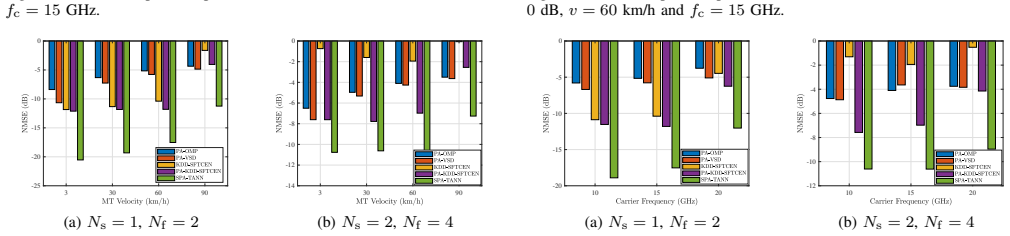
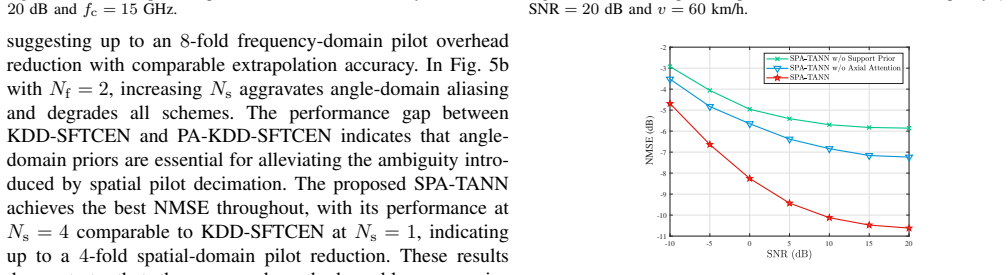
Summary. The paper addresses pilot-overhead reduction for FR3 massive MIMO-OFDM by formulating spatial-frequency-temporal (SFT) channel extrapolation in an angle-delay-Doppler (ADD) tensor representation. Its analytical core (Sec. III-A) shows that uniform decimation of the SFT observations folds the ADD domain into structured aliasing groups of size N_s N_f N_t, and Proposition 2 proves that decimated observations depend on the ADD tensor G only through group-wise sums, so intra-group ambiguity is unresolvable from pilots alone. To resolve the ambiguity the authors introduce binary marginal support priors (s_ang, s_de, s_do), take a pseudo-inverse LS estimate G_LS (Eq. 20) as network input, and learn a prior-conditioned de-aliasing operator via a tensor-structure-aware axial-attention network (TANN) with multi-scale CNN FiLM gating and per-axis gated residuals. Mixed-configuration training over decimation factors and SNRs yields a single model that generalizes across pilot patterns. Simulations on QuaDRiGa/3GPP 38.901 channels (RMa/UMa/UMi NLoS) with held-out velocities and carrier frequencies report up to ~8× frequency and ~4× spatial pilot reduction versus OMP, VSD, and KDD-SFTCEN (± prior assistance), with ablations in Fig. 8–9.
Significance. If the results hold, the paper makes a genuinely useful contribution on two levels. First, the aliasing analysis is clean and honestly stated: Proposition 1 and Proposition 2 are proved from decimation of complex exponentials and regrouping of the rank-one expansion, and the paper does not overclaim — it explicitly acknowledges (Sec. III-C) that pilots alone cannot resolve intra-group ambiguity and that priors are necessary. This is a parameter-free, falsifiable structural result that usefully delimits what any SFT extrapolation method can achieve under uniform decimation. Second, the engineering package is strong: a unified architecture whose input dimensionality is decoupled from the decimation factors, mixed-configuration training without retraining, dual-domain consistency loss, evaluation across SNR, velocity, carrier, and three 3GPP scenarios, and a meaningful ablation (Fig. 8) showing the support prior is the largest single contributor. The Fig. 9 visualization is also informative. The principal caveat — which determines how much of the headline gain is real in deployment — is that every dB attributable to de-aliasing is mediated by the support priors, whose provenance and误差
major comments (3)
- [Sec. V-A, Sec. III-C, Eq. (19)-(21)] Sec. V-A / Sec. III-C: the manuscript never states how the binary support priors s_ang, s_de, s_do are generated in the simulations. Proposition 2 (Eqs. 14–15) proves the network input G_LS (Eq. 20) contains no intra-group positional information, so all de-aliasing gains over the w/o-support-prior ablation (Fig. 8, where this variant shows the largest degradation) must originate from the priors. If the simulation supports are oracle-derived by thresholding the ground-truth ADD spectrum of the same channel realization, then Figs. 4–7 and Table II — and hence the 8×/4× pilot-reduction headline — are upper bounds conditioned on perfect prior knowledge, and the deployment story (CKMs, historical CSI, ISAC velocity estimates) is asserted rather than demonstrated. The authors must (a) disclose exactly how the priors were produced, and (b) if oracle-derived, add at least one experiment with pri
- [Sec. IV-B.3, Eqs. (35)-(36); Sec. V-C] Sec. IV-B.3, Eqs. (35)-(36): the gated residual connection is claimed to 'enhance robustness to imperfect priors' and Sec. III-C claims the formulation 'tolerates moderate support errors', but no experiment varies support accuracy. A prior-error sweep is load-bearing for the central claim because the angle-domain prior does the hardest disambiguation work: Sec. III-B.3 itself argues that no physical concentration prior exists in the angle domain, so s_ang must come from geometry-dependent sources that drift with user motion and CKM quantization. A minimal fix is an ablation at (N_s, N_f) = (2,4) with controlled corruption of s_ang (bit flips at rates {0, 5, 10, 20%}, cyclic shifts by 1–2 bins, and staleness of one coherence interval), reporting whether the gated residual actually degrades gracefully or flips alias branches catastrophically. Without this, the robustness claim attached to
- [Sec. V-A.2, Figs. 4-5, Table II] Sec. V-A.2: the prior-assisted baselines (PA-OMP, PA-VSD, PA-KDD-SFTCEN) are described as using 'angle-domain circular shifting to resolve the aliasing ambiguity', but it is not stated whether they receive the same support priors (and same prior quality) as SPA-TANN. If PA-KDD-SFTCEN uses the identical s_ang, the comparison is fair and the residual margin isolates the architectural contribution — this should be stated explicitly. If the baselines use a different or weaker prior, the margins in Figs. 4b, 5b and Table II conflate prior quality with architecture and the comparison must be equalized.
minor comments (7)
- [Eq. (20)] Eq. (20): A_o, B_o, C_o have more columns than rows under decimation, so the pseudo-inverse yields a minimum-norm solution. Please state this explicitly and confirm in one line that G_LS indeed equals (up to noise) the group-wise aggregated tensor whose entries are the sums in Eq. (14) — this would tighten the link between the Proposition 2 analysis and the network input.
- [Table I, Eq. (39), Sec. IV-D] Table I: the loss weights w_main and w_d (Eq. 39), their exponential decay schedule, the Doppler oversampling usage, and which decimation factors are randomized during mixed-configuration training (N_t appears fixed at 14 — please confirm only (N_s, N_f) are randomized) are not reported. These are needed for reproducibility.
- [Figs. 4-8] Figs. 4–8 as reproduced lack visible legends/line styles in the text; please ensure each curve is clearly identified (SPA-TANN vs. PA variants vs. baselines), ideally with consistent markers across figures.
- [Sec. III-B.2] Sec. III-B.2: the condition ν_max < 1/(2N_t ΔT) is invoked to justify retaining low-Doppler bins, but with the Table I parameters (N_t = 14, ΔT ≈ 17.8 µs at Δf = 60 kHz) the unambiguous Doppler window is ~4 kHz and the maximum Doppler at 90 km/h, 20 GHz is ~3.3 kHz — close to the boundary. A brief comment on how close the operating points sit to Doppler aliasing, and the role of S_ν = 2, would help.
- [Fig. 2] Fig. 2: the alias-branch illustration is helpful but the annotation 'alias outside the physical Doppler range' vs. 'ambiguous alias branch' would benefit from a short caption sentence tying each row to the corresponding case in Sec. III-B.1–3.
- [Sec. IV-D.2] Sec. IV-D.2: the complexity statement dismisses the multi-scale CNN gating as 'negligible'; since the gates are shared across layers and operate per axis, a one-line count (parameters and FLOPs of the gating module vs. the attention backbone) would substantiate the 'lightweight' claim.
- [Eqs. (12), (19), Sec. IV-B.2] Notation: Eq. (19) defines s_ang, s_de, s_do but Sec. IV-B.2 writes the generic support as 'd ∈ {0,1}^{K_d×1}' reusing the axis index d as the vector symbol; suggest s_d for consistency. Also define ⟨n⟩_K (used in Eq. 12) at first use — it is defined there, but the 1-based modulo convention should be flagged again where A_i,j,k is used in Eq. (14).
Circularity Check
No significant circularity: aliasing non-identifiability is a standard decimation identity, and SPA-TANN performance is empirical supervised learning against external channel generators, not a by-construction restatement of its inputs.
full rationale
The load-bearing analytical claims (Lemma 1, Prop. 1–2, Eqs. 9–15) follow from classical DTFT/uniform-decimation identities applied to steering vectors; the observation that G and alias-equivalent G' yield the same decimated Y0 when group-wise sums agree is a genuine non-identifiability result, not a definition that smuggles the network output back into the premise. The recovery map (Eq. 21) is explicitly prior-conditioned operator learning: G_LS is the LS group-aggregate initialization and s_ang/s_de/s_do are auxiliary inputs; the paper does not claim that decimated pilots alone identify the ADD support. Training and evaluation use QuaDRiGa/3GPP-generated channels with held-out SNR, velocity, carrier, scenario, and pilot-decimation configurations, and NMSE is measured against ground-truth SFT tensors—standard supervised benchmarking, not fitted-input-called-prediction. Author-adjacent tensor/CSI citations appear only as related work and do not supply a uniqueness theorem that forces the main NMSE claims. Concerns about oracle vs. realistic support priors affect external validity of the reported gains, not circularity of the derivation chain. Steps left empty.
Axiom & Free-Parameter Ledger
free parameters (4)
- ADD grid sizes K_ang, K_de, K_do (and Doppler oversampling S_ν=2) =
S_ν=2; K_* not numerically fixed beyond multiples of N_s,N_f,N_t
- TANN depth/width (L=4, D=16, N_h=4, kernels 1 and 3) =
L=4, D=16, N_h=4, κ∈{1,3}
- Composite loss weights w_main, w_d with exponential decay =
Not numerically tabulated beyond qualitative decay
- Mixed training distribution over (N_s,N_f), SNR, scenarios =
N_f∈{2,4,8,16}, N_s∈{1,2,4}; 30k samples split 24/3/3k
axioms (6)
- domain assumption Far-field planar-wave multipath CIR with finite L paths (Eq. 1–2).
- domain assumption Limited-scattering / low effective rank of practical channels justifying sparse ADD energy.
- standard math Uniform antenna/comb/temporal selection matrices (Eq. 6) induce the stated cyclic alias equivalence (Prop. 1).
- ad hoc to paper ADD dictionaries built on periodic DFT grids with K_d multiple of N_d so continuous shifts become cyclic index groups (Sec. III-A).
- domain assumption Marginal binary supports are obtainable and informative enough for angle-branch resolution (Sec. III-C).
- domain assumption QuaDRiGa / 3GPP 38.901 statistics adequately represent FR3 SFT channels for the claimed generalization.
invented entities (2)
-
Structured 3D ADD aliasing groups A_i,j,k
independent evidence
-
TANN / SPA-TANN (axial-attention + multi-scale CNN FiLM gates + per-axis residual gates)
no independent evidence
read the original abstract
Upper mid-band massive multiple-input multiple-output (MIMO) offers a favorable capacity-coverage trade-off for next-generation wireless systems, but its large antenna arrays, wide bandwidths, and faster temporal variation substantially increase the pilot overhead required for accurate channel state information (CSI) acquisition. To reduce this overhead, this paper establishes a tensor-structured multi-domain channel extrapolation framework that exploits the limited-scattering nature of practical propagation environments to recover complete CSI across the spatial-frequency-temporal (SFT) domains from limited observations. Specifically, we develop a Tucker-based SFT-domain signal model to represent the complete CSI, where the factor matrices are parameterized by angle-delay-Doppler (ADD)-domain grids. Thanks to this representation, we reveal that limited SFT-domain observations imposed by uniform pilot patterns and antenna-port selection inherently induce ADD-domain aliasing, so that multiple physically distinct ADD-domain components become indistinguishable within structured ADD aliasing groups. To tackle this issue, we introduce a support-prior-assisted ADD-domain de-aliasing mechanism that leverages coarse-grained support information. Since exact closed-form characterization of this mechanism is difficult to derive, we propose a tensor-structure-aware axial-attention neural network (TANN), which integrates axis-wise attention with a lightweight multi-scale CNN-based gating module to incorporate support priors for ADD-domain de-aliasing. With tensor-structure modeling and mixed-configuration training over different pilot decimation factors, TANN yields a unified model that generalizes across pilot configurations without retraining. Numerical results demonstrate the effectiveness and strong generalization of the proposed framework over benchmark methods under diverse scenarios.
Figures



Reference graph
Works this paper leans on
-
[1]
Novel listen-before-talk access scheme with adaptive backoff procedure for uplink centric broadband communication,
H. Zhou, Y . Deng, and A. Nallanathan, “Novel listen-before-talk access scheme with adaptive backoff procedure for uplink centric broadband communication,”IEEE Internet Things J., vol. 10, no. 22, pp. 19 981– 19 992, 2023
2023
-
[2]
Enhancing 5G QoS management for XR traffic through XR loopback mechanism,
B. Bojovi ´c, S. Lag ´en, K. Koutlia, X. Zhang, P. Wang, and L. Yu, “Enhancing 5G QoS management for XR traffic through XR loopback mechanism,”IEEE J. Sel. Areas Commun., vol. 41, no. 6, pp. 1772– 1786, 2023
2023
-
[3]
5G NR mmWave indoor coverage with massive antenna system,
S. H. R. Naqvi, P. H. Ho, and L. Peng, “5G NR mmWave indoor coverage with massive antenna system,”J. Commun. Networks, vol. 23, no. 1, pp. 1–11, 2021
2021
-
[4]
Tensor- structured Bayesian channel prediction for upper mid-band XL-MIMO systems,
H. Hou, Y . Wang, X. Yi, W. Wang, D. T. M. Slock, and S. Jin, “Tensor- structured Bayesian channel prediction for upper mid-band XL-MIMO systems,”IEEE Trans. Commun., vol. 74, pp. 3968–3983, 2026
2026
-
[5]
Toward unified AI models for MU-MIMO communications: A tensor equivariance framework,
Y . Wang, H. Hou, X. Yi, W. Wang, and S. Jin, “Toward unified AI models for MU-MIMO communications: A tensor equivariance framework,”IEEE Trans. Wireless Commun., vol. 24, no. 12, pp. 10 517– 10 533, Dec. 2025
2025
-
[6]
A survey on hybrid beamforming techniques in 5G: Architecture and system model perspectives,
I. Ahmed, H. Khammari, A. Shahid, A. Musa, K. S. Kim, E. De Poorter, and I. Moerman, “A survey on hybrid beamforming techniques in 5G: Architecture and system model perspectives,”IEEE Commun. Surveys Tuts., vol. 20, no. 4, pp. 3060–3097, 2018
2018
-
[7]
Massive MIMO channel estimation for millimeter wave systems via matrix completion,
E. Vlachos, G. C. Alexandropoulos, and J. Thompson, “Massive MIMO channel estimation for millimeter wave systems via matrix completion,” IEEE Signal Process. Lett., vol. 25, no. 11, pp. 1675–1679, 2018
2018
-
[8]
Chunk-based resource allocation in OFDMA systems - part I: chunk allocation,
H. Zhu and J. Wang, “Chunk-based resource allocation in OFDMA systems - part I: chunk allocation,”IEEE Trans. Commun., vol. 57, no. 9, pp. 2734–2744, 2009
2009
-
[9]
Chunk-based resource allocation in OFDMA systems—part II: Joint chunk, power and bit allocation,
——, “Chunk-based resource allocation in OFDMA systems—part II: Joint chunk, power and bit allocation,”IEEE Trans. Commun., vol. 60, no. 2, pp. 499–509, 2012
2012
-
[10]
Sub-6 GHz to mmWave for 5G-advanced and beyond: Channel measurements, characteristics and impact on system performance,
H. Miao, J. Zhang, P. Tang, L. Tian, X. Zhao, B. Guo, and G. Liu, “Sub-6 GHz to mmWave for 5G-advanced and beyond: Channel measurements, characteristics and impact on system performance,”IEEE J. Sel. Areas Commun., vol. 41, no. 6, pp. 1945–1960, 2023. [11]Study on channel model for frequencies from 0.5 to 100 GHz, Version 16.1.0. document 3GPP T.R. 38.901...
1945
-
[12]
Deep learning based antenna-time domain channel extrapolation for hybrid mmWave massive MIMO,
S. Zhang, S. Zhang, J. Ma, T. Liu, and O. A. Dobre, “Deep learning based antenna-time domain channel extrapolation for hybrid mmWave massive MIMO,”IEEE Trans. Veh. Technol., vol. 71, no. 12, pp. 13 398– 13 402, 2022
2022
-
[13]
Deep learning based antenna selection for channel extrapolation in FDD massive MIMO,
Y . Yang, S. Zhang, F. Gao, C. Xu, J. Ma, and O. A. Dobre, “Deep learning based antenna selection for channel extrapolation in FDD massive MIMO,” inProc. IEEE Int. Conf. Wireless Commun. Signal Process. (WCSP). IEEE, 2020, pp. 182–187
2020
-
[14]
Deep learning- based antenna selection and CSI extrapolation in massive MIMO sys- tems,
B. Lin, F. Gao, S. Zhang, T. Zhou, and A. Alkhateeb, “Deep learning- based antenna selection and CSI extrapolation in massive MIMO sys- tems,”IEEE Trans. Wireless Commun., vol. 20, no. 11, pp. 7669–7681, 2021
2021
-
[15]
Deep learning-based channel extrapolation for 5G advanced massive MIMO: Hardware prototype and experimental evaluation,
H. Li, M. Wang, R. Han, N. Wang, H. Wu, Y . Gu, W. Yuan, and F. Gao, “Deep learning-based channel extrapolation for 5G advanced massive MIMO: Hardware prototype and experimental evaluation,”IEEE Trans. Wireless Commun., vol. 24, no. 3, pp. 1756–1771, 2025
2025
-
[16]
Y . Gao, X. Wu, J. Jun, Z. Zhang, Z. Yang, S. Xu, C.-X. Wang, and Z. Han, “Channel extrapolation for MIMO systems with the assistance of multi-path information induced from channel state information,”arXiv preprint arXiv:2601.21524, 2026
arXiv 2026
-
[17]
X. He, H. Hou, Y . Wang, W. Wang, S. Jin, S. Chatzinotas, and B. Ottersten, “Deep learning-based joint uplink-downlink CSI acqui- sition for next-generation upper mid-band systems,”arXiv preprint arXiv:2512.02557, 2025
arXiv 2025
-
[18]
On the training of MIMO-OFDM channels with least square channel estimation and linear interpolation,
S. J. Lee, “On the training of MIMO-OFDM channels with least square channel estimation and linear interpolation,”IEEE Commun. Lett., vol. 12, no. 2, pp. 100–102, 2008
2008
-
[19]
OFDM channel estimation by singular value decomposition,
O. Edfors, M. Sandell, J.-J. Van de Beek, S. K. Wilson, and P. O. Bor- jesson, “OFDM channel estimation by singular value decomposition,” IEEE Trans. Commun., vol. 46, no. 7, pp. 931–939, 1998
1998
-
[20]
Pay less but get more: A dual-attention-based channel estimation network for massive MIMO sys- tems with low-density pilots,
B. Zhou, X. Yang, S. Ma, F. Gao, and G. Yang, “Pay less but get more: A dual-attention-based channel estimation network for massive MIMO sys- tems with low-density pilots,”IEEE Trans. Wireless Commun., vol. 23, no. 6, pp. 6061–6076, 2024
2024
-
[21]
WLC43-5: low-complexity adaptive high- resolution channel prediction for OFDM systems,
I. C. Wong and B. L. Evans, “WLC43-5: low-complexity adaptive high- resolution channel prediction for OFDM systems,” inProc. IEEE Global Telecommun. Conf. (GLOBECOM). IEEE, 2006, pp. 1–5
2006
-
[22]
Channel prediction in high-mobility massive MIMO: From spatio-temporal autoregression to deep learning,
C. Wu, X. Yi, Y . Zhu, W. Wang, L. You, and X. Gao, “Channel prediction in high-mobility massive MIMO: From spatio-temporal autoregression to deep learning,”IEEE J. Sel. Areas Commun., vol. 39, no. 7, pp. 1915–1930, 2021
1915
-
[23]
Machine learning-based channel prediction in massive MIMO with channel aging,
J. Yuan, H. Q. Ngo, and M. Matthaiou, “Machine learning-based channel prediction in massive MIMO with channel aging,”IEEE Trans. Wireless Commun., vol. 19, no. 5, pp. 2960–2973, 2020
2020
-
[24]
Prediction of time-varying multi-user MIMO channels based on DOA estimation using compressed sensing,
S. Uehashi, Y . Ogawa, T. Nishimura, and T. Ohgane, “Prediction of time-varying multi-user MIMO channels based on DOA estimation using compressed sensing,”IEEE Trans. Veh. Technol., vol. 68, no. 1, pp. 565– 577, 2019
2019
-
[25]
LSTM-GRU model-based chan- nel prediction for one-bit massive MIMO system,
I. Helmy, P. Tarafder, and W. Choi, “LSTM-GRU model-based chan- nel prediction for one-bit massive MIMO system,”IEEE Trans. Veh. Technol., vol. 72, no. 8, pp. 11 053–11 057, 2023
2023
-
[26]
Accurate channel prediction based on transformer: Making mobility negligible,
H. Jiang, M. Cui, D. W. K. Ng, and L. Dai, “Accurate channel prediction based on transformer: Making mobility negligible,”IEEE J. Sel. Areas Commun., vol. 40, no. 9, pp. 2717–2732, 2022
2022
-
[27]
A two-stage 2D channel extrapolation scheme for TDD 5G NR systems,
Y . Wan and A. Liu, “A two-stage 2D channel extrapolation scheme for TDD 5G NR systems,”IEEE Trans. Wireless Commun., vol. 23, no. 8, pp. 8497–8511, 2024
2024
-
[28]
Multi-domain channel extrapolation for FDD massive MIMO systems,
Y . Han, S. Jin, X. Li, C.-K. Wen, and T. Q. S. Quek, “Multi-domain channel extrapolation for FDD massive MIMO systems,”IEEE Trans. Commun., vol. 69, no. 12, pp. 8534–8550, 2021
2021
-
[29]
Low-overhead channel estimation via 3D extrapolation for TDD mmWave massive MIMO systems under high-mobility scenarios,
B. Zhou, X. Yang, S. Ma, F. Gao, and G. Yang, “Low-overhead channel estimation via 3D extrapolation for TDD mmWave massive MIMO systems under high-mobility scenarios,”IEEE Trans. Wireless Commun., vol. 24, no. 4, pp. 2797–2813, 2025
2025
-
[30]
Enabling 6G through multi-domain channel extrapolation: Opportunities and challenges of generative artificial intelligence,
Y . Gao, Z. Lu, Y . Wu, Y . Jin, S. Zhang, X. Chu, S. Xu, and C.- X. Wang, “Enabling 6G through multi-domain channel extrapolation: Opportunities and challenges of generative artificial intelligence,”IEEE Commun. Mag., vol. 64, no. 1, pp. 222–228, 2026
2026
-
[31]
Joint beam alignment and Doppler estimation for fast time-varying wideband mmWave channels,
H. Hou, Y . Wang, X. Yi, W. Wang, and S. Jin, “Joint beam alignment and Doppler estimation for fast time-varying wideband mmWave channels,” IEEE Trans. Wireless Commun., vol. 23, no. 9, pp. 5477–5492, 2024
2024
-
[32]
6G new mid-band/FR3 (6–24 GHz): Channel measurement, characteristics and modeling,
H. Miao, J. Zhang, P. Tang, Q. Zhen, J. Meng, X. Liu, E. Liu, P. Liu, L. Tian, and G. Liu, “6G new mid-band/FR3 (6–24 GHz): Channel measurement, characteristics and modeling,”IEEE Open J. Commun. Soc., vol. 6, pp. 9942–9960, 2025
2025
-
[33]
E. Liu, P. Tang, H. Miao, Q. Zhen, J. Zhang, and S. Wang, “Measurement-based analysis of outdoor massive MIMO channel char- acteristics over FR3 frequency band,”arXiv preprint arXiv:2606.11622, 2026
Pith/arXiv arXiv 2026
-
[34]
A tensor-structured approach to dynamic channel prediction for massive MIMO systems with temporal non-stationarity,
H. Hou, Y . Wang, Y . Zhu, X. Yi, W. Wang, D. T. M. Slock, and S. Jin, “A tensor-structured approach to dynamic channel prediction for massive MIMO systems with temporal non-stationarity,”IEEE Trans. Wireless Commun., vol. 25, pp. 6869–6886, 2026
2026
-
[35]
A tutorial on environment-aware communications via channel knowledge map for 6G,
Y . Zeng, J. Chen, J. Xu, D. Wu, X. Xu, S. Jin, X. Gao, D. Gesbert, S. Cui, and R. Zhang, “A tutorial on environment-aware communications via channel knowledge map for 6G,”IEEE Commun. Surveys Tuts., vol. 26, no. 3, pp. 1478–1519, Feb. 2024
2024
-
[36]
Environment-aware hybrid beamforming by leveraging channel knowledge map,
D. Wu, Y . Zeng, S. Jin, and R. Zhang, “Environment-aware hybrid beamforming by leveraging channel knowledge map,”IEEE Trans. Wireless Commun., vol. 23, no. 5, pp. 4990–5005, May. 2024
2024
-
[37]
Statistical CSI-based distributed precoding design for OFDM-cooperative multi-satellite systems,
Y . Wang, V . N. Ha, K. Ntontin, H. Yan, W. Wang, S. Chatzinotas, and B. Ottersten, “Statistical CSI-based distributed precoding design for OFDM-cooperative multi-satellite systems,”IEEE J. Sel. Areas Commun., vol. 44, pp. 3219–3236, 2026
2026
-
[38]
Attention is all you need,
A. Vaswani, N. Shazeer, N. Parmar, J. Uszkoreit, L. Jones, A. N. Gomez, Ł. Kaiser, and I. Polosukhin, “Attention is all you need,”Advances in neural information processing systems, vol. 30, 2017
2017
-
[39]
QuaDRiGa: A 3- D multi-cell channel model with time evolution for enabling virtual field trials,
S. Jaeckel, L. Raschkowski, K. B ¨orner, and L. Thiele, “QuaDRiGa: A 3- D multi-cell channel model with time evolution for enabling virtual field trials,”IEEE Trans. Antennas Propag., vol. 62, no. 6, pp. 3242–3256, Jun. 2014
2014
-
[40]
Signal recovery from random mea- surements via orthogonal matching pursuit,
J. A. Tropp and A. C. Gilbert, “Signal recovery from random mea- surements via orthogonal matching pursuit,”IEEE Trans. Inf. Theory, vol. 53, no. 12, pp. 4655–4666, Dec. 2007
2007
-
[41]
Estimating channels with hundreds of sub-paths for MU-MIMO uplink: A structured high-rank tensor approach,
P. Chen and L. Cheng, “Estimating channels with hundreds of sub-paths for MU-MIMO uplink: A structured high-rank tensor approach,”IEEE Signal Process. Lett., vol. 31, pp. 2320–2324, Sep. 2024
2024
discussion (0)
Sign in with ORCID, Apple, or X to comment. Anyone can read and Pith papers without signing in.