REVIEW 4 major objections 7 minor 39 references
Model Predictive Planner for UAV Navigation in Non-Convex Air Corridors
T0 review · 4 major / 7 minor · reviewed 2026-07-31 · grok-4.5
Pith's one-line read A single mixed-integer tracking MPC with a shortest-path offset cost plans dynamically feasible UAV paths through non-convex air corridors and reaches the target without a separate global planner.
desk verdict Clean packaging of known tracking-MPC + shortest-path offset ideas into one MI planner for UAM corridors; useful engineering, overstated “guarantee,” thin empirics. read the letter →
The pith
A machine-rendered reading of the paper's core claim, the machinery that carries it, and where it could break.
The reading
What carries the argument
The shortest-path offset cost Vo(r): a weighted length of an ns-segment path from the artificial output ys to the target yt, with every interpolated point forced inside exactly one zonotopic corridor segment by binary indicators and Big-M constraints; this cost replaces the usual Euclidean offset and is solved inside the same MIP as the dynamics.
What would settle it
Run the same four-zonotope canyon scenario with Np = 2 and show either that the continuous straight-line segments between nodes leave the corridor, or that the closed-loop trajectory still stalls in a local minimum short of the target; either outcome would break the claimed guarantee.
Extended reading notes
Core claim
A mixed-integer tracking MPC that jointly optimizes the predicted trajectory, an artificial steady-state, and a piecewise-linear shortest path connecting that artificial output to the true target generates dynamically consistent, corridor-feasible references that converge to the goal in non-convex airspace without any external global planning stage.
Load-bearing premise
Checking that only a few discrete sample points along each artificial-path segment lie inside the corridor is enough to keep the whole continuous path inside and thereby guarantee global convergence.
Editorial extensions
If this is right
- UAV motion planning in structured UAM corridors can drop the separate geometric global planner and still reach changing targets.
- Corridor geometry alone (ns = nz and intersection-based warm-start) supplies a feasible first guess, removing the need for a precomputed roadmap.
- Short prediction horizons remain sufficient once the offset cost encodes global connectivity.
- The same MIP structure can later absorb multi-agent constraints or reactive obstacles once integer complexity is reduced.
Reading between the lines
- If continuous-segment verification (via hybrid zonotopes) succeeds, the same offset-cost idea could extend to free-flight regions that are not pre-partitioned into corridors.
- The aggressive force profiles seen in simulation suggest that adding input-rate penalties would trade a little path length for smoother actuator use without losing the convergence property.
- Because the warm-start already exploits consecutive zonotope intersections, the method may scale better to longer corridor networks than a generic mixed-integer shortest-path solver.
Editorial analysis
A structured set of objections, weighed in public.
Referee Report
Summary. The paper proposes a motion planner for UAV navigation in non-convex urban air corridors, formulated as a single mixed-integer tracking MPC (problem (9)). Corridor membership is enforced via Big-M zonotope containment with binary segment assignment (Eqs. (4)–(6)), and convergence in the non-convex domain is sought by replacing the Euclidean offset cost of standard tracking MPC with a shortest-path-inspired offset Vo(r) (Eq. (7)) over an ns-segment artificial path, following Köhler et al. (2025). A geometry-based warm start (problem (10)) restricts intermediate path nodes to consecutive zonotope intersections, removing the external roadmap required by the parent method. A single numerical study (four orthogonal rectangular zonotopes, point-mass dynamics (11), N=5, τs=0.5 s, Np=2) shows a constraint-compliant trajectory reaching the target.
Significance. If the formulation performs as claimed, it is a useful contribution: a single MI optimization that simultaneously enforces dynamic feasibility, corridor containment, and global guidance, without a separate geometric planner. The warm-start construction (§4.1, problem (10)) is a genuinely practical element, and the manuscript is honest about several limitations (tunneling at τs=0.5 s, solver scaling, reliance on Bonmin). The claimed payoff, however, is precisely the convergence guarantee in the Abstract and §6, and that is where the manuscript is weakest: the guarantee is asserted, not established, and the mechanism that is supposed to deliver it has a concrete correctness gap (finite-point containment, see Major Comment 1). The result is currently a promising heuristic planner with one hand-tuned demonstration, not a planner with a guaranteed property. The gap appears fixable within the paper's scope, hence the recommendation.
major comments (4)
- [§3.2 / Eqs. (5)–(8), (9h)–(9l)] §3.2, Eqs. (5)–(6), (8c)–(8e), (9h)–(9i), (9l): containment of the artificial path is enforced only at the finite interpolation set A={k/Np}, and the segment-assignment binaries ζi(q,α) are free to select a different zonotope at each α. With the experiment's Np=2, only endpoints and the midpoint of each straight segment are checked; the open sub-intervals between checked points are unconstrained, so a segment can exit Z=∪Zi (e.g., cut the outside corner at the L-bend of the §5 corridor) while satisfying all constraints. In that case Vo(r) (7) strictly underestimates the true shortest feasible path length, and the Lyapunov/geodesic argument inherited from Soloperto et al. (2023a)/Köhler et al. (2025) — invoked in §3.2 ('the offset cost induces global convergence') and behind the Abstract's 'guarantee convergence' — loses its premise. The authors appear aware (§6 defers 'geometric methods
- [Abstract / §3.2 / §6] Abstract, §3.2, §6: no convergence statement is actually proved. There is no theorem, proposition, or lemma establishing recursive feasibility and convergence of the receding-horizon scheme (9) in the non-convex setting — the text asserts the conclusion ('ensures global target convergence', §6) by analogy with Köhler et al. (2025). Even granting continuous containment, transferring that result requires verifying its hypotheses here: the relationship between the offset weight κs (ks=50) and the stage-cost weights (Q,R), the role of the terminal equality x(N)=xs with a short horizon N=5, and the shrinkage λ in (2). The manuscript should either (i) provide a formal statement with proof (or an explicit, hypothesis-by-hypothesis reduction to the cited result), or (ii) downgrade the claim to 'mitigates local minima / converges in simulation' and frame the guarantee as conjectural. As written,
- [§4.1 / §5] Contribution (iii) is 'a geometry-based warm start for real-time operation' (§1, §4.1), yet the paper reports no computation times at all. §5 names the toolchain (Matlab 2025a, CasADi, Bonmin) but gives neither solve times per MPC step, nor a comparison with/without the warm start (problem (10)), nor the number of binary variables in the instance (nz=4 zonotopes, N=5, Np=2, ns=4 implies a specific count that should be stated). Additionally, Bonmin is a local/heuristic MINLP solver: it does not certify global optimality of the mixed-integer subproblem, so even a correct offset-cost design could silently return a suboptimal artificial path in harder topologies. A minimal table of per-step solve times (with and without warm start, plus one larger-nz case) and a sentence on solver choice would substantially support the real-time claim.
- [§5 / Fig. 2] §5: validation rests on a single hand-tuned scenario with one target and one initial condition. The failure mode the method is designed to avoid — the Euclidean-offset local minimum of Fig. 2(a) — is never simulated: there is no baseline run of the standard tracking MPC (Euclidean Vo) in the same corridor, so the reader cannot verify that the proposed offset is doing the claimed work in this instance. A baseline comparison, and at least one additional configuration (e.g., a target behind two bends, or a U-shaped corridor where the shortcut-through-the-wall failure is sharpest), would materially strengthen the evidence for the central claim.
minor comments (7)
- [§3.1 / §4 / Fig. 5] Cross-reference errors: §4, second paragraph refers to 'the optimization problem in (19)' — should be (9). Fig. 5 caption cites 'the original problem (18)' and 'the auxiliary optimization problem (20)' — should be (8) and (10). §3.1 refers to 'the predicted output feasibility constraints of (9)' before problem (9) is introduced (presumably (3) is meant).
- [Throughout] Typos/OCR artifacts: 'UA V', 'F AA', and 'K¨ ohler' (with spurious space) recur throughout, including the Abstract; '(x(k), u(k))∈X×U' in §2 is missing its opening parenthesis. Inconsistent index ranges: (3c) uses j∈N0:N while (9c) uses N0:N−1 for the same operational constraint.
- [§5] §5 states 'two interpolation points (Np=2)', but per the definition A={k/Np | k∈N0:Np} this yields three evaluated points (α=0, 1/2, 1) per segment. Please reconcile the wording; the actual binary-variable count depends on it.
- [§3.1 / Eq. (9)] §3.1: the argument that ys∈Z needs no explicit constraint because x(N)=xs implies ys=h(x(N)) deserves one more sentence: it requires that the terminal output actually satisfies the corridor constraint at j=N and that h is the same map used in (3d). As (9c) excludes j=N from the operational constraints, please confirm (4)/(9d) is still imposed at j=N (the index range in (9d) says N0:N, which is consistent — but (9c) is not).
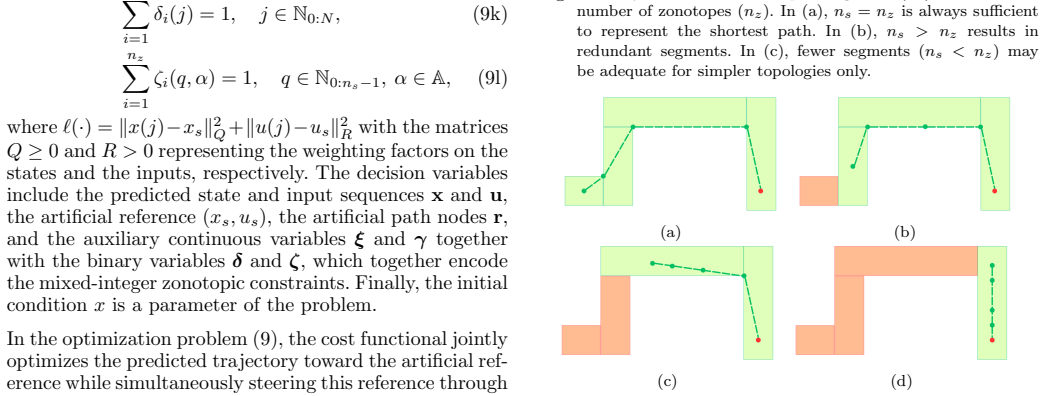
- [§4.1 / Fig. 3] §4.1, Fig. 3: the claim that 'ns=nz is always sufficient to represent the shortest path' is stated without justification. It is plausible for a linearly ordered chain of pairwise-border-intersecting zonotopes, but for general unions of nz convex sets a shortest feasible path can require revisiting a region or bending multiple times at one intersection. Please state the precise corridor-topology assumption under which the claim holds.
- [§4.1 / §5 figures] Figures 3–5 are referenced as analytical aids but are described only in captions; a brief in-text walkthrough of Fig. 4(a)–(d) (what changes between panels) would help. Fig. 6–9: please add axis labels/units and mark the zonotope boundaries and target in Fig. 6(b) for readability.
- [References / §3.2] Köhler et al. (2025) is cited as arXiv:2509.15917 — an unpublished preprint. Since the convergence mechanism is imported wholesale from it, the paper's claims are partly hostage to that reference's status; at minimum this dependency should be flagged in the text.
Circularity Check
No significant circularity: methods paper designs an MI tracking-MPC cost/constraint set and demonstrates it in simulation; nothing is predicted from a quantity that was fitted or defined in terms of itself.
full rationale
The paper's load-bearing chain is constructive, not predictive. Problem (9) is an optimization formulation the authors design: stage cost ℓ, mixed-integer zonotopic containment (4)/(9d), and a shortest-path offset Vo(r) adapted from Soloperto/Köhler (external citations). Numerical §5 then solves that designed problem on one corridor instance and reports feasible, target-reaching trajectories. There is no fitted parameter later re-labeled as a prediction, no uniqueness theorem imported from the authors' own prior work to forbid alternatives, and no self-definitional loop (X defined via Y then used to derive Y). Self-citations (Santos et al. 2024; Nascimento et al. 2023) supply background tracking-MPC and zonotope NMPC context and are not load-bearing for the numerical outcome or the convergence claim. The finite-interpolation gap (Np=2) raised by the skeptic is a correctness/guarantee gap, not circularity: the offset is not forced equal to true geodesic length by construction of a fit; the formulation simply under-constrains continuous segments. Score 0 is therefore appropriate.
Assumptions & free parameters
free parameters (8)
- prediction horizon N =
5
- sampling time τs =
0.5 s
- offset weight κs (ks) =
50
- stage-cost weights Q, R =
Q=I, R=0.25 I
- Big-M constant M =
15000
- interpolation count Np =
2
- number of artificial path segments ns =
ns = nz
- steady-state shrinkage λ =
unspecified in (0,1)
assumptions (6)
- domain assumption Discrete-time nonlinear dynamics x+=f(x,u) and output map y=h(x) adequately model the planning layer for the low-level controller.
- domain assumption Admissible airspace is a finite union of convex zonotopes that intersect only at borders.
- standard math Big-M indicator constraints with a finite M correctly encode y∈Zi XOR assignment.
- ad hoc to paper Containment of a finite set of interpolated points on each straight segment implies a usable shortest-path proxy for offset cost and convergence.
- domain assumption Tracking-MPC artificial-reference theory (recursive feasibility / enlarged domain of attraction) extends to this non-convex MI setting once the shortest-path offset is used.
- ad hoc to paper A path through nz corridor regions can be parameterized by ns=nz linear segments for initialization and offset representation.
invented entities (2)
-
Corridor-structured artificial path r with mixed-integer zonotopic segment assignment (ζ, γ)
-
Geometry-restricted warm-start problem (10) confining intermediate nodes to consecutive zonotope intersections
Cite this review
Pith. "Pith review of Model Predictive Planner for UAV Navigation in Non-Convex Air Corridors." pith.science (2026). https://pith.science/paper/EKUPGVV5
@misc{pith2026260724369,
  author       = {Pith},
  title        = {Pith review of: Model Predictive Planner for UAV Navigation in Non-Convex Air Corridors},
  year         = {2026},
  howpublished = {\url{https://pith.science/paper/EKUPGVV5}},
  note         = {Machine review of arXiv:2607.24369}
}
read the original abstract
This work presents a motion planning framework for UAV navigation in non-convex urban air corridors. The planner is based on a mixed-integer tracking model predictive control formulation that enforces corridor feasibility and dynamic consistency within a single optimization problem. To guarantee convergence to the target and mitigate the occurrence of local minima induced by non-convex geometry, a shortest-path-based offset cost with feasibility constraints is embedded directly into the planning problem. Numerical simulations show that the proposed formulation generates dynamically valid trajectories that satisfy the corridor constraints and converge to the target without relying on external global planning stages.
Figures


Figures from the paper (6 more)


Reference graph
Works this paper leans on
-
[1]
Automatica , volume=
Control of systems integrating logic, dynamics, and constraints , author=. Automatica , volume=
-
[2]
Hybrid Systems: Computation and Control , pages=
Reachability of uncertain linear systems using zonotopes , author=. Hybrid Systems: Computation and Control , pages=
-
[3]
Proceedings of the 3rd Conference on Learning for Dynamics and Control , pages =
Data-Driven Reachability Analysis Using Matrix Zonotopes , author =. Proceedings of the 3rd Conference on Learning for Dynamics and Control , pages =. 2021 , month =
2021
-
[4]
Proceedings of the 26th ACM International Conference on Hybrid Systems: Computation and Control , series =
Ertai, Luo and Kochdumper, Niklas and Bak, Stanley , title =. Proceedings of the 26th ACM International Conference on Hybrid Systems: Computation and Control , series =. 2023 , publisher =
2023
-
[5]
Zonotope/Hyperplane Intersection for Hybrid Systems Reachability Analysis , booktitle =
Girard, Antoine and Le Guernic, Colas , editor =. Zonotope/Hyperplane Intersection for Hybrid Systems Reachability Analysis , booktitle =. 2008 , publisher =. doi:10.1007/978-3-540-78929-1_16 , url =
-
[6]
Ellipsotopes: Uniting Ellipsoids and Zonotopes for Reachability Analysis and Fault Detection , year =
Kousik, Shreyas and Dai, Albert and Gao, Grace Xing , journal =. Ellipsotopes: Uniting Ellipsoids and Zonotopes for Reachability Analysis and Fault Detection , year =
-
[7]
Combining zonotopes and support functions for efficient reachability analysis of linear systems , year=
Althoff, Matthias and Frehse, Goran , booktitle=. Combining zonotopes and support functions for efficient reachability analysis of linear systems , year=
-
[8]
Sparse Polynomial Zonotopes: A Novel Set Representation for Reachability Analysis , year=
Kochdumper, Niklas and Althoff, Matthias , journal=. Sparse Polynomial Zonotopes: A Novel Set Representation for Reachability Analysis , year=
Show all 39 references
-
[9]
and Bird, Trevor J
Siefert, Jacob A. and Bird, Trevor J. and Thompson, Andrew F. and Glunt, Jonah J. and Koeln, Justin P. and Jain, Neera and Pangborn, Herschel C. , journal=. Reachability Analysis Using Hybrid Zonotopes and Functional Decomposition , year=
-
[10]
Journal of Intelligent Manufacturing , year =
Zhou, Chengmin and Huang, Bingding and Fränti, Pasi , title =. Journal of Intelligent Manufacturing , year =. doi:10.1007/s10845-021-01867-z , url =
-
[11]
and Kong, Z
Goerzen, C. and Kong, Z. and Mettler, B. , title =. Journal of Intelligent and Robotic Systems , year =. doi:10.1007/s10846-009-9383-1 , url =
-
[12]
IET Cyber-Systems and Robotics , volume =
Quan, Lun and Han, Luxin and Zhou, Boyu and Shen, Shaojie and Gao, Fei , title =. IET Cyber-Systems and Robotics , volume =
-
[13]
and Thrun, Sebastian , title =
Likhachev, Maxim and Gordon, Geoffrey J. and Thrun, Sebastian , title =. Advances in Neural Information Processing Systems 16 (NIPS 2003) , editor =. 2004 , pages =
2003
-
[14]
, title =
LaValle, Steven M. , title =. 1998 , number =
1998
-
[15]
LaValle , title =
Steven M. LaValle , title =. 2006 , pages =
2006
-
[16]
and Jussila, Jari Juhani , TITLE =
Israr, Amber and Ali, Zain Anwar and Alkhammash, Eman H. and Jussila, Jari Juhani , TITLE =. Drones , VOLUME =. 2022 , NUMBER =
2022
-
[17]
2009 , publisher=
Model Predictive Control: Theory and Design , author=. 2009 , publisher=
2009
-
[18]
Model Predictive Contouring Control for Collision Avoidance in Unstructured Dynamic Environments , year=
Brito, Bruno and Floor, Boaz and Ferranti, Laura and Alonso-Mora, Javier , journal=. Model Predictive Contouring Control for Collision Avoidance in Unstructured Dynamic Environments , year=
-
[19]
arXiv preprint arXiv:2508.21677 , year=
Robust Convex Model Predictive Control with collision avoidance guarantees for robot manipulators , author=. arXiv preprint arXiv:2508.21677 , year=
-
[20]
arXiv preprint arXiv:2507.09134 , year=
Integrating Planning and Predictive Control Using the Path Feasibility Governor , author=. arXiv preprint arXiv:2507.09134 , year=
-
[21]
IEEE Control Systems , volume=
A quantitative framework for layered multirate control: Toward a theory of control architecture , author=. IEEE Control Systems , volume=
-
[22]
IFAC Proceedings Volumes , volume=
MPC for tracking of piece-wise constant references for constrained linear systems , author=. IFAC Proceedings Volumes , volume=
-
[23]
2024 , author =
Analysis and design of model predictive control frameworks for dynamic operation—An overview , journal =. 2024 , author =
2024
-
[24]
Nonlinear
Limon, Daniel and Ferramosca, Antonio and Alvarado, Ignacio and Alamo, Teodoro , journal=. Nonlinear
-
[25]
Set-point tracking
Santos, Marcelo Alves and Ferramosca, Antonio and Raffo, Guilherme Vianna , journal=. Set-point tracking
-
[26]
Proceedings of the IEEE 63rd CDC , pages=
Model predictive control for tracking using artificial references: Fundamentals, recent results and practical implementation , author=. Proceedings of the IEEE 63rd CDC , pages=
-
[27]
and Limon, Daniel and Garone, Emanuele , journal=
Cotorruelo, Andres and Ramirez, Daniel R. and Limon, Daniel and Garone, Emanuele , journal=. Nonlinear. 2021 , volume=
2021
-
[28]
Safe Exploration and Escape Local Minima With Model Predictive Control Under Partially Unknown Constraints , year=
Soloperto, Raffaele and Mesbah, Ali and Allgöwer, Frank , journal=. Safe Exploration and Escape Local Minima With Model Predictive Control Under Partially Unknown Constraints , year=
-
[29]
A Nonlinear
Soloperto, Raffaele and Köhler, Johannes and Allgöwer, Frank , journal=. A Nonlinear. 2023 , volume=
2023
-
[30]
, journal=
Prajapat, Manish and Köhler, Johannes and Turchetta, Matteo and Krause, Andreas and Zeilinger, Melanie N. , journal=. Safe Guaranteed Exploration for Nonlinear Systems , year=
-
[31]
Nascimento, Iuro B. P. and Rego, Brenner S. and Pimenta, Luciano C. A. and Raffo, Guilherme V. , booktitle =. 2023 , pages =
2023
-
[32]
2024 , eprint=
Mixed-Integer MPC-Based Motion Planning Using Hybrid Zonotopes with Tight Relaxations , author=. 2024 , eprint=
2024
-
[33]
K. An. arXiv preprint arXiv:2509.15917 , year=
-
[34]
Automatica , volume=
Reference and command governors for systems with constraints: A survey on theory and applications , author=. Automatica , volume=. 2017 , publisher=
2017
-
[35]
Vehicles , volume=
A survey of path planning algorithms for mobile robots , author=. Vehicles , volume=
-
[36]
XXIV Congresso Brasileiro de Automática (CBA 2022) , pages=
Análise de Regiões Seguras para Navegação de VANTs em Ambiente Urbano , author=. XXIV Congresso Brasileiro de Automática (CBA 2022) , pages=. 2022 , organization=
2022
-
[37]
Ellipsotopes: Uniting Ellipsoids and Zonotopes for Reachability Analysis and Fault Detection , year =
Kousik, Shreyas and Dai, Albert and Gao, Grace Xing , journal =. Ellipsotopes: Uniting Ellipsoids and Zonotopes for Reachability Analysis and Fault Detection , year =. doi:10.1109/TAC.2022.3191750 , keywords =
2022
-
[38]
Proceedings of the IEEE 52nd CDC , pages=
A quadratic programming-based method for determining the distance between a point and a zonotope , author=. Proceedings of the IEEE 52nd CDC , pages=
-
[39]
Proceedings of the IEEE 49th CDC , pages=
An efficient algorithm for computing the H-representation of a zonotope , author=. Proceedings of the IEEE 49th CDC , pages=
Reviewed July 31, 2026 · model on record in the stance chip above.
Discussion (0). Sign in to comment.