REVIEW 4 major objections 8 minor 57 references
Synaptic clustering emerges from learning and supports covariance discrimination
T0 review · 4 major / 8 minor · reviewed 2026-07-31 · grok-4.5
Pith's one-line read Dendrites trained on a covariance task spontaneously form functional synapse clusters, and learned placement is needed for the solution.
desk verdict Clean existence result that dendrites + rewiring grow E/I clusters on a covariance task, but the shuffle does not isolate FSCs from fan-in reallocation. read the letter →
The pith
A machine-rendered reading of the paper's core claim, the machinery that carries it, and where it could break.
The reading
What carries the argument
Dendrinet on the PCC task: a binary-tree network of conductance-based branches composing shunting inhibition with a piecewise linear-to-tanh (Poirazi) nonlinearity, trained by gradient descent plus DeepST rewiring under a fixed sparse synapse budget; clustering is scored by fan-in-normalized block entropy, and necessity is probed by component ablations and post-training weight/mask shuffles.
What would settle it
A placement shuffle that randomizes only within-block co-localization while holding fan-in, channel reuse, weight distributions, and E–I pairing fixed, yet leaves test accuracy intact—or dual-color imaging under NMDAR block that fails to show the predicted rise in inhibitory clustering with loss of excitatory clusters.
Extended reading notes
Core claim
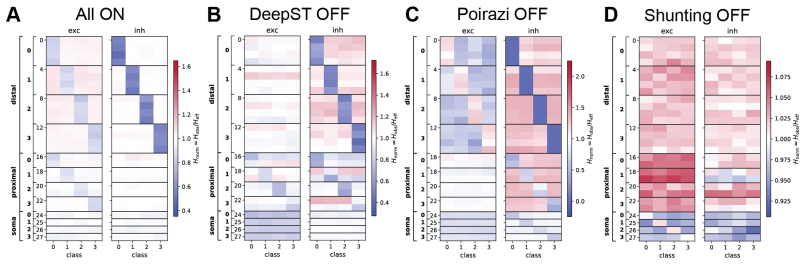
Neurons with hierarchical dendrites solve the Permuted-Covariance Classification task and develop class-selective excitatory and inhibitory functional synapse clusters only when both dendritic nonlinearities (shunting inhibition and the Poirazi NMDA-proxy) and structural plasticity are active. Ablating the nonlinearities reduces excitatory clusters and performance while increasing inhibitory clusters; shuffling learned connectivity with nonlinearities held fixed also reduces performance, with inhibitory organization proving more critical than excitatory.
Load-bearing premise
That post-training shuffles and the joint need for nonlinearities plus rewiring isolate a causal role for functional clusters themselves, rather than for broader learned placement (fan-in, channel repetition, and excitation–inhibition pairing) of which clusters are only one part.
Editorial extensions
If this is right
- NMDAR-block deficits should be read as joint loss of nonlinear computation and reorganization of inhibitory clustering, not only loss of excitatory clusters.
- Connectomic analyses that treat synapses as neuron-to-neuron edges without dendritic location discard a functionally load-bearing variable.
- Inhibitory FSCs on distal branches are a predicted motif for covariance-sensitive circuits and should be looked for alongside excitatory ones.
- Feedforward shared-source E/I onto distal dendrites (as in hippocampal temporoammonic–neurogliaform motifs) is a natural biological analogue of the learned architecture.
Reading between the lines
- A pure FSC knockout that preserves other connectivity statistics would be the decisive next simulation; until then the paper shows necessity of learned placement more cleanly than of clusters alone.
- The stronger sensitivity to inhibitory shuffles suggests future theory should treat distal E–I co-placement, not excitatory clustering alone, as the computational primitive.
- Bio-plausible local plasticity rules that still recover the same distal E/I organization would close the gap between task-optimized existence proofs and learnability in tissue.
Editorial analysis
A structured set of objections, weighed in public.
Referee Report
Summary. The manuscript introduces Dendrinet, a feedforward network of four readout neurons, each with a binary-tree dendritic structure, conductance-based (shunting) inhibition, a Poirazi/piecewise-linear-to-tanh NMDAR-proxy nonlinearity, and a structural plasticity rule (DeepST, adapted from DEEP R) that rewires synapses under a fixed budget. The authors train the model on a purpose-built Permuted-Covariance Classification (PCC) task in which class information resides exclusively in permuted block covariance structure, so above-chance performance requires second-order computation (LDA fails, QDA is Bayes-optimal). A full 2^3 ablation (shunting, Poirazi, DeepST) over 40 seeds shows all three components are jointly needed for high accuracy; under the ALL-ON condition, excitatory and inhibitory synapses cluster onto task-defined covariance blocks in distal branches (quantified by a fan-in-corrected normalized entropy metric), and a class-dependent excitation/inhibition correlation mechanism emerges in which non-preferred classes are shunted subthreshold while preferred-class residuals are amplified. Post-training shuffles of learned weights or connectivity degrade performance (inhibitory shuffles more than excitatory). An appendix theorem shows, in a linearized single-branch SNR model, that concentrating synapses in one block maximizes an expected-competitor SNR. The authors frame the work as isolating FSC contributions from the NMDAR-block confound that besets APV experiments, and —to
Significance. If the results hold, this is a useful contribution on two fronts. First, it provides a clean "glass-box" demonstration that FSC-like organization can emerge from task optimization rather than being asserted a priori, with a full 2^3 ablation, 40 seeds per condition, and parameter/depth/sparsity-matched MLP baselines — a level of control uncommon in this literature. Second, the inhibitory findings (distal inhibitory FSCs; increased inhibitory clustering when the NMDAR-proxy is removed) are genuinely novel and generate a falsifiable experimental prediction (redistribution, not abolition, of clustering under NMDAR block) testable with dual-color imaging. The mechanism analysis in Figs. 5-6 (class-dependent E/I correlation placing non-preferred classes subthreshold and preferred classes in the amplifying regime of the Poirazi function) is a concrete, interpretable account, and the appendix supplies a worked SNR theorem rather than a plausibility argument. The authors' explicit hedging ("suggest, but do not isolate") is appropriate; the residual gap between that hedge and the title/§3.5 framing is what the requested control would close.
major comments (4)
- [§3.5, Fig. 7; §2.6.5] The mask shuffle reverses two things at once: within-branch block clustering (H_norm, Fig. 4A) and the learned per-branch fan-in allocation (Fig. 3A shows DeepST concentrates synapses on distal branches). Since §3.4/Fig. 5 locate the class-selective E/I correlation mechanism in the distal branches, flattening fan-in alone would dismantle the computation even if within-branch clustering were irrelevant. The authors acknowledge the shuffle 'does not change only FSCs,' but §3.5 is still titled 'Ablation of Functional Synapse Clusters,' and the result is offered as evidence about clustering. A fan-in-preserving control is needed and is straightforward: permute channel identities of synapses within each branch (holding per-branch fan-in and the weight multiset fixed), and separately permute synapses across branches while preserving within-branch block composition. Only the comparison of these
- [§2.2.2; Fig. 2F; §3.1] The Poirazi slope m and threshold b were 'used values that yielded optimal performance for a 7-node Dendrinet model with all biological components active.' The headline claim that 'all three biological properties are necessary' (Fig. 2F) therefore rests on comparisons in which the nonlinearity-ablated conditions run at an operating point tuned for the ALL-ON model. The Poirazi-OFF drop could partly reflect a mismatched operating point rather than loss of supralinear amplification per se (e.g., the threshold b is also used to set the initialization operating point, Eq. 6). A sensitivity sweep over (m, b) per condition, or at minimum a re-tuning of remaining hyperparameters for the ablated conditions, is needed to support the necessity claim as stated.
- [§2.6.5 (Synapse Shuffle Ablation)] The randomization procedure is underspecified: 'each shuffle is defined by which subset it preserves vs shuffles' does not state the permutation scope (within branch, within neuron, or network-wide), whether E and I synapses are shuffled jointly or within valence pools, whether the one-synapse-per-channel-per-branch constraint is maintained post-shuffle, or whether shuffled masks are rebalanced. These details determine what the control actually controls for and must be stated precisely, ideally with pseudocode.
- [Theorem 3.1 and Appendix A] The theorem is honestly caveated, but its assumptions (binary weights, single linearized leaf, expected competitor under uniform permutations, and the z-space Pearson covariance of Eq. 11) are some distance from the trained model (softplus weights, hierarchical tree, and inputs x = Φ(z) whose copula-transformed correlations differ from the stated r=0.9/0.3). Please state explicitly, near the theorem, which of the empirical findings it does and does not explain — in particular that the E/I correlation mechanism of Fig. 5 is only addressed by Theorem A.6, which compares two placements rather than proving optimality — and note that the quantitative ρ values do not carry through the CDF transform.
minor comments (8)
- [Figs. 2F, 4, 7] Statistical reporting: N=40 seeds is stated in captions, but no error bars, confidence intervals, or test procedures (which test, correction for multiple comparisons across the 8 conditions) are described for Figs. 2F, 4, or 7. Please add these.
- [§2.5, 'Per seed data independence'] Model and dataset seeds are set equal per run (§2.5), so initialization and data realization covary across seeds. This is a minor design concern; consider decorrelating them or noting why this coupling is harmless.
- [§2.6.4 / §3.3] The FSC operationalization uses the task's ground-truth blocks as the definition of 'correlated activity.' Since FSCs are empirically defined by observed presynaptic correlations, please state explicitly that here correlation is inferred from the generative block structure of the copula, and note that the transform to x-space preserves block dependence but not exact Pearson values.
- [§2.6.4, Eqs. (8)-(10)] The small constant ε in Eqs. (8)-(9) is never given a value; its size can matter for low-weight blocks. Also, the Monte Carlo null (M=2,000) reassigns the branch's observed weights to random locations — please confirm the null is recomputed per branch and per class as the text implies.
- [Throughout] Typos and grammar: 'fromation' (Discussion, para. 1); 'nonlinar dendritic compartmnets' (Discussion); 'must to come' (Discussion); 'biologicaly' (Discussion); 'each of the 3 biological components are active' (§2.4); 'set to 1e-6 in for the analyses' (§2.3).
- [Fig. 7 caption; §3.3] 'DON'/'DOFF' appear only in the Fig. 7 caption and are never defined in the main text; the SON/PON/DON toggling notation used in §3.3 should be introduced once, in §2.4, and used consistently.
- [§3.3, Fig. 4C] The inhibitory-compensation finding (Poirazi-OFF increases inhibitory clustering) is one of the most novel results and connects to the falsifiable prediction in the Discussion; it deserves a quantitative treatment (effect size across seeds) rather than the current qualitative description of Fig. 4C.
- [§2.2.1, Eq. (1)] In Eq. (1), the summation index i over upstream branch inputs g_{v,i} V_{out,i} is undefined in the text, and the reuse of 'v' for both valence (Eq. 3) and branch weights is confusing; please disambiguate the notation.
Circularity Check
No load-bearing circularity: FSCs are an emergent measured outcome under external task labels, not defined as the training objective; only mild hyperparameter selection for the ALL-ON condition.
-
fitted input called prediction
[§2.2.2 Nonlinearities (Poirazi hyperparameters)]
"To choose the hyperparameters m and b, we used values that yielded optimal performance for a 7-node Dendrinet model with all biological components active."
m and b are selected to maximize performance of the full (ALL-ON) model that is later treated as the reference condition in which FSCs and high accuracy co-occur. Ablation comparisons therefore use a nonlinearity already tuned under the joint presence of shunting, Poirazi, and DeepST. This is weak circularity-adjacent model selection: it does not make FSC emergence or accuracy tautological, but it slightly favors the ALL-ON operating point relative to identity/ablated variants that were not given the same hyperparameter search.
full rationale
The derivation chain is self-contained against external benchmarks. Class labels and block-covariance structure of the PCC task are fixed before training and are independent of Dendrinet parameters. Performance is cross-entropy / held-out accuracy, compared to LDA, QDA, and parameter-matched MLPs. Functional synapse clustering is quantified post hoc by normalized block-entropy against a fan-in-matched Monte Carlo null (Eqs. 7–10), not optimized as a loss term, so emergence of H_norm < 1 under ALL-ON is an empirical result rather than true by construction. Theorem 3.1 derives an SNR advantage for block-concentrated binary synapses from the same covariance model the task uses; that is a supporting calculation for why clustering can help, not a redefinition of the empirical metric or of accuracy. Ablations (shunting / Poirazi / DeepST off) and post-hoc weight/mask shuffles are interventional tests, and the paper itself states that the shuffle “does not change only FSCs” and only “suggests, but do[es] not isolate” an FSC contribution—so the central claim is not forced by definition. The sole mild circularity-adjacent choice is selecting Poirazi (m, b) for best ALL-ON 7-node performance before running the ablation suite; that is ordinary model selection, not a fitted quantity renamed as an independent prediction. Self-citations (e.g. Jones & Kording dendritic ML work) are background, not uniqueness theorems that forbid alternatives. Score 1 reflects that minor hyperparameter dependence only.
Assumptions & free parameters
free parameters (6)
- Poirazi slope m and threshold b =
selected for best ALL-ON 7-node performance (numeric values not reported in text)
- DeepST prune weight threshold =
1e-6
- Fixed synapse budget per neuron (E and I) =
140 excitatory and 140 inhibitory synapses per neuron
- Synapse and branch-weight learning rates / weight decay =
synapse lr=0.1; branch lr=0.001; weight decay=1e-2; grad clip=5.0
- PCC correlation levels and block geometry =
r_in=0.9, r_out=0.3; N=200; 20×10 blocks; 4 classes
- Initial sparsity / target fan-in scale =
average 20 synapses per branch at initialization
assumptions (6)
- domain assumption Steady-state conductance equation with E rev=1, I/leak rev=0 yields divisive shunting (Eq. 1).
- domain assumption Poirazi piecewise linear-to-tanh is a valid computational proxy for NMDAR dendritic spikes (Eq. 2).
- ad hoc to paper Class information in PCC lives only in second-order block structure after matched marginals (Gaussian copula + CDF).
- ad hoc to paper Backprop + DeepST rewiring is an acceptable optimizer to ask whether FSC-like organization can support the computation (existence), not how biology learns it.
- domain assumption Binary-tree discrete branches with at most one synapse per input channel per branch suffice to represent functional clustering.
- standard math For fixed synapse count s≤n, expected-competitor SNR is maximized by placing all synapses in one covariance block (Theorem 3.1).
invented entities (4)
-
Dendrinet
-
DeepST (Deep Synaptic Translocation)
-
Permuted-Covariance Classification (PCC) task
-
Normalized entropy clustering metric H_norm
Cite this review
Pith. "Pith review of Synaptic clustering emerges from learning and supports covariance discrimination." pith.science (2026). https://pith.science/paper/VVNM2PMZ
@misc{pith2026260724503,
  author       = {Pith},
  title        = {Pith review of: Synaptic clustering emerges from learning and supports covariance discrimination},
  year         = {2026},
  howpublished = {\url{https://pith.science/paper/VVNM2PMZ}},
  note         = {Machine review of arXiv:2607.24503}
}
read the original abstract
Functional synapse clusters (FSCs) are synapses with correlated presynaptic activity that are colocalized on the same neuronal dendritic branch. FSCs have been observed after learning in cortical and hippocampal pyramidal neurons. However, previous efforts to ablate FSCs by pharmacologically blocking dendritic nonlinearities to establish causal necessity may have confounded effects. Therefore, whether FSCs are causally necessary for computation is unknown. Here, we attempt to isolate FSCs from this potential confounder in silico. We train Dendrinet, an artificial neural network architecture with hierarchical dendritic segments and sparse conductance-based synapses, on a Permuted-Covariance Classification (PCC) task. This task cannot be solved by single-layer linear-nonlinear artificial neural networks. We find that neurons with dendrites can be trained to solve the task and develop excitatory and inhibitory FSCs if both dendritic nonlinearities and synaptic structural plasticity are active. Turning off dendritic nonlinearities reduces excitatory FSCs, which replicates experimental findings, and reduces performance while unexpectedly increasing inhibitory FSCs. Furthermore, shuffling learned synaptic connectivity while keeping the nonlinearities fixed reduces performance. This shows sensitivity to learned connectivity, but the shuffle does not change only FSCs. Shuffling inhibitory synapse properties reduces performance more than the corresponding excitatory shuffle, showing higher sensitivity to inhibitory organization. This work suggests that dendritic compartmentalization and learned synaptic organization can support computation of covariance structure.
Figures


Figures from the paper (4 more)


Reference graph
Works this paper leans on
-
[1]
M. Florencia Iacaruso, Ioana T. Gasler, and Sonja B. Hofer. Synaptic organization of visual space in primary visual cortex.Nature, 547(7664):449–452, July 2017. ISSN 1476-4687. doi: 10.1038/nature23019
-
[2]
Synaptic Clustering and Memory Formation.Front
George Kastellakis and Panayiota Poirazi. Synaptic Clustering and Memory Formation.Front. Mol. Neurosci., 12, December 2019. ISSN 1662-5099. doi: 10.3389/fnmol.2019.00300
arXiv 2019
-
[3]
Dendritic Computation.Annual Review of Neuroscience, 28(1): 503–532, 2005
Michael London and Michael Häusser. Dendritic Computation.Annual Review of Neuroscience, 28(1): 503–532, 2005. doi: 10.1146/annurev.neuro.28.061604.135703
arXiv 2005
-
[4]
Greg J. Stuart and Nelson Spruston. Dendritic integration: 60 years of progress.Nat Neurosci, 18(12): 1713–1721, December 2015. ISSN 1546-1726. doi: 10.1038/nn.4157
doi:10.1038/nn.4157 2015
-
[5]
Daniel E. Wilson, David E. Whitney, Benjamin Scholl, and David Fitzpatrick. Orientation selectivity and the functional clustering of synaptic inputs in primary visual cortex.Nat Neurosci, 19(8):1003–1009, August 2016. ISSN 1097-6256. doi: 10.1038/nn.4323
-
[6]
Ami Citri and Robert C. Malenka. Synaptic Plasticity: Multiple Forms, Functions, and Mechanisms. Neuropsychopharmacol, 33(1):18–41, January 2008. ISSN 1740-634X. doi: 10.1038/sj.npp.1301559
-
[7]
Anthony Holtmaat and Karel Svoboda. Experience-dependent structural synaptic plasticity in the mam- malian brain.Nat Rev Neurosci, 10(9):647–658, September 2009. ISSN 1471-0048. doi: 10.1038/nrn2699
doi:10.1038/nrn2699 2009
-
[8]
Thomas Kleindienst, Johan Winnubst, Claudia Roth-Alpermann, Tobias Bonhoeffer, and Christian Lohmann. Activity-Dependent Clustering of Functional Synaptic Inputs on Developing Hippocampal Den- drites.Neuron, 72(6):1012–1024, December 2011. ISSN 0896-6273. doi: 10.1016/j.neuron.2011.10.015
Show all 57 references
-
[9]
Locally Synchronized Synaptic Inputs.Science, 335(6066):353–356, January 2012
Naoya Takahashi, Kazuo Kitamura, Naoki Matsuo, Mark Mayford, Masanobu Kano, Norio Matsuki, and Yuji Ikegaya. Locally Synchronized Synaptic Inputs.Science, 335(6066):353–356, January 2012. doi: 10.1126/science.1210362
2012 doi
-
[10]
The dendritic engram.Front Behav Neurosci, 17:1212139, July 2023
George Kastellakis, Simone Tasciotti, Ioanna Pandi, and Panayiota Poirazi. The dendritic engram.Front Behav Neurosci, 17:1212139, July 2023. ISSN 1662-5153. doi: 10.3389/fnbeh.2023.1212139
2023
-
[11]
Frank, Shan Huang, Miou Zhou, Amos Gdalyahu, George Kastellakis, Tawnie K
Adam C. Frank, Shan Huang, Miou Zhou, Amos Gdalyahu, George Kastellakis, Tawnie K. Silva, Elaine Lu, Ximiao Wen, Panayiota Poirazi, Joshua T. Trachtenberg, and Alcino J. Silva. Hotspots of dendritic spine turnover facilitate clustered spine addition and learning and memory.Nat...
-
[12]
Fear extinction reverses dendritic spine formation induced by fear conditioning in the mouse auditory cortex.Proc Natl Acad Sci U S A, 115(37):9306–9311, September 2018
Cora Sau Wan Lai, Avital Adler, and Wen-Biao Gan. Fear extinction reverses dendritic spine formation induced by fear conditioning in the mouse auditory cortex.Proc Natl Acad Sci U S A, 115(37):9306–9311, September 2018. ISSN 0027-8424. doi: 10.1073/pnas.1801504115
2018 doi
-
[13]
Bloss, Mark S
Erik B. Bloss, Mark S. Cembrowski, Bill Karsh, Jennifer Colonell, Richard D. Fetter, and Nelson Spruston. Single excitatory axons form clustered synapses onto CA1 pyramidal cell dendrites.Nat Neurosci, 21(3): 353–363, March 2018. ISSN 1546-1726. doi: 10.1038/s41593-018-0084-6
2018 doi
-
[14]
M. L. Mayer, G. L. Westbrook, and P. B. Guthrie. V oltage-dependent block by Mg2+ of NMDA responses in spinal cord neurones.Nature, 309(5965):261–263, May 1984. ISSN 0028-0836. doi: 10.1038/309261a0
1984 doi
-
[15]
Nowak, P
L. Nowak, P. Bregestovski, P. Ascher, A. Herbet, and A. Prochiantz. Magnesium gates glutamate-activated channels in mouse central neurones.Nature, 307(5950):462–465, February 1984. ISSN 0028-0836. doi: 10.1038/307462a0
1984 doi
-
[16]
Koester, and Yitzhak Schiller
Jackie Schiller, Guy Major, Helmut J. Koester, and Yitzhak Schiller. NMDA spikes in basal dendrites of cortical pyramidal neurons.Nature, 404(6775):285–289, March 2000. ISSN 1476-4687. doi: 10.1038/ 35005094
-
[17]
Larkum, and Jackie Schiller
Guy Major, Matthew E. Larkum, and Jackie Schiller. Active Properties of Neocortical Pyramidal Neuron Dendrites.Annual Review of Neuroscience, 36(V olume 36, 2013):1–24, July 2013. ISSN 0147-006X, 1545-4126. doi: 10.1146/annurev-neuro-062111-150343. 17
2013 doi
-
[18]
R. G. M. Morris, E. Anderson, G. S. Lynch, and M. Baudry. Selective impairment of learning and blockade of long-term potentiation by an N-methyl-D-aspartate receptor antagonist, AP5.Nature, 319(6056): 774–776, February 1986. ISSN 1476-4687. doi: 10.1038/319774a0
1986 doi
-
[19]
Trachtenberg, and Alcino J
Megha Sehgal, Daniel Almeida Filho, George Kastellakis, Sungsoo Kim, Jinsu Lee, Yang Shen, Shan Huang, Ayal Lavi, Giselle Fernandes, Irene Davila Mejia, Sunaina Soans Martin, Asli Pekcan, Melody Shana Wu, Won Do Heo, Panayiota Poirazi, Joshua T. Trachtenberg, and Alcino J. Sil...
2025 doi
-
[20]
Antic, Wen-Liang Zhou, Anna R
Srdjan D. Antic, Wen-Liang Zhou, Anna R. Moore, Shaina M. Short, and Katerina D. Ikonomu. The decade of the dendritic NMDA spike.Journal of Neuroscience Research, 88(14):2991–3001, 2010. ISSN 1097-4547. doi: 10.1002/jnr.22444. _eprint: https://onlinelibrary.wiley.com/doi/pdf/1...
2010 doi
-
[21]
Panayiota Poirazi, Terrence Brannon, and Bartlett W. Mel. Pyramidal Neuron as Two-Layer Neural Network.Neuron, 37(6):989–999, March 2003. ISSN 0896-6273. doi: 10.1016/S0896-6273(03)00149-1
2003 doi
-
[22]
Mel, and Jackie Schiller
Alon Polsky, Bartlett W. Mel, and Jackie Schiller. Computational subunits in thin dendrites of pyramidal cells.Nat Neurosci, 7(6):621–627, June 2004. ISSN 1097-6256. doi: 10.1038/nn1253
2004 doi
-
[23]
Single cortical neurons as deep artificial neural networks.Neuron, 109(17):2727–2739.e3, September 2021
David Beniaguev, Idan Segev, and Michael London. Single cortical neurons as deep artificial neural networks.Neuron, 109(17):2727–2739.e3, September 2021. ISSN 1097-4199. doi: 10.1016/j.neuron.2021. 07.002
2021 doi
-
[24]
What can a neuron compute, June 2026
Ido Aizenbud, David Beniaguev, Noam Pnueli, Idan Segev, and Michael London. What can a neuron compute, June 2026
2026
-
[25]
Daniel L. K. Yamins and James J. DiCarlo. Using goal-driven deep learning models to understand sensory cortex.Nat Neurosci, 19(3):356–365, March 2016. ISSN 1546-1726. doi: 10.1038/nn.4244
2016 doi
-
[26]
Richards, Timothy P
Blake A. Richards, Timothy P. Lillicrap, Philippe Beaudoin, Yoshua Bengio, Rafal Bogacz, Amelia Christensen, Claudia Clopath, Rui Ponte Costa, Archy de Berker, Surya Ganguli, Colleen J. Gillon, Danijar Hafner, Adam Kepecs, Nikolaus Kriegeskorte, Peter Latham, Grace W. Lindsay,...
2019
-
[27]
Might a Single Neuron Solve Interesting Machine Learning Problems Through Successive Computations on Its Dendritic Tree?Neural Computation, 33(6):1554–1571, May 2021
Ilenna Simone Jones and Konrad Paul Kording. Might a Single Neuron Solve Interesting Machine Learning Problems Through Successive Computations on Its Dendritic Tree?Neural Computation, 33(6):1554–1571, May 2021. ISSN 0899-7667. doi: 10.1162/neco_a_01390
2021 doi
-
[28]
Bartlett W. Mel. NMDA-Based Pattern Discrimination in a Modeled Cortical Neuron.Neural Comput, 4 (4):502–517, July 1992. ISSN 0899-7667. doi: 10.1162/neco.1992.4.4.502
1992 doi
-
[29]
B. W. Mel, D. L. Ruderman, and K. A. Archie. Translation-invariant orientation tuning in visual "complex" cells could derive from intradendritic computations.J Neurosci, 18(11):4325–4334, June 1998. ISSN 0270-6474. doi: 10.1523/JNEUROSCI.18-11-04325.1998
1998
-
[30]
Ujfalussy and Judit K
Balázs B. Ujfalussy and Judit K. Makara. Impact of functional synapse clusters on neuronal response selectivity.Nat Commun, 11(1):1413, March 2020. ISSN 2041-1723. doi: 10.1038/s41467-020-15147-6
2020 doi
-
[31]
Deep Rewiring: Training very sparse deep networks, August 2018
Guillaume Bellec, David Kappel, Wolfgang Maass, and Robert Legenstein. Deep Rewiring: Training very sparse deep networks, August 2018. arXiv:1711.05136
2018 arXiv
-
[32]
Interpreting Black-Box Models: A Review on Explainable Artificial Intelligence.Cogn Comput, 16(1):45–74, January 2024
Vikas Hassija, Vinay Chamola, Atmesh Mahapatra, Abhinandan Singal, Divyansh Goel, Kaizhu Huang, Simone Scardapane, Indro Spinelli, Mufti Mahmud, and Amir Hussain. Interpreting Black-Box Models: A Review on Explainable Artificial Intelligence.Cogn Comput, 16(1):45–74, January 2...
2024 doi
-
[33]
Oxford University Press, New York, New York, 1999
Christoph Koch.Biophysics of Computation: Information Processing in Single Neurons. Oxford University Press, New York, New York, 1999. ISBN 0-19-510491-9
1999
-
[34]
Panayiota Poirazi, Terrence Brannon, and Bartlett W. Mel. Arithmetic of Subthreshold Synaptic Summation in a Model CA1 Pyramidal Cell.Neuron, 37(6):977–987, March 2003. ISSN 0896-6273. doi: 10.1016/ S0896-6273(03)00148-X
2003
-
[35]
Friedman.The Elements of Statistical Learning: Data Mining, Inference, and Prediction
Trevor Hastie, Robert Tibshirani, and Jerome H. Friedman.The Elements of Statistical Learning: Data Mining, Inference, and Prediction. Springer, 2009. ISBN 978-0-387-84884-6. 18
2009
-
[36]
Neuronal ensembles: Building blocks of neural circuits
Rafael Yuste, Rosa Cossart, and Emre Yaksi. Neuronal ensembles: Building blocks of neural circuits. Neuron, 112(6):875–892, March 2024. ISSN 08966273. doi: 10.1016/j.neuron.2023.12.008
2024 doi
-
[37]
Robert C. Froemke. Plasticity of Cortical Excitatory-Inhibitory Balance.Annual Review of Neuro- science, 38(V olume 38, 2015):195–219, July 2015. ISSN 0147-006X, 1545-4126. doi: 10.1146/ annurev-neuro-071714-034002. URL https://www.annualreviews.org/content/journals/10. 1146/a...
2015
-
[38]
Perceptron Learning and Classification in a Modeled Cortical Pyramidal Cell.Front Comput Neurosci, 14:33, 2020
Toviah Moldwin and Idan Segev. Perceptron Learning and Classification in a Modeled Cortical Pyramidal Cell.Front Comput Neurosci, 14:33, 2020. ISSN 1662-5188. doi: 10.3389/fncom.2020.00033
2020
-
[39]
Dendritic action potentials and computation in human layer 2/3 cortical neurons.Science, 367(6473):83–87, January 2020
Albert Gidon, Timothy Adam Zolnik, Pawel Fidzinski, Felix Bolduan, Athanasia Papoutsi, Panayiota Poirazi, Martin Holtkamp, Imre Vida, and Matthew Evan Larkum. Dendritic action potentials and computation in human layer 2/3 cortical neurons.Science, 367(6473):83–87, January 2020...
2020
-
[40]
Do Biological Constraints Impair Dendritic Computation? Neuroscience, 489:262–274, May 2022
Ilenna Simone Jones and Konrad Paul Kording. Do Biological Constraints Impair Dendritic Computation? Neuroscience, 489:262–274, May 2022. ISSN 0306-4522. doi: 10.1016/j.neuroscience.2021.07.036
2022 doi
-
[41]
Dendritic Integration Inspired Artificial Neural Networks Capture Data Correlation
Chongming Liu, Jingyang Ma, Songting Li, and Douglas Zhou. Dendritic Integration Inspired Artificial Neural Networks Capture Data Correlation. InAdvances in Neural Information Pro- cessing Systems, volume 37, pages 79325–79349. Curran Associates, Inc., 2024. doi: 10. 52202/079...
2024
-
[42]
Ujfalussy, Judit K
Balázs B. Ujfalussy, Judit K. Makara, Máté Lengyel, and Tiago Branco. Global and Multiplexed Dendritic Computations under In Vivo-like Conditions.Neuron, 100(3):579–592.e5, November 2018. ISSN 0896-
2018
-
[43]
Dendrites endow artificial neural networks with accurate, robust and parameter-efficient learning.Nat Commun, 16(1):943, January 2025
Spyridon Chavlis and Panayiota Poirazi. Dendrites endow artificial neural networks with accurate, robust and parameter-efficient learning.Nat Commun, 16(1):943, January 2025. ISSN 2041-1723. doi: 10.1038/s41467-025-56297-9
2025 doi
-
[44]
Hansen, and Bratislav Misic
Vincent Bazinet, Justine Y . Hansen, and Bratislav Misic. Towards a biologically annotated brain con- nectome.Nat. Rev. Neurosci., 24(12):747–760, December 2023. ISSN 1471-003X, 1471-0048. doi: 10.1038/s41583-023-00752-3
2023 doi
-
[45]
Alexander Bae, Mahaly Baptiste, Maya R
J. Alexander Bae, Mahaly Baptiste, Maya R. Baptiste, Caitlyn A. Bishop, Agnes L. Bodor, Derrick Brittain, Victoria Brooks, JoAnn Buchanan, Daniel J. Bumbarger, Manuel A. Castro, Brendan Celii, Erick Cobos, Forrest Collman, Nuno Maçarico da Costa, Bethanny Danskin, Sven Dorkenw...
2025
-
[46]
Vasserman, HyoJong Jang, Bryce W
Anthony Moreno-Sanchez, Alexander N. Vasserman, HyoJong Jang, Bryce W. Hina, Catherine R. von Reyn, and Jessica Ausborn. Morphology and synapse topography optimize linear encoding of synapse numbers in Drosophila looming responsive descending neurons.eLife, 13, October 2024. d...
2024 doi
-
[47]
Chen, Katherine L
Jerry L. Chen, Katherine L. Villa, Jae Won Cha, Peter T. C. So, Yoshiyuki Kubota, and Elly Nedivi. Clustered Dynamics of Inhibitory Synapses and Dendritic Spines in the Adult Neocortex.Neuron, 74(2): 361–373, April 2012. ISSN 0896-6273. doi: 10.1016/j.neuron.2012.02.030
2012 doi
-
[48]
Abbott, Idan Segev, Hanchuan Peng, and Franck Polleux
Daniel Maxim Iascone, Yujie Li, Uygar Sümbül, Michael Doron, Hanbo Chen, Valentine Andreu, Finola Goudy, Heike Blockus, Larry F. Abbott, Idan Segev, Hanchuan Peng, and Franck Polleux. Whole-Neuron Synaptic Mapping Reveals Spatially Precise Excitatory/Inhibitory Balance Limitin...
2020 doi
-
[49]
Poorthuis, Daniella Apelblat, Karzan Muhammad, M
Elisabeth Abs, Rogier B. Poorthuis, Daniella Apelblat, Karzan Muhammad, M. Belen Pardi, Leona Enke, Dahlia Kushinsky, De-Lin Pu, Max Ferdinand Eizinger, Karl-Klaus Conzelmann, Ivo Spiegel, and Johannes J. Letzkus. Learning-Related Plasticity in Dendrite-Targeting Layer 1 Inter...
2018 doi
-
[50]
Neurogliaform cells and other interneurons of stratum lacunosum-moleculare gate entorhinal-hippocampal dialogue.J Physiol, 589(Pt 8):1875–1883, April 2011
Marco Capogna. Neurogliaform cells and other interneurons of stratum lacunosum-moleculare gate entorhinal-hippocampal dialogue.J Physiol, 589(Pt 8):1875–1883, April 2011. ISSN 1469-7793. doi: 10.1113/jphysiol.2010.201004
2011
-
[51]
Price, Bruno Cauli, Endre R
Christopher J. Price, Bruno Cauli, Endre R. Kovacs, Akos Kulik, Bertrand Lambolez, Ryuichi Shigemoto, and Marco Capogna. Neurogliaform Neurons Form a Novel Inhibitory Network in the Hippocampal CA1 Area.J. Neurosci., 25(29):6775–6786, July 2005. ISSN 0270-6474, 1529-2401. doi:...
2005
-
[52]
Matteo Carandini and David J. Heeger. Normalization as a canonical neural computation.Nat Rev Neurosci, 13(1):51–62, January 2012. ISSN 1471-0048. doi: 10.1038/nrn3136
2012 doi
-
[53]
The gradient clusteron: A model neuron that learns to solve classification tasks via dendritic nonlinearities, structural plasticity, and gradient descent
Toviah Moldwin, Menachem Kalmenson, and Idan Segev. The gradient clusteron: A model neuron that learns to solve classification tasks via dendritic nonlinearities, structural plasticity, and gradient descent. PLOS Computational Biology, 17(5):e1009015, May 2021. ISSN 1553-7358....
2021 doi
-
[54]
Baggetta, Brian M
Zhe Dong, Yu Feng, Keziah Diego, Austin M. Baggetta, Brian M. Sweis, Zachary T. Pennington, Sophia I. Lamsifer, Yosif Zaki, Federico Sangiuliano, Paul A. Philipsberg, Denisse Morales-Rodriguez, Daniel Kircher, Paul Slesinger, Tristan Shuman, Daniel Aharoni, and Denise J. Cai. ...
- [2018]
-
[2025]
by construction
doi: 10.1126/sciadv.adr6470. 20 A Functional Synapse Cluster benefit proof Σk = (1−ρ l)IN + (ρl −ρ g) NbX j Pke(j)e(j)⊤ P ⊤ k +ρ g11⊤,(11) wheree (j) ∈ {0,1}N is a binary vector with nonzero entries at the indices satisfying jN Nb ≤i < (j+1)N Nb . Lemma A.1(Precision matrix de...
-
[6273]
doi: 10.1016/j.neuron.2018.08.032
2018 doi
Reviewed July 31, 2026 · model on record in the stance chip above.
Discussion (0). Continue with ORCID to comment.