REVIEW 4 major objections 7 minor 188 references
Gaia membership shows NGC 2266 and NGC 2324 are relaxed clusters missing low-mass stars.
Reviewed by Pith at T0; open to challenge. T0 means a machine referee read the full paper against a public rubric. the ladder, T0–T4 →
T0 review · grok-4.5
2026-07-31 10:37 UTC pith:47YLJLLS
load-bearing objection Solid incremental Gaia reanalysis of two known clusters; the shallow MF slopes are real enough to publish but partly undercut by the paper’s own completeness numbers. the 4 major comments →
Stellar Dynamics and Evolution of the Intermediate-Age Open Clusters NGC 2266 and NGC 2324
The pith
A machine-rendered reading of the paper's core claim, the machinery that carries it, and where it could break.
Core claim
With GMM-selected high-probability members, both clusters show present-day mass-function slopes of about 1.13 and 1.24 over roughly 0.75–2 solar masses—shallower than a Kroupa-like initial mass function—together with relaxation times of only ~8 and ~14 Myr, far shorter than their ages, so both systems are dynamically relaxed and deficient in low-mass stars.
What carries the argument
GMM membership probabilities on Gaia astrometry (RA, Dec, parallax, proper motions), with a P≥0.7 cut adopted after comparison to pyUPMASK; that cleaned sample then drives King-profile structure, isochrone ages, and the luminosity-to-mass conversion that yields the present-day mass function.
Load-bearing premise
The ages, distances, and stellar masses all rest on metallicities chosen to make the isochrones look right on the color-magnitude diagram, not on the spectroscopic metal abundances of the same members.
What would settle it
Re-derive the mass functions and ages using a metallicity fixed to the LAMOST member mean (or high-resolution spectroscopy) instead of the photometrically preferred Z, and check whether the MF slopes remain shallower than Kroupa and whether Age/TR still greatly exceeds 1.
If this is right
- Both clusters should be treated as dynamically relaxed systems when used as Galactic-disk age or abundance tracers.
- Mass-function work on these clusters must correct for preferential low-mass loss rather than assume a pristine initial mass function.
- GMM membership on Gaia DR3 recovers substantially more faint members than earlier DR2 catalogs, changing total mass and structural radii.
- NGC 2324 is the better candidate of the pair for follow-up mass-segregation tests; NGC 2266 shows no significant radial mass sorting.
Where Pith is reading between the lines
- If photometric metallicity remains the dominant age driver, similar intermediate-age clusters in crowded third-quadrant fields may systematically mis-estimate dynamical age until spectroscopy is folded into the isochrone prior.
- The method comparison implies that for heavily contaminated fields, CMD coherence after clustering may be a better acceptance metric than raw member count alone.
- Dissociation times of a few hundred Myr suggest these clusters will remain identifiable long enough for multi-epoch proper-motion and binary studies to catch ongoing evaporation.
Editorial analysis
A structured set of objections, weighed in public.
Referee Report
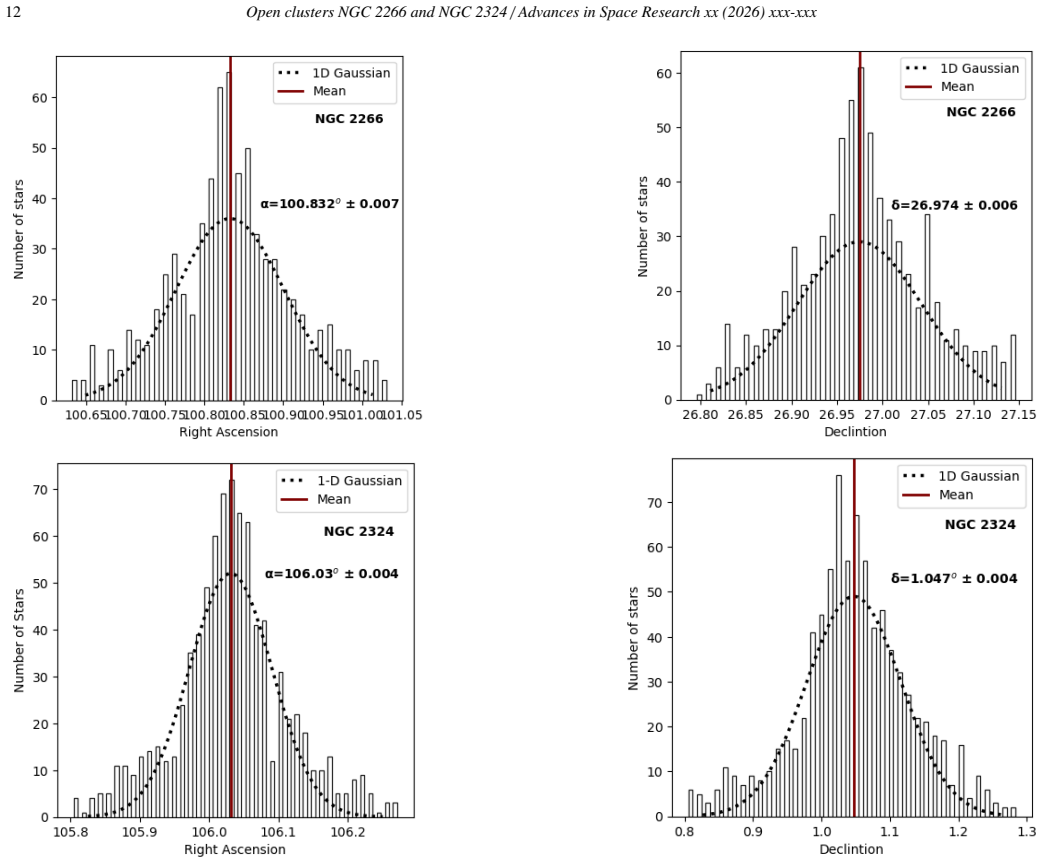
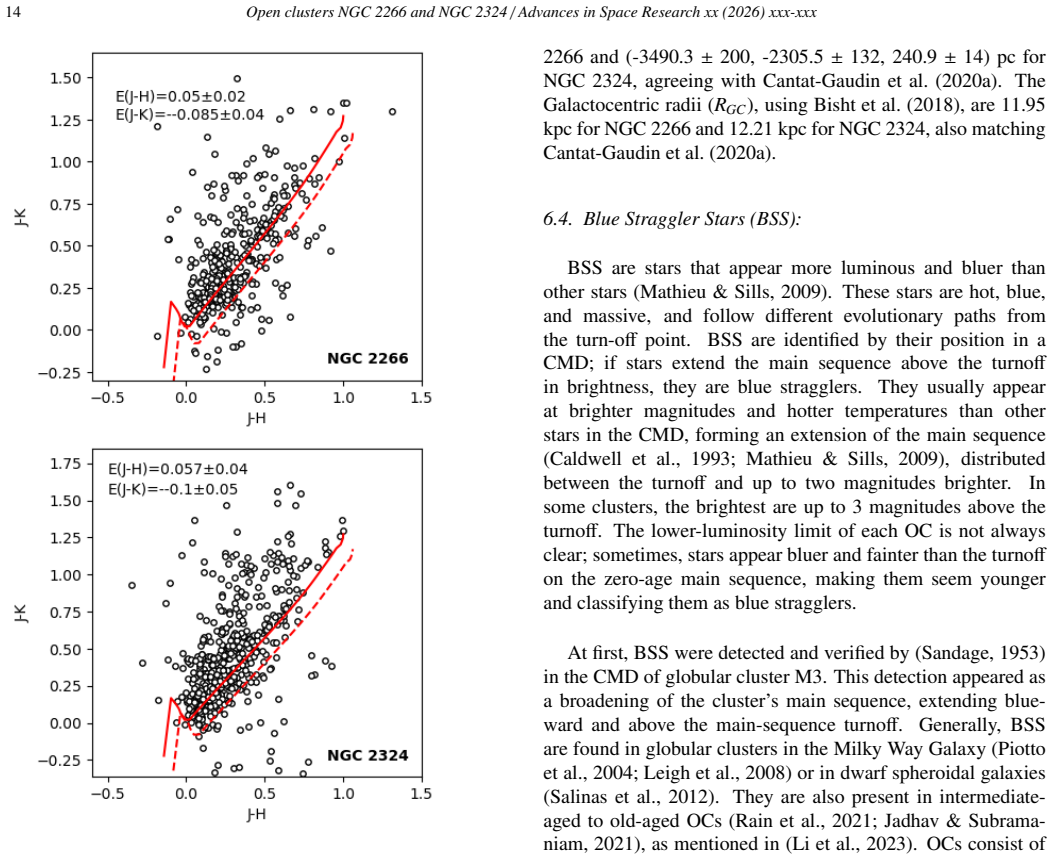
Summary. The authors reanalyze the intermediate-age open clusters NGC 2266 and NGC 2324 with Gaia DR3, supplemented by 2MASS and LAMOST DR7. Membership is derived with two unsupervised methods (GMM and pyUPMASK); the GMM sample (719 and 852 members at P≥0.7) is adopted after a CMD-dispersion comparison. Bailer–Jones Bayesian distances (3.55, 4.18 kpc), King-profile structural parameters, reddening from 2MASS TCDs, and PARSEC isochrone ages (1.1 Gyr, 790 Myr) at photometrically chosen metallicities are derived. The central result is a dynamical one: present-day mass-function slopes of x=1.13±0.18 and 1.24±0.19 over ~0.75–2.0 M⊙, shallower than Kroupa, combined with relaxation times of 7.9 and 14.4 Myr (τ=Age/T_R≫1), are taken to indicate dynamically evolved clusters depleted in low-mass stars. A KS test finds no significant mass segregation in NGC 2266 and a marginal hint in NGC 2324; dissociation times of ~0.4–0.5 Gyr are estimated.
Significance. If the MF result survives a proper completeness treatment, the paper would provide useful evidence that two intermediate-age outer-disk clusters are dynamically evolved, adding to the still-sparse census of PDMFs below ~1 M⊙ in this age/distance regime. The deeper membership catalogs (2 mag beyond Cantat-Gaudin 2020) and the quantitative GMM-vs-pyUPMASK comparison are genuine contributions, and the sensitivity tests on the membership probability threshold show good practice. However, the work is methodologically incremental — a standard pipeline applied to two well-studied clusters — and its scientific weight rests entirely on the faint-end MF analysis that is currently compromised. Significance is therefore moderate and conditional on the revisions above.
major comments (4)
- [§7.2, Fig. 15, Table 3] The headline MF slopes are fitted over 0.75–2.0 M⊙, but the LF/MF are stated to use only members brighter than G=19. With the adopted isochrone distance moduli (3.16/3.98 kpc) and A_G≈0.19–0.22, G=19 corresponds to M_G≈6.3, which on the adopted PARSEC isochrones (1.1 Gyr, Z=0.0084; 790 Myr, Z=0.0038) maps to ≈0.85–0.9 M⊙. Stars of 0.75–0.80 M⊙ have M_G≈7.3–8, i.e. G≈19.8–20.4 — fainter than even the G=20 limit used elsewhere. The lowest fitted mass bin(s) are therefore expected to be significantly undercounted, and incompleteness at the faint end flattens exactly the slope whose shallowness is the central result. §7.2 asserts the fit range is 'unaffected by incompleteness' but offers no demonstration (no completeness curve, no slope-vs-magnitude-cut test), and the text itself acknowledges the lowest-mass decline may be incompleteness-driven. This must be resolved: either restrict the pow
- [§2, §7.1, §7.2, Table 4] The completeness limit is stated inconsistently: §2 and the Introduction adopt G=20 as the completeness limit 'for membership selection and subsequent analyses, including luminosity function, mass function', while §7.1–7.2 use G=19 as the LF/MF limit, and the mass-segregation faint sample (Table 4, note) uses G≤20, reaching 0.63–0.64 M⊙ — fainter than the MF analysis itself. Related internal contradictions: §7.1 quotes absolute-magnitude ranges of −2.95≤M_G≤2.02 (NGC 2266) and −1.08≤M_G≤3.86 (NGC 2324), yet the same paragraph states the LF peaks at M_G≈4–5, outside the quoted ranges; with a G<19 cut the faint end should extend to M_G≈6.3. These numbers as printed are mutually inconsistent and make it impossible to verify which stars actually entered the LF/MF. The authors need to harmonize the magnitude limits, correct the quoted M_G ranges, and state explicitly how many stars and which
- [§6.2, §6.3, §7.1] The adopted metallicities (Z=0.0084, [Fe/H]=−0.35 for NGC 2266; Z=0.0038, −0.70 for NGC 2324) are chosen by visual CMD fit rather than from the LAMOST member spectroscopy, which for NGC 2266 yields ⟨[Fe/H]⟩=−0.62±0.57 dex. Age, reddening, distance modulus, and the mass–luminosity relation used for the MF are all co-adjusted within the age–metallicity–reddening–distance degeneracy, and the same CMD is then used to construct the LF/MF. Furthermore, two different distances are used in different places: isochrone distances (3.16/3.98 kpc) for the LF/MF absolute magnitudes, Bailer–Jones distances (3.55/4.18 kpc) for Galactocentric coordinates and (implicitly) the structural pc conversions — a 10–12% systematic offset that directly shifts the M_G-to-mass mapping at the faint end, compounding Major Comment 1. At minimum the authors should (i) quantify the MF slope sensitivity to the adopted Z a
- [§7.3, §7.4, §8] The dynamical-evolution narrative is internally strained. NGC 2266 is the older cluster with the larger τ=Age/T_R, yet shows no mass segregation (D=0.102, p=0.231), while the younger NGC 2324 shows a mild hint (p=0.077). If T_R is truly 7.9 Myr (τ>100), two-body relaxation should have produced unambiguous segregation in NGC 2266; its absence, together with a shallow PDMF that may itself be an incompleteness artifact (Major Comment 1), leaves the 'dynamically evolved' conclusion supported mainly by the short T_R estimate — which in turn depends on N, R_h, and m̄ whose mutual consistency is unclear (see minor comment on total mass). The discussion in §7.4 and §8 should explicitly address this tension rather than asserting relaxation from τ≫1 alone.
minor comments (7)
- [§7.4] The quoted dynamical evolution parameters do not follow from the paper's own numbers: 1.1 Gyr / 7.9 Myr = 139, not τ=153; 790 Myr / 14.4 Myr = 54.9, not 61.7. Please check the arithmetic or the T_R values. Also, the Spitzer & Hart (1971) formula is conventionally written with log10(0.4N); using natural log gives ~8 Myr for NGC 2266 — please state which convention is used.
- [§7.2, Table 3] Mass bookkeeping is inconsistent: 719 members at mean mass 1.43 M⊙ implies ~1030 M⊙, not the quoted total 752.91 M⊙. Presumably the total/mean mass refer to the G<19 subsample, but N in the relaxation-time formula is then ambiguous. Please define which sample enters each quantity.
- [Table 5] Table 5 lists distances as '3550±0.23' pc and '4180±0.24' pc; the uncertainties should be ±230 and ±240 pc (the 0.23/0.24 are in kpc).
- [§6.2, §6.3] §6.3: '719 evolved member stars' — 'evolved' appears to be a typo; these are all members. Also, the Z↔[Fe/H] conversion formula in §6.2 (Z = 0.013/(0.04)×10^{-(Fe/H)}) is misprinted/garbled; please give the correct expression.
- [§4] The parallax treatment mixes pieces: a constant −0.029 mas zero-point is applied (Lindegren et al. 2021 actually give the magnitude/color-dependent Z5), and the adopted distances are then taken from the Bailer-Jones catalog (the 2018 reference is DR2-based; for DR3 parallaxes the 2021 EDR3 geometric distances would be appropriate). The resulting distances agree with literature, so this is presentation-level, but it should be cleaned up.
- [Table 5, §8] Table 5 shows Selim et al. (2014) derived an MF slope of 2.68 for NGC 2266 — drastically steeper than the 1.13 found here. Given that the sign of this difference is the headline result, one paragraph discussing the origin of the discrepancy (magnitude limits, membership, mass range) is needed.
- [References, Fig. 4] Reference list needs a pass: Cantat-Gaudin et al. 2020a and 2020b are the same paper; the Gaia Collaboration (2020) entry is titled as Data Release 3; several in-text citations (e.g. Higuera et al. 2002, Gao 2014/2018) have reference entries whose titles do not obviously match the claims attributed to them. Also Figure 4's caption (membership probability vs G) does not match its in-text description (spatial concentration illustration).
Circularity Check
No significant circularity: standard observational OC analysis; photometric parameter co-fitting is degeneracy, not derivation-by-construction.
specific steps
-
fitted input called prediction
[§6.2–6.3 and §7.2 (metallicity/isochrone choice → MF)]
"Although the metallicity derived from LAMOST spectroscopy provides an independent estimate, the adopted metallicity for the isochrone fitting was chosen to yield the best photometric fit to the Gaia CMD. ... The best agreement between the observed CMDs and the theoretical isochrones was obtained for Z=0.0084 ... and Z=0.0038 ... The mass distribution was obtained by converting the luminosity function into a mass function using the mass–luminosity relation derived from the best-fitting PARSEC isochrones."
Z, age, reddening and distance modulus are co-adjusted until the isochrone matches the Gaia CMD; the same isochrones then supply the mass–luminosity map for the PDMF. This couples fitted inputs to the mass scale of the MF, a classic degeneracy. It is only weakly circular: the slope x is still a free fit to counts, not equal to the inputs by definition, and is not presented as an independent first-principles prediction.
full rationale
The paper is a conventional Gaia-based open-cluster reanalysis. Membership comes from external Gaia DR3 astrometry via GMM/pyUPMASK; distances from parallax/Bailer-Jones; structure from King fits; MF slopes from power-law fits to masses mapped via PARSEC isochrones. Nothing is predicted from a quantity that is defined as that prediction. The only mild interdependence is the usual CMD degeneracy: Z (and jointly age, AG, distance modulus) is chosen for best visual isochrone match to the same Gaia CMD later used for the LF/MF mass–luminosity mapping (§6.2–6.3, §7.2). That makes absolute masses and ages systematically coupled, but the reported MF slopes remain empirical least-squares fits to binned star counts, not forced equal to the inputs. Short TR and τ≫1 follow from N, Rh, and mean mass of the adopted members plus the isochrone age; they are consistency checks, not tautologies. Self-citations (Bisht et al.) are methodological and non-load-bearing. No uniqueness theorem, ansatz smuggling, or renamed known law. Score 1 only for the acknowledged photometric co-adjustment; central dynamical claims are not circular by construction.
Axiom & Free-Parameter Ledger
free parameters (7)
- Membership probability threshold P≥0.7 =
0.7
- Photometric metallicity NGC 2266 =
Z=0.0084 ([Fe/H]≈−0.35)
- Photometric metallicity NGC 2324 =
Z=0.0038 ([Fe/H]≈−0.70)
- E(B−V) reddening from TCD/CMD =
0.17±0.04 and 0.22±0.06 mag
- Isochrone log(age) means =
9.05 and 8.90
- MF completeness magnitude cut =
G≤19 mag
- Gaia parallax zero-point offset =
−0.029 mas
axioms (7)
- domain assumption Cluster and field stars in (position, parallax, proper motion) space are well-described as a mixture of multivariate Gaussians (GMM) or by pyUPMASK spatial random-field rejection.
- domain assumption King (1962) empirical density law describes the radial surface-density profile, yielding rc, rt, and concentration.
- domain assumption PARSEC/COLIBRI isochrones (Marigo et al. 2017) correctly map age, Z, and extinction to Gaia CMD morphology and supply the mass–luminosity relation for the PDMF.
- domain assumption Bailer-Jones et al. Bayesian distances with exponentially decreasing space-density prior are preferred over naive 1/ϖ for these parallax precisions.
- domain assumption Spitzer & Hart (1971) half-mass relaxation time and the Binney & Tremaine-style dissociation time formula apply with Rh from Larsen (2006) and mean mass from the MF sample.
- domain assumption Standard interstellar reddening law with E(J−H)/E(J−K)≈0.55–0.60 and AG=1.86 E(GBP−GRP).
- standard math Expectation-maximization and related clustering mathematics are correctly implemented in the software used.
read the original abstract
We present a refined astrometric and photometric analysis of the well-studied intermediate-age open clusters NGC 2266 and NGC 2324 using high-precision Gaia DR3 data, complemented by 2MASS and LAMOST DR7 catalogs. Probable cluster members are identified using unsupervised machine learning techniques. We apply both Gaussian Mixture Models (GMMs) and \texttt{pyUPMASK}. We find that the GMM-based membership sample yields a cleaner, more coherent cluster sequence in the Gaia CMDs than pyUPMASK. We identified 719 and 852 high-probability members ($P \geq 0.7$) for NGC 2266 and NGC 2324, respectively. Using the parallax method, we determine distances of 3.55 $\pm$ 0.23~kpc for NGC 2266 and 4.18 $\pm$ 0.24~kpc for NGC 2324. The radius estimates for both clusters are 7.23 $\pm$ 0.47 pc and 10.94 $\pm$ 0.63 pc. Isochrone fitting estimated ages of $1.1 \pm 0.1$~Gyr for NGC 2266 and $790 \pm 150$~Myr for NGC 2324. These age estimates were derived assuming metallicities of $Z = 0.0084$ and $Z = 0.0038$, respectively. The King profile fitting indicates that both clusters exhibit compact, well-defined radial structures. Their tidal radii are $8.84'$ (9.13 pc) for NGC 2266 and $10.97'$ (13.34 pc) for NGC 2324. The slopes of the present-day mass functions are $1.13\pm0.18$ for NGC 2266 and $1.24\pm0.19$ for NGC 2324, indicating a deficiency of low-mass stars. The derived mass-function slopes are consistent with dynamical evolution in both clusters. The clusters exhibit short relaxation times, while only NGC 2324 shows a mild indication of mass segregation. This study highlights the power of Gaia astrometry to resolve internal structures within open clusters and refine their dynamical parameters.
Figures






Reference graph
Works this paper leans on
-
[9]
, & author Fenkart, R
author Becker, W. , & author Fenkart, R. ( year 1971 ). title Photometric studies of galactic open clusters. i. methods and standard sequences . journal Astronomy and Astrophysics Supplement Series \/ , volume 4 \/ , pages 241--252
1971
-
[11]
, & author Tremaine , S
author Binney , J. , & author Tremaine , S. ( year 2008 ). title Galactic Dynamics: Second Edition \/ . Princeton Series in Astrophysics. address Princeton, NJ : publisher Princeton University Press
2008
-
[13]
, author Ganesh , S
author Bisht , D. , author Ganesh , S. , author Baliyan , K. S. et al. ( year 2018 ). title Study of II Galactic quadrant of Milky Way Galaxy using open clusters . journal Bulletin de la Societe Royale des Sciences de Liege \/ , volume 87 \/ , pages 229--233
2018
-
[18]
, author James , A
author Caldwell , N. , author James , A. , author Rose , K. et al. ( year 1993 ). title The Stellar Population of the Galactic Open Cluster NGC 6791 . journal \/ , volume 117 \/ issue (3) , pages 140--156
1993
-
[24]
, & author Maitra , R
author Chattopadhyay , S. , & author Maitra , R. ( year 2017 ). title A Bayesian approach for open cluster membership determination . journal \/ , volume 469 \/ , pages 3374--3384
2017
-
[25]
author Chumak , Y. O. , author Platais , I. , author McLaughlin , D. E. et al. ( year 2010 ). title The structure and dynamics of open clusters . journal \/ , volume 402 \/ , pages 1841--1854
2010
-
[27]
author Cutri , R. M. et al. ( year 2003 ). title 2MASS All-Sky Catalog of Point Sources
2003
-
[28]
( year 1996 )
author de la Fuente Marcos , R. ( year 1996 ). title The evolution of binary open clusters . journal \/ , volume 314 \/ , pages 453--461
1996
-
[29]
author Dempster, A. P. , author Laird, N. M. , & author Rubin, D. B. ( year 1977 ). journal Journal of the Royal Statistical Society: Series B (Methodological) \/ , volume 39 \/ , pages 1
1977
-
[35]
, & author Munari , U
author Fiorucci , M. , & author Munari , U. ( year 2003 ). title The Asiago Database on Photometric Systems . journal \/ , volume 401 \/ , pages 781--791
2003
-
[36]
, author Pryor , C
author Fischer , P. , author Pryor , C. , author Murray , S. et al. ( year 1998 ). title The Dynamics of the Globular Cluster NGC 6397 . journal \/ , volume 115 \/ , pages 592--605
1998
-
[39]
( year 2014 )
author Gao , X.-H. ( year 2014 ). title The Galactic open cluster system . journal Research in Astronomy and Astrophysics \/ , volume 14 \/ , pages 159--166
2014
-
[40]
( year 2018 a )
author Gao , X.-H. ( year 2018 a ). title Open cluster parameters and Galactic structure . journal Publications of the Astronomical Society of Japan \/ , volume 70 \/ , pages 68
2018
-
[41]
( year 2018 b )
author Gao , X.-H. ( year 2018 b ). title Open clusters in the Milky Way . journal \/ , volume 156 \/ , pages 121
2018
-
[42]
, author Clari \'a , J
author Geisler , D. , author Clari \'a , J. J. , & author Minniti , D. ( year 1992 ). title Metal Abundances and Ages of Open Clusters in the Galactic Disk . journal \/ , volume 104 \/ , pages 1892--1905
1992
-
[43]
author Hagen , G. L. ( year 1970 ). title Publications of the David Dunlap Observatory . journal Publications of the David Dunlap Observatory \/ , volume 3 \/ , pages 1--62
1970
-
[44]
author Heggie , D. , & author Hut , P. ( year 2003 ). title The Gravitational Million-Body Problem: A Multidisciplinary Approach to Star Cluster Dynamics \/ . address Cambridge : publisher Cambridge University Press . :10.1017/CBO9781139164531
-
[46]
author Higuera , M. A. , author Uribe , A. , & author Barrera , R. S. ( year 2002 ). title Open clusters in the Galactic disk . journal Revista Mexicana de Astronomía y Astrofísica Conference Series \/ , volume 14 \/ , pages 33--33
2002
-
[48]
author Hills , J. G. , & author Day , C. A. ( year 1976 ). title Stellar Collisions in Dense Stellar Systems . journal Astrophysical Letters \/ , volume 17 \/ , pages 87--91
1976
-
[55]
author Jones , B. F. , & author Walker , M. F. ( year 1988 ). title The motion of stars in the globular cluster M13 . journal \/ , volume 95 \/ , pages 1755--1767
1988
-
[56]
, & author Mazur , B
author Kaluzny , J. , & author Mazur , B. ( year 1991 ). title CCD photometry of open clusters . journal Acta Astronomica \/ , volume 41 \/ , pages 191--212
1991
-
[58]
, & author Rousseeuw , P
author Kaufman , L. , & author Rousseeuw , P. J. ( year 1990 ). title Finding Groups in Data: An Introduction to Cluster Analysis \/ . Wiley Series in Probability and Mathematical Statistics. address New York : publisher Wiley
1990
-
[64]
, author Byun , Y.-I
author Kyeong , J.-M. , author Byun , Y.-I. , & author Sung , E. C. ( year 2001 ). title Photometric study of open clusters . journal Journal of Korean Astronomical Society \/ , volume 34 \/ , pages 143--147
2001
-
[65]
author Larsen , S. S. ( year 2006 ). title An ISHAPE User's Guide
2006
-
[71]
( year 2019 )
author Luo , A.-L. ( year 2019 ). title LAMOST Data Release 7
2019
-
[72]
, & author et al
author Luo , A.-L. , & author et al. ( year 2015 ). title The LAMOST Spectroscopic Survey
2015
-
[73]
, author Boeva , S
author Maciejewski , G. , author Boeva , S. , author Georgiev , T. et al. ( year 2008 ). title CCD Photometry of Open Clusters . journal Baltic Astronomy \/ , volume 17 \/ , pages 51--65
2008
-
[78]
, author Joshi , Y
author Maurya , J. , author Joshi , Y. C. , author Elsanhoury , W. H. et al. ( year 2021 ). title Study of open clusters using Gaia astrometry . journal \/ , volume 164 \/ , pages 64
2021
-
[80]
, author Clari \'a , J
author Mermilliod , J.-C. , author Clari \'a , J. J. , author Andersen , J. et al. ( year 2001 ). title Radial velocities of open clusters . journal \/ , volume 375 \/ , pages 30--39
2001
-
[81]
( year 2000 )
author Meylan , G. ( year 2000 ). title Massive Stellar Clusters . In booktitle Massive Stellar Clusters \/ (pp. pages 215--232 ). publisher ASP Conference Series volume volume 211 of series Astronomical Society of the Pacific Conference Series \/
2000
-
[84]
, author Akkaya Oralhan , \.I
author Netopil , M. , author Akkaya Oralhan , \.I . , author Çakmak , H. et al. ( year 2021 ). title Open clusters in the Gaia era . journal Journal of Astronomy \/ ,
2021
-
[86]
author Pera , M. S. , author Perren , G. I. , author Moitinho , A. et al. ( year 2021 ). title A catalogue of Galactic open clusters from Gaia DR2 . journal \/ ,
2021
-
[92]
, & author Mermilliod , J.-C
author Raboud , D. , & author Mermilliod , J.-C. ( year 1998 ). title The structure of open clusters . journal \/ , volume 333 \/ , pages 897--909
1998
-
[98]
, author Miakutin , V
author Sagar , R. , author Miakutin , V. I. , author Piskunov , A. E. et al. ( year 1988 ). title Photometric study of open clusters . journal \/ , volume 234 \/ , pages 831--842
1988
-
[102]
author Selim, I. M. , author Haroon, A. , author Ismail, H. A. et al. ( year 2014 ). title Optical and infrared photometric study of open star cluster ngc 2266 . journal Romanian Astronomical Journal \/ , volume 24 \/ issue (2) , pages 159--170
2014
-
[106]
, author Barrera , R
author Uribe , A. , author Barrera , R. , & author Brieva , E. ( year 2006 ). title Photometric study of open clusters . journal Serbian Astronomical Journal \/ , volume 173 \/ , pages 57--65
2006
-
[107]
( year 2023 )
author Yontan , T. ( year 2023 ). title Photometric analysis of open clusters . journal \/ , volume 165 \/ , pages 79
2023
-
[109]
Tracing the Galactic Origins of Selected Four G-type Stars in the Solar Neighborhood. , keywords =. doi:10.3847/1538-3881/add343 , archivePrefix =. 2504.17844 , primaryClass =
-
[110]
, year = 2019, month = nov, volume =
On the mass segregation of cores and stars. , year = 2019, month = nov, volume =. doi:10.1093/mnras/stz2646 , archivePrefix =. 1909.07982 , primaryClass =
Pith/arXiv arXiv 2019
-
[111]
Improving the open cluster census. II. An all-sky cluster catalogue with Gaia DR3. , keywords =. doi:10.1051/0004-6361/202346285 , archivePrefix =. 2303.13424 , primaryClass =
-
[112]
Estimating Distance from Parallaxes. IV. Distances to 1.33 Billion Stars in Gaia Data Release 2. , keywords =. doi:10.3847/1538-3881/aacb21 , archivePrefix =. 1804.10121 , primaryClass =
-
[113]
Painting a portrait of the Galactic disc with its stellar clusters. , keywords =. doi:10.1051/0004-6361/202038192 , archivePrefix =. 2004.07274 , primaryClass =
Pith/arXiv arXiv 2004
-
[114]
UPMASK: unsupervised photometric membership assignment in stellar clusters. , keywords =. doi:10.1051/0004-6361/201321143 , archivePrefix =. 1309.4471 , primaryClass =
-
[115]
, year = 2023, month = oct, volume =
Revisiting the mass of open clusters with Gaia data. , year = 2023, month = oct, volume =. doi:10.1093/mnras/stad2291 , archivePrefix =. 2307.15182 , primaryClass =
Pith/arXiv arXiv 2023
-
[116]
, year = 2000, volume =
Luminosity function and mass segregation in M92. , year = 2000, volume =
2000
-
[117]
, year = 2006, month = aug, volume =
Mergers of Close Primordial Binaries. , year = 2006, month = aug, volume =. doi:10.1086/505127 , adsurl =
doi:10.1086/505127 2006
-
[118]
, year = 2021, month = jan, volume =
Characterizing dynamical states of Galactic open clusters with Gaia DR2. , year = 2021, month = jan, volume =. doi:10.1093/mnras/staa3192 , archivePrefix =. 2010.04825 , primaryClass =
Pith/arXiv arXiv 2021
-
[119]
Estimating Distances from Parallaxes. III. Distances of Two Million Stars in the Gaia DR1 Catalogue. , year = 2016, month = dec, volume =. doi:10.3847/1538-4357/833/1/119 , archivePrefix =. 1609.07369 , primaryClass =
Pith/arXiv arXiv 2016
-
[120]
Estimating Distances from Parallaxes. V. Geometric and Photogeometric Distances to 1.47 Billion Stars in Gaia Early Data Release 3. , year = 2021, month = mar, volume =. doi:10.3847/1538-3881/abd806 , archivePrefix =. 2012.05220 , primaryClass =
Pith/arXiv arXiv 2021
-
[121]
, year = 2003, month = mar, volume =
Dynamical evolution of star clusters in tidal fields. , year = 2003, month = mar, volume =. doi:10.1046/j.1365-8711.2003.06286.x , archivePrefix =. astro-ph/0211471 , primaryClass =
arXiv 2003
-
[122]
and Fenkart, R
Becker, W. and Fenkart, R. , title =. Astronomy and Astrophysics Supplement Series , year =
-
[123]
Unveiling dynamics and variability in open clusters: insights from a comprehensive analysis of six galactic clusters. , keywords =. doi:10.1093/mnras/staf1739 , archivePrefix =. 2510.02462 , primaryClass =
-
[124]
Galactic Dynamics: Second Edition
-
[125]
, year = 2020, month = may, volume =
A comprehensive study of open clusters Czernik 14, Haffner 14, Haffner 17 and King 10 using multicolour photometry and Gaia DR2 astrometry. , year = 2020, month = may, volume =. doi:10.1093/mnras/staa656 , adsurl =
-
[126]
, year = 2020, month = sep, volume =
An Investigation of Poorly Studied Open Cluster NGC 4337 Using Multicolor Photometric and Gaia DR2 Astrometric Data. , year = 2020, month = sep, volume =. doi:10.3847/1538-3881/ab9ffd , archivePrefix =. 2006.13618 , primaryClass =
Pith/arXiv arXiv 2020
-
[127]
A Deep Investigation of Two Poorly Studied Open Clusters Haffner 22 and Melotte 71 in the Gaia era. , keywords =. doi:10.1088/1538-3873/ac6195 , archivePrefix =. 2203.16459 , primaryClass =
-
[128]
, year = 2017, month = apr, volume =
Parameters of Three Selected Model Galactic Potentials Based on the Velocities of Objects at Distances up to 200 kpc. , year = 2017, month = apr, volume =. doi:10.1134/S1063773717040016 , adsurl =
-
[129]
Old open clusters as key tracers of Galactic chemical evolution. II. Iron and elemental abundances in NGC 2324, NGC 2477, NGC 2660, NGC 3960, and Berkeley 32. , year = 2008, month = mar, volume =. doi:10.1051/0004-6361:20078507 , adsurl =
-
[130]
, year = 1990, month = mar, volume =
Membership probabilities of stars in open clusters. , year = 1990, month = mar, volume =
1990
-
[131]
, year = 1993, month = mar, volume =
The Stellar Population of the Galactic Open Cluster NGC 6791. , year = 1993, month = mar, volume =
1993
-
[132]
, year = 1989, month = oct, volume =
The Relationship Between Infrared, Optical, and Ultraviolet Extinction. , year = 1989, month = oct, volume =. doi:10.1086/167900 , adsurl =
doi:10.1086/167900 1989
-
[133]
, year = 2016, month = dec, volume =
NGC 2324: an old open cluster in the Galactic anticentre. , year = 2016, month = dec, volume =. doi:10.1093/mnras/stv2584 , adsurl =
-
[134]
, year = 2018, month = oct, volume =
Synthetic Stellar Populations: Revisiting the Stellar Color-Temperature Relation. , year = 2018, month = oct, volume =. doi:10.1093/mnrasl/sly104 , adsurl =
-
[135]
, year = 2017, month = aug, volume =
A Bayesian approach for open cluster membership determination. , year = 2017, month = aug, volume =
2017
-
[136]
, year = 2010, month = mar, volume =
The structure and dynamics of open clusters. , year = 2010, month = mar, volume =
2010
-
[137]
Open cluster parameters from Gaia data. , year = 2023, volume =. doi:10.1051/0004-6361/202345000 , adsurl =
-
[138]
, year = 2011, month = dec, volume =
The dynamical evolution of young star clusters. , year = 2011, month = dec, volume =. doi:10.1111/j.1365-2966.2010.17650.x , adsurl =
arXiv 2011
-
[139]
, year = 1999, month = apr, volume =
The Globular Cluster System of the Galaxy. , year = 1999, month = apr, volume =
1999
-
[140]
, year = 1941, month = jul, volume =
The Galactic Clusters Messier 46, Messier 50, and NGC 2324. , year = 1941, month = jul, volume =. doi:10.1086/144312 , adsurl =
-
[141]
2MASS All-Sky Catalog of Point Sources
-
[142]
Dempster, A. P. and Laird, N. M. and Rubin, D. B. , year =. Journal of the Royal Statistical Society: Series B (Methodological) , volume =
-
[143]
Bulletin de la Societe Royale des Sciences de Liege , keywords =
Study of II Galactic quadrant of Milky Way Galaxy using open clusters. Bulletin de la Societe Royale des Sciences de Liege , keywords =
-
[144]
, year = 2019, month = sep, volume =
The initial mass function of embedded clusters. , year = 2019, month = sep, volume =. doi:10.1051/0004-6361/201935071 , adsurl =
-
[145]
The evolution of the stellar mass function of star clusters. , year = 2018, volume =. doi:10.1093/mnras/stx2345 , adsurl =
-
[146]
Open clusters and their fundamental parameters. , year = 2012, volume =. doi:10.1051/0004-6361/201118305 , adsurl =
-
[147]
A catalogue of open cluster parameters. , year = 2014, volume =. doi:10.1051/0004-6361/201322699 , adsurl =
-
[149]
Star cluster disruption in the Large Magellanic Cloud. , year = 2002, volume =. doi:10.1046/j.1365-8711.2002.05823.x , adsurl =
arXiv 2002
-
[150]
, year = 1996, volume =
The evolution of binary open clusters. , year = 1996, volume =
1996
-
[151]
, year = 1997, volume =
Blue straggler stars in Galactic globular clusters. , year = 1997, volume =
1997
-
[152]
IEEE Transactions on Pattern Analysis and Machine Intelligence , year = 2002, volume =
Unsupervised Learning of Finite Mixture Models. IEEE Transactions on Pattern Analysis and Machine Intelligence , year = 2002, volume =. doi:10.1109/34.990138 , adsurl =
discussion (0)
Sign in with ORCID, Apple, or X to comment. Anyone can read and Pith papers without signing in.