REVIEW 27 references
The Missing Layer: Specification Infrastructure for AI Oversight
T0 review · reviewed 2026-07-30 · grok-4.5
Pith's one-line read AI oversight is missing a shared specification layer that turns human intent into machine-checkable artifacts other layers can act on.
desk verdict Useful diagnostic vocabulary for agent oversight; the composition claim is the soft spot, not the matrix itself. read the letter →
The pith
A machine-rendered reading of the paper's core claim, the machinery that carries it, and where it could break.
The reading
What carries the argument
The Oversight Infrastructure Matrix: five technical layers (Legibility, Specification, Mediation, Evaluation, Escalation) crossed with six concerns (alignment, robustness, adversarial defense, security, governance, accountability), plus six Layer-2 design principles—elicitability, composability, conformity, adversary-awareness, traceability, and governability—that turn specifications into runtime enforcement, evaluation criteria, and escalation triggers under governance.
What would settle it
A structured survey with a public coding rubric that finds existing Layer-2 work already has shared vocabulary, design principles, composability standards, and governance practices comparable to software engineering, databases, or cryptography—or a production composition of constitutions, authorization policies, and formal specs that already satisfies the six principles end to end without the proposed framework.
Extended reading notes
Core claim
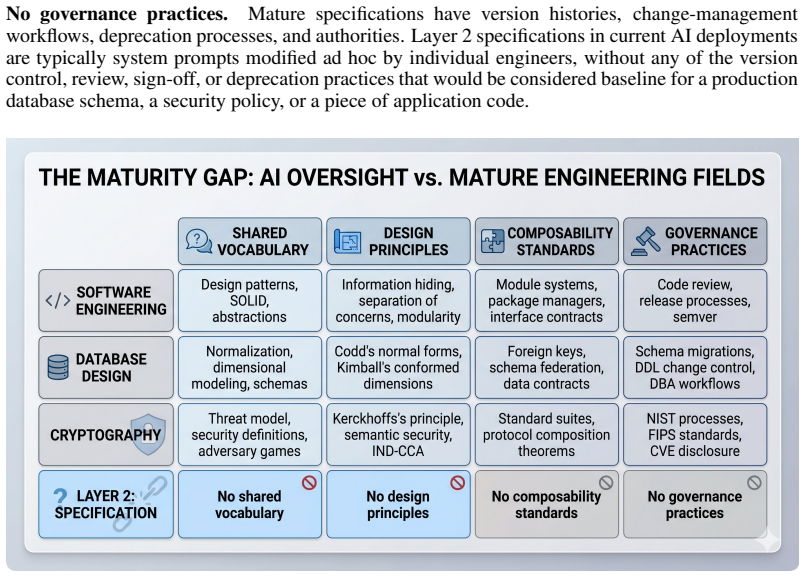
Layer 2 (Specification) is the connective tissue of AI oversight: every other layer depends on machine-checkable intent, yet the field treats specification work as scattered fragments rather than shared infrastructure. The gap is a coordination failure, not a missing research idea. Naming the layer, measuring it against maturity indicators, and giving six design principles makes existing fragments—authorization languages, constitutions, policy engines, formal methods—composable instead of isolated.
Load-bearing premise
That an informal survey of current agent, policy, alignment, and formal-methods systems is enough to say Layer 2 has none of the four maturity marks, and that composition failures are mainly missing specification infrastructure rather than deeper limits on combining those systems.
Editorial extensions
If this is right
- Teams can map tools and papers onto matrix cells and see which Layer-2 cells remain empty or contested.
- One versioned specification can drive mediation, evaluation thresholds, and escalation triggers instead of three separate ad-hoc artifacts.
- Audit and incident review can attribute failures to a named spec version and authority rather than an opaque runtime refusal.
- Existing systems such as authorization languages and constitutional training become fragments to extend and compose, not competing full answers.
- Regulated deployments gain an engineering target for the controls, change management, and audit trails frameworks already demand.
Reading between the lines
- If Layer 2 becomes shared infrastructure, procurement and certification may start requiring versioned, adversary-aware specs the way they require schema migrations and IAM policy review today.
- The hardest remaining problem may shift from writing single-domain invariants to cross-organization conformity—same terms meaning the same thing across vendors and agents.
- Domains with mature informal invariants (warehousing, dosing rules, booking envelopes) will adopt first; open-ended chat agents will lag until elicitability tools catch up.
- Without incentive alignment for publishing composable specs, the vocabulary could spread while production systems stay proprietary one-offs.
Signed reviews
Editorial analysis
A structured set of objections, weighed in public.
Circularity Check
Mostly non-circular framework paper; only mild definitional tautology in Proposition 1 (traceability/governability ⇒ attribution by construction).
-
self definitional
[§5 Proposition 1; Appendix A]
"Proposition 1 (Cross-layer coupling requires a Layer 2 anchor). Let F be a formal specification of a runtime constraint, E ∈ {Layer 3 enforcement, Layer 4 evaluation criterion, Layer 5 escalation trigger} a downstream enforcement or evaluation artifact, and A an audit record of an incident. If F satisfies traceability and governability, then E and A can be linked to the same versioned specification identifier v(F)... The proof, stated in Appendix A, is immediate from the definitions but the observation is load-bearing... Traceability requires that every enforcement decision made under F carrie"
Traceability is defined as every decision carrying v(F) and governability as v(F) resolving to content/authority; the proposition then concludes that E and A attribute to F via those lookups. The forward direction is true by construction of the two definitions, not an independent derivation. The paper admits the proof is immediate from the definitions, so the ‘load-bearing’ cross-layer coupling claim at this step is definitional rather than predictive.
full rationale
This is a taxonomy/position paper, not a fit-then-predict or uniqueness-theorem derivation. There are no fitted parameters relabeled as predictions, no author self-citation chain, no imported uniqueness theorem, and no ansatz smuggled via prior work by the same authors. Cedar, Constitutional AI, OPA, TLA+, NIST/EU materials, and Kimball/Parnas/Codd analogues are external. CARMA is explicitly framed as design-intent evidence, not measured validation of a forced result. The only clear circular step is Proposition 1 / Appendix A: traceability and governability are defined as version-carrying audit linkage and durable authority resolution, then the proposition ‘proves’ that those properties yield attribution—stated as immediate from the definitions. The broader ‘Layer 2 is connective tissue’ claim is partly true by how the five-layer stack is carved (specs drive mediation/eval/escalation), which is normal taxonomy design rather than a hidden reduction of an empirical prediction. Table 2’s absolute ‘None’ is a strong informal-survey claim, not circularity. Overall circularity is minor and non-load-bearing for the paper’s useful vocabulary contribution.
Assumptions & free parameters
assumptions (6)
- domain assumption Any deployed oversight system must contain five technical layers: Legibility, Specification, Mediation, Evaluation, Escalation.
- domain assumption Six persistent concerns (alignment, robustness, adversarial defense, security, governance, accountability) flow through every layer and form a complete second axis for organizing oversight work.
- ad hoc to paper Engineering maturity of a specification discipline is adequately diagnosed by four indicators: shared vocabulary, design principles, composability standards, and governance practices.
- domain assumption Observed non-composition of constitutions, Cedar policies, evals, and agent frameworks is primarily a missing shared Layer-2 infrastructure/coordination problem rather than irreducible semantic or incentive conflict.
- standard math If a formal spec F satisfies traceability and governability, downstream enforcement/evaluation artifacts and audit records can be attributed to version v(F); otherwise they decouple.
- ad hoc to paper An informal reading of listed agent frameworks, policy-as-code systems, alignment specs, and FM-for-AI case studies is sufficient to claim Layer 2 lacks all four maturity marks pending a companion survey.
invented entities (4)
-
Oversight Infrastructure Matrix (5 layers × 6 concerns)
-
Six Layer-2 design principles (elicitability, composability, conformity, adversary-awareness, traceability, governability)
-
CARMA
-
Reference Layer-2 architecture (authoring → compiler → sidecar capability/policy/invariant checks → Kimball audit facts → governed spec repo)
Cite this review
Pith. "Pith review of The Missing Layer: Specification Infrastructure for AI Oversight." pith.science (2026). https://pith.science/paper/W6GHYR5X
@misc{pith2026260724866,
  author       = {Pith},
  title        = {Pith review of: The Missing Layer: Specification Infrastructure for AI Oversight},
  year         = {2026},
  howpublished = {\url{https://pith.science/paper/W6GHYR5X}},
  note         = {Machine review of arXiv:2607.24866}
}
read the original abstract
AI safety has a missing layer. Interpretability, formal methods, security engineering, evaluation methodology, and reinforcement-learning safety each produce substantial work, but the resulting artifacts do not compose into deployable oversight: every team fielding an agentic system builds its own audit schema, policy dialect, monitoring stack, and escalation path, mostly reinventions of patterns understood elsewhere. We diagnose this as a coordination gap, not a research gap, and propose a two-axis taxonomy: five technical layers (Legibility, Specification, Mediation, Evaluation, Escalation) crossed with six concerns spanning alignment, robustness, adversarial defense, security, governance, and accountability, populating the resulting 5x6 matrix with existing work. Layer 2 (Specification), where humans translate intent into machine-checkable artifacts, is the connective tissue every layer depends on, yet it lacks four marks of a mature engineering discipline: shared vocabulary, design principles, composability standards, and governance practices. We propose six design principles for Layer 2, from elicitability and composability to adversary-awareness, traceability, and governability, made concrete through worked examples and a reference architecture turning specifications into runtime enforcement, evaluation, and escalation. Existing systems such as Cedar, Constitutional AI, and Open Policy Agent each address a fragment of Layer 2 well and the matrix poorly; treating them as fragments of one shared layer makes composition tractable. As evidence, we introduce CARMA, a Layer 2 prototype for autonomous ETL agents in which one specification drives enforcement, evaluation, and escalation, with every decision traceable to a versioned specification, naming what AI oversight is missing and giving independent teams principles to build the missing pieces so they compose.
Figures


Figures from the paper (1 more)

Reference graph
Works this paper leans on
-
[1]
Scaling monosemanticity: Extracting interpretable features from Claude 3 Sonnet
Templeton, A., Conerly, T., Marcus, J., et al. Scaling monosemanticity: Extracting interpretable features from Claude 3 Sonnet. Transformer Circuits Thread , Anthropic, 2024
2024
-
[2]
In-context scheming reasoning evaluations of frontier models
Apollo Research. In-context scheming reasoning evaluations of frontier models. Technical report, Apollo Research, 2024
2024
-
[3]
Constitutional AI : Harmlessness from AI feedback
Bai, Y., Kadavath, S., Kundu, S., et al. Constitutional AI : Harmlessness from AI feedback. arXiv:2212.08073 , 2022
arXiv 2022
-
[4]
Cedar: A new language for expressive, fast, safe, and analyzable authorization
Cassez, F., Cook, B., Cutler, C., Disselkoen, C., Foster, N., Jhala, R., Kaplan, K., Kici 'a n, J., Klugerman, D., Lengauer, J., Marnix, V., McCloghrie, K., Peterson, C., Rungta, N., Simpson, E., Sroka, M., Ta - Shma, P., Torlak, E., and Yoo, Y. Cedar: A new language for expressive, fast, safe, and analyzable authorization. In Proceedings of the ACM on Pr...
2024
-
[5]
Codd, E. F. A relational model of data for large shared data banks. Communications of the ACM , 13(6):377--387, 1970
1970
-
[6]
A mathematical framework for transformer circuits
Elhage, N., Nanda, N., Olsson, C., et al. A mathematical framework for transformer circuits. Transformer Circuits Thread , 2021
2021
-
[7]
Regulation (EU) 2024/1689 laying down harmonised rules on artificial intelligence ( AI Act)
European Commission. Regulation (EU) 2024/1689 laying down harmonised rules on artificial intelligence ( AI Act). Official Journal of the European Union , 2024
2024
-
[8]
The capacity for moral self-correction in large language models
Ganguli, D., Askell, A., Schiefer, N., et al. The capacity for moral self-correction in large language models. arXiv:2302.07459 , 2022
arXiv 2022
Show all 27 references
-
[9]
Red teaming language models to reduce harms
Ganguli, D., Lovitt, L., Kernion, J., et al. Red teaming language models to reduce harms. arXiv:2209.07858 , 2022
2022 arXiv
-
[10]
and Micali, S
Goldwasser, S. and Micali, S. Probabilistic encryption. Journal of Computer and System Sciences , 28(2):270--299, 1984
1984
-
[11]
Not what you've signed up for: Compromising real-world LLM -integrated applications with indirect prompt injection
Greshake, K., Abdelnabi, S., Mishra, S., Endres, C., Holz, T., and Fritz, M. Not what you've signed up for: Compromising real-world LLM -integrated applications with indirect prompt injection. In AISec Workshop, ACM CCS , 2023
2023
-
[12]
A survey of safety and trustworthiness of deep neural networks: Verification, testing, adversarial attack and defence, and interpretability
Huang, X., Kroening, D., Ruan, W., et al. A survey of safety and trustworthiness of deep neural networks: Verification, testing, adversarial attack and defence, and interpretability. Computer Science Review , 37:100270, 2020
2020
-
[13]
I., Durmus, E., Tamkin, A., and Ganguli, D
Huang, S., Siddarth, D., Lovitt, L., Liao, T. I., Durmus, E., Tamkin, A., and Ganguli, D. Collective constitutional AI : Aligning a language model with public input. In ACM FAccT , 2024
2024
-
[14]
Sleeper agents: Training deceptive LLMs that persist through safety training
Hubinger, E., Denison, C., Mu, J., et al. Sleeper agents: Training deceptive LLMs that persist through safety training. arXiv:2401.05566 , 2024
2024 arXiv
-
[15]
ISO/IEC 42001:2023 information technology --- artificial intelligence --- management system
ISO/IEC. ISO/IEC 42001:2023 information technology --- artificial intelligence --- management system. International standard, 2023
2023
-
[16]
L., Julian, K., and Kochenderfer, M
Katz, G., Barrett, C., Dill, D. L., Julian, K., and Kochenderfer, M. J. Reluplex: An efficient SMT solver for verifying deep neural networks. In CAV , 2017
2017
-
[17]
and Ross, M
Kimball, R. and Ross, M. The Data Warehouse Toolkit: The Definitive Guide to Dimensional Modeling . Wiley, 3rd edition, 2013
2013
-
[18]
Specifying Systems: The TLA+ Language and Tools for Hardware and Software Engineers
Lamport, L. Specifying Systems: The TLA+ Language and Tools for Hardware and Software Engineers . Addison-Wesley, 2002
2002
-
[19]
Leveson, N. G. Engineering a Safer World: Systems Thinking Applied to Safety . MIT Press, 2011
2011
-
[20]
Frontier models are capable of in-context scheming
Meinke, A., Sch \"o gler, B., Hobbhahn, M., et al. Frontier models are capable of in-context scheming. arXiv:2412.04984 , 2024
2024 arXiv
-
[21]
Artificial intelligence risk management framework (AI RMF 1.0)
National Institute of Standards and Technology. Artificial intelligence risk management framework (AI RMF 1.0). NIST AI 100-1, 2023
2023
-
[22]
In-context learning and induction heads
Olsson, C., Elhage, N., Nanda, N., et al. In-context learning and induction heads. Transformer Circuits Thread , 2022
2022
-
[23]
Rego: A policy language for the cloud
Open Policy Agent Project. Rego: A policy language for the cloud. Cloud Native Computing Foundation, 2019
2019
-
[24]
Parnas, D. L. On the criteria to be used in decomposing systems into modules. Communications of the ACM , 15(12):1053--1058, 1972
1972
-
[25]
Red teaming language models with language models
Perez, E., Huang, S., Song, F., et al. Red teaming language models with language models. In EMNLP , 2022
2022
-
[26]
The Cedar language: Design, semantics, and applications
Rungta, N., Cutler, C., Disselkoen, C., et al. The Cedar language: Design, semantics, and applications. In PLDI , 2024
2024
-
[27]
Prompt injection: What's the worst that can happen? Technical blog, 2023
Willison, S. Prompt injection: What's the worst that can happen? Technical blog, 2023
2023
Reviewed July 30, 2026 · model on record in the stance chip above.
Discussion (0). Continue with ORCID to comment.