REVIEW 3 major objections 7 minor 42 references
A base station that receives sparse channel and content-preference feedback can prioritize important image regions and lower semantic reconstruction error via collaborative multi-agent learning.
Reviewed by Pith at T0; open to challenge. T0 means a machine referee read the full paper against a public rubric. the ladder, T0–T4 →
T0 review · grok-4.5
2026-07-31 03:38 UTC pith:3KSEWJC2
load-bearing objection Solid systems/MARL paper on joint content-aware SC scheduling plus sparse dual feedback; headline % gains are on a shaped reward, not raw weighted MSE, so treat the abstract numbers carefully. the 3 major comments →
Optimization of Collaborative Semantic Communication Network Performance with Channel and Content Preference Feedback
The pith
A machine-rendered reading of the paper's core claim, the machinery that carries it, and where it could break.
Core claim
When users cooperatively choose when to send limited CSI versus content-preference feedback, and the base station jointly allocates sub-channels and power, semantic-weighted reconstruction error falls relative to equal-importance transmission and to non-cooperative learners; VDAC-DNC recovers these policies efficiently by continuous action approximation plus local Q-value neighborhood search rather than full discrete enumeration.
What carries the argument
VDAC-DNC (value-decomposition actor-critic with dynamic neighborhood construction): value decomposition aggregates local Q-functions into a team reward, the actor emits a continuous action distribution that is rounded to a discrete seed, and DNC expands only a small neighbor set around that seed to pick the action with maximum Q-value, avoiding traversal of the full discrete allocation space.
Load-bearing premise
Users obtain perfect channel state from pilots and can therefore send accurate CSI feedback and compute exact uplink rates; if that CSI is noisy or stale, both the feedback content and the training reward become wrong.
What would settle it
Repeat the multi-user image trials with noisy or delayed pilot-based CSI at the users and check whether the reported reward and weighted-MSE gains over multi-agent QAC and no-feedback baselines shrink or reverse.
If this is right
- Sparse joint CSI and preference feedback measurably lowers semantic-weighted MSE versus CSI-only, preference-only, or silent operation.
- Collaborative feedback timing keeps uplink load near a stable few messages per slot, avoiding the congestion or under-use that independent learners produce.
- Dynamic neighborhood construction yields multi-fold training speedup while preserving final reward as the number of users grows.
- Even with heterogeneous user power budgets, coordination still improves team reward because high-power users can report more often.
- Sub-image scheduling that reacts to received preference weights can protect important objects on better channels while deprioritizing background.
Where Pith is reading between the lines
- The continuous-policy-plus-local-neighborhood trick is reusable for other large combinatorial wireless decisions such as joint association and beam selection.
- Top-D category preference vectors are a natural bridge to existing ROI or attention codecs; fusing them could shrink the uplink feedback payload further.
- Deployment will need an explicit model of imperfect uplink CSI inside the state, because the perfect-pilot assumption is the first thing real channels violate.
Editorial analysis
A structured set of objections, weighed in public.
Referee Report
Summary. The paper proposes a semantic communication framework in which a BS transmits content-segmented sub-images to multiple users, and users cooperatively decide when to send CSI feedback, content-preference feedback, or remain silent, under uplink bandwidth and power budgets. The authors formulate a semantic-weighted MSE minimization problem over sub-channel allocation, feedback selection, and user power (Eq. 6), and solve it with a value-decomposition actor-critic method augmented by a "dynamic neighborhood construction" (DNC) module that rounds the continuous actor output and runs a simulated-annealing search over a small discrete neighborhood using the critic's Q-values. A convergence lemma (Lemma 1) is given, and simulations compare against MAQAC, independent Q, an ablation without DNC, and one-shot transmission, reporting reward gains of up to 5.04%/18.55% and a 2.9x–5.3x training speedup from DNC.
Significance. If the results hold, the paper makes a useful contribution: the explicit tradeoff between spending scarce uplink resources on CSI versus content-preference feedback is, to my knowledge, not treated in prior semantic-communication work ([13]–[17] consider one or neither), and the problem is genuinely multi-agent because simultaneous feedback transmissions share the uplink band. The DNC mechanism — using a continuous policy to seed a small discrete Q-maximizing neighborhood search — is a reasonable and clearly described approach to large discrete action spaces, and the paper ships a non-trivial set of ablations (feedback type in Fig. 8, DNC search range in Fig. 9, device heterogeneity in Fig. 10, convergence-time measurements in Fig. 5). However, the headline quantitative claims are stated as percentages of a composite RL reward rather than of the paper's own objective (semantic-weighted MSE, Eq. 6), which currently limits how much weight the empirical claims can bear.
major comments (3)
- [§V, Figs. 3–4, 8–10; Eq. (9); Table I] The headline claims (abstract and §V: 'improve performance by up to 5.04% and 18.55%') are percentages of the accumulated composite reward r = (D^B − D^A) − κ_R e_R − κ_F e_F (Eq. 9), not of the stated objective in Eq. (6). The reward mixes an MSE-difference term with integer counts of delay violations, so these percentages depend on the relative scale set by κ_R and κ_F — yet κ_R and κ_F appear nowhere in Table I, are never tuned, and are never ablated. Moreover, a percentage of an accumulated reward stream is not well-defined if the accumulated reward is near zero or changes sign, and the y-axes of Figs. 3–4 do not let the reader rule this out. The only raw-MSE comparison in the paper (Table II) is against one-shot transmission, a much weaker baseline, where gains are 55–84% — which sits oddly next to single-digit reward gains against the real baselines. The authors should (i) report t
- [§IV.A, Lemma 1 and its proof; Eqs. (22)–(29); Algorithm 1] The convergence argument has two gaps. (1) Condition (i), E[Q_G(o,a)] = Q^{πθ}(o,a), is an exact-unbiasedness assumption on the function approximator; the proof discharges it with 'the error introduced by the Q function approximation decreases as the neural networks are trained,' which restates the assumption rather than establishing it, and the cited result [34] (COMA) does not assume exact unbiasedness. (2) More seriously, the reduction to a single-agent policy gradient in Eqs. (27)–(29) is valid only if the executed joint action is drawn from the factored policy πθ. It is not: the BS's executed action is the output of the DNC simulated-annealing search (Algorithm 1), i.e., a Q-maximizing neighbor of the actor's sample, not the sample itself. The executed policy is therefore a critic-dependent distortion of πθ, and the identity ∇θJ = E[∇θ log πθ · Q^{πθ}] does not apply to it without a
- [§II.B.2, Eq. (3); §IV.B] The uplink model assumes users obtain perfect CSI via pilot-assisted estimation, while the downlink rate without fresh CSI collapses to a fixed outage-capacity formula (Eq. 2). This asymmetry drives the entire feedback tradeoff: the value of a CSI-feedback action is computed against an exact uplink rate, and the reward that trains VDAC-DNC is evaluated under the same assumption. Since §IV.B claims the method 'can be deployed in practical scenarios,' the paper should include at least one robustness experiment or analysis with noisy or stale uplink CSI (e.g., estimation error variance swept over a plausible range), showing whether the learned feedback policy and the reported gains survive. The internal comparisons against baselines are unaffected (all share the channel model), so this is a correctness-risk concern about external validity rather than an internal inconsistency — but it curre
minor comments (7)
- [Table I] Several quantities needed to reproduce the simulations are missing: κ_R, κ_F, the discount factor γ, learning rates λ_a, λ_c, λ_h, slot durations Δt and Δt_f, K and T, and the DNC parameters y, c_β, c_k (l and ε are given). N_0 is listed twice with different formatting. The image dataset used for the sub-image experiments is never named anywhere in §V — please state it.
- [§II.B.1, Eq. (2)] The 'otherwise' branch of Eq. (2) is described as the standard outage-capacity formulation, but the expression log2(1 − P^D d_v^{-2} ln(1−ξ)/(I+N_0)) does not match the standard Rayleigh outage rate log2(1 + F^{-1}(ξ)·SNR) in [29]; it can also go negative inside the log for plausible parameter ranges. Please verify the formula or the derivation.
- [§III.B.2, Eqs. (16)–(18)] Eq. (16) defines L_c as the expected TD error (unsquared), and Eqs. (17)–(18) then take gradients of (1/2)L_c^2 — i.e., the square of an expectation rather than the expected squared TD error. Presumably the intended loss is E[(TD error)^2]; please correct the notation. Similarly, Eqs. (19)–(20) multiply the score function by L_c without explaining that the TD error serves as the advantage estimate; a sentence would help.
- [§V, Fig. 10 discussion] The text says that as the fraction of low-power users increases from 20% to 80%, the proposed method's reward increases by up to 11.84%, and explains this via high-power devices transmitting feedback more frequently. As written this is internally contradictory (or the x-axis/percentages are mislabeled). Please clarify.
- [§III.A, BS Actions] δ_{n,v}(t) ∈ {0, J_{k,v}} should presumably be {0, 1, ..., J_{k,v}} (an index set), not the two-element set containing the count.
- [References] [24] and [40] are the same MADDPG paper cited twice. Several references are arXiv preprints ([15], [17], [21], [26], [42]); please update to published versions where available.
- [§V, Fig. 3 discussion] The 5.04%/18.55% figures are 'up to' values taken at episode 14000; given the shaded half-standard-deviation bands in Fig. 3, please report whether the gap is statistically significant at convergence (e.g., mean ± std of converged reward over seeds), rather than at a single episode count.
Circularity Check
No significant circularity: empirical MARL optimization paper whose claims are simulation comparisons against external baselines, not first-principles predictions forced by definition or self-citation.
full rationale
The paper formulates a concrete resource-allocation problem (Eq. 6: minimize semantic-weighted MSE subject to allocation, power, and delay constraints) and solves it with a hybrid actor-critic / value-decomposition algorithm plus a neighborhood search (DNC). The objective, channel model, reward shaping (Eq. 9), and algorithm components are independently specified; none is defined in terms of the reported percentage gains. Comparative claims (5.04%, 18.55%, etc.) are empirical outcomes of Monte-Carlo training against external baselines (MAQAC / MADDPG-style centralized critic, independent Q-learning, one-shot transmission), not quantities recovered by construction from fitted parameters. Self-citations (e.g., prior Chen/Zhou/Wei MARL or semantic-comm works) appear only as related-work context or standard policy-gradient rewrite steps; none supplies a uniqueness theorem or ansatz that forces the present result. Hyperparameters (κ_R, κ_F, DNC cooling schedule, l) are author-chosen free parameters that affect the optimized policy, but they are not fitted so that any equation equals the claimed improvement. Metric mismatch between composite reward and raw weighted MSE is a reporting/validity concern, not circularity. Derivation chain is self-contained engineering + simulation; score 0.
Axiom & Free-Parameter Ledger
free parameters (5)
- κR, κF (delay penalty weights in reward)
- DNC search hyperparameters (l, y, ε, cβ, ck) =
l=10 in Table I; ablations use l∈{0,1,2,4}
- Actor/critic/MLP learning rates λa, λc, λh and network sizes
- Content preference top-D and importance weights ω =
D=4
- Simulation scenario knobs (V, N, pmax, ξ, interference range, distances) =
V=15, N=6, pmax=5W, ξ=0.2, etc.
axioms (5)
- domain assumption Users obtain perfect instantaneous CSI via pilots and can form exact CSI feedback vectors cv(t).
- domain assumption Downlink without updated CSI follows the standard outage-capacity log expression with fixed outage probability ξ (Eq. 2).
- domain assumption Sub-image extraction (InternImage-style), VAE encoding, and compression/decompression are fixed and sufficiently good that residual error is dominated by scheduling and packet loss.
- standard math Global Q is well approximated by sum or QMIX-style monotonic mixing of local Qs, and multi-agent policy gradient reduces to single-agent form under factorization (Lemma 1).
- ad hoc to paper One sub-image occupies at most one sub-channel per slot; each user sends at most one feedback type per slot; total uplink band is split equally among simultaneous feedback users g(t).
invented entities (2)
-
VDAC-DNC algorithm (value-decomposition actor-critic + dynamic neighborhood construction)
no independent evidence
-
Semantic-weighted MSE objective with joint CSI/content feedback selection
no independent evidence
read the original abstract
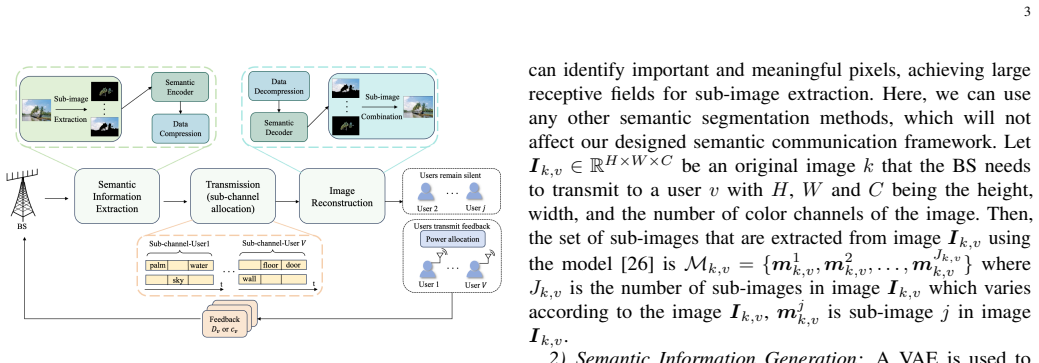
Existing semantic communication frameworks treat and transmit all image regions with equal importance, which is not practical for real-world applications which may prioritize different content in an image. To address this issue, we propose a novel semantic communication framework that enables a transmitter to use limited channel and content feedback to prioritize the transmission of important image regions. In particular, in the proposed framework, a base station (BS) divides each image into sub-images, extracts their semantic information, and transmits them to users according to their preferences. The users will reconstruct the image based on the received sub-images and cooperatively decide when to send channel state information (CSI) or content-preference feedback under dynamic channels and limited resources. We formulate an optimization problem to minimize the semantic-weighted mean square error between the original image and the regenerated image by optimizing sub-channel allocation, users' power allocation, and feedback selection. To address this problem, a value decomposition actor- critic (AC) with dynamic neighborhood construction (VDAC-DNC) scheme is proposed. The proposed method combines AC with value decomposition networks to allow the BS to approximate discrete actions by a continuous action distribution, thus reducing the output dimension and improving training efficiency. The introduced DNC method further improves training efficiency by constructing a small discrete neighboring action space to search for an action with the maximum Q value, thus avoiding traversing the large discrete action space. Simulation results show that the proposed VDAC-DNC scheme can improve the performance by up to 5.04% and 18.55% compared to the standard multi-agent QAC method and the proposed method without feedback transmission.
Figures


Reference graph
Works this paper leans on
-
[1]
Less data, more knowledge: Building next-generation semantic communication networks,
C. Chaccour, W. Saad, M. Debbah, Z. Han, and H. Poor, “Less data, more knowledge: Building next-generation semantic communication networks,” IEEE Commun. Surv. Tutor ., vol. 27, no. 1, pp. 37–76, Feb. 2025
2025
-
[2]
Cross-modal generative semantic communications for mobile aigc: Joint semantic encoding and prompt engineering,
Y . Liu, H. Du, D. Niyato, J. Kang, Z. Xiong, S. Mao, P. Zhang, and X. Shen, “Cross-modal generative semantic communications for mobile aigc: Joint semantic encoding and prompt engineering,”IEEE Trans. Mob. Comput., vol. 23, no. 12, pp. 14871–14888, Aug. 2024
2024
-
[3]
Task-oriented communications for nextg: End-to-end deep learning and AI security aspects,
Y . Sagduyu, S. Ulukus, and A. Yener, “Task-oriented communications for nextg: End-to-end deep learning and AI security aspects,”IEEE Wireless Commun., vol. 30, no. 3, pp. 52–60, Jun. 2023
2023
-
[4]
Task-oriented multi-user semantic communications for VQA,
H. Xie, Z. Qin, and G. Li, “Task-oriented multi-user semantic communications for VQA,”IEEE Wireless Commun. Lett., vol. 11, no. 3, pp. 553–557, Mar. 2022
2022
-
[5]
Semantic communication: A survey on research landscape, challenges, and future directions,
T. M. Getu, G. Kaddoum, and M. Bennis, “Semantic communication: A survey on research landscape, challenges, and future directions,”Proc. IEEE, vol. 112, no. 11, pp. 1649–1685, Nov. 2024
2024
-
[6]
Deep joint source-channel coding for wireless image transmission with adaptive rate control,
M. Yang and H. Kim, “Deep joint source-channel coding for wireless image transmission with adaptive rate control,” inProc. IEEE Int. Conf. Acoust., Speech, Signal Process. (ICASSP), Singapore, May 2022, pp. 5193–5197
2022
-
[7]
Semantic communications for image recovery and classification via deep joint source and channel coding,
Z. Lyu, G. Zhu, J. Xu, B. Ai, and S. Cui, “Semantic communications for image recovery and classification via deep joint source and channel coding,”IEEE Trans. Wireless Commun., vol. 23, no. 8, pp. 8388–8404, Jan. 2024
2024
-
[8]
Energy efficient multi-modal probabilistic semantic communication (PSCom),
J. Dai, J. Li, Z. Zhao, Z. Yang, Z. Zhang, and M. Shikh-Bahaei, “Energy efficient multi-modal probabilistic semantic communication (PSCom),” IEEE Trans. Green Commun. Netw., vol. 9, no. 4, pp. 1951–1963, Dec. 2025
1951
-
[9]
Predictive and adaptive deep coding for wireless image transmission in semantic communication,
W. Zhang, H. Zhang, H. Ma, H. Shao, N. Wang, and V . Leung, “Predictive and adaptive deep coding for wireless image transmission in semantic communication,”IEEE Trans. Wireless Commun., vol. 22, no. 8, pp. 5486–5501, Aug. 2023
2023
-
[10]
WITT: A wireless image transmission transformer for semantic communications,
K. Yang, S. Wang, J. Dai, K. Tan, K. Niu, and P. Zhang, “WITT: A wireless image transmission transformer for semantic communications,” inProc. IEEE Int. Conf. Acoust. Speech Signal Process. (ICASSP), Rhodes Island, Greece, Jun. 2023, pp. 1–5
2023
-
[11]
On the capacity region of the layered packet erasure broadcast channel with feedback,
S. Li, D. Tuninetti, and N. Devroye, “On the capacity region of the layered packet erasure broadcast channel with feedback,” inProc. IEEE Int. Conf. Commun. (ICC), Shanghai, China, May 2019, pp. 1–6
2019
-
[12]
On the stability region of the layered packet erasure broadcast channel with output feedback,
S. Li, H. Seferoglu, D. Tuninetti, and N. Devroye, “On the stability region of the layered packet erasure broadcast channel with output feedback,” inProc. IEEE Inf. Theory Workshop (ITW), Visby, Sweden, Aug. 2019, pp. 1–5
2019
-
[13]
SCAN: Semantic communication with adaptive channel feedback,
G. Zhang, Q. Hu, Y . Cai, and G. Yu, “SCAN: Semantic communication with adaptive channel feedback,”IEEE Trans. Cogn. Commun. Netw., vol. 10, no. 5, pp. 1759–1773, Oct. 2024
2024
-
[14]
Transformer-aided wireless image transmission with channel feedback,
H. Wu, Y . Shao, E. Ozfatura, K. Mikolajczyk, and D. Gündüz, “Transformer-aided wireless image transmission with channel feedback,” IEEE Trans. Wireless Commun., vol. 23, no. 9, pp. 11904–11919, Sep. 2024
2024
-
[15]
Adaptive wireless image semantic transmission: Design, simulation, and prototype validation,
J. Ding, P. Jiang, C. Wen, and S. Jin, “Adaptive wireless image semantic transmission: Design, simulation, and prototype validation,” 2024, [Online]. Available: https://arxiv.org/abs/2410.17536
Pith/arXiv arXiv 2024
-
[16]
Semantic segmentation-based semantic communication system for image transmission,
J. Wu, C. Wu, Y . Lin, T. Yoshinaga, L. Zhong, X. Chen, and Y . Ji, “Semantic segmentation-based semantic communication system for image transmission,”Digit. Commun. Netw., vol. 10, no. 3, pp. 519–527, Jun. 2024
2024
-
[17]
Quantization- aware collaborative inference for large embodied ai models,
Z. Lyu, M. Xiao, M. Skoglund, M. Debbah, and H. V . Poor, “Quantization- aware collaborative inference for large embodied ai models,” 2026, [Online]. Available: https://arxiv.org/abs/2602.13052
arXiv 2026
-
[18]
Covert UA V data transmission via semantic communication: A DRL-driven joint position and power optimization method,
R. Xu, G. Li, Z. Yang, J. Kang, X. Zhang, and J. Li, “Covert UA V data transmission via semantic communication: A DRL-driven joint position and power optimization method,” inProc. Int. Conf. Commun. China (ICCC), Hangzhou, China, Aug. 2024, pp. 66–71
2024
-
[19]
Performance optimization for semantic communications: An attention- based reinforcement learning approach,
Y . Wang, M. Chen, T. Luo, W. Saad, D. Niyato, H. V . Poor, and S. Cui, “Performance optimization for semantic communications: An attention- based reinforcement learning approach,”IEEE J. Select. Areas Commun., vol. 40, no. 9, pp. 2598–2613, Feb. 2022
2022
-
[20]
Optimization of image transmission in cooperative semantic communication networks,
W. Zhang, Y . Wang, M. Chen, T. Luo, and D. Niyato, “Optimization of image transmission in cooperative semantic communication networks,” IEEE Trans. Wireless Commun., vol. 23, no. 2, pp. 861–873, Feb. 2024
2024
-
[21]
Semantic-aware resource management for C-V2X platooning via multi-agent reinforcement learning,
W. Zhang, Q. Wu, P. Fan, K. Wang, N. Cheng, W. Chen, and K. B. Letaief, “Semantic-aware resource management for C-V2X platooning via multi-agent reinforcement learning,” 2025, [Online]. Available: https://arxiv.org/abs/2411.04672
Pith/arXiv arXiv 2025
-
[22]
Challenges of real-world reinforcement learning: definitions, benchmarks and analysis,
G. Dulac-Arnold et al., “Challenges of real-world reinforcement learning: definitions, benchmarks and analysis,”Mach. Learn., vol. 110, no. 9, pp. 2419–2468, Sep. 2021
2021
-
[23]
Value-decomposition networks for cooperative multi- agent learning based on team reward,
P. Sunehag et al., “Value-decomposition networks for cooperative multi- agent learning based on team reward,” inProc. Int. Conf. Auton. Agents Multiagent Syst., Stockholm, Sweden, Jul. 2018, pp. 2085–2087
2018
-
[24]
Multi- agent actor-critic for mixed cooperative-competitive environments,
R. Lowe, Y . Wu, A. Tamar, J. Harb, P. Abbeel, and I. Mordatch, “Multi- agent actor-critic for mixed cooperative-competitive environments,” in Proc. Neural Inf. Process. Syst. (NIPS), Long Beach, CA, USA, Dec. 2017, pp. 6382–6393
2017
-
[25]
High- resolution image synthesis with latent diffusion models,
R. Rombach, A. Blattmann, D. Lorenz, P. Esser, and B. Ommer, “High- resolution image synthesis with latent diffusion models,” inProc. IEEE/CVF Conf. Comput. Vis. Pattern Recognit. (CVPR), New Orleans, LA, USA, Jun. 2022, pp. 10684–10695
2022
-
[26]
InternImage: Exploring large-scale vision foundation models with deformable convolutions,
W. Wang et al., “InternImage: Exploring large-scale vision foundation models with deformable convolutions,” 2023, [Online]. Available: https://arxiv.org/abs/2211.05778. 14
Pith/arXiv arXiv 2023
-
[27]
Scaling up your kernels to 31×31: Revisiting large kernel design in CNNs,
X. Ding, X. Zhang, J. Han, and G. Ding, “Scaling up your kernels to 31×31: Revisiting large kernel design in CNNs,” inProc. IEEE/CVF Conf. Comput. Vis. Pattern Recognit. (CVPR), New Orleans, LA, USA, Jun. 2022, pp. 11953–11965
2022
-
[28]
Swin Transformer: Hierarchical vision transformer using shifted windows,
Z. Liu, Y . Lin, Y . Cao, H. Hu, Y . Wei, Z. Zhang, S. Lin, and B. Guo, “Swin Transformer: Hierarchical vision transformer using shifted windows,” in Proc. IEEE/CVF Int. Conf. Comput. Vis. (ICCV), Montreal, QC, Canada, Oct. 2021, pp. 9992–10002
2021
-
[29]
Tse and P
D. Tse and P. Viswanath,Fundamentals of Wireless Communication, Cambridge University Press, 2005
2005
-
[30]
Modeling and enhancement of the IEEE 802.11 RTS/CTS scheme in an error-prone channel,
M. Yazid, D. Aissani, L. Bouallouche-Medjkoune, N. Amrouche, and B. Kamel, “Modeling and enhancement of the IEEE 802.11 RTS/CTS scheme in an error-prone channel,”F orm. Asp. Comput., Jan. 2015
2015
-
[31]
A closer look at invalid action masking in policy gradient algorithms,
S. Huang and S. Ontañón, “A closer look at invalid action masking in policy gradient algorithms,” inProc. Int. FLAIRS Conf., Jensen Beach, FL, USA, May 2022
2022
-
[32]
Monotonic value function factorisation for deep multi- agent reinforcement learning,
T. Rashid et al., “Monotonic value function factorisation for deep multi- agent reinforcement learning,”J. Mach. Learn. Res., vol. 21, no. 178, pp. 1–51, 2020
2020
-
[33]
Kochenderfer and T
M. Kochenderfer and T. Wheeler,Algorithms for Optimization, MIT Press, Cambridge, MA, USA, 2019
2019
-
[34]
Counterfactual multi-agent policy gradients,
J. Foerster, G. Farquhar, T. Afouras, N. Nardelli, and S. Whiteson, “Counterfactual multi-agent policy gradients,” inProc. AAAI Conf. Artif. Intell., New Orleans, Louisiana, USA, Apr. 2018, vol. 32
2018
-
[35]
Policy gradient methods for reinforcement learning with function approximation,
R. S Sutton, D. A McAllester, S. P Singh, and Y . Mansour, “Policy gradient methods for reinforcement learning with function approximation,” inProc. Adv. Neural Inf. Process. Syst., Cambridge, MA, USA, Nov. 1999, pp. 1057–1063
1999
-
[36]
Learning adaptive jamming and beamforming for hybrid IRS-assisted secure NOMA transmissions,
D. Zhou, L. Li, S. Gong, B. Gu, G. Chen, and D. Niyato, “Learning adaptive jamming and beamforming for hybrid IRS-assisted secure NOMA transmissions,”IEEE Trans. Commun., vol. 73, no. 11, pp. 12235–12247, Nov. 2025
2025
-
[37]
Transformer- based collaborative reinforcement learning for fluid antenna system (FAS)-enabled 3D UA V positioning,
X. Xu, H. Xu, D. Wei, W. Saad, M. Bennis, and M. Chen, “Transformer- based collaborative reinforcement learning for fluid antenna system (FAS)-enabled 3D UA V positioning,”IEEE J. Select. Areas Commun., vol. 44, pp. 1128–1143, 2026
2026
-
[38]
Optimizing model splitting and device task assignment for deceptive signal-assisted private multi-hop split learning,
D. Wei, X. Xu, Y . Liu, H. V . Poor, and M. Chen, “Optimizing model splitting and device task assignment for deceptive signal-assisted private multi-hop split learning,”IEEE J. Select. Areas Commun., vol. 44, pp. 1512–1528, 2026
2026
-
[39]
Simulated annealing,
D. Bertsimas and J. N. Tsitsiklis, “Simulated annealing,”Statist. Sci., vol. 8, no. 1, pp. 10–15, Feb. 1993
1993
-
[40]
Multi- agent actor-critic for mixed cooperative-competitive environments,
R. Lowe, Y . Wu, A. Tamar, J. Harb, P. Abbeel, and I. Mordatch, “Multi- agent actor-critic for mixed cooperative-competitive environments,” in Proc. Adv. Neural Inf. Process. Syst. (NIPS), Long Beach, CA, USA, Dec. 2017, vol. 30, pp. 6382–6393
2017
-
[41]
Multi-agent reinforcement learning: Independent vs. cooperative agents,
M. Tan, “Multi-agent reinforcement learning: Independent vs. cooperative agents,” inProc. Int. Conf. Mach. Learn. (ICML), Amherst, MA, USA, Jun. 1993, pp. 330–337
1993
-
[42]
Resource allocation for semantic-aware net- works,
L. Yan et al., “Resource allocation for semantic-aware net- works,”arXiv preprint arXiv:2201.06023, 2022, [Online]. Available: https://arxiv.org/abs/2201.06023
Pith/arXiv arXiv 2022
discussion (0)
Sign in with ORCID, Apple, or X to comment. Anyone can read and Pith papers without signing in.