REVIEW 4 major objections 4 minor 86 references
Expert-guided agentic AI, run over roughly 124,000 sleep recordings, linked reduced N2 brain-to-brain coupling to later Parkinson's and Alzheimer's diagnoses (hazard ratios 1.48 and 1.38).
Reviewed by Pith at T0; open to challenge. T0 means a machine referee read the full paper against a public rubric. the ladder, T0–T4 →
T0 review · deepseek-v4-flash
2026-08-01 03:12 UTC pith:2T3MSGDC
load-bearing objection The agentic AI infrastructure is the real, honestly reported contribution; the headline PD/AD risk association is a single-cohort, reverse-causation-sensitive finding that the paper's own limitations section undercuts. the 4 major comments →
Agentic AI-enabled discovery across large-scale sleep physiology
The pith
A machine-rendered reading of the paper's core claim, the machinery that carries it, and where it could break.
Core claim
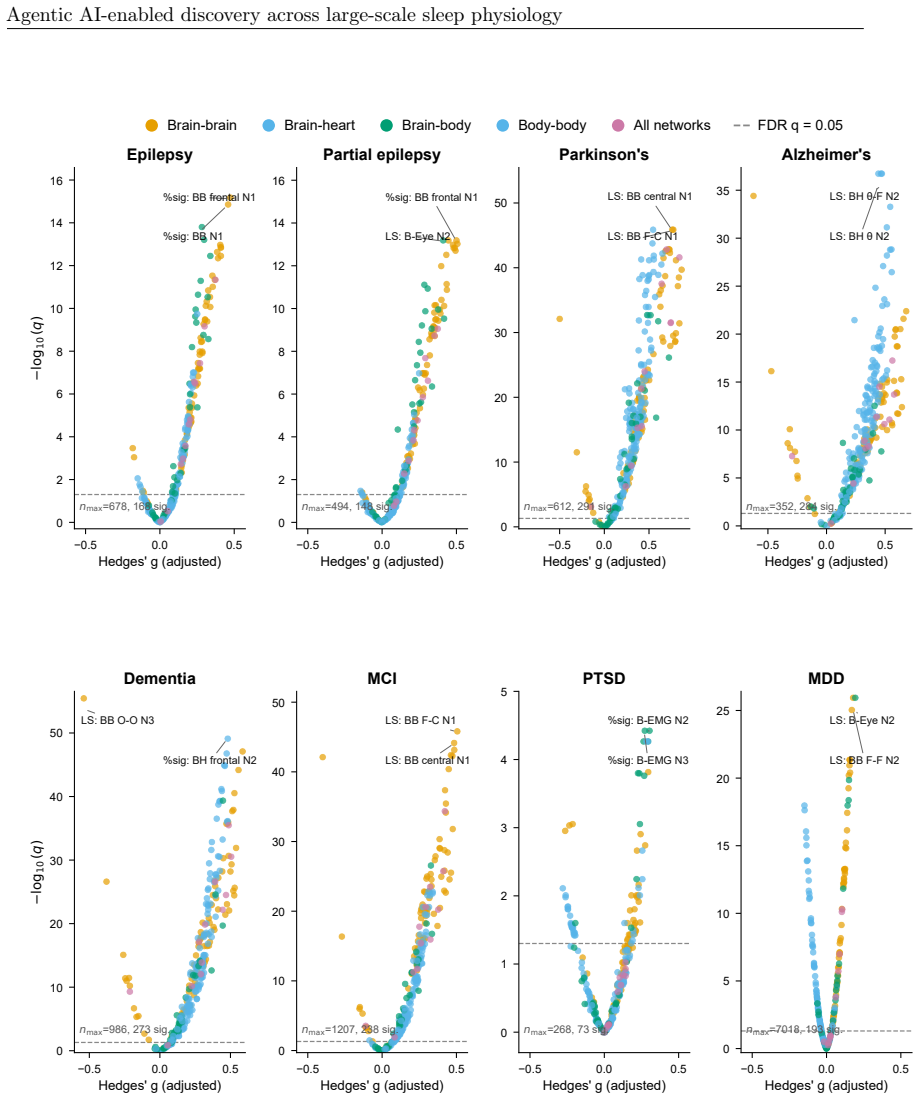
Central claim: an expert-guided agentic AI environment can turn cohort-scale polysomnography archives into auditable, code-verified discoveries. Its most consequential finding: a one-standard-deviation drop in N2 brain–brain coupling is associated with later Parkinson's (HR 1.48) and Alzheimer's (HR 1.38) diagnoses in a prospective analysis, with cross-sectional patterns replicating in an independent cohort. The same system yields late-fusion sleep-age clocks that beat early fusion, an OSA-skewed COMISA phenotype defined by post-arousal wakefulness, REM duration tracking preceding NREM over wake, and a frontal fast-sigma deficit with theta excess in narcolepsy type 1.
What carries the argument
The machinery is AI Sleep Co-Scientist: a conversational interface directing three specialist agents (Hypothesis, Preprocessing, Execution) over a shared read-only substrate of ~124,000 PSG recordings. Every reported number is bound to an executable script; canonical splits and expert approval gate irreversible steps. The disease-risk result uses time-delay stability (TDS): sliding-window cross-correlation marks a physiological link when the lag stays stable in >7% of windows, giving stage-specific brain–brain and brain–heart coupling networks. The ageing result uses late fusion: a ridge combination of seven interpretable domain clocks that beats unrestricted early fusion.
Load-bearing premise
The load-bearing premise is that the reduced N2 brain–brain coupling measured on a single night of PSG precedes the disease rather than reflecting prodromal pathology already present at baseline, and that EHR/PheCode-derived time-to-diagnosis is an unbiased incident-outcome measure — a premise tested prospectively in only one of the two cohorts behind the headline risk finding.
What would settle it
A landmark/lag analysis would settle it: restrict the Cox models to PSG recordings made at least five years before the first recorded Parkinson's or Alzheimer's diagnosis. If the per-SD hazard ratios for N2 brain–brain coupling fall toward 1.0 once the prodromal window is excluded, the claim that reduced coupling precedes disease by years collapses into reverse causation; if the HRs persist, the early-risk-marker claim survives. A complementary check is whether reduced N2 coupling also predicts non-neurodegenerative outcomes — if it does indiscriminately, the marker's specificity is weaker tha
If this is right
- N2 brain–brain coupling becomes a candidate early risk marker: a one-SD reduction is associated with 48% and 38% higher hazards of later Parkinson's and Alzheimer's diagnoses, with reduced brain–heart coupling adding an autonomic signal consistent with cardiac noradrenergic denervation in Parkinson's disease.
- Sleep ageing should be modeled as a multi-domain process, not a single global axis: the late-fusion residual's associations concentrate in cardiometabolic, renal, respiratory, and autonomic outcomes, and disease-specific reweighting of domain residuals did not improve discrimination.
- COMISA's distinguishing physiology lies in arousal recovery, not respiratory burden: longer post-arousal wakefulness and more irregular arousal organization separate it from OSA, pointing to impaired re-stabilization of sleep as the target for stratification.
- The NREM–REM architecture findings — bimodal inter-REM NREM duration with a valley preceding first N3, and REM-bout duration tracking NREM more strongly than wake — reproduce across large cohorts and persist under the disordered REM regulation of narcolepsy type 1, constraining models of REM homeostasis.
- The agentic workflow is itself a reusable discovery instrument: with expert steering and code-linked outputs, a ~50 TB archive supported five end-to-end studies, and the preserved collaboration trajectories are put forward as a resource for training future scientific-collaborator models.
Where Pith is reading between the lines
- The incidence analysis behind HR 1.48/1.38 comes from a single cohort; the independent cohort replicates the cross-sectional coupling differences but not the prospective outcome analysis, so the reproducibility of the lead-time effect itself rests on one site.
- Translating this marker into a screening instrument is not tested: time-delay stability needs full-bandwidth multichannel PSG, so a practical version would require an EEG-only or home-device surrogate for N2 coupling, and single-night recordings carry first-night effects the paper acknowledges.
- The paper's observation that long-horizon agent runs drift, and that restarting from a consolidated specification beats continued feedback, implies the bottleneck for wider automation is evaluating claim quality rather than generating hypotheses — consistent with its closing proposal to train future models on preserved collaboration trajectories.
- A natural next test the paper does not run is whether N2 coupling is modifiable: if the deficit responds to treatment of sleep apnoea or other interventions, the risk association could be examined as a surrogate endpoint in trials rather than only as an observational marker.
Editorial analysis
A structured set of objections, weighed in public.
Referee Report
Summary. The paper describes AI Sleep Co-Scientist, an expert-guided agentic system applied to roughly 124,000 PSG recordings across four cohorts, and reports five case studies. The system combines a conversational interface, hypothesis, preprocessing, and execution agents, with every reported number linked to an executable script and a shared read-only data substrate with canonical splits. The five case studies cover: (1) time-delay-stability (TDS) physiological coupling networks and incident Parkinson's and Alzheimer's disease risk; (2) a physiologically structured late-fusion sleep-age clock and its associations with prevalent and incident disease; (3) arousal dynamics in comorbid insomnia and sleep apnoea (COMISA); (4) inter-REM-interval NREM duration bimodality and REM-bout regulation; (5) transient-oscillation abnormalities in narcolepsy type 1. The most consequential claim is that reduced N2 brain-brain coupling is associated with incident PD (HR 1.48, 95% CI 1.31–1.67) and AD (HR 1.38, 95% CI 1.25–1.53) in the Stanford Sleep Clinic cohort. The paper presents extensive code-grounding, cohort-flow quality control, and independent reruns for some analyses, together with cross-site concordance for the coupling effect sizes.
Significance. If the reported findings were fully supported, this would be a useful demonstration that agentic AI can serve as an auditable discovery instrument for large, multimodal physiological archives, and the specific PD/AD coupling signal could be an early risk marker worth prospective study. The paper has concrete strengths: supplementary code traces for the headline HR and the sleep-age MAE, mechanical cohort-flow checks, read-only data mounts, and three independent reruns of the sleep-age study. These are real and should be preserved. However, the current evidence base is weaker than the abstract's wording suggests. The PD/AD hazard ratios come from a single clinical referral cohort with no external prospective replication; the sleep-age external validation is unstable across reruns (one rerun yields negative R² on HSP); and the COMISA hybrid-score shift is based on in-sample feature selection. These are load-bearing gaps that prevent the paper from supporting its strongest claims.
major comments (4)
- [Network-physiology coupling; Fig. 2e; Supplementary Fig. 8] The headline HRs for incident Parkinson's and Alzheimer's disease (1.48 and 1.38) are computed only in SSC. Figure 2e is labeled 'SSC prospective analysis,' and the code trace in Supplementary Figure 8 confirms an SSC-only analysis. HSP is used only for cross-sectional Hedges'g concordance (Fig. 2d), not for Cox models, even though the Methods state that HSP has linked EHR follow-up and the design text says SSC can serve as discovery and HSP as external validation. This is load-bearing: the paper's most consequential claim has no external prospective replication. Please report HSP Cox HRs, or state explicitly in the abstract and main text that the incident association was observed only in SSC. If HSP follow-up is not usable for these outcomes, say so and adjust the replication claims.
- [Network-physiology coupling; Cox models and Discussion] Even within SSC, excluding prevalent cases does not exclude reverse causation from prodromal disease. PD and AD pathology can alter sleep physiology years before clinical diagnosis, and PheCode-derived time-to-diagnosis in a referral cohort is subject to surveillance and diagnostic-delay bias. The Discussion acknowledges the analyses are retrospective and hypothesis-generating, but the abstract's 'associated with incident disease' statement overstates the support. Add a landmark or lag analysis excluding diagnoses within 1–2 years after PSG, or at minimum stratify by time since PSG, and discuss the direction-of-effect ambiguity explicitly in the results section.
- [Sleep-ageing study; Supplementary Table 5] The main text claims the late-fusion model 'generalized better' to HSP (MAE 8.83 vs. 9.52, R²=0.494). Supplementary Table 5 reports three independent reruns from the same high-level prompt with HSP MAEs of 13.20, 8.51, and 11.46 years and R² of −0.12, 0.53, and 0.10. One rerun has a negative external R², meaning the model is worse than predicting the mean age. This is an internal inconsistency: the main-text generalization claim is not stable across the paper's own reruns. Report the full rerun distribution in the main text and temper the generalization claim, or provide a concrete explanation for why the original run is preferred.
- [COMISA hybrid score; Fig. 4c,d] The hybrid score is constructed by selecting the 15 features with the largest group effects in the same dataset and then testing whether the COMISA mean differs from 0.5 (p<10^-300). In-sample feature selection biases both the centroid positions and the resulting p-value; this is not a valid test of population-level OSA-skew. The pairwise AUCs appear to be properly validated and are not the problem, but the 'OSA-skewed continuum' claim in Fig. 4d currently rests on a biased procedure. Use nested feature selection (e.g., select features within training folds and evaluate on held-out test data) or explicitly label the hybrid score as a descriptive, in-sample index rather than a hypothesis test.
minor comments (4)
- [Fig. 2 caption] The 'Discovery + replication' label in Fig. 2a could be read as prospective replication. Clarify that HSP is used for cross-sectional effect-size replication, not for incident-outcome replication.
- [REM-sleep regulation; Fig. 5c,d] The claim that the Ns valley 'closely precedes' the first N3 epoch is based on the median time-to-first-N3; state this explicitly in the text so readers do not interpret it as a per-IRI distributional claim. The causal language 'putative inhibition window' is appropriately hedged, but the figure caption should avoid implying a direct temporal sequence from a cross-sectional coincidence.
- [Methods; TDS quality filter] Table 3 shows that 1,836 SSC subjects were excluded by the TDS feature-loading quality filter. The criteria of this filter are not described in the Methods. Add a sentence specifying what 'TDS feature-loading quality filter' means (e.g., missing channels, failed feature extraction) so readers can assess whether it could introduce selection bias.
- [Abstract and Discussion] The Discussion's limitations paragraph already states that the analyses are retrospective, hypothesis-generating, and based on precomputed features. This is appropriate, but the abstract should be aligned with that language; currently the abstract presents the PD/AD HRs and the sleep-age generalization without the caveats that the Discussion itself requires.
Circularity Check
No material circularity: reported associations are data-driven regressions on precomputed features, with held-out and cross-cohort evaluation.
full rationale
The paper's derivation chain does not reduce any central claimed result to its own inputs. The PD/AD hazard ratios (Fig. 2e) are fitted from TDS coupling features and EHR-derived time-to-event data; the feature definition (7% stable-link threshold) and the outcome are independent quantities, so the HR is not true by construction. The sleep-age residual is trained on chronological age, then frozen and evaluated for disease associations on a held-out SSC test set and externally in HSP; the disease regression is a separate analysis, not a renamed fit. The COMISA hybrid score uses in-sample feature selection, but the reported OSA-skewed mean is an empirical summary of distances to pre-fitted centroids rather than a tautology. Self-citations appear as background context (e.g., SleepFM, Stanford Sleep Bench) or as cohort sources (HSP, CDH), and none is invoked as a uniqueness proof or as the sole justification of a central claim. The paper explicitly labels the analyses retrospective and hypothesis-generating; the single-cohort SSC prospective HR and the absence of a prodromal reverse-causation control are validity/replication limitations, not circularity.
Axiom & Free-Parameter Ledger
free parameters (3)
- COMISA hybrid-score feature count k =
15
- REM short/long bout thresholds =
short REM <= 5 min, long REM >= 10 min
- AHI <= 50 standardization subset =
AHI <= 50
axioms (7)
- domain assumption EHR/PheCode diagnosis dates represent unbiased incident disease events
- domain assumption Single-night in-laboratory PSG approximates habitual sleep traits
- domain assumption Automated PSG detectors (U-Sleep, MAD, ABED, DynamO, YASA) are sufficiently valid in these cohorts
- domain assumption TDS stable-link threshold of 7% defines meaningful physiological coupling
- standard math Two-component Gaussian mixture on log10(Ns) is appropriate for detecting bimodality
- ad hoc to paper Direction consistency across channels is evidence of a real signal
- ad hoc to paper Only findings that reproduced across agent branches are reported
read the original abstract
Sleep occupies roughly one-third of human life, yet many aspects of its physiology remain poorly understood. Large polysomnography (PSG) datasets offer new opportunities to study sleep and its links to disease, but extracting insight from these recordings requires substantial expert effort and remains difficult for general-purpose AI systems. We developed AI Sleep Co-Scientist, an expert-guided environment in which human scientists direct specialist agents for hypothesis development, signal preprocessing, and statistical analysis, reviewing intermediate outputs. Each reported result is linked to the executable code that produced it. Across four cohorts of approximately 124,000 PSG recordings and more than 50 TB of raw signals, we conducted five case studies spanning how sleep physiology relates to future disease, how it distinguishes clinical phenotypes, and how sleep is organized and regulated. Diminished network-level physiological coupling during sleep was associated with incident Parkinson's disease (HR 1.48) and Alzheimer's disease (HR 1.38). A physiologically structured late-fusion sleep-age model outperformed an unconstrained early-fusion approach, and its age residual was associated with incident disease across multiple organ systems. Arousal dynamics characterized comorbid insomnia and sleep apnoea as an intermediate phenotype skewed towards obstructive sleep apnoea, distinguished by prolonged post-arousal wakefulness. Rapid eye movement (REM) bout duration tracked preceding non-REM sleep more closely than intervening wakefulness. Transient-oscillation analysis identified a fast-sigma deficit and excess centrofrontal theta activity in narcolepsy type 1. Together, these findings connect sleep to disease risk, clinical classification, and its own regulation, and show how agentic AI can support large-scale, multimodal discovery.
Figures




Reference graph
Works this paper leans on
-
[1]
Sleep duration and all-cause mortality: a systematic review and meta-analysis of prospective studies.Sleep, 33(5):585–592, 2010
Francesco P Cappuccio, Lanfranco D’Elia, Pasquale Strazzullo, and Michelle A Miller. Sleep duration and all-cause mortality: a systematic review and meta-analysis of prospective studies.Sleep, 33(5):585–592, 2010
2010
-
[2]
A meta-analysis of the impact of short-term sleep deprivation on cognitive variables.Psychological bulletin, 136(3):375, 2010
Julian Lim and David F Dinges. A meta-analysis of the impact of short-term sleep deprivation on cognitive variables.Psychological bulletin, 136(3):375, 2010
2010
-
[3]
Is sleep essential?PLoS biology, 6(8):e216, 2008
Chiara Cirelli and Giulio Tononi. Is sleep essential?PLoS biology, 6(8):e216, 2008
2008
-
[4]
Physiological correlates of prolonged sleep deprivation in rats.Science, 221(4606):182–184, 1983
Allan Rechtschaffen, Marcia A Gilliland, Bernard M Bergmann, and Jacqueline B Winter. Physiological correlates of prolonged sleep deprivation in rats.Science, 221(4606):182–184, 1983
1983
-
[5]
Simon and Schuster, 2017
Matthew Walker.Why we sleep: Unlocking the power of sleep and dreams. Simon and Schuster, 2017
2017
-
[6]
Richard B Berry, Rita Brooks, Charlene E Gamaldo, Susan M Harding, Carole Marcus, Bradley V Vaughn, et al. The AASM manual for the scoring of sleep and associated events.Rules, Terminology and Technical Specifications, Darien, Illinois, American Academy of Sleep Medicine, 176(2012):7, 2012
2012
-
[7]
CAISR: achieving human-level performance in automated sleep analysis across all clinical sleep metrics.Sleep, 48(8):zsaf134, 2025
Samaneh Nasiri, Wolfgang Ganglberger, Thijs Nassi, Erik-Jan Meulenbrugge, Valdery Moura Junior, Manohar Ghanta, Aditya Gupta, Katie L Stone, Magnus Ruud Kjaer, Oliver Sum-Ping, et al. CAISR: achieving human-level performance in automated sleep analysis across all clinical sleep metrics.Sleep, 48(8):zsaf134, 2025
2025
-
[8]
Rahul Thapa, Bryan He, Magnus Ruud Kjær, Hyatt Moore, Gauri Ganjoo, Emmanuel Mignot, and James Zou. SleepFM: multi-modal representation learning for sleep across brain activity, ECG and respiratory signals.arXiv preprint arXiv:2405.17766, 2024
Pith/arXiv arXiv 2024
-
[9]
A multimodal sleep foundation model for disease prediction.Nature Medicine, pages 1–11, 2026
Rahul Thapa, Magnus Ruud Kjaer, Bryan He, Ian Covert, Hyatt Moore IV, Umaer Hanif, Gauri Ganjoo, M Brandon Westover, Poul Jennum, Andreas Brink-Kjaer, et al. A multimodal sleep foundation model for disease prediction.Nature Medicine, pages 1–11, 2026
2026
-
[10]
Magnus Ruud Kjaer, Rahul Thapa, Gauri Ganjoo, Hyatt Moore IV, Poul Joergen Jennum, Bran- don M Westover, James Zou, Emmanuel Mignot, Bryan He, and Andreas Brink-Kjaer. Stanford Sleep Bench: Evaluating polysomnography pre-training methods for sleep foundation models.arXiv preprint arXiv:2512.09591, 2025
arXiv 2025
-
[11]
SleepLM: Natural-language intelligence for human sleep.arXiv preprint arXiv:2602.23605, 2026
Zongzhe Xu, Zitao Shuai, Eideen Mozaffari, Ravi S Aysola, Rajesh Kumar, and Yuzhe Yang. SleepLM: Natural-language intelligence for human sleep.arXiv preprint arXiv:2602.23605, 2026
Pith/arXiv arXiv 2026
-
[12]
Autonomous chemical research with large language models.Nature, 624(7992):570–578, 2023
Daniil A Boiko, Robert MacKnight, Ben Kline, and Gabe Gomes. Autonomous chemical research with large language models.Nature, 624(7992):570–578, 2023
2023
-
[13]
Towards end-to-end automation of AI research.Nature, 651(8107):914–919, 2026
Chris Lu, Cong Lu, Robert Tjarko Lange, Yutaro Yamada, Shengran Hu, Jakob Foerster, David Ha, and Jeff Clune. Towards end-to-end automation of AI research.Nature, 651(8107):914–919, 2026
2026
-
[14]
Kosmos: An AI scientist for autonomous discovery.arXiv preprint arXiv:2511.02824, 2025
Ludovico Mitchener, Angela Yiu, Benjamin Chang, Mathieu Bourdenx, Tyler Nadolski, Arvis Sulovari, Eric C Landsness, Daniel L Barabasi, Siddharth Narayanan, Nicky Evans, et al. Kosmos: An AI scientist for autonomous discovery.arXiv preprint arXiv:2511.02824, 2025
Pith/arXiv arXiv 2025
-
[15]
Autonomous biomedical research with an artificial intelligence agent
Kexin Huang, Serena Zhang, Hanchen Wang, Yuanhao Qu, Yingzhou Lu, Ryan Li, Yusuf Roohani, Lin Qiu, Shiyi Cao, Gavin Li, et al. Autonomous biomedical research with an artificial intelligence agent. Science, page eadz4351, 2026
2026
-
[16]
Ai-researcher: Autonomous scientific innovation.Advances in Neural Information Processing Systems, 38:9481–9520, 2026
Jiabin Tang, Lianghao Xia, Zhonghang Li, and Chao Huang. Ai-researcher: Autonomous scientific innovation.Advances in Neural Information Processing Systems, 38:9481–9520, 2026
2026
-
[17]
Eubiota: Modular agentic AI for autonomous discovery in the gut microbiome.bioRxiv, pages 2026–02, 2026
Pan Lu, Yifan Gao, William G Peng, Haoxiang Zhang, Kunlun Zhu, Elektra K Robinson, Qixin Xu, Masakazu Kotaka, Harrison G Zhang, Bingxuan Li, et al. Eubiota: Modular agentic AI for autonomous discovery in the gut microbiome.bioRxiv, pages 2026–02, 2026
2026
-
[18]
The virtual biotech: A multi-agent AI framework for therapeutic discovery and development.bioRxiv, pages 2026–02, 2026
Harrison G Zhang, Peter Eckmann, Jiacheng Miao, Andrew B Mahon, and James Zou. The virtual biotech: A multi-agent AI framework for therapeutic discovery and development.bioRxiv, pages 2026–02, 2026
2026
-
[19]
Alexander Novikov, Ngân V˜ u, Marvin Eisenberger, Emilien Dupont, Po-Sen Huang, Adam Zsolt Wagner, Sergey Shirobokov, Borislav Kozlovskii, Francisco JR Ruiz, Abbas Mehrabian, et al. Alphaevolve: A coding agent for scientific and algorithmic discovery.arXiv preprint arXiv:2506.13131, 2025
Pith/arXiv arXiv 2025
-
[20]
Accelerating scientific discovery with Co-Scientist.Nature, pages 1–3, 2026
Juraj Gottweis, Wei-Hung Weng, Alexander Daryin, Tao Tu, Petar Sirkovic, Artiom Myaskovsky, Grzegorz Glowaty, Felix Weissenberger, Alessio Orlandi, Dan Popovici, et al. Accelerating scientific discovery with Co-Scientist.Nature, pages 1–3, 2026. 23 Agentic AI-enabled discovery across large-scale sleep physiology
2026
-
[21]
Empowering biomedical discovery with AI agents.Cell, 187(22):6125–6151, 2024
Shanghua Gao, Ada Fang, Yepeng Huang, Valentina Giunchiglia, Ayush Noori, Jonathan Richard Schwarz, Yasha Ektefaie, Jovana Kondic, and Marinka Zitnik. Empowering biomedical discovery with AI agents.Cell, 187(22):6125–6151, 2024
2024
-
[22]
Autonomous LLM-driven research—from data to human-verifiable research papers.NEJM AI, 2(1):AIoa2400555, 2025
Tal Ifargan, Lukas Hafner, Maor Kern, Ori Alcalay, and Roy Kishony. Autonomous LLM-driven research—from data to human-verifiable research papers.NEJM AI, 2(1):AIoa2400555, 2025
2025
-
[23]
The Virtual Lab of AI agents designs new SARS-CoV-2 nanobodies.Nature, 646(8085):716–723, 2025
Kyle Swanson, Wesley Wu, Nash L Bulaong, John E Pak, and James Zou. The Virtual Lab of AI agents designs new SARS-CoV-2 nanobodies.Nature, 646(8085):716–723, 2025
2025
-
[24]
Qichen Li, Shenghan Wen, Haoqi Sun, Wolfgang Ganglberger, Ayush Tripathi, Niels Turley, Samuel Waters, Arnav Gupta, Aditya Gupta, Manohar Ghanta, Bruce Nearing, Han Wu, Katie L. Stone, Chad Robichaux, Zhiyong Zhang, Qiao Li, Gauri Ganjoo, Christine Tsien Silvers, Bharath Gunapati, Kiran Maski, Samaneh Nasiri, Dennis Hwang, Lynn Marie Trotti, Umakanth Katw...
2026
-
[25]
Automatic detection of chronic insomnia from polysomnographic and clinical variables using machine learning
Umaer Hanif, Ulysse Gimenez, Alyssa Cairns, Daniel Lewin, Nisar Ashraf, and Emmanuel Mignot. Automatic detection of chronic insomnia from polysomnographic and clinical variables using machine learning. In2023 45th Annual International Conference of the IEEE Engineering in Medicine & Biology Society (EMBC), pages 1–5. IEEE, 2023
2023
-
[26]
Associations between self-reported parasomnias and psychiatric illness in 370,000 patients with sleep disorders.Psychiatry and Clinical Neurosciences, 78(11):667–677, 2024
Umaer Hanif, Alyssa Cairns, Vincent Mysliwiec, Ruggero G Bettinardi, Maxime Elbaz, Ulysse Gimenez, and Emmanuel JM Mignot. Associations between self-reported parasomnias and psychiatric illness in 370,000 patients with sleep disorders.Psychiatry and Clinical Neurosciences, 78(11):667–677, 2024
2024
-
[27]
The use of the odds ratio product and self-reported data to detect comorbid insomnia and sleep apnea.SLEEPJ, 49(2):zsaf198, 2026
Umaer Hanif, Veronica Guadagni, Kari Lambing, Ulysse Gimenez, Poul Jennum, Alexander Sweetman, and Vincent Mysliwiec. The use of the odds ratio product and self-reported data to detect comorbid insomnia and sleep apnea.SLEEPJ, 49(2):zsaf198, 2026
2026
-
[28]
Stephansen, Alexander N
Jens B. Stephansen, Alexander N. Olesen, Mads Olsen, Aditya Ambati, Eileen B. Leary, Hyatt E. Moore, Oscar Carrillo, Ling Lin, Fang Han, Han Yan, Yun L. Sun, Yves Dauvilliers, Sabine Scholz, Lucie Barateau, Birgit Hogl, Ambra Stefani, Seung Chul Hong, Tae Won Kim, Fabio Pizza, Giuseppe Plazzi, Stefano Vandi, Elena Antelmi, Dimitri Perrin, Samuel T. Kuna, ...
2018
-
[29]
The National Sleep Research Resource: towards a sleep data commons.Journal of the American Medical Informatics Association, 25(10):1351–1358, 2018
Guo-Qiang Zhang, Licong Cui, Remo Mueller, Shiqiang Tao, Matthew Kim, Michael Rueschman, Sara Mariani, Daniel Mobley, and Susan Redline. The National Sleep Research Resource: towards a sleep data commons.Journal of the American Medical Informatics Association, 25(10):1351–1358, 2018
2018
-
[30]
U-Sleep: resilient high-frequency sleep staging.NPJ digital medicine, 4(1):72, 2021
Mathias Perslev, Sune Darkner, Lykke Kempfner, Miki Nikolic, Poul Jørgen Jennum, and Christian Igel. U-Sleep: resilient high-frequency sleep staging.NPJ digital medicine, 4(1):72, 2021
2021
-
[31]
Automatic detection of cortical arousals in sleep and their contribution to daytime sleepiness.Clinical Neurophysiology, 131(6):1187–1203, 2020
Andreas Brink-Kjaer, Alexander Neergaard Olesen, Paul E Peppard, Katie L Stone, Poul Jennum, Emmanuel Mignot, and Helge BD Sorensen. Automatic detection of cortical arousals in sleep and their contribution to daytime sleepiness.Clinical Neurophysiology, 131(6):1187–1203, 2020
2020
-
[32]
Expert-level probabilistic breathing event detector informs phenotyping of sleep apnea.Nature Communications, 2026
Magnus Ruud Kjaer, Umaer Hanif, Andreas Brink-Kjaer, Mads Olsen, Oliver Sum-Ping, Oscar Carrillo, Scott A Sands, Susan Redline, Katie L Stone, Poul Jennum, et al. Expert-level probabilistic breathing event detector informs phenotyping of sleep apnea.Nature Communications, 2026
2026
-
[33]
Transient oscillation dynamics during sleep provide a robust basis for electroencephalographic phenotyping and biomarker identification.Sleep, 46(1):zsac223, 2023
Patrick A Stokes, Preetish Rath, Thomas Possidente, Mingjian He, Shaun Purcell, Dara S Manoach, Robert Stickgold, and Michael J Prerau. Transient oscillation dynamics during sleep provide a robust basis for electroencephalographic phenotyping and biomarker identification.Sleep, 46(1):zsac223, 2023
2023
-
[34]
Saibene, M
M. Saibene, M. Ballegaard, Y. Gu, et al. A continuous network physiology analysis of brain–heart interactions in epileptic seizures.Scientific Reports, July 2026. Published 10 July 2026
2026
-
[35]
An open-source, high-performance tool for automated sleep staging.eLife, 10:e70092, 2021
Raphael Vallat and Matthew P Walker. An open-source, high-performance tool for automated sleep staging.eLife, 10:e70092, 2021
2021
-
[36]
Network physiology reveals relations between network topology and physiological function.Nature communications, 3(1):702, 2012
Amir Bashan, Ronny P Bartsch, Jan W Kantelhardt, Shlomo Havlin, and Plamen Ch Ivanov. Network physiology reveals relations between network topology and physiological function.Nature communications, 3(1):702, 2012
2012
-
[37]
Chronic heart failure detection based on long-term RR interval dynamics.Journal of Electrocardiology, 97:154242, 2026
Teemu Pukkila, Topi Niemi, and Esa Räsänen. Chronic heart failure detection based on long-term RR interval dynamics.Journal of Electrocardiology, 97:154242, 2026. 24 Agentic AI-enabled discovery across large-scale sleep physiology
2026
-
[38]
Diego Candia-Rivera, Marie Vidailhet, Mario Chavez, and Fabrizio De Vico Fallani. A framework for quantifying the coupling between brain connectivity and heartbeat dynamics: Insights into the disrupted network physiology in Parkinson’s disease.Human Brain Mapping, 45(5):e26668, 2024
2024
-
[39]
Age estimation from sleep studies using deep learning predicts life expectancy.NPJ digital medicine, 5(1):103, 2022
Andreas Brink-Kjaer, Eileen B Leary, Haoqi Sun, M Brandon Westover, Katie L Stone, Paul E Peppard, Nancy E Lane, Peggy M Cawthon, Susan Redline, Poul Jennum, et al. Age estimation from sleep studies using deep learning predicts life expectancy.NPJ digital medicine, 5(1):103, 2022
2022
-
[40]
Brain age from the electroencephalogram of sleep.Neurobiology of aging, 74:112–120, 2019
Haoqi Sun, Luis Paixao, Jefferson T Oliva, Balaji Goparaju, Diego Z Carvalho, Kicky G van Leeuwen, Oluwaseun Akeju, Robert J Thomas, Sydney S Cash, Matt T Bianchi, et al. Brain age from the electroencephalogram of sleep.Neurobiology of aging, 74:112–120, 2019
2019
-
[41]
Machine learning–based sleep electroencephalographic brain age index and dementia risk: an individual participant data meta-analysis
Haoqi Sun, Sasha Milton, Yi Fang, Hash Brown Taha, Shreya Shiju, Robert J Thomas, Wolfgang Ganglberger, Matthew P Pase, Timothy Hughes, Shaun Purcell, et al. Machine learning–based sleep electroencephalographic brain age index and dementia risk: an individual participant data meta-analysis. JAMA Network Open, 9(3):e261521, 2026
2026
-
[42]
Decoding information about cognitive health from the brainwaves of sleep.Scientific Reports, 13(1):11448, 2023
Noor Adra, Lisa W Dümmer, Luis Paixao, Ryan A Tesh, Haoqi Sun, Wolfgang Ganglberger, Mike Westmeijer, Madalena Da Silva Cardoso, Anagha Kumar, Elissa Ye, et al. Decoding information about cognitive health from the brainwaves of sleep.Scientific Reports, 13(1):11448, 2023
2023
-
[43]
Hallmarks of aging: An expanding universe.Cell, 186:243–278, 1 2023
Carlos López-Otín, Maria A Blasco, Linda Partridge, Manuel Serrano, and Guido Kroemer. Hallmarks of aging: An expanding universe.Cell, 186:243–278, 1 2023
2023
-
[44]
American Academy of Sleep Medicine, Darien, IL, 3 edition, 2014
International classification of sleep disorders. American Academy of Sleep Medicine, Darien, IL, 3 edition, 2014
2014
-
[45]
Developing a successful treatment for co-morbid insomnia and sleep apnoea.Sleep medicine reviews, 33:28–38, 2017
Alexander M Sweetman, Leon C Lack, Peter G Catcheside, Nick A Antic, Ching Li Chai-Coetzer, Simon S Smith, James A Douglas, and R Doug McEvoy. Developing a successful treatment for co-morbid insomnia and sleep apnoea.Sleep medicine reviews, 33:28–38, 2017
2017
-
[46]
Alexander Sweetman, Seamas Farrell, Douglas M Wallace, and Megan Crawford. The effect of cognitive behavioural therapy for insomnia in people with comorbid insomnia and sleep apnoea: A systematic review and meta-analysis.Journal of Sleep Research, 32(6):e13847, 2023
2023
-
[47]
The association of co-morbid insomnia and sleep apnea with prevalent cardiovascular disease and incident cardiovascular events.Journal of sleep research, 31(5):e13563, 2022
Bastien Lechat, Sarah Appleton, Yohannes Adama Melaku, Kristy Hansen, R Doug McEvoy, Robert Adams, Peter Catcheside, Leon Lack, Danny J Eckert, and Alexander Sweetman. The association of co-morbid insomnia and sleep apnea with prevalent cardiovascular disease and incident cardiovascular events.Journal of sleep research, 31(5):e13563, 2022
2022
-
[48]
Bi-directional relationships between co-morbid insomnia and sleep apnea (COMISA).Sleep medicine reviews, 60:101519, 2021
Alexander Sweetman, Leon Lack, R Doug McEvoy, Simon Smith, Danny J Eckert, Amal Osman, Jayne C Carberry, Douglas Wallace, Phuc D Nguyen, and Peter Catcheside. Bi-directional relationships between co-morbid insomnia and sleep apnea (COMISA).Sleep medicine reviews, 60:101519, 2021
2021
-
[49]
Obstructive sleep apnea is a distinct physiological endotype in individuals with comorbid insomnia and sleep apnea.Annals of the American Thoracic Society, 20(10):1508–1515, 2023
Elliot J Brooker, Shane A Landry, Luke DJ Thomson, Garun S Hamilton, Pedro R Genta, Sean PA Drummond, and Bradley A Edwards. Obstructive sleep apnea is a distinct physiological endotype in individuals with comorbid insomnia and sleep apnea.Annals of the American Thoracic Society, 20(10):1508–1515, 2023
2023
-
[50]
Respiratory arousal threshold among patients with isolated sleep apnea and with comorbid insomnia (COMISA).Scientific reports, 13(1):7638, 2023
Marcela Yanagimori, Mariana D Fernandes, Michelle L Garcia, Paula G Scudeller, Carlos RR Carvalho, Bradley Edwards, Geraldo Lorenzi-Filho, and Pedro R Genta. Respiratory arousal threshold among patients with isolated sleep apnea and with comorbid insomnia (COMISA).Scientific reports, 13(1):7638, 2023
2023
-
[51]
Physiopathological correlations of comorbid insomnia and sleep apnoea (COMISA)–a systematic review and meta-analysis.Sleep and Breathing, 30(2):101, 2026
Ervin Cotrik, Janete Hernandes, Viviane Castro, and Edilson Zancanella. Physiopathological correlations of comorbid insomnia and sleep apnoea (COMISA)–a systematic review and meta-analysis.Sleep and Breathing, 30(2):101, 2026
2026
-
[52]
Dynamic coupling between the central and autonomic nervous systems during sleep: a review.Neuroscience & Biobehavioral Reviews, 90:84–103, 2018
Massimiliano de Zambotti, John Trinder, Alessandro Silvani, Ian M Colrain, and Fiona C Baker. Dynamic coupling between the central and autonomic nervous systems during sleep: a review.Neuroscience & Biobehavioral Reviews, 90:84–103, 2018
2018
-
[53]
Sleep changes in the disorder of insomnia: a meta-analysis of polysomnographic studies.Sleep medicine reviews, 18(3):195–213, 2014
Chiara Baglioni, Wolfram Regen, Armand Teghen, Kai Spiegelhalder, Bernd Feige, Christoph Nissen, and Dieter Riemann. Sleep changes in the disorder of insomnia: a meta-analysis of polysomnographic studies.Sleep medicine reviews, 18(3):195–213, 2014
2014
-
[54]
Reconsidering sleep perception in insomnia: from misperception to mismeasurement.Journal of sleep research, 32(6):e14028, 2023
Aurélie M Stephan and Francesca Siclari. Reconsidering sleep perception in insomnia: from misperception to mismeasurement.Journal of sleep research, 32(6):e14028, 2023. 25 Agentic AI-enabled discovery across large-scale sleep physiology
2023
-
[55]
Heart rate response to cortical arousals in patients with isolated obstructive sleep apnea and with comorbid insomnia (COMISA).Sleep and Breathing, 28(2):735–744, 2024
Bernice M Wulterkens, Lieke WA Hermans, Pedro Fonseca, Hennie CJP Janssen, Pauline V van Hirtum, Sebastiaan Overeem, and Merel M van Gilst. Heart rate response to cortical arousals in patients with isolated obstructive sleep apnea and with comorbid insomnia (COMISA).Sleep and Breathing, 28(2):735–744, 2024
2024
-
[56]
Interactions between insomnia and obstructive sleep apnea.medRxiv, pages 2026–07, 2026
Yanyuan Dai, Yun Li, Elisabeth Heremans, Ulysse Gimenez, Umaer Hanif, and Emmanuel Mignot. Interactions between insomnia and obstructive sleep apnea.medRxiv, pages 2026–07, 2026
2026
-
[57]
Sleep homeostasis and models of sleep regulation.Journal of biological rhythms, 14(6):559–570, 1999
Alexander A Borb and Peter Achermann. Sleep homeostasis and models of sleep regulation.Journal of biological rhythms, 14(6):559–570, 1999
1999
-
[58]
A unified mathematical model to quantify performance impairment for both chronic sleep restriction and total sleep deprivation.Journal of theoretical biology, 331:66–77, 2013
Pooja Rajdev, David Thorsley, Srinivasan Rajaraman, Tracy L Rupp, Nancy J Wesensten, Thomas J Balkin, and Jaques Reifman. A unified mathematical model to quantify performance impairment for both chronic sleep restriction and total sleep deprivation.Journal of theoretical biology, 331:66–77, 2013
2013
-
[59]
Revisiting brain gene expression changes and protein modifications tracking homeostatic sleep pressure.npj Biological Timing and Sleep, 2(1):30, 2025
Valérie Mongrain, Marcos G Frank, and Tanya Leduc. Revisiting brain gene expression changes and protein modifications tracking homeostatic sleep pressure.npj Biological Timing and Sleep, 2(1):30, 2025
2025
-
[60]
Neural and homeostatic regulation of REM sleep.Frontiers in psychology, 11:1662, 2020
Sung-Ho Park and Franz Weber. Neural and homeostatic regulation of REM sleep.Frontiers in psychology, 11:1662, 2020
2020
-
[61]
JOEL H Benington and H Craig Heller. REM-sleep timing is controlled homeostatically by accumulation of REM-sleep propensity in non-REM sleep.American Journal of Physiology-Regulatory, Integrative and Comparative Physiology, 266(6):R1992–R2000, 1994
1994
-
[62]
Does the function of REM sleep concern non-REM sleep or waking?Progress in neurobiology, 44(5):433–449, 1994
Joel H Benington and H Craig Heller. Does the function of REM sleep concern non-REM sleep or waking?Progress in neurobiology, 44(5):433–449, 1994
1994
-
[63]
Homeostasis of REM sleep after total and selective sleep deprivation in the rat.Journal of Neurophysiology, 84(5):2699–2702, 2000
Adrián Ocampo-Garcés, Enrique Molina, Alberto Rodríguez, and Ennio A Vivaldi. Homeostasis of REM sleep after total and selective sleep deprivation in the rat.Journal of Neurophysiology, 84(5):2699–2702, 2000
2000
-
[64]
Long-term vs
Paul Franken. Long-term vs. short-term processes regulating REM sleep.Journal of sleep research, 11(1):17–28, 2002
2002
-
[65]
Circadian andhomeostatic controlof rapideye movement(REM)sleep: promotion of REM tendency by the suprachiasmatic nucleus.Journal of Neuroscience, 20(11):4300–4310, 2000
Sarah WWurts andDale M Edgar. Circadian andhomeostatic controlof rapideye movement(REM)sleep: promotion of REM tendency by the suprachiasmatic nucleus.Journal of Neuroscience, 20(11):4300–4310, 2000
2000
-
[66]
A predictive propensity measure to enter REM sleep.Frontiers in Neuroscience, 18:1431407, 2024
Alexander G Ginsberg, Madelyn Esther C Cruz, Franz Weber, Victoria Booth, and Cecilia G Diniz Behn. A predictive propensity measure to enter REM sleep.Frontiers in Neuroscience, 18:1431407, 2024
2024
-
[67]
Naghmeh Akhavan, Alexander G Ginsberg, Madelyn EC Cruz, Yunxi Yan, Shelby R Stowe, Dinesh Pal, Franz Weber, Cecilia G Diniz Behn, and Victoria Booth. A data-driven measure of REM sleep propensity for human and rodent sleep.arXiv preprint arXiv:2604.01252, 2026
arXiv 2026
-
[68]
Elicitation of sleep-onset REM periods in normal individuals using the sleep interruption technique (SIT).Sleep Medicine, 3(6):479–488, 2002
Tomoka Takeuchi, Kazuhiko Fukuda, and Timothy I Murphy. Elicitation of sleep-onset REM periods in normal individuals using the sleep interruption technique (SIT).Sleep Medicine, 3(6):479–488, 2002
2002
-
[69]
Effects of sleep interruption on body temperature in human subjects.Sleep, 16(5):478–483, 1993
Y Sasaki, A Miyasita, T Takeuchi, M Inugami, K Fukuda, and K Ishihara. Effects of sleep interruption on body temperature in human subjects.Sleep, 16(5):478–483, 1993
1993
-
[70]
Sleep problems in narcolepsy and the role of hypocretin/orexin deficiency
Emmanuel Mignot, Jamie Zeitzer, Fabio Pizza, and Giuseppe Plazzi. Sleep problems in narcolepsy and the role of hypocretin/orexin deficiency. InFrontiers of Neurology and Neuroscience. S. Karger AG, 2021
2021
-
[71]
’SleepCycles’ package for R – a free software tool for the detection of sleep cycles from sleep staging.MethodsX, 8:101318, 2021
Christine Blume and Christian Cajochen. ’SleepCycles’ package for R – a free software tool for the detection of sleep cycles from sleep staging.MethodsX, 8:101318, 2021
2021
-
[72]
An asymmetrical hypothesis for the NREM-REM sleep alternation—what is the NREM-REM cycle?Frontiers in Neuroscience, 15:627193, 2021
Olivier Le Bon. An asymmetrical hypothesis for the NREM-REM sleep alternation—what is the NREM-REM cycle?Frontiers in Neuroscience, 15:627193, 2021
2021
-
[73]
A probabilistic model for the ultradian timing of REM sleep in mice.PLoS computational biology, 17(8):e1009316, 2021
Sung-Ho Park, Justin Baik, Jiso Hong, Hanna Antila, Benjamin Kurland, Shinjae Chung, and Franz Weber. A probabilistic model for the ultradian timing of REM sleep in mice.PLoS computational biology, 17(8):e1009316, 2021
2021
-
[74]
Homeostatic regulation of REM sleep in humans during extended sleep.Sleep, 21(3):267–276, 1998
Giuseppe Barbato and Thomas A Wehr. Homeostatic regulation of REM sleep in humans during extended sleep.Sleep, 21(3):267–276, 1998
1998
-
[75]
Vivaldi, and Adrián Ocampo-Garcés
Alejandro Bassi, Ennio A. Vivaldi, and Adrián Ocampo-Garcés. The time course of the probability of transition into and out of REM sleep.Sleep, 32(5):655–669, 2009. 26 Agentic AI-enabled discovery across large-scale sleep physiology
2009
-
[76]
REM sleep-dependent short-term and long-term hourglass processes in the ultradian organization and recovery of REM sleep in the rat.Sleep, 43(8):zsaa023, 2020
Adrián Ocampo-Garcés, Alejandro Bassi, Enzo Brunetti, Jorge Estrada, and Ennio A Vivaldi. REM sleep-dependent short-term and long-term hourglass processes in the ultradian organization and recovery of REM sleep in the rat.Sleep, 43(8):zsaa023, 2020
2020
-
[77]
Hilaire, James K Wyatt, Frank AJL Scheer, Kenneth P Wright Jr, Emery N Brown, Joseph M Ronda, et al
Wei Wang, Robin K Yuan, Jude F Mitchell, Kirsi-Marja Zitting, Melissa A St. Hilaire, James K Wyatt, Frank AJL Scheer, Kenneth P Wright Jr, Emery N Brown, Joseph M Ronda, et al. Desynchronizing the sleep–wake cycle from circadian timing to assess their separate contributions to physiology and behaviour and to estimate intrinsic circadian period.Nature prot...
2023
-
[78]
Tanya Dimitrov, Mingjian He, Robert Stickgold, and Michael J. Prerau. Sleep spindles comprise a subset of a broader class of electroencephalogram events.Sleep, 44(9):zsab099, 2021
2021
-
[79]
Sleep state switching.Neuron, 68(6):1023–1042, 2010
Clifford B Saper, Patrick M Fuller, Nigel P Pedersen, Jun Lu, and Thomas E Scammell. Sleep state switching.Neuron, 68(6):1023–1042, 2010
2010
-
[80]
Deficiency of orexin signaling during sleep is involved in abnormal REM sleep architecture in narcolepsy.Proceedings of the National Academy of Sciences, 120(42):e2301951120, 2023
Hiroto Ito and Akihiro Yamanaka. Deficiency of orexin signaling during sleep is involved in abnormal REM sleep architecture in narcolepsy.Proceedings of the National Academy of Sciences, 120(42):e2301951120, 2023
2023
discussion (0)
Sign in with ORCID, Apple, or X to comment. Anyone can read and Pith papers without signing in.