REVIEW 3 major objections 6 minor 58 references
Hyperspectral Intrinsic Decomposition: Joint Recovery of Reflectance and Photometric Components for Non-Lambertian Scenes
T0 review · 3 major / 6 minor · reviewed 2026-08-01 · deepseek-v4-flash
Pith's one-line read Hyperspectral intrinsic decomposition in non-Lambertian scenes can be reduced to estimating two spectral–spatial variables, with illuminant, shading, and specularity derived in closed form, making complete blind decomposition from one image
desk verdict A solid non-Lambertian HID framework with a genuinely useful dataset, but the quantitative leaderboard is built on synthetic data from the authors' own generator and the reflectance scale-ambiguity claim in Sec. VI-B is analytically wrong. read the letter →
The pith
A machine-rendered reading of the paper's core claim, the machinery that carries it, and where it could break.
The reading
What carries the argument
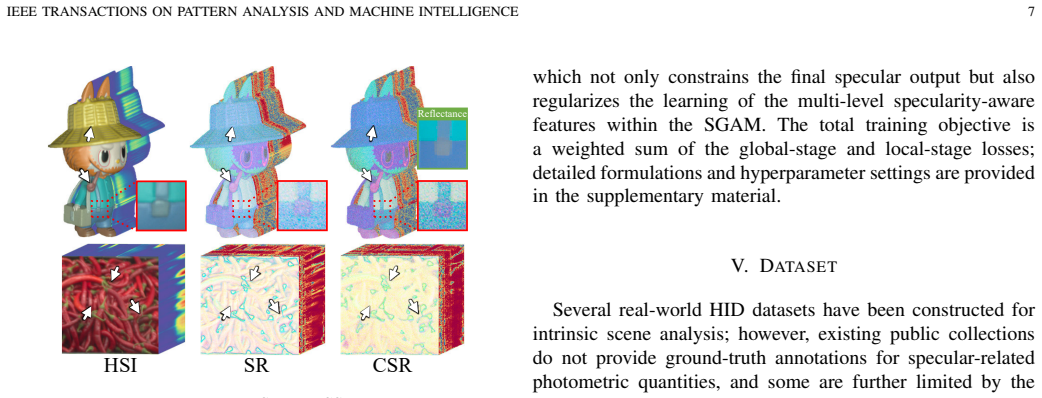
The load-bearing identity is the two-variable inversion of the dichromatic reflection model: with P_d(u,λ)=g(u)L(λ)P_r(u,λ) and P_s=I−P_d, the four coupled components are re-expressed as two spectral–spatial targets, and closed-form averaging gives the illuminant spectrum, shading factor, and specular coefficient. Two derived photometrically invariant descriptors carry the global stage: the Spectral-Gradient Ratio (SR), which suppresses illuminant and specular terms while retaining shading-modulated reflectance differences, and the Cross Spectral-Gradient Ratio (CSR), which depends only on reflectance; they are injected as boundary priors aligned to the diffuse and reflectance subnetworks. T
What would settle it
Acquire a set of real objects with the same cross-polarization measurement protocol used to build the paper's dataset, but under illuminants and specular configurations outside the synthetic generator's sampling pools, compute pixel-wise ground truth for reflectance, shading, and specular coefficient, and check whether DichroicFormer's roughly 5–13× MSE advantages over the baselines persist; if the margins vanish, the synthetic training distribution—not the inversion math—is doing the work.
Extended reading notes
Core claim
Under the neutral-interface dichromatic reflection model, an observed hyperspectral pixel is I(u,λ)=g(u)L(λ)S(u,λ)+k(u)L(λ). The key algebraic observation is that defining the diffuse term P_d=gL S and keeping reflectance P_r=S turns the image into I=P_d+P_s, so the specular term is just I−P_d. Estimating the two spectral–spatial targets P_d and P_r therefore determines the full factorization: the illuminant spectrum is recovered by spatially averaging P_d/P_r plus P_s with peak normalization, and the shading factor and specular coefficient are recovered by spectral averaging. This reduction removes the dimensional mismatch that forced earlier methods to estimate components separately, and t
Load-bearing premise
The quantitative results rest on the assumption that the paper's synthetic training-and-test renderer—a simple linear mixture of diffuse and specular terms followed by clipping—faithfully captures real imaging, since real-capture evaluation is only qualitative.
Editorial extensions
If this is right
- A single hyperspectral image, without depth, multi-view, or controlled illumination hardware, can in principle yield a complete dichromatic decomposition: reflectance, shading, specular coefficient, and illuminant spectrum.
- Because the illuminant, shading, and specular coefficient are derived rather than predicted, their relative scales are automatically consistent with the image formation model, which is why the paper introduces shared-scale rs-MSE metrics.
- Decoupling the specular output from the analytic I−P_d path allows the method to handle saturated and clipped specular highlights without letting clipping corrupt the diffuse estimate.
- The synthetic generator's independent control over illuminant spectra and diffuse–specular balance enables training and testing under conditions real captures cannot exhaust, while the new real-world annotations provide a reference for non-Lambertian evaluation.
- The two-variable reformulation is not network-specific: any estimator of P_d and P_r inherits the closed-form recovery of the photometric components.
Reading between the lines
- If the inversion reduction is as domain-simplifying as it appears, the same P_d/P_r parametrization could be applied to RGB or multispectral intrinsic decomposition, since the closed-form steps are wavelength-agnostic; this is an extension the paper does not claim.
- The large gap between si-MSE and rs-MSE for the baselines suggests that per-component scale alignment has been systematically hiding relative-scale errors; adopting shared-scale metrics more widely in intrinsic imaging would likely re-rank existing methods—an editorial inference, not a paper claim.
- The SR/CSR descriptors assume high spectral sampling density so the illuminant is locally flat; a natural stress test is whether performance degrades gracefully on coarse-band or strongly peaked-illuminant sensors, which the paper leaves to future work.
- The generator's independent control over diffuse and specular scaling could be used to map robustness curves, such as error versus specular fraction or clipping severity, giving practitioners a principled way to choose acquisition exposure settings.
Signed reviews
Editorial analysis
A structured set of objections, weighed in public.
Referee Report
Summary. The paper proposes DichroicFormer, a single-image hyperspectral intrinsic decomposition method for non-Lambertian scenes under the dichromatic reflection model (DRM). The core idea is to reformulate the recovery of four coupled components (reflectance, shading factor, specular coefficient, illuminant spectrum) as estimation of two spectral–spatial variables: the diffuse term P_d and the reflectance P_r. Illuminant L, shading g, and specular coefficient k are then derived in closed form. The architecture is a dual-scale network with a global-stage invariant-driven module using spectral-gradient ratios and a local-stage specularity-guided attention module. The paper also introduces the CITE real-world dataset with component-level annotations and the PISG synthetic generator. Quantitative evaluation on PISG-generated test pairs is claimed to show state-of-the-art performance under both scale-invariant and scale-coupled metrics, with qualitative results on CITE and KAUST real HSIs.
Significance. If the claims hold, the paper makes several valuable contributions: a useful algebraic reduction of DRM inversion, a new public dataset (CITE), a controllable physically motivated generator (PISG), and a carefully ablated architecture. The closed-form derivations for L, g, and k are parameter-free and transparent, and the dual-scale design with photometrically invariant descriptors is well motivated. The ablations are internally consistent and isolate contributions of the proposed modules. However, the paper's central quantitative claim is weakened by two issues: the absolute reflectance metric is gauge-dependent because of a genuine scale ambiguity in the DRM, and all quantitative results are obtained on PISG-synthesized test images rather than on real captures. These issues do not necessarily invalidate the method, but they require correction or additional evidence before the claimed state-of-the-art performance can be accepted.
major comments (3)
- [Sec. VI-B, Eq. (1)] The statement "For reflectance, which admits no scale ambiguity under the joint constraint, we report absolute MSE and SSIM" is analytically incorrect under the DRM. In Eq. (1), the transformation g(u) -> alpha g(u), S(u,lambda) -> S(u,lambda)/alpha leaves I(u,lambda) unchanged for any alpha>0, with L and k untouched. This is an exact symmetry of the image-formation model. The closed-form inversion in Eqs. (4)-(5) preserves this ambiguity rather than removing it. Consequently, absolute MSE for reflectance depends on the gauge in which each method happens to output S, and the large gap in Table I (0.007 vs 0.189) may substantially reflect gauge alignment of the learned estimator to the PISG training convention rather than physical decomposition fidelity. The authors should either adopt a canonical gauge (e.g., normalize each predicted reflectance by a fixed scalar) and apply it to all met
- [Secs. V-B, VI-A, VI-C; Eq. (16)] All quantitative results in Tables I-III are produced on PISG-generated test pairs: "the PISG generates 240 test pairs from the held-out objects" (Sec. VI-A), using the same DRM-plus-clipping synthesis model (Eq. (16)) as the training distribution. Real CITE captures are evaluated only qualitatively (Sec. VI-D.1, VI-D.2), and the KAUST experiment is also qualitative. Thus the central SOTA claim is not yet supported by evidence on real sensor data, where noise, misalignment, polarizer imperfections, and deviations from the DRM may substantially change performance. I recommend adding a quantitative evaluation on real CITE images using the component annotations obtained from Eq. (15), or explicitly redrawing the quantitative claims to the synthetic distribution. At minimum, the paper should report how the PISG test distribution relates to the real CITE captures (e.g., how much clipping, noi
- [Sec. IV-C; Eq. (3)] The paper replaces the analytic relation P_s = I - P_d with a learned specular prediction P_L_s from SGAM, and the two are decoupled: "the analytic pathway ties the final specular output directly to the diffuse estimate" and the specular branch is independently supervised and detached. This means the final outputs do not have to satisfy P_L_d + P_L_s = I, so the closed-form derivations of L, g, and k in Eqs. (4)-(5), which assume a consistent P_s, may not be anchored to the observed image. The recomposition panels in Fig. 8 are visual only. I recommend reporting a quantitative recomposition error, e.g., ||I - (P_L_d + P_L_s)||, on the test set and on real captures, and stating explicitly whether the derived photometric components are required to satisfy the DRM exactly or only approximately.
minor comments (6)
- [Sec. IV-A] The notation "P^G_d = I + R^G_s" appears inconsistent with the standard relation P_d = I - P_s. If R^G_s is a negative specular residual, this should be stated; otherwise the sign convention is confusing.
- [Sec. V-A, Eq. (15)] The expression "R = I_perp ⊙ R_coat / I_coat" mixes element-wise multiplication and division in an ambiguous way. Please use explicit element-wise division or bracket notation.
- [Sec. IV-B, Eqs. (9)-(12)] The approximation rho_1 ≈ rho_2 ≈ 1 is justified by a small spectral sampling interval. Since the paper subsamples to 36 bands over 440-700 nm, the effective interval is roughly 7-8 nm. Please state whether the SR/CSR approximation was validated at this subsampled resolution, or whether the descriptors are computed on the full 80-band data before subsampling.
- [Sec. VI-A] The training illuminant pool is described as containing 30 spectra, while the test set uses five illuminant spectra. Please clarify whether these five are seen during training or are held-out, and how they were selected.
- [Sec. VI-C] The sentence "DichroicFormer achieves the best performance on every evaluated component under both metric families" is too strong given the gauge-dependence of the absolute MSE metric. Please qualify it in view of the scale ambiguity discussed above.
- [General] Several formal analyses are deferred to the Supplementary Material, including the formal argument about scale relationships. Since the main text makes strong claims about scale ambiguity, the key statement should at least be summarized in the main text or the supplementary material should be provided with the submission.
Circularity Check
No circular derivation; the closed-form inversion formulas are algebraic identities from the DRM
full rationale
The central inversion paradigm (Eqs. 2-5) is a reparameterization, not a circular prediction: P_d and P_r are defined as gLS and S, and L, g, k are then obtained by algebraic manipulation of P_d, P_r, P_s, with P_s = I - P_d. No target quantity is fed back into the definitions; the network's actual job is to estimate the two spectral-spatial target variables, after which the remaining components are computed in closed form. The SR/CSR descriptors are derived from the DRM and used only as conditioning priors, not as supervised targets, so they do not smuggle in the output. The quantitative test uses PISG-generated pairs from the same generative equation (Eq. 16) as the training distribution, which is a data-distribution limitation rather than a circular step; held-out objects and unseen illuminant/config combinations still make this a legitimate within-distribution benchmark, and the external KAUST results are qualitative only. The claim that reflectance has no scale ambiguity under the joint constraint is analytically questionable, since g -> αg and S -> S/α leave Eq. 1 invariant, making the absolute-MSE metric gauge-sensitive; however, this is a metric-validity concern, not a reduction of the derivation to its inputs. Self-citations in the related work are not load-bearing for the proposed derivation.
Assumptions & free parameters
free parameters (3)
- PISG diffuse scaling range a =
sampled uniformly from [0.65, 0.85]
- PISG specular scaling range b =
sampled uniformly from [0.5, 1.1]
- Spectral band selection =
36 bands from 80 (440-700 nm), short-wavelength end below 450 nm discarded
assumptions (5)
- domain assumption Dichromatic reflection model with neutral interface reflection and a single illuminant spectral distribution (Eq. 1).
- domain assumption Illuminant spectrum is approximately constant over adjacent spectral channels (rho1 ≈ rho2 ≈ 1), making the residual epsilon in Eq. (11) negligible.
- domain assumption Cross-polarization capture fully suppresses specular reflection and the lacquer coating provides a uniform reference reflectance, so Eq. (15) yields ground-truth R, g, k.
- domain assumption PISG-synthesized images (Eqs. 16-17) are representative of real non-Lambertian captures.
- domain assumption The learned network can infer the non-unique decomposition from a single image given supervised training.
Cite this review
Pith. "Pith review of Hyperspectral Intrinsic Decomposition: Joint Recovery of Reflectance and Photometric Components for Non-Lambertian Scenes." pith.science (2026). https://pith.science/paper/BY57RIT3
@misc{pith2026260725371,
  author       = {Pith},
  title        = {Pith review of: Hyperspectral Intrinsic Decomposition: Joint Recovery of Reflectance and Photometric Components for Non-Lambertian Scenes},
  year         = {2026},
  howpublished = {\url{https://pith.science/paper/BY57RIT3}},
  note         = {Machine review of arXiv:2607.25371}
}
read the original abstract
Hyperspectral intrinsic decomposition (HID) aims to disentangle material-related spectral properties and photometric effects in hyperspectral images (HSIs), which is essential for understanding real-world imaging processes and benefits a variety of downstream applications. Most existing HID studies have been developed under Lambertian or near-Lambertian assumptions. The few prior non-Lambertian efforts rely on simplified specular assumptions insufficient to handle diverse real-world specularity, and typically require auxiliary inputs or recover only a subset of the coupled reflectance and photometric components, hindering complete and blind decomposition. In this paper, we revisit the dichromatic reflection model (DRM) and develop a unified inversion paradigm that reformulates the recovery of four coupled reflectance and photometric components as the estimation of two spectral--spatial target variables. Building on this reformulation, we propose a dual-scale decomposition scheme to handle non-Lambertian effects with distinct spatial characteristics. At the global scale, photometrically invariant descriptors serve as edge priors for high-fidelity intrinsic boundary preservation; at the local scale, specularity-guided attention directs refinement with emphasis on specularity-dominated regions, including those affected by clipping distortion. To facilitate future research, we establish CITE, the first public real-world HID dataset for non-Lambertian objects, and develop a Physically-faithful Intrinsic Set Generator (PISG) for controllable data synthesis. Extensive ablation studies and experiments on the CITE and additional HSIs demonstrate the effectiveness of our method and its robustness across diverse scenes.
Figures


Figures from the paper (7 more)


Reference graph
Works this paper leans on
-
[1]
Aperture diffraction for compact snapshot spectral imaging,
T. Lv, H. Ye, Q. Yuan, Z. Shi, Y . Wang, S. Wang, and X. Cao, “Aperture diffraction for compact snapshot spectral imaging,” inProceedings of the IEEE/CVF International Conference on Computer Vision, 2023, pp. 10 574–10 584
2023
-
[2]
Compact self-adaptive coding for spectral compressive sensing,
Z. Shi, H. Ye, T. Lv, Y . Wang, and X. Cao, “Compact self-adaptive coding for spectral compressive sensing,” in2023 IEEE International Conference on Computational Photography (ICCP). IEEE, 2023, pp. 1–12
2023
-
[3]
Evaluation of prospect inversion approaches using multi-angular spectral reflectance factor of leaves,
C. Yao, Z. Sun, and S. Lu, “Evaluation of prospect inversion approaches using multi-angular spectral reflectance factor of leaves,”IEEE Trans- actions on Geoscience and Remote Sensing, 2024
2024
-
[4]
Decomposing multispectral face images into diffuse and specular shading and biophysical parameters,
S. Alotaibi and W. A. Smith, “Decomposing multispectral face images into diffuse and specular shading and biophysical parameters,” in2019 IEEE International Conference on Image Processing (ICIP). IEEE, 2019, pp. 3138–3142
2019
-
[5]
Multispectral illumination estimation using deep unrolling network,
Y . Li, Q. Fu, and W. Heidrich, “Multispectral illumination estimation using deep unrolling network,” inProceedings of the IEEE/CVF inter- national conference on computer vision, 2021, pp. 2672–2681
2021
-
[6]
Multispectral photometric stereo for acquiring high-fidelity surface normals,
G. Nam and M. H. Kim, “Multispectral photometric stereo for acquiring high-fidelity surface normals,”IEEE computer graphics and applica- tions, vol. 34, no. 6, pp. 57–68, 2014
2014
-
[7]
Intrinsic decomposition from a single spectral image,
X. Chen, W. Zhu, Y . Zhao, Y . Yu, Y . Zhou, T. Yue, S. Du, and X. Cao, “Intrinsic decomposition from a single spectral image,”Applied optics, vol. 56, no. 20, pp. 5676–5684, 2017
2017
-
[8]
Multispectral image intrinsic decomposition via subspace constraint,
Q. Huang, W. Zhu, Y . Zhao, L. Chen, Y . Wang, T. Yue, and X. Cao, “Multispectral image intrinsic decomposition via subspace constraint,” inProceedings of the IEEE Conference on Computer Vision and Pattern Recognition, 2018, pp. 6430–6439
2018
Show all 58 references
-
[9]
Optimal solution of the dichromatic model for multispectral photometric invariance,
C. P. Huynh and A. Robles-Kelly, “Optimal solution of the dichromatic model for multispectral photometric invariance,” inStructural, Syntactic, and Statistical Pattern Recognition: Joint IAPR International Workshop, SSPR & SPR 2008, Orlando, USA, December 4-6, 2008. Proceeding...
2008
-
[10]
A solution of the dichromatic model for multispectral photometric invariance,
——, “A solution of the dichromatic model for multispectral photometric invariance,”International Journal of Computer Vision, vol. 90, no. 1, pp. 1–27, 2010
2010
-
[11]
Efficient estimation of reflectance parameters from imaging spectroscopy,
L. Gu, A. A. Robles-Kelly, and J. Zhou, “Efficient estimation of reflectance parameters from imaging spectroscopy,”IEEE Transactions on Image Processing, vol. 22, no. 9, pp. 3648–3663, 2013
2013
-
[12]
Shape, illumination, and reflectance from shading,
J. T. Barron and J. Malik, “Shape, illumination, and reflectance from shading,”IEEE transactions on pattern analysis and machine intelli- gence, vol. 37, no. 8, pp. 1670–1687, 2014
2014
-
[13]
Intrinsic rgb and multispectral images recovery by independent quadratic programming,
A. Krebs, Y . Benezeth, and F. Marzani, “Intrinsic rgb and multispectral images recovery by independent quadratic programming,”PeerJ Com- puter Science, vol. 6, p. e256, 2020
2020
-
[14]
Using color to separate reflection components,
S. A. Shafer, “Using color to separate reflection components,”Color Research & Application, vol. 10, no. 4, pp. 210–218, 1985
1985
-
[15]
A benchmark dataset and evaluation for non-lambertian and uncalibrated photometric stereo,
B. Shi, Z. Wu, Z. Mo, D. Duan, S.-K. Yeung, and P. Tan, “A benchmark dataset and evaluation for non-lambertian and uncalibrated photometric stereo,” inProceedings of the IEEE conference on computer vision and pattern recognition, 2016, pp. 3707–3716
2016
-
[16]
Towards high-resolution specular highlight detection,
G. Fu, Q. Zhang, L. Zhu, Q. Lin, Y . Wang, S. Fan, and C. Xiao, “Towards high-resolution specular highlight detection,”International Journal of Computer Vision, vol. 132, no. 1, pp. 95–117, 2024
2024
-
[17]
Estimating reflectance parameters of an object from saturated spectral images,
S. Li, Y . Manabe, and K. Chihara, “Estimating reflectance parameters of an object from saturated spectral images,” inInternational Conference on Computer Graphics, Imaging and Visualisation (CGIV’06). IEEE, 2006, pp. 335–340
2006
-
[18]
Saturated signals in spectroscopic imaging: why and how should we deal with this regularly observed phenomenon?
A. Nardecchia, V . Motto-Ros, and L. Duponchel, “Saturated signals in spectroscopic imaging: why and how should we deal with this regularly observed phenomenon?”Analytica Chimica Acta, vol. 1157, p. 338389, 2021
2021
-
[19]
Recovering intrinsic scene characteristics,
H. Barrow, J. Tenenbaum, A. Hanson, and E. Riseman, “Recovering intrinsic scene characteristics,”Comput. vis. syst, vol. 2, no. 3-26, p. 2, 1978
1978
-
[20]
Lightness and retinex theory,
E. H. Land and J. J. McCann, “Lightness and retinex theory,”Josa, vol. 61, no. 1, pp. 1–11, 1971
1971
-
[21]
Deriving intrinsic images from image sequences,
Y . Weiss, “Deriving intrinsic images from image sequences,” inPro- ceedings Eighth IEEE International Conference on Computer Vision. ICCV 2001, vol. 2. IEEE, 2001, pp. 68–75
2001
-
[22]
Re- covering intrinsic images with a global sparsity prior on reflectance,
C. Rother, M. Kiefel, L. Zhang, B. Sch ¨olkopf, and P. Gehler, “Re- covering intrinsic images with a global sparsity prior on reflectance,” Advances in neural information processing systems, vol. 24, 2011
2011
-
[23]
Towards high-quality intrinsic images in the wild,
G. Fu, Q. Zhang, and C. Xiao, “Towards high-quality intrinsic images in the wild,” in2019 IEEE International Conference on Multimedia and Expo (ICME). IEEE, 2019, pp. 175–180
2019
-
[24]
A closed-form solution to retinex with nonlocal texture constraints,
Q. Zhao, P. Tan, Q. Dai, L. Shen, E. Wu, and S. Lin, “A closed-form solution to retinex with nonlocal texture constraints,”IEEE transactions on pattern analysis and machine intelligence, vol. 34, no. 7, pp. 1437– 1444, 2012
2012
-
[25]
Intrinsic image decomposition using a sparse representation of reflectance,
L. Shen, C. Yeo, and B.-S. Hua, “Intrinsic image decomposition using a sparse representation of reflectance,”IEEE transactions on pattern analysis and machine intelligence, vol. 35, no. 12, pp. 2904–2915, 2013
2013
-
[26]
Intrinsic image decomposition with non- local texture cues,
L. Shen, P. Tan, and S. Lin, “Intrinsic image decomposition with non- local texture cues,” in2008 IEEE Conference on Computer Vision and Pattern Recognition. IEEE, 2008, pp. 1–7
2008
-
[27]
Single image layer separation using relative smoothness,
Y . Li and M. S. Brown, “Single image layer separation using relative smoothness,” inProceedings of the IEEE conference on computer vision and pattern recognition, 2014, pp. 2752–2759
2014
-
[28]
An l 1 image transform for edge-preserving smoothing and scene-level intrinsic decomposition,
S. Bi, X. Han, and Y . Yu, “An l 1 image transform for edge-preserving smoothing and scene-level intrinsic decomposition,”ACM Transactions on Graphics (TOG), vol. 34, no. 4, pp. 1–12, 2015
2015
-
[29]
Intrinsic image decom- position with step and drift shading separation,
B. Sheng, P. Li, Y . Jin, P. Tan, and T.-Y . Lee, “Intrinsic image decom- position with step and drift shading separation,”IEEE Transactions on Visualization and Computer Graphics, vol. 26, no. 2, pp. 1332–1346, 2018
2018
-
[30]
Direct intrinsics: Learning albedo- shading decomposition by convolutional regression,
T. Narihira, M. Maire, and S. X. Yu, “Direct intrinsics: Learning albedo- shading decomposition by convolutional regression,” inProceedings of the IEEE international conference on computer vision, 2015, pp. 2992– 2992
2015
-
[31]
Enhancing intrinsic image decomposition with transformer and laplacian pyramid network
J. Liu, Y . Ma, X. Meng, S. Zhang, Z. Liu, and Y . Song, “Enhancing intrinsic image decomposition with transformer and laplacian pyramid network.”Traitement du Signal, vol. 41, no. 1, 2024
2024
-
[32]
Intrinsic image transformation via scale space decomposition,
L. Cheng, C. Zhang, and Z. Liao, “Intrinsic image transformation via scale space decomposition,” inProceedings of the IEEE conference on computer vision and pattern recognition, 2018, pp. 656–665
2018
-
[33]
Crefnet: Learning consis- tent reflectance estimation with a decoder-sharing transformer,
J. Luo, N. Zhao, W. Li, and C. Richardt, “Crefnet: Learning consis- tent reflectance estimation with a decoder-sharing transformer,”IEEE Transactions on Visualization and Computer Graphics, vol. 30, no. 9, pp. 6407–6420, 2023
2023
-
[34]
Self-supervised intrinsic image decomposition,
M. Janner, J. Wu, T. D. Kulkarni, I. Yildirim, and J. Tenenbaum, “Self-supervised intrinsic image decomposition,”Advances in neural information processing systems, vol. 30, 2017
2017
-
[35]
Unsupervised learning for intrinsic image decomposition from a single image,
Y . Liu, Y . Li, S. You, and F. Lu, “Unsupervised learning for intrinsic image decomposition from a single image,” inProceedings of the IEEE/CVF conference on computer vision and pattern recognition, 2020, pp. 3248–3257
2020
-
[36]
Eyeir: Single eye image inverse rendering in the wild,
S. Liang, H. Wang, and F. Lu, “Eyeir: Single eye image inverse rendering in the wild,” inACM SIGGRAPH 2024 Conference Papers, 2024, pp. 1–11
2024
-
[37]
Quadratic objective functions for dichromatic model parameters estimation,
A. Krebs, Y . Benezeth, and F. Marzani, “Quadratic objective functions for dichromatic model parameters estimation,” in2017 International Conference on Digital Image Computing: Techniques and Applications (DICTA). IEEE, 2017, pp. 1–8
2017
-
[38]
An optimisation approach to the recovery of reflection parameters from a single hyperspectral image,
S. Rahman and A. Robles-Kelly, “An optimisation approach to the recovery of reflection parameters from a single hyperspectral image,” Computer vision and image understanding, vol. 117, no. 12, pp. 1672– 1688, 2013
2013
-
[39]
Estimating reflectance parameters, light direction, and shape from a single multispectral image,
——, “Estimating reflectance parameters, light direction, and shape from a single multispectral image,”IEEE Transactions on Computational Imaging, vol. 3, no. 4, pp. 837–852, 2017. IEEE TRANSACTIONS ON PATTERN ANALYSIS AND MACHINE INTELLIGENCE 18
2017
-
[40]
Multi- modal non-isotropic light source modelling for reflectance estimation in hyperspectral imaging,
J. Mehami, R. Falque, T. Vidal-Calleja, and A. Alempijevic, “Multi- modal non-isotropic light source modelling for reflectance estimation in hyperspectral imaging,”IEEE Robotics and Automation Letters, vol. 7, no. 4, pp. 10 336–10 343, 2022
2022
-
[41]
Spectral dichromatic parameter recovery from two views via total variation hyper-priors,
F. Bergamasco, A. Torsello, and A. Robles-Kelly, “Spectral dichromatic parameter recovery from two views via total variation hyper-priors,” inComputer Vision–ACCV 2016 Workshops: ACCV 2016 International Workshops, Taipei, Taiwan, November 20-24, 2016, Revised Selected Papers, ...
2016
-
[42]
Spectralgaussians: Semantic, spectral 3d gaussian splatting for multi-spectral scene representation, visualization and analysis,
S. N. Sinha, H. Graf, and M. Weinmann, “Spectralgaussians: Semantic, spectral 3d gaussian splatting for multi-spectral scene representation, visualization and analysis,”arXiv preprint arXiv:2408.06975, 2024
2024 arXiv
-
[43]
Multispectral photometric stereo for spatially-varying spectral reflectances: A well posed problem?
H. Guo, F. Okura, B. Shi, T. Funatomi, Y . Mukaigawa, and Y . Mat- sushita, “Multispectral photometric stereo for spatially-varying spectral reflectances: A well posed problem?” inProceedings of the IEEE/CVF Conference on Computer Vision and Pattern Recognition, 2021, pp. 963– 971
2021
-
[44]
Multispectral photometric stereo for spatially-varying spectral reflectances,
——, “Multispectral photometric stereo for spatially-varying spectral reflectances,”International Journal of Computer Vision, vol. 130, no. 9, pp. 2166–2183, 2022
2022
-
[45]
Non-lambertian multi- spectral photometric stereo via spectral reflectance decomposition
J. Lv, H. Guo, G. Chen, J. Liang, and B. Shi, “Non-lambertian multi- spectral photometric stereo via spectral reflectance decomposition.” in IJCAI, 2023, pp. 1249–1257
2023
-
[46]
Shape and re- flectance reconstruction using concentric multi-spectral light field,
M. Zhou, Y . Ding, Y . Ji, S. S. Young, J. Yu, and J. Ye, “Shape and re- flectance reconstruction using concentric multi-spectral light field,”IEEE Transactions on Pattern Analysis and Machine Intelligence, vol. 42, no. 7, pp. 1594–1605, 2020
2020
-
[47]
Intrinsic image decomposition as two independent deconvolution problems,
A. Krebs, Y . Benezeth, and F. Marzani, “Intrinsic image decomposition as two independent deconvolution problems,”Signal Processing: Image Communication, vol. 86, p. 115872, 2020
2020
-
[48]
Mst++: Multi-stage spectral-wise transformer for efficient spectral reconstruction,
Y . Cai, J. Lin, Z. Lin, H. Wang, Y . Zhang, H. Pfister, R. Timofte, and L. Van Gool, “Mst++: Multi-stage spectral-wise transformer for efficient spectral reconstruction,” inProceedings of the IEEE/CVF Conference on Computer Vision and Pattern Recognition, 2022, pp. 745–755
2022
-
[49]
Restormer: Efficient transformer for high-resolution image restoration,
S. W. Zamir, A. Arora, S. Khan, M. Hayat, F. S. Khan, and M.-H. Yang, “Restormer: Efficient transformer for high-resolution image restoration,” inProceedings of the IEEE/CVF conference on computer vision and pattern recognition, 2022, pp. 5728–5739
2022
-
[50]
Illumination intensity, object geometry and highlights invariance in multispectral imaging,
R. Montoliu, F. Pla, and A. C. Klaren, “Illumination intensity, object geometry and highlights invariance in multispectral imaging,” inIberian Conference on Pattern Recognition and Image Analysis. Springer, 2005, pp. 36–43
2005
-
[51]
Spectral invariant repre- sentation for spectral reflectance image,
A. Ibrahim, S. Tominaga, and T. Horiuchi, “Spectral invariant repre- sentation for spectral reflectance image,” in2010 20th International Conference on Pattern Recognition. IEEE, 2010, pp. 2776–2779
2010
-
[52]
Ground truth dataset and baseline evaluations for intrinsic image algorithms,
R. Grosse, M. K. Johnson, E. H. Adelson, and W. T. Freeman, “Ground truth dataset and baseline evaluations for intrinsic image algorithms,” in 2009 IEEE 12th International Conference on Computer Vision. IEEE, 2009, pp. 2335–2342
2009
-
[53]
Illuminant estimation in multispectral imaging,
H. A. Khan, J.-B. Thomas, J. Y . Hardeberg, and O. Laligant, “Illuminant estimation in multispectral imaging,”Journal of the Optical Society of America A, vol. 34, no. 7, pp. 1085–1098, 2017
2017
-
[54]
Illumination separation of non-lambertian scenes from a single hyperspectral image,
T. Su, Y . Zhou, Y . Yu, X. Cao, and S. Du, “Illumination separation of non-lambertian scenes from a single hyperspectral image,”Optics express, vol. 26, no. 20, pp. 26 167–26 178, 2018
2018
-
[55]
Shades of gray and colour constancy,
G. D. Finlayson and E. Trezzi, “Shades of gray and colour constancy,” inColor and imaging conference, vol. 12. Society of Imaging Science and Technology, 2004, pp. 37–41
2004
-
[56]
Specularity removal from imaging spec- troscopy data via entropy minimisation,
L. Gu and A. Robles-Kelly, “Specularity removal from imaging spec- troscopy data via entropy minimisation,” in2011 International Confer- ence on Digital Image Computing: Techniques and Applications. IEEE, 2011, pp. 59–65
2011
-
[57]
Separating reflection components of textured surfaces using a single image,
R. T. Tan and K. Ikeuchi, “Separating reflection components of textured surfaces using a single image,”IEEE transactions on pattern analysis and machine intelligence, vol. 27, no. 2, pp. 178–193, 2005
2005
-
[58]
Cbam: Convolutional block attention module,
S. Woo, J. Park, J.-Y . Lee, and I. S. Kweon, “Cbam: Convolutional block attention module,” inProceedings of the European conference on computer vision (ECCV), 2018, pp. 3–19. Hao Yereceived the B.E. degree from the School of Computer Science and Engineering, Northeastern Univ...
2018
Reviewed August 1, 2026 · model on record in the stance chip above.
Discussion (0). Continue with ORCID to comment.