REVIEW 4 major objections 5 minor 23 references
Modular Robotic Catheters for Endovascular Aneurysm Repair
T0 review · 4 major / 5 minor · reviewed 2026-08-01 · deepseek-v4-flash
Pith's one-line read The paper argues that a two-segment, tendon-driven catheter fabricated by thermal drawing and laser micro-machining, with four degrees of freedom, can bend up to 72 degrees and cannulate the renal and mesenteric arteries in an aorta phantom
desk verdict A well-described prototype and fabrication pipeline for a two-segment tendon-driven catheter, but the clinical-utility claim leans on a benchtop bend angle that hasn't been shown to survive vessel constraints. read the letter →
The pith
A machine-rendered reading of the paper's core claim, the machinery that carries it, and where it could break.
The reading
What carries the argument
The load-bearing mechanism is the combination of thermal fiber drawing (which produces tens of meters of multi-lumen tubing with precise channel geometry) and laser micro-machining (which creates tendon-anchor windows and asymmetric slot profiles that tune the bending stiffness of each segment). A constant-curvature forward kinematics model describes the two-segment catheter, and the modular handle converts rotation of a pinion into linear motion of antagonistic rack-mounted tendons, so each actuation unit controls one bending plane.
What would settle it
In an ex-vivo or cadaveric aorta with branch angles matching the reported anatomy, actuate both segments to maximum and measure the tip angle and the curvature of the passive shaft; if the passive shaft bends significantly before the tip reaches about 64 degrees at the renal ostium, the central maneuverability claim is falsified.
Extended reading notes
Core claim
The paper's central claim is that a bespoke 6 Fr catheter, with two serially connected steering segments offset by 45 degrees and driven by antagonistic tendon pairs, can achieve multi-plane bending up to 72° and navigate to the renal and inferior mesenteric arteries in a silicone aorta phantom. The catheter is made by thermal drawing of a 3D-printed polycarbonate preform, creating an 8-channel multilumen tube with a 1.1 mm guidewire lumen, and laser micro-machining is used both to cut windows for tendon attachment and to profile the segments so the distal segment is softer than the proximal. A modular 3D-printed handle with four actuation units, each pulling an antagonistic pair of molybden
Load-bearing premise
The assumption that the bend angles and stiffness measured on a bench top and in a simplified silicone phantom will hold inside tortuous, living vasculature, where tendon forces may bend the entire shaft rather than only the steerable segments.
Editorial extensions
If this is right
- If the system works as demonstrated, surgeons could catheterize renal and mesenteric arteries with a single handheld device, avoiding multiple access points and reducing procedure time.
- The thermal drawing process makes the catheter body cheap to produce in long runs, which could lower the cost barrier for robotic catheter systems.
- The modular handle is designed to accept more tendon pairs, so future versions with additional bending segments would not require a new handle design.
- The measured 72° bend exceeds the reported average angles of the target arteries (renal 64.1°, SMA 51.5°, iliac 40.5°), suggesting the device has the reach needed for standard anatomy.
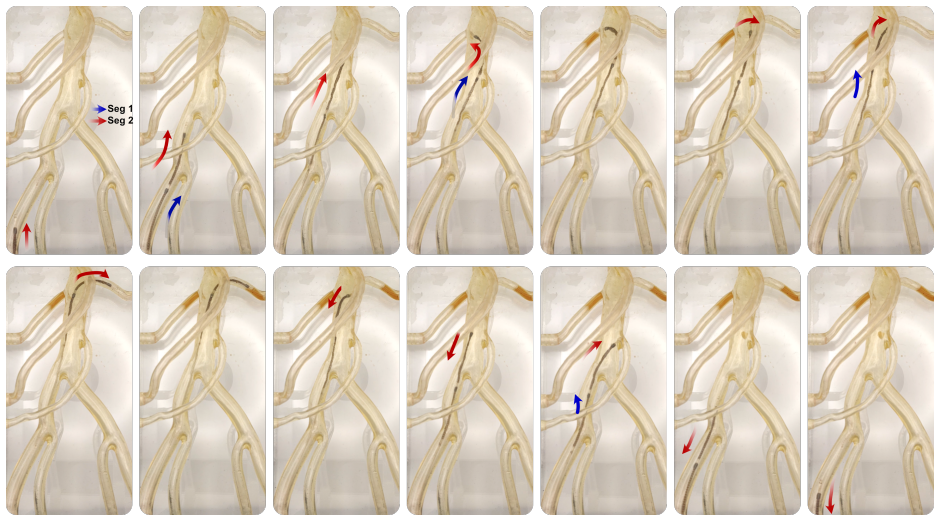
- The successful in-vitro cannulation with dye injection in three aortic branches indicates the two-segment design can execute the maneuvers needed for FEVAR/BEVAR, at least in a simplified phantom.
Reading between the lines
- Because the handle is modular and the tendon-anchor windows are made by laser cutting, the same fabrication pipeline could be adapted to catheters with three or four segments, or to different lumen configurations, without fundamental redesign.
- The muscling and curve alignment limitations suggest that a helical tendon-channel design, as the paper cites from prior work, would be a likely next step; if it eliminated passive shaft motion, the clinical viability would rise substantially.
- The 72° bend was measured with the catheter free in air; a natural next experiment is to measure the achievable tip angle while a stiff guidewire or stent graft is loaded in the central lumen, since that would approximate the real delivery condition.
- The paper's comparison against average anatomical angles is a useful benchmark, but individual patients can have sharper angles; a patient-specific planning tool using the kinematics model could tell preoperatively whether this catheter can reach a target.
Editorial analysis
A structured set of objections, weighed in public.
Referee Report
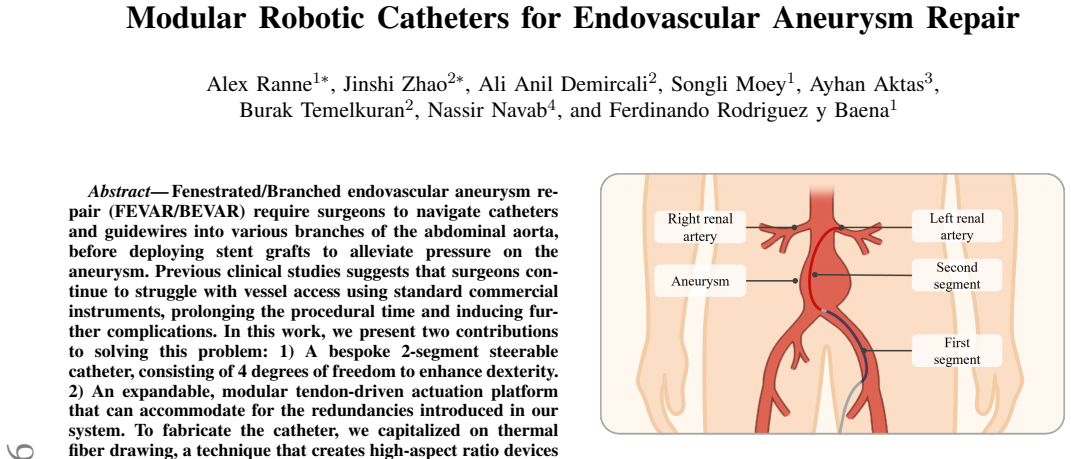
Summary. The paper reports the design, fabrication, benchtop characterization, and in-vitro evaluation of a 6 Fr, two-segment, tendon-driven steerable catheter intended for target-vessel catheterization in FEVAR/BEVAR. The catheter body is made by thermal fiber drawing of a 3D-printed polycarbonate preform, with laser-micromachined windows and stiffness-reducing slots; a modular, expandable 3D-printed handle provides four antagonistic tendon actuation pairs. Evaluation comprises a COMSOL FEM study of bending stiffness as a function of laser slot depth, free-space bending demonstrations (up to 72° combined two-segment bend), a ring-based navigation course, and a qualitative dye-injection experiment in a silicone abdominal aortic phantom. The manuscript claims that the device addresses difficult vessel catheterization and has the potential to shorten endovascular procedures.
Significance. If the performance claims held with quantitative support, the paper would offer a useful engineering contribution: thermal drawing is a scalable and potentially low-cost route to multi-lumen steerable catheter bodies, and the modular actuation handle is a practical response to the tendon-count scaling problem. The FEM stiffness-versus-slot-depth sweep is a sensible design tool, and the authors are candid in listing major limitations including neglected friction and the muscling/curve-alignment phenomena. However, the current evidence is essentially a proof-of-concept: the bending angles are single free-space demonstrations, the in-vitro test is qualitative, and the transfer from benchtop to constrained, tortuous vasculature is not quantified. The central applicability claim for FEVAR/BEVAR is therefore not yet established at the level the conclusion implies.
major comments (4)
- [§III-B, Fig. 6] The central quantitative claim of up to 72° of combined bending is supported only by a single, unrepeated benchtop observation. No trial count, measurement uncertainty, or error bars are reported, and the tip pose is not compared with the forward kinematic model of §II-D (Eqs. 3-4). The subsequent argument in §IV that the device is 'fit to traverse' renal, SMA, and iliac anatomies because 72° exceeds the cited clinical angles (64.1°, 51.5°, 40.5°) is therefore not statistically grounded. Please provide repeated measurements with variability, or explicitly label the values as single demonstrative observations and avoid drawing clinical-fit conclusions from them.
- [§III-D, Fig. 8] The in-vitro study is reported as a single qualitative dye-injection demonstration. There are no objective success criteria, no tracking of the catheter tip relative to the vessel ostia, no number of attempts, no completion time, no repeated runs, and no comparator catheter. Dye appearing in the branch arteries could occur with partial or transient engagement, so the statement that the catheter 'navigate[s] in vitro to the renal and inferior mesenteric arteries' is not quantitatively substantiated. Please add at least a success rate and a tip-position error metric, or report the study as a single feasibility demonstration rather than a validation.
- [§IV and §II-D] The paper acknowledges 'muscling' (whole-shaft motion due to tendon pull) and 'curve alignment' (undesired full-catheter rotation) in §IV, while the forward kinematic model in §II-D explicitly assumes no external loading, no torsional deformation, and constant curvature. These are exactly the phenomena that dominate when the catheter is constrained inside a compliant, tortuous vessel. The in-vitro experiment does not quantify any of these effects, so the transfer of free-space bending performance to FEVAR/BEVAR is not demonstrated. Either quantify these phenomena—e.g., by tracking the proximal segment and the shaft during the phantom experiment—or materially soften the claims about suitability for FEVAR/BEVAR.
- [§III-A, Eq. (5)] The FEM study evaluates bending stiffness under point loads and does not model tendon-actuation mechanics, tendon-channel friction, or the deployment of the catheter through a vessel. Consequently, the selection of 0.4 mm distal and 0.2 mm proximal slot depths is a stiffness heuristic rather than a validated design optimization. The authors already acknowledge the friction limitation; however, the manuscript should also state explicitly that the depth selection was not verified against actuation force, achievable curvature under load, or steerability in a constrained environment.
minor comments (5)
- [§III-B] The text refers to 'Figure 5(d)' for the multi-plane bending views, but the referenced images are in Fig. 6(d). Please correct the citation.
- [§IV] The text attributes prior work to 'Bogusky et al. [22]', but reference [22] is an Enrique Romo patent. Please correct the citation or the reference entry.
- [§II-C] 'accommodate for 2×n tendons, where n represents the number of actuators embedded' is ambiguous; clarify whether n is the number of actuation units and whether the total tendon count is 2n or 2n+2.
- [§II-A, Eq. (1)] Equation (1) uses r_p and r_d, but the surrounding text says 'preform diameter' and 'fiber diameter'. Please define whether these are radii or diameters and use consistent notation.
- [Abstract and §I] Minor grammar: 'Previous clinical studies suggests' should be 'suggest'; also the abstract's claim of potential to 'shorten the length of future endovascular surgeries' is too strong and should be conditioned on the reported proof-of-concept evidence.
Circularity Check
No circularity: the paper's measurements, FEM stiffness study, and standard constant-curvature kinematics are self-contained.
full rationale
The paper makes no claim that a derived quantity is equal to a fitted input. The forward kinematic model (Sect. II-D, Eqs. 2-4) is a standard constant-curvature homogeneous transform; it describes the geometry of two serially attached bending segments and is not used to predict the measured bending angles. The 35° and 72° values (Sect. III-B) are direct benchtop measurements, not outputs of the model. The FEM study (Sect. III-A) uses cantilever beam theory (Eq. 5) with a fixed Young's modulus and measured geometry to estimate bending stiffness as a function of laser-profile depth; the chosen depths (0.2 mm/0.4 mm) are justified by that simulation but the later bending and navigation results are measured, not fitted. The literature comparison of 72° to reported renal/mesenteric/iliac angles is an external benchmark, not an input to any calculation. The only overlapping-author citation is [14], used as background for 3D-printed preform thermal drawing; it is not load-bearing for any derived result. Limitations such as muscling and curve alignment (Sect. IV) are acknowledged validation risks, not steps that reduce a prediction to its inputs. Therefore no circular step can be quoted or exhibited.
Assumptions & free parameters
free parameters (2)
- Laser profile depths =
distal 400 µm, proximal 200 µm
- Furnace zone temperatures =
120/190/85 °C
assumptions (6)
- domain assumption Each bending segment bends uniformly under the constant-curvature assumption (Sect. II-D).
- domain assumption No torsional deformation, negligible gravity, no external loading, and tendons follow a continuous, parallel path to the backbone (Sect. II-D).
- domain assumption The FEM cantilever model with no friction is representative of the catheter's bending mechanics (Sect. III-A).
- domain assumption Average branch-vessel angles from the literature (renal 64.1°, SMA 51.5°, iliac 40.5°) are a sufficient measure of clinical navigability (Sect. IV).
- domain assumption The in-vitro silicon phantom replicates the relevant anatomical environment for FEVAR/BEVAR access (Sect. III-D).
- domain assumption The 3D-printed polycarbonate preform, after thermal drawing, retains the intended channel geometry with sufficient structural integrity for a 1 m catheter (Sect. II-A).
Cite this review
Pith. "Pith review of Modular Robotic Catheters for Endovascular Aneurysm Repair." pith.science (2026). https://pith.science/paper/S56KQCYI
@misc{pith2026260725807,
  author       = {Pith},
  title        = {Pith review of: Modular Robotic Catheters for Endovascular Aneurysm Repair},
  year         = {2026},
  howpublished = {\url{https://pith.science/paper/S56KQCYI}},
  note         = {Machine review of arXiv:2607.25807}
}
read the original abstract
Fenestrated/Branched endovascular aneurysm repair (FEVAR/BEVAR) require surgeons to navigate catheters and guidewires into various branches of the abdominal aorta, before deploying stent grafts to alleviate pressure on the aneurysm. Previous clinical studies suggests that surgeons continue to struggle with vessel access using standard commercial instruments, prolonging the procedural time and inducing further complications. In this work, we present two contributions to solving this problem: 1) A bespoke 2-segment steerable catheter, consisting of 4 degrees of freedom to enhance dexterity. 2) An expandable, modular tendon-driven actuation platform that can accommodate for the redundancies introduced in our system. To fabricate the catheter, we capitalized on thermal fiber drawing, a technique that creates high-aspect ratio devices at scale, and processed the catheter with laser micro-machining to soften its tip. We evaluated the system using simulations, where we investigated the catheter's bending stiffness, then its steerability with in-vitro experiments in vascular phantoms. This handheld, robotic steerable catheter system has the potential to shorten the length of future endovascular surgeries, and give clinicians the tools to resolve challenging clinical cases.
Figures


Figures from the paper (4 more)


Reference graph
Works this paper leans on
-
[8]
Thermally drawn poly- meric catheters for mr-guided cardiovascular intervention.Advanced Science, 11(45):2407704, 2024
Mohamed EMK Abdelaziz, Libaihe Tian, Thomas Lottner, Simon Reiss, Timo Heidt, Alexander Maier, Klaus Düring, Constantin von zur Mühlen, Michael Bock, Eric Yeatman, et al. Thermally drawn poly- meric catheters for mr-guided cardiovascular intervention.Advanced Science, 11(45):2407704, 2024
2024
-
[14]
Ali Anil Demircali, Jinshi Zhao, Ayhan Aktas, Mohamed EMK Abdelaziz, and Burak Temelkuran. Fabrication of fibers with complex features using thermal drawing of 3d-printed preforms.arXiv preprint arXiv:2502.00741, 2025
arXiv 2025
-
[1]
New study reveals latest data on global burden of cardiovascular disease, 2023
Institute for Health Metrics and Evaluation. New study reveals latest data on global burden of cardiovascular disease, 2023. Accessed: 2025-02-22
2023
-
[2]
Epidemiology and contemporary management of abdominal aortic aneurysms.Abdominal Radiology, 43:1032–1043, 2018
Brant W Ullery, Richard L Hallett, and Dominik Fleischmann. Epidemiology and contemporary management of abdominal aortic aneurysms.Abdominal Radiology, 43:1032–1043, 2018
2018
-
[3]
Completion of target vessel stenting after fevar via snare technique in a patient with tortuous right renal artery.Innovations, 16(6):559–561, 2021
Alexander Tschischka, Peter Schott, Patrick Freyhardt, Apostolos Mamopoulos, Gabor Gäbel, and Marcus Katoh. Completion of target vessel stenting after fevar via snare technique in a patient with tortuous right renal artery.Innovations, 16(6):559–561, 2021. Fig. 8. In-vitro evaluation of tendon driven catheter: Tendon-driven catheter navigating through an ...
2021
-
[4]
Andres Schanzer, Adam W Beck, Matthew Eagleton, Mark A Far- ber, Gustavo Oderich, Darren Schneider, Matthew P Sweet, Allison Crawford, Carlos Timaran, US Multicenter Fenestrated/Branched Aor- tic Research Consortium, et al. Results of fenestrated and branched endovascular aortic aneurysm repair after failed infrarenal endovascu- lar aortic aneurysm repair...
2020
-
[5]
Angelos Karelis, Stéphan Haulon, Björn Sonesson, Donald Adam, Tilo Kölbel, Gustavo Oderich, Enrico Cieri, Thomas Mesnard, Eric Verhoeven, Nuno Dias, et al. Editor’s choice–multicentre outcomes of redo fenestrated/branched endovascular aneurysm repair to rescue failed fenestrated endografts.European Journal of V ascular and Endovascular Surgery, 62(5):738–...
2021
-
[6]
Medical device and treatment method
John Paul Urbanski, Gareth Davies, Mahmood Mirza, and Bogdan Beca. Medical device and treatment method
Show all 23 references
-
[7]
Surgical method and apparatus for treating atrial fibrillation
James Gammie, Randy Jordan, Marwan Abboud, Allan Zingeler, and Saqib Masroor. Surgical method and apparatus for treating atrial fibrillation
-
[9]
Raymond N Haddad, Ahmed Adel Hassan, Mahmoud Al Soufi, and Mohamed Kasem. Swiftninja steerable microcatheter: a new kid on the block for selective catheterization of vascular and valvular congenital lesions.Frontiers in Cardiovascular Medicine, 10:1322787, 2023
2023
-
[10]
Clinical experience with the bendit steerable microcatheter: a new paradigm for endovascular treatment.Journal of NeuroInterventional Surgery, 15(8):771–775, 2023
Monika Killer-Oberpfalzer, René Chapot, David Orion, John D Barr, Oz Cabiri, and Alejandro Berenstein. Clinical experience with the bendit steerable microcatheter: a new paradigm for endovascular treatment.Journal of NeuroInterventional Surgery, 15(8):771–775, 2023
2023
-
[11]
Robotics in interventional radiology: past, present, and future.The Arab Journal of Interventional Radiology, 2(02):56–63, 2018
Maria Alejandra Rueda, Celia Theodoreli Riga, and Mohamad S Hamady. Robotics in interventional radiology: past, present, and future.The Arab Journal of Interventional Radiology, 2(02):56–63, 2018
2018
-
[12]
Robotic endovascular surgery: current and future practice
Lucinda Cruddas, Guy Martin, and Celia Riga. Robotic endovascular surgery: current and future practice. InSeminars in V ascular Surgery, volume 34, pages 233–240. Elsevier, 2021
2021
-
[13]
Bioengineering, augmented reality, and robotic surgery in vascular surgery: A literature review.Frontiers in Surgery, 9:966118, 2022
Sara Condino, Roberta Piazza, Marina Carbone, Jonathan Bath, Nicola Troisi, Mauro Ferrari, and Raffaella Berchiolli. Bioengineering, augmented reality, and robotic surgery in vascular surgery: A literature review.Frontiers in Surgery, 9:966118, 2022
2022
-
[15]
Multi-selective catheter for mr-guided endovascular interventions.Medical Engineering & Physics, 37(7):623–630, 2015
Helene CM Clogenson, Joris Y van Lith, Jenny Dankelman, Andreas Melzer, and John J van den Dobbelsteen. Multi-selective catheter for mr-guided endovascular interventions.Medical Engineering & Physics, 37(7):623–630, 2015
2015
-
[16]
Janina Mayers, Brianna Hofman, Indie Sobiech, and Maria P Kwesiga. Insights into the biocompatibility of biodegradable metallic molyb- denum for cardiovascular applications-a critical review.Frontiers in Bioengineering and Biotechnology, 12:1457553, 2024
2024
-
[17]
How does the biocompatibility of molybdenum compare to the gold standard titanium?—an in vivo rat model.Applied Sciences, 13(10):6312, 2023
André Toschka, Henriette Möllmann, Dominik Hoppe, Georg Poehle, Lutz van Meenen, Maximilian Seidl, Nadia Karnatz, and Majeed Rana. How does the biocompatibility of molybdenum compare to the gold standard titanium?—an in vivo rat model.Applied Sciences, 13(10):6312, 2023
2023
-
[18]
Ferromagnetic soft continuum robots.Science robotics, 4(33):eaax7329, 2019
Yoonho Kim, German A Parada, Shengduo Liu, and Xuanhe Zhao. Ferromagnetic soft continuum robots.Science robotics, 4(33):eaax7329, 2019
2019
-
[19]
The anatomy of renal arteries in adults.EABR
Dobrivoje Stojadinovic, Ivana Zivanovic-Macuzic, Maja Jakovcevski, Dejan Jeremic, Marija Kovacevic, and Milos Minic. The anatomy of renal arteries in adults.EABR. Experimental and Applied Biomedical Research, 23(2):147–153, 2022
2022
-
[20]
Huseyin Ozkurt, Merve Meltem Cenker, Nagihan Bas, Sukru Mehmet Erturk, and M. Basak. Measurement of the distance and angle between the aorta and superior mesenteric artery: normal values in different BMI categories.Surgical and Radiologic Anatomy, 29(7):595–599,
-
[21]
Study of aortic-common iliac bifurcation and its clinical significance.Journal of clinical and diagnostic research: JCDR, 8(7):AC06, 2014
Arvind Deswal, Binod Kumar Tamang, and Anju Bala. Study of aortic-common iliac bifurcation and its clinical significance.Journal of clinical and diagnostic research: JCDR, 8(7):AC06, 2014
2014
-
[22]
Flexible robotic surgical system, Dec 2017
Enrique Romo. Flexible robotic surgical system, Dec 2017
2017
-
[2007]
PMID: 17646894
Epub 2007 Jul 24. PMID: 17646894
2007
Reviewed August 1, 2026 · model on record in the stance chip above.
Discussion (0). Continue with ORCID to comment.