REVIEW 3 major objections 4 minor 14 references
The Rate-Distortion-Deception Tradeoff
T0 review · 3 major / 4 minor · reviewed 2026-08-01 · deepseek-v4-flash
Pith's one-line read The paper establishes the rate-distortion-deception function R_Y(D,P) as the exact characterization of achievable rates for lossy compression with both a fidelity (distortion) constraint and a statistical deception constraint toward a targe
desk verdict RDD coding theorem holds up; Gaussian sections overclaim and need repair. read the letter →
The pith
A machine-rendered reading of the paper's core claim, the machinery that carries it, and where it could break.
The reading
What carries the argument
The RDD function R_Y(D,P) = inf I(X;Xhat) subject to expected distortion ≤ D and D_KL(P_Xhat || P_Y) ≤ P — a mutual-information minimization whose feasible set is convex in (D,P) because KL divergence is convex and distortion is linear. For the discrete cases, KKT conditions reduce the problem to fixed-point equations for the reconstruction marginal q, with a Lagrange multiplier β controlling deception. For the Gaussian cases, the jointly-Gaussian ansatz allows the optimization to be expressed in covariance terms, leading to closed-form scalar results and, for vector sources, a coupled matrix system that is solved numerically and cross-validated with a convex log-det program.
What would settle it
For a scalar Gaussian source with target mean/variance different from the source's, compute the minimum mutual information over all couplings p_{Xhat|X} using a numerical search that does not impose joint Gaussianity (e.g., a fine quantization of the channel or a neural-estimator based optimization). If the resulting minimum I(X;Xhat) for some (D,P) is lower than the paper's expression, the jointly-Gaussian ansatz is false for that regime. Similarly, for a vector case where Σ_X and Σ_Y do not commute, compare the paper's alternating-minimization result with the convex log-det program's output:
Extended reading notes
Core claim
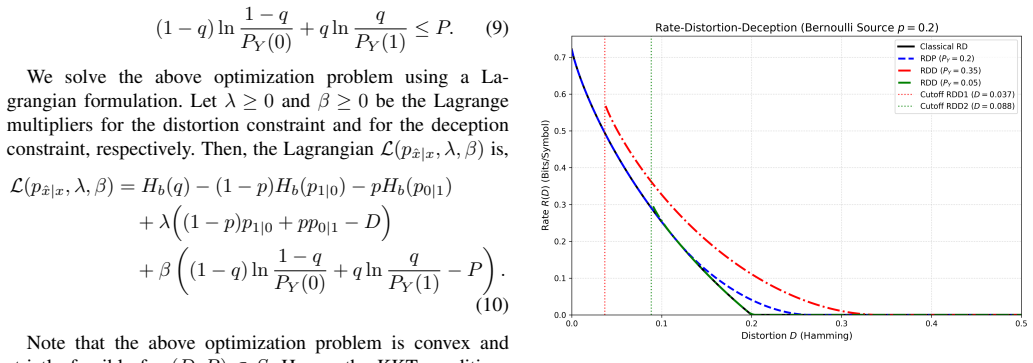
The central claim is Theorem 1: the triplet (R,D,P) is achievable if and only if the feasible set S_{D,P} is nonempty and R ≥ R_Y(D,P), where R_Y(D,P) is the infimum of I(X;Xhat) over all conditional distributions satisfying the distortion and deception constraints. This is a complete characterization, meaning the tradeoff surface is exactly described by the single-letter mutual information optimization. The paper also evaluates the function for Bernoulli sources with Bernoulli and ternary targets, giving closed-form KKT solutions and a Blahut-Arimoto algorithm, and for scalar and vector Gaussian sources, where the optimal reconstruction is assumed jointly Gaussian.
Load-bearing premise
The closed-form Gaussian RDD expressions rest on the unproved assumption that the optimal reconstruction is jointly Gaussian with the source for a target distribution different from the source; if that assumption fails, those expressions could overestimate the true minimum rate.
Editorial extensions
If this is right
- The RDD function provides a fundamental limit for any compression system that must simultaneously meet a fidelity requirement and a statistical camouflage requirement; no scheme can beat the characterized rate.
- Unlike rate-distortion-perception, RDD has a sharp distortion floor: below a certain D, no rate, not even infinite, can satisfy the deception constraint; the paper identifies this via the non-emptiness of S_{D,P}.
- Because the target distribution can be chosen freely, the same machinery covers privacy-by-disguise scenarios, where the 'target' is a generic or vendor distribution rather than the user's own.
- For Gaussian sources, the derived equations give explicit operational meaning to the tradeoff: the reconstruction is a linearly-scaled and noise-added version of the source, with coefficients determined by λ and β.
- The convex log-det program in Appendix D provides a polynomial-time way to compute R_Y(D,P) for vector Gaussian sources and a ground truth to verify the faster alternating algorithm.
Reading between the lines
- The paper's Gaussian analysis restricts to jointly Gaussian coupling; if a non-Gaussian coupling could achieve lower mutual information for the same (D,P), the closed-form RDD expressions would be only upper bounds. The paper does not rule this out for P_Y ≠ P_X.
- The fixed-point iteration for non-commuting covariance pairs is empirically stable but not proven to converge globally; the paper itself notes this and offers a convex program instead. A practical implementation would need to rely on the convex solver for reliability.
- The deception framework suggests an immediate testable extension to task-oriented compression where the target distribution is derived from the receiver's decision boundary, not a fixed P_Y.
- The sharp distortion floor might be exploitable in reverse: a receiver could detect deception by checking whether the observed reconstruction statistics are impossible at the claimed rate.
Editorial analysis
A structured set of objections, weighed in public.
Referee Report
Summary. The paper defines a rate-distortion-deception (RDD) function R_Y(D,P) as the infimum of I(X;\hat X) subject to E[d(X,\hat X)] ≤ D and D_KL(P_{\hat X} || P_Y) ≤ P, where P_Y is a target distribution distinct from the source. Theorem 1 states that (R,D,P) is achievable if and only if the feasible set is nonempty and R ≥ R_Y(D,P), proved via the strong functional representation lemma. The paper then evaluates R_Y for Bernoulli sources (binary and ternary reconstructions) using KKT and a Blahut-Arimoto algorithm, and for scalar and vector Gaussian sources using a jointly-Gaussian ansatz, claiming a complete characterization of the Gaussian cases.
Significance. If Theorem 1 and the Gaussian evaluations are correct, the paper offers a useful generalization of the rate-distortion-perception framework, with explicit formulas for Bernoulli sources and numerical procedures for Gaussian sources. The coding theorem is standard and credible; the Bernoulli KKT solution is explicit, and the BA/log-det algorithms are reproducible. However, the Gaussian 'complete characterization' is not fully established: the optimality of a jointly Gaussian reconstruction is asserted without proof for P_Y ≠ P_X, and there is a dimensional error in the scalar Gaussian derivation. These issues are fixable but must be addressed before the Gaussian claims can be accepted.
major comments (3)
- [Sections V–VI] The claim that the optimal reconstruction \hat X is jointly Gaussian with X is asserted without proof for P_Y ≠ P_X. Reference [11] treats the RDP case where the target equals the source, P_Y = P_X; for an arbitrary Gaussian target the argument does not follow from that reference. Since all Gaussian closed forms and the log-det program (84)–(86) parameterize the joint distribution by covariance matrices, this ansatz is load-bearing. Please supply a proof (a maximum-entropy argument should suffice) or explicitly label the Gaussian results as upper bounds on R_Y(D,P).
- [Eq. (39)] Equation (39) reads σ_X^2 − 2a + σ_{\hat X}^2 = D. Here a is a dimensionless regression coefficient in \hat X = aX + Z + b, so the term 2a has incompatible dimensions with the variances. The correct expression is σ_X^2 − 2a σ_X^2 + σ_{\hat X}^2 = D, obtained from (31) with μ_X = μ_{\hat X}. This typo propagates into the Region-3 solution and the rate expression and must be corrected.
- [Section VI, Region 2] The sentence 'When these conditions are satisfied, the optimal reconstruction becomes Σ_{\hat X} = 0' is incorrect. A degenerate zero-covariance Gaussian has infinite KL divergence to N(0,Σ_Y) for finite P, so it is not feasible. The optimal independent reconstruction is the minimizer of the vector analogue of the scalar D_min(P) problem in (41)–(42), not the zero matrix. Please correct this statement and the accompanying characterization.
minor comments (4)
- [Appendix B, Eq. (65)] In the achievability part, the encoding function is denoted f', but Eq. (65) writes H(f(X^n,Z')|Z'). It should be H(f'(X^n,Z')|Z').
- [Section IV, after Eq. (24)] The statement 'For β=1, p_{x|hat x} depends strictly on the target distribution' is imprecise: the transition probability in (25) also depends on the distortion term exp(−λ d(x,·)) even when β=1.
- [Section VI, Eqs. (48)–(52)] I checked the algebra leading from (48)–(50) to (51)–(52); it is consistent. My concern is not the algebra but the Gaussian optimality assumption identified in Major Comment 1.
- [General] The paper assumes that the support of \hat X is contained in the support of P_Y for the KL divergence to be finite. This assumption is stated in Section II but could be made more prominently in the Theorem-1 statement and in the examples.
Circularity Check
No circularity in the RDD derivation; the Gaussian examples rest on an unproved optimality ansatz, a correctness gap rather than a circular step.
full rationale
The central RDD function (5) is defined as an infimum over conditional distributions, and Theorem 1 proves achievability by a standard converse and the strong functional representation lemma [14]; no fitted parameter is later relabeled as a prediction. The Bernoulli and Bernoulli-ternary evaluations solve the convex KKT/Blahut-Arimoto equations directly, with no step that reduces the result to its own definition. The scalar and vector Gaussian sections invoke 'Similar to [11]' (an external, non-overlapping reference) to justify restricting the reconstruction to be jointly Gaussian with X; because [11] establishes Gaussian optimality in the RDP setting (P_Y=P_X), extending it to arbitrary P_Y is an unproved assumption, but it is not a circular step—the assumption does not equate the derived expressions with the optimization's inputs by construction. Self-citations [12] and [13] are contextual references on summarization and do not carry the derivation. Equation (39) appears to omit a factor of σ_X^2 in the distortion identity (σ_X^2 − 2a + σ_hatX^2 = D vs. (1−a)^2 σ_X^2 + σ_Z^2), a likely typo that affects the scalar Region-3 expressions but not the coding theorem or the non-circularity assessment.
Assumptions & free parameters
assumptions (6)
- domain assumption Unlimited common randomness U is available to encoder and decoder.
- standard math The strong functional representation lemma (Li-Gamal [14]) can represent any single-letter channel p_{Xhat|X} with rate near I(X;Xhat).
- domain assumption In the Gaussian sections, the optimal reconstruction is jointly Gaussian with X.
- standard math For (D,P) in S, the optimization is strictly feasible, so KKT conditions are necessary and sufficient.
- ad hoc to paper The Blahut-Arimoto iteration with lambda > 0 and beta in [0,1] covers all Pareto-optimal points of the Bernoulli-ternary problem.
- domain assumption The support of Xhat is contained in the support of Y for the KL deception constraint.
Cite this review
Pith. "Pith review of The Rate-Distortion-Deception Tradeoff." pith.science (2026). https://pith.science/paper/C4VONBZ5
@misc{pith2026260725997,
  author       = {Pith},
  title        = {Pith review of: The Rate-Distortion-Deception Tradeoff},
  year         = {2026},
  howpublished = {\url{https://pith.science/paper/C4VONBZ5}},
  note         = {Machine review of arXiv:2607.25997}
}
read the original abstract
The problem of finding the optimal compression rate for a given random variable has been traditionally studied under two main constraints: distortion and perception. The distortion constraint enforces the fidelity of our reconstruction with respect to the observed realization of the random variable, while the perception constraint ensures that the reconstruction is close to a sample from the distribution of the random variable of interest. In this work, we explore the possibility of reconstruction, such that the reconstructed sample is still within a desired fidelity level with our original realization of the random variable, but at the same time, it resembles a sample from a different target distribution. We term this criterion as the deception constraint and find the fundamental tradeoffs of rate-distortion and deception.
Figures

Reference graph
Works this paper leans on
-
[11]
J. Qian, S. Salehkalaibar, J. Chen, A. Khisti, W. Yu, W. Shi, Y . Ge, and W. Tong. Rate-distortion-perception tradeoff for gaussian vector sources.IEEE Journal on Selected Areas in Information Theory, 6:1– 17, November 2025
2025
-
[1]
C. E. Shannon. A mathematical theory of communication.The Bell System Technical Journal, 27(3):379–423, July 1948
1948
-
[2]
Wyner and J
A. Wyner and J. Ziv. The rate-distortion function for source coding with side information at the decoder.IEEE Transactions on Information Theory, 22(1):1–10, January 1976
1976
-
[3]
R. Timo, T. Chan, and A. Grant. Rate distortion with side-information at many decoders.IEEE Transactions on Information Theory, 57(8):5240– 5257, August 2011
2011
-
[4]
Yamamoto
H. Yamamoto. Source coding theory for cascade and branching communication systems.IEEE Transactions on Information Theory, 27(3):299–308, May 1981
1981
-
[5]
MolavianJazi and A
E. MolavianJazi and A. Yener. Two-way lossy compression via a relay with self source. InIEEE ISIT, July 2016
2016
-
[6]
Blau and T
Y . Blau and T. Michaeli. Rethinking lossy compression: The rate- distortion-perception tradeoff. InICML, June 2019
2019
-
[7]
Theis and A
L. Theis and A. B. Wagner. A coding theorem for the rate-distortion- perception function. InICLR Neural Compression Workshop, April 2021
2021
Show all 14 references
-
[8]
A. B. Wagner. The rate-distortion-perception tradeoff: The role of common randomness. Available online at arXiv:2202.04147
-
[9]
Hamdi and D
Y . Hamdi and D. G ¨und¨uz. The rate-distortion-perception trade-off with side information. InIEEE ISIT, June 2023
2023
-
[10]
Zhang, J
G. Zhang, J. Qian, J. Chen, and A. Khisti. Universal rate-distortion- perception representations for lossy compression.IEEE Transactions on Information Theory, 71(11):8633–8653, November 2025
2025
-
[12]
Arda and A
E. Arda and A. Yener. Rate-distortion-perception trade-off in summa- rization. InAllerton Conference, September 2025
2025
-
[13]
Arda and A
E. Arda and A. Yener. A rate-distortion framework for summarization. InIEEE ISIT, June 2025
2025
-
[14]
C. T. Li and A. E. Gamal. Strong functional representation lemma and applications to coding theorems.IEEE Transactions on Information Theory, 64(11):6967–6978, November 2018
2018
Reviewed August 1, 2026 · model on record in the stance chip above.
Discussion (0). Continue with ORCID to comment.