REVIEW 4 major objections 4 minor 64 references
X-ray polarization of Cygnus X-1 stays put during accretion dips, pointing to a large-scale corona as the source of the polarized emission.
Reviewed by Pith at T0; open to challenge. T0 means a machine referee read the full paper against a public rubric. the ladder, T0–T4 →
T0 review · deepseek-v4-flash
2026-08-01 00:38 UTC pith:SM45THER
load-bearing objection First dedicated dip spectro-polarimetric analysis of Cyg X-1; the null result is real but too weak to carry the extended-oblate-corona conclusion the abstract hangs on it. the 4 major comments →
Unchanged X-Ray Polarization During Accretion Dips in the Low Hard State of Cygnus X-1
The pith
A machine-rendered reading of the paper's core claim, the machinery that carries it, and where it could break.
Core claim
The central claim is that during accretion dips in Cygnus X-1's low hard state, the polarization signature is stable: in joint IXPE/NICER/NuSTAR spectro-polarimetric fits, the 2-8 keV polarization degree (roughly 3-4%) and polarization angle (about -20 to -30 degrees, aligned with the radio jet) are consistent between dip and off-dip intervals, within the larger dip uncertainties. The spectral model requires a partial-covering absorber (TBpcf) whose covering fraction rises to about 0.72 in the dip, absorbing the DISKBB thermal component to an upper limit that corresponds to zero disk flux in the 2-8 keV band. Since removing the disk's photons does not change the polarization, the disk emissi
What carries the argument
The central mechanism is the accretion dip as a natural spectro-polarimetric lever: dense, cold clumps from the companion wind or outer disk partially cover the X-ray source, modeled with the TBpcf partial-covering absorption model, which heavily suppresses the soft DISKBB thermal component while leaving the NTHCOMP Comptonized emission and reflection largely intact. By comparing IXPE polarization in dip and off-dip intervals selected from hardness-ratio light curves, and by fitting Stokes I, Q, U spectra with the same broadband spectral model, the paper isolates whether the removed disk component carries polarization. The constancy of polarization degree and angle across the dip is the evid
Load-bearing premise
The conclusion rests on the assumption that the flux dips are pure absorption events—cold, partial-covering absorption of an otherwise unchanged intrinsic spectrum—so that the dip genuinely removes the disk's photons rather than changing the corona's own emission; if the dips include intrinsic coronal variability or a different absorber geometry, the unchanged polarization would not isolate the disk contribution.
What would settle it
A future Cygnus X-1 dip observation with enough counts to measure the 2-3.5 keV polarization to better than 1% precision would settle it: if the polarization degree or angle changes during the dip while the disk component is firmly suppressed, the extended-corona claim fails; if polarization remains constant while DISKBB is undetected, it holds. Alternatively, finding a dip where the partial-covering fraction reaches above 0.9 and the DISKBB component remains measurable with non-zero polarization would directly contradict the assumption of a negligible disk contribution.
If this is right
- If the disk contributes negligibly to the 2-8 keV polarization, then measuring polarization in Cygnus X-1's hard state is effectively measuring the corona alone, simplifying the interpretation of IXPE data.
- The unchanged polarization angle during dips supports a coronal geometry extended parallel to the disk plane (oblate), rather than a compact lamp-post along the jet axis, because a small emission region would be more easily affected by passing clumps.
- The stability of polarization across dips distinguishes black hole X-ray binaries from dipping neutron-star low-mass X-ray binaries, where polarization degree and angle changes have been reported; this points to a different Comptonizing structure in the inner region.
- The alignment of the polarization angle with the radio jet across states and dips ties the polarized X-ray emission to the jet-launching region, suggesting the corona and jet share a common vertical axis.
- Future observations with higher sensitivity could use short dips as probes of outer-disk and corona geometry without needing long exposures for each orbital phase.
Where Pith is reading between the lines
- If the corona is truly the sole polarized component, then in the soft state, where the disk dominates the flux, the polarization should drop or change in a way that tracks the disk's geometric orientation; comparing soft-state and hard-state polarization with the same instruments would test whether the disk is intrinsically unpolarized or simply diluted.
- The constancy of the polarization angle during dips implies the absorbing clumps cover the line of sight in a way that is symmetric with respect to the polarization plane; a future dip with better statistics showing a temporary angle rotation would set a quantitative upper limit on the corona's size relative to the clumps.
- The contrast with the dipping neutron-star source GX 13+1 suggests that the presence or absence of a solid surface and boundary layer changes the corona's geometry; this could be tested by polarimetric monitoring of a larger sample of dipping neutron-star and black hole binaries with simultaneous broadband coverage.
- A stronger test of the large-corona claim would be to model how a clump of given size and optical depth partially covers an extended slab corona and predict the expected polarization variation as a function of covering fraction; the current non-detection of variation could then be translated into a lower limit on the coronal scale.
Editorial analysis
A structured set of objections, weighed in public.
Referee Report
Summary. The paper presents a joint IXPE/NICER/NuSTAR spectro-polarimetric analysis of Cygnus X-1 during flux dips in the 2022 low hard state. The authors identify dip and off-dip intervals from hardness-ratio selections, measure the 2–8 keV polarization with the model-independent PCUBE algorithm, and fit a broadband spectral model with partial-covering absorption (TBpcf). They find that the dip and off-dip polarization degree and angle are consistent, while the spectral fit drives the DISKBB normalization to zero in the dip. They conclude that the obscured thermal disk does not contribute significantly to the X-ray polarization and that the polarization originates from an extended, oblate accretion-disk corona whose geometry is unaffected by localized clumping.
Significance. The paper combines three observatories and performs a rare dip-state polarimetric measurement; the model-independent PCUBE results and the detailed appendices are strengths. If the conclusion were robust, it would provide direct evidence against significant disk-polarized emission in the Cyg X-1 hard state and support an extended-slab coronal geometry. However, the dip-state polarization is often a non-detection, and the central interpretation rests on a single absorption model that is not tested against intrinsic-variability alternatives. The manuscript is valuable as a measurement and a tentative constraint, but the stated conclusion is not supported at the claimed strength; a major revision with a reframing and additional model competition is needed.
major comments (4)
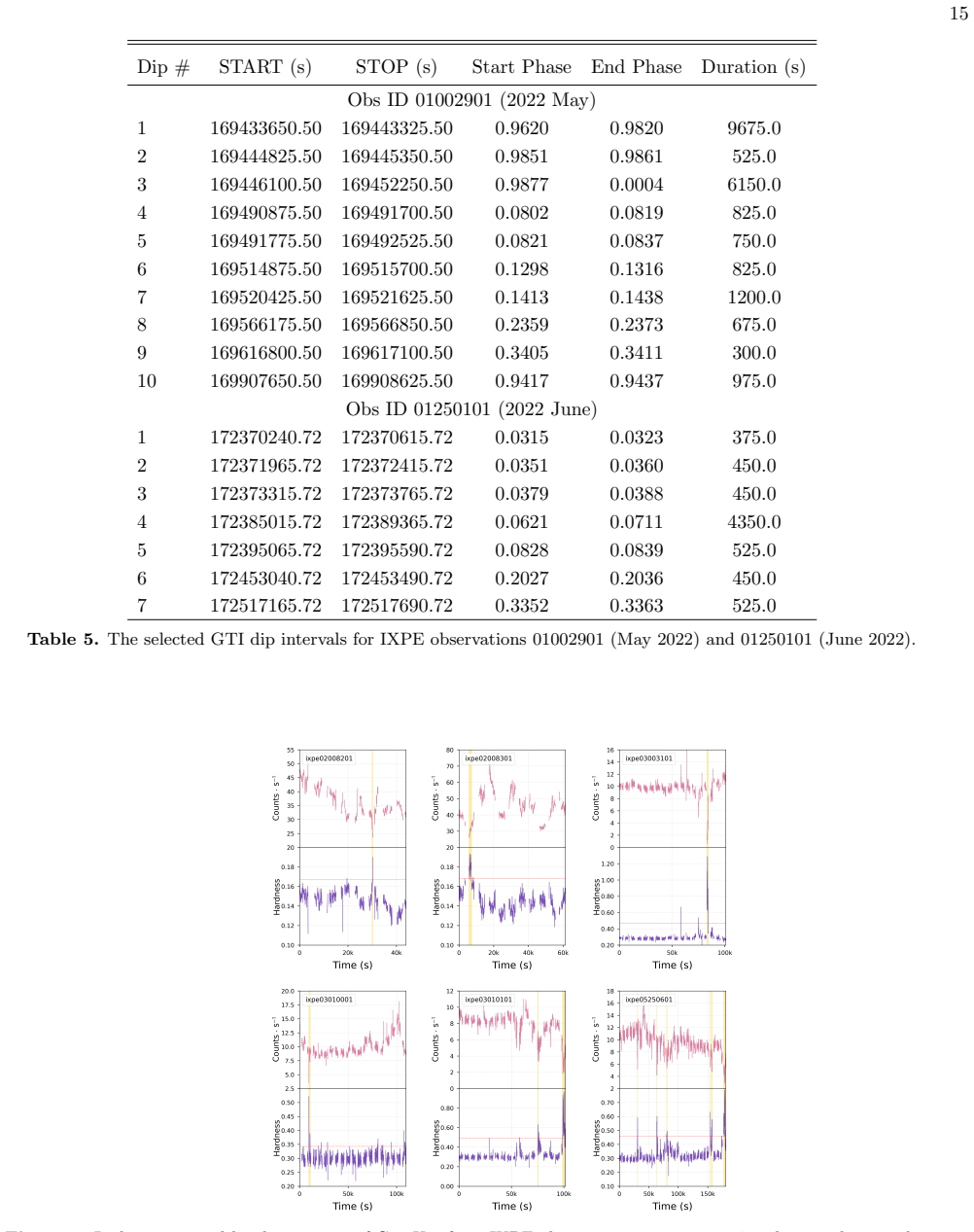
- [§3.2, Table 1, Abstract/Conclusions] The dip-state polarization is not a significant detection: for June 2022, the 2–8 keV dip PD is 2.6±1.3% with MDP99=3.8%, and the 2–3.5 keV dip PD is 1.2±1.7% with MDP99=5.3%. The paper's own text states in §3.2 that 'the dip state is not significant enough to support any claim.' Yet the Abstract and §4 conclude that the obscured disk does not contribute to the polarization and that the corona is extended/oblate. This is internally inconsistent. The conclusions must be reframed as tentative or upper-limit statements, or the combined May+June analysis must demonstrate a significant dip/off-dip comparison.
- [§2.2, Table 2, Appendix E] The central inference assumes that dips are partial-covering absorption (TBpcf) of an otherwise unchanged intrinsic spectrum. No competing intrinsic-variability model (e.g., the DISKBB component fading, or the NTHCOMP seed/normalization changing without an absorber) is tested. Appendix E re-fits NICER data with the same TBpcf model; this checks internal consistency of the MBPO treatment but does not test model uniqueness. Moreover, off-dip DISKBB contributes only 0.19/7.11 ≈ 2.7% of the 2–8 keV flux, so the total polarization would be nearly unchanged if this weak component vanished for any reason. The paper needs a quantitative diagnostic or a direct comparison with an intrinsic-variability model to support the absorption interpretation.
- [§2.3, Table 3] The component-resolved polarization constraints are degenerate and assumption-dependent. In the dip, Table 3 gives only an upper limit for NTHCOMP (PD<30%) and a very broad range for reflection (PD>20%), while the 'unphysical' disk polarization values (72–89%) are obtained only after freezing other components at chosen values. Thus the assertion that the disk's polarized contribution is negligible is an inference from total PD/PA stability plus the spectral model, not a measured bound. The authors should derive and quote an upper limit on the disk polarized flux, or explicitly state that the data only weakly constrain it.
- [§2.2, MBPO parameters, Table 2] The MBPO cross-calibration parameters change significantly between off-dip and dip (e.g., IXPE dΓ2 from −0.098±0.010 to −0.48±0.13; IXPE norm from 0.865±0.004 to 1.13±0.05). Because the spectro-polarimetric analysis fixes these parameters, a cross-calibration mismatch could affect the modeled IXPE polarization. Appendix E validates the TBpcf fit only with NICER data (which use no MBPO), so it does not fully address this concern for IXPE. Please show that the dip/off-dip polarization conclusions are stable under reasonable variations of the IXPE MBPO parameters.
minor comments (4)
- [Table 2] The column header 'Overlap dip' is unclear. If it refers simply to the dip interval used in the joint fit, rename it 'Dip' for consistency with Table 1.
- [Figure 2 and Appendix B] The dip-selection criterion is described as HR > 2σ_HR + HR_average in Appendix B, while Figure 2's caption says '2.0 standard deviations above the mean.' Please specify the exact statistic and make the caption consistent with the text.
- [Eq. (1)] The definition MBPO(E1)=N(E1/Ebr)^{dΓ1} and MBPO(E2)=... reads like a step function. It would help to state explicitly that the formula is evaluated at a representative energy E in each band, with E1<Ebr<E2.
- [References] The reference list contains two separate entries for Arnaud 1996. Please remove the duplicate.
Circularity Check
No significant circularity: the polarization comparison is model-independent, and the absorption interpretation is an assumption rather than a derived prediction.
full rationale
The central measured result—PD/PA consistency between dip and off-dip states—is obtained with the model-independent PCUBE algorithm (Appendix A.1, Table 1), not from a model that assumes the conclusion. The spectral decomposition attributing the dip flux reduction to TBpcf absorption is a fitted interpretation, and the inference that the disk contributes negligibly to polarization follows from the small fitted disk flux (Table 2: off-dip disk flux 0.19 vs total 7.11; dip disk flux 0.00) combined with the independent polarization comparison. This is a standard observational inference, not an equation-level reduction of a prediction to its inputs. The paper itself concedes in §3.2 that 'the dip state is not significant enough to support any claim,' so the abstract's stronger wording is an overstatement but not a circularity. Self-citations (e.g., Di Marco et al. 2025; Di Marco 2026 for pollin; La Monaca et al.) provide context, tools, and comparisons on other sources; none functions as a load-bearing uniqueness theorem or ansatz that forces the result. No step in the derivation chain is equivalent by construction to its own inputs, so no significant circularity is found.
Axiom & Free-Parameter Ledger
free parameters (8)
- TBPCF column density (dip) =
5.2 ± 0.2 × 10^22 cm^-2
- TBPCF covering fraction =
0.715 (+0.012, -0.011) dip; <0.068 off-dip
- DISKBB normalization =
10.4 (+3.7,-1.1) ×10^2 off-dip; <3.8 dip
- NTHCOMP photon index =
1.620 (+0.010,-0.006) off-dip; 1.54±0.03 dip
- RELXILLCP normalization =
4.1 (+0.2,-0.3) ×10^-2 off-dip; 4.9 (+2.0,-1.7) ×10^-2 dip
- XILLVERCP normalization =
2.5 (+0.5,-0.3) ×10^-3 off-dip; <6.0 ×10^-3 dip
- MBPO cross-calibration parameters =
dΓ ≈ -0.09 to -0.22; Ebr 2.6–4.0 keV; norm 0.87–1.17
- DISKBB temperature =
0.503 (+0.013,-0.017) keV off-dip
axioms (6)
- domain assumption The 2022 May/June observations are in the same low hard state; flux dips are due to variable absorption, not a spectral state change.
- ad hoc to paper The dip flux reduction is produced by cold partial-covering absorption (TBpcf), with the same intrinsic continuum outside the absorber.
- domain assumption The reflection component is dominated by the Fe line and is unpolarized.
- domain assumption Black hole spin = 0.998, inclination = 27.5°, kTe(NTHCOMP) = 94.2 keV, abundances = wilm.
- domain assumption MBPO cross-calibration adjustments do not mimic or suppress the intrinsic absorption signal.
- domain assumption IXPE Stokes parameters add linearly across spectral components in the spectro-polarimetric decomposition.
read the original abstract
Cygnus X-1 serves as a foundational benchmark for studying accretion mechanisms in stellar-mass black hole X-ray binaries. While traditional X-ray timing and spectroscopy have mapped its bimodal state transitions, constraining the exact geometric configuration of its accreting plasma requires additional tools. In this letter, we present a joint spectro-polarimetric analysis of Cygnus X-1 during flux-decrease events, or ``dips'', observed in its low hard state using simultaneous data from IXPE, NICER, and NuSTAR. The broadband spectral model reveals that the energy-dependent flux reduction during these dips is best described by a partial-covering absorption model, heavily impacting the softer energy bands. This absorption is consistent with obscuration by dense, cold clumps originating from the companion's stellar wind or the outer accretion disk during superior conjunction. Notably, our polarimetric analysis demonstrates that despite significant flux drops, the polarization degree and polarization angle in the 2-8 keV band remain largely consistent between dip and off-dip intervals. The stability of the polarization signature during these highly absorbed periods indicates that the obscured thermal disk emission does not significantly contribute to the total polarization. Ultimately, these results strongly support a scenario where the X-ray polarization originates from an extended, likely oblate, accretion-disk corona whose large scale renders its overall geometry unaffected by localized clumping.
Figures




Reference graph
Works this paper leans on
-
[1]
New results from long-term observations of Cygnus X-1. , keywords =. doi:10.1086/182020 , adsurl =
-
[2]
Bimodal behavior of accretion disks: theory and application to Cygnus X-1 transitions. , keywords =. doi:10.1086/155314 , adsurl =
-
[3]
Correlated X-Ray Spectral and Timing Behavior of the Black Hole Candidate XTE J1550-564: A New Interpretation of Black Hole States. , keywords =. doi:10.1086/318954 , archivePrefix =. astro-ph/0001163 , primaryClass =
-
[5]
The evolution of the timing properties of the black-hole transient GX 339-4 during its 2002/2003 outburst. , keywords =. doi:10.1051/0004-6361:20042457 , archivePrefix =. astro-ph/0504577 , primaryClass =
Pith/arXiv arXiv 2002
-
[6]
Astrophysics of Black Holes: From Fundamental Aspects to Latest Developments , year = 2016, editor =
Transient Black Hole Binaries. Astrophysics of Black Holes: From Fundamental Aspects to Latest Developments , year = 2016, editor =. doi:10.1007/978-3-662-52859-4_2 , archivePrefix =. 1603.07872 , primaryClass =
Pith/arXiv arXiv 2016
-
[7]
Progress of Theoretical Physics Supplement , keywords =
Radiative Processes, Spectral States and Variability of Black-Hole Binaries. Progress of Theoretical Physics Supplement , keywords =. doi:10.1143/PTPS.155.99 , archivePrefix =. astro-ph/0403683 , primaryClass =
-
[8]
X- and Gamma-Ray Astronomy , year = 1973, editor =
Black Holes in Binary Systems: Observational Appearances. X- and Gamma-Ray Astronomy , year = 1973, editor =
1973
-
[9]
, keywords =
Comptonization of X-Rays in Plasma Clouds - Typical Radiation Spectra. , keywords =
-
[10]
Simultaneous X-ray and gamma-ray observations of CYG X-1 in the hard state by GINGA and OSSE. , keywords =. doi:10.1093/mnras/288.4.958 , archivePrefix =. astro-ph/9610156 , primaryClass =
-
[11]
Fifty Years After the Discovery of the First Stellar-Mass Black Hole: A Review of Cyg X-1. Galaxies , keywords =. doi:10.3390/galaxies12060080 , archivePrefix =. 2411.12507 , primaryClass =
-
[12]
Science , year = 1965, month = jan, volume =
Cosmic X-ray Sources. Science , year = 1965, month = jan, volume =. doi:10.1126/science.147.3656.394 , adsurl =
-
[13]
, year = 1972, month = oct, volume =
Observation of a Correlated X-Ray Transition in Cygnus X-1. , year = 1972, month = oct, volume =. doi:10.1086/181042 , adsurl =
-
[14]
Everything you always wanted to know about accretion but were afraid to ask
Modelling the behaviour of accretion flows in X-ray binaries. Everything you always wanted to know about accretion but were afraid to ask. , keywords =. doi:10.1007/s00159-007-0006-1 , archivePrefix =. 0708.0148 , primaryClass =
-
[15]
Long term variability of Cygnus X-1. IV. Spectral evolution 1999-2004. , keywords =. doi:10.1051/0004-6361:20053938 , archivePrefix =. astro-ph/0510193 , primaryClass =
Pith/arXiv arXiv 1999
-
[16]
Long term variability of Cygnus X-1. V. State definitions with all sky monitors. , keywords =. doi:10.1051/0004-6361/201321128 , archivePrefix =. 1303.1198 , primaryClass =
-
[17]
X-ray emitting region of Cygnus X-1 constrained by short absorption dips. , keywords =. doi:10.1093/pasj/psaf107 , adsurl =
-
[18]
Identification of the soft X-ray excess in Cygnus X-1 with disc emission. , keywords =. doi:10.48550/arXiv.astro-ph/9509020 , archivePrefix =. astro-ph/9509020 , primaryClass =
-
[19]
Dependence of the orbital modulation and spectral hardness on the superorbital phase
Superorbital variability of X-ray and radio emission of Cyg X-1 - II. Dependence of the orbital modulation and spectral hardness on the superorbital phase. , keywords =. doi:10.1111/j.1365-2966.2008.13666.x , archivePrefix =. 0802.1391 , primaryClass =
arXiv 2008
-
[20]
2D wind clumping in hot, massive stars from hydrodynamical line-driven instability simulations using a pseudo-planar approach. , keywords =. doi:10.1051/0004-6361/201731718 , archivePrefix =. 1710.07780 , primaryClass =
-
[21]
Journal of Astronomical Telescopes, Instruments, and Systems , keywords =
The Imaging X-Ray Polarimetry Explorer (IXPE): Pre-Launch. Journal of Astronomical Telescopes, Instruments, and Systems , keywords =. doi:10.1117/1.JATIS.8.2.026002 , archivePrefix =. 2112.01269 , primaryClass =
-
[22]
The Two-Phase Pair Corona Model for Active Galactic Nuclei and X-Ray Binaries: How to Obtain Exact Solutions. , keywords =. doi:10.1086/177865 , archivePrefix =. astro-ph/9605073 , primaryClass =
-
[23]
The Instrument of the Imaging X-Ray Polarimetry Explorer. , keywords =. doi:10.3847/1538-3881/ac19b0 , archivePrefix =. 2108.00284 , primaryClass =
-
[24]
Doughnut strikes sandwich: the geometry of hot medium in accreting black hole X-ray binaries. , keywords =. doi:10.1051/0004-6361/201732345 , archivePrefix =. 1711.08509 , primaryClass =
-
[25]
Polarization signatures of strong gravity in active galactic nuclei accretion discs. , keywords =. doi:10.1111/j.1365-2966.2004.08396.x , archivePrefix =. astro-ph/0409356 , primaryClass =
arXiv 2004
-
[26]
New Constraints on the Spin of the Black Hole Cygnus X-1 and the Physical Properties of its Accretion Disk Corona. , keywords =. doi:10.3847/1538-4357/ac7725 , archivePrefix =. 2201.07360 , primaryClass =
-
[27]
Polarized x-rays constrain the disk-jet geometry in the black hole x-ray binary Cygnus X-1. Science , keywords =. doi:10.1126/science.add5399 , archivePrefix =. 2206.09972 , primaryClass =
-
[28]
X-Ray Dips and Polarization Angle Swings in GX 13+1. , keywords =. doi:10.3847/2041-8213/ada7f8 , archivePrefix =. 2501.05511 , primaryClass =
Pith/arXiv arXiv 2041
-
[29]
Variability of X-ray polarization of Cyg X-1. , keywords =. doi:10.1051/0004-6361/202555411 , archivePrefix =. 2505.03942 , primaryClass =
-
[30]
An IXPE-led X-Ray Spectropolarimetric Campaign on the Soft State of Cygnus X-1: X-Ray Polarimetric Evidence for Strong Gravitational Lensing. , keywords =. doi:10.3847/2041-8213/ad58e4 , archivePrefix =. 2406.12014 , primaryClass =
Pith/arXiv arXiv 2041
-
[31]
Space Telescopes and Instrumentation 2014: Ultraviolet to Gamma Ray , year = 2014, editor =
The neutron star interior composition explorer (NICER): mission definition. Space Telescopes and Instrumentation 2014: Ultraviolet to Gamma Ray , year = 2014, editor =. doi:10.1117/12.2056811 , adsurl =
-
[32]
Space Telescopes and Instrumentation 2016: Ultraviolet to Gamma Ray , year = 2016, editor =
The Neutron star Interior Composition Explorer (NICER): design and development. Space Telescopes and Instrumentation 2016: Ultraviolet to Gamma Ray , year = 2016, editor =. doi:10.1117/12.2231304 , adsurl =
-
[33]
Astroparticle Physics , keywords =
Design, construction, and test of the Gas Pixel Detectors for the IXPE mission. Astroparticle Physics , keywords =. doi:10.1016/j.astropartphys.2021.102628 , archivePrefix =. 2107.05496 , primaryClass =
arXiv 2021
-
[34]
Space Telescopes and Instrumentation 2022: Ultraviolet to Gamma Ray , year = 2022, editor =
In-orbit monitoring of the imaging x-ray polarimeters on-board IXPE. Space Telescopes and Instrumentation 2022: Ultraviolet to Gamma Ray , year = 2022, editor =. doi:10.1117/12.2629413 , adsurl =
-
[35]
Astronomical Data Analysis Software and Systems V, A.S.P
XSPEC: The First Ten Years , author=. Astronomical Data Analysis Software and Systems V, A.S.P. Conference Series , year=
-
[36]
On the Absorption of X-Rays in the Interstellar Medium. , keywords =. doi:10.1086/317016 , archivePrefix =. astro-ph/0008425 , primaryClass =
-
[37]
The role of the reflection fraction in constraining black hole spin. , keywords =. doi:10.1093/mnrasl/slu125 , archivePrefix =. 1408.2347 , primaryClass =
-
[38]
Definition of the reflection fraction and its implementation in relxill
Normalizing a relativistic model of X-ray reflection. Definition of the reflection fraction and its implementation in relxill. , keywords =. doi:10.1051/0004-6361/201628135 , archivePrefix =. 1601.03771 , primaryClass =
-
[39]
Improved Reflection Models of Black Hole Accretion Disks: Treating the Angular Distribution of X-Rays. , keywords =. doi:10.1088/0004-637X/782/2/76 , archivePrefix =. 1312.3231 , primaryClass =
-
[40]
Cygnus X-1 contains a 21-solar mass black hole Implications for massive star winds. Science , keywords =. doi:10.1126/science.abb3363 , archivePrefix =. 2102.09091 , primaryClass =
-
[41]
The hitchhiker's guide to the IXPE data analysis
The hitchhiker's guide to the IXPE data analysis. arXiv e-prints , keywords =. doi:10.48550/arXiv.2604.03366 , archivePrefix =. 2604.03366 , primaryClass =
work page internal anchor Pith review Pith/arXiv arXiv doi:10.48550/arxiv.2604.03366
-
[42]
, year = 2026, month = jun, doi =
High Polarization and Complex Accretion Wind Structure in 4U 1700-37. , year = 2026, month = jun, doi =
2026
-
[43]
Calibration of the IXPE Focal Plane X-Ray Polarimeters to Polarized Radiation. , keywords =. doi:10.3847/1538-3881/ac7719 , archivePrefix =. 2206.07582 , primaryClass =
-
[44]
Highly Significant Detection of X-Ray Polarization from the Brightest Accreting Neutron Star Sco X-1. , keywords =. doi:10.3847/2041-8213/ad132d , archivePrefix =. 2311.06359 , primaryClass =
Pith/arXiv arXiv 2041
-
[45]
Astronomische Nachrichten , keywords =
Weakly Magnetized Accreting Neutron Stars as Seen by IXPE. Astronomische Nachrichten , keywords =. doi:10.1002/asna.20240126 , adsurl =
-
[46]
The very high X-ray polarization of accreting black hole IGR J17091‑3624 in the hard state. , keywords =. doi:10.1093/mnras/staf859 , archivePrefix =. 2503.22665 , primaryClass =
-
[47]
Detection of X-Ray Polarization in the Hard State of IGR J17091-3624: Spectropolarimetric Study with IXPE and NuSTAR Data. , keywords =. doi:10.3847/1538-4357/adf1e6 , archivePrefix =. 2504.16402 , primaryClass =
-
[48]
The effect of returning radiation on relativistic reflection. , keywords =. doi:10.1093/mnras/stac1593 , archivePrefix =. 2206.07973 , primaryClass =
-
[49]
Handling the Background in IXPE Polarimetric Data. , keywords =. doi:10.3847/1538-3881/acba0f , archivePrefix =. 2302.02927 , primaryClass =
-
[50]
The Nuclear Spectroscopic Telescope Array (NuSTAR) High-energy X-Ray Mission. , keywords =. doi:10.1088/0004-637X/770/2/103 , archivePrefix =. 1301.7307 , primaryClass =
-
[51]
Astronomical Data Analysis Software and Systems XII , year = 2003, editor =
New Features of SAOImage DS9. Astronomical Data Analysis Software and Systems XII , year = 2003, editor =
2003
-
[52]
ixpeobssim: A simulation and analysis framework for the imaging X-ray polarimetry explorer. SoftwareX , keywords =. doi:10.1016/j.softx.2022.101194 , archivePrefix =. 2203.06384 , primaryClass =
arXiv 2022
-
[53]
Optimal binning of X-ray spectra and response matrix design. , keywords =. doi:10.1051/0004-6361/201527395 , archivePrefix =. 1601.05309 , primaryClass =
-
[54]
X-ray polarization changes with the state transition in Cygnus X-1. , keywords =. doi:10.1093/mnras/stad3961 , archivePrefix =. 2307.14604 , primaryClass =
-
[55]
A Weighted Analysis to Improve the X-Ray Polarization Sensitivity of the Imaging X-ray Polarimetry Explorer. , keywords =. doi:10.3847/1538-3881/ac51c9 , archivePrefix =. 2202.01093 , primaryClass =
-
[56]
Astronomical Data Analysis Software and Systems V , year = 1996, editor =
XSPEC: The First Ten Years. Astronomical Data Analysis Software and Systems V , year = 1996, editor =
1996
-
[57]
The orbital period of HDE 226868/Cyg X-1. , keywords =. doi:10.1046/j.1365-8711.1998.02064.x , archivePrefix =. astro-ph/9812101 , primaryClass =
arXiv 1998
-
[58]
X-ray spectropolarimetric characterization of GX 340+0 in the horizontal branch: A highly inclined source?. , keywords =. doi:10.1051/0004-6361/202451966 , archivePrefix =. 2410.00972 , primaryClass =
-
[59]
X-ray spectropolarimetric characterization of the Z-source GX 340+0 in the normal branch. \ in press , keywords =. doi:https://doi.org/10.1051/0004-6361/202555134 , archivePrefix =. 2508.13278 , primaryClass =
-
[60]
IXPE view of the Sco-like source GX 349+2 in the normal branch. , keywords =. doi:10.1051/0004-6361/202555647 , archivePrefix =. 2507.07163 , primaryClass =
-
[61]
Polarization of X-ray emission from the Sgr B2 cloud. , keywords =. doi:10.1046/j.1365-8711.2002.05113.x , archivePrefix =. astro-ph/0111065 , primaryClass =
arXiv 2002
-
[62]
Cygnus X-3 revealed as a Galactic ultraluminous X-ray source by IXPE. Nature Astronomy , keywords =. doi:10.1038/s41550-024-02294-9 , archivePrefix =. 2303.01174 , primaryClass =
-
[63]
, keywords =
Comptonization of low-frequency radiation in accretion disks Angular distribution and polarization of hard radiation. , keywords =
-
[64]
X-Ray Polarized View of the Accretion Geometry in the X-Ray Binary Circinus X-1. , keywords =. doi:10.3847/2041-8213/ad1832 , archivePrefix =. 2311.04632 , primaryClass =
Pith/arXiv arXiv 2041
-
[65]
IXPE View of BH XRBs during the First 2.5 Years of the Mission. Galaxies , keywords =. doi:10.3390/galaxies12050054 , adsurl =
discussion (0)
Sign in with ORCID, Apple, or X to comment. Anyone can read and Pith papers without signing in.