REVIEW 3 major objections 4 minor 83 references
Static topological dilatonic black hole with multiple horizons and its thermodynamics
T0 review · 3 major / 4 minor · reviewed 2026-08-01 · deepseek-v4-flash
Pith's one-line read This paper constructs an exact static topological black hole in Einstein-dilaton gravity with a nonlinear electromagnetic field whose metric function can have up to five horizons, and shows that the resulting thermodynamics can contain a tr
desk verdict A useful but unpolished extension of Gao's multi-horizon construction to dilaton gravity; the exactness claim rests on a truncation condition that looks inconsistent as printed and needs a referee's algebra check. read the letter →
The pith
A machine-rendered reading of the paper's core claim, the machinery that carries it, and where it could break.
The reading
What carries the argument
The load-bearing object is the electric field written as a four-term power series whose exponents are controlled by the dilaton-dependent parameter gamma = alpha^2/(1+alpha^2). The coefficients are chosen so that the gauge-field equation reduces to a finite polynomial, and the resulting expressions plug into the Einstein and dilaton equations to give the closed metric function (25). The truncation conditions that set higher-order electric-field terms to zero are what turn an infinite construction into an exact solution; the same series structure then defines the temperature, the free energies, and the Smarr relation.
What would settle it
A direct numerical integration of the field equations without truncating the series at fourth order, using small generic values for the next coefficients, and checking whether a five-horizon solution still exists would settle whether the multiple-horizon phenomenon is a property of the full Lagrangian rather than a special truncation.
Extended reading notes
Core claim
The central discovery is an exact metric function U(r) that describes a static topological charged black hole when the electromagnetic Lagrangian is a finite truncation of a dilaton-modified power series over the Maxwell invariant. By adjusting the mass, charge, dilaton coupling, and nonlinear coefficients, U(r) can have up to five zeros, so the number of horizons is no longer limited to two. The same solution yields a nonmonotonic temperature and a free-energy structure with multiple stable phases, including a triple point in the canonical ensemble. The paper also derives a Smarr relation by treating the cosmological constant and the nonlinear coupling constants as thermodynamic variables.
Load-bearing premise
The whole construction rests on the assumption that the infinite nonlinear Lagrangian can be truncated by setting the coefficients alpha5, alpha6, and so on to specific values that force the higher electric-field terms to vanish; if those coefficients are generic, the closed-form metric function (25) and the five-horizon conclusion cease to follow.
Editorial extensions
If this is right
- The number of horizons becomes a controllable feature of the solution: retaining more terms in the nonlinear series should produce black holes with more than five horizons and correspondingly more thermodynamic phases.
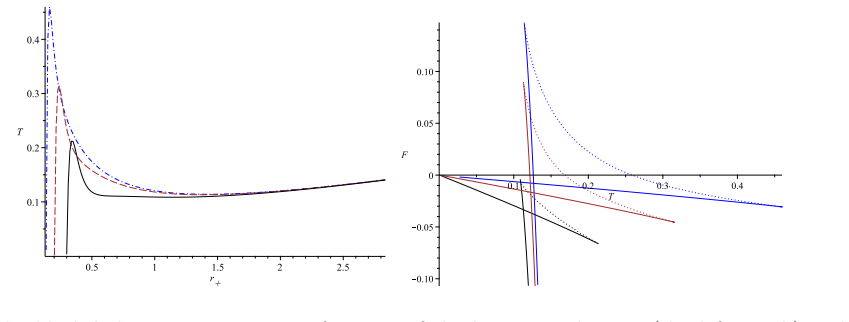
- In the canonical ensemble, the free energy predicts three coexisting phases (small, medium, and large) and a triple point for suitably tuned charge and cosmological constant, alongside ordinary first-order transitions.
- In the grand canonical ensemble, above a critical electric potential the small-black-hole phase disappears through a zero-temperature first-order transition, and the Gibbs free energy becomes discontinuous, implying a zeroth-order transition.
- The critical exponents take the classical mean-field values in all three thermodynamic descriptions considered, indicating a universality that goes beyond the particular ensemble.
- Extending the phase space to treat the cosmological constant as pressure and the nonlinear couplings as thermodynamic variables yields a Smarr relation and an extended first law.
Reading between the lines
- The same truncation-then-solve logic could be applied to rotating or higher-curvature analogues, potentially giving a whole family of multi-horizon black holes whose phase structure mirrors the nonlinear series length.
- The triple point appears to arise from the coexistence of multiple power-law terms in the metric function; a Landau-type free energy with two competing order parameters might reproduce the phase diagram without needing the full metric.
- The requirement that higher-order coefficients be tuned to zero suggests a testable hierarchy: if a UV completion produces generic coefficients, the five-horizon solution is a special limit rather than a generic prediction, and measurements of black-hole ringdown or shadows could constrain that tuning.
Editorial analysis
A structured set of objections, weighed in public.
Referee Report
Summary. The paper constructs a static, topological, charged black-hole solution in Einstein-dilaton gravity with a nonlinear electromagnetic Lagrangian of Gao type, L_ne = Σ_j α_j e^{-8αΦj/(n-1)} (F²)^j (Eq. (2)). Using a static ansatz (6) with R(r)=e^{2αΦ/(n-1)} and a Liouville dilaton potential (10), the authors obtain a closed-form metric function U(r) (Eq. (25)) whose gauge field is a four-term truncation of an infinite series (Eq. (22)). The truncation is enforced by tuning the nonlinear coefficients (Eq. (21)); the authors argue the procedure can be extended to arbitrarily many horizons. They analyze energy conditions (all four satisfied for the NED outside the horizon for the plotted cases; only NEC for the dilaton), derive the first law T=(∂M/∂S)_q, Φ_q=(∂M/∂q)_S, and develop Euclidean thermodynamics in the grand canonical and canonical ensembles, obtaining phase diagrams with first-order transitions, a possible triple point, and local-stability criteria. In extended phase space they derive an equation of state, find mean-field critical exponents (β=1/2, γ=1, δ=3, α=0), and give a Smarr relation (109) with the nonlinear couplings treated as thermodynamic variables.
Significance. The paper is a constructive extension of Gao's multihorizon construction [53] to dilaton gravity, and if the solution is exact it provides a new family of dilatonic black holes with up to five horizons and a correspondingly richer thermodynamic phase structure (triple point, multiple stable phases). The presentation has real virtues: the metric, temperature, mass, charge and free energies are given in closed form; the Lorentzian first law and the Euclidean results are cross-checked (entropy (44) is reproduced from the on-shell action; the Gauss-law charge (67) matches (49)); and the Smarr relation (109) is a nontrivial extension that treats the nonlinear couplings as thermodynamic variables. Because the construction is algebraic, every displayed formula is checkable, and this is exactly why the missing verification of the truncation conditions is decisive: the thermodynamic claims are interesting but contingent on the exactness of (22)-(25). The paper does not overstate its novelty relative to [53,57], and the energy-condition and phase-transition discussion is appropriately cautionary in places, but the abstract's energy-condition claim outruns the demonstration.
major comments (3)
- [§2, Eqs. (19)–(21)] Eq. (21) is internally inconsistent with the displayed coefficients (19)–(20). Substituting the printed α5 = −(176α2^4 − 132α2^2α3 + 9α3^2 + 16α2α4) into (19) does not produce b5 = 0; cancellation there would require α5 = 176α2^4 + 132α2^3α3 + 9α3^2 + 16α2α4. Likewise, inserting the printed α5 and α6 into the bracket of (20) leaves a non-zero residual at order b1^11, so the b6 coefficient does not vanish. Consequently the four-term field (22) and the metric (25) are not verified as written. Please correct the displayed conditions or show the consistent recursion.
- [§2, after Eq. (21)] The assertion following (21) that 'the following coefficients bi are set to zero as well and it always can be done' is not proved. With the four-term Er of (22), the left side of (13) is an infinite Laurent series in r, so matching the RHS requires infinitely many coefficient conditions; only the first two are exhibited. A sequential elimination may well exist — each new α_{i+1} appears linearly in bi (cf. (15)–(20)), so one can solve for it order by order — but the paper must state and prove this, or give the general recurrence. If any higher-order residual survives, (22) is not exact and the five-horizon solution and its thermodynamics collapse. This is load-bearing.
- [§2, Eqs. (3)–(5), (25)] The full field-equation verification is missing. The paper states that combining Ett and Err gives (11) and that 'the equations (3) and (4) give rise to' (23)–(24), but it never shows that (11), (22), (23)–(24), and (25) satisfy all components of (3) and the dilaton equation (4), including the angular components. Given the complexity of (25) and the unresolved truncation issue, this is not cosmetic. Please supply the explicit substitution (an appendix or supplementary notebook would suffice), so the exactness claim can be checked.
minor comments (4)
- [Notation; Eqs. (25), (48), (60), (76)] The symbol α2 is used both for the second nonlinear coefficient (e.g. (22), (34)) and for the square of the dilaton coupling α² (e.g. denominators n−2+α2 and 1−α2 in (25), (40), (48); also '1−α4' in (60) is presumably 1−α^4). This collision makes several formulas ambiguous; (76) even has 'n−2+a2'. Please use distinct notation, e.g. a_2 for the nonlinear coefficient.
- [§2.1 and Abstract] The abstract claims that for the nonlinear electromagnetic field 'all the energy conditions are fulfilled outside of the black hole', but §2.1 verifies this only numerically for one parameter set (Fig. 3) and then extrapolates. The explicit relations (34)–(35) are not analyzed in general. Either prove the relevant inequalities from (34)–(35) under stated conditions, or soften the abstract wording.
- [§5.1, Eq. (109)] The Smarr relation is derived 'via Euler homogeneous functions theorem', but the homogeneity weights and the explicit derivatives ∂M/∂α2, ∂M/∂α3, ∂M/∂α4 are not given, so (109)–(112) cannot be checked from the text. Please list the weights or provide the derivatives.
- [§2, Eq. (21); Eq. (83)] After (21), 'conditions on the higher order coefficients bi' should read 'coefficients αi'. Also, Eq. (83) contains a typo: the exponent '(4−3n)(1−g)' should be '(1−γ)'.
Circularity Check
No significant circularity: the multi-horizon solution is an explicit construction from the chosen action, not a fitted prediction; self-citations are not load-bearing.
full rationale
The central derivation starts from the action (1), the ansatze (6) and (9), the Liouville potential (10), and the field equations (3)-(5). The nonlinear coefficients α5 and α6 are chosen in Eq. (21) to truncate the electric-field series; this is a condition on the Lagrangian parameters, not a fit to an external target. The metric function U(r) in Eq. (25), the temperature (40), entropy (44), mass (46), charge (49), and potential (51) are all explicit consequences of that chosen solution, and the first law (52)-(53) is checked as internal consistency. The Euclidean actions in GCE and CE reproduce the same entropy, charge, and mass, again a consistency check rather than a circular prediction. References [13, 53, 57] supply the construction framework and known multi-horizon/thermodynamic phenomena from other authors; the author's own earlier papers are used for standard formulas or for quantities rederived here, and none of them alone carries the central existence claim. The main weakness is not circularity: after Eq. (21) the paper asserts that the higher coefficients 'always can be done' without proving consistency of the infinite set of truncation conditions, so the exactness of the truncated electric field (22) and of the five-horizon solution is an unverified algebraic claim — a correctness risk, not a circular reduction. No step of the derivation reduces by construction to its own input.
Assumptions & free parameters
free parameters (3)
- α (dilaton coupling) =
chosen by hand; e.g. 0.1, 0.3, 0.5 in figures
- b (integration constant / scale) =
set to 1 or 0.9 in figures
- Nonlinear coefficients α2, α3, α4 =
different choices in different figures, e.g. α2=-0.0893, α3=0.0295, α4=-0.01453
assumptions (7)
- ad hoc to paper Static topological metric ansatz with R(r)=exp(2αΦ/(n-1)), Eq. (6)-(9)
- ad hoc to paper Liouville-form dilaton potential V(Φ)=Σ Λ_k exp(λ_k Φ), Eq. (10), with λ0 and λ1 fixed by the solution
- domain assumption Normalization α1=1 to recover Maxwell theory in the linear limit
- ad hoc to paper Truncation constraints on α5, α6, ..., Eq. (21)
- domain assumption Entropy S = horizon area / 4 for this dilaton theory, Eq. (44)
- domain assumption Euclidean background subtraction, including β√U=β0√U0 and chosen reference backgrounds
- standard math Euler homogeneous-function theorem for deriving the Smarr relation, Eq. (110)
Cite this review
Pith. "Pith review of Static topological dilatonic black hole with multiple horizons and its thermodynamics." pith.science (2026). https://pith.science/paper/3OOEIGN5
@misc{pith2026260726535,
  author       = {Pith},
  title        = {Pith review of: Static topological dilatonic black hole with multiple horizons and its thermodynamics},
  year         = {2026},
  howpublished = {\url{https://pith.science/paper/3OOEIGN5}},
  note         = {Machine review of arXiv:2607.26535}
}
read the original abstract
We obtain a static topological charged black hole solution within Einstein-dilaton theory with nonlinear electromagnetic field represented by an infinite series over Maxwell field invariant. In contrast with standard Einstein-Maxwell-dilaton (EMD) theory where the black hole might have no more than two horizons, the nonlinear generalization might give rise to a solution with arbitrary number of horizons. We examine energy conditions and show that for the nonlinear electromagnetic field itself all the energy conditions are fulfilled outside of the black hole, whereas for the dilaton field the only condition which is not violated outside is the Null Energy Condition (NEC). We also study thermodynamics of the black hole and show that the thermal behaviour of the solution is considerably richer than for its standard EMD cousin. To have complete description of the thermodynamics we also use the Euclidean method, which allows us to consider the so-called Grand Canonical and Canonical Ensembles. The results obtained by different approaches show their consistency. The Euclidean description naturally allowed us to consider global stability, which is shown to have some common features with standard EMD solution, or even Reissner-Nordstr\"{o}m black hole. But there some new peculiarities caused by the nonlinear field, namely we might have additional stable phases and a triple point. To examine near critical behaviour we consider the extended phase space approach, where the cosmological constant is supposed to be a thermodynamic variable. Making use of the extended formalism we also obtain the Smarr relation.
Figures


Figures from the paper (12 more)




Reference graph
Works this paper leans on
-
[53]
Gao, Phys
C. Gao, Phys. Rev. D 104, 064038 (2021)
2021
-
[1]
Will, Liv
C. Will, Liv. Rev. Rel. 17, 4 (2014)
2014
-
[2]
B. P. Abbott, et al , Phys. Rev. Lett. 116, 061102 (2016)
2016
-
[3]
Brans, R
C. Brans, R. H. Dicke, Phys. Rev. 124, 925 (1961)
1961
-
[4]
Gibbons, K
G. Gibbons, K. Maeda, Nucl. Phys. B 298, 741 (1988)
1988
-
[5]
Garfinkle, G
D. Garfinkle, G. T. Horowitz, A. Strominger, Phys. Rev. D 43, 3140 (1991)
1991
-
[6]
Witten, Phys
E. Witten, Phys. Rev. D 44, 314 (1991)
1991
-
[7]
Kallosh, T
R. Kallosh, T. Ortin, Phys. Rev. D 48, 742 (1993)
1993
Show all 83 references
-
[8]
Gregory, J
R. Gregory, J. A. Harvey, Phys. Rev. D 47, 2411 (1993)
1993
-
[9]
S. J. Poletti, D. L. Wiltshire, Phys. Rev. D 50, 7260 (1994); Erratum Phys. Rev. D 52, 3753 (1995)
1994
-
[10]
R. G. Cai, J. Y. Ji, K. S. Soh, Phys. Rev. D 57, 6547 (1998)
1998
-
[11]
C. J. Gao, S. N. Zhang, Phys. Rev. D 70, 124019 (2004)
2004
-
[12]
S. S. Yazadjiev, Class. Quant. Grav. 22, 3875 (2005)
2005
-
[13]
Sheykhi, Phys
A. Sheykhi, Phys. Rev. D 76, 124025 (2007)
2007
-
[14]
Sheykhi, Phys
A. Sheykhi, Phys. Rev. D 77, 104022 (2008). 30
2008
-
[15]
Sheykhi, M
A. Sheykhi, M. Allahverdizadeh, Phys. Rev. D 78, 064073 (2008)
2008
-
[16]
Sen, Nucl
A. Sen, Nucl. Phys. B 440, 421 (1995)
1995
-
[17]
Cvetiˇ c, D
M. Cvetiˇ c, D. Youm, Phys. Rev. D 52, 2144 (1995)
1995
-
[18]
Cvetiˇ c, D
M. Cvetiˇ c, D. Youm, Nucl. Phys. B 472, 249 (1996)
1996
-
[19]
Cvetiˇ c, D
M. Cvetiˇ c, D. Youm, Nucl. Phys. B 476, 118 (1996)
1996
-
[20]
Chong, M
Z.-W. Chong, M. Cvetiˇ c, H. L¨ u, and C. N. Pope, Nucl. Phys. B 717, 246 (2005)
2005
-
[21]
Lavrelashvili, D
G. Lavrelashvili, D. Maison, Nucl. Phys. D 410, 407 (1993)
1993
-
[22]
Kleihaus, J
B. Kleihaus, J. Kunz, A. Sood, Phys. Rev. D 54, 5070 (1996)
1996
-
[23]
Kleihaus, J
B. Kleihaus, J. Kunz, Phys. Rev. Lett. 78, 2527 (1997)
1997
-
[24]
Brihaye, B
Y. Brihaye, B. Hartmann, J. Kunz, Phys. Rev. D 65, 024019 (2001)
2001
-
[25]
Kleihaus, J
B. Kleihaus, J. Kunz, F. Navarro-Lerida, Phys. Rev. D 69, 064028 (2004)
2004
-
[26]
E. Radu, D. H. Tchrakian, Class. Quant. Grav. 22, 879 (2005)
2005
-
[27]
M. M. Stetsko, Phys. Rev. D 101, 124017 (2020)
2020
-
[28]
M. M. Stetsko, Int. J. Mod. Phys. A 36, 2150034 (2021)
2021
-
[29]
M. M. Stetsko, Gen. Rel. Grav. 53, 2 (2021)
2021
-
[30]
Mazur, J
D. Mazur, J. S. Heyl, MNRAS 412, 1381 (2011)
2011
-
[31]
J. Y. Kim, Eur. Phys. J. C 82, 485 (2022)
2022
-
[32]
A. G. Suvorov, J. A. Pons, MNRAS 539, 3655 (2025)
2025
-
[33]
G. A. Porto, J. P. Pereira, G. Bittencourt, E. Guzm´ an-Herr era, Astrophys. J. 1005, 220 (2026)
2026
-
[34]
Heisenberg, H
W. Heisenberg, H. Euler, Zeitschrift f¨ ur Physik, 98, 714 (1936)
1936
-
[35]
G. V. Dunne, Int. J. Mod. Phys.: Conf. Series 14, 42 (2012)
2012
-
[36]
M. Born, L. Infeld, Proc. Roy. Soc. A 144, 425 (1934)
1934
-
[37]
Hassa ¨ ıne, C
M. Hassa ¨ ıne, C. Martinez, Class. Quant. Grav. 25, 195023 (2008)
2008
-
[38]
Maeda, M
H. Maeda, M. Hassa ¨ ıne, C. Martinez, Phys. Rev. D 79, 044012 (2009)
2009
-
[39]
Bandos, K
I. Bandos, K. Lechner, D. Sorokin, P. K. Townsend, Phys. Re v. D 102, 121703 (2020)
2020
-
[40]
Ay´ on-Beato, A
, E. Ay´ on-Beato, A. Garc ´ ıa, Phys. Rev. Lett.80, 5056 (1998)
1998
-
[41]
Cai, D.-W
R.-G. Cai, D.-W. Pang, A. Wang, Phys. Rev. D 70, 124034 (2004)
2004
-
[42]
S. H. Hendi, E. Eslam Panah, S. Panahiyan, JHEP 11, 157 (2015)
2015
-
[43]
Flores-Alfonso, B
D. Flores-Alfonso, B. A. Gonz´ alez-Moralez, R. Linares, M. Ma ceda, Phys. Lett. B 812, 136011 (2021)
2021
-
[44]
Bokuli´ c, C
A. Bokuli´ c, C. A. R. Herdeiro, Phys. Rev. 111, 064046 (2025)
2025
-
[45]
I. Zh. Stefanov, S. S. Yazadjiev, M. D. Todorov, Phys. Rev. D 75, 084036 (2007)
2007
-
[46]
S. H. Mazharimousavi, M. Halilsoy, Int. J. Mod. Phys. A 30, 1550177 (2015)
2015
-
[47]
M. M. Stetsko, Phys. Rev. D 99, 044028 (2019)
2019
-
[48]
M. M. Stetsko, Phys. Rev. D 101, 104004 (2020)
2020
-
[49]
Kord Zangeneh, A
M. Kord Zangeneh, A. Sheykhi, M. H. Dehghani, Phys. Rev. D 91, 044035 (2015)
2015
-
[50]
M. H. Dehghani, M. R. Setare, Phys. Rev. D 100, 044022 (2019)
2019
-
[51]
Nojiri, S
S. Nojiri, S. D. Odintsov, Phys. Rev. D 96, 104008 (2017)
2017
-
[52]
C. Gao, Y. Lu, S. Yu, Y. G. Shen, Phys. Rev. D 97, 104013 (2018)
2018
-
[54]
Bravo-Gaete, M
M. Bravo-Gaete, M. B. Ahmed, R. B. Mann, C. Quijada, arxiv:26 05.24783
-
[55]
Pleba´ nski, Lectures on Non-Linear Electrodynamics Nordita, (1968)
J. Pleba´ nski, Lectures on Non-Linear Electrodynamics Nordita, (1968)
1968
-
[56]
Humberto Salazar I., Alberto Garcia D., Jerzy Pleba´ nski, J. Mat h. Phys. 28, 2171 (1987)
1987
-
[57]
Tavakoli, J
M. Tavakoli, J. Wu, R. B. Mann, JHEP 12, 117 (2022). 31
2022
-
[58]
C. Fang, J. Jiang, M. Zhang, JHEP 01, 102 (2023)
2023
-
[59]
J. Yang, R. B. Mann, JHEP 08, 028 (2023)
2023
-
[60]
R. M. Wald, General Relativity, U. Chicago Press (1984)
1984
-
[61]
Kontou, K
E.-A. Kontou, K. Sanders, Class. Quant. Grav. 37, 193001 (2020)
2020
-
[62]
Bokuli´ c, I
A. Bokuli´ c, I. Smoli´ c, T. Juri´ c, Phys. Rev. D103, 124059 (2021)
2021
-
[63]
Brimingham, Class
D. Brimingham, Class. Quant. Grav. 16, 1197 (1999)
1999
-
[64]
V. Iyer, R. M. Wald, Phys. Rev. D 50, 846 (1994)
1994
-
[65]
M. M. Stetsko, Eur. Phys. J. C 79, 244 (2019)
2019
-
[66]
J. D. Brown, J. M. York, Phys. Rev. D 47, 1407 (1993)
1993
-
[67]
W Gibbons, S
G. W Gibbons, S. W. Hawking, Phys. Rev. D 15, 2572 (1977)
1977
- [68]
-
[69]
Chamblin, R
A. Chamblin, R. Emparan, C. V. Johnson, R. C. Myers, Phys.Rev . D 60, 064018 (1999)
1999
-
[70]
Chamblin, R
A. Chamblin, R. Emparan, C. V. Johnson, R. C. Myers, Phys.Rev . D 60, 104026 (1999)
1999
-
[71]
J. F. Pedraza, W. Sybesma, M. R. Wisser, Class. Quant. Grav. 36, 054002 (2019)
2019
-
[72]
S. W. Hawking, S. F. Ross, Phys. Rev. D 52, 5865 (1995)
1995
-
[73]
Altamirano, D
N. Altamirano, D. Kubizˇ n´ ak, R. B. Mann, Z. Sherkatghanad,Class. Quant. Grav. 31, 042001 (2014)
2014
-
[74]
Dehghani, S
A. Dehghani, S. H. Hendi, R. B. Mann, Phys. Rev. D 101, 084026 (2020)
2020
-
[75]
Kastor, S
D. Kastor, S. Ray, J. Traschen, Class. Quant. Grav. 26, 195011 (2009)
2009
-
[76]
Dolan, Class
B. Dolan, Class. Quant. Grav. 28, 125020 (2011)
2011
-
[77]
Gunasekaran, D
S. Gunasekaran, D. Kubizˇ n´ ak, R. B. Mann, JHEP 10, 110 (2012)
2012
-
[78]
Wei, Y.-X
S.-W. Wei, Y.-X. Liu, Phys. Rev. D 90, 044057 (2014)
2014
-
[79]
Kubizˇ n´ ak, R
D. Kubizˇ n´ ak, R. B. Mann, M. Teo, Class. Quant. Grav. 34, 063001 (2017)
2017
-
[80]
M. H. Dehghani, S. H. Kamrani, A. Sheykhi, Phys. Rev. D 90, 104020 (2014)
2014
-
[81]
Dayyani, A
Z. Dayyani, A. Sheykhi, M. H. Dehghani, Phys. Rev. D 95, 084004 (2017)
2017
-
[82]
Gulin, I
L. Gulin, I. Smoli´ c, Class. Quant. Grav. 35, 025015 (2018)
2018
-
[83]
Zhang, S
Y. Zhang, S. Gao, Class. Quant. Grav. 35, 145007 (2018) 32
2018
Reviewed August 1, 2026 · model on record in the stance chip above.
Discussion (0). Continue with ORCID to comment.