REVIEW 2 major objections 5 minor 46 references
This paper claims that a base station with electromagnetically reconfigurable antennas can learn a staged active-sensing policy that progressively refines multi-user position estimates, and that a practical finite-state ERA codebook perform
Reviewed by Pith at T0; open to challenge. T0 means a machine referee read the full paper against a public rubric. the ladder, T0–T4 →
A learned LSTM-GNN policy that sequentially reconfigures a shared reconfigurable antenna aperture improves multi-user wireless localization accuracy over fixed-pattern arrays in simulation.
T0 review reviewed 2026-08-01 challenge →
load-bearing objection Solid learning-based multi-user ERA localization, convincingly demonstrated in simulation but with hardware transfer conditional on an unverified phase-free ERA model. the 2 major comments →
Multi-User Localization via Active Sensing with Electromagnetically Reconfigurable Antennas
The pith
A machine-rendered reading of the paper's core claim, the machinery that carries it, and where it could break.
The reading
Core claim
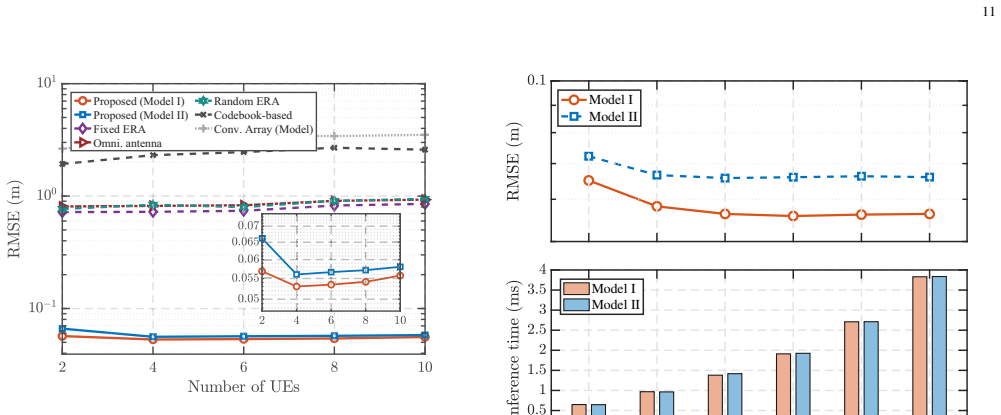
Under a synchronized wideband geometric channel model, the paper defines the joint design of stage-wise ERA configuration policies and localization policies as the minimization of the weighted cumulative multi-user position error (problem P1). Because the observations are high-dimensional and the users are coupled through the shared aperture, the authors parameterize both policies with a neural network that is unrolled over sensing stages. Their numerical finding is that the learned policy yields position estimates whose RMSE decreases monotonically across stages, that the finite-state measured codebook nearly matches the idealized spherical-harmonic synthesis model, and that removing the re
What carries the argument
The load-bearing mechanism is the two-timescale active sensing loop: at stage level, a recurrent LSTM summarizes all pilot observations up to the current stage into per-user states; a graph neural network then propagates messages between users to account for the shared-aperture coupling; attention pooling forms a global context; and model-specific heads output either continuous spherical-harmonic coefficients (Model I) or one-hot selections from a measured radiation codebook via Gumbel-Softmax with straight-through estimation (Model II), while a localization head outputs stage-wise position estimates. The ERA radiation response multiplies the array steering vector element-wise in the channel
Load-bearing premise
The load-bearing premise is that each ERA state can be represented as a frequency-flat, phase-free directional amplitude gain shared by all subcarriers, with no coupling between elements—if real states add phase variation, frequency selectivity, or coupling, the coherent array response changes and the learned policy may not transfer.
What would settle it
Measure the complex (amplitude and phase) radiation pattern of each ERA state on a real device, and simulate or test the trained policy with those measured patterns including state-dependent phase and mutual coupling; if the stage-wise RMSE no longer decreases or falls below the fixed-ERA baseline, the frequency-flat amplitude-only model is the reason.
If this is right
- If the result holds, an ERA-equipped base station can refine multi-user localization over a few sensing stages with no additional antennas or bandwidth, enabling early termination when accuracy targets are met.
- The close performance of the finite-state measured codebook suggests practical hardware can capture most of the benefit of arbitrary pattern synthesis.
- The shared, permutation-invariant policy accommodates a variable number of users, so the same trained system can serve different cell loads.
- Because random reconfiguration does not help, the benefit requires observation-adaptive configuration—so the learning loop, not just pattern diversity, is essential.
- The sensitivity to clock bias and LoS blockage implies the learned policy is calibrated to the nominal synchronized geometric channel distribution and should not be expected to transfer to unsynchronized or heavily blocked environments without retraining.
Where Pith is reading between the lines
- One testable extension is to train with state-dependent phase and mutual coupling in the channel model; if the architecture still refines estimates, the approach would be more hardware-robust than the current amplitude-only model suggests.
- The same encoder-LSTM-GNN template could apply to other shared-aperture sensing problems, such as radar-like mapping or multi-target channel estimation, where a common configuration must serve several directions at once.
- The stage-weight decay results hint at a tunable exploration-exploitation schedule in the EM domain; a principled schedule could be learned rather than fixed.
- A real-device experiment comparing stage-wise RMSE against the simulated curves would directly test whether the learned policies transfer to hardware, since the reported latency excludes transmission and reconfiguration delays.
Editorial analysis
A structured set of objections, weighed in public.
Referee Report
Summary. This paper studies active sensing for multi-user localization at a BS equipped with electromagnetically reconfigurable antennas (ERAs). The BS receives uplink pilots from K single-antenna UEs over T stages, with P pilot blocks per stage; the shared ERA configuration can be changed between stages based on historical observations. The authors introduce two ERA models: a spherical-harmonic synthesis model (Model I) and a measured finite-state codebook model (Model II). They formulate the joint design of the ERA configuration policy and the localization policy as a cumulative stage-weighted squared error problem (P1), and propose a CNN-LSTM-GNN architecture with model-specific output heads, trained end-to-end via Adam with a straight-through Gumbel-Softmax for Model II. Numerical experiments under a synthetic wideband geometric channel (1 LoS + 3 NLoS paths, fixed channel distribution, 3–8 active UEs) show progressive RMSE reduction over stages, gains over fixed/random ERA, omnidirectional, codebook-based, and model-based baselines, and close performance between Model II and Model I. Ablations indicate roles for the LSTM, GNN, and attention pooling, and robustness tests cover LoS blockage, clock bias, and amplitude perturbations.
Significance. If the results hold, the paper makes a useful step toward sequential, shared-aperture ERA sensing for multi-user localization. Its main strengths are the unified treatment of two ERA modeling paradigms, the architecture that handles variable numbers of users through shared-weight LSTM and GNN modules, the inclusion of several relevant baselines and ablations, and a transparent statement of scope: the conclusion explicitly limits claims to the considered synchronized, calibrated channel distribution. The paper does not provide theoretical guarantees, but the empirical evidence is internally consistent under its stated assumptions. The principal gap is the absence of any validation of the finite-state model against state-dependent phase behavior or mutual coupling, which matters for the 'practically implementable' claim.
major comments (2)
- [§II-B2, Eq. (10); §V-E, Fig. 11] The finite-state model treats each ERA state as a real, nonnegative, frequency-flat gain b_M(ϑ) and explicitly excludes state-dependent phase variations and mutual coupling. However, the channel in Eq. (5) depends on the complex product a(ϑ_{k,ℓ}) ⊙ g_{t,p}(ϑ_{k,ℓ}); if practical ERA states impose an angle-dependent phase, the coherent array response and the learned configuration policy will differ from the simulated manifold. The pattern-perturbation robustness test in Fig. 11 applies only amplitude perturbations (˜b_s = b_s 10^{ε/20}); it does not inject phase perturbations. Therefore the paper's claim that Model II is a 'practically implementable' model and that its performance is 'close to Model I' is not yet supported for real ERA hardware. Please add a phase-perturbation experiment (or use a complex measured codebook), and soften the 'practically implementable' wording to 'under th
- [§V, Figs. 7–11 and Table III] All quantitative results are single-run point estimates; no error bars, confidence intervals, or random-seed variation are reported. The differences between Model I and Model II are small in several regimes (e.g., Fig. 8), and the ablation degradation values in Table III are relative percentages (4.3%, 6.1%, 13.1%). Without run-to-run statistics, the comparative claims—especially the 'close to Model I' claim and the ranking of ablations—are not statistically grounded. Please report means and standard deviations over at least three independent training runs, or otherwise quantify the uncertainty.
minor comments (5)
- [§III (first paragraph)] Typo: 'we proposes' should be 'we propose.'
- [§VI (Conclusion)] Typo: 'Specificity' should be 'Specifically.'
- [§IV-C2, Eq. (26)] The Gumbel-Softmax relaxation is attributed to [44], but that reference is a temperature-scaling study and does not introduce Gumbel-Softmax. Please cite the original Gumbel-Softmax papers (e.g., Jang et al., 2017; Maddison et al., 2017) in addition to or instead of [44].
- [§II-B2] The normalization condition is given as a continuous integral over |b_M(ϑ)|², but the library is described as discrete 721×361 samples. Please specify how the discrete normalization is implemented.
- [§V-C, baselines 4 and 5] The model-based MUSIC/DFT baselines are described briefly. Please provide a few more details (e.g., number of paths assumed by MUSIC, whether wideband operation uses per-subcarrier processing or a joint approach), so the baseline strength can be assessed.
Circularity Check
No significant circularity: the central claim is a held-out numerical comparison; self-citation [29] is background only.
full rationale
Walking the derivation chain: the paper defines the coupled problem in (14) and trains the network with the mask-normalized objective (29). It does not fit any parameter to the evaluation set; Section V-E states 'we generate another 5,120 independent samples and evaluate the fully trained proposed framework and all baselines'. All schemes share 'the same geometric channel distribution, active-user masks, and total pilot-block budget'. Therefore the reported progressive RMSE reduction and superiority over fixed/random/omni baselines is an empirical, held-out result, not an identity with the training objective. The most self-citation-adjacent step is [29] ('active sensing was further combined with ERA-assisted localization in [29]'), but the paper explicitly distinguishes its contribution: 'these studies are mainly developed for RIS-assisted systems or single-user localization, and therefore do not address the shared-aperture sensing design' and Table I marks [29] as single-user. So the multi-user contribution is not imported from that citation. The SH synthesis and measured-codebook models are cited to external references [10],[17],[37]; no uniqueness theorem from the authors is invoked. The paper also states its own limits: 'results should be interpreted within the considered channel distribution and under ideal training assumptions', and Section II-B2 notes 'State-dependent phase variations are not included in the available pattern data' and 'Element-wise mutual coupling among elements is not explicitly modeled'. These are acknowledged scope limitations, not disguised circularity. Overall, no load-bearing derivation reduces to its inputs; only a minor, non-load-bearing self-citation prevents a fully clean 0.
Axiom & Free-Parameter Ledger
free parameters (5)
- SHOD truncation order Q =
25
- Stage-weight decay factor γ =
1 (equal weights α_t=1/T)
- Gumbel-Softmax temperature schedule =
τ0=1.25 annealed to τmin=0.35 over 0.9I
- Initial first-stage ERA probing =
Azimuths uniformly in [-60°,60°], elevation 0°, SH orders ℓ≤1 tapered by 0.35^ℓ; Model II states chosen for max gain
- Training hyperparameters =
hidden dim 256, batch 128, 50k iterations, lr 1e-3, weight decay 1e-6, grad clip 1.0
axioms (6)
- domain assumption Perfect synchronization between BS and UEs, so delays are purely geometric.
- domain assumption Channel = LoS + three single-bounce NLoS paths with free-space amplitudes.
- domain assumption ERA gain is frequency-flat and shared across subcarriers.
- domain assumption Model II radiation states are amplitude-only with equal total power and no mutual coupling.
- domain assumption Spherical harmonics provide a complete basis for radiation patterns; Q=25 truncation is sufficient.
- ad hoc to paper A shared-weight deep network can approximate the optimal active-sensing and localization mappings.
Cite this review
Pith. "Pith review of Multi-User Localization via Active Sensing with Electromagnetically Reconfigurable Antennas." pith.science (2026). https://pith.science/paper/QFYXQBVA
@misc{pith2026260726605,
  author       = {Pith},
  title        = {Pith review of: Multi-User Localization via Active Sensing with Electromagnetically Reconfigurable Antennas},
  year         = {2026},
  howpublished = {\url{https://pith.science/paper/QFYXQBVA}},
  note         = {Machine review of arXiv:2607.26605}
}
read the original abstract
This paper investigates multi-user localization in uplink wireless systems assisted by electromagnetically reconfigurable antennas (ERAs). Unlike traditional localization schemes, we formulate an active sensing problem where a base station (BS) exploits historical pilot observations accumulated over previous sensing stages to adapt the shared ERA configuration and progressively refine position estimates. To capture both theoretical flexibility and practical hardware constraints, we establish a unified wideband geometric signal model accommodating two complementary ERA paradigms: a synthesis-based model utilizing spherical-harmonic basis functions, and a finite-state model based on measured radiation codebooks. Because analytically solving the resulting joint design problem is highly intractable due to the high-dimensional observation and the shared-aperture coupling among multiple users, we develop a learning-based active sensing framework. Specifically, pilot-matched wideband observations are compressed into compact user-wise features and sequentially accumulated by a long short-term memory (LSTM) module. These temporal features are then processed by a graph neural network (GNN) to capture multi-user shared-aperture coupling. Model-specific output heads generate either continuous synthesis coefficients or finite-state ERA selections, while a localization head produces stage-wise position estimates. Numerical results under a specific channel distribution show that the proposed ERA-assisted active sensing framework achieves progressive localization refinement across sensing stages and obtains better performance than conventional non-reconfigurable arrays and representative ablation baselines.
Figures




Reference graph
Works this paper leans on
-
[1]
Localization as a Key Enabler of 6 G Wireless Systems: A Comprehensive Survey and an Outlook,
S. E. Trevlakis et al., “Localization as a Key Enabler of 6 G Wireless Systems: A Comprehensive Survey and an Outlook,” IEEE Open J. Commun. Soc., vol. 4, pp. 2733-2801, 2023
2023
-
[2]
Toward 6G with Teraher tz Com- munications: Understanding the Propagation Channels,
X. Cai, X. Cheng and F. Tufvesson, “Toward 6G with Teraher tz Com- munications: Understanding the Propagation Channels,” IEEE Commun. Mag., vol. 62, no. 2, pp. 32-38, Feb. 2024
2024
-
[3]
High-accuracy localization for ass isted living: 5G systems will turn multipath channels from foe to friend,
K. Witrisal et al., “High-accuracy localization for ass isted living: 5G systems will turn multipath channels from foe to friend,” IEEE Signal Process. Mag., vol. 33, no. 2, pp. 59-70, Mar. 2016
2016
-
[4]
Intelligent reflecting sur- face enhanced indoor robot path planning: A radio map-based approach,
X. Mu, Y . Liu, L. Guo, J. Lin, and R. Schober, “Intelligent reflecting sur- face enhanced indoor robot path planning: A radio map-based approach,” IEEE Trans. Wireless Commun., vol. 20, no. 7, pp. 4732-4747, Jul. 2021
2021
-
[5]
A Survey on the Impact of Multipath on Wideband Time-of-Arrival-Based Localizat ion,
S. Aditya, A. F. Molisch and H. M. Behairy, "A Survey on the Impact of Multipath on Wideband Time-of-Arrival-Based Localizat ion," Proc. IEEE, vol. 106, no. 7, pp. 1183-1203, Jul. 2018
2018
-
[6]
Scaling up MIMO: Opportunities and chal lenges with very large arrays,
F. Rusek et al., “Scaling up MIMO: Opportunities and chal lenges with very large arrays,” IEEE Signal Process. Mag., vol. 30, no. 1, pp. 40-60, Jan. 2013
2013
-
[7]
A Survey of Beam Management for mmWave and T Hz Communications Towards 6G,
Q. Xue et al., “A Survey of Beam Management for mmWave and T Hz Communications Towards 6G,” IEEE Commun. Surveys Tuts., vol. 26, no. 3, pp. 1520-1559, 2024
2024
-
[8]
Reconfigurable Massive MIMO: Precoding D esign and Channel Estimation in the Electromagnetic Domain,
K. Ying et al., “Reconfigurable Massive MIMO: Precoding D esign and Channel Estimation in the Electromagnetic Domain,” IEEE Trans. Commun., vol. 73, no. 5, pp. 3423-3440, May 2025
2025
-
[9]
Successive Localization and B eamforming in 5G mmWave MIMO Communication Systems,
B. Zhou, A. Liu and V . Lau, “Successive Localization and B eamforming in 5G mmWave MIMO Communication Systems,” IEEE Trans. Signal Process., vol. 67, no. 6, pp. 1620-1635, 15 March, 2019
2019
-
[10]
Electromagnetically Reconfigurable Fl uid Antenna System for Wireless Communications: Design, Modeling, Alg orithm, Fabrication, and Experiment,
R. Wang et al., “Electromagnetically Reconfigurable Fl uid Antenna System for Wireless Communications: Design, Modeling, Alg orithm, Fabrication, and Experiment,” IEEE J. Sel. Areas Commun., vol. 44, pp. 1464-1479, 2026
2026
-
[11]
A novel pixel-based reconfigurable ant enna applied in fluid antenna systems with high switching speed,
J. Zhang et al., “A novel pixel-based reconfigurable ant enna applied in fluid antenna systems with high switching speed,” IEEE Open J. Antennas Propag., vol. 6, no. 1, pp. 212-228, Feb. 2025
2025
-
[12]
Tri-timescale beamforming design for tr i-hybrid archi- tectures with reconfigurable antennas,
M. Liu et al., “Tri-timescale beamforming design for tr i-hybrid archi- tectures with reconfigurable antennas,” arXiv preprint arXiv:2503.03620, 2025
arXiv 2025
-
[13]
Characteristic mode analysis of ESPAR fo r single-RF MIMO systems,
Z. Han et al., “Characteristic mode analysis of ESPAR fo r single-RF MIMO systems,” IEEE Trans. Wireless Commun., vol. 20, no. 4, pp. 2353-2367, Apr. 2021
2021
-
[14]
P . Zheng et al., “Tri-Hybrid Multi-User Precoding Usin g Pattern- Reconfigurable Antennas: Fundamental Models and Practical Algo- rithms,” arXiv preprint arXiv:2505.08938, 2025
Pith/arXiv arXiv 2025
-
[15]
A Survey on Reconfigurable and Movable Ante nnas for Wireless Communications and Sensing,
W. Ma et al., "A Survey on Reconfigurable and Movable Ante nnas for Wireless Communications and Sensing," IEEE Commun. Surveys Tuts., vol. 28, pp. 4842-4882, 2026
2026
-
[16]
P . Zheng et al., “Electromagnetically Reconfigurable A ntennas for 6G: Enabling Technologies, Prototype Studies, and Research Ou tlook,” arXiv preprint arXiv:2506.00657, 2025
arXiv 2025
-
[17]
Hybrid Codebook Design for Localiza tion Using Electromagnetically Reconfigurable Fluid Antenna System,
A. Fadakar et al., "Hybrid Codebook Design for Localiza tion Using Electromagnetically Reconfigurable Fluid Antenna System, " IEEE J. Sel. Topics Signal Process., early access, pp. 1-16, 2026
2026
-
[18]
A Tutorial on Movable Antennas for Wirele ss Networks,
L. Zhu et al., “A Tutorial on Movable Antennas for Wirele ss Networks,” IEEE Commun. Surveys Tuts., vol. 28, pp. 3002-3054, 2026
2026
-
[19]
6D Movable Antenna-Aided Hybrid Beamf orming for Multi-User Communications,
Y . Zhang et al., “6D Movable Antenna-Aided Hybrid Beamf orming for Multi-User Communications,” 2024 IEEE Globecom Worksh ops (GC Wkshps), Cape Town, South Africa, 2024, pp. 1-6
2024
-
[20]
A Tutorial on Fluid Antenna System for 6 G Networks: Encompassing Communication Theory, Optimizati on Methods and Hardware Designs,
W. K. New et al., “A Tutorial on Fluid Antenna System for 6 G Networks: Encompassing Communication Theory, Optimizati on Methods and Hardware Designs,” IEEE Commun. Surveys Tuts., vol. 27, no. 4, pp. 2325-2377, Aug. 2025
2025
-
[21]
Direction-of-arrival estimatio n using radiation power pattern with an ESPAR antenna,
E. Taillefer et al., “Direction-of-arrival estimatio n using radiation power pattern with an ESPAR antenna,” IEEE Trans. Antennas Propag., vol. 53, no. 2, pp. 678-684, 2005
2005
-
[22]
Direction-of-arrival estimation with single-RF ESPAR antennas via sparse signal reconstruction,
R. Qian et al., “Direction-of-arrival estimation with single-RF ESPAR antennas via sparse signal reconstruction,” in 2015 IEEE 16th Interna- tional W orkshop on Signal Processing Advances in Wireless C ommuni- cations (SPAWC), 2015, pp. 485-489
2015
-
[23]
Simple 2-D direction-of-arrival estimatio n using an ESPAR antenna,
L. Kulas, “Simple 2-D direction-of-arrival estimatio n using an ESPAR antenna,” IEEE Antennas Wireless Propag. Lett. vol. 16, pp. 2513-2516, 2017
2017
-
[24]
Single-anchor indoor localizati on using ESPAR antenna,
M. Rzymowski et al., “Single-anchor indoor localizati on using ESPAR antenna,” IEEE Antennas Wireless Propag. Lett., vol. 15, pp. 1183-1186, 2016
2016
-
[25]
Active learning and CSI acquisition for mmWave initial alignment,
S.-E. Chiu et al., “Active learning and CSI acquisition for mmWave initial alignment,” IEEE J. Sel. Areas Commun., vol. 37, no. 11, pp. 2474- 2489, Nov. 2019
2019
-
[26]
Active sensing for communications b y learning,
F. Sohrabi et al., “Active sensing for communications b y learning,” IEEE J. Sel. Areas Commun., vol. 40, no. 6, pp. 1780-1794, Jun. 2022
2022
-
[27]
Active sensing for two- sided beam alignment using ping-pong pilots,
T. Jiang, F. Sohrabi, and W. Y u, “Active sensing for two- sided beam alignment using ping-pong pilots,” in Proc. Asilomar Conf. Signals Syst. Comput., Pacific Grove, California, USA, Nov. 2022, pp. 913-918
2022
-
[28]
Active sensing for reciprocal MIMO channels,
T. Jiang, and W. Y u, “Active sensing for reciprocal MIMO channels,” IEEE Trans. Signal Process., vol. 72, pp. 2905-2920, 2024
2024
-
[29]
User Localization via Active Sens- ing with Electromagnetically Reconfigurable Antennas,
R. Zhang, Y . Zhang, and Y . Zhang, “User Localization via Active Sens- ing with Electromagnetically Reconfigurable Antennas,” arXiv preprint arXiv:2601.20501, 2026
arXiv 2026
-
[30]
Localization in multipath environment s via active sensing with reconfigurable intelligent surfaces,
Y . Li and W. Y u, “Localization in multipath environment s via active sensing with reconfigurable intelligent surfaces,” IEEE Commun. Lett., vol. 28, no. 9, pp. 2061-2065, Sep. 2024
2061
-
[31]
Active sensing for locali zation with reconfigurable intelligent surface,
Z. Zhang, T. Jiang, and W. Y u, “Active sensing for locali zation with reconfigurable intelligent surface,” in Proc. IEEE Int. Conf. Commun. (ICC), Rome, Italy, May 2023, pp. 4261-4266
2023
-
[32]
Localization with reconfi gurable intelligent surface: An active sensing approach,
Z. Zhang, T. Jiang, and W. Y u, “Localization with reconfi gurable intelligent surface: An active sensing approach,” IEEE Trans. Wireless Commun., vol. 23, no. 7, pp. 7698-7711, Jul. 2024
2024
-
[33]
Learning Beamforming Codebooks for Active Sensing With Reconfigurable Intelligent Surface,
Z. Zhang and W. Y u, "Learning Beamforming Codebooks for Active Sensing With Reconfigurable Intelligent Surface," IEEE Trans. Wireless Commun., vol. 24, no. 8, pp. 6504-6517, Aug. 2025
2025
-
[34]
Active Sensing for Multiuse r Beam Tracking With Reconfigurable Intelligent Surface,
H. Han, T. Jiang, and W. Y u, “Active Sensing for Multiuse r Beam Tracking With Reconfigurable Intelligent Surface,” IEEE Trans. Wireless Commun., vol. 24, no. 1, pp. 540-554, Jan. 2025
2025
-
[35]
Graph neural networks for scalable rad io resource management: Architecture design and theoretical analysis ,
Y . Shen, et al., “Graph neural networks for scalable rad io resource management: Architecture design and theoretical analysis ,” IEEE J. Sel. Areas Commun., vol. 39, no. 1, pp. 101–115, Jan. 2021
2021
-
[36]
J. Chen et al., “Integrated Sensing and Communication w ith Tri- Hybrid Beamforming Across Electromagnetically Reconfigur able Anten- nas,” arXiv preprint, arXiv:2510.14530, 2025
arXiv 2025
-
[37]
Unified array manifold decomposition b ased on spherical harmonics and 2-D fourier basis,
M. Costa et al., “Unified array manifold decomposition b ased on spherical harmonics and 2-D fourier basis,” IEEE Trans. Signal Process., vol. 58, no. 9, pp. 4634-4645, 2010
2010
-
[38]
Why deep neural networks for fu nction approximation?
S. Liang and R. Srikant, “Why deep neural networks for fu nction approximation?” in Proc. Int. Conf. Learn. Represent. (ICLR), Toulon, France, 2017
2017
-
[39]
Role of deep learning in wireless communic ations,
W. Y u et al., “Role of deep learning in wireless communic ations,” IEEE BITS Inf. Theory Mag., vol. 2, no. 2, pp. 56-72, Nov. 2022
2022
-
[40]
Deep Sets,
M. Zaheer, et al., “Deep Sets,” Adv. Neural Inf. Process. Syst. (NeurIPS), vol. 30, pp. 3391–3401, 2017
2017
-
[41]
Set Transformer: A framework for attent ion-based permutation-invariant neural networks,
J. Lee, et al., “Set Transformer: A framework for attent ion-based permutation-invariant neural networks,” Proc. 36th Int. Conf. Mach. Learn. (ICML), vol. 97, pp. 3744–3753, Jun. 2019
2019
-
[42]
Learning to reflect and t o beamform for intelligent reflecting surface with implicit channel es timation,
T. Jiang, H. V . Cheng, and W. Y u, “Learning to reflect and t o beamform for intelligent reflecting surface with implicit channel es timation,” IEEE J. Sel. Areas Commun., vol. 39, no. 7, pp. 1931-1945, Jul. 2021
1931
-
[43]
A Deep Learning Framework for Joint Cha nnel Acqui- sition and Communication Optimization in Movable Antenna S ystems,
R. Zhang et al., "A Deep Learning Framework for Joint Cha nnel Acqui- sition and Communication Optimization in Movable Antenna S ystems," IEEE Trans. Wireless Commun., vol. 25, pp. 14471-14485, 2026
2026
-
[44]
H. Xuan, B. Y ang, and X. Li, “Exploring the impact of temp erature scaling in softmax for classification and adversarial robus tness,” arXiv preprint arXiv:2502.20604, 2025
Pith/arXiv arXiv 2025
-
[45]
Adam: A method for stochastic opt imization,
D. P . Kingma and J. Ba, “Adam: A method for stochastic opt imization,” Proc. Int. Conf. Learn. Represent. (ICLR), San Diego, CA, USA, 2015
2015
-
[46]
Neural networks and machine learning,
A. Sayal et al., “Neural networks and machine learning, ” Proc. 2023 IEEE 5th Int. Conf. Cybernetics, Cognition Machine Learn. A ppl. (ICC- CMLA), Hamburg, Germany, pp. 58-63, 2023
2023
This paper was first reviewed by deepseek-v4-flash on August 1, 2026.
discussion (0)
Sign in with ORCID, Apple, or X to comment. Anyone can read and Pith papers without signing in.