REVIEW 3 major objections 5 minor 43 references
Galvanic Vestibular Stimulation in Latent Space
T0 review · 3 major / 5 minor · reviewed 2026-08-01 · deepseek-v4-flash
Pith's one-line read Text-described sensations can be turned into GVS waveforms people match to visual scenes.
desk verdict A genuinely useful first dataset for text-GVS pairing, but the behavioral validation never isolates synthesis from plain retrieval, so the headline feasibility claim remains unproven. read the letter →
The pith
A machine-rendered reading of the paper's core claim, the machinery that carries it, and where it could break.
The reading
What carries the argument
The retrieval-guided 1D-CNN variational autoencoder. Waveforms are encoded into a latent space; for a new text prompt, the system retrieves the top-K semantically similar waveform–text records, computes fusion weights from text similarity, local latent sensitivity, and posterior log-variance, fuses their latent posteriors by moment matching, and optimizes in latent space against a waveform-domain target before post-processing. The VAE's smooth latent geometry (local stability, near-linear interpolation, distance correlation r=0.945) is what makes retrieval-based fusion and latent optimization tractable.
What would settle it
Run the same congruence task with two additional conditions: (1) waveforms that are simply the top-retrieved database waveform, and (2) waveforms scrambled in amplitude, polarity, or pulse count. If retrieval-only waveforms perform as well as generated ones, or if a classifier using only those low-level features predicts judgments at the same 63%, the paper's generative contribution is not established.
Extended reading notes
Core claim
The central claim is that GVS waveforms carry recoverable, generation-usable semantic associations. A library of 100 diverse waveforms produced descriptions that clustered into 15 semantic categories; permutation tests showed same-waveform descriptions were more concentrated than chance. A retrieval-guided 1D-CNN VAE maps text embeddings to fused latent posteriors and decodes them into candidate waveforms. The paper's independent behavioral evidence — above-chance balanced accuracy with a mild 'yes' bias — supports the feasibility of text-conditioned GVS synthesis. The paper is careful to frame the mapping as fuzzy and many-to-many: generated waveforms guide experience toward a target range
Load-bearing premise
The paper itself notes a 'yes' bias and possible demand characteristics; the load-bearing assumption is that above-chance matching reflects genuine narrative–sensation congruence from generation, not low-level waveform cues inherited from retrieved database waveforms or response bias.
Editorial extensions
If this is right
- GVS can be positioned as a programmable output channel: given a natural-language sensation, a usable candidate waveform can be generated rather than hand-designed.
- Above-chance cross-modal matching with participants who never saw the training data suggests at least some waveform–sensation associations generalize across people.
- Retrieval-augmented generation is a viable strategy for conditioning time-series stimuli when paired data are small and associations are noisy.
- The paired dataset and pipeline provide a foundation for scaling vestibular cues into interactive and generative media, where visuals and audio are already generated automatically.
Reading between the lines
- Extension: the paper does not isolate the generative model's contribution from plain retrieval; a direct comparison against replaying the top-retrieved waveform would clarify whether the VAE fusion adds signal beyond database lookup.
- Extension: because the observed accuracy is modest and partly explained by a bias toward 'correct,' a useful next step is to regress congruence judgments on low-level waveform features (amplitude, polarity, pulse count, ramp shape) to see how much of the effect is semantic.
- Extension: the fuzzy, many-to-many framing suggests future systems should output a distribution over candidate sensations and use closed-loop user feedback for individual calibration, rather than a single deterministic waveform.
Editorial analysis
A structured set of objections, weighed in public.
Referee Report
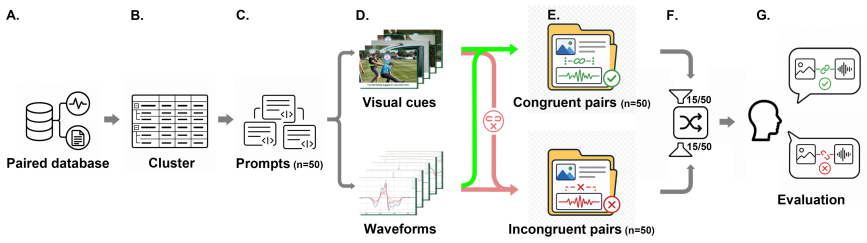
Summary. The paper introduces a paired dataset of 100 GVS waveforms and 1,526 free-form sensation descriptions collected from 16 participants, plus a retrieval-guided 1D-CNN variational autoencoder that generates candidate 5 s waveforms from natural-language descriptions. Analyses show waveform-specific semantic organization relative to a participant-preserving permutation baseline, latent-space continuity and geometric consistency, and above-chance discrimination by 10 new participants of congruent versus incongruent waveform–visual-cue pairings (balanced accuracy 63.33%, d' = 0.70, t(9) = 6.16, P < 0.001). The authors conclude that text-conditioned GVS synthesis is feasible and that GVS could become a programmable semantically congruent feedback modality.
Significance. If the generative claim is sustained, the dataset and pipeline would be a valuable contribution to embodied interaction: they provide an open waveform–description resource, a reproducible hardware setup, and a concrete method for moving from free-form text to candidate stimulation waveforms. Strengths include the participant-preserving permutation test, consistency of the reported signal-detection numbers with the raw hit/false-alarm rates, and the decision to validate with previously unseen participants. The central weakness is that the validation does not isolate the generative model from plain retrieval: by construction, the generated waveform is a cosine-weighted fusion of retrieved dataset waveforms, and the 'correct' answer is defined by the same semantic-category structure used for retrieval. The paper's own limitations section acknowledges dependence on the retrieval library but does not test a retrieval-only baseline, leaving the key claim of 'synthesis' underevidenced.
major comments (3)
- [Text-Driven Waveform Generation, Eqs. (3)-(4); Stimulus Pair Construction for Behavioral Validation] The central claim that the framework performs text-conditioned synthesis is not isolated from plain retrieval. In Eqs. (3)-(4), the fused posterior is a softmax-weighted combination of top-K retrieved latent posteriors, and the post-processing sign-aligns and peak-matches the decoded waveform to the top retrieved candidate. The behavioral validation then defines congruent pairs as same-category prompt/visual/waveform combinations using a k=10 partition of the same E5 embedding space used for retrieval. An above-chance score is therefore equally consistent with participants responding to category signal inherited directly from the retrieved library. A retrieval-only control (e.g., presenting the top-1 retrieved dataset waveform, or the waveform-domain fusion without VAE decoding/latent optimization) is necessary to support the synthesis claim. Without it, the generative model's contributi
- [Behavioral evidence for narrative–stimulus congruence; Stimulus Pair Construction for Behavioral Validation] The behavioral result may also reflect low-level waveform features rather than semantic congruence. Because retrieval selects waveforms by text similarity, categories could differ systematically in peak count, pulse rate, amplitude, or polarity, and participants could use such features to judge congruence without any narrative understanding. The paper reports only aggregate hit and false-alarm rates and the response criterion. I ask for analysis of the generated stimuli's low-level feature distributions across categories, or a control condition that matches pairs on these features while varying semantic category; otherwise the interpretation that participants perceived semantic congruence is not established.
- [Semantic embedding, clustering, and prompts] The validation ground truth is a k=10 clustering of the same text-embedding space used for retrieval, and the clustering procedure is described only as a preprocessing choice. No stability or reliability evidence is given for either the k=14 analysis partition or the k=10 validation partition. Since 'correct' responses are defined by this partition, any method using the same embeddings will align with the ground truth by construction. Reporting cluster stability (e.g., bootstrap or split-half consistency) or independent human category ratings would help show that the categories are not an artifact of a particular clustering run.
minor comments (5)
- [Table 1A] Header row contains the typo 'T otal' (should be 'Total'). Also consider specifying that the 15 categories include the predefined low-intensity category plus 14 data-driven clusters.
- [Materials and Methods, GVS hardware and calibration] Equation (1) introduces R1, R2, R3, R4, and k without explicitly defining all terms in the text; please add a sentence defining the resistor ratio and k.
- [Results, Perceptual Evaluation of Model-generated GVS Stimuli] The phrase 'one-sample tests against chance level' is imprecise: balanced accuracy is tested against 0.5 and d' against 0. Please state the null values explicitly in the text for readers.
- [Stimulus Pair Construction for Behavioral Validation] It would help to report whether the 300 trials used unique visual cues and waveforms or how many times each stimulus was reused, since individual stimuli could appear in multiple pairs across participants.
- [Limitations and future work] The limitations section candidly notes dependence on the retrieval library; consider moving this acknowledgment earlier, since it directly qualifies the abstract's 'feasibility of text-conditioned GVS synthesis' claim.
Circularity Check
Behavioral validation of 'synthesis' is constructed from the same category/retrieval structure as generation; retrieval-only baseline absent.
-
self definitional
[Methods: Stimulus Pair Construction for Behavioral Validation; Methods: Text-Driven Waveform Generation (Eqs. 3–4; post-processing)]
"Fusion scores combined semantic similarity, LLS, and mean posterior log-variance (Equation 3): a_i = s_i − β LLS_i + γ log σ_i², w_i = exp(a_i/τ)/Σ_{j∈I_K} exp(a_j/τ). ... Visual cues and waveforms originating from the same semantic category were combined to form 50 congruent pairs. ... The decoded waveform was sign-aligned to the top-ranked retrieved candidate and peak-matched to the mean absolute peak magnitude of the retrieved candidates."
The validation ground truth is the 10-category partition of the E5-large-v2 embedding space used for retrieval: congruent pairs are same-category prompt–visual–waveform combinations, and incongruent pairs are cross-category. Generation, by Eqs. 3–4, weights retrieved records by cosine semantic similarity s_i and fuses their latent posteriors; post-processing then sign-aligns and peak-matches the decoded output to the top retrieved candidate. Therefore a prompt in category C yields a waveform that is by construction heavily anchored to dataset waveforms whose descriptions are textually closest to category C, and the 'correct' answer is defined by that same category structure. Above-chance discrimination only demonstrates that category signal present in the retrieved library survives into th
full rationale
The dataset construction, waveform-level permutation analyses, and latent-space continuity metrics are self-contained and not circular. The main circularity is in the behavioral validation of the generative claim: Eq. 3 weights retrieved descriptions by E5 cosine similarity, Eq. 4 fuses their latent posteriors, and post-processing sign-aligns/peak-matches to the top retrieved candidate; the congruence ground truth is a k-means partition of the same E5 space. Thus 'congruent' and 'incongruent' stimuli are generated, respectively, from same-category and cross-category retrieved records, so the 63.33% accuracy is partly expected if participants can perceive category signal inherited from the retrieved library. The authors candidly note in Limitations that performance depends on the retrieval library, but no retrieval-only or top-1 baseline is reported, so the central 'text-conditioned synthesis' claim is not isolated from plain retrieval. Self-citations (Refs. 16, 26, 41) concern hardware and prior GVS display work and are not load-bearing for the derivation. Overall this is partial, not total, circularity because independent behavioral measurement and the novel dataset remain; the specific synthesis claim reduces by construction to retrieval of category-matched exemplars.
Assumptions & free parameters
free parameters (6)
- k=14 data-driven semantic clusters =
14
- k=10 validation clusters =
10
- Fusion coefficients beta, gamma, tau (Eq. 3) =
not reported
- Top-K retrieval count =
not reported
- VAE architecture and training hyperparameters =
not reported
- Waveform library sampling distribution =
n/a (design spec)
assumptions (5)
- domain assumption E5-large-v2 sentence embeddings capture semantic similarity of free-form sensation descriptions well enough for clustering and retrieval.
- ad hoc to paper K-means partitions (k=14 analysis, k=10 validation) yield meaningful, stable sensation categories that can serve as ground truth.
- domain assumption Free-form verbal self-report during stimulation is a valid measure of the evoked sensation.
- standard math Signal detection theory's equal-variance Gaussian model applies to the two-choice congruence task.
- domain assumption The VAE decoder g_theta is smooth enough that perturbation, interpolation, and gradient-based latent optimization are meaningful generative operations.
Cite this review
Pith. "Pith review of Galvanic Vestibular Stimulation in Latent Space." pith.science (2026). https://pith.science/paper/HQNCLR2O
@misc{pith2026260726659,
  author       = {Pith},
  title        = {Pith review of: Galvanic Vestibular Stimulation in Latent Space},
  year         = {2026},
  howpublished = {\url{https://pith.science/paper/HQNCLR2O}},
  note         = {Machine review of arXiv:2607.26659}
}
read the original abstract
Galvanic vestibular stimulation (GVS) is widely used to modulate self-orientation, balance, and motion perception; the discriminability of frequency-encoded cues further suggests its potential as a standalone modality for embodied feedback. However, synthesizing GVS waveforms congruent with target events or bodily states remains challenging. GVS waveforms combine current direction, intensity, duration, and onset and offset transitions, yet how these parameters jointly shape users' perceptual and associative responses remains underexplored. To address this gap, we contribute a dataset linking GVS waveforms to free-form experience descriptions, as well as a retrieval-guided generative model for synthesizing candidate waveforms from target descriptions. The dataset comprises 100 GVS waveforms and 1,526 valid free-form sensation descriptions collected from 16 participants. Semantic analysis revealed diverse motion- and force-related sensations, localized bodily sensations, and situational associations. Compared with a participant-preserving permutation baseline, descriptions elicited by the same waveform covered fewer semantic categories (8.18 vs. 9.45) and exhibited a higher dominant-category proportion (26.97% vs. 21.25%; both P < 0.001). Building on this dataset, we implemented the generative model as a retrieval-guided one-dimensional convolutional variational autoencoder. An independent behavioral study recruited 10 participants who had not contributed to the dataset collection. Performance in discriminating congruent from incongruent waveform-visual cue pairings was significantly above chance, with an accuracy of 63.33%, d-prime = 0.70, and p < 0.001. Together, these findings demonstrate the feasibility of text-conditioned GVS synthesis and support the development of GVS as a programmable modality for semantically congruent embodied feedback across interactive scenarios.
Figures


Figures from the paper (2 more)

Reference graph
Works this paper leans on
-
[1]
A wide-ranging review of galvanic vestibular stimulation: from its genesis to basic science and clinical applications
Marchand S, Langlade A, Legois Q, and S´ everac Cauquil A. A wide-ranging review of galvanic vestibular stimulation: from its genesis to basic science and clinical applications. Experimental Brain Research 2025;243:131
2025
-
[2]
Neural substrates, dynamics and thresholds of galvanic vestibular stimulation in the behaving primate
Kwan A, Forbes PA, Mitchell DE, Blouin JS, and Cullen KE. Neural substrates, dynamics and thresholds of galvanic vestibular stimulation in the behaving primate. Nature Communications 2019;10:1904
2019
-
[3]
Probing the human vestibular system with galvanic stimulation
Fitzpatrick RC and Day BL. Probing the human vestibular system with galvanic stimulation. Journal of Applied Physiology 2004;96(6):2301–16
2004
-
[4]
Noisy Galvanic Stimulation Improves Roll-Tilt Vestibular Perception in Healthy Subjects
Keywan A, Wuehr M, Pradhan C, and Jahn K. Noisy Galvanic Stimulation Improves Roll-Tilt Vestibular Perception in Healthy Subjects. Frontiers in Neurology 2018;9:83
2018
-
[5]
Quantifying virtual self- motion sensations induced by galvanic vestibular stimulation
Gallagher M, Romano F, Bockisch CJ, Ferr` e ER, and Bertolini G. Quantifying virtual self- motion sensations induced by galvanic vestibular stimulation. Journal of Vestibular Research 2023;33:21–30
2023
-
[6]
Effects of galvanic vestibular stimulation on human posture and perception while standing
Wardman DL, Taylor JL, and Fitzpatrick RC. Effects of galvanic vestibular stimulation on human posture and perception while standing. The Journal of Physiology 2003;551:1033–42. 20
2003
-
[7]
Position and velocity responses to galvanic vestibu- lar stimulation in human subjects during standing
Wardman DL, Day BL, and Fitzpatrick RC. Position and velocity responses to galvanic vestibu- lar stimulation in human subjects during standing. The Journal of Physiology 2003;547:293– 9
2003
-
[8]
Comparison of Power Spectrum Characteristics of Body Sway during a Static Upright Standing Posture in Healthy Elderly People and Young Adults
Demura S and Kitabayashi T. Comparison of Power Spectrum Characteristics of Body Sway during a Static Upright Standing Posture in Healthy Elderly People and Young Adults. Per- ceptual and Motor Skills 2006;102:467–76
2006
Show all 43 references
-
[9]
Galvanic vestibular stimulation improves the results of vestibular rehabilitation
Carmona S, Ferrero A, Pianetti G, Escol´ a N, Arteaga MV, and Frankel L. Galvanic vestibular stimulation improves the results of vestibular rehabilitation. Annals of the New York Academy of Sciences 2011;1233:E1–E7
2011
-
[10]
Frequency-Specific Effects of Galvanic Vestibular Stimulation on Response-Time Performance in Parkinson’s Disease
Lee S, Smith PF, Lee WH, and McKeown MJ. Frequency-Specific Effects of Galvanic Vestibular Stimulation on Response-Time Performance in Parkinson’s Disease. Frontiers in Neurology 2021;12:758122
2021
-
[11]
Noisy Galvanic Vestibular Stimulation Induces a Sustained Improvement in Body Balance in Elderly Adults
Fujimoto C, Yamamoto Y, Kamogashira T, et al. Noisy Galvanic Vestibular Stimulation Induces a Sustained Improvement in Body Balance in Elderly Adults. Scientific Reports 2016;6:37575
2016
-
[12]
Balance Ninja: Towards the Design of Digital Vertigo Games via Galvanic Vestibular Stimulation
Byrne R, Marshall J, and Mueller F. Balance Ninja: Towards the Design of Digital Vertigo Games via Galvanic Vestibular Stimulation. In:Proceedings of the 2016 Annual Symposium on Computer-Human Interaction in Play. CHI PLAY ’16. Austin, Texas, USA: Association for Computing Ma...
2016
-
[13]
GVS RIDE: providing a novel ex- perience using a head mounted display and four-pole galvanic vestibular stimulation
Aoyama K, Higuchi D, Sakurai K, Maeda T, and Ando H. GVS RIDE: providing a novel ex- perience using a head mounted display and four-pole galvanic vestibular stimulation. In:ACM SIGGRAPH 2017 Emerging Technologies. SIGGRAPH ’17. Los Angeles, California: Associa- tion for Comput...
2017
-
[14]
Omnidirectional Galvanic Vestibular Stimulation in Virtual Reality
Groth C, Tauscher JP, Heesen N, Hattenbach M, Castillo S, and Magnor M. Omnidirectional Galvanic Vestibular Stimulation in Virtual Reality. IEEE Transactions on Visualization & Computer Graphics 2022;28:2234–44
2022
-
[15]
Electrical, Vibrational, and Cooling Stimuli-Based Redirected Walking: Comparison of Various Vestibular Stimulation-Based Redirected Walking Systems
Hwang S, Lee J, Kim Y, Seo Y, and Kim S. Electrical, Vibrational, and Cooling Stimuli-Based Redirected Walking: Comparison of Various Vestibular Stimulation-Based Redirected Walking Systems. In:Proceedings of the 2023 CHI Conference on Human Factors in Computing Systems. CHI ’...
2023
-
[16]
Vestibular Stimulation Enhances Hand Redi- rection
Katori K, Tanaka Y, Ochiai Y, and Lopes P. Vestibular Stimulation Enhances Hand Redi- rection. In:Proceedings of the 38th Annual ACM Symposium on User Interface Software and Technology. UIST ’25. Association for Computing Machinery, 2025.doi:10.1145/3746059. 3747776
2025 doi
-
[17]
Four-pole Galvanic Vestibular Stimulation Causes Body Sway About Three Axes
Aoyama K, Iizuka H, Ando H, and Maeda T. Four-pole Galvanic Vestibular Stimulation Causes Body Sway About Three Axes. Scientific Reports 2015;5:10168
2015
-
[18]
Efficacy of Galvanic Vestibular Stimulation as a Display Modality Dissociated from Self-Orientation
Smith KJ, Datta A, Burkhart C, and Clark TK. Efficacy of Galvanic Vestibular Stimulation as a Display Modality Dissociated from Self-Orientation. Human Factors 2024;66(3):862–71. 21
2024
-
[19]
Utz KS, Dimova V, Oppenl¨ ander K, and Kerkhoff G. Electrified minds: Transcranial direct cur- rent stimulation (tDCS) and Galvanic Vestibular Stimulation (GVS) as methods of non-invasive brain stimulation in neuropsychology—A review of current data and future implications. Ne...
2010
-
[20]
Using low levels of stochastic vestibular stimulation to improve balance function
Goel R, Kofman I, Jeevarajan J, et al. Using low levels of stochastic vestibular stimulation to improve balance function. PLOS ONE 2015;10:e0136335
2015
-
[21]
Minor adverse effects of galvanic vestibular stimulation in persons with stroke and healthy individuals
Utz KS, Korluss K, Schmidt L, et al. Minor adverse effects of galvanic vestibular stimulation in persons with stroke and healthy individuals. Brain Injury 2011;25:1058–69
2011
-
[22]
A review of parameter settings for Galvanic Vestibular Stimulation in clinical applications
Valter Y, Vataksi L, Allred AR, et al. A review of parameter settings for Galvanic Vestibular Stimulation in clinical applications. Frontiers in Human Neuroscience 2025;19:1518727
2025
-
[23]
Galvanic Vestibular Stimulation Modifies Vection Paths in Healthy Subjects
Lepecq JC, De Waele C, Mertz-Josse S, et al. Galvanic Vestibular Stimulation Modifies Vection Paths in Healthy Subjects. Journal of Neurophysiology 2006;95:3199–207
2006
-
[24]
Effects of Galvanic Vestibu- lar Stimulation on Upper and Lower Extremities Motor Symptoms in Parkinson’s Disease
Khoshnam M, H¨ aner DMC, Kuatsjah E, Zhang X, and Menon C. Effects of Galvanic Vestibu- lar Stimulation on Upper and Lower Extremities Motor Symptoms in Parkinson’s Disease. Frontiers in Neuroscience 2018;12:633
2018
-
[25]
Questioning the Lasting Effect of Galvanic Vestibular Stimulation on Postural Control
Nooristani M, Maheu M, Houde MS, Bacon BA, and Champoux F. Questioning the Lasting Effect of Galvanic Vestibular Stimulation on Postural Control. PLOS ONE 2019;14:e0224619
2019
-
[26]
Exploring Daily Applications of Wearable Galvanic Vestibular Stimulation via a Self-Customizable Toolkit
Zhao X, Li J, Fushimi T, and Ochiai Y. Exploring Daily Applications of Wearable Galvanic Vestibular Stimulation via a Self-Customizable Toolkit. In:Proceedings of the Augmented Hu- mans International Conference 2026. New York, NY, USA: Association for Computing Ma- chinery, 20...
2026
- [27]
-
[28]
Time Weaver: a conditional time series generation model
Narasimhan SS, Agarwal S, Akcin O, Sanghavi S, and Chinchali S. Time Weaver: a conditional time series generation model. In:Proceedings of the 41st International Conference on Machine Learning. ICML’24. Vienna, Austria: JMLR.org, 2024
2024
-
[29]
VerbalTS: Generating Time Series from Texts
Gu S, Li C, Jing B, and Ren K. VerbalTS: Generating Time Series from Texts. In:Proceedings of the 42nd International Conference on Machine Learning. Ed. by Singh A, Fazel M, Hsu D, et al. Vol. 267. Proceedings of Machine Learning Research. PMLR, 2025:20448–76.url: https://proc...
2025
-
[30]
Human Perception of Self- Motion and Orientation During Galvanic Vestibular Stimulation and Physical Motion
Allred AR, Austin CR, Klausing L, Boggess N, and Clark TK. Human Perception of Self- Motion and Orientation During Galvanic Vestibular Stimulation and Physical Motion. PLOS Computational Biology 2024;20:e1012601
2024
-
[31]
A Survey on Generative Modeling with Limited Data, Few Shots, and Zero Shot
Abdollahzadeh M, Liu G, Malekzadeh T, Teo CT, Chandrasegaran K, and Cheung NM. A Survey on Generative Modeling with Limited Data, Few Shots, and Zero Shot. Transactions on Machine Learning Research 2025. Survey Certification. 22
2025
-
[32]
Reducing the Dimensionality of Data with Neural Networks
Hinton GE and Salakhutdinov RR. Reducing the Dimensionality of Data with Neural Networks. Science 2006;313:504–7
2006
-
[33]
Auto-Encoding Variational Bayes
Kingma DP and Welling M. Auto-Encoding Variational Bayes. In:Proceedings of the 2nd International Conference on Learning Representations (ICLR). 2014
2014
-
[34]
Augmenting Time Series Data: An Interpretable Approach with Metric Learning and Variational Autoencoders
Zhang C, Qin H, Zhang Y, Jiang C, Zhang D, and Deng W. Augmenting Time Series Data: An Interpretable Approach with Metric Learning and Variational Autoencoders. International Journal of Electrical Power & Energy Systems 2024;161:110190
2024
-
[35]
Retrieval-Augmented Generation for Knowledge-Intensive NLP Tasks
Lewis P, Perez E, Piktus A, et al. Retrieval-Augmented Generation for Knowledge-Intensive NLP Tasks. In:Advances in Neural Information Processing Systems. Vol. 33. 2020:9459–74
2020
-
[36]
SE-Diff: Simulator and Experience Enhanced Diffusion Model for Comprehensive ECG Generation
Wang X, Han K, Xu Y, et al. SE-Diff: Simulator and Experience Enhanced Diffusion Model for Comprehensive ECG Generation. In:The Fourteenth International Conference on Learn- ing Representations. ICLR 2026 Poster. 2026.url:https://openreview.net/forum?id= 95ZV35sBDm
2026
-
[37]
Retrieval-augmented diffusion models for time series fore- casting
Liu J, Yang L, Li H, and Hong S. Retrieval-augmented diffusion models for time series fore- casting. In:Proceedings of the 38th International Conference on Neural Information Processing Systems. NIPS ’24. Vancouver, BC, Canada: Curran Associates Inc., 2024
2024
-
[38]
Text Embeddings by Weakly-Supervised Contrastive Pre- training
Wang L, Yang N, Huang X, et al. Text Embeddings by Weakly-Supervised Contrastive Pre- training. arXiv preprint arXiv:2212.03533 2022
2022 arXiv
-
[39]
Some Methods for Classification and Analysis of Multivariate Observations
MacQueen JB. Some Methods for Classification and Analysis of Multivariate Observations. In:Proceedings of the Fifth Berkeley Symposium on Mathematical Statistics and Probability. Vol. 1. University of California Press, 1967:281–97
1967
-
[40]
Modeling 2-Alternative Forced-Choice Tasks: Ac- counting for Both Magnitude and Difference Effects
Ratcliff R, Voskuilen C, and Teodorescu A. Modeling 2-Alternative Forced-Choice Tasks: Ac- counting for Both Magnitude and Difference Effects. Cognitive Psychology 2018;103:1–22
2018
-
[41]
Design and evaluation of a voltage-controlled current source for galvanic vestibular stimulation research
Liu Z, Suzuki S, Fushimi T, and Ochiai Y. Design and evaluation of a voltage-controlled current source for galvanic vestibular stimulation research. HardwareX 2025;22:e00647
2025
-
[42]
Low intensity transcranial electric stimulation: Safety, ethical, legal regulatory and application guidelines
Antal A, Alekseichuk I, Bikson M, et al. Low intensity transcranial electric stimulation: Safety, ethical, legal regulatory and application guidelines. Clinical Neurophysiology 2017;128:1774– 809
2017
-
[43]
Z-Image: An Efficient Image Generation Foundation Model with Single-Stream Diffusion Transformer
Z-Image Team, Cai H, Cao S, et al. Z-Image: An Efficient Image Generation Foundation Model with Single-Stream Diffusion Transformer. arXiv preprint arXiv:2511.22699 2025. 23
2025 arXiv
Reviewed August 1, 2026 · model on record in the stance chip above.
Discussion (0). Continue with ORCID to comment.