REVIEW 4 major objections 5 minor 14 references
CalTwin: Towards Calibrated, Shift-Robust Medical World Models via Fisher-Information Regularisation
T0 review · 4 major / 5 minor · reviewed 2026-07-30 · grok-4.5
Pith's one-line read One training objective can make a medical world model’s latent dynamics both more accurate under hospital shift and slightly better calibrated.
desk verdict Honest feasibility note that ports the authors’ own FIM+CMP penalties to a small GRU dynamics head; PhysioNet gains are mostly FIM, and their own eICU table undercuts the unified claim. read the letter →
The pith
A machine-rendered reading of the paper's core claim, the machinery that carries it, and where it could break.
The reading
What carries the argument
CalTwin (Eq. 6): L = −log p_θ(s_{t+1}|s_t,a_t) + λ1 (θ̂−θ)ᵀ Î^(k−1)(θ̂−θ) + λ2 CMP(s_t,y_t). The first penalty is a diagonal empirical Fisher Information Matrix accumulated by EMA across sequential hospital fragments; the second is the Confidence Misalignment Penalty applied to an auxiliary discrete clinical-risk head that shares the encoder and latent state with the continuous GRU transition predictor.
What would settle it
Run the same architecture under closed-loop self-conditioned multi-step rollouts on a held-out hospital and check whether CalTwin still beats Fisher-only and CMP-only on trajectory error and ECE; if the auxiliary-head penalty adds no closed-loop calibration gain, the unified calibration claim for the dynamics model fails.
Extended reading notes
Core claim
Covariate shift across non-colocated hospital fragments and confidence misalignment in autoregressive forecasts admit a unified treatment for a medical world model’s latent transition predictor. The combined objective is transition negative log-likelihood plus a quadratic Fisher-information penalty that anchors parameters to an exponentially accumulated prior from earlier fragments, plus a Confidence Misalignment Penalty on a discrete auxiliary risk head sharing the same latent state. On PhysioNet 2019 this reduced OOD next-step latent MSE by 9.1 percent (Fisher alone 7.0 percent); ECE reduction was 0.7 percent for the full objective. The Fisher KL approximation transfers from classification
Load-bearing premise
That penalising overconfidence only on a discrete auxiliary risk head which shares the latent state is enough to calibrate the continuous multi-step transition forecasts themselves.
Editorial extensions
If this is right
- Federated or batch-sequential training of medical digital twins can replace density-ratio importance weights with an accumulating Fisher prior that needs only local gradients.
- The same combined objective is intended to transfer to imaging world models (cardiac, ultrasound, surgical video) once multi-site fragments exist.
- Even fixed untuned λ1 and λ2 already move OOD next-step MSE; held-out tuning is expected to improve the accuracy–calibration trade-off.
- Teacher-forced one-step gains under hospital shift are presented as a necessary first check before claiming reliable counterfactual or closed-loop planning use.
Reading between the lines
- The eICU ranking reversal suggests the Fisher term’s benefit may depend on whether fragments are true hospital identities or enrolment-order proxies; a controlled synthetic site-shift study with known shift magnitude would separate those cases.
- A continuous version of the misalignment penalty that acts on predictive variance would remove dependence on the auxiliary-head design choice and can be ablated on the same sepsis and mortality setups.
- If the Fisher constraint limits how freely the shared representation can be recalibrated, an adaptive λ schedule driven by the overcommitted-mass signal is a direct next control experiment the paper already flags as open.
Editorial analysis
A structured set of objections, weighed in public.
Referee Report
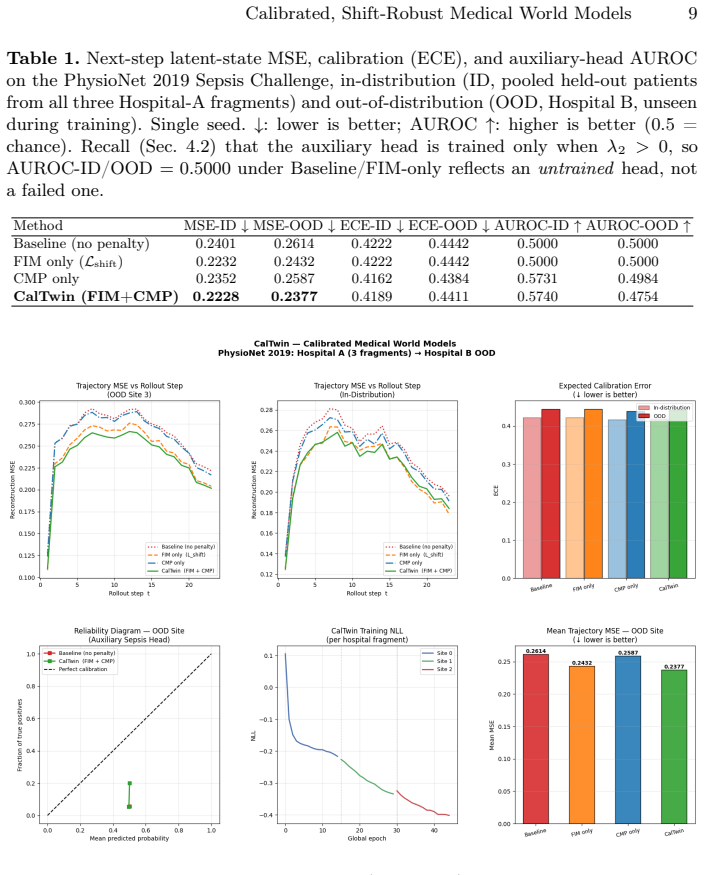
Summary. The paper proposes CalTwin, a single regularisation objective for medical world-model latent transition predictors that combines a Fisher-Information Matrix (FIM) penalty for fragmented covariate shift with a Confidence Misalignment Penalty (CMP) for calibration. The FIM term is adapted from the authors' prior FIcsR work to the transition log-likelihood; CMP is applied to a discrete auxiliary clinical-risk head sharing the latent state, with the claim that calibration propagates to the continuous dynamics. The combined objective (Eq. 6) is derived with an explicit transfer analysis of which proof steps carry over from classification. Empirical evaluation is a single-seed feasibility study on PhysioNet 2019 (Hospital A fragments vs held-out Hospital B) and a second site on eICU-CRD Demo, reporting next-step latent MSE, ECE, and auxiliary-head AUROC under teacher-forced rollouts. On PhysioNet, CalTwin cuts OOD MSE by 9.1% (FIM alone 7.0%) with a small ECE gain; on eICU the ranking reverses and CMP-only wins four of six metrics.
Significance. If the unified objective were shown to deliver stable shift-robustness and calibration for multi-step medical dynamics under real multi-site fragmentation, it would be a useful, lightweight contribution to trustworthy medical world models and digital twins, where federated/batch-sequential training and overconfident forecasts are genuine deployment barriers. Strengths that count in the paper's favour include: explicit separation of proof steps that transfer without modification from those that require adaptation; transparent reporting of the eICU ranking reversal rather than selective emphasis on PhysioNet; and use of real multi-hospital ICU data rather than synthetic shift. Those strengths do not yet establish the central claim, but they make the manuscript a usable foundation rather than an oversold prototype.
major comments (4)
- [Sec. 3.3, Eq. 6] Sec. 3.3 and Eq. 6: The calibration half of the unified claim rests on the unproven assertion that discrete CMP on an auxiliary risk head calibrates the continuous transition predictor via shared s_t. The manuscript itself labels this a 'design choice, not a settled result' and leaves continuous-output CMP to future work. No metric directly measures calibration of p_θ(s_{t+1}|s_t,a_t) (e.g., continuous ranked probability score, interval coverage, or latent-space reliability). Without that link, L_CalTwin is an FIM shift regulariser plus an auxiliary-head regulariser, not a demonstrated joint treatment of dynamics calibration.
- [Sec. 1; Secs. 4.2–4.3] Sec. 1 vs Secs. 4.2–4.3: The motivating failure mode is endogenous overconfidence under autoregressive self-conditioning (teacher forcing at train time, self-generated inputs at deployment). All reported MSE/ECE/AUROC are teacher-forced one-step metrics. The closed-loop regime that is said to invalidate post-hoc calibration is never evaluated. Until closed-loop results are shown, the claim that training-time CMP is required for multi-step clinical forecasts is not tested.
- [Tables 1–2; Sec. 4.2; Sec. 5] Tables 1–2 and Sec. 5: The central empirical claim (CalTwin unifies both benefits) is not dataset-stable. On PhysioNet, FIM drives OOD MSE (−7.0% alone, −9.1% combined) and CalTwin’s OOD ECE (0.4411) is worse than CMP-only (0.4384). On eICU-CRD Demo, FIM-only does not improve OOD MSE (−0.4% vs baseline) and CMP-only wins four of six columns. With single seed and fixed λ1=0.5, λ2=0.3 (no grid search; Sec. 4.2), it is not yet possible to attribute gains to the combined objective rather than dataset-specific shift structure or untuned trade-offs. Multi-seed runs and held-out λ tuning on both sites are load-bearing for any method-contribution claim.
- [Table 1; Sec. 4.3; Table 2] Sec. 4.3 / Table 1 AUROC-OOD: On PhysioNet the CMP-trained head’s OOD AUROC collapses to chance or below (0.475–0.498) despite modest ID signal (~0.57). That undercuts the claim that CMP yields clinically meaningful, shift-robust confidence on the auxiliary outcome used as the calibration proxy. The eICU AUROC-OOD (~0.84) goes the other way, reinforcing instability rather than resolving it. Either the auxiliary-head design or the evaluation protocol needs to be strengthened before calibration transfer is asserted.
minor comments (5)
- [Abstract] Abstract and Sec. 4 lead with the 9.1% PhysioNet OOD MSE figure; the eICU reversal is only fully stated later. For balance, the abstract should briefly note that the second site does not replicate the ranking.
- [Eq. 1] Eq. (1) cites a missing reference (‘[?]’) for the second-order KL/FIM expansion; restore the standard citation (e.g., the EWC or information-geometry source already used elsewhere).
- [Fig. 2] Fig. 2 is described in the caption but reliability-diagram and per-step MSE trends are hard to audit from text alone; ensure axis scales and method colours are unambiguous in the camera-ready figure.
- [Sec. 4.1] Sec. 4.1: enrolment-order fragmentation within Hospital A is a proxy for site shift; state more clearly how this differs from genuine hospital-identity fragments on eICU so readers do not over-interpret cross-table comparisons.
- [Fig. 1; Sec. 1] Typos/style: ‘CalT win’ / ‘Missaligne-ment’ in Fig. 1; ‘aparametric’, ‘aclinicalinterface’ spacing errors in the introduction; standardise ‘CalTwin’ spelling throughout.
Circularity Check
Mild self-citation assembly of prior FIcsR/CalShift penalties; empirical MSE/ECE claims are independent measurements, not forced by construction.
-
self citation load bearing
[Sec. 3.4 Eq. 6; also Abstract and Sec. 1 ‘Our position’]
"directly mirroring L_CalShift = L_c + λ_1 I(θ) + λ_2 CMP in [4], with L_c replaced by the world model’s transition log-likelihood... combines a Fisher-Information-based shift penalty adapted from our prior work on fragmented covariate-shift remediation [5,3] with a Confidence Misalignment Penalty adapted from our prior work on calibrated vision-language classification [4]"
The unified objective’s form and the claim that the two penalties ‘provably combine’ are justified almost entirely by citations to the same authors’ CalShift/FIcsR papers rather than by a self-contained derivation in this manuscript. This is load-bearing for the method’s provenance, but it does not force the reported PhysioNet/eICU numbers, which remain independent measurements.
-
renaming known result
[Sec. 3.2 Eqs. 1–4; Sec. 3.4]
"This is the same approximation used in Elastic Weight Consolidation (EWC) [6] and in FIcsR [5] for classification... the proofs in [5] carry over to the transition-predictor setting without modification... The unified training objective... is L_CalTwin(θ) = −log p_θ(s_{t+1}|s_t,a_t) + λ_1 (θ̂−θ)^T Î^{(k−1)}(θ̂−θ) + λ_2 CMP(s_t,y_t)"
CalTwin is CalShift/FIcsR with the classification loss renamed to a GRU transition NLL and applied to an auxiliary sepsis/mortality head. The paper is explicit about the rename-and-adapt move, and external EWC support partially breaks the self-cite loop; still, the ‘combined objective’ is not a new first-principles object so much as a re-labeling of the authors’ prior regulariser pair.
full rationale
CalTwin’s objective (Eq. 6) is explicitly assembled by swapping the authors’ prior CalShift classification loss for a world-model transition NLL and retaining the same FIM and CMP penalty terms from overlapping-author papers [3,4,5]. That is ordinary modular reuse, not a derivation in which a claimed prediction equals its fitted inputs. The load-bearing numerical claims (9.1% OOD MSE reduction, ECE deltas, Table 1–2 rankings) are single-seed empirical measurements on PhysioNet 2019 and eICU-CRD Demo; they are not algebraic restatements of λ1/λ2 or of the FIM accumulator. The FIM–KL second-order step is also anchored to the external EWC literature [6], and the paper itself flags the auxiliary-head CMP propagation and teacher-forced evaluation as unsettled design choices rather than theorems. No uniqueness theorem is imported to forbid alternatives, and no fitted constant is renamed as a forecast. Circularity burden is therefore low: one mild self-citation/renaming pattern around the objective’s provenance, with the evaluation chain remaining self-contained against external benchmarks.
Assumptions & free parameters
free parameters (4)
- λ1 (FIM penalty weight) =
0.5 (fixed)
- λ2 (CMP weight) =
0.3 (fixed)
- α (FIM EMA decay) =
0.9
- latent dimension D and GRU width =
D=32, GRU 64
assumptions (4)
- standard math Second-order Taylor expansion yields D_KL(P(θ|B_k) || Q(θ̂)) ≈ (1/2)(θ̂-θ)^T I(θ)(θ̂-θ) with I the Fisher information.
- domain assumption Empirical (diagonal) Fisher computed on transition log-likelihood gradients is a valid stand-in for the true FIM for over-parameterized networks.
- ad hoc to paper Calibration of a discrete auxiliary risk head sharing latent state s_t propagates to the continuous transition predictor.
- domain assumption Hospital-system or hospital-id splits on PhysioNet 2019 and eICU demo are faithful proxies for the fragmented covariate shift that medical world models will face on imaging.
invented entities (2)
-
CalTwin objective (L_CalTwin)
-
Auxiliary-head adaptation of CMP to continuous dynamics
Cite this review
Pith. "Pith review of CalTwin: Towards Calibrated, Shift-Robust Medical World Models via Fisher-Information Regularisation." pith.science (2026). https://pith.science/paper/5CDB6OD3
@misc{pith2026260726752,
  author       = {Pith},
  title        = {Pith review of: CalTwin: Towards Calibrated, Shift-Robust Medical World Models via Fisher-Information Regularisation},
  year         = {2026},
  howpublished = {\url{https://pith.science/paper/5CDB6OD3}},
  note         = {Machine review of arXiv:2607.26752}
}
read the original abstract
Medical world models aim to learn a latent state of patient or organ physiology and a transition function that forecasts how that state evolves under interventions, supporting downstream tasks from imaging-based diagnosis to digital-twin treatment planning. Two failure modes threaten the reliability of such models in clinical deployment: (i)~\emph{covariate shift}, because training data are fragmented across hospitals, scanners, and time, so the feature distribution seen by the latent-dynamics predictor differs across fragments and from the distribution at deployment; and (ii)~\emph{confidence misalignment}, because multi-step forecasts are often overconfident exactly where clinical risk is highest. We argue that both problems admit a unified treatment via a single lightweight regularisation objective, \textbf{CalTwin}, which combines a Fisher-Information-based shift penalty adapted from our prior work on fragmented covariate-shift remediation~\cite{khan2025mitigating,khan2025causal} with a Confidence Misalignment Penalty adapted from our prior work on calibrated vision-language classification~\cite{khan2025confidence}, applied here to a GRU-based medical world model's latent transition predictor. We derive the combined objective, establish which proof steps transfer from the classification setting without modification and which require adaptation, and evaluate it on the PhysioNet 2019 Sepsis Challenge, treating the two hospital systems as sequential training fragments and the unseen system as an out-of-distribution test. CalTwin reduces OOD next-step latent-state MSE by 9.1\% relative to the no-penalty baseline (FIM penalty alone accounts for 7.0\%); the ECE reduction from the Confidence Misalignment Penalty is real but small (0.7\% for CalTwin, 1.3\% for CMP alone).
Figures

Reference graph
Works this paper leans on
-
[1]
IEEE Internet of Things Journal11(21), 34749–34773 (2024)
Chen, J., Shi, Y., Yi, C., Du, H., Kang, J., Niyato, D.: Generative-ai-driven human digital twin in iot healthcare: A comprehensive survey. IEEE Internet of Things Journal11(21), 34749–34773 (2024)
2024
-
[2]
In: International conference on machine learning
Guo, C., Pleiss, G., Sun, Y., Weinberger, K.Q.: On calibration of modern neural networks. In: International conference on machine learning. pp. 1321–1330. PMLR (2017)
2017
-
[3]
arXiv preprint arXiv:2502.15756 (2025)
Khan, B., Mirza, B., Syed, T.: Causal covariate shift correction using fisher infor- mation penalty. arXiv preprint arXiv:2502.15756 (2025)
arXiv 2025
-
[4]
In: Proceed- ings of the Computer Vision and Pattern Recognition Conference
Khan, B., Qureshi, R., Durrani, N.M., Syed, T.Q.: Confidence-calibrated covariate shift correction for few-shot classification in vision-language models. In: Proceed- ings of the Computer Vision and Pattern Recognition Conference. pp. 6511–6523 (2025)
2025
-
[5]
Neurocomputing p
Khan, B., Syed, T.Q., Mirza, B., Durrani, N.M.: Mitigating covariate shift in non- colocated data with learned parameter priors. Neurocomputing p. 131656 (2025)
2025
-
[6]
Proceedings of the national academy of sciences114(13), 3521–3526 (2017)
Kirkpatrick, J., Pascanu, R., Rabinowitz, N., Veness, J., Desjardins, G., Rusu, A.A., Milan, K., Quan, J., Ramalho, T., Grabska-Barwinska, A., et al.: Overcoming catastrophic forgetting in neural networks. Proceedings of the national academy of sciences114(13), 3521–3526 (2017)
2017
-
[7]
Scientific data5(1), 180178 (2018)
Pollard, T.J., Johnson, A.E., Raffa, J.D., Celi, L.A., Mark, R.G., Badawi, O.: The eicu collaborative research database, a freely available multi-center database for critical care research. Scientific data5(1), 180178 (2018)
2018
-
[8]
arXiv preprint arXiv:2511.16333 (2025)
Qazi, M.A., Nadeem, M., Yaqub, M.: Beyond generative ai: World models for clinical prediction, counterfactuals, and planning. arXiv preprint arXiv:2511.16333 (2025)
arXiv 2025
Show all 14 references
-
[9]
In: 2019 Computing in Cardiology (CinC)
Reyna, M.A., Josef, C., Seyedi, S., Jeter, R., Shashikumar, S.P., Westover, M.B., Sharma, A., Nemati, S., Clifford, G.D.: Early prediction of sepsis from clinical data: the physionet/computing in cardiology challenge 2019. In: 2019 Computing in Cardiology (CinC). pp. Page–1. I...
2019
-
[10]
Frontiers in Digital Health7, 1633539 (2025)
Rudsari, H.K., Tseng, B., Zhu, H., Song, L., Gu, C., Roy, A., Irajizad, E., Butner, J., Long, J., Do, K.A.: Digital twins in healthcare: a comprehensive review and future directions. Frontiers in Digital Health7, 1633539 (2025)
2025
-
[11]
The Lancet Digital Health7(7) (2025)
Sadée, C., Testa, S., Barba, T., Hartmann, K., Schuessler, M., Thieme, A., Church, G.M., Okoye, I., Hernandez-Boussard, T., Hood, L., et al.: Medical digital twins: enabling precision medicine and medical artificial intelligence. The Lancet Digital Health7(7) (2025)
2025
-
[12]
Journal of statistical planning and inference90(2), 227–244 (2000) 14 B
Shimodaira, H.: Improving predictive inference under covariate shift by weighting the log-likelihood function. Journal of statistical planning and inference90(2), 227–244 (2000) 14 B. Khan et al
2000
-
[13]
Snoek, J., Ovadia, Y., Fertig, E., Lakshminarayanan, B., Nowozin, S., Sculley, D., Dillon, J.V., Ren, J., Nado, Z.: Can you trust your model’s uncertainty? evaluating predictive uncertainty under dataset shift (2019)
2019
-
[14]
npj Digital Medicine8(1), 286 (2025)
Zhu, H., Bai, J., Li, N., Li, X., Liu, D., Buckeridge, D.L., Li, Y.: Fedweight: mitigat- ing covariate shift of federated learning on electronic health records data through patients re-weighting. npj Digital Medicine8(1), 286 (2025)
2025
Reviewed July 30, 2026 · model on record in the stance chip above.
Discussion (0). Continue with ORCID to comment.