REVIEW 3 major objections 6 minor 41 references
TREA-Net: A Transferable Residual Epidemiological Adaptation Network for Dengue Incidence Forecasting
T0 review · 3 major / 6 minor · reviewed 2026-07-30 · grok-4.5
Pith's one-line read A tiny transferable correction, guided by a climate-aware epidemic model, improves 8-week dengue forecasts when a new country has only 1.5–2 years of data.
desk verdict Solid applied transfer setup for low-data dengue forecasting: N-invariant residual on backbone+ETSIR, two-scalar target adapt, real multi-backbone gains—not a new theory, but clean and usable. read the letter →
The pith
A machine-rendered reading of the paper's core claim, the machinery that carries it, and where it could break.
The reading
What carries the argument
N-invariant gated residual correction: for each horizon–region pair it takes the normalized backbone forecast, ETSIR forecast, and their absolute gap, then outputs a gate and residual so the corrected forecast is backbone plus gate times residual; only two global target scalars (scale and shift) are fit at deployment.
What would settle it
On a held-out target country with short history, check whether TREA-Net raises mean absolute error versus its frozen backbone (and loses Wilcoxon significance) when source–target transmission dynamics or anomalous climate diverge, especially if real weather forecasts replace training-period climatology and still fail to help.
Extended reading notes
Core claim
Epidemiological knowledge learned from data-rich dengue surveillance can be transferred to structurally different, data-scarce systems by freezing a neural forecasting backbone and applying an N-invariant gated residual correction driven by ETSIR projections, with only two target-specific scalars for local adaptation. In transfers from Colombia and Nicaragua to Mexico and Malaysia under 78 or 104 weeks of target history, this improves the paired backbone in 9 of 10 settings and yields the best mean absolute errors when paired with zero-shot TiRex.
Load-bearing premise
A single residual map learned from Colombia and Nicaragua, plus two country-wide scalars and weather replaced by historical weekly averages over the forecast horizon, is assumed to capture enough local epidemiology to help rather than hurt in a new place.
Editorial extensions
If this is right
- Agencies with ~1.5–2 years of weekly dengue data can improve multi-week forecasts without retraining large backbones or matching the source country’s number of regions.
- Zero-shot foundation-model forecasts can be sharpened with a ~5K-parameter residual module and two local scalars estimated in under a minute on CPU.
- Calibrated conformal intervals can stay near baseline coverage while becoming substantially narrower at 8-week lead when the point forecast is stabilized (as reported for Mexico).
- The same backbone-agnostic adapter can be re-evaluated as an open early-warning add-on for other climate-sensitive pathogens once local ETSIR and short target histories exist.
Reading between the lines
- If the two-scalar adapter is enough here, other public-health transfer settings may benefit more from freezing large models and learning tiny residual bridges than from full fine-tuning under short histories.
- Replacing climatology with operational weather forecasts is a direct next stress test: gains should grow when anomalies drive outbreaks and shrink if the residual overfits source climate regimes.
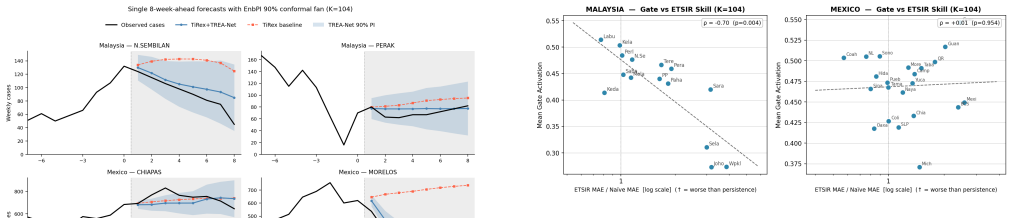
- The gate’s spatial link to ETSIR skill in Malaysia hints that monitoring gate activation could flag regions where the mechanistic prior should be down-weighted in operations.
Editorial analysis
A structured set of objections, weighed in public.
Referee Report
Summary. The paper proposes TREA-Net, a backbone-agnostic transfer framework for 8-week-ahead subnational dengue forecasting when the target surveillance system has only K∈{78,104} weeks of history. It feeds normalized backbone forecasts, ETSIR mechanistic projections, and their absolute discrepancy into a shared pointwise gated residual module trained on reweighted Colombia and Nicaragua windows, then adapts to each target with two global scalars (γ, β) while freezing the backbone and correction weights. The N-invariant design is intended to transfer across unequal numbers of administrative units. Empirically, across five backbones and ten backbone–target settings, TREA-Net improves MAE in 9 of 10 comparisons (Wilcoxon), TREA-Net–TiRex attains the lowest MAE on all target datasets (≈7.1% average reduction vs zero-shot TiRex), ablations support the ETSIR feature and multi-source training, and EnbPI intervals maintain empirical coverage while narrowing 8-week width by 29.6% in Mexico.
Significance. If the reported transfer results hold under broader deployment conditions, TREA-Net is a practically useful contribution: a lightweight (~5K-parameter), N-invariant residual adapter that augments both target-trained sequence models and a frozen foundation model (TiRex) without backbone fine-tuning or fixed spatial topology. The multi-country low-data protocol, multi-backbone evaluation, ablations (no ETSIR, in-domain adapter, per-node 2N adapter), Wilcoxon testing, gate-skill analysis, and conformal efficiency results are concrete strengths relative to many hybrid epi-ML papers that remain single-system and end-to-end. The two-scalar target adapter and open evaluation framing are well matched to health agencies with short surveillance histories. Significance is applied rather than foundational: gains are modest and geography-dependent, but the design is portable and the empirical package is stronger than typical residual-hybrid forecasting notes.
major comments (3)
- [Results and Comparisons; Table 1] Table 1 and the abstract claim improvement in 9 of 10 settings, but effect sizes are highly heterogeneous: Mexico gains are often material (e.g., PatchTST K=78: 89.5→74.4; TiRex K=104: 60.1→51.2), whereas several Malaysia deltas are near noise (e.g., N-HiTS K=104: 29.0→29.1 degradation; TCN K=104: 40.0→39.9). Wilcoxon significance on paired seeds does not establish operational value. The Results/Discussion should foreground effect-size heterogeneity (not only win count), report paired percentage reductions with uncertainty, and qualify the portable early-warning claim by when the frozen correction helps versus leaves the backbone essentially unchanged.
- [Methodology: ETSIR Mechanistic Prior; Discussion: Limitations] Methodology (ETSIR test-time covariates) replaces future temperature/precipitation over the H=8 horizon by training-period week-specific climatology. This is load-bearing for both the ETSIR feature and the learned gate/Δ mapping, yet there is no sensitivity experiment (oracle future weather vs climatology vs persistence weather; or years with anomalous climate). Without that, it remains unclear how much of the transferred residual is robust epidemiological structure versus source-trained compensation for a systematically biased climate prior. A compact ablation or error breakdown on high-anomaly windows would substantially strengthen the central transfer claim.
- [Related Work; Experiments; Table 2] Related Work cites transfer/hybrid methods (CALI-Net, EINNs, EGDL, EARTH, PETSA-style adapters) but Experiments compare mainly backbone-only, ARIMA, ETSIR alone, and ETSIR-PINN. For the claim of a superior transferable residual adapter under unequal N and short K, at least one competitive transfer or parameter-efficient adaptation baseline (e.g., target-only residual on (yB,yE), FiLM-style adapter, or simple source-trained residual without multi-source reweighting beyond the existing ablation) should be reported under the same K protocol. Table 2’s in-domain adapter helps but does not fully close this gap.
minor comments (6)
- [Figure 3; Uncertainty Quantification] Figure 3 is informative, but aggregate metrics (MAE by horizon, coverage by horizon, and interval width already partly in Figure 6) should be cross-referenced in the main caption so readers do not over-generalize from four selected units.
- [Methodology; Table 1] Notation: byE / ŷE and MinMax tildes are clear, but the manuscript sometimes switches between incidence I_t and log(1+I_t) scales when discussing MAE on raw counts; state explicitly at each table that metrics are always on inverse-transformed case counts.
- [References] Wang et al. 2025 ETSIR citation is incomplete (“as cited in the main paper” / “et al.”). Provide a full bibliographic entry or preprint identifier for reproducibility of the mechanistic prior.
- [Multi-Source Training; Supplementary settings] Multi-source reweighting (w_g = D_min/|D_g|) is sensible; briefly state whether windows are sampled with replacement or loss-reweighted in the implementation, and whether backbone-specific source models share identical hyperparameters across Colombia and Nicaragua.
- [Abstract; Empirical Coverage under Distribution Shift] Abstract states conformal prediction “maintains empirical coverage” while the appendix reports ~87% (Mexico) and ~81% (Malaysia) vs 90% nominal under distribution shift. Align abstract wording with the undercoverage already documented.
- [Throughout] Typos/style: “Rodr íguez” spacing artifacts; “Aedes aegypti” should be consistently italicized; arXiv footer date “29 Jul 2026” looks like a metadata glitch and should be corrected if unintentional.
Circularity Check
No significant circularity: standard source-train / target-adapt / held-out-test pipeline; reported MAE gains are not forced by construction.
full rationale
TREA-Net’s load-bearing claim is empirical transfer performance (Table 1: 9/10 backbone–geography improvements; TREA-Net–TiRex lowest MAE), not a first-principles derivation. The chain is: (i) ETSIR parameters fit on training-period observations only with MSA loss and climatological future weather; (ii) backbone forecasts produced independently (target-trained or zero-shot TiRex); (iii) N-invariant gated residual trained on reweighted Colombia/Nicaragua source windows from backbone–ETSIR triples; (iv) only two global scalars (γ, β) fit on early target adaptation windows; (v) metrics on post-K held-out target weeks never used for fitting, scaling, or selection. None of these steps defines the reported test MAE as the fitted quantity. Ablations (Table 2) remove ETSIR features, multi-source training, or the two-scalar adapter and show degradations, which is falsifiable rather than tautological. Self-citations (e.g., Panja et al. on zero-shot epidemic forecasting) are background, not uniqueness theorems that force the architecture or the gains. No self-definitional loop, fitted-input-as-prediction, or ansatz-via-self-citation reduces the central claim to its inputs.
Assumptions & free parameters
free parameters (5)
- Target adaptation scalars (γ_g*, β_g*) =
Per target geography; values not numerically tabulated
- Source-trained gate and delta MLP weights (~5K params) =
~5K parameters, hidden dim 64
- ETSIR parameter vector θ per region/geography =
Fit per series from training observations
- Backbone weights (LSTM/N-HiTS/TCN/PatchTST) and TiRex frozen pretrained weights =
Hidden dim 64 for trained backbones; TiRex external checkpoint
- Optimization and protocol hyperparameters =
As in Table 4 / protocol text
assumptions (5)
- domain assumption Dengue incidence dynamics are usefully summarized by ETSIR: lagged log-incidence plus piecewise-linear temperature and precipitation effects with thresholds.
- domain assumption Future weather over the forecast horizon may be replaced by week-specific training-period climatology without destroying the value of the mechanistic prior.
- ad hoc to paper A pointwise shared-weight residual on (backbone, ETSIR, |diff|) transfers across unequal numbers of administrative units and across backbone families.
- ad hoc to paper Two global scale/shift parameters suffice for target adaptation under K≈78–104 weeks, and node-specific 2N adapters are unnecessary or harmful.
- standard math Standard supervised time-series learning, MinMax train-only scaling, and Wilcoxon signed-rank testing on paired MAEs are valid evaluation tools here.
invented entities (2)
-
TREA-Net gated residual correction module
-
Two-scalar target adapter (γ, β)
Cite this review
Pith. "Pith review of TREA-Net: A Transferable Residual Epidemiological Adaptation Network for Dengue Incidence Forecasting." pith.science (2026). https://pith.science/paper/JLUKNPBR
@misc{pith2026260726854,
  author       = {Pith},
  title        = {Pith review of: TREA-Net: A Transferable Residual Epidemiological Adaptation Network for Dengue Incidence Forecasting},
  year         = {2026},
  howpublished = {\url{https://pith.science/paper/JLUKNPBR}},
  note         = {Machine review of arXiv:2607.26854}
}
read the original abstract
Accurate multi-week dengue forecasting supports timely vector-control interventions, outbreak preparedness, and healthcare resource allocation. However, newly established surveillance systems often lack the historical data needed to train reliable neural forecasting models. Although pretrained time-series models offer promising zero-shot forecasts, their cross-domain training may not capture local epidemiological dynamics. We propose TREA-Net, a Transferable Residual Epidemiological Adaptation Network for dengue forecasting under limited data. TREA-Net augments neural forecasting backbones with projections from an Environmental Time-Series Susceptible-Infected-Recovered model and learns a lightweight gated residual correction transferable from data-rich to data-scarce regions. Its node-invariant design accommodates surveillance systems with different numbers of locations, while target adaptation requires learning only two global parameters. We transfer knowledge from long-running dengue surveillance in Colombia and Nicaragua to 8-week-ahead forecasting in Mexico and Malaysia using only 78 or 104 weeks of target data. Across five neural backbones and ten transfer settings, TREA-Net improves the corresponding backbone in 9 out of 10 settings, with statistically significant gains. When integrated with TiRex, a foundation model for forecasting, it achieves the lowest mean absolute error across all target datasets. Conformal prediction further maintains empirical coverage while reducing 8-week prediction-interval width by 29.6% in Mexico. These results demonstrate TREA-Net's potential as a lightweight and portable early-warning framework for health agencies with limited surveillance data.
Figures


Figures from the paper (2 more)


Reference graph
Works this paper leans on
-
[1]
, title =
Kermack, William Ogilvy and McKendrick, Anderson G. , title =. Proceedings of the Royal Society A , volume =. 1927 , publisher =
1927
-
[2]
PLoS Neglected Tropical Diseases , volume=
Detecting the impact of temperature on transmission of Zika, dengue, and chikungunya using mechanistic models , author=. PLoS Neglected Tropical Diseases , volume=. 2017 , publisher=
2017
-
[3]
Chaos, Solitons & Fractals , volume=
An ensemble neural network approach to forecast Dengue outbreak based on climatic condition , author=. Chaos, Solitons & Fractals , volume=. 2023 , publisher=
2023
-
[4]
Scientific Data , volume=
The climate hazards infrared precipitation with stations---a new environmental record for monitoring extremes , author=. Scientific Data , volume=. 2015 , publisher=
2015
-
[5]
Earth System Science Data , volume=
ERA5-Land: a state-of-the-art global reanalysis dataset for land applications , author=. Earth System Science Data , volume=. 2021 , publisher=
2021
-
[6]
Remote Sensing of Environment , volume=
Google Earth Engine: Planetary-scale geospatial analysis for everyone , author=. Remote Sensing of Environment , volume=. 2017 , publisher=
2017
-
[7]
An environmental time-series
Wang and others , journal=. An environmental time-series
-
[8]
2024 , note=
OpenDengue: a scalable global database of dengue case data , author=. 2024 , note=
2024
Show all 41 references
-
[9]
IEEE transactions on pattern analysis and machine intelligence , volume=
Conformal prediction for time series , author=. IEEE transactions on pattern analysis and machine intelligence , volume=. 2023 , publisher=
2023
-
[10]
Forty-second International Conference on Machine Learning , year=
EARTH: Epidemiology-Aware Neural ODE with Continuous Disease Transmission Graph , author=. Forty-second International Conference on Machine Learning , year=
-
[11]
Machine Learning , volume=
Epidemic-guided deep learning for spatiotemporal forecasting of tuberculosis outbreak , author=. Machine Learning , volume=. 2025 , publisher=
2025
-
[12]
Physica A: Statistical Mechanics and its Applications , volume=
Forecasting dengue epidemics using a hybrid methodology , author=. Physica A: Statistical Mechanics and its Applications , volume=. 2019 , publisher=
2019
-
[13]
Dynamics of Measles Epidemics: Estimating Scaling of Transmission Rates Using a Time Series
Bj. Dynamics of Measles Epidemics: Estimating Scaling of Transmission Rates Using a Time Series. Ecological Monographs , volume =
-
[14]
and Brady, Oliver J
Bhatt, Samir and Gething, Peter W. and Brady, Oliver J. and Messina, Jane P. and Farlow, Andrew W. and Moyes, Catherine L. and Drake, John M. and Brownstein, John S. and Hoen, Anne G. and Sankoh, Osman and Myers, Monica F. and George, Dylan B. and Jaenisch, Thomas and Wint, G....
-
[15]
Dengue and Severe Dengue: Global Situation , year =
-
[16]
2024 , publisher=
Zhang, Shun-Xian and Yang, Guo-Bing and Zhang, Ren-Jie and Zheng, Jin-Xin and Yang, Jian and Lv, Shan and Duan, Lei and Tian, Li-Guang and Chen, Mu-Xin and Liu, Qin and others , journal=. 2024 , publisher=
2024
-
[17]
Lee, Hoesung and Calvin, Katherine and Dasgupta, Dipak and Krinner, Gerhard and Mukherji, Aditi and Thorne, Peter and Trisos, Christopher and Romero, Jos
-
[18]
Proceedings of the 37th AAAI Conference on Artificial Intelligence (AI for Social Impact track) , year =
Rodr. Proceedings of the 37th AAAI Conference on Artificial Intelligence (AI for Social Impact track) , year =
-
[19]
Steering a Historical Disease Forecasting Model Under a Pandemic: Case of Flu and
Rodr. Steering a Historical Disease Forecasting Model Under a Pandemic: Case of Flu and. Proceedings of the 35th AAAI Conference on Artificial Intelligence , year =
-
[20]
Cao, Jiayue and Cheng, Ziqiang and Su, Min and Hui, Cang , title =
-
[21]
PLOS ONE , year =
Fujita, Satoki and Akutsu, Tatsuya , title =. PLOS ONE , year =
-
[22]
Proceedings of the 32nd AAAI Conference on Artificial Intelligence , year =
Perez, Ethan and Strub, Florian and de Vries, Harm and Dumoulin, Vincent and Courville, Aaron , title =. Proceedings of the 32nd AAAI Conference on Artificial Intelligence , year =
-
[23]
and Sharifi-Noghabi, Hossein and Oliveira, Gabriel L
Medeiros, Heitor R. and Sharifi-Noghabi, Hossein and Oliveira, Gabriel L. and Irandoust, Saghar , title =. Proceedings of the 42nd International Conference on Machine Learning (ICML) , year =
-
[24]
Proceedings of the International Conference on Learning Representations (ICLR) , year =
Xu, Jiyuan and Zhang, Wenyu and Jing, Xin and Nie, Jiahao and Chen, Shuai and Zhang, Shuai , title =. Proceedings of the International Conference on Learning Representations (ICLR) , year =
-
[25]
and Sinthong, Phanwadee and Kalagnanam, Jayant , title =
Nie, Yuqi and Nguyen, Nam H. and Sinthong, Phanwadee and Kalagnanam, Jayant , title =. Proceedings of the International Conference on Learning Representations (ICLR) , year =
-
[26]
Proceedings of the 41st International Conference on Machine Learning (ICML) , year =
Das, Abhimanyu and Kong, Weihao and Sen, Rajat and Zhou, Yichen , title =. Proceedings of the 41st International Conference on Machine Learning (ICML) , year =
-
[27]
and Mahoney, Michael W
Ansari, Abdul Fatir and Stella, Lorenzo and Turkmen, Caner and Zhang, Xiyuan and Mercado, Pedro and Shen, Huibin and Shchur, Oleksandr and Rangapuram, Syama Sundar and Pineda Arango, Sebastian and Kapoor, Shubham and Zschiegner, Jasper and Maddix, Danielle C. and Mahoney, Mich...
2024
-
[28]
Advances in Neural Information Processing Systems (NeurIPS) , year =
Auer, Andreas and Podest, Patrick and Klotz, Daniel and B. Advances in Neural Information Processing Systems (NeurIPS) , year =
-
[29]
NeurIPS 2025 Workshop on Backdoor Reasoning, Robustness, Trust and Safety in Time Series (
Panja, Madhurima and Modak, Ojas and Younes, Grace and Chakraborty, Tanujit , title =. NeurIPS 2025 Workshop on Backdoor Reasoning, Robustness, Trust and Safety in Time Series (. 2025 , note =
2025
-
[30]
Proceedings of the 29th ACM International Conference on Information & Knowledge Management (CIKM) , year =
Deng, Songgaojun and Wang, Shusen and Rangwala, Huzefa and Wang, Lijing and Ning, Yue , title =. Proceedings of the 29th ACM International Conference on Information & Knowledge Management (CIKM) , year =
-
[31]
When Rigidity Hurts: Soft Consistency Regularization for Probabilistic Hierarchical Time Series Forecasting , booktitle =
Kamarthi, Harshavardhan and Kong, Lingkai and Rodr. When Rigidity Hurts: Soft Consistency Regularization for Probabilistic Hierarchical Time Series Forecasting , booktitle =. 2023 , doi =
2023
-
[32]
, title =
Chen, Yixin and Ong, Janet Hui Yun and Rajarethinam, Jayasukmar and Yap, Grace and Ng, Lee Ching and Cook, Alex R. , title =. BMC Medicine , volume =. 2018 , doi =
2018
-
[33]
and Apfeldorf, Karyn M
Johansson, Michael A. and Apfeldorf, Karyn M. and Dobson, Scott and Devita, Jason and Buczak, Anna L. and Baugher, Benjamin and others , title =. Proceedings of the National Academy of Sciences , volume =. 2019 , doi =
2019
-
[34]
2016 , doi =
Codeço, Claudia Torres and Cruz, Oswaldo Gonçalves and Riback, Thais Iara Souza and Degener, Carolin Margrit and Gomes, Marcelo Ferreira da Costa and Villela, Daniel and Bastos, Leonardo and Camargo, Simone and Saraceni, Valeria and Lemos, Maria Cristina Freitas and Coelho, Fl...
2016
-
[35]
Economic impact of dengue fever in
Laserna, Andr. Economic impact of dengue fever in. Revista Panamericana de Salud P. 2018 , doi =
2018
-
[36]
2025 , address =
Bolet. 2025 , address =
2025
-
[37]
2025 , address =
Panorama Epidemiol. 2025 , address =
2025
-
[38]
and Crisp, Andrew M
Dean, Natalie E. and Crisp, Andrew M. and Che-Mendoza, Azael and Kirstein, Ofer D. and Barrera-Fuentes, Guillermo A. and Earnest, James T. and Puerta-Guardo, Henry N. and Collins, Matthew H. and Pavia-Ruz, Norma and Ayora-Talavera, Guadalupe and Gonz. Randomized Trial of Targe...
2025
-
[39]
arXiv preprint arXiv:2208.11517 , year=
EpiGNN: Exploring Spatial Transmission with Graph Neural Network for Regional Epidemic Forecasting , author=. arXiv preprint arXiv:2208.11517 , year=
-
[40]
arXiv preprint arXiv:2211.08271 , year=
When, why and how to build a hybrid mechanistic and deep learning model for epidemiology , author=. arXiv preprint arXiv:2211.08271 , year=
-
[41]
PLOS Computational Biology , volume=
Systems biology informed deep learning for inferring parameters and hidden dynamics , author=. PLOS Computational Biology , volume=. 2020 , publisher=
2020
Reviewed July 30, 2026 · model on record in the stance chip above.
Discussion (0). Continue with ORCID to comment.