REVIEW 3 major objections 6 minor 42 references
A Type-and-Effect System for Temporal Dependency Analysis of Render-based Reactive Programs
T0 review · 3 major / 6 minor · reviewed 2026-07-30 · grok-4.5
Pith's one-line read Willow turns React-style render timing into checkable effects so cascades, loops, and stale handlers show up before runtime.
desk verdict Solid PL core calculus with a real effect algebra for React-style timing; the multi-render graph story is useful but less formally pinned than the one-step preservation. read the letter →
The pith
A machine-rendered reading of the paper's core claim, the machinery that carries it, and where it could break.
The reading
What carries the argument
The temporal dependency graph built from Willow effects—especially the graded next modality ○ᴺᵘ and the handler lifecycle modalities 2/3/⊘/7—carries the argument: effects over-approximate when state may change and when listeners are bound or torn down, and graph expansion recovers full multi-render consequences including loops.
What would settle it
Port the checker to a non-toy React hooks codebase that uses dynamic component mount/unmount and concurrent features; if the inferred graphs miss known render loops or stale-listener bugs that appear in the real runtime, or flood false positives on correct code, the transfer claim fails.
Extended reading notes
Core claim
Time-aware typing of render-based reactive programs is practical: if you treat renders as the unit of time and track state updates plus the full event-handler lifecycle as graded effects, the resulting temporal dependency graph lets standard graph algorithms statically catch the timing bugs that framework runtimes usually bury, and those effects are preserved by a time-aware operational semantics.
Load-bearing premise
The simplified two-phase model (no mount/unmount, no concurrent scheduler lanes, only static event labels) is close enough to real React that the static warnings still mean something in production apps.
Editorial extensions
If this is right
- Debounce, form validation, and API-check patterns can carry types that visibly place network work behind timers and show race or stuck-status bugs at compile time.
- Inter-render feedback loops and missing handler cleanups become graph properties rather than runtime surprises.
- First-render cost and high-frequency expensive handlers can be warned about from the same effect graph without running the app.
- Library authors can expose temporal contracts (e.g. “this fetch is debounced”) that compose through parent components via effect polymorphism.
Reading between the lines
- Extending the system with dependent vertex structures for dynamic mount/unmount, as the paper itself flags, is the main bridge from the core calculus to production React tooling.
- The same graded-next and handler-lifecycle effects could likely annotate other virtual-DOM or signal-based UI runtimes, not only React-shaped ones.
- Once effects are in the type, CI could gate merges on “no new inter-render loops” or “no unbound high-frequency handlers” the way linters gate complexity today.
Editorial analysis
A structured set of objections, weighed in public.
Referee Report
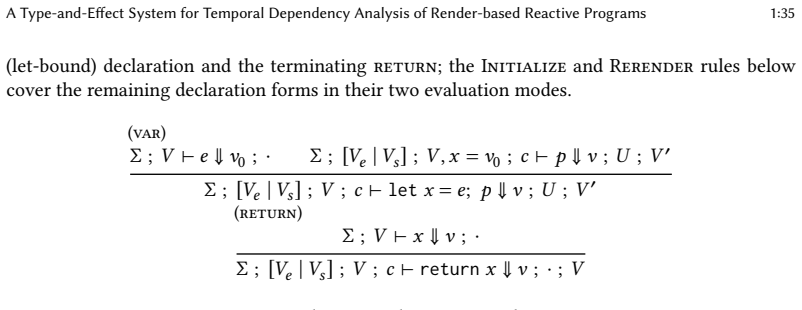
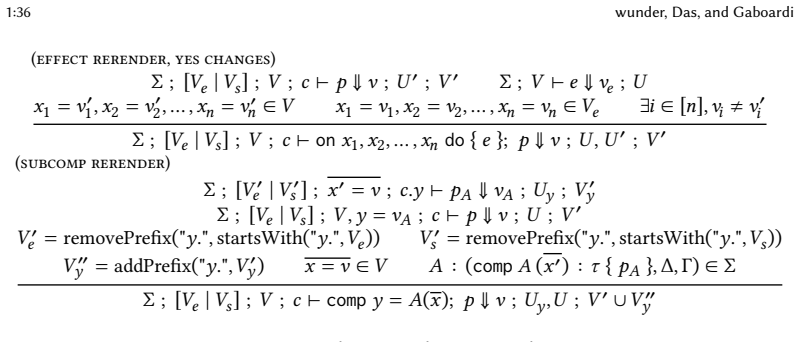
Summary. Willow is a React-inspired core calculus with a two-phase (render/housekeeping) operational semantics and a type-and-effect system that tracks state updates, event-handler lifecycle (bind/once/cancel/remove), and delays via a graded next modality ○ over host units (renders, ms, network). Effects inhabit an algebra with sequencing, branching, and event-guarded modalities; cascading effects live in an environment Δ and are expanded post-check into temporal dependency graphs on which the authors run standard graph algorithms for inter-render loops, render cascades, stale listeners, high-frequency handlers, and first-render cost. The paper proves preservation of effects w.r.t. an instrumented trace semantics (Theorem 6.1 / Appendix F), implements Hindley–Milner-style effect inference in Haskell, and evaluates on debounce, MovingDot, mutual recursion, and a signup-form case study that surfaces a stuck loading state, a request race, and a deliberate retry loop.
Significance. If the results hold at the stated scope, the work is a solid contribution to typed reactive programming: it makes render-relative and mixed-unit timing first-class in an effect system, unifies handler registration/teardown with state cascades, and shows that the resulting graphs support useful static warnings. Strengths include a detailed preservation development (configurations, declarations, expressions, queue typing, causes, subeffecting), a working inference prototype that checks every paper example, and a concrete case study that finds real timing bugs. The fidelity gap to full React (no mount/unmount, no concurrent lanes, static event labels) is acknowledged; within the simplified model the approach is a credible foundation for further work rather than an immediate drop-in React analyzer.
major comments (3)
- [§5.4, Theorem 6.1 / Appendix F] Abstract, Contributions, and §5.4 claim that inferred effects form temporal dependency graphs on which standard algorithms “statically detect” render cascades and inter-render loops. Theorem 6.1 / F.1 only guarantees that a change in X produces a sub-effect of the Δ cascade in the next housekeeping queue (justify-on). The multi-render full-effect expansion (recursive unfolding of ○, 2/3, ∗/+, loop[·] markers; §5 “Immediate, cascading, and full effects”) is never stated as a corollary relating operational multi-render traces to paths/cycles in that graph, including across mixed units (r vs ms vs n) and + branches. Either prove a soundness lemma for the expansion (over-approximation of multi-step traces) or clearly demote cascade/loop detection to a post-hoc heuristic justified only up to one cascade step plus informal graph reading.
- [Abstract; Conclusion; §4; ty subcomp decl] The central “practical foundation for … reactive programs” claim (Abstract; Conclusion) rests on a deliberately simplified semantics: immutable render phase, single event queue, no component mount/unmount, no React priority lanes or concurrent features, and only statically known event-label tuples (Conclusion; Related Work vs React-tRace). Subcomponent typing is α-renaming plus Δ_A ⊆ Δ (ty subcomp decl). These restrictions are load-bearing for transfer to real React; the paper flags mount/unmount as future dependent vertex structure work but still markets the analyses as catching defects “missed by compiler transformations and other current tools.” Scope the evaluation and claims explicitly to Willow’s model, and qualify every React-transfer sentence accordingly.
- [§7] Evaluation (§7) is a prototype inference run on hand-written patterns (debounce, MovingDot, mutual recursion, one signup form). There is no corpus study, no comparison against existing React linters/compilers, no false-positive/negative accounting, and no measurement of annotation burden beyond “minimal.” The signup-form findings are illuminating but anecdotal. For the claim that the system “statically finds and draws attention to timing bugs,” add at least a small structured case suite with expected warnings, or soften the empirical language to “feasibility demonstration.”
minor comments (6)
- [§2–§5] Notation for modalities is inconsistent across the text (○1𝑟 vs ○^{1r}, 2 vs □-like square, 7 vs remove glyph). Pick one rendering and stick to it in body, figures, and appendix.
- [Fig. 1; Fig. 7; Fig. 13] Figure 1 syntax uses if 𝑥 then … (variable scrutinee) while expression typing/semantics allow general 𝑒1; align syntax and rules.
- [§5] df (dataflow function) is left as a parameter with “simplest instantiation = free variables.” State how the prototype instantiates df and whether imprecise df affects soundness of causes or only precision of cascades.
- [§8] Related work on FRP/modal FRP (Fran, Simply RaTT, ultrametric FRP) and graded monads is appropriate; a short explicit contrast table (what Willow tracks that React-tRace/λreact do not, and vice versa) would help readers.
- [throughout] Typos and spacing: “Reactiveprogrammingframeworks”, “timing as-sumptionsburied”, “aprototypetype-and-effect”, “theseeffectscanbecomposed” suggest PDF generation issues; clean the camera-ready text.
- [§6; Appendix F] Appendix F is long and useful; cross-reference key lemmas (Flush Queue Preservation, Listen typing inversion, expression listener-safety) from the main Theorem 6.1 statement so readers can navigate.
Circularity Check
No circularity: standard PL metatheory (syntax, semantics, effects, preservation) with post-hoc graph analyses defined on the effect algebra, not fitted or self-justified predictions.
full rationale
Willow’s derivation chain is the ordinary formal-methods pattern: a core calculus with two-phase render/housekeeping semantics, a type-and-effect system whose effects are introduced by typing rules for setters and event primitives, a preservation theorem (Thm 6.1 / F.1) proved against an instrumented semantics with traces, and post-typecheck analyses that treat inferred effects as a temporal dependency graph. Nothing in that chain is equivalent to its inputs by construction. Effects are not fitted to runtime traces or empirical timing data; cascade and full-effect expansion are defined operations on Δ and the effect grammar (○, ∗, +, 2/3, etc.), and loop/cascade/stale-listener checks are standard graph walks over that structure. Self-citations (Das et al. temporal session types; Rinaldi et al. graph types with overlapping authors) appear only as related-work inspiration for modalities and future mount/unmount extensions, not as load-bearing unproven lemmas inside the preservation argument, which is developed self-contained in the appendix. Gaps the skeptic notes—that multi-render full-effect soundness is not a stated corollary of Thm 6.1, and that the simplified semantics omits mount/unmount—are fidelity or completeness concerns, not circular reductions of claim to input. Score 0 with empty steps is the correct outcome.
Assumptions & free parameters
assumptions (5)
- domain assumption Render-based execution is adequately modeled by alternating immutable render phases and housekeeping flushes of a single ordered event queue, with external events admitted only between renders.
- domain assumption Event labels ℓ⟨v⟩ carry only statically known discriminant tuples; dynamic ids cannot enter the effect layer.
- domain assumption A dataflow function df soundly over-approximates expression dependencies (default: free variables).
- standard math Standard type-and-effect and operational-semantics metatheory (preservation via instrumented traces, subeffecting as a preorder, graded-monoid laws for ○).
- domain assumption External scheduler ℰ is well-behaved: payloads inhabit Σ_E and the scheduler may be treated as an opaque source of typed firings.
invented entities (3)
-
Willow core calculus (components, on-blocks, bind/once/cancel/remove)
independent evidence
-
Graded effect algebra with ○^{N_u}, 2_e, 3_e, ⊘_e, 7_e, ∗, +
independent evidence
-
Temporal dependency graph extracted from Δ and effects
independent evidence
Cite this review
Pith. "Pith review of A Type-and-Effect System for Temporal Dependency Analysis of Render-based Reactive Programs." pith.science (2026). https://pith.science/paper/SIY7Z5MV
@misc{pith2026260727074,
  author       = {Pith},
  title        = {Pith review of: A Type-and-Effect System for Temporal Dependency Analysis of Render-based Reactive Programs},
  year         = {2026},
  howpublished = {\url{https://pith.science/paper/SIY7Z5MV}},
  note         = {Machine review of arXiv:2607.27074}
}
read the original abstract
Reactive programming frameworks such as React allow developers to build interactive applications by declaratively specifying how outputs depend on changing inputs. Although this model makes it easy to reason about what an application computes, the temporal behavior of reactive programs remains difficult to understand and verify. Applications implicitly rely on timing assumptions buried in framework runtimes, leading to subtle bugs such as stale reads, transient inconsistencies, order-dependent behavior, and unintended feedback cycles. To address these challenges, this paper presents Willow, a core calculus for reactive programming inspired by React. Willow gives a time-aware operational semantics that models computation in terms of renders, the fundamental evaluation step in which components produce user interface descriptions, and pairs it with a novel type-and-effect system that statically tracks timing behavior as effects. A "next" modality expresses delays measured not only in renders but in any unit the host environment exposes--renders, network requests, or milliseconds. A family of modalities tracks the lifecycle of event handlers: when they are registered, when they fire, when pending events are canceled and when handlers are removed. A key insight is that the resulting effects form a temporal dependency graph, letting standard graph algorithms statically detect render cascades and inter-render loops that cause non-termination or performance degradation. We formalize Willow and prove preservation of the effect system with respect to the time-aware semantics. We also implement a prototype checker with automatic effect inference and evaluate it on representative reactive patterns such as debouncing, form inputs, and API-driven updates. Our results demonstrate that time-aware typing provides a practical foundation for reasoning about the temporal correctness of reactive programs.
Figures


Figures from the paper (34 more)





Reference graph
Works this paper leans on
-
[1]
Danel Ahman. 2023. When Programs Have to Watch Paint Dry. InFoundations of Software Science and Computation Structures, Orna Kupferman and Pawel Sobocinski (Eds.). Springer Nature Switzerland, Cham, 1–23.doi:10.1007/978- 3-031-30829-1_1 1:26 wunder, Das, and Gaboardi
doi:10.1007/978- 2023
-
[2]
SimplyRaTT:afitch-stylemodalcalculus forreactiveprogrammingwithoutspaceleaks
PatrickBahr,ChristianUldalGraulund,andRasmusEjlersMøgelberg.2019. SimplyRaTT:afitch-stylemodalcalculus forreactiveprogrammingwithoutspaceleaks. Proceedings of the ACM on Programming Languages3,ICFP(July2019), 1–27. doi:10.1145/3341713
-
[3]
IshanBanerjee,BaoNguyen,VahidGarousi,andAtifMemon.2013. Graphicaluserinterface(GUI)testing:Systematic mapping and repository.Information and Software Technology 55, 10 (Oct. 2013), 1679–1694.doi:10.1016/j.infsof.2013. 03.004
-
[4]
Gérard Berry and Georges Gonthier. 1992. The ESTEREL synchronous programming language: design, semantics, implementation. Sci. Comput. Program. 19, 2 (Nov. 1992), 87–152.doi:10.1016/0167-6423(92)90005-V
-
[5]
Aloïs Brunel, Marco Gaboardi, Damiano Mazza, and Steve Zdancewic. 2014. A Core Quantitative Coeffect Calculus. In Programming Languages and Systems - 23rd European Symposium on Programming, ESOP 2014, Held as Part of the European Joint Conferences on Theory and Practice of Software, ETAPS 2014, Grenoble, France, April 5-13, 2014, Proceedings (Lecture Note...
doi:10.1007/978-3- 2014
-
[6]
Lin Clark and React Team. 2017. React Fiber Architecture.https://github.com/acdlite/react-fiber-architecture
2017
-
[7]
Cooper and Shriram Krishnamurthi
Gregory H. Cooper and Shriram Krishnamurthi. 2006. Embedding dynamic dataflow in a call-by-value language. In Proceedings of the 15th European Conference on Programming Languages and Systems (Vienna, Austria)(ESOP’06). Springer-Verlag, Berlin, Heidelberg, 294–308.doi:10.1007/11693024_20
-
[8]
Patrick Cousot. 2019. Abstract Semantic Dependency. InStatic Analysis - 26th International Symposium, SAS 2019, Porto, Portugal, October 8-11, 2019, Proceedings (Lecture Notes in Computer Science, Vol. 11822) , Bor-Yuh Evan Chang (Ed.). Springer, 389–410.doi:10.1007/978-3-030-32304-2_19
Show all 42 references
-
[9]
Evan Czaplicki. 2012. Elm : Concurrent FRP for Functional GUIs.https://www.semanticscholar.org/paper/Elm-%3A- Concurrent-FRP-for-Functional-GUIs-Czaplicki/1791a8a278b83c54425d7581cb45320feba5f4b0
2012
-
[10]
Parallelcomplexityanalysiswithtemporalsessiontypes
AnkushDas,JanHoffmann,andFrankPfenning.2018. Parallelcomplexityanalysiswithtemporalsessiontypes. Proc. ACM Program. Lang. 2, ICFP (July 2018), 91:1–91:30.doi:10.1145/3236786
2018 doi
-
[11]
Camil Demetrescu, Irene Finocchi, and Andrea Ribichini. 2011. Reactive imperative programming with dataflow constraints.In Proceedings of the 2011 ACM international conference on Object oriented programming systems languages and applications (OOPSLA ’11) . Association for Comp...
2011
-
[12]
Denning and Peter J
Dorothy E. Denning and Peter J. Denning. 1977. Certification of Programs for Secure Information Flow.Commun. ACM 20, 7 (1977), 504–513.doi:10.1145/359636.359712
1977
-
[13]
Conal Elliott and Paul Hudak. 1997. Functional reactive animation. InProceedings of the second ACM SIGPLAN in- ternational conference on Functional programming (ICFP ’97) . Association for Computing Machinery, New York, NY, USA, 263–273. doi:10.1145/258948.258973
1997
-
[14]
Ottenstein, and Joe D
Jeanne Ferrante, Karl J. Ottenstein, and Joe D. Warren. 1987. The Program Dependence Graph and Its Use in Opti- mization. ACM Transactions on Programming Languages and Systems 9, 3 (1987), 319–349.doi:10.1145/24039.24041
1987
- [15]
-
[16]
Event-DrivenMultipartySessionActors
SimonFowlerandRaymondHu.2017. Event-DrivenMultipartySessionActors. Presentedatthe11thACMSIGPLAN Workshop on Higher-Order Programming with Effects (HOPE 2023). No proceedings
2017
-
[17]
Ghica and Alex I
Dan R. Ghica and Alex I. Smith. 2014. Bounded Linear Types in a Resource Semiring. InProgramming Languages and Systems, Zhong Shao (Ed.). Springer, Berlin, Heidelberg, 331–350.doi:10.1007/978-3-642-54833-8_18
2014 doi
-
[18]
Jean-Yves Girard, Andre Scedrov, and Philip J. Scott. 1992. Bounded linear logic: a modular approach to polynomial- time computability. Theoretical Computer Science 97, 1 (April 1992), 1–66.doi:10.1016/0304-3975(92)90386-T
1992 doi
-
[19]
Google. 2020. Largest Contentful Paint (LCP). web.dev.https://web.dev/articles/lcp. Core Web Vitals metric for perceived load speed; sites should target LCP of 2.5 seconds or less
2020
-
[20]
Christian Uldal Graulund, Dmitrij Szamozvancev, and Neel Krishnaswami. 2021. Adjoint Reactive GUI Programming. In Foundations of Software Science and Computation Structures , Stefan Kiefer and Christine Tasson (Eds.). Vol. 12650. Springer International Publishing, Cham, 289–30...
2021 doi
-
[21]
ThesynchronousdataflowprogramminglanguageLUSTRE
N.Halbwachs,P.Caspi,P.Raymond,andD.Pilaud.1991. ThesynchronousdataflowprogramminglanguageLUSTRE. Proc. IEEE 79, 9 (1991), 1305–1320.doi:10.1109/5.97300
1991 doi
-
[22]
Gilles Kahn. 1974. The Semantics of a Simple Language for Parallel Programming. InIFIP Congress. https://api. semanticscholar.org/CorpusID:18030506
1974
-
[23]
Ohad Kammar, Sam Lindley, and Nicolas Oury. 2013. Handlers in action. InProceedings of the 18th ACM SIGPLAN international conference on Functional programming (ICFP ’13). Association for Computing Machinery, New York, NY, USA, 145–158. doi:10.1145/2500365.2500590 A Type-and-Ef...
2013
-
[24]
Shin-yaKatsumata.2014. Parametriceffectmonadsandsemanticsofeffectsystems.In The 41st Annual ACM SIGPLAN- SIGACT Symposium on Principles of Programming Languages, POPL ’14, San Diego, CA, USA, January 20-21, 2014 , Suresh Jagannathan and Peter Sewell (Eds.). ACM, 633–646.doi:10...
2014
-
[25]
David Khourshid. 2022. Goodbye, useEffect. Reactathon 2022 Conference Talk, Real World React (YouTube).https: //www.youtube.com/watch?v=HPoC-k7Rxwo
2022
-
[26]
Krishnaswami and Nick Benton
Neelakantan R. Krishnaswami and Nick Benton. 2011. Ultrametric Semantics of Reactive Programs. In2011 IEEE 26th Annual Symposium on Logic in Computer Science . IEEE, Toronto, ON, Canada, 257–266.doi:10.1109/LICS.2011.38
2011 doi
-
[27]
Jay Lee, Joongwon Ahn, and Kwangkeun Yi. 2025. React-tRace: A Semantics for Understanding React Hooks.doi:10. 1145/3763067 arXiv:2507.05234 [cs]
2025 arXiv
- [28]
-
[29]
Magnus Madsen, Ondřej Lhoták, and Frank Tip. 2020. A Semantics for the Essence of React. InLIPIcs, Volume 166, ECOOP 2020, Vol. 166. Schloss Dagstuhl – Leibniz-Zentrum für Informatik, 12:1–12:26.doi:10.4230/LIPICS.ECOOP. 2020.12 Artwork Size: 26 pages, 814986 bytes Medium: app...
2020 doi
-
[30]
GUItesting:pitfallsandprocess
A.M.Memon.2002. GUItesting:pitfallsandprocess. Computer 35,8(Aug.2002),87–88. doi:10.1109/MC.2002.1023795
2002 arXiv
-
[31]
Meta Platforms. 2013. React: A JavaScript Library for Building User Interfaces.https://react.dev
2013
-
[32]
Meta Platforms. 2024. React Compiler.https://react.dev/learn/react-compiler/introduction
2024
-
[33]
Cooper,Michael Greenberg,Aleks Bromfield,andShriram Krishnamurthi.2009
LeoA.Meyerovich,ArjunGuha, JacobBaskin, GregoryH. Cooper,Michael Greenberg,Aleks Bromfield,andShriram Krishnamurthi.2009. Flapjax:aprogramminglanguageforAjaxapplications.In Proceedings of the 24th ACM SIGPLAN Conference on Object Oriented Programming Systems Languages and Appl...
2009
-
[34]
Stefan K. Muller. 2022. Static prediction of parallel computation graphs.Proc. ACM Program. Lang. 6, POPL (Jan. 2022), 46:1–46:31.doi:10.1145/3498708
2022 doi
-
[35]
Rachit Nigam, Pedro Henrique Azevedo de Amorim, and Adrian Sampson. 2023. Modular Hardware Design with Timeline Types. Proc. ACM Program. Lang. 7, PLDI (June 2023), 120:343–120:367.doi:10.1145/3591234
2023 doi
-
[36]
Amir Pnueli. 1977. The temporal logic of programs. InProceedings of the 18th Annual Symposium on Foundations of Computer Science (SFCS ’77). IEEE Computer Society, USA, 46–57.doi:10.1109/SFCS.1977.32
1977 doi
-
[37]
Francis Rinaldi, june wunder, Arthur Azevedo de Amorim, and Stefan K. Muller. 2024. Pipelines and Beyond: Graph Types for ADTs with Futures.Proc. ACM Program. Lang. 8, POPL (Jan. 2024), 17:482–17:511.doi:10.1145/3632859
2024 doi
-
[38]
Rosenband
Daniel L. Rosenband. 2004. The ephemeral history register: flexible scheduling for rule-based designs. InProceedings of the Second ACM/IEEE International Conference on Formal Methods and Models for Co-Design (MEMOCODE ’04).IEEE Computer Society, USA, 189–198.doi:10.1109/MEMCOD...
2004 arXiv
-
[39]
TemporalVerificationwithAnswer-EffectModification:DependentTemporal Type-and-Effect System with Delimited Continuations
TaroSekiyamaandHiroshiUnno.2023. TemporalVerificationwithAnswer-EffectModification:DependentTemporal Type-and-Effect System with Delimited Continuations. Proc. ACM Program. Lang. 7, POPL (Jan. 2023), 71:2079– 71:2110. doi:10.1145/3571264
2023 doi
-
[40]
Taro Sekiyama and Hiroshi Unno. 2025. Algebraic Temporal Effects: Temporal Verification of Recursively Typed Higher-Order Programs. Proc. ACM Program. Lang. 9, POPL (Jan. 2025), 78:2306–78:2336.doi:10.1145/3704914
2025 doi
-
[41]
Sam Van den Vonder, Joeri De Koster, Florian Myter, and Wolfgang De Meuter. 2017. Tackling the awkward squad for reactive programming: the actor-reactor model. InProceedings of the 4th ACM SIGPLAN International Workshop on Reactive and Event-Based Languages and Systems (REBLS ...
2017
-
[42]
causes” The “causes
Zhanyong Wan and Paul Hudak. 2000. Functional reactive programming from first principles. InProceedings of the ACM SIGPLAN 2000 Conference on Programming Language Design and Implementation (Vancouver, British Columbia, Canada) (PLDI ’00). Association for Computing Machinery, N...
2000
Reviewed July 30, 2026 · model on record in the stance chip above.
Discussion (0). Continue with ORCID to comment.