REVIEW 4 major objections 6 minor 95 references
Organizing amateur badminton match evidence around an expert issue taxonomy, rallies, and linked video produces more frequent, concrete, actionable, and appropriate tactical reflections than a report-and-statistics baseline.
Reviewed by Pith at T0; open to challenge. T0 means a machine referee read the full paper against a public rubric. the ladder, T0–T4 →
T0 review · grok-4.5
2026-07-30 11:52 UTC pith:O4FM4ATZ
load-bearing objection Solid sports-HCI systems paper with a real taxonomy and a cleanly scoped study, but the headline stats likely overstate precision by treating nested reflection entries as independent. the 4 major comments →
TactiPlay: Multi-Granularity Tactical Parsing and Video-Anchored Match Review for Amateur Badminton Players
The pith
A machine-rendered reading of the paper's core claim, the machinery that carries it, and where it could break.
Core claim
When match evidence is organized into an expert-taxonomy-guided, rally-level, video-anchored review workflow, amateur players produce more frequent reflections that experts rate as more concrete, actionable, and appropriate than those produced with a fixed report-and-statistics interface, even when both systems start from the same verified stroke- and rally-level labels.
What carries the argument
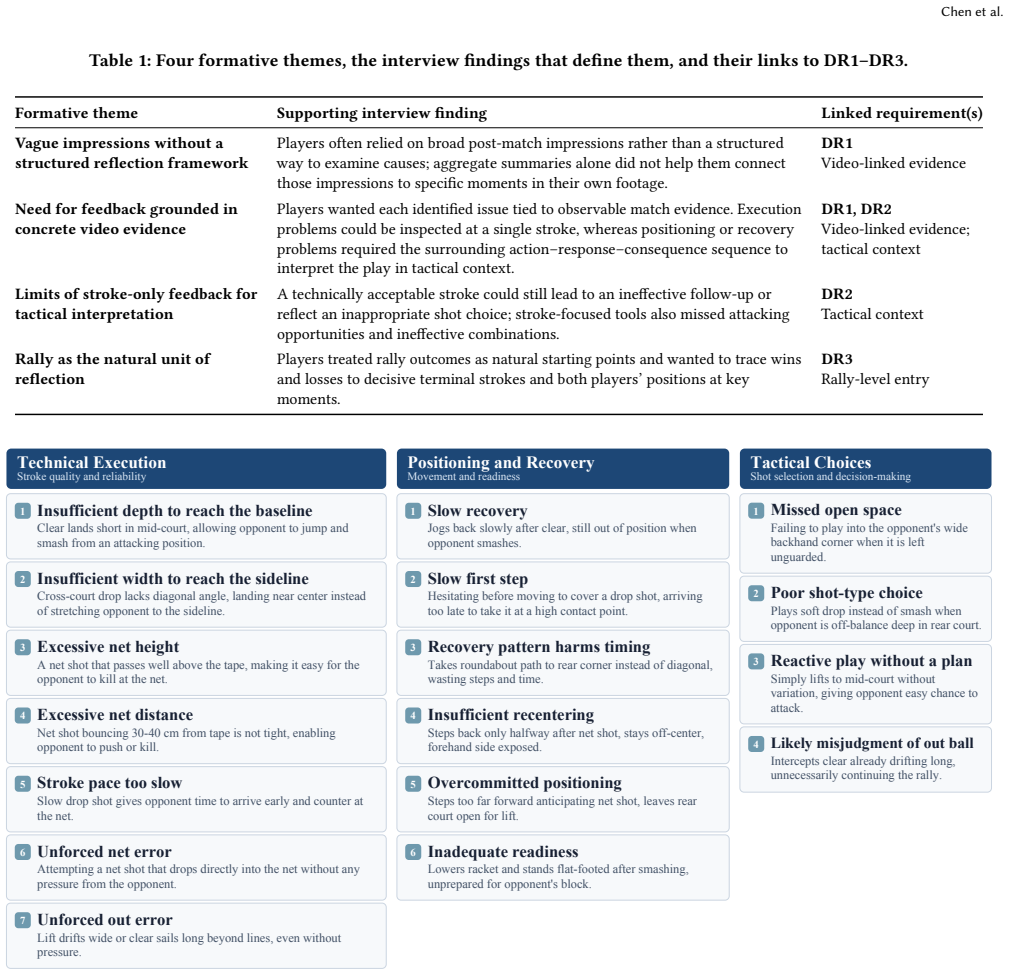
The expert-taxonomy-guided, rally-level, video-anchored review workflow: a hierarchical performance-issue taxonomy (Technical Execution, Positioning and Recovery, Tactical Choices) used to structure pipeline outputs into four report topics, rally explainers, subtopic-linked clips, and synchronized court visualizations so players can move between diagnosis and evidence.
Load-bearing premise
The better reflections come from the integrated review workflow itself, not from the fact that each player saw two different matches or from joint differences in prompt structure, clustering, linking, and report packaging that the study did not separate.
What would settle it
Run a component-controlled within-subjects study on the same matches with matched report length: if taxonomy organization plus video linking is removed while keeping the same verified labels and generator, expert-rated reflection frequency, concreteness, actionability, and appropriateness should fall back to baseline levels.
If this is right
- Amateur post-match tools should treat rallies as the primary entry point and link every issue card to the corresponding video snippets.
- Feedback should separate terminal winning/losing patterns from non-terminal process issues using a coach-derived taxonomy rather than only court-zone technical stats.
- Interface design that supports a report-to-evidence loop can replace predominantly manual video search for many recreational players.
- Similar taxonomy-plus-video workflows could transfer to other rally-based racket sports after sport-specific taxonomy validation.
- Coaches could use such systems as assistants that pre-compile key rallies and issue clusters from underused match recordings.
Where Pith is reading between the lines
- If trajectory and position traces remain unverified, heatmap-backed spatial claims will be the first place trust breaks when the system is taken fully automatic.
- The same scaffolding may matter most for players just above beginner technique, who have strokes but no shared language for recovery and shot choice.
- Visualizing counterfactual footwork or return paths on the original clip is the natural next interaction after problem-linked replay.
- Without longitudinal cross-match views, players may still confuse one-off errors with habits the taxonomy is meant to surface.
Editorial analysis
A structured set of objections, weighed in public.
Referee Report
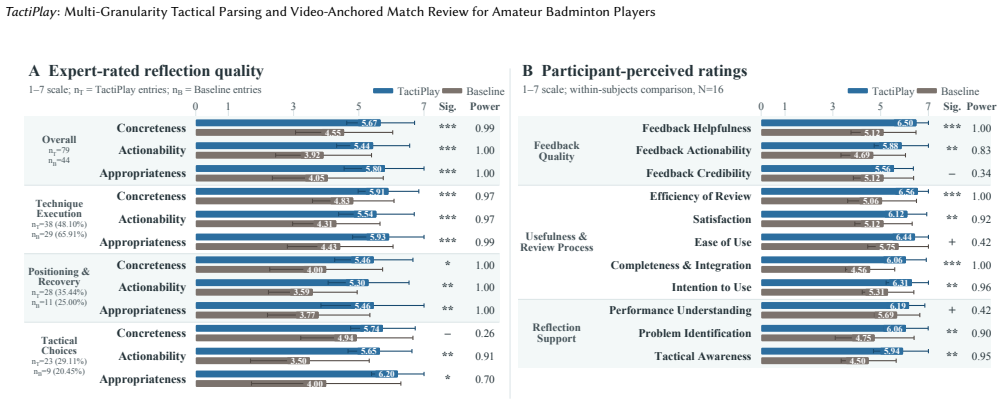
Summary. The paper presents TactiPlay, a post-match review system for amateur badminton players. A formative interview study (N=8) yields three design requirements (video-linked feedback, tactical rather than stroke-only focus, rally-level entry points); free-form annotations of seven amateur matches by three national-level players are open-coded into a three-domain, 17-descriptor performance-issue taxonomy. A two-stage pipeline (CV/VLM event detection, then GPT-4.1-based issue generation, clustering, and rally summarization) feeds an interface with a four-topic structured report, subtopic-linked video clips, a Rally Explainer, and a dynamic court heatmap. A within-subjects study (N=16) compares TactiPlay against a report-and-statistics baseline using the same upstream detection pipeline, manual label verification, and report generator. The authors report that TactiPlay elicits nearly twice as many reflection entries, with higher expert-rated concreteness, actionability, and appropriateness, higher subjective ratings on 8 of 11 items, and a shift from video-driven manual search to a report-to-evidence review strategy.
Significance. If the main result holds, the paper makes a solid contribution to sports HCI: a worked example of how to organize AI-generated match analysis into a taxonomy-guided, rally-level, video-anchored reflection workflow for amateurs, with an evaluation showing that this organization changes both reflection quality and review strategy. The expert-derived taxonomy (304 annotations from national-level players, 17 descriptors) is a reusable artifact. The study is careful by field standards: within-subjects with Latin-square counterbalancing, identical upstream pipeline and verification protocol across conditions, blinded expert rating with strong ICCs, and unusually transparent non-claims about autonomous raw-video analysis. The detected strategy reversal (report-to-evidence loop) is a genuinely interesting interaction finding. Impact is moderate rather than transformative: N=16, single session, no behavioral outcome.
major comments (4)
- [§6.1, Figure 5 Part A] The primary outcome appears to be analyzed at the level of pooled reflection entries (nT=79, nB=44 overall; 38/29, 28/11, 23/9 per domain). Entries are nested within only 16 participants who contributed unequal numbers of entries per condition (~5 vs ~3 on average), so entry-level tests violate independence and the reported p-values and observed power (0.97-1.00) are not interpretable as stated. §6 says Wilcoxon signed-rank was used for paired data, but the figure's units are entries, not participants. Please re-analyze at the participant level (per-participant mean quality per condition, Wilcoxon, N=16, with effect sizes) or fit mixed-effects models with a random intercept per participant (and per match), and report per-participant entry counts. Also address the unequal-pool composition: with nearly twice as many TactiPlay entries, pooled means mix a quantity effect with a quality effec
- [§5.4.1 (rater blinding)] Condition labels were removed before expert rating, but TactiPlay-condition entries plausibly echo taxonomy descriptors, subtopic phrasing, and linked-clip references (cf. P7 and P16 quotes), making the condition inferable to raters who had also calibrated on taxonomy categories. Partial unblinding would bias exactly the three dimensions (concreteness, actionability, appropriateness) that carry the headline claim. Please either run a blinding audit (ask raters to guess condition per entry and test whether guessability correlates with scores), or add a dedicated limitation and a robustness check (e.g., restrict to entries with no taxonomy-specific vocabulary).
- [§5.1 vs §6-7 (attribution of effects)] The conditions differ jointly in prompt structure, taxonomy organization, clustering, video linking, interaction, and probably report length; each participant also reviewed two different matches. The integrated-workflow framing in §5.1 and §7.3 is honest, and I do not ask for a full ablation, but the causal language should be kept at workflow level throughout: the abstract and §6.1 phrases like 'elicits more frequent, concrete, actionable' reflections read as component-level attribution. Please also add one paragraph on the report-volume confound: higher helpfulness/efficiency ratings and more reflection entries are expected when one condition simply contains more content, and the interesting claim is about organization and linkage, not quantity.
- [§3.3.2 and §7.3 (diagnosis correctness)] The pipeline's issue generation (GPT-4.1 with taxonomy reference) is central to the contribution, yet the correctness of generated diagnoses is never validated; §7.3 acknowledges this, and P3's quote ('the system said I was intercepted, but the shuttle was actually out') shows errors are visible to users. Since 'appropriateness' of reflections was rated against footage rather than against system output, the current evidence cannot rule out that participants reflect confidently on partly wrong diagnoses. Please add a small expert audit: sample k generated issues (e.g., 30-50) stratified by topic, have badminton experts judge correctness against the linked clips, and report the rate. This materially strengthens the taxonomy-grounding claim at modest cost.
minor comments (6)
- [§3.3.1] Reported detection metrics are modest (rally segmentation 75%, winner/win-reason 68%, hit detection precision 0.71/recall 0.72, hitter ID 77.9%), and stroke classification accuracy is only described as 'insufficient' without a number. Please give the number, and state the provenance/size of each test set and whether the 109-rally and 564-hit evaluations overlap with the seven taxonomy-annotation videos or the 32 study matches.
- [Figure 5 (observed power column)] Post-hoc observed power is generally uninformative and here especially misleading if computed on pooled entries (see Major Comment 1). Consider replacing the power column with effect sizes (e.g., rank-biserial r or Cliff's delta) and confidence intervals.
- [§5.3 (counterbalancing)] Each participant reviewed two different matches with different opponents; match difficulty could affect reflection quality. The 2×2 Latin square handles order, but please report whether match identity (or opponent strength) showed any association with entry counts or quality, even descriptively.
- [Typos] Typesetting artifacts: 'presentTactiPlay' and 'inTactiPlay' (missing spaces) in Abstract/§1; 'Tactical A wareness Issues' in §4.1; 'R¯utenis Paulauskas' in ref [51]. Schön is cited as 2017 (a reprint); consider citing the original 1983 edition.
- [Figure 3 / §4.1] The frequency-based star rating on subtopic cards (Figure 3-F2) is mentioned only in the caption; one sentence on its rationale and scale would help, since frequency is not obviously a severity signal.
- [§6.3 / Figure 6] Figure 6 is descriptive over 16 participants; the report-driven vs video-driven shift (12/16 vs 6/16) is a nice result and could support a simple exact test (e.g., McNemar) rather than counts alone.
Circularity Check
No significant circularity: empirical HCI systems evaluation with independent taxonomy and blinded expert-rated outcomes.
full rationale
TactiPlay is a design-and-evaluation paper, not a first-principles derivation that claims to predict quantities from fitted inputs. The load-bearing chain is: formative interviews yield design requirements; national-level athletes’ free-form annotations yield an independent performance-issue taxonomy; a pipeline maps verified match events onto that taxonomy; a within-subjects study compares the integrated workflow to a report-and-statistics baseline on expert-rated reflection quality (condition labels removed, raters checking footage). None of these steps reduces a claimed prediction to its own definition or fit. The taxonomy is not fitted to the N=16 reflection scores; DR1–DR3 are requirements that motivate the system, not quantities the study pretends to discover from scratch. Self-citations in related work are ordinary background and are not used as uniqueness theorems that force the result. Statistical concerns (entry-level vs participant-level analysis, unequal entry pools, possible partial unblinding via taxonomy phrasing) affect correctness and inference strength, not circularity of a derivation. Per the analyzer rules this is an honest non-finding: score 0, no circular steps.
Axiom & Free-Parameter Ledger
free parameters (3)
- Tactical chunk length (three-stroke unit) =
3 strokes (fixed design choice)
- Manual verification effort / corrected label set =
~25 min per 8-min match
- VLM/LLM analysis stack (Doubao-seed-1.6; GPT-4.1)
axioms (5)
- domain assumption Post-match reflection-on-action improves when feedback is structured and linked to inspectable video evidence (Schön; sports pedagogy literature).
- ad hoc to paper Amateur singles performance issues can be adequately organized into Technical Execution, Positioning and Recovery, and Tactical Choices with 17 sub-descriptors derived from national-level free-form annotations.
- domain assumption Three consecutive strokes form a minimal observable action–response–outcome tactical unit suitable for amateur review.
- ad hoc to paper With stroke- and rally-level labels manually verified, differences between conditions can be attributed to how evidence is organized and linked, not to upstream detection alone.
- domain assumption Expert ratings of concreteness, actionability, and appropriateness of written reflections are a valid primary measure of tactical reflection quality for this population.
invented entities (2)
-
Expert-derived amateur badminton performance-issue taxonomy (3 domains, 17 descriptors)
no independent evidence
-
TactiPlay integrated review workflow (four-topic report + Rally Explainer + linked clips + dynamic court viz)
no independent evidence
read the original abstract
Amateur badminton players increasingly record matches, yet existing tools provide only aggregate statistics or generic summaries, leaving most unable to extract tactical insights without expert guidance. A formative study (N=8) reveals the need for multi-granularity, video-anchored tactical analysis centered on rallies. We derive a taxonomy of performance issues from national-level athletes' annotations and present TactiPlay, an interactive system that instantiates an expert-taxonomy-guided, rally-level, video-anchored review workflow. The system's analytical pipeline organizes match events into taxonomy-grounded feedback, while its interface links structured reports to rally summaries, video evidence, and court visualizations. A within-subjects study (N=16) shows that TactiPlay elicits more frequent, concrete, actionable, and appropriate reflections than a report-and-statistics baseline. These findings show how organizing reviewed match evidence into a taxonomy-guided, video-linked workflow can support amateur players' tactical reflection.
Figures



Reference graph
Works this paper leans on
-
[1]
Anderson, Zoe Knowles, and David Gilbourne
Alisa G. Anderson, Zoe Knowles, and David Gilbourne. 2004. Reflective Practice for Sport Psychologists: Concepts, Models, Practical Implications, and Thoughts on Dissemination.The Sport Psychologist18, 2 (2004), 188–203. doi:10.1123/tsp. 18.2.188
work page doi:10.1123/tsp 2004
-
[2]
Fraser Anderson, Tovi Grossman, Justin Matejka, and George Fitzmaurice. 2013. YouMove: enhancing movement training with an augmented reality mirror. In Proceedings of the 26th Annual ACM Symposium on User Interface Software and Technology(St. Andrews, Scotland, United Kingdom)(UIST ’13). Association for Computing Machinery, New York, NY, USA, 311–320. doi...
-
[3]
Adrià Arbués-Sangüesa, Coloma Ballester, and Gloria Haro. 2019. Single- Camera Basketball Tracker through Pose and Semantic Feature Fusion. arXiv:1906.02042 [cs.CV] doi:10.48550/arXiv.1906.02042
work page internal anchor Pith review Pith/arXiv arXiv doi:10.48550/arxiv.1906.02042 2019
-
[4]
Arnold Baca and Philipp Kornfeind. 2006. Rapid Feedback Systems for Elite Sports Training.IEEE Pervasive Computing5, 4 (2006), 70–76. doi:10.1109/MPRV.2006.82
-
[5]
Berry, B
J. Berry, B. Abernethy, and J. Côté. 2008. The contribution of structured activity and deliberate play to the development of expert perceptual and decision-making skill.Journal of Sport & Exercise Psychology30, 6 (Dec. 2008), 685–708. doi:10. 1123/jsep.30.6.685
2008
-
[6]
Andrzej Białecki, Peter Xenopoulos, Paweł Dobrowolski, Robert Białecki, and Jan Gajewski. 2024. ESPORT: Electronic Sports Professionals Observations and Reflections on Training.Physical Culture and Sport. Studies and Research105, 1 (2024), 13–23. doi:10.2478/pcssr-2024-0021
-
[7]
James Bridgeman and Andrea Giraldez-Hayes. 2024. Using artificial intelligence- enhanced video feedback for reflective practice in coach development: benefits Chen et al. and potential drawbacks.Coaching: An International Journal of Theory, Research and Practice17, 1 (2024), 32–49
2024
-
[8]
Enya Bullard, Nibraas Khan, and Nilanjan Sarkar. 2025. Enhancing Athletic Per- formance Through AI: An Iterative Prompt Engineering Approach for LLM-Based Coaching Feedback. InInternational Conference on Human-Computer Interaction (Communications in Computer and Information Science, Vol. 2529). Springer Nature Switzerland, Cham, Switzerland, 251–255. doi:...
-
[9]
David Bunker and Rod Thorpe. 1982. A Model for the Teaching of Games in Secondary Schools.Bulletin of Physical Education18, 1 (1982), 5–8
1982
-
[10]
Subhajit Chaudhury, Daiki Kimura, Phongtharin Vinayavekhin, Asim Munawar, Ryuki Tachibana, Koji Ito, Yuki Inaba, Minoru Matsumoto, Shuji Kidokoro, and Hi- roki Ozaki. 2019. Unsupervised temporal feature aggregation for event detection in unstructured sports videos. In2019 IEEE International Symposium on Multime- dia (ISM). IEEE, Piscataway, NJ, USA, 9–16....
arXiv 2019
-
[11]
Taizhou Chen, Kai Chen, Xingyu Liu, Pingchuan Ke, and Zhida Sun. 2026. Bad- minSense: Enabling Fine-Grained Badminton Stroke Evaluation on a Single Smartwatch. arXiv:2603.21825 [cs.HC] doi:10.48550/arXiv.2603.21825
-
[12]
Yu-Jou Chen and Yu-Shuen Wang. 2024. TrackNetV3: Enhancing ShuttleCock Tracking with Augmentations and Trajectory Rectification. InProceedings of the 5th ACM International Conference on Multimedia in Asia(Tainan, Taiwan) (MMAsia ’23). Association for Computing Machinery, New York, NY, USA, Article 1, 7 pages. doi:10.1145/3595916.3626370
arXiv 2024
-
[13]
Xiangtong Chu, Xiao Xie, Shuainan Ye, Haolin Lu, Hongguang Xiao, Zeqing Yuan, Chen Zhu-Tian, Hui Zhang, and Yingcai Wu. 2021. TIVEE: Visual exploration and explanation of badminton tactics in immersive visualizations.IEEE Transactions on Visualization and Computer Graphics28, 1 (2021), 118–128
2021
-
[14]
MMPose Contributors. 2020. OpenMMLab Pose Estimation Toolbox and Bench- mark. https://github.com/open-mmlab/mmpose
2020
-
[15]
Christopher Cushion, Paul Ford, and Andrew Williams. 2012. Coach behaviours and practice structures in youth soccer: Implications for talent development. Journal of sports sciences30 (09 2012). doi:10.1080/02640414.2012.721930
arXiv 2012
-
[16]
K. Anders Ericsson. 2006. The Influence of Experience and Deliberate Practice on the Development of Superior Expert Performance. InThe Cambridge Handbook of Expertise and Expert Performance, K. Anders Ericsson, Neil Charness, Paul J. Feltovich, and Robert R. Hoffman (Eds.). Cambridge University Press, Cambridge, UK, 683–704. doi:10.1017/CBO9780511816796.038
-
[17]
Juliana Exel and Peter Dabnichki. 2024. Precision sports science: what is next for data analytics for athlete performance and well-being optimization?Applied Sciences14, 8 (2024), 3361
2024
-
[18]
Anna Fitzpatrick, Joe Stone, Simon Choppin, and John Kelley. 2023. Analysing Hawk-Eye ball-tracking data to explore successful serving and returning strate- gies at Wimbledon.International Journal of Performance Analysis in Sport24 (12 2023), 1–18. doi:10.1080/24748668.2023.2291238
arXiv 2023
-
[19]
I. M. Franks and G. Miller. 1991. Training coaches to observe and remember. Journal of Sports Sciences9, 3 (1991), 285–297. doi:10.1080/02640419108729890 Autumn
-
[20]
Yan Gao. 2025. The role of artificial intelligence in enhancing sports education and public health in higher education: innovations in teaching models, evaluation systems, and personalized training.Frontiers in Public Health13 (2025), 1554911
2025
-
[21]
Wolf Gawin, Chris Beyer, and Marko Seidler. 2015. A competition analysis of the single and double disciplines in world-class badminton.International Journal of Performance Analysis in Sport15, 3 (2015), 997–1006
2015
-
[22]
1988.Learning by Doing: A Guide to Teaching and Learning Methods
Graham Gibbs. 1988.Learning by Doing: A Guide to Teaching and Learning Methods. Further Education Unit, Oxford Polytechnic, Oxford, UK
1988
-
[23]
Wade Gilbert and Pierre Trudel. 2001. Learning to Coach through Experience: Re- flection in Model Youth Sport Coaches.Journal of Teaching in Physical Education 21 (10 2001), 16–34. doi:10.1123/jtpe.21.1.16
-
[24]
Ryan Groom, Christopher Cushion, and Lee Nelson. 2011. The Delivery of Video-Based Performance Analysis by England Youth Soccer Coaches: Towards a Grounded Theory.Journal of Applied Sport Psychology23, 1 (01 2011), 16–32. doi:10.1080/10413200.2010.511422
arXiv 2011
-
[25]
Fabian Hammes, Alexander Hagg, Alexander Asteroth, and Daniel Link. 2022. Artificial intelligence in elite sports—a narrative review of success stories and challenges.Frontiers in sports and active living4 (2022), 861466
2022
-
[26]
Sandra G Hart and Lowell E Staveland. 1988. Development of NASA-TLX (Task Load Index): Results of empirical and theoretical research. InAdvances in psy- chology. Vol. 52. Elsevier, Amsterdam, The Netherlands, 139–183
1988
-
[27]
Xusheng He, Wei Liu, Shanshan Ma, Qian Liu, Chenghao Ma, and Jianlong Wu
-
[28]
Yuchen He, Zeqing Yuan, Yihong Wu, Liqi Cheng, Dazhen Deng, and Yingcai Wu
-
[29]
Kristina Host and Marina Ivašić-Kos. 2022. An overview of Human Action Recognition in sports based on Computer Vision.Heliyon8, 6 (2022), e09633. doi:10.1016/j.heliyon.2022.e09633
-
[30]
Tzu-Han Hsu, Ching-Hsuan Chen, Nyan Ping Jut, Tsì-Uí İk, Wen-Chih Peng, Yu-Shuen Wang, Yu-Chee Tseng, Jiun-Long Huang, Yu-Tai Ching, Chih-Chuan Wang, and Yuan-Hsiang Lin. 2019. CoachAI: A Project for Microscopic Bad- minton Match Data Collection and Tactical Analysis. In2019 20th Asia-Pacific Network Operations and Management Symposium (APNOMS). IEEE, Pis...
arXiv 2019
-
[31]
Yi-Hua Hsu, Chih-Chang Yu, and Hsu-Yung Cheng. 2024. Enhancing badminton game analysis: an approach to shot refinement via a fusion of shuttlecock tracking and hit detection from monocular camera.Sensors24, 13 (2024), 4372
2024
-
[32]
Yu-Chuan Huang, I-No Liao, Ching-Hsuan Chen, Tsì-Uí İk, and Wen-Chih Peng
-
[33]
Mike Hughes and Roger Bartlett. 2002. The use of performance indicators in performance analysis.Journal of sports sciences20 (11 2002), 739–54. doi:10.1080/ 026404102320675602
2002
-
[34]
Matthew Jörke, Shardul Sapkota, Lyndsea Warkenthien, Niklas Vainio, Paul Schmiedmayer, Emma Brunskill, and James A. Landay. 2025. GPTCoach: Towards LLM-Based Physical Activity Coaching. InProceedings of the 2025 CHI Conference on Human Factors in Computing Systems (CHI ’25). Association for Computing Machinery, New York, NY, USA, Article 993, 46 pages. do...
doi:10.1145/3706598 2025
-
[35]
Matthias Jud and Stefan Thalmann. 2025. AI in digital sports coaching– a systematic review.Managing Sport and Leisure30, 6 (2025), 1577–1593. doi:10.1080/23750472.2024.2449016
arXiv 2025
-
[36]
Smiti Kaul, David Borland, Nan Cao, and David Gotz. 2021. Improving visualiza- tion interpretation using counterfactuals.IEEE Transactions on Visualization and Computer Graphics28, 1 (2021), 998–1008
2021
-
[37]
Lisanne Kleygrewe, RI Vana Hutter, Matthijs Koedijk, and Raôul RD Oudejans
-
[38]
Äli Leijen, Kai Valtna, Djuddah AJ Leijen, and Margus Pedaste. 2012. How to determine the quality of students’ reflections?Studies in Higher Education37, 2 (2012), 203–217
2012
-
[39]
Liebermann, Larry Katz, Mike Hughes, Roger Bartlett, Jim McClements, and Ian Franks
Dario G. Liebermann, Larry Katz, Mike Hughes, Roger Bartlett, Jim McClements, and Ian Franks. 2002. Advances in the application of information technology to sport performance.Journal of sports sciences20 (11 2002), 755–69. doi:10.1080/ 026404102320675611
2002
-
[40]
Tica Lin, Alexandre Aouididi, Zhutian Chen, Johanna Beyer, Hanspeter Pfis- ter, and Jui-Hsien Wang. 2024. VIRD: Immersive Match Video Analysis for High-Performance Badminton Coaching.IEEE Transactions on Visualization and Computer Graphics30, 1 (2024), 458–468. doi:10.1109/TVCG.2023.3327161
arXiv 2024
-
[41]
Changing perspectives: Enhancing learning efficacy with the after-action review in virtual reality training for police.Ergonomics67, 5 (2024), 628–637
2024
-
[42]
Paul Liu and Jui-Hsien Wang. 2022. MonoTrack: Shuttle trajectory reconstruction from monocular badminton video. arXiv:2204.01899 [cs.CV] https://arxiv.org/ abs/2204.01899
Pith/arXiv arXiv 2022
-
[43]
Ji Ma, Jiale Wu, Haoyu Wang, Yanze Zhang, Xiao Xie, Zheng Zhou, Hui Zhang, Jiachen Wang, and Yingcai Wu. 2025. T3Set: A Multimodal Dataset with Targeted Suggestions for LLM-based Virtual Coach in Table Tennis Training. InProceedings of the 31st ACM SIGKDD Conference on Knowledge Discovery and Data Mining V
2025
-
[44]
Henry B Mann and Donald R Whitney. 1947. On a test of whether one of two random variables is stochastically larger than the other.The annals of mathematical statistics18, 1 (1947), 50–60. doi:10.1214/aoms/1177730491
arXiv 1947
-
[45]
Tica Lin, Ruxun Xiang, Gardenia Liu, Divyanshu Tiwari, Meng-Chia Chiang, Chenjiayi Ye, Hanspeter Pfister, and Chen Zhu-Tian. 2025. SportsBuddy: De- signing and Evaluating an AI-Powered Sports Video Storytelling Tool Through Real-World Deployment. In2025 IEEE 18th Pacific Visualization Conference (Paci- ficVis). IEEE, Piscataway, NJ, USA, 214–223
2025
-
[46]
2013.Routledge handbook of sports performance analysis
Tim McGarry, Peter O’Donoghue, and Jaime Sampaio (Eds.). 2013.Routledge handbook of sports performance analysis. Routledge, London, UK
2013
-
[47]
Daniel Memmert, Koen APM Lemmink, and Jaime Sampaio. 2017. Current approaches to tactical performance analyses in soccer using position data.Sports medicine47, 1 (2017), 1–10
2017
-
[48]
Association for Computing Machinery, New York, NY, USA, 5686–5697
-
[49]
Peter O’Donoghue. 2006. The use of feedback videos in sport.International Journal of Performance Analysis in Sport6 (11 2006), 1–14. doi:10.1080/24748668. 2006.11868368
Pith/arXiv arXiv 2006
-
[50]
Iain McCormick and Stewart Forsyth. 2024. Assessing the effectiveness of group based reflective practice for coaches.International Journal of Evidence Based Coaching and Mentoring22, 1 (Feb. 2024), 293–302. doi:10.24384/rhbp-8660
-
[51]
R¯utenis Paulauskas, Domantas Šakinis, and Bruno Figueira. 2025. Padel vs. tennis doubles: a comparison of performance demands and game attributes.Frontiers in Sports and Active Living7 (2025), 1540424
2025
-
[52]
Alastair Pearson, Tom Webb, Gemma Milligan, and Matt Miller-Dicks. 2023. The use of video feedback as a facet of performance analysis: an integrative review.International Review of Sport and Exercise Psychology18 (07 2023), 417–439. doi:10.1080/1750984X.2023.2235700
arXiv 2023
-
[53]
Mitchell Naughton, Paul M Salmon, Heidi R Compton, and Scott McLean. 2024. Challenges and opportunities of artificial intelligence implementation within sports science and sports medicine teams.Frontiers in Sports and Active Living6 (2024), 1332427
2024
-
[54]
2013.Performance analysis of sport IX
Derek Peters and Peter O’Donoghue (Eds.). 2013.Performance analysis of sport IX. Routledge, London, UK
2013
-
[55]
Sajjad Pashaie, Sardar Mohammadi, and Hamed Golmohammadi. 2024. Unlocking Athlete Potential: The Evolution of Coaching Strategies through Artificial Intelli- gence. OnlineFirst inProceedings of the Institution of Mechanical Engineers, Part P: Journal of Sports Engineering and Technology. doi:10.1177/17543371241300889 TactiPlay: Multi-Granularity Tactical ...
-
[56]
Machar Reid, Miguel Crespo, Brendan Lay, and Jason Berry. 2007. Skill acquisition in tennis: Research and current practice.Journal of Science and Medicine in Sport 10, 1 (2007), 1–10. doi:10.1016/j.jsams.2006.05.011
-
[57]
Joan Sargeant, Jocelyn Lockyer, Karen Mann, Eric Holmboe, Ivan Silver, Heather Armson, Erik Driessen, Tanya Macleod, Wendy Yen, Kathryn Ross, and Mary Power. 2015. Facilitated Reflective Performance Feedback: Developing an Evidence- and Theory-Based Model That Builds Relationship, Explores Reac- tions and Content, and Coaches for Performance Change (R2C2)...
-
[58]
Charles Perin, Romain Vuillemot, and Jean-Daniel Fekete. 2013. SoccerStories: A kick-off for visual soccer analysis.IEEE transactions on visualization and computer graphics19, 12 (2013), 2506–2515
2013
-
[59]
Shin Yue See, Raveendran Paramesran, Mohd Fikree Hassan, and Ganesh Krish- nasamy. 2025. A Comparative Analysis of Deep Learning Models and Gradient Computation for Rally Detection in Badminton Videos.SN Computer Science6, 5 (May 2025), 447. doi:10.1007/s42979-025-03935-0
-
[60]
Tom Polk, Dominik Jäckle, Johannes Häußler, and Jing Yang. 2019. CourtTime: Generating actionable insights into tennis matches using visual analytics.IEEE Transactions on Visualization and Computer Graphics26, 1 (2019), 397–406
2019
-
[61]
Maria Skublewska-Paszkowska, Paweł Powroźnik, and Edyta Łukasik. 2020. Learning Three Dimensional Tennis Shots Using Graph Convolutional Networks. Sensors20 (10 2020), 6094. doi:10.3390/s20216094
-
[62]
Nien-En Sun, Yu-Ching Lin, Shao-Ping Chuang, Tzu-Han Hsu, Dung-Ru Yu, Ho-Yi Chung, and Tsì-Uí İk. 2020. TrackNetV2: Efficient Shuttlecock Tracking Network. In2020 International Conference on Pervasive Artificial Intelligence (ICPAI). IEEE, Piscataway, NJ, USA, 86–91. doi:10.1109/ICPAI51961.2020.00023
arXiv 2020
-
[63]
2017.The reflective practitioner: How professionals think in action
Donald A Schön. 2017.The reflective practitioner: How professionals think in action. Routledge, New York, NY, USA
2017
-
[64]
Yong En Tan, John See, Junaidi Abdullah, Lai Kuan Wang, and Kar Weng Ban
-
[65]
Roland Sigrist, Georg Rauter, Robert Riener, and Peter Wolf. 2012. Augmented visual, auditory, haptic, and multimodal feedback in motor learning: A review. Psychonomic bulletin & review20 (11 2012). doi:10.3758/s13423-012-0333-8
-
[66]
Kevin Till, Rhodri S Lloyd, Sam McCormack, Graham Williams, Joseph Baker, and Joey C Eisenmann. 2022. Optimising long-term athletic development: An investigation of practitioners’ knowledge, adherence, practices and challenges. PloS one17, 1 (2022), e0262995
2022
-
[67]
Satvik Vats and Shiva Mehta. 2024. Rallying Innovations: CNN-SVM Frameworks for Badminton Shot Recognition. In2024 15th International Conference on Com- puting Communication and Networking Technologies (ICCCNT). IEEE, Piscataway, NJ, USA, 1–6. doi:10.1109/ICCCNT61001.2024.10723988
Pith/arXiv arXiv 2024
-
[68]
Wuzhou Sun. 2023. SoloShuttlePose. https://github.com/sunwuzhou03/ SoloShuttlePose
2023
-
[69]
Jingdong Wang, Ke Sun, Tianheng Cheng, Borui Jiang, Chaorui Deng, Yang Zhao, Dong Liu, Yadong Mu, Mingkui Tan, Xinggang Wang, Wenyu Liu, and Bin Xiao
-
[70]
Jiachen Wang, Jiang Wu, Anqi Cao, Zheng Zhou, Hui Zhang, and Yingcai Wu
-
[71]
Shuhei Tarashima, Muhammad Abdul Haq, Yushan Wang, and Norio Tagawa
-
[72]
Wei-Yao Wang, Yung-Chang Huang, Tsi-Ui Ik, and Wen-Chih Peng. 2023. Shut- tleSet: A Human-Annotated Stroke-Level Singles Dataset for Badminton Tactical Analysis. arXiv:2306.04948 [cs.LG] https://arxiv.org/abs/2306.04948
Pith/arXiv arXiv 2023
-
[73]
Zhe Wang, Petar Veličković, Daniel Hennes, Nenad Tomašev, Laurel Prince, Michael Kaisers, Yoram Bachrach, Romuald Elie, Li Kevin Wenliang, Federico Piccinini, et al . 2024. TacticAI: an AI assistant for football tactics.Nature communications15, 1 (2024), 1906
2024
-
[74]
Joshua Weidlich, Aron Fink, Andreas Frey, Ioana Jivet, Sebastian Gombert, Lukas Menzel, Tornike Giorgashvili, Jane Yau, and Hendrik Drachsler. 2025. Highly informative feedback using learning analytics: how feedback literacy moderates student perceptions of feedback.International Journal of Educational Technology in Higher Education22, 1 (2025), 43
2025
-
[75]
Jiachen Wang, Dazhen Deng, Xiao Xie, Xinhuan Shu, Yu-Xuan Huang, Le-Wen Cai, Hui Zhang, Min-Ling Zhang, Zhi-Hua Zhou, and Yingcai Wu. 2021. Tac- valuer: Knowledge-based stroke evaluation in table tennis. InProceedings of the 27th ACM SIGKDD Conference on Knowledge Discovery & Data Mining. Associa- tion for Computing Machinery, New York, NY, USA, 3688–3696
2021
-
[76]
Frank Wilcoxon. 1945. Individual comparisons by ranking methods.Biometrics bulletin1, 6 (1945), 80–83
1945
-
[77]
Junhao Wu, Xiuer Gu, Zhiying Li, Yeying Jin, Yunfeng Diao, Zhiyu Li, Zhenbo Song, Xiaomei Zhang, and Zhaoxin Fan. 2025. HieroAction: Hierarchically Guided VLM for Fine-Grained Action Analysis. arXiv:2508.16942 [cs.CV] doi:10. 48550/arXiv.2508.16942
work page internal anchor Pith review Pith/arXiv arXiv doi:10.48550/arxiv.2508.16942 2025
-
[78]
Jiang Wu, Dongyu Liu, Ziyang Guo, and Yingcai Wu. 2022. RASIPAM: Interactive pattern mining of multivariate event sequences in racket sports.IEEE Transactions on Visualization and Computer Graphics29, 1 (2022), 940–950
2022
-
[79]
Jiang Wu, Dongyu Liu, Ziyang Guo, Qingyang Xu, and Yingcai Wu. 2021. Tac- ticFlow: Visual analytics of ever-changing tactics in racket sports.IEEE Transac- tions on Visualization and Computer Graphics28, 1 (2021), 835–845
2021
-
[80]
Wei-Yao Wang, Kai-Shiang Chang, Teng-Fong Chen, Chih-Chuan Wang, Wen- Chih Peng, and Chih-Wei Yi. 2020. Badminton coach ai: A badminton match data analysis platform based on deep learning.Physical Education Journal53, 2 (2020), 201–213
2020
discussion (0)
Sign in with ORCID, Apple, or X to comment. Anyone can read and Pith papers without signing in.