REVIEW 4 major objections 6 minor 58 references
Training Quantum Dragons
T0 review · 4 major / 6 minor · reviewed 2026-07-30 · grok-4.5
Pith's one-line read NEGF electron transport for quantum-dragon nanodevices can be solved on quantum computers with only three to four physical qubits.
desk verdict Solid first quantum-NEGF circuit demo on toy dragons; T=1 under VQLS is mostly enforced by the ansatz, so judge it on overlaps and the mapping, not the headline transmission. read the letter →
The pith
A machine-rendered reading of the paper's core claim, the machinery that carries it, and where it could break.
The reading
What carries the argument
A similarity transformation that block-diagonalizes the NEGF linear system, decoupling the perfectly transmitting dragon mode from null modes and sharply reducing the Pauli decomposition of the block-encoded matrix so the problem fits compact HHL and VQLS circuits.
What would settle it
Run unconstrained VQLS (no |r|²=|s|² forced on the ansatz) on the same 2-site dragon matrices and check whether the measured |s|² still equals 1 across the band and whether the full state overlaps the classical dragon solution above the noise floor.
Extended reading notes
Core claim
The first quantum-computer implementation of NEGF is obtained by recasting the scattering problem as a linear system solvable by HHL and VQLS; for quantum-dragon nanodevices in the single-band tight-binding model, those algorithms recover the perfect-transmission solution T(E)=1 on circuits of only three to four physical qubits, as shown in ideal and noise-aware simulations and on physical IBM hardware.
Load-bearing premise
That recovering T(E)=1 with the variational solver shows the linear system was solved, even though perfect transmission is built into the trial state by a hard constraint rather than left free for the optimizer to discover.
Editorial extensions
If this is right
- VQLS is positioned as the practical near-term route for NEGF transport on NISQ processors, while HHL is the intended fault-tolerant successor once logical error rates fall.
- The same block-diagonal dragon reduction can be reused for larger multi-slice devices that share graphene or carbon-nanotube connectivity.
- Physics-aware ansätze that encode current conservation can keep the physical observable T(E)=1 even when wavefunction fidelity degrades near band edges.
- Extensions to DNA molecular wires and full tight-binding nanotube junctions become the natural next targets once the qubit count and optimizer scale.
Reading between the lines
- Because the dragon condition is an eigenvalue constraint that forces a zero mode, any quantum linear solver that preserves that kernel will automatically report T=1; the harder test is devices that are not dragons, where transmission is energy-dependent and cannot be hard-wired into the ansatz.
- The extreme compactness (3–4 qubits) is bought by the dragon similarity transform; without it, general disordered NEGF matrices would need far more Pauli terms and deeper circuits, so the headline qubit counts do not automatically transfer to arbitrary nanodevices.
- If unconstrained VQLS fails near band edges while constrained VQLS succeeds, the method is better read as a constrained variational search for dragon-compatible states than as a general NEGF inverter.
Editorial analysis
A structured set of objections, weighed in public.
Referee Report
Summary. The manuscript recasts the NEGF scattering problem for single-band tight-binding nanodevices as a linear system A|x⟩=|b⟩ whose solution encodes reflection and transmission amplitudes, then applies HHL and VQLS to 2-site and 6-site quantum-dragon devices that are known to satisfy T(E)=1 across the lead band. A similarity transformation block-diagonalizes the system into an equivalent linear chain plus a null subspace, reducing the Pauli decomposition and mapping the problems onto 3–4 physical qubits. Ideal HHL statevector overlaps reach ~99% and ideal shot simulations recover T≈1; noisy HHL collapses; VQLS (with a |r|²=|s|² ansatz constraint) yields mid-band overlaps ≳90% on ibm_torino for the 2-site device and weaker ideal-simulation overlaps for the 6-site device.
Significance. If the claims hold under a clarified reading, this is a useful first demonstration that NEGF transport LSEs can be mapped to compact HHL/VQLS circuits, with an explicit similarity reduction that lowers Pauli weight. Ideal HHL fidelity and a limited hardware VQLS run on ibm_torino are concrete benchmarks. The work does not claim a complexity advantage for these tiny systems; its value is methodological (NEGF→LSE→quantum linear algebra) and as a pathway toward larger nanodevice Hamiltonians on future FT hardware. Strengths include the careful classical reformulation (Secs. II–III), the block-diagonalization that reduces L, and transparent reporting of noisy-HHL failure modes.
major comments (4)
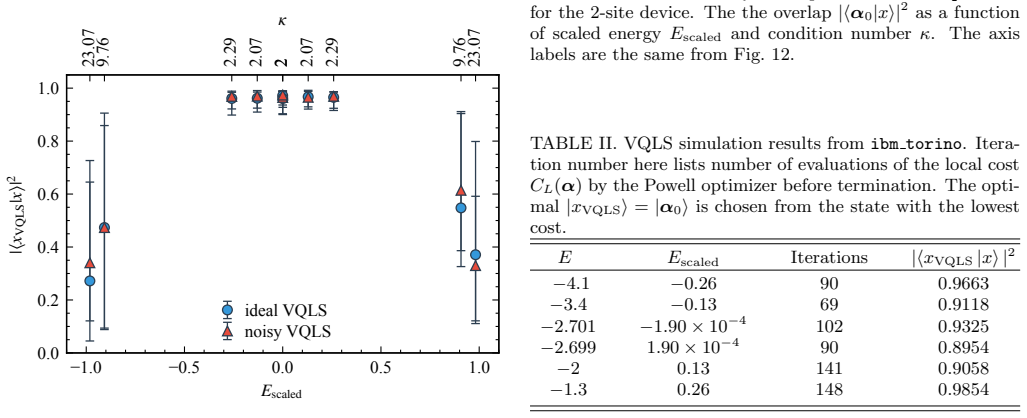
- [Section IV, Section V.B] Sec. IV (after Eq. 50) and Sec. V.B: VQLS supplements CL(α) with the constraint |r|²=|s|² on the trial state, so T(E)=1 is recovered “by construction… regardless of the optimizer’s wavefunction fidelity.” The abstract and introduction frame the result as computing T(E) of quantum dragons. That framing overstates what VQLS demonstrates. The load-bearing evidence is wavefunction overlap with the classical solution (Figs. 12–14), not T(E). The manuscript should restate the VQLS claim around overlap/fidelity of |x⟩, treat T=1 as an imposed physical prior, and report unconstrained VQLS (or an ablation) so readers can separate ansatz bias from solver performance.
- [Section V.A, Fig. 10] Sec. V.A and discussion of Fig. 10: noisy HHL yields ΔHHL≈0.375 because decoherence flattens block-register probabilities to 1/8, which forces the ratio |xs|²/|xr|²=1 and thus T=1 trivially. Presenting noisy T(E)≈1 alongside ideal T(E) without equal emphasis that the observable is uninformative under that noise model weakens the “feasibility on physical processors” claim for HHL. Either omit noisy T as a success metric or state explicitly that only overlap (and structured probability vectors) are diagnostic.
- [Sections II.B–II.C, Eqs. (17), (26)] Secs. II.B–II.C, Eqs. (17), (26), (29): devices are constructed to satisfy the dragon eigenvalue conditions from prior work, so T(E)=1 is an input property, not a prediction. That is legitimate for benchmarking solvers, but the paper should say clearly that the algorithms are validated on instances with known closed-form structure (equivalent linear chain + null modes), not that they discover ballistic transport in disordered systems. Without that caveat, the “training quantum dragons” narrative reads stronger than the experiments support.
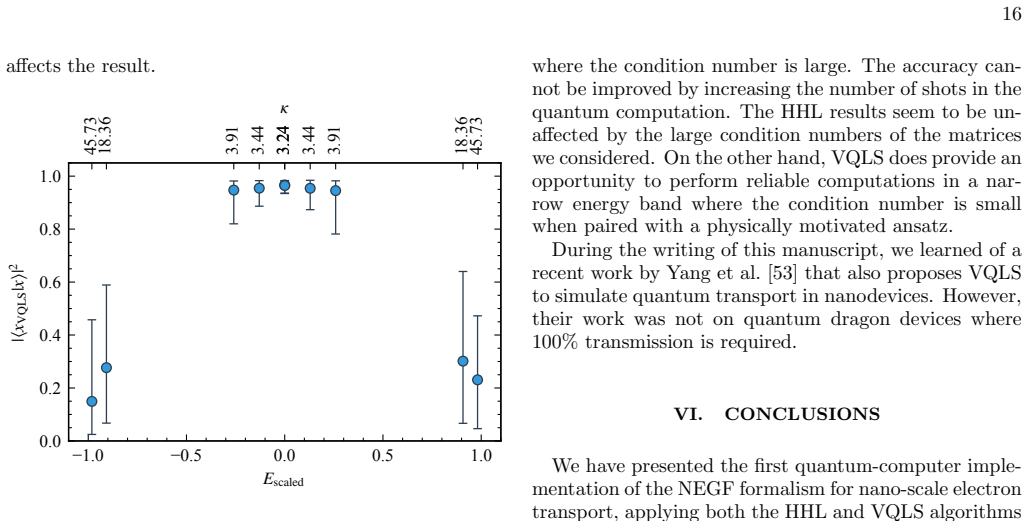
- [Section V.B–V.D, Figs. 12–14] Figs. 12–14 and Sec. V.D: VQLS overlap degrades sharply where the condition number κ of the reduced block is large (band edges), and the 6-site device (L=14, larger Hilbert space) shows substantially worse ideal overlap than the 2-site case. The comparison that “HHL is unaffected by κ while VQLS is not” is only supported in ideal simulation; noisy HHL is unusable. A revised discussion should quantify the κ window where VQLS is reliable, state optimizer budgets (Powell evaluations, shots) as limiting factors, and avoid implying a clean NISQ-vs-FT division beyond what the data show.
minor comments (6)
- [Abstract] Abstract: “3 and 4 total physical qubits” is easy to misread; HHL uses additional clock and flag qubits (nc≈6–7 plus ancilla). Clarify system vs total qubits.
- [Section II.D, Eq. (36)] Eq. (36) and surrounding text: normalization constant c and the relation T=|xs|²/|xr|² under current conservation should be cross-checked against the block-encoded |x̃⟩ convention in Eq. (39) so readout formulas are unambiguous.
- [Table II] Table II: report the achieved CL values and whether termination was by budget or convergence; “Iterations” alone is hard to interpret.
- [Throughout] Typos/notation: “wavefucntion” (II.A); “V ARIA TIONAL” spacing in the Sec. IV heading; “ibmq torino” vs “ibm_torino” inconsistency; “QVLS” vs “VQLS” in Fig. 12 caption.
- [Section V.D] Related work: Yang et al. [53] is noted; a short explicit contrast (dragon vs general devices; constrained vs unconstrained cost) would help priority and scope.
- [Appendix B] Appendix B: t-tuning via expected 1/√3 probabilities is useful; state whether this protocol was used only in simulation or is proposed for hardware (cost).
Circularity Check
VQLS recovers the headline observable T(E)=1 by an explicit ansatz constraint, not by unconstrained solution of the NEGF linear system; noisy HHL likewise yields T=1 from flattened probabilities.
-
self definitional
[Sec. IV (after Eq. 50) and Sec. V.B (discussion of Fig. 12)]
"We supplement the local cost function CL(α) calculation by a physical constraint for perfect transmission |r|² = |s|² which requires the αr and the αs component of the trial state |α⟩ to have the same magnitude. ... Consequently and by construction, T(E) = 1 is recovered across the entire conducting bandwidth regardless of the optimizer’s wavefunction fidelity."
T(E)=|s|² is the quantity the paper claims VQLS computes from the NEGF linear system. Enforcing |r|²=|s|² (and current conservation) directly on the variational ansatz makes T(E)=1 true for every accepted trial state by definition of the search manifold, independent of whether A|α⟩≈|b⟩. The paper acknowledges this (“by construction”) yet still presents VQLS hardware/simulation runs as computing dragon transmission.
-
self definitional
[Sec. V.A, discussion of noisy HHL and Fig. 10]
"If one looks at the Psuccess for the noisy simulations, one sees that the success probabilities are much higher than the statevector estimates. The reason behind this is that the error model calculations results in many false positives for the |1⟩a flag qubit state leading to large success rates. Consequently, all the probabilities in the 8-component block qubit state are just random variables with equal probabilities of 1/8. ... At the same time, the noisy model will produce a perfect transmission T(E) = 1 since it is calculated from ratio of probabilities that are all exactly 1/8."
Under the noise model the measured block-register probabilities are structureless (uniform 1/8). T(E) is defined as the ratio |xs|²/|xr|² (Eq. 47), which is then identically 1 for any such flat distribution. Reporting T(E)=1 from noisy HHL therefore does not evidence a correct solve of the LSE; it is forced by the definition of T from equal random probabilities.
1 more flagged steps
-
self citation load bearing
[Sec. II.B–II.C, Eqs. (12)–(17), (25)–(30); citations [10, 29–32]]
"Quantum dragon devices exhibit perfect transmission across the full conducting band regardless of internal disorder. ... The quantum dragon solution [10] for this device where the transmission coefficient T(E) = 1 ... is obtained with the following choice of device parameters: ... The quantum dragon condition [10, 29–31] for T(E) = 1 solution can be stated as an eigenvalue equation A v_dragon = 0."
The devices under test are parameterized (β, tab, κj, dragon vectors) so that the classical NEGF LSE already has the exact solution T(E)=1 by the eigenvalue/inter-slice conditions of prior Novotny et al. work. The quantum algorithms are therefore scored on recovering a property that was built into the Hamiltonian choice. This is legitimate as a known-answer benchmark, but it means success on T(E) cannot be read as discovery or independent verification of transport physics; the load-bearing “perfect transmission” premise is imported from the authors’ own prior definitions.
full rationale
The paper’s strongest public claim is that HHL and VQLS “compute the transmission coefficient T(E)” of quantum-dragon nanodevices. For ideal HHL this is largely non-circular: the algorithm solves the block-encoded LSE and T is read from measured amplitudes, with wavefunction overlap as an independent check. Two load-bearing steps are circular. (1) Quantum dragons are chosen precisely because prior Novotny work already guarantees T(E)=1 via eigenvalue conditions on A and the inter-slice B matrices; the devices are a known-answer benchmark, not a prediction. (2) More seriously, Section IV supplements the VQLS local cost with the physical constraint |r|²=|s|² on the trial state, and Section V.B states explicitly that “by construction, T(E)=1 is recovered across the entire conducting bandwidth regardless of the optimizer’s wavefunction fidelity.” Thus the headline VQLS observable is enforced on the optimization manifold rather than inferred from solving A|x⟩=|b⟩. Noisy HHL similarly prints T=1 because decoherence flattens block-register probabilities to 1/8, making the ratio trivial. The only non-circular evidence is wavefunction overlap with the classical |x⟩, which the paper itself shows degrades with condition number κ and is weak for the 6-site device. Score 6 reflects one clear by-construction reduction of the central VQLS claim, while HHL ideal results and overlap metrics retain independent content.
Assumptions & free parameters
free parameters (4)
- HHL evolution time t and clock qubits n_c (per energy) =
e.g. t=0.3–0.664 eV^{-1}, n_c=6–7; s'=0.5 eV fixed
- Dragon angles β (and β_j) and hoppings t_ab, t_intra, κ_j =
β=23°/72°/70°/50°; t_ab=1.9 eV; κ=0.1,-0.39 (examples in text/App. A)
- VQLS optimizer budget and shots =
1000 shots; ≤150 (2-site) / ≤600 (6-site) cost evaluations
- Lead parameters t_L, ε_L =
t_L=2.7 eV, ε_L=-2.7 eV
assumptions (6)
- domain assumption Single-particle tight-binding NEGF scattering reduces to a finite LSE whose solution encodes r and s (and thus T=|s|² for identical leads).
- domain assumption Quantum dragon eigenvalue/inter-slice conditions imply T(E)=1 on the full lead band independent of internal disorder.
- standard math HHL solves sparse well-conditioned Hermitian LSEs with runtime scaling in κ and log N under standard oracular assumptions; non-Hermitian A is handled by Hermitian dilation.
- standard math VQLS local cost C_L vanishes iff A|α⟩ ∥ |b⟩ (up to the usual caveats on local vs global costs and barren plateaus).
- ad hoc to paper Enforcing |r|²=|s|² on the VQLS trial state is an acceptable physical constraint that does not invalidate claims of solving the transport LSE.
- domain assumption Noise model of Fake_Torino / ibm_torino and finite-shot sampling adequately represent near-term feasibility for these circuits.
Cite this review
Pith. "Pith review of Training Quantum Dragons." pith.science (2026). https://pith.science/paper/4C6ZJAIH
@misc{pith2026260727168,
  author       = {Pith},
  title        = {Pith review of: Training Quantum Dragons},
  year         = {2026},
  howpublished = {\url{https://pith.science/paper/4C6ZJAIH}},
  note         = {Machine review of arXiv:2607.27168}
}
abstract
The Non-Equilibrium Green's Function (NEGF) is the standard formalism for nano-scale electron transport. By recasting the NEGF scattering problem as a linear system of equations whose solution encodes the transmission and reflection amplitudes, we present the first quantum computerized implementation of NEGF. We apply both the Harrow--Hassidim--Lloyd and Variational Quantum Linear Solver algorithms to compute the transmission coefficient $T(E)$ of quantum dragon nanodevices within the single-band tight-binding model. Quantum dragon devices exhibit perfect transmission across the full conducting band regardless of internal disorder. The problem maps onto compact circuits of 3 and 4 total physical qubits for the 2-site and 6-site dragon devices, respectively. A similarity transformation block-diagonalizes the NEGF linear system reducing the Pauli decomposition of the block-encoded matrix. We demonstrate the feasibility of quantum computation by performing ideal and noise-aware simulations and computations on physical IBM quantum processor.
Figures


Figures from the paper (16 more)




Reference graph
Works this paper leans on
-
[1]
statevector
Schmidt decomposition in terms of new orthonormal basis|i⟩ A = P a Uai|a⟩,|i⟩ B = P b V ∗ bi|b⟩allows one to write |α⟩2-qubit = 1X i=0 λi|i⟩A ⊗ |i⟩B = (U⊗V ∗)(λ0|00⟩+λ 1|11⟩).(56) Then the desired 2-qubit state can be prepared from ini- tial state|00⟩=|0⟩ ⊗ |0⟩by first creating a superposi- tion state (λ 0|0⟩+λ 1|1⟩)⊗ |0⟩with the single rotation 11 Ry(2 c...
-
[2]
Brandbyge, J.-L
M. Brandbyge, J.-L. Mozos, P. Ordej´ on, J. Taylor, and K. Stokbro, Density-functional method for nonequilib- rium electron transport, Phys. Rev. B65, 165401 (2002)
2002
-
[3]
Similarly, for the 6-site device, we ex- pect 5 non-zero amplitudes of magnitude 1/ √
-
[4]
At the same time, the noisy model will produce a perfect transmissionT(E) = 1 since it is calculated from ratio of probabilities that are all exactly 1/8
One then finds that ∆HHL ≡ |⟨ √ ˜x2| p x2 HHL⟩|2 = (3/ √ 24)2 ≈0.375 deterministically because the noise model produces the measured probabilities uniformly without any structure. At the same time, the noisy model will produce a perfect transmissionT(E) = 1 since it is calculated from ratio of probabilities that are all exactly 1/8. We observe that the ac...
1963
-
[5]
As per the formulation of the 2-site state|˜x⟩in Eq. (39), mea- surement of the 8-dimensional block-qubit state in the HHL algorithm should return an 8-dimensional probabil- ity vector with the 5 th to 7 th component being ideally 1/3. Here we tunedtfrom measurements in ideal sim- ulations. On real quantum hardware, it would be an expensive exercise but a...
-
[6]
Thakur and N
A. Thakur and N. Sarkar, A tutorial on the NEGF method for electron transport in devices and defective materials, Eur. Phys. J. B96, 113 (2023)
2023
-
[7]
Datta,Electronic Transport in Mesoscopic Systems (Cambridge University Press, Cambridge, UK, 1995)
S. Datta,Electronic Transport in Mesoscopic Systems (Cambridge University Press, Cambridge, UK, 1995)
1995
-
[8]
C. H. Lewenkopf and E. R. Mucciolo, The recursive Green’s function method for graphene, J. Comput. Elec- tron.12, 203 (2013)
2013
Show all 58 references
-
[9]
A. W. Harrow, A. Hassidim, and S. Lloyd, Quantum al- gorithm for linear systems of equations, Phys. Rev. Lett. 103, 150502 (2009)
2009
-
[10]
Golze, M
D. Golze, M. Dvorak, and P. Rinke, The GW com- pendium: A practical guide to theoretical photoemission spectroscopy, Front. Chem.7, 377 (2019)
2019
-
[11]
Georges, G
A. Georges, G. Kotliar, W. Krauth, and M. J. Rozen- berg, Dynamical mean-field theory of strongly correlated fermion systems and the limit of infinite dimensions, Rev. 21 Mod. Phys.68, 13 (1996)
1996
-
[12]
Stroeks, J
M. Stroeks, J. Helsen, and B. Terhal, Solving free fermion problems on a quantum computer, Phys. Rev. Research 6, 033335 (2024)
2024
-
[13]
Bravo-Prieto, R
C. Bravo-Prieto, R. LaRose, M. Cerezo, Y. Subasi, L. Cincio, and P. J. Coles, Variational Quantum Linear Solver, Quantum7, 1188 (2023)
2023
-
[14]
M. A. Novotny, Energy-independent total quantum transmission of electrons through nanodevices with cor- related disorder, Phys. Rev. B90, 165103 (2014)
2014
-
[15]
R. P. Feynman, Simulating physics with computers, Int. J. Theor. Phys.21, 467 (1982)
1982
-
[16]
Y. Cao, J. Romero, J. P. Olson, M. Degroote, P. D. John- son, M. Kieferova, I. D. Kivlichan, T. Menke, B. Per- opadre, N. P. D. Sawaya, S. Sim, L. Veis, and A. Aspuru- Guzik, Quantum chemistry in the age of quantum com- puting, Chem. Rev.119, 10856 (2019)
2019
-
[17]
McArdle, S
S. McArdle, S. Endo, A. Aspuru-Guzik, S. C. Benjamin, and X. Yuan, Quantum computational chemistry, Rev. Mod. Phys.92, 015003 (2020)
2020
-
[18]
Preskill, Quantum computing in the NISQ era and beyond, Quantum2, 79 (2018)
J. Preskill, Quantum computing in the NISQ era and beyond, Quantum2, 79 (2018)
2018
-
[19]
Peruzzo, J
A. Peruzzo, J. McClean, P. Shadbolt, M.-H. Yung, X.-Q. Zhou, P. J. Love, A. Aspuru-Guzik, and J. L. O’Brien, A variational eigenvalue solver on a photonic quantum processor, Nat. Commun.5, 4213 (2014)
2014
-
[20]
J. R. McClean, J. Romero, R. Babbush, and A. Aspuru- Guzik, The theory of variational hybrid quantum- classical algorithms, New J. Phys.18, 023023 (2016)
2016
-
[21]
Tilly, H
J. Tilly, H. Chen, S. Cao,et al., The variational quan- tum eigensolver: a review of methods and best practices, Phys. Rep.986, 1 (2022)
2022
-
[22]
M. Yusf, L. Gan, C. Moffat, and G. Rupak, Elastic scat- tering on a quantum computer, Phys. Rev. C111, 034001 (2025), arXiv:2406.09231 [nucl-th]
2025 arXiv
-
[23]
Aruteet al., Hartree-Fock on a superconducting qubit quantum computer, Science369, 1084 (2020)
F. Aruteet al., Hartree-Fock on a superconducting qubit quantum computer, Science369, 1084 (2020)
2020
-
[24]
Cerezo, A
M. Cerezo, A. Sone, T. Volkoff, L. Cincio, and P. J. Coles, Cost function dependent barren plateaus in shal- low parametrized quantum circuits, Nature Communica- tions12, 1791 (2021)
2021
-
[25]
Bauer, S
B. Bauer, S. Bravyi, M. Motta, and G. K.-L. Chan, Quantum algorithms for quantum chemistry and quan- tum materials science, Chem. Rev.120, 12685 (2020)
2020
-
[26]
C. Cade, L. Mineh, A. Montanaro, and S. Stanisic, Strategies for solving the Fermi-Hubbard model on near- term quantum computers, Phys. Rev. B102, 235122 (2020)
2020
-
[27]
Frank, P
S. Frank, P. Poncharal, Z. L. Wang, and W. A. de Heer, Carbon nanotube quantum resistors, Science280, 1744 (1998)
1998
-
[28]
K. I. Bolotin, K. J. Sikes, Z. Jiang, M. Klima, G. Fuden- berg, J. Hone, P. Kim, and H. L. Stormer, Ultrahigh elec- tron mobility in suspended graphene, Solid State Com- mun.146, 351 (2008)
2008
-
[29]
Javey, J
A. Javey, J. Guo, Q. Wang, M. Lundstrom, and H. Dai, Ballistic carbon nanotube field-effect transistors, Nature 424, 654 (2003)
2003
-
[30]
Trauzettel, D
B. Trauzettel, D. V. Bulaev, D. Loss, and G. Burkard, Spin qubits in graphene quantum dots, Nature Phys.3, 192 (2007)
2007
-
[31]
A. K. Geim and K. S. Novoselov, The rise of graphene, Nature Mater.6, 183 (2007)
2007
-
[32]
Assouline, L
A. Assouline, L. Pugliese, H. Chakraborti, S. Lee, L. Bernabeu, M. Jo, K. Watanabe, T. Taniguchi, D. C. Glattli, N. Kumada, H.-S. Sim, F. D. Parmentier, and P. Roulleau, Emission and coherent control of Levitons in graphene, Science382, 1260 (2023)
2023
-
[33]
Inkoom and M
G. Inkoom and M. A. Novotny, Quantum dragon solu- tions for electron transport through nanostructures based on rectangular graphs, Journal of Physics Communica- tions2, 115019 (2018)
2018
-
[34]
M. A. Novotny and T. Novotn´ y, Order amidst disorder in 2D+3D quantum dragon composite nanodevices with varying breadth, Journal of Physics: Conference Series 1740, 012002 (2021)
2021
-
[35]
M. A. Novotny, G. Inkoom, and T. Novotn´ y, Order amidst disorder for two-dimensional nanoribbons with various boundary conditions, Europhysics Letters143, 26005 (2023)
2023
-
[36]
Novotny and T
M. Novotny and T. Novotn´ y, Universal scaling of electron transmission for nearly ballistic and quantum dragon nanodevices, Chaos, Solitons & Fractals199, 116879 (2025)
2025
-
[37]
A. H. Castro Neto, F. Guinea, N. M. R. Peres, K. S. Novoselov, and A. K. Geim, The electronic properties of graphene, Rev. Mod. Phys.81, 109 (2009)
2009
-
[38]
Hamada, S.-i
N. Hamada, S.-i. Sawada, and A. Oshiyama, New one- dimensional conductors: Graphitic microtubules, Physi- cal Review Letters68, 1579 (1992)
1992
-
[39]
Nakada, M
K. Nakada, M. Fujita, G. Dresselhaus, and M. S. Dres- selhaus, Edge state in graphene ribbons: Nanometer size effect and edge shape dependence, Physical Review B54, 17954 (1996)
1996
-
[40]
Reich, J
S. Reich, J. Maultzsch, C. Thomsen, and P. Ordej´ on, Tight-binding description of graphene, Phys. Rev. B66, 035412 (2002)
2002
-
[41]
Saito, M
R. Saito, M. Fujita, G. Dresselhaus, and M. S. Dressel- haus, Electronic structure of graphene tubules based on C60, Phys. Rev. B46, 1804 (1992)
1992
-
[42]
Abraham, AduOffei, I
H. Abraham, AduOffei, I. Y. Akhalwaya, G. Alek- sandrowicz, T. Alexander, and et al., Qiskit: An Open- source Framework for Quantum Computing (2019)
2019
-
[43]
Google Quantum AI, Quantum error correction below the surface code threshold, Nature638, 920 (2025)
2025
-
[44]
IBM Quantum, IBM quantum development and in- novation roadmap,https://www.ibm.com/roadmaps/ quantum(2024), accessed: 2024
2024
-
[45]
Bravyiet al., High-threshold and low-overhead fault- tolerant quantum memory, Nature627, 778 (2024)
S. Bravyiet al., High-threshold and low-overhead fault- tolerant quantum memory, Nature627, 778 (2024)
2024
-
[46]
Quantinuum, Quantinuum accelerated roadmap to fault-tolerant quantum computing,https: //www.quantinuum.com(2024), accessed: 2024
2024
-
[47]
Porath, A
D. Porath, A. Bezryadin, C. de Vries, and C. Dekker, Direct measurement of electrical transport through DNA molecules, Nature403, 635 (2000)
2000
-
[48]
Guti´ errez, S
R. Guti´ errez, S. Mandal, and G. Cuniberti, Dissipative effects in the electronic transport through DNA molecu- lar wires, Phys. Rev. B71, 235116 (2005)
2005
-
[49]
Cuniberti, E
G. Cuniberti, E. Maci´ a, A. Rodr ´ ıguez, and R. A. R¨ omer, Tight-binding modeling of charge migration in DNA devices, inCharge Migration in DNA: Perspec- tives from Physics, Chemistry, and Biology, edited by T. Chakraborty (Springer Berlin Heidelberg, Berlin, Hei- delberg, ...
2007
-
[50]
Mohammad and M
H. Mohammad and M. P. Anantram, Charge transport through DNA with energy-dependent decoherence, Phys. Rev. E108, 044403 (2023). 22
2023
-
[51]
Aaronson, Read the fine print, Nat
S. Aaronson, Read the fine print, Nat. Phys.11, 291 (2015)
2015
-
[52]
H. J. Morrell, A. Zaman, and H. Y. Wong, A step-by-step HHL algorithm walkthrough to enhance understanding of critical quantum computing concepts, IEEE Access11, 77117 (2023)
2023
-
[53]
M. J. D. Powell, An efficient method for finding the minimum of a function of several variables with- out calculating derivatives, The Computer Journal7, 155 (1964), https://academic.oup.com/comjnl/article- pdf/7/2/155/959784/070155.pdf
1964
-
[54]
Virtanen, R
P. Virtanen, R. Gommers, T. E. Oliphant, M. Haber- land, T. Reddy, D. Cournapeau, E. Burovski, P. Pe- terson, W. Weckesser, J. Bright, S. J. van der Walt, M. Brett, J. Wilson, K. J. Millman, N. Mayorov, A. R. J. Nelson, E. Jones, R. Kern, E. Larson, C. J. Carey, ˙I. Po- lat, Y...
2020
-
[55]
Suzuki, Y
Y. Suzuki, Y. Kawase, Y. Masumura, Y. Hiraga, M. Nakadai, J. Chen, K. M. Nakanishi, K. Mitarai, R. Imai, S. Tamiya, T. Yamamoto, T. Yan, T. Kawakubo, Y. O. Nakagawa, Y. Ibe, Y. Zhang, H. Yamashita, H. Yoshimura, A. Hayashi, and K. Fujii, Qulacs: a fast and versatile quantum ci...
2021
-
[56]
Larocca, S
M. Larocca, S. Thanasilp, S. Wang, K. Sharma, J. Bia- monte, P. J. Coles, L. Cincio, J. R. McClean, Z. Holmes, and M. Cerezo, Barren plateaus in variational quantum computing, Nature Reviews Physics7, 174–189 (2025)
2025
-
[57]
Yang and J
Q. Yang and J. Guo, Variational quantum linear solver for simulating quantum transport in nanoscale semicon- ductor devices (2025), arXiv:2509.07005 [quant-ph]
2025 arXiv
-
[58]
A. E. Miroshnihenko, S. Flach, and Y. S. Kivshar, Fano resonances in nanoscale strucrtures, Reviews of Modern Physics82, 2257 (2010)
2010
Reviewed July 30, 2026 · model on record in the stance chip above.
Discussion (0). Continue with ORCID to comment.