REVIEW 3 major objections 5 minor 45 references
Psych-ECA: A Reproducible Semi-Synthetic Benchmark for Synthetic Control Arms in Longitudinal Psychiatry
T0 review · 3 major / 5 minor · reviewed 2026-08-02 · deepseek-v4-flash
Pith's one-line read In a new semi-synthetic benchmark for psychiatric synthetic control arms, calibration — not point accuracy — separates the methods, with only the Scribe trajectory-bridge delivering both accuracy and properly calibrated uncertainty.
desk verdict Useful benchmark, but the generator is built to Scribe's specifications, so the headline ranking is partly a consistency check — and the abstract overclaims Type-I control against its own Table 4. read the letter →
The pith
A machine-rendered reading of the paper's core claim, the machinery that carries it, and where it could break.
The reading
What carries the argument
The central object is a semi-synthetic generative model: latent psychiatric severity follows an Ornstein-Uhlenbeck diffusion with patient-specific set-points, observed visits arrive via an inhomogeneous Poisson process whose intensity grows with severity (informative observation), and observed scores add validated-scale measurement noise. Running on this generator is the Scribe estimator, an inverse-intensity-weighted Ornstein-Uhlenbeck bridge for the point estimate plus weighted conformal prediction bands for uncertainty. The conformal layer is the load-bearing component for calibration: it widens the bands exactly when the donor pool becomes less trustworthy under strong informative sampli
What would settle it
Generate a dataset from a different non-Markovian model (for example, one with random effects that drift over time or regime-switching severity) using the same evaluation protocol, and check whether Scribe's 90% bands still achieve at least 90% empirical coverage and a Type-I error no larger than 0.05; if not, the claim that it is uniquely calibrated collapses.
Extended reading notes
Core claim
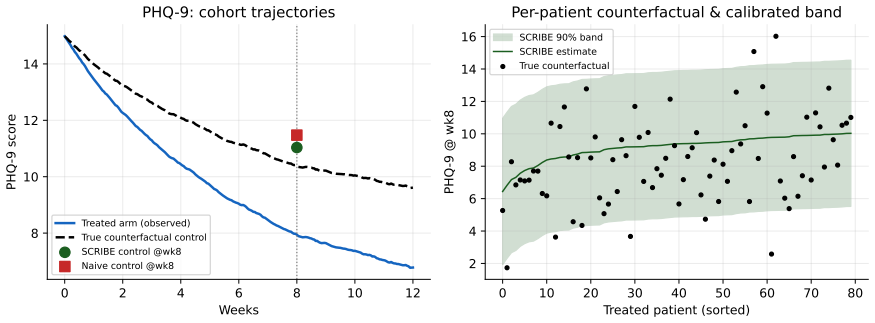
The paper claims that in its Psych-ECA benchmark, trajectory-based and flexible machine-learning estimators achieve the best counterfactual accuracy, but only the Scribe method is simultaneously accurate and calibrated. Scribe attains 93–96% empirical coverage of nominal 90% prediction intervals while equally accurate competitors under-cover: gradient boosting covers only 87–88%, and the uncalibrated SDE bridge covers a dangerous 62–75%. The inverse-intensity correction built into Scribe's point estimate reduces absolute treatment-effect bias by 40–50% under informative observation, and Scribe's conformal intervals are the only trajectory method that keeps the trial false-positive rate at or
Load-bearing premise
The entire ranking assumes that real psychiatric symptom trajectories and visit times behave like the simulated Ornstein-Uhlenbeck process with severity-dependent observation intensity; if real trajectories are non-Markovian, have a different intensity structure, or different placebo and dropout dynamics, the measured calibration advantage of Scribe could shrink or reverse.
Editorial extensions
If this is right
- ECA evaluations should report calibration and trial-decision error, not just counterfactual RMSE, because point accuracy alone cannot discriminate between methods.
- Inverse-intensity weighting is necessary to control bias in psychiatric real-world data where sicker patients are observed more often.
- Scribe's calibrated bands can keep Type-I error at or below nominal without sacrificing power, making it a safer choice for confirmatory go/no-go decisions.
- Psych-ECA provides a reproducible benchmark with fixed seeds and code, so future ECA methods can be scored on the same regulator-relevant axes.
Reading between the lines
- Because the generator embeds exactly the OU dynamics and intensity model that Scribe assumes, the measured calibration advantage is likely to shrink under misspecified generative dynamics — a point the paper itself acknowledges in its Limitations section.
- The same evaluation protocol could be applied to real randomized trial data with a concurrent control arm held out, checking whether Scribe's empirical coverage and Type-I error hold outside simulation.
- The conformal calibration layer could in principle be attached to any point estimator, potentially bringing the coverage of methods like gradient boosting up to nominal without sacrificing their accuracy.
- If non-Markovian disease progression or comorbidity is common in real psychiatric populations, the benchmark's external validity should be revisited with a wider family of generative models.
Editorial analysis
A structured set of objections, weighed in public.
Referee Report
Summary. The paper introduces Psych-ECA, a semi-synthetic benchmark for external/synthetic control arms in psychiatry. The generator simulates latent Ornstein–Uhlenbeck severity trajectories, adds validated-scale measurement noise, and creates informative visit times via a severity-dependent exponential intensity. Eight estimators (LOCF, pooled RWD mean, kNN matching, linear mixed model, gradient boosting, naive OU bridge, IIW OU bridge, and the proposed Scribe method) are compared on counterfactual RMSE, |ATE bias|, coverage of nominal-90% bands, and Type-I/power under a 5% z-test. The headline findings are that trajectory and flexible-ML methods tie on point accuracy, but only Scribe is both accurate and calibrated, and only Scribe controls the false-positive rate as informativeness grows.
Significance. If the claims are sustained, Psych-ECA would be a useful reproducible tool for evaluating ECA methods on calibration and downstream decision error—axes that the field underemphasizes relative to point accuracy. The paper's strengths are its semi-synthetic design with ground-truth counterfactuals, its multi-outcome scope (PHQ-9, HAM-A, PANSS), and its stated commitment to releasing code, data generators, and seeds. The main weaknesses are that the central ranking is largely built into the generator (Scribe is correctly specified for the data-generating process), and that the abstract overstates the Type-I results in Table 4. These issues affect the paper's central claims and require substantive revision, but the benchmark itself is a reasonable starting point that could be extended into a defensible evaluation instrument.
major comments (3)
- [Abstract, §3.3, Table 4] The abstract claims Scribe is the only trajectory method that 'keeps the trial false-positive rate at or below nominal as informativeness grows,' and §3.3 says its false-positive rate 'falls to nominal or below (0.17 at moderate, 0.00 at strong).' Table 4 directly contradicts this: at moderate informativeness Scribe's Type-I error is 0.167, more than three times the nominal 0.05, and at none it is 0.500. Only at the strong setting (0.000) is it below nominal. This is not a wording nuance; the headline claim misrepresents the paper's own data. The text and abstract must be corrected to state that Scribe reaches nominal/below only at the strongest informativeness level, or the benchmark must include additional settings that actually support the broader claim.
- [§2.1, Eq. (1); §4 Limitations] The central finding that Scribe is uniquely accurate and calibrated is an in-sample consistency result, not a robustness result. The generative model's latent process is an OU diffusion (Eq. 1) and its visit intensity is λ(t)=λ0 exp(αZ(t))—exactly the model class of Scribe's IIW-OU bridge. The comparator methods (kNN, LMM, gradient boosting) are generic approximations that are misspecified for this DGP. The paper itself concedes in §4 that the generator 'favours correctly-specified dynamical methods.' Consequently, the conclusion that Scribe is 'the only method on the accuracy–calibration frontier' (Abstract; §4) is not supported as a general or external claim; it is a verification that Scribe works on its own generative assumptions. To make the ranking claim load-bearing, the authors should add misspecification arms (e.g., non-Markovian latent processes, visit intensity depending on obs
- [§3.1, Tables 2–4] All numerical results are reported as means over 8 seeds with no standard errors, confidence intervals, or seed-level distributions. For example, Scribe and gradient boosting differ by only 0.02 PHQ-9 RMSE (2.31 vs 2.33), and the Type-I differences in Table 4 (e.g., 0.458 vs 0.458 vs 0.500) may be within simulation noise. Claims of ties, 'unique frontier,' and 'only method' require evidence that these differences are not sampling artifacts. Please provide per-seed variability measures and a suitable comparison (e.g., bootstrap intervals or a mixed-effects model over seeds) for the key accuracy, coverage, and Type-I comparisons.
minor comments (5)
- [Throughout] The capitalization of 'Scribe' vs 'SCRIBE' is inconsistent across text and figures (e.g., Fig. 1 and Fig. 2 use 'SCRIBE' while the text uses 'Scribe'). Standardize.
- [Reproducibility] The manuscript states that all code, data-generation scripts, and seeds are released, but no repository URL, commit hash, or licensing information is provided. For a reproducibility-focused paper, an explicit link is essential.
- [§2.1, Eq. (1)] The statement that treated and counterfactual paths use 'the same Brownian increments' should clarify how this is achieved (e.g., shared random key per patient) so that the exact per-patient counterfactual is well-defined and reproducible.
- [Abstract] The abstract's phrase 'maintains nominal false-positive rates as informativeness increases' will be misleading even after the Type-I correction; consider phrasing such as 'reaches nominal or below only at the strongest informativeness setting tested.'
- [Table 1] The caption uses 'elev. δ0' and the table lists 'elev.δ 0'; this is fine, but consider defining the enrollment elevation in the text of §2.1 (it appears only implicitly).
Circularity Check
Scribe's accuracy/IIW advantages are built into the generator: the DGP is Scribe's own OU+intensity model, so the headline comparison is a consistency check rather than an independent benchmark finding.
-
self definitional
[§2.1 Generative model; §2.3 Methods compared; §4 Limitations]
"For each patient we simulate a scalar latent severity Z(t) as a mean-reverting (Ornstein–Uhlenbeck) diffusion, dZ(t) = −κ(Z(t)−µ_i)dt + σdW(t) ... Visit times follow an inhomogeneous Poisson process with severity-dependent intensity λ(t) =λ0 exp(αZ(t)) ... [Scribe is] the full method (IIW bridge + weighted conformal trajectory bands) ... the generator embeds OU dynamics and a known intensity model, which favours correctly-specified dynamical methods."
The data-generating process is defined to be exactly the process Scribe assumes: OU latent severity (Eq. 1) and log-linear visit intensity λ(t)=λ0e^{αZ(t)}. Scribe is the 'IIW bridge', i.e. the correctly specified estimator for this DGP (plus conformal bands). Therefore the headline that Scribe/IIW-OU has the best point accuracy and that IIW halves bias is not an empirical discovery; it is a consistency check of a model against data generated from itself. The paper explicitly concedes this favoritism. The comparison with misspecified competitors therefore cannot bear the weight of the conclusion that Scribe is 'the only method on the accuracy–calibration frontier' outside this constructed world.
full rationale
Psych-ECA is a semi-synthetic benchmark, and the paper is transparent that its generator 'embeds OU dynamics and a known intensity model'. Nevertheless, the central comparative claim—that Scribe is uniquely on the accuracy–calibration frontier—is substantially forced by construction. The generator's latent process (Eq. 1) is exactly the OU diffusion that Scribe's 'IIW bridge' assumes, and the visit process is exactly the exponential intensity model λ(t)=λ0exp(αZ(t)) that the inverse-intensity weighting corrects. Thus Scribe is the correctly specified estimator for its own DGP, while kNN, LMM, GBM, LOCF and pooled RWD are misspecified. Under such a DGP, the correctly specified model will typically win on point accuracy and bias; the paper even concedes this in §4. The calibration and Type-I claims are less strictly forced, because conformal calibration is not part of the DGP, but they are evaluated only inside this favorable world and partly depend on the same construction. One further internal inconsistency: §3.3 and the Abstract claim Scribe keeps Type-I 'at or below nominal', but Table 4 reports 0.167 at moderate informativeness versus the 0.05 nominal, so the favorable-method narrative outruns the paper's own numbers. No external benchmark or real-data validation is provided that would convert the consistency check into evidence of real-world superiority. This is a partial circularity of the 'right model wins on its own generative process' type, not a total derivation from definitions.
Assumptions & free parameters
free parameters (4)
- Per-condition OU and noise parameters (κ, σ, µ̄, δ0, σ_obs; Table 1) =
3 conditions × 5 values, e.g. PHQ-9: κ=0.18, σ=1.1, µ̄=9, δ0=6, σ_obs=1.6
- Informativeness parameter α and its none/moderate/strong levels (Table 1 α values) =
α=0.090 (PHQ-9), 0.050 (HAM-A), 0.012 (PANSS); level multipliers not stated numerically
- True treatment effect Δ used in the alternative regime =
not stated numerically ('large simulated effects')
- Design constants: landmark L, donor count, trial cohort size, seeds, matching ratio, nominal band level =
L=8 wks; 1500 donors; 300 trial patients; 8 seeds; 1:20 kNN; 90% bands
assumptions (5)
- domain assumption Latent severity follows an OU diffusion with patient set-point µ_i and fixed κ, σ (Eq. 1, §2.1)
- domain assumption Visit times follow an inhomogeneous Poisson process with known intensity λ(t)=λ0 exp(αZ(t)) (§2.1)
- domain assumption Observed scores are latent severity plus Gaussian noise with known σ_obs, clipped to the instrument range (§2.1)
- domain assumption Untreated counterfactual is generated with the same Brownian increments as the treated path; latent ignorability holds (§2.1, §4)
- ad hoc to paper The conformal layer adequately approximates donor-model (common-mode) uncertainty so Type-I error reaches nominal (§3.3)
invented entities (1)
-
Scribe trajectory-bridge estimator (IIW OU bridge + weighted conformal bands)
Cite this review
Pith. "Pith review of Psych-ECA: A Reproducible Semi-Synthetic Benchmark for Synthetic Control Arms in Longitudinal Psychiatry." pith.science (2026). https://pith.science/paper/5QCFBW2F
@misc{pith2026260727224,
  author       = {Pith},
  title        = {Pith review of: Psych-ECA: A Reproducible Semi-Synthetic Benchmark for Synthetic Control Arms in Longitudinal Psychiatry},
  year         = {2026},
  howpublished = {\url{https://pith.science/paper/5QCFBW2F}},
  note         = {Machine review of arXiv:2607.27224}
}
read the original abstract
External and synthetic control arms (ECAs) are entering psychiatric drug development, but the field lacks a benchmark that evaluates the properties regulators care about: not only how accurately a method reconstructs untreated trajectories, but whether its uncertainty is calibrated, whether it is robust to the informative observation times common in mental-health records (sicker patients are seen more often), and what false-positive rate it induces in go/no-go trial decisions. Real psychiatric trial data (e.g. STAR-D and registry cohorts) require credentialed access and lack ground-truth counterfactuals, so, following established semi-synthetic benchmarks in causal inference (IHDP, ACIC, and the PK-PD tumor-growth simulator), we release Psych-ECA, a fully reproducible generator of longitudinal symptom trajectories for depression (PHQ-9), anxiety (HAM-A), and psychosis (PANSS) with known counterfactual control arms, informative visits, and validated-scale measurement noise. We benchmark eight estimators spanning carry-forward, pooled real-world-data averages, nearest-neighbour matching, linear mixed models, gradient boosting, and the Scribe trajectory-bridge method. Three findings emerge. First, trajectory and flexible machine learning methods achieve the best counterfactual accuracy (about 2.3 PHQ-9 RMSE), outperforming cross-sectional baselines. Second, only Scribe is both accurate and calibrated, achieving 93-96% empirical coverage of nominal 90% prediction intervals, compared with 87-88% for gradient boosting and 62-75% for uncalibrated SDE models. Third, inverse-intensity correction reduces bias under informative sampling, while Scribe's calibrated intervals are the only trajectory method that maintains nominal false-positive rates as informativeness increases. We release all code, data-generation scripts, and random seeds to enable fully reproducible evaluation.
Figures


Figures from the paper (1 more)

Reference graph
Works this paper leans on
-
[1]
Advances in Neural Information Processing Systems (NeurIPS) , year=
Neural Ordinary Differential Equations , author=. Advances in Neural Information Processing Systems (NeurIPS) , year=
-
[2]
Advances in Neural Information Processing Systems (NeurIPS) , year=
Latent Ordinary Differential Equations for Irregularly-Sampled Time Series , author=. Advances in Neural Information Processing Systems (NeurIPS) , year=
-
[3]
Advances in Neural Information Processing Systems (NeurIPS) , year=
Neural Controlled Differential Equations for Irregular Time Series , author=. Advances in Neural Information Processing Systems (NeurIPS) , year=
-
[4]
International Conference on Artificial Intelligence and Statistics (AISTATS) , year=
Scalable Gradients for Stochastic Differential Equations , author=. International Conference on Artificial Intelligence and Statistics (AISTATS) , year=
-
[5]
Efficient and Accurate Gradients for Neural
Kidger, Patrick and Foster, James and Li, Xuechen and Lyons, Terry , booktitle=. Efficient and Accurate Gradients for Neural
-
[6]
Stochastic Differential Equations: An Introduction with Applications , author=
-
[7]
International Conference on Machine Learning (ICML) , year=
Continuous-Time Modeling of Counterfactual Outcomes Using Neural Controlled Differential Equations , author=. International Conference on Machine Learning (ICML) , year=
-
[8]
International Conference on Learning Representations (ICLR) , year=
Estimating Counterfactual Treatment Outcomes over Time through Adversarially Balanced Representations , author=. International Conference on Learning Representations (ICLR) , year=
Show all 45 references
-
[9]
Advances in Neural Information Processing Systems (NeurIPS) , year=
Forecasting Treatment Responses over Time Using Recurrent Marginal Structural Networks , author=. Advances in Neural Information Processing Systems (NeurIPS) , year=
-
[10]
International Conference on Machine Learning (ICML) , year=
Causal Transformer for Estimating Counterfactual Outcomes , author=. International Conference on Machine Learning (ICML) , year=
-
[11]
Epidemiology , volume=
Marginal Structural Models and Causal Inference in Epidemiology , author=. Epidemiology , volume=
-
[12]
Mathematical Modelling , volume=
A New Approach to Causal Inference in Mortality Studies with a Sustained Exposure Period , author=. Mathematical Modelling , volume=
-
[13]
Scientific Reports , volume=
Prediction of Treatment Response for Combined Chemo- and Radiation Therapy for Non-Small Cell Lung Cancer Patients Using a Bio-Mathematical Model , author=. Scientific Reports , volume=
-
[14]
arXiv preprint arXiv:2604.12992 , year=
Causal Diffusion Models for Counterfactual Outcome Distributions in Longitudinal Data , author=. arXiv preprint arXiv:2604.12992 , year=
-
[15]
Journal of the American Statistical Association , volume=
Synthetic Control Methods for Comparative Case Studies , author=. Journal of the American Statistical Association , volume=
-
[16]
American Economic Review , volume=
The Economic Costs of Conflict: A Case Study of the Basque Country , author=. American Economic Review , volume=
-
[17]
2023 , howpublished=
Considerations for the Design and Conduct of Externally Controlled Trials for Drug and Biological Products: Draft Guidance for Industry , author=. 2023 , howpublished=
2023
-
[18]
Clinical Epidemiology , volume=
Synthetic and External Controls in Clinical Trials -- A Primer for Researchers , author=. Clinical Epidemiology , volume=
-
[19]
Health Services Research , volume=
Development and Validation of a High-Quality Composite Real-World Mortality Endpoint , author=. Health Services Research , volume=
-
[20]
Clinical Pharmacology & Therapeutics , volume=
Beyond Randomized Clinical Trials: Use of External Controls , author=. Clinical Pharmacology & Therapeutics , volume=
-
[21]
Algorithmic Learning in a Random World , author=
-
[22]
Advances in Neural Information Processing Systems (NeurIPS) , year=
Conformal Prediction Under Covariate Shift , author=. Advances in Neural Information Processing Systems (NeurIPS) , year=
-
[23]
Journal of the Royal Statistical Society: Series B , volume=
Conformal Inference of Counterfactuals and Individual Treatment Effects , author=. Journal of the Royal Statistical Society: Series B , volume=
-
[24]
Advances in Neural Information Processing Systems (NeurIPS) , year=
Conformal Time-Series Forecasting , author=. Advances in Neural Information Processing Systems (NeurIPS) , year=
-
[25]
Advances in Neural Information Processing Systems (NeurIPS) , year=
Adaptive Conformal Inference Under Distribution Shift , author=. Advances in Neural Information Processing Systems (NeurIPS) , year=
-
[26]
Sur la th
Schr. Sur la th. Annales de l'Institut Henri Poincar
-
[27]
A Survey of the Schr
L. A Survey of the Schr. Discrete and Continuous Dynamical Systems , volume=
-
[28]
Diffusion
De Bortoli, Valentin and Thornton, James and Heng, Jeremy and Doucet, Arnaud , booktitle=. Diffusion
-
[29]
arXiv preprint arXiv:2303.08797 , year=
Stochastic Interpolants: A Unifying Framework for Flows and Diffusions , author=. arXiv preprint arXiv:2303.08797 , year=
-
[30]
Journal of the American Statistical Association , volume=
Semiparametric and Nonparametric Regression Analysis of Longitudinal Data , author=. Journal of the American Statistical Association , volume=
-
[31]
Biometrics , volume=
Joint Modeling and Analysis of Longitudinal Data with Informative Observation Times , author=. Biometrics , volume=
-
[32]
Statistical Methods in Medical Research , volume=
Longitudinal Data Subject to Irregular Observation: A Review of Methods with a Focus on Visit Processes, Assumptions, and Study Design , author=. Statistical Methods in Medical Research , volume=
-
[33]
Canadian Journal of Statistics , volume=
Longitudinal Data Analysis for Generalized Linear Models with Follow-up Dependent on Outcome-Related Variables , author=. Canadian Journal of Statistics , volume=
-
[34]
and Monti, Ricardo Pio and Hyv
Khemakhem, Ilyes and Kingma, Diederik P. and Monti, Ricardo Pio and Hyv. Variational Autoencoders and Nonlinear. International Conference on Artificial Intelligence and Statistics (AISTATS) , year=
-
[35]
Unsupervised Feature Extraction by Time-Contrastive Learning and Nonlinear
Hyv. Unsupervised Feature Extraction by Time-Contrastive Learning and Nonlinear. Advances in Neural Information Processing Systems (NeurIPS) , year=
-
[36]
and Williams, Janet B
Kroenke, Kurt and Spitzer, Robert L. and Williams, Janet B. W. , journal=. The
-
[37]
The British Journal of Psychiatry , volume=
A New Depression Scale Designed to Be Sensitive to Change , author=. The British Journal of Psychiatry , volume=
-
[38]
British Journal of Medical Psychology , volume=
The Assessment of Anxiety States by Rating , author=. British Journal of Medical Psychology , volume=
-
[39]
and Fiszbein, Abraham and Opler, Lewis A
Kay, Stanley R. and Fiszbein, Abraham and Opler, Lewis A. , journal=. The Positive and Negative Syndrome Scale (
-
[40]
John and Trivedi, Madhukar H
Rush, A. John and Trivedi, Madhukar H. and Wisniewski, Stephen R. and others , journal=. Acute and Longer-Term Outcomes in Depressed Outpatients Requiring One or Several Treatment Steps: A
-
[41]
Acta Psychiatrica Scandinavica , volume=
Clinically Meaningful Changes on Depressive Symptom Measures and Patient-Reported Outcomes in Patients with Treatment-Resistant Depression , author=. Acta Psychiatrica Scandinavica , volume=
-
[42]
World Psychiatry , volume=
Has the Rising Placebo Response Impacted Antidepressant Clinical Trial Outcome? , author=. World Psychiatry , volume=
-
[43]
JAMA , volume=
Digital Phenotyping: Technology for a New Science of Behavior , author=. JAMA , volume=
-
[44]
JMIR Mental Health , volume=
New Tools for New Research in Psychiatry: A Scalable and Customizable Platform to Empower Data-Driven Smartphone Research , author=. JMIR Mental Health , volume=
-
[45]
Behaviour Research and Therapy , volume=
Addressing the Treatment Gap: A Key Challenge for Extending Evidence-Based Psychosocial Interventions , author=. Behaviour Research and Therapy , volume=
Reviewed August 2, 2026 · model on record in the stance chip above.
Discussion (0). Sign in to comment.