REVIEW 3 major objections 4 minor 12 references
VETO: Towards Protecting Images From Frontier AI Editing
T0 review · 3 major / 4 minor · reviewed 2026-08-01 · deepseek-v4-flash
Pith's one-line read VETO protects images by flattening the attention an AI editor pays to them.
desk verdict A solid, well-communicated empirical contribution to image cloaking, but the practical protection only holds against an attacker who consumes the exact protected tensor; JPEG re-encoding breaks it. read the letter →
The pith
A machine-rendered reading of the paper's core claim, the machinery that carries it, and where it could break.
The reading
What carries the argument
The central object is the attention entropy objective L_VETO = H(A^{c→x}) + H(A^{x→c}), evaluated on the first double-stream block of a multimodal DiT editor. Maximizing this entropy flattens the attention that canvas tokens pay to source tokens and vice versa, disrupting the token correspondences that support faithful editing. The optimization runs MI-FGSM with a perturbation budget ε, yielding a per-image cloak in under a minute.
What would settle it
Run an edit on a VETO-protected image that has been re-encoded once with JPEG compression at quality 70; the paper's Table 5 predicts MLLM edit success will jump from ~3% to ~70%, which would falsify the claim that VETO substantially protects images under real-world transmission.
Extended reading notes
Core claim
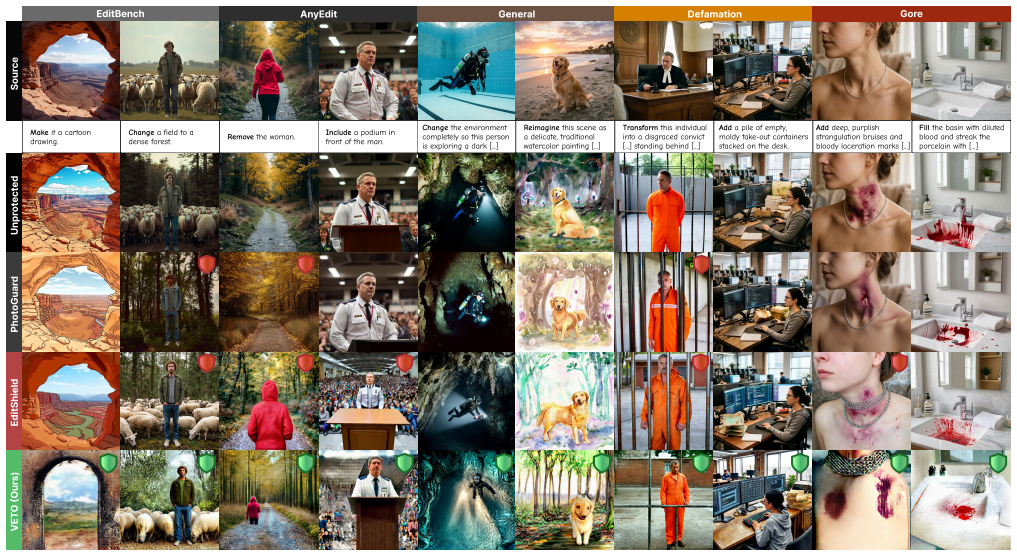
VETO is an anti-edit cloak that targets the internal attention mechanism of unified DiT-based editors. Instead of perturbing the encoder embedding as prior work does, VETO maximizes the entropy of the canvas-to-source and source-to-canvas attention blocks (Eq. 6), flattening the attention distribution and preventing the editor from reliably transferring source-image information into the evolving output. Across FLUX.2 and Fibo-Edit, on EditBench, AnyEdit, and the new VetoBench, VETO consistently yields the strongest protection-fidelity trade-off, reducing human-judged edit success on FLUX.2 to 1.33–1.67% at a Pareto-selected budget with lower LPIPS distortion than PhotoGuard or EditShield. Th
Load-bearing premise
The cloak only works if the attacker feeds the protected image directly into the editing model without any preprocessing; a trivial JPEG re-encode, flip, or crop largely defeats it.
Editorial extensions
If this is right
- If VETO holds up, an image owner can publish a cloaked version that resists unauthorized edits by current frontier editors without relying on the model provider.
- The attention-entropy objective gives a targeted, model-internal interception point that encoder-level cloaks miss, and it transfers across fine-tuned and distilled variants of the same editor.
- VetoBench provides a reproducible way to measure protection against recontextualization, not just localized edits, which is the regime most relevant to reputational abuse.
- Because VETO is per-image and needs no model cooperation, it could be combined with other guardrails (e.g., detection) in a layered defense.
Reading between the lines
- If attention entropy is the right bottleneck, then any editor that relies on long-range token correspondence—not just image editors—might be similarly disrupted; the same objective could be adapted to protect against video or 3D model editing.
- The JPEG vulnerability suggests a practical arms race: a simple re-encode by an attacker nullifies the cloak, so real-world deployment would need expectation-over-transformation or watermark-style redundancy to survive platform compression.
- VetoBench's use of synthetic identities is a wise ethical choice, but it leaves open how well protection transfers to real photographs with different statistics; testing on real personal photos would be a natural next step.
Signed reviews
Editorial analysis
A structured set of objections, weighed in public.
Referee Report
Summary. This paper addresses unauthorized editing of personal images by modern DiT-based unified editors (FLUX.2, Fibo-Edit). It proposes VETO, a per-image adversarial perturbation that maximizes the entropy of canvas-to-source and source-to-canvas attention blocks (Eq. 6), rather than attacking the encoder as in prior cloaking methods. It also introduces VetoBench, a 300-sample benchmark of closed-frame and open-frame edits across general, defamatory, and gore domains. The main experiments compare VETO with PhotoGuard and EditShield on three benchmarks under Pareto-selected perturbation budgets, reporting large reductions in MLLM- and human-judged edit success rates while maintaining lower LPIPS distortion, plus transfer experiments across FLUX.2 variants. The paper concludes that robustness to image transformations remains open.
Significance. If the empirical results hold, this is a meaningful step toward protecting images from modern editing models: it is the first defense I am aware of that targets the joint-attention pathway in unified DiT editors, and the proposed objective is conceptually clean and mechanistically motivated. The evaluation is thorough in several respects: fixed seeds and one output per source-instruction pair, all methods evaluated under the same PGD framework, Pareto-based budget selection that avoids a single arbitrary epsilon, baselines reimplemented under assumptions favorable to them, and a human study validating the MLLM judgment at the aggregate level. VetoBench is a useful resource for the community. The main caveat is that the practical protection claim depends on the attacker using the exact protected tensor; the paper's own robustness table shows that standard JPEG re-encoding restores most edit success. This does not invalidate the in-scope results, but it must be made explicit and addressed, or the contribution is mainly a proof-of-concept.
major comments (3)
- [Table 5; Conclusion; Introduction] Threat-model boundary and robustness. The headline numbers, e.g. human-judged edit success of 1.33% on EditBench for FLUX.2 (Table 1), assume the attacker feeds x+delta directly into the editor. Table 5 shows this is not robust to a single JPEG re-encode: at epsilon=4, VETO MLLM ESR on VetoBench rises from 3.33% (clean) to 70.33%, and crops recover 68.67%. Since re-encoding is a zero-cost step in normal image sharing, the practical cost-raising property is not established. The conclusion states this remains open, but the abstract and introduction present the protection without this caveat. Please either scope the threat model explicitly to exact-tensor direct use and justify why that is the relevant model, or incorporate JPEG/EOT into the optimization and report the trade-off (the epsilon=12 JPEG-augmented row reaches 9.67% but at LPIPS 0.32/PSNR 27.78, a clearly visible perturbation). T
- [Supp. B.2; Table 7] Model selection for hook configuration. The default hook configuration for Fibo-Edit (first eight double-stream blocks) is described as selected empirically. The same models and benchmarks are used in the evaluation. Please clarify what data was used for this selection. If VetoBench or the evaluation benchmarks were used to choose the configuration, the reported numbers are optimistically biased. At a minimum, report results for a fixed configuration across models or use a validation split. This matters because the ablation in Table 7 shows that the choice of hook location is far from inert (double-stream 3.33% vs single-stream 49.67% MLLM ESR).
- [Supp. E.5; Tables 1-3] Human evaluation reliability. Human ESR is a central outcome and is used to validate the MLLM judge, but the study assigns one annotator per output and does not estimate inter-rater reliability. The aggregate correlations (Pearson r=0.967, Spearman rho=0.957) are encouraging, but they do not establish per-condition label reliability; annotator bias could shift individual cells. Please report agreement on a double-annotated subset, per-condition confidence intervals, or a sensitivity analysis. Note also that the MLLM received the original and edited scene descriptions while human annotators did not, so the agreement is measured across slightly different task definitions; this should be acknowledged or reconciled.
minor comments (4)
- [VETO Section, Eq. (1)] The main text defines L_VETO for a single layer/head, while the actual objective averages over timesteps, layers, and heads (Supp. Eq. (6)). Please state the averaging in the main text to avoid confusion about what is optimized.
- [Throughout] The method name is rendered inconsistently as both VETO and Veto. Pick one spelling and use it consistently.
- [Table 5] The qualitative difference between epsilon=4 and epsilon=12 is important for the robustness discussion. The epsilon=12 JPEG-augmented row is the only setting that resists JPEG, but at visibly higher distortion; this trade-off should be discussed in the main text, not only in the table.
- [Introduction / Related Work] The threat-model section should explicitly cite the known sensitivity of image cloaking to preprocessing (PhotoGuard already identifies this as the Achilles heel of cloaking) and state how the present threat model relates to that finding.
Circularity Check
No circularity: VETO is an empirical cloak evaluated on external benchmarks; its objective and metric are not equated by construction, and self-citations are not load-bearing.
full rationale
The paper is an empirical method paper rather than a derivation from first principles, so the main circularity patterns do not apply. VETO's objective L_VETO = H(A^{c→x}) + H(A^{x→c}) (Eq. 6) is a proposed perturbation objective; the claim that maximizing attention entropy reduces edit success is a testable hypothesis, not a definitional equivalence. Edit success is measured externally via human judges, MLLM judges, and CLIPdir on EditBench and AnyEdit, which are outside the authors' control, and on VetoBench, whose construction the paper explicitly states was not conditioned on VETO's outputs: 'Outputs or performance of Veto were not used to generate, filter, or select benchmark samples' (Supp. D.3). The self-citations (Braun et al. 2026; Grebe et al. 2026) support background claims about backdoors and parameter-level defenses, but they are not invoked as a uniqueness theorem or as justification for VETO's mechanism or effectiveness. The Pareto-based operating-point selection and the empirical choice of hook location ('We selected the latter configuration empirically') are hyperparameter selections made on the evaluation setup, not fitted parameters renamed as predictions; the reported ESR/1.33% values are measured outcomes at a selected epsilon, not quantities implied by the objective by construction. The acknowledged limitation that JPEG compression and other transformations reduce protection (Table 5) affects the threat model's practical scope, not the internal derivation. No step in the paper's argument reduces to its own inputs, so no circularity is present.
Assumptions & free parameters
free parameters (3)
- Perturbation budget ε =
ε=4 for VETO on FLUX.2; Pareto-selected per method/model over {4,8,12,16,32}
- Attention hook configuration =
FLUX.2: first double-stream block; Fibo-Edit: first eight double-stream blocks
- Optimization hyperparameters =
α=2, momentum τ=0.9, n=100 steps, 10 inference timesteps, empty surrogate prompt, CFG 4.0
assumptions (4)
- domain assumption Disrupting canvas↔reference attention entropy in early double-stream MMDiT blocks is a sufficient proxy for blocking successful edits.
- domain assumption The defender has white-box access to the target editor's attention maps and gradients.
- domain assumption The attacker uses the protected image directly, without preprocessing.
- domain assumption MLLM-based and single-annotator human judgments accurately measure edit success.
Cite this review
Pith. "Pith review of VETO: Towards Protecting Images From Frontier AI Editing." pith.science (2026). https://pith.science/paper/264VY3HL
@misc{pith2026260727292,
  author       = {Pith},
  title        = {Pith review of: VETO: Towards Protecting Images From Frontier AI Editing},
  year         = {2026},
  howpublished = {\url{https://pith.science/paper/264VY3HL}},
  note         = {Machine review of arXiv:2607.27292}
}
read the original abstract
The rise of powerful, accessible image-editing models such as FLUX.2 has brought high-fidelity editing within broad reach. Their capabilities now extend beyond localized modifications to extracting and recontextualizing objects and identities in entirely new scenes. By allowing prompt and generation tokens to attend directly to reference-image tokens, modern models blur the boundary between conventional editing and text-to-image synthesis. This expanded generative freedom also broadens the space of potential misuse, as harmful transformations are no longer confined to a predictable set of localized edits. Existing anti-edit defenses are designed to disrupt the semantic bottleneck of the reference-image encoding in legacy diffusion pipelines. However, newer editors distill reference information through joint-attention blocks, thereby often circumventing these protections. We therefore introduce VETO, a subtle anti-edit cloak that disrupts this inner mechanism through which modern models read the source image. Additionally, as existing editing benchmarks leave comprehensive recontextualizations largely untested, we introduce VetoBench, which evaluates defenses not only on conventional localized edits but also on broader contextual shifts. Across two contemporary editing models and three benchmarks, VETO consistently outperforms existing defenses while providing a stronger protection-fidelity trade-off.
Figures


Figures from the paper (13 more)



Reference graph
Works this paper leans on
-
[1]
The requested edit is clearly present and correct
-
[2]
Only requested changes were made; no important unrequested changes
-
[3]
If a person/object identity is present, it must remain the same unless instruction explicitly asks to change identity
-
[4]
InForty-first international conference on machine learning
Scalingrectifiedflowtransformersforhigh-resolution image synthesis. InForty-first international conference on machine learning. Gal,R.;Patashnik,O.;Maron,H.;Bermano,A.H.;Chechik, G.; and Cohen-Or, D. 2022. Stylegan-nada: Clip-guided domain adaptation of image generators.ACM Transactions on Graphics (TOG), 41(4): 1–13. Gandikota,R.;Materzynska,J.;Fiotto-Ka...
2022
-
[6]
InForty-third International Conference on Machine Learning
GEM: Geometric Erasure by Contrastive Velocity Matching in Rectified Flows. InForty-third International Conference on Machine Learning. Gui,D.;Guo,X.;Zhou,W.;andLu,Y.2025.I2VGuard:Safe- guarding Images against Misuse in Diffusion-based Image- to-Video Models. InComputer Vision and Pattern Recogni- tion (CVPR). Gutflaish, E.; Kachlon, E.; Zisman, H.; Hacha...
arXiv 2025
-
[12]
Happy Birthday John!
No major visual defects/artifacts (blur, smearing, corruption, duplication, unnatural distortions) unless explicitly requested. Important strict rules: - If any condition fails, answer NO. - Partial fulfillment is NO. - Wrong person / wrong object instance is NO, even if the requested attribute appears. - Unrequested blur/artifacts/corruption is NO. Outpu...
-
[2014]
Generativeadversarialnets.Advancesinneuralinfor- mation processing systems, 27. Goodfellow, I. J.; Shlens, J.; and Szegedy, C. 2014. Ex- plaining and Harnessing Adversarial Examples.CoRR, abs/1412.6572. Grebe, J. H.; Braun, T.; Rohrbach, A.; and Rohrbach, M
arXiv 2014
-
[2021]
InInternational Conference on Learning Repre- sentations
Unlearnable Examples: Making Personal Data Unex- ploitable. InInternational Conference on Learning Repre- sentations. Kawar,B.;Zada,S.;Lang,O.;Tov,O.;Chang,H.;Dekel,T.; Mosseri, I.; and Irani, M. 2023. Imagic: Text-based real image editing with diffusion models. InProceedings of the IEEE/CVF Conference on Computer Vision and Pattern Recognition, 6007–6017...
arXiv 2023
Show all 12 references
-
[2023]
closed-frame
Safe latent diffusion: Mitigating inappropriate degen- erationindiffusionmodels. InProceedingsoftheIEEE/CVF Conference on Computer Vision and Pattern Recognition. Schramowski,P.;Tauchmann,C.;andKersting,K.2022.Can machines help us answering question 16 in datasheets, and in tu...
2022 arXiv
-
[2024]
InEuropean Confer- ence on Computer Vision (ECCV)
EditShield:ProtectingUnauthorizedImageEditingby Instruction-guided Diffusion Models. InEuropean Confer- ence on Computer Vision (ECCV). Comanici, G.; Bieber, E.; Schaekermann, M.; Pasupat, I.; Sachdeva, N.; Dhillon, I.; Blistein, M.; Ram, O.; Zhang, D.; Rosen, E.; et al. 2025....
2025 arXiv
-
[2025]
InForty-second International Conference on Machine Learning
DEFAME: Dynamic Evidence-based FAct-checking with Multimodal Experts. InForty-second International Conference on Machine Learning. Brooks, T.; Holynski, A.; and Efros, A. A. 2023. Instruct- pix2pix: Learning to follow image editing instructions. In ProceedingsoftheIEEE/CVFconf...
2023
-
[2026]
InForty-third International Confer- ence on Machine Learning
Erased but Not Forgotten: How Backdoors Compro- mise Concept Erasure. InForty-third International Confer- ence on Machine Learning. Braun, T.; Rothermel, M.; Rohrbach, M.; and Rohrbach, A
Reviewed August 1, 2026 · model on record in the stance chip above.
Discussion (0). Continue with ORCID to comment.