REVIEW 3 major objections 4 minor 18 references
A new survey finds that over 70 percent of massive stars in the Small Magellanic Cloud are close binaries, the first such measurement at low metallicity.
Reviewed by Pith at T0; open to challenge. T0 means a machine referee read the full paper against a public rubric. the ladder, T0–T4 →
T0 review · deepseek-v4-flash
2026-08-01 08:05 UTC pith:JQPNGLTQ
load-bearing objection A transparent early-summary of BLOeM's first nine epochs: the 70-80% binary fraction is plausible but imported from companion papers, and the abstract overstates its robustness. the 3 major comments →
Multiplicity of Massive Stars at Low Metallicity: Early Results from the BLOeM Campaign
The pith
A machine-rendered reading of the paper's core claim, the machinery that carries it, and where it could break.
Core claim
Analysing radial velocities from the first nine epochs of the BLOeM campaign, the authors establish that close binarity is common among massive main-sequence stars at roughly 20% solar metallicity: 62 binaries among 139 O stars and 153 among 309 early B dwarfs/giants, leading to bias-corrected intrinsic fractions of 70+11-6% and 80±8%, respectively. Across the mass range 8–80 M☉, the intrinsic binary fraction is 70–80%. By contrast, OBe stars show an observed fraction of only 18–32%, early B supergiants 34%, and BAF supergiants essentially zero at the standard threshold; these low values, compared with their main-sequence progenitors, are taken as evidence that most of these evolved objects
What carries the argument
The central mechanism is multi-epoch radial-velocity monitoring: each star is observed repeatedly with a medium-resolution spectrograph, and stars whose velocities vary by more than about 20 km/s between epochs are flagged as binary candidates. The nine-epoch, 2–3 month baseline strongly selects short-period systems; the conversion from observed to intrinsic binary fractions relies on bias corrections that assume an underlying orbital-parameter distribution. The analysis also uses Hertzsprung–Russell diagram placement, spectral classification, and the contrast between main-sequence and evolved subsamples to argue for binary-interaction origins.
Load-bearing premise
The intrinsic fractions of 70–80% depend on correction factors imported from higher-metallicity surveys, which assume how many binaries are missed due to short baselines, low inclinations, and extreme mass ratios; if the true period distribution at low metallicity is weighted toward longer periods, the corrected numbers will be too high.
What would settle it
Analyse the complete 25-epoch dataset for the same SMC stars, measuring orbital periods out to ~1000 days and deriving intrinsic binary fractions with the observed period distribution rather than an assumed one; if the resulting intrinsic fractions for 8–80 M☉ main-sequence stars fall significantly below 70%, the paper's central claim fails. Alternatively, a direct search for long-period systems (P > 100 days) among the O and early-B sample that reveals a substantial hidden population would also lower the corrected fractions.
If this is right
- Close binaries are common, not rare, at low metallicity, so binary-driven pathways such as mass transfer, mergers, and stripped-star formation must be included in models of metal-poor stellar populations.
- The observed excess of stars in the Hertzsprung gap challenges standard single-star evolution; either the main sequence extends cooler at low Z or the gap is heavily populated by binary-interaction products.
- Most BAF supergiants and OBe stars are likely binary-interaction products, meaning these luminous objects are not straightforward single-star evolutionary stages.
- The full 25-epoch dataset will provide orbital solutions for hundreds of binaries, identify dormant black-hole companions, and allow a derivation of the initial mass function of single and binary stars at low Z.
- These results strengthen the case that the binary-dominated massive-star population in the metal-poor early Universe is a viable source of gravitational-wave mergers.
Where Pith is reading between the lines
- I infer that if the binary fraction rises as metallicity falls, merger rates for compact-object binaries from low-metallicity environments could be higher than current estimates that assume Solar-neighbourhood statistics.
- The bias corrections that convert observed to intrinsic fractions borrow period and mass-ratio distributions from higher-metallicity surveys; if low-metallicity systems have longer periods, the 70–80% values would shrink — a testable prediction for the full 25-epoch dataset.
- The assertion that most BAF supergiants are binary-interaction products rests on having no directly observed binary population in that sample; the full dataset or a comparison with an alternative evolutionary channel (e.g., blue-loop stars) could distinguish these origins.
- The steep decline in binary fraction from main-sequence to evolved stars suggests that the binary fraction itself evolves with age, so present-day fractions should not be mistaken for initial multiplicities.
Editorial analysis
A structured set of objections, weighed in public.
Referee Report
Summary. This Messenger article reports early results from the BLOeM campaign, a 25-epoch FLAMES/GIRAFFE spectroscopic survey of 929 massive stars in the Small Magellanic Cloud at ~20% solar metallicity. Using the first nine epochs (Oct–Dec 2023), it presents observed and intrinsic binary fractions for five subsamples: O stars (f_obs = 45±4%, f_int = 70+11/−6%), early B dwarfs/giants (f_obs = 50±3%, f_int = 80±8%), OBe stars (f_obs = 18±4%, rising to 32±5% with candidates, no bias correction), early B supergiants (f_obs = 34±3%, f_int = 40±4%), and BAF supergiants (no detections at 20 km/s; 25% and 5% at 5 km/s in late-B and AF types). It concludes that close binaries are ubiquitous on the main sequence at low metallicity, that most BAF supergiants and OBe stars are binary-interaction products, and that the full 25-epoch dataset will deliver orbital solutions and black-hole constraints.
Significance. If the headline numbers hold, this is the first large-scale demonstration that close binary fractions remain high at 20% solar metallicity, with direct implications for binary-driven evolution and low-metallicity gravitational-wave progenitors. The survey design is a substantial advance: 929 stars, 25 epochs, and a homogeneous selection over the SMC. The early results are internally consistent, and the text is transparent about several limitations (no bias correction for OBe, need for full dataset for early-B supergiants, possible variability contamination). The main quantitative claims, however, are imported from five companion papers, and the central '>70%' intrinsic-fraction result is not derived or justified on-page here.
major comments (3)
- [Multiplicity across the main sequence] The headline intrinsic fractions (70+11−6% for O stars, 80±8% for B dwarfs) are not derived anywhere in this paper; they are taken from Sana et al. (2025) and Villaseñor et al. (2025). The text does not state the assumed period, mass-ratio, or inclination distributions used in the bias correction, nor the detection-efficiency model. Since the paper itself concedes that the nine-epoch baseline cannot identify long-period, low-inclination, or extreme-mass-ratio binaries, the '>70%' claim is model-dependent. Please add a summary of the correction assumptions or explicitly qualify the abstract and this section as reporting the companion papers' model-dependent results.
- [Multiplicity of BAF supergiants] The conclusion that 'most BAF supergiants are products of binary interaction' depends entirely on the assumption, attributed to Patrick et al. (2025), that BAF supergiants would share the orbital-parameter distribution of main-sequence binaries if they were ordinary post-main-sequence stars. This assumption is stated but not tested here, and plausible evolutionary effects (orbital expansion, tidal circularization, merger products) could change the expected distribution. At minimum, the text should state that this conclusion is conditional on the assumed comparison distribution, and ideally provide a sensitivity test using alternative orbital distributions.
- [Multiplicity of classical OBe stars / Summary bullets] The bullet list states 'Most BAF supergiants and OBe stars are binary-interaction products.' For OBe stars, the body reports f_obs = 18±4% (32±5% including candidates) and explicitly says 'No bias correction was attempted, owing to uncertain underlying orbital properties' and 'intrinsic variability may have contaminated the results.' The body only says the low fraction is 'potentially consistent with' the accretor interpretation. The summary bullet overstates the OBe evidence. Please revise the bullet to match the caveats.
minor comments (4)
- [Abstract] Typo: 'intrument' should be 'instrument'.
- [Figure 3] The line 'nstars 814726278309139' appears garbled; the sample sizes should be formatted clearly for each bar.
- [The BLOeM sample and survey] 'dPI: Bodensteiner' may be a typo for 'deputy PI' or 'PI'; please clarify.
- [Multiplicity across the main sequence] The citation 'see also Moe & Di Stefano, 2013' after the B-dwarf f_obs value is unclear; specify what comparison is intended.
Circularity Check
Headline intrinsic binary fractions (70–80%) are imported from companion papers with overlapping authorship; no on-page derivation of the bias corrections.
specific steps
-
self citation load bearing
[Section 'Multiplicity across the main sequence: high also at low metallicity' and Figure 3 caption]
"Accounting for observational biases, they derived an intrinsic (present-day) binary fraction of fint = 70+11–6 %. ... Together, these two subsamples demonstrate that close binarity is common among main-sequence massive stars at 20% of solar metallicity, with intrinsic fractions of 70–80% ... Results for O stars, B dwarfs, OBe stars, early B supergiants and late BAF supergiants are taken from Sana et al. (2025), Villaseñor et al. (2025), Bodensteiner et al. (2025), Britavskiy et al. (2025) and Patrick et al. (2025)."
The paper's central quantitative claim—intrinsic binary fractions >70% and 70–80% on the main sequence—is not derived from data or equations shown in this manuscript. The text explicitly states that the results are 'taken from' five companion papers with heavy author overlap with the present article (Sana, Shenar, Bodensteiner appear in both). The observed-to-intrinsic bias corrections that convert fobs = 45±4% and fobs = 50±3% into fint = 70+11−6% and fint = 80±8% are not presented or justified here. Thus, within the paper's own derivation chain, the headline result reduces to a self-citation rather than an independent on-page derivation.
full rationale
This is an ESO Messenger campaign-summary article, so citing companion papers is expected; nevertheless, the abstract's signature result—'high intrinsic binary fractions (>70%)'—is explicitly imported from Sana et al. (2025) and Villaseñor et al. (2025), whose author lists overlap heavily with the present paper, and the bias corrections are not reproduced in the text. This makes the central claim load-bearing on self-citation. I do not find a definitional or fitting-relabeled-as-prediction circularity on the page: the observed fractions (45±4%, 50±3%) are reported as empirical data, and the paper is transparent that the intrinsic values come from the companion papers. The stated limitation—'identifying long-period, low-inclination and extreme mass-ratio binaries will only be possible with the full dataset'—and the BAF-supergiant conclusion's reliance on an assumed main-sequence orbital-parameter distribution are model-dependence and robustness issues rather than circular steps. Because the core claim is not derived in this manuscript but is not definitionally forced either, a moderate score of 4 is appropriate.
Axiom & Free-Parameter Ledger
free parameters (2)
- Radial-velocity binary-detection threshold =
20 km/s peak-to-peak (relaxed to 5 km/s for BAF supergiants)
- Underlying orbital-parameter distributions assumed in bias corrections
axioms (5)
- domain assumption The SMC has Z ~ 20% solar metallicity and hosts a representative massive-star population at a distance of 62 kpc.
- domain assumption The bias corrections applied in the companion papers (Sana et al. 2025; Villaseñor et al. 2025) correctly convert observed RV-variable fractions to intrinsic binary fractions from nine epochs over a 2-3 month baseline.
- domain assumption Massive-star multiplicity is dominated by short-period systems (periods of days to months).
- ad hoc to paper BAF supergiants, if they were ordinary post-main-sequence stars, would share the orbital-parameter distribution of main-sequence binary systems.
- domain assumption Standard single-star evolutionary models correctly predict a sparse Hertzsprung gap.
Cite this review
Pith. "Pith review of Multiplicity of Massive Stars at Low Metallicity: Early Results from the BLOeM Campaign." pith.science (2026). https://pith.science/paper/JQPNGLTQ
@misc{pith2026260727395,
  author       = {Pith},
  title        = {Pith review of: Multiplicity of Massive Stars at Low Metallicity: Early Results from the BLOeM Campaign},
  year         = {2026},
  howpublished = {\url{https://pith.science/paper/JQPNGLTQ}},
  note         = {Machine review of arXiv:2607.27395}
}
read the original abstract
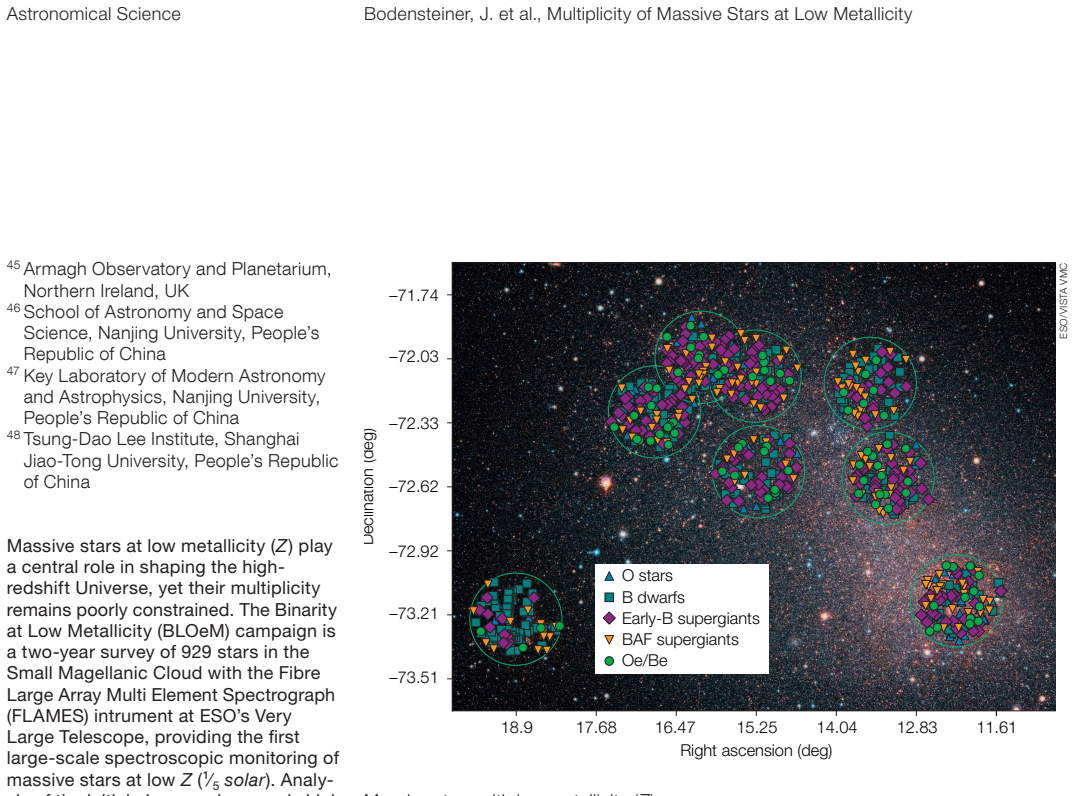
Massive stars at low metallicity (Z) play a central role in shaping the high-redshift Universe, yet their multiplicity remains poorly constrained. The Binarity at Low Metallicity (BLOeM) campaign is a two-year survey of 929 stars in the Small Magellanic Cloud with the Fibre Large Array Multi Element Spectrograph (FLAMES) instrument at ESO's Very Large Telescope, providing the first large-scale spectroscopic monitoring of massive stars at low Z (1/5 solar). Analysis of the initial nine epochs reveals high intrinsic binary fractions (>70%) on the main sequence and a steep decline in evolved objects. Analysis of the full dataset will yield orbital solutions, identify black-hole companions, and allow a derivation of the initial mass function for single and binary stars at low Z.
Figures


Reference graph
Works this paper leans on
-
[1]
Bestenlehner, J. M. et al. 2025, MNRAS, 540, 3523
2025
-
[2]
& Sana, H
Bodensteiner, J., Shenar, T. & Sana, H. 2020, A&A, 641, A42
2020
-
[3]
Bodensteiner, J. et al. 2025, A&A, 698, A38
2025
-
[4]
Britavskiy, N. et al. 2025, A&A, 698, A40
2025
-
[5]
& Yoshida, N
Bromm, V. & Yoshida, N. 2011, ARA&A, 49, 373 de Burgos, A. et al. 2025, A&A, 695, A87 de Mink, S. E. et al. 2014, ApJ, 782, 7 Gaia Collaboration et al. 2023, A&A, 674, A1
2011
-
[6]
Hopkins, P. F. et al. 2014, MNRAS, 445, 581
2014
-
[7]
Klessen, R. S. & Glover, S. C. O. 2023, ARA&A, 61, 65
2023
-
[8]
2012, ARA&A, 50, 107
Langer, N. 2012, ARA&A, 50, 107
2012
-
[9]
& Bodensteiner, J
Marchant, P. & Bodensteiner, J. 2024, ARA&A, 62, 21
2024
-
[10]
Menon, A. et al. 2024, ApJL, 963, L42
2024
-
[11]
& Di Stefano, R
Moe, M. & Di Stefano, R. 2013, ApJ, 778, 95
2013
-
[12]
Patrick, L. R. et al. 2025, A&A, 698, A39
2025
-
[13]
Podsiadlowski, Ph., Joss, P. C. & Hsu, J. J. L. 1992, ApJ, 391, 246
1992
-
[14]
Sana, H. et al. 2012, Science, 337, 444
2012
-
[15]
Sana, H. et al. 2025, Nat Astron, 9, 1337
2025
-
[16]
Shenar, T. et al. 2024, A&A, 690, A289 Villaseñor, J. I. et al. 2025, A&A, 698, A41
2024
-
[17]
Vink, J. S. et al. 2010, A&A, 512, L7
2010
-
[18]
La Caixa
Willcox, R. et al. 2025, A&A, 700, A59 and OBe stars within the sample (PI: Mahy, ID: 115.28A9). Together, these efforts will illuminate the origins and properties of stellar-mass black holes and neutron stars, gravitational- wave progenitors, and massive stars in general in conditions approaching those of the early Universe. Acknowledgements TS acknowled...
2025
discussion (0)
Sign in with ORCID, Apple, or X to comment. Anyone can read and Pith papers without signing in.