REVIEW 3 major objections 5 minor 28 references
Rethinking Artificial Intelligence in Medical Imaging: Assumptions, Reality, and Reframing
T0 review · 3 major / 5 minor · reviewed 2026-07-31 · grok-4.5
Pith's one-line read The bedside gap in medical imaging AI is structural misalignment with how clinicians decide, not weak algorithms.
desk verdict Solid clinical-AI perspective that integrates known failure modes into a physician-aligned agentic agenda; the causal claim that performance is not primary is asserted, not shown. read the letter →
The pith
A machine-rendered reading of the paper's core claim, the machinery that carries it, and where it could break.
The reading
What carries the argument
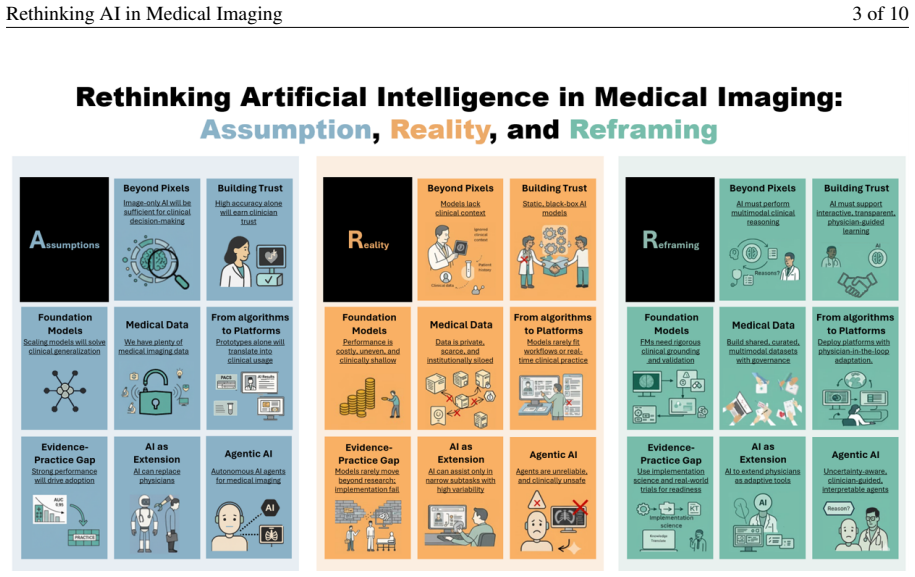
Six-dimension clinical-alignment framework (pixels-only vs multimodal context; trust and physician-in-the-loop vs AI-in-the-loop; foundation-model limits; data shareability and curation; algorithms-to-platforms; prediction-to-actionability), culminating in agentic AI defined by context orchestration, uncertainty-aware escalation, and action-oriented recommendations.
What would settle it
Compare, in matched complex multimodal cases, whether physician-aligned agentic systems that retrieve EHR context and output decision-linked recommendations produce measurably better adoption, decision quality, and patient outcomes than strong pixel-only predictors that only raise benchmark accuracy.
Extended reading notes
Core claim
The paper's central claim is that limited bedside impact of medical imaging AI reflects structural misalignment between design-and-evaluation practices and clinical decision-making, expressed in six interconnected dimensions, and that closing the gap requires reorienting from benchmark-centric products toward agentic, physician-aligned systems that extend clinical judgment rather than replace it.
Load-bearing premise
The load-bearing premise is that algorithmic performance is already good enough that structural and clinical misalignment, not residual capability or evidence gaps, is the primary reason impact stays limited.
Editorial extensions
If this is right
- Success metrics shift from task accuracy on image benchmarks to decision quality, workflow fit, and patient outcomes.
- Systems must ingest labs, history, therapies, and priors rather than treat patients as voxel grids alone.
- Translation work prioritizes integrated platforms, human-in-the-loop feedback, and post-deployment monitoring over one-off validated algorithms.
- Models are designed around concrete clinical choices and time horizons, not standalone risk scores.
- Agentic tools retrieve context, escalate when out of range, and leave final authority with the physician.
Reading between the lines
- If the structural diagnosis is right, more scale and better black-box accuracy alone will keep yielding patchy adoption.
- Reimbursement and governance may need to fund ongoing platform stewardship and surveillance, not only initial model clearance.
- The same six-dimension lens likely applies to other multimodal clinical AI domains beyond imaging.
- Regulatory sandboxes for adaptive agents become a practical bottleneck once systems can act across EHR and imaging.
Editorial analysis
A structured set of objections, weighed in public.
Referee Report
Summary. This Perspective argues that the limited bedside impact of medical imaging AI after a decade of research is driven primarily by structural misalignment between how systems are designed/evaluated and how clinical decisions are made, rather than by insufficient algorithmic performance, regulation, or explainability. It organizes the argument into six interconnected dimensions—pixel-only models, trust and inflexible interfaces, foundation-model limits in data-sparse domains, non-shareable/under-curated data, algorithm-to-platform gaps, and prediction-centric rather than actionable outputs—each mapped as Assumptions, Reality, and Reframing (Fig. 1). The authors distinguish physician-in-the-loop AI from AI-in-the-loop physicians (Fig. 2), advocate implementation-science and co-design approaches, and culminate in a vision of agentic imaging AI with three capacities: context orchestration, uncertainty-aware reasoning, and action-oriented recommendations that extend rather than replace clinical judgment.
Significance. If the structural-misalignment diagnosis is largely right, the piece offers a useful integrated agenda for a field that often treats workflow, trust, multimodality, platforms, and actionability as separate afterthoughts. The Assumptions/Reality/Reframing map, the paired operating modes (physician-in-the-loop vs AI-in-the-loop), and the three-capacity agentic framing are clear conceptual contributions that can orient design, evaluation, and deployment discussions beyond benchmark accuracy. Concrete pointers to MONAI Label, Kaapana, task-based evaluation, iKT, and MedAgentBench give practitioners starting points. As a Perspective the value is synthesis and reorientation rather than new empirics; that is appropriate if the causal ranking is stated with suitable epistemic humility and the agentic program is framed as a research agenda rather than a demonstrated cure.
major comments (3)
- [Abstract; Introduction] Abstract and Introduction: The load-bearing claim that the research-to-bedside gap “is not primarily a product of insufficient algorithmic performance, inadequate regulation, or limited explainability” but “structural misalignment” is asserted without comparative or stratified evidence (e.g., adoption stratified by demonstrated accuracy vs workflow fit; head-to-head of performance-limited vs integration-limited tools; quantification of failure modes). For a Perspective this need not be a full causal study, but the ranking should be qualified as a working hypothesis and residual capability/generalizability/outcome-evidence gaps should be acknowledged as co-equal or context-dependent barriers. Otherwise the six reframings read as design advice that does not actually explain limited impact.
- [Beyond pixels] Beyond pixels / dimension 1: The text correctly notes that well-validated image-only tools (e.g., LVO triage, breast screening) already have clinical value and that radiologists often work with limited history. That acknowledgment undercuts listing “dominance of pixel-only models” as a primary structural failure without specifying for which case classes (screening vs complex/ambiguous longitudinal care) multimodality is decision-critical. Please bound the claim: when pixel-only is adequate vs when missing labs/therapy context is the binding constraint, ideally with the hemoglobin/prostate example tied to a concrete decision failure mode rather than a general limitation.
- [Shift towards agentic AI in radiology; Conclusion] Shift towards agentic AI in radiology: The three capacities (context orchestration, uncertainty-aware reasoning, action-oriented output) are a coherent design target, but the same section states that competence-boundary mechanisms are lacking and that regulation is unready for autonomous action. The Conclusion then treats agentic, physician-aligned AI as the architecture medicine needs. Tighten the claim: present agentic systems as a proposed research and evaluation agenda (with MedAgentBench-style benchmarks and staged/sandbox deployment), not as an established solution that closes the translation gap. Explicit success criteria and failure modes would strengthen falsifiability.
minor comments (5)
- [Figure 1] Fig. 1 is central to the argument but is only described in caption/text; ensure the six rows are labeled consistently with the Abstract’s six dimensions and that “Assumptions / Reality / Reframing” cells are readable in print.
- [Figure 2] Fig. 2 caption (“interlinking of physician-in-the-loop AI and AI-in-the-loop physician”) should briefly state what the figure shows operationally (data/label flow vs real-time decision support) so it stands alone.
- [References; From algorithms to platforms] Typos/style: “Arman Rhamim” in ref. [8] should be Rahmim; “transform practice into isolation” should be “in isolation”; Abstract “served as primary proving ground” → “as a primary”; occasional missing spaces before citations and en-dash consistency.
- [A central bottleneck in data] The data-ownership/custodian paragraph ([22–24]) is provocative and useful; a sentence acknowledging legitimate privacy, consent, and equity counter-arguments would balance the governance claim without diluting the sharing bottleneck point.
- [References] Several themes lean on the author group’s prior work (continual learning [11–14], trust [8], task-based evaluation [9], implementation science [25], Bethesda report [24]). That is fine for a Perspective, but adding a few independent multi-center adoption or negative-result citations on translation failure would reduce appearance of a closed citation circle.
Circularity Check
No derivation-by-construction circularity; Perspective asserts a causal ranking without reducing it to fitted inputs, definitional identities, or load-bearing self-citation chains.
full rationale
This is an argumentative Perspective, not a formal derivation. It claims the research-to-bedside gap reflects structural misalignment across six dimensions and should be addressed by agentic, physician-aligned AI. There are no equations, fitted parameters renamed as predictions, uniqueness theorems, or ansatzes smuggled in via prior author work that force the conclusion by construction. Author-group citations (continual learning, trust, task-based evaluation, implementation science, Bethesda/nuclear-medicine AI reports) supply background examples and related framing but are not required for the logical form of the misalignment claim; the central causal ranking is expert assertion/synthesis, not a reduction to those citations. Minor self-citation density is normal for a synthesis piece and does not make the thesis circular. Score 1 reflects only light, non-load-bearing self-reference, not a circular step that collapses the result into its inputs.
Assumptions & free parameters
assumptions (8)
- domain assumption Clinical decisions in complex imaging cases systematically require multimodal context (labs, comorbidities, therapies, priors, trajectory), so pixel-only optimization is structurally insufficient for those cases.
- domain assumption The research-to-bedside gap in medical imaging AI is real and “not proportionate” to a decade of work, and is not primarily caused by insufficient accuracy, regulation, or explainability.
- domain assumption Trust and adoption require utility, reliability, transparency, value alignment, and preserved professional agency; static black-box tools with middling accuracy erode trust.
- domain assumption In data-sparse medical imaging, scale alone (foundation models) cannot substitute for curated multimodal data, clinical validation, and evaluation rigor.
- domain assumption Shareable, well-governed, diverse datasets (including carefully constrained synthetic data) are a prerequisite for non-incremental multicenter progress.
- domain assumption Implementation science / integrated knowledge translation and platform integration (PACS/EHR, monitoring, reimbursement) are necessary to close evidence–practice gaps for AI.
- domain assumption Actionable clinical AI must be organized around decisions and consequences, not generic prediction metrics alone.
- ad hoc to paper Agentic architectures with context orchestration, uncertainty-aware escalation, and action-oriented outputs are the appropriate technical response to missing context and brittle one-shot classification.
invented entities (3)
-
Six-dimension structural misalignment framework (Assumptions/Reality/Reframing map)
-
AI-in-the-loop physician (vs physician-in-the-loop AI) as paired operating modes
-
Three-capacity agentic imaging AI (context orchestration, uncertainty-aware reasoning, action-oriented output)
Cite this review
Pith. "Pith review of Rethinking Artificial Intelligence in Medical Imaging: Assumptions, Reality, and Reframing." pith.science (2026). https://pith.science/paper/BTBJOM5E
@misc{pith2026260727428,
  author       = {Pith},
  title        = {Pith review of: Rethinking Artificial Intelligence in Medical Imaging: Assumptions, Reality, and Reframing},
  year         = {2026},
  howpublished = {\url{https://pith.science/paper/BTBJOM5E}},
  note         = {Machine review of arXiv:2607.27428}
}
read the original abstract
Medical imaging has served as primary proving ground for clinical artificial intelligence (AI), yet a decade of intense research has not translated into proportionate bedside impact. We argue that this gap is not primarily a product of insufficient algorithmic performance, inadequate regulation, or limited explainability. Rather, it reflects a structural misalignment, between how AI systems are designed and evaluated, and how clinical decisions are made. This Perspective identifies six interconnected dimensions of this misalignment: the dominance of pixel-only models in a multimodal clinical world; the erosion of physician trust through opaque and inflexible systems; the unfulfilled promise of foundation models in data-sparse medical domains; the persistent bottleneck of non-shareable, under-curated datasets; the gap between validated algorithms and deployable clinical platforms; and the failure of prediction-centric AI to generate actionable clinical guidance. For each dimension, we reframe the problem and propose a path forward, culminating in a vision of agentic, physician-aligned AI that extends, rather than replaces, clinical judgment.
Figures

Reference graph
Works this paper leans on
-
[1]
A brief history of ai: how to prevent another winter (a critical review).PET clinics, 16(4):449–469, 2021
Amirhosein Toosi, Andrea G Bottino, Babak Saboury, Eliot Siegel, and Arman Rahmim. A brief history of ai: how to prevent another winter (a critical review).PET clinics, 16(4):449–469, 2021
2021
-
[2]
Foundation models for radiology: fundamentals, applications, opportunities, challenges, risks, and prospects.Diagnostic and Interventional Radiology, 2025
Tugba Akinci D’Antonoli, Christian Bluethgen, Renato Cuocolo, Michail E Klontzas, Andrea Ponsiglione, and Burak Kocak. Foundation models for radiology: fundamentals, applications, opportunities, challenges, risks, and prospects.Diagnostic and Interventional Radiology, 2025
2025
-
[3]
Fda-authorized oncology artificial intelligence and machine learning devices and their clinical evidence: A cross-sectional analysis
Henry Litt, Paras Mehta, Aarush Sahni, and Ronac Mamtani. Fda-authorized oncology artificial intelligence and machine learning devices and their clinical evidence: A cross-sectional analysis. Journal of Cancer Policy, page 100743, 2026
2026
-
[4]
Xiaoxuan Liu, Livia Faes, Aditya U Kale, Siegfried K Wagner, Dun Jack Fu, Alice Bruynseels, Thushika Mahendiran, Gabriella Moraes, Mohith Shamdas, Christoph Kern, et al. A comparison of deep learning performance against health-care professionals in detecting diseases from medical imaging: a systematic review and meta-analysis.The lancet digital health, 1(...
2019
-
[5]
The revolution of glu- cose monitoring methods and systems: A survey
Nourhan Bayasi, Hani Saleh, Baker Mohammad, and Mohammad Ismail. The revolution of glu- cose monitoring methods and systems: A survey. In2013 IEEE 20th International Conference on Electronics, Circuits, and Systems (ICECS), pages 92–93. IEEE, 2013
2013
-
[6]
Tomasz M Beer, Catherine M Tangen, Lisa B Bland, Maha Hussain, Bryan H Goldman, Thomas G DeLoughery, and E David Crawford. The prognostic value of hemoglobin change after initiating androgen-deprivation therapy for newly diagnosed metastatic prostate cancer: a multivariate anal- ysis of southwest oncology group study 8894.Cancer, 107(3):489–496, 2006
2006
-
[7]
Farida Mohsen, Hazrat Ali, Nady El Hajj, and Zubair Shah. Artificial intelligence-based methods for fusion of electronic health records and imaging data.arXiv preprint arXiv:2210.13462, 2022
arXiv 2022
-
[8]
Trustworthy artificial intelligence in medical imaging.PET clinics, 17 (1):1, 2022
Navid Hasani, Michael A Morris, Arman Rhamim, Ronald M Summers, Elizabeth Jones, Eliot Siegel, and Babak Saboury. Trustworthy artificial intelligence in medical imaging.PET clinics, 17 (1):1, 2022
2022
Show all 28 references
-
[9]
Objective task-based evaluation of artificial intelligence-based medical imaging methods: framework, strategies, and role of the physician
Abhinav K Jha, Kyle J Myers, Nancy A Obuchowski, Ziping Liu, Md Ashequr Rahman, Babak Saboury, Arman Rahmim, and Barry A Siegel. Objective task-based evaluation of artificial intelligence-based medical imaging methods: framework, strategies, and role of the physician. PET clin...
2021
-
[10]
Interactive per- sonalized ai for physician-in-the-loop 3d tumor segmentation on ct
Nourhan Bayasi, Mahan Pouromidi, Fereshteh Yousefirizi, and Arman Rahmim. Interactive per- sonalized ai for physician-in-the-loop 3d tumor segmentation on ct. In2026 Joint AAPM|COMP Annual Meeting & Exhibition. AAPM, 2026
2026
-
[11]
Continual-zoo: Leveraging zoo models for continual classification of medical images
Nourhan Bayasi, Ghassan Hamarneh, and Rafeef Garbi. Continual-zoo: Leveraging zoo models for continual classification of medical images. InProceedings of the IEEE/CVF Conference on Computer Vision and Pattern Recognition, pages 4128–4138, 2024
2024
-
[12]
GC 2: Generalizable continual classifica- tion of medical images.IEEE Transactions on Medical Imaging, 43(11):3767–3779, 2024
Nourhan Bayasi, Ghassan Hamarneh, and Rafeef Garbi. GC 2: Generalizable continual classifica- tion of medical images.IEEE Transactions on Medical Imaging, 43(11):3767–3779, 2024
2024
-
[13]
Continual-GEN: Continual group ensembling for domain-agnostic skin lesion classification
Nourhan Bayasi, Siyi Du, Ghassan Hamarneh, and Rafeef Garbi. Continual-GEN: Continual group ensembling for domain-agnostic skin lesion classification. InInternational Conference on Medical Image Computing and Computer-Assisted Intervention, pages 3–13. Springer, 2023. Rethinki...
2023
-
[14]
Biaspruner: Mitigating bias transfer in continual learning for fair medical image analysis.Medical image analysis, page 103764, 2025
Nourhan Bayasi, Jamil Fayyad, Alceu Bissoto, Ghassan Hamarneh, and Rafeef Garbi. Biaspruner: Mitigating bias transfer in continual learning for fair medical image analysis.Medical image analysis, page 103764, 2025
2025
-
[15]
The false hope of current ap- proaches to explainable artificial intelligence in health care.The lancet digital health, 3(11):e745– e750, 2021
Marzyeh Ghassemi, Luke Oakden-Rayner, and Andrew L Beam. The false hope of current ap- proaches to explainable artificial intelligence in health care.The lancet digital health, 3(11):e745– e750, 2021
2021
-
[16]
On the challenges and perspectives of foundation models for medical image analysis.Medical image analysis, 91:102996, 2024
Shaoting Zhang and Dimitris Metaxas. On the challenges and perspectives of foundation models for medical image analysis.Medical image analysis, 91:102996, 2024
2024
-
[17]
Boosternet: Improving domain gener- alization of deep neural nets using culpability-ranked features
Nourhan Bayasi, Ghassan Hamarneh, and Rafeef Garbi. Boosternet: Improving domain gener- alization of deep neural nets using culpability-ranked features. InProceedings of the IEEE/CVF Conference on Computer Vision and Pattern Recognition, pages 538–548, 2022
2022
-
[18]
Towards gener- alist foundation model for radiology by leveraging web-scale 2d&3d medical data.Nature Com- munications, 16(1):7866, 2025
Chaoyi Wu, Xiaoman Zhang, Ya Zhang, Hui Hui, Yanfeng Wang, and Weidi Xie. Towards gener- alist foundation model for radiology by leveraging web-scale 2d&3d medical data.Nature Com- munications, 16(1):7866, 2025
2025
-
[19]
Vision foundation models for computed tomography
Suraj Pai, Ibrahim Hadzic, Dennis Bontempi, Keno Bressem, Benjamin H Kann, Andriy Fedorov, Raymond H Mak, and Hugo JWL Aerts. Vision foundation models for computed tomography. arXiv preprint arXiv:2501.09001, 2025
2025 arXiv
-
[20]
Avit: Adapting vision transform- ers for small skin lesion segmentation datasets
Siyi Du, Nourhan Bayasi, Ghassan Hamarneh, and Rafeef Garbi. Avit: Adapting vision transform- ers for small skin lesion segmentation datasets. InInternational Conference on Medical Image Computing and Computer-Assisted Intervention, pages 25–36. Springer, 2023
2023
-
[21]
Code and data sharing practices in the radiology artificial intelligence literature: a meta-research study.Radiol- ogy: Artificial Intelligence, 4(5):e220081, 2022
Kesavan Venkatesh, Samantha M Santomartino, Jeremias Sulam, and Paul H Yi. Code and data sharing practices in the radiology artificial intelligence literature: a meta-research study.Radiol- ogy: Artificial Intelligence, 4(5):e220081, 2022
2022
-
[22]
Much ado about data ownership.Harv
Barbara J Evans. Much ado about data ownership.Harv. JL & Tech., 25:69, 2011
2011
-
[23]
Herington et al
J. Herington et al. Ethical considerations for artificial intelligence in medical imaging: Data col- lection, development, and evaluation.J. Nucl. Med., 64:1848–1854, 2023
2023
-
[24]
Rahmim et al
A. Rahmim et al. Nuclear medicine ai in action: The bethesda report (ai summit 2024).arXiv [physics.med-ph], 2025. doi: 10.48550/arXiv.2406.01044
2024 doi
-
[25]
Fayaz-Bakhsh, J
A. Fayaz-Bakhsh, J. Tania, S. L. Lutfi, A. K. Jha, and A. Rahmim. What is implementation science: And why it matters for bridging the artificial intelligence innovation-to-application gap in medical imaging.PET Clin., 21:1–16, 2026
2026
- [26]
-
[27]
Marije Wijnberge, Bart F Geerts, Liselotte Hol, Nikki Lemmers, Marijn P Mulder, Patrick Berge, Jimmy Schenk, Lotte E Terwindt, Markus W Hollmann, Alexander P Vlaar, et al. Effect of a machine learning–derived early warning system for intraoperative hypotension vs standard care...
2020
-
[28]
Medagentbench: a virtual ehr environment to benchmark medical llm agents
Yixing Jiang, Kameron C Black, Gloria Geng, Danny Park, James Zou, Andrew Y Ng, and Jonathan H Chen. Medagentbench: a virtual ehr environment to benchmark medical llm agents. Nejm Ai, 2(9):AIdbp2500144, 2025
2025
Reviewed July 31, 2026 · model on record in the stance chip above.
Discussion (0). Sign in to comment.