REVIEW 2 major objections 5 minor 51 references
On any compact toric contact manifold of Reeb type, there are T-invariant CR structures whose CR Yamabe invariants take negative values, and when the manifold is transversally Fano they take all three signs.
Reviewed by Pith at T0; open to challenge. T0 means a machine referee read the full paper against a public rubric. the ladder, T0–T4 →
T0 review · grok-4.5
2026-07-31 00:47 UTC pith:KPQEWB2T
load-bearing objection Solid toric reduction that answers the sign question for CR Yamabe invariants; main caveat is a mild higher-dim hypothesis that is fixable. the 2 major comments →
The toric CR Yamabe problem
The pith
A machine-rendered reading of the paper's core claim, the machinery that carries it, and where it could break.
Core claim
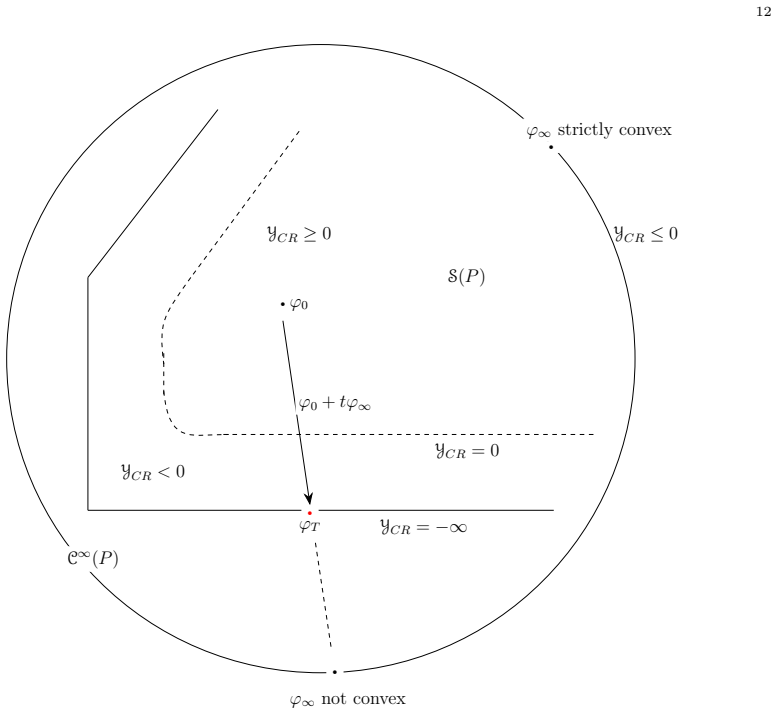
For any compact toric contact manifold of Reeb type the T-equivariant CR Yamabe problem is equivalent to an elliptic boundary-value problem on the moment polytope. Along paths of symplectic potentials that become singular or go to infinity, the reduced Einstein–Hilbert energy tends to non-positive values or to minus infinity, so the manifold always carries T-invariant CR structures of negative CR Yamabe invariant; when it is transversally Fano it also carries structures of zero and positive invariant.
What carries the argument
The reduced CR Einstein–Hilbert functional EH(φ,f) = (2∫_∂P f^{-n} dσ + n∫_P f^{-n-1} ⟨H_φ, Hess f⟩ dx) / (∫_P f^{-n-1} dx)^{n/(n+1)}, defined on pairs of a normalised symplectic potential φ and a positive function f on the moment polytope P; its critical points are precisely the T-invariant constant Tanaka–Webster structures, and its limiting behaviour along paths of potentials controls the sign of the equivariant Yamabe energy.
Load-bearing premise
In higher dimensions the energy is proved to go to minus infinity only when the Hessian of the limiting potential vanishes to order strictly higher than the dimension of the polytope along a hyperplane through an interior point; without that quantitative vanishing the integral against the test function need not diverge.
What would settle it
Construct an explicit path of symplectic potentials on a polytope of dimension greater than one whose Hessian vanishes only to order n−1 or lower at an interior degeneracy, and check whether the reduced energy still tends to minus infinity; if it remains bounded the case-2 claim fails.
If this is right
- Every compact toric contact manifold of Reeb type admits a T-invariant CR structure with negative CR Yamabe invariant.
- Every transversally Fano toric contact manifold admits T-invariant CR structures realising all three signs of the CR Yamabe invariant.
- Constant-scalar-curvature Sasaki structures cannot lie in the interior of the convex hull of constant Tanaka–Webster structures in the same conformal class.
- The equivariant Yamabe energy is controlled by a simpler functional I(f) on concave positive functions on the polytope, linking it to K-stability of the toric Sasaki manifold.
- Explicit non-Sasaki constant Tanaka–Webster examples exist that are not absolute minimisers of the Einstein–Hilbert energy in their T-invariant conformal class.
Where Pith is reading between the lines
- The same polytope reduction should let one decide whether a constant-scalar-curvature Sasaki metric that realises the global minimum of the Einstein–Hilbert energy on the Reeb cone is automatically a T-invariant CR Yamabe minimiser in its conformal class.
- Extending the energy continuously to weakly convex or piecewise-linear potentials would turn the question of the sign of the toric CR Yamabe invariant into a purely convex-geometric problem on the moment polytope.
- The appearance of both signs on a fixed contact structure suggests that the ordinary (non-equivariant) CR Yamabe invariant may also change sign under deformation of the CR structure, even without torus symmetry.
Editorial analysis
A structured set of objections, weighed in public.
Referee Report
Summary. The paper studies the T-equivariant CR Yamabe problem on compact co-oriented contact manifolds of Reeb type carrying a fixed-point-free torus action of maximal dimension. Using the Guillemin–Abreu–Martelli–Sparks–Yau dictionary, the authors reduce T-invariant constant Tanaka–Webster scalar curvature to a nonlinear elliptic boundary-value problem (Prop. 1.2 / Eq. (2)) for a pair (symplectic potential φ, conformal factor f) on the labelled moment polytope P. They derive an explicit formula for the reduced Einstein–Hilbert functional EH(φ,f) and prove (Thm. 1.4) that along paths of normalised symplectic potentials that either escape to infinity with strictly convex leading term or hit a controlled degeneracy of the Hessian, the equivariant CR Yamabe energy Y^T_CR tends to a non-positive value or to −∞ respectively. Corollaries assert that every such contact toric manifold admits a T-invariant CR structure of negative Yamabe invariant, and that transversally Fano ones realise all three signs. Further results include a convex-hull obstruction for cscS structures (Prop. 1.8), an extension of EH to piecewise-linear geodesic ribbons via an action functional (Prop. 1.7 / §5), and a collection of explicit cscTW and sign-changing examples (§6).
Significance. The work supplies the first systematic dimensional reduction of the equivariant CR Yamabe problem in the toric setting and gives concrete, computable control on the sign of Y^T_CR. The answer to the question of Sung–Takeuchi on the existence of compatible CR structures of both positive and negative Yamabe invariant on a fixed contact structure is of clear interest. The reduced functional I(f) and its link to toric K-stability (Question 5.3) open a natural bridge between CR Yamabe theory and the existing Donaldson–Futaki / weighted cscK literature. The explicit non-Sasaki cscTW examples on the trivial Hirzebruch surface and the sign-changing deformations in §§6.1–6.3 are useful concrete data. The core analytic arguments (test-function estimates with piecewise-linear creases and radial powers) are standard and transparent once the toric dictionary is in place.
major comments (2)
- [Theorem 1.4 (Case 2), Corollary 1.5, Lemma 4.1 / Corollary 4.2] Corollary 1.5 asserts existence of a T-invariant CR structure with Y^T_CR < 0 in every dimension, yet Case 2 of Theorem 1.4 requires the quantitative vanishing-order hypothesis α > n−1 on ⟨v_T, (Hess φ_T) v_T⟩ along the crease (Lemma 4.1 / Cor. 4.2). The paper only remarks that the condition is automatic when dim N = 3. An explicit construction (or a short existence argument) of paths in S_o(P) that realise this order in all dimensions is needed for the corollary to hold as stated; without it the higher-dimensional claim rests on an unverified hypothesis.
- [Corollary 1.6, §1.1] Corollary 1.6 claims the existence of a T-invariant CR structure with Y^T_CR = 0 on every transversally Fano toric contact manifold. Positive sign follows from the Sasaki–Einstein metric (FOW09) together with CR-Obata uniqueness; negative sign follows from Cor. 1.5. The zero value is not constructed and is not justified by an intermediate-value argument: the paper does not establish continuity of the map φ ↦ Y^T_CR(φ) on S_o(P) (or on any path connecting a positive structure to a negative one). Either a continuity statement or an explicit zero-energy example should be supplied.
minor comments (5)
- [Proposition 1.2] Proposition 1.2: the phrase “the value of the of Tanaka-Webster scalar curvature” contains a duplicated article; also the constant C should be identified with the value of EH up to the usual positive normalisation factor already used later in the text.
- [Figure 1 (§4)] Figure 1 is a helpful schematic but the regions labelled Y_CR ≤ 0 / ≥ 0 / < 0 are not rigorously delimited by the theorems; a caption clarifying that the figure is only heuristic would avoid over-interpretation.
- [Throughout] Several typographical artefacts appear in the extracted text (“T oric”, “Y amabe”, “W e will use”, stray spaces in section headings). A careful proof-reading pass is recommended before final submission.
- [§5, equations (16)–(17)] In §5 the passage from the smooth action functional A^χ_s(t) to the singular Monge–Ampère expression (17) invokes Rudin’s theorems on Lebesgue decomposition; a one-sentence reminder that the singular part of MA(φ_∞) is supported on the crease set (hence has vanishing Radon–Nikodym derivative) would make the justification self-contained.
- [Question 1.9, §6.2.3] Question 1.9 is well-motivated by the examples of §6.2 and §6.4; it would help the reader if the authors briefly indicated whether any of the explicit non-Sasaki cscTW solutions constructed in §6.2.3 could serve as counter-examples once the EH = EH_min hypothesis is dropped (they already show they are not absolute minimisers).
Circularity Check
No significant circularity: sign limits of the toric CR Yamabe energy are direct test-function estimates on a reduced Einstein–Hilbert functional.
full rationale
The load-bearing claims (Theorem 1.4 and Corollaries 1.5–1.6) are obtained by writing the T-invariant Einstein–Hilbert functional in action-angle coordinates via the Abreu formula and the standard integration-by-parts identity on the Delzant polytope, then evaluating it on explicit test functions (piecewise-linear creases for degenerating paths; radial powers for paths to infinity). The resulting limits ≤0 and −∞ are elementary integral estimates; they do not encode the conclusion in a normalization, fit, or uniqueness theorem. Positive Yamabe sign for transversally Fano examples uses the external Futaki–Ono–Wang existence of Sasaki–Einstein metrics, not a self-referential uniqueness import. Self-citations (LLS23/25, BHLTF, Leg11, ACMY24) supply background dictionary and variational characterizations whose statements are independent of the new sign theorems. No step reduces a claimed prediction to a fitted input or to a definition that already contains the result.
Axiom & Free-Parameter Ledger
axioms (7)
- domain assumption Classification of compact contact toric manifolds of Reeb type by good strictly convex moment cones (Lerman, BM93, BG00).
- domain assumption Guillemin–Abreu–Martelli–Sparks–Yau correspondence: toric Sasaki structures ↔ symplectic potentials with prescribed boundary singularities (Prop. 2.3–2.4).
- domain assumption Abreu formula for transversal/Tanaka–Webster scalar curvature Scal_TW = −(H^{ij})_{,ij} and its conformal transformation law (6).
- standard math Integration-by-parts identity ∫_P ψ_1 (H^{ij} ψ_0)_{ij} dx = −2∫_∂P ψ_1 ψ_0 dσ + ∫_P ψ_0 ⟨H,Hess ψ_1⟩ dx (Don02, AM19).
- domain assumption Existence of T-invariant cscTW structures (Zhang 2009; Ho 2025 equivariant CR Yamabe).
- domain assumption Transversally Fano toric Sasaki manifolds admit Sasaki–Einstein metrics (Futaki–Ono–Wang 2009).
- ad hoc to paper Case-2 vanishing-order hypothesis: ⟨v_T, Hess φ_T v_T⟩ = O(|x−x_T|^α) with α>n−1 along the crease.
invented entities (2)
-
Reduced functional I(f) = 2∫_∂P f^{-n} dσ / (∫_P f^{-n-1} dx)^{n/(n+1)}
no independent evidence
-
Action functional A^χ_s(t) along toric geodesic ribbons
no independent evidence
read the original abstract
We study the equivariant CR Yamabe problem for a fixed-point-free torus action on a co-oriented compact contact manifold. Such examples arise naturally in the study of Sasakian manifolds with constant scalar curvature. In the toric case, we show that this problem is equivalent to a kind of boundary value problem for an elliptic PDE on a pair of functions defined on a convex, polyhedral domain. We provide examples of solutions and prove that many contact toric manifolds admit compatible CR structures with distinct signs of CR Yamabe invariants.
Figures


Reference graph
Works this paper leans on
-
[1]
K\" a hler geometry of toric varieties and extremal metrics
Miguel Abreu. K\" a hler geometry of toric varieties and extremal metrics. Internat. J. Math. , 9(6):641--651, 1998
1998
-
[2]
K\"ahler- S asaki geometry of toric symplectic cones in action-angle coordinates
Miguel Abreu. K\"ahler- S asaki geometry of toric symplectic cones in action-angle coordinates. Port. Math. , 67(2):121--153, 2010
2010
-
[3]
Vestislav Apostolov, David M. J. Calderbank, Paul Gauduchon, and Christina W. T nnesen-Friedman. Hamiltonian 2-forms in K \"ahler geometry. II . G lobal classification. J. Differential Geom. , 68(2):277--345, 2004
2004
-
[4]
Vestislav Apostolov, David M. J. Calderbank, Paul Gauduchon, and Christina W. T nnesen-Friedman. Hamiltonian 2-forms in K \"a hler geometry III , extremal metrics and stability. Invent. Math. , 173(3):547--601, 2008
2008
-
[5]
Vestislav Apostolov, David M. J. Calderbank, and Eveline Legendre. Weighted K -stability of polarized varieties and extremality of S asaki manifolds. Adv. Math. , 391:Paper No. 107969, 63, 2021
2021
-
[6]
On the variation of the E instein- H ilbert action in pseudohermitian geometry
Claudio Afeltra, Jih-Hsin Cheng, Andrea Malchiodi, and Paul Yang. On the variation of the E instein- H ilbert action in pseudohermitian geometry. J. Reine Angew. Math. , 813:81--102, 2024. With an appendix by Xiaodong Wang
2024
-
[7]
Compactness in dimension five and equivariant noncompactness for the CR Y amabe problem
Claudio Afeltra, Pak Tung Ho, and Andrea Pinamonti. Compactness in dimension five and equivariant noncompactness for the CR Y amabe problem. arXiv:2603.12157 [math.AP] https://arxiv.org/abs/2603.12157v1, 2026
arXiv 2026
-
[8]
Conformally K \"ahler, E instein- M axwell geometry
Vestislav Apostolov and Gideon Maschler. Conformally K \"ahler, E instein- M axwell geometry. J. Eur. Math. Soc. (JEMS) , 21(5):1319--1360, 2019
2019
-
[9]
The S^1 -equivariant Y amabe invariant of 3-manifolds
Bernd Ammann, Farid Madani, and Mihaela Pilca. The S^1 -equivariant Y amabe invariant of 3-manifolds. Int. Math. Res. Not. IMRN , (20):6310--6328, 2017
2017
-
[10]
The K \"a hler geometry of toric manifolds
Vestislav Apostolov. The K \"a hler geometry of toric manifolds. Lecture Notes of CIRM winter school. https://arxiv.org/pdf/2208.12493 arxiv:2208.12493 [math.DG] , 2019
Pith/arXiv arXiv 2019
-
[11]
\'etude d'un certain type d'\'equations diff\'erentielles non lin\'eaires
Thierry Aubin. \'etude d'un certain type d'\'equations diff\'erentielles non lin\'eaires. C. R. Acad. Sci. Paris S\'er. A-B , 280(7):455--457, 1975
1975
-
[12]
Scalar curvature and isometry group
Bérard Bergery. Scalar curvature and isometry group. Kaigai Publications , pages 9 -- 28, 1983
1983
-
[13]
Boyer and Krzysztof Galicki
Charles P. Boyer and Krzysztof Galicki. A note on toric contact geometry. J. Geom. Phys. , 35(4):288--298, 2000
2000
-
[14]
Boyer and Krzysztof Galicki
Charles P. Boyer and Krzysztof Galicki. Sasakian geometry . Oxford Mathematical Monographs. Oxford University Press, Oxford, 2008
2008
-
[15]
An application of the D uistermaat- H eckman theorem and its extensions in S asaki geometry
Charles Boyer, Hongnian Huang, and Eveline Legendre. An application of the D uistermaat- H eckman theorem and its extensions in S asaki geometry. Geom. Topol. , 22(7):4205--4234, 2018
2018
-
[16]
Boyer, Hongnian Huang, Eveline Legendre, and Christina W
Charles P. Boyer, Hongnian Huang, Eveline Legendre, and Christina W. T nnesen Friedman. The E instein- H ilbert functional and the S asaki- F utaki invariant. Int. Math. Res. Not. , (7):1942--1974, 2017
1942
-
[17]
Boyer, Hongnian Huang, Eveline Legendre, and Christina W
Charles P. Boyer, Hongnian Huang, Eveline Legendre, and Christina W. Tønnesen-Friedman. Some Open Problems in Sasaki Geometry , page 143–168. London Mathematical Society Lecture Note Series. Cambridge University Press, 2020
2020
-
[18]
Boyer, Hongnian Huang, Eveline Legendre, and Christina W
Charles P. Boyer, Hongnian Huang, Eveline Legendre, and Christina W. T nnesen Friedman. Twins in K \"ahler and S asaki geometry. J. Geom. Phys. , 216:Paper No. 105591, 29, 2025
2025
-
[19]
Banyaga and P
A. Banyaga and P. Molino. G\'eom\'etrie des formes de contact compl\`etement int\'egrables de type toriques. In S\'eminaire G aston D arboux de G \'eom\'etrie et T opologie D iff\'erentielle, 1991--1992 ( M ontpellier) , pages 1--25. Univ. Montpellier II, Montpellier, 1993
1991
-
[20]
Boyer and Christina W
Charles P. Boyer and Christina W. T nnesen-Friedman. The S asaki join, H amiltonian 2-forms, and constant scalar curvature. J. Geom. Anal. , 26(2):1023--1060, 2016
2016
-
[21]
Boyer and Christina W
Charles P. Boyer and Christina W. T nnesen-Friedman. The S^3_w S asaki join construction. J. Math. Soc. Japan , 74(4):1335--1371, 2022
2022
-
[22]
Robustness of CSC Sasaki existence under the join operation
Charles P. Boyer and Christina W. T nnesen-Friedman. Robustness of CSC S asaki E xistence under the J oin operation. arXiv.2604.09893 [math.DG] https://doi.org/10.48550/arXiv.2604.09893, 2026
work page internal anchor Pith review Pith/arXiv arXiv doi:10.48550/arxiv.2604.09893 2026
-
[23]
Extremal K \"a hler metrics
Eugenio Calabi. Extremal K \"a hler metrics. In Seminar on Differential Geometry , volume 102 of Annals of Mathematical Studies , pages 259--290. Princeton University Press, 1982
1982
-
[24]
Hamiltoniens p\' e riodiques et images convexes de l'application moment
Thomas Delzant. Hamiltoniens p\' e riodiques et images convexes de l'application moment. Bull. Soc. Math. France , 116(3):315--339, 1988
1988
-
[25]
Donaldson
Simon K. Donaldson. Scalar curvature and stability of toric varieties. J. Differential Geom. , 62(2):289--349, 2002
2002
-
[26]
Volume minimization and obstructions to solving some problems in K \"ahler geometry
Akito Futaki and Hajime Ono. Volume minimization and obstructions to solving some problems in K \"ahler geometry. ICCM Not. , 6(2):51--60, 2018
2018
-
[27]
Transverse K \"ahler geometry of S asaki manifolds and toric S asaki- E instein manifolds
Akito Futaki, Hajime Ono, and Guofang Wang. Transverse K \"ahler geometry of S asaki manifolds and toric S asaki- E instein manifolds. J. Differential Geom. , 83(3):585--635, 2009
2009
-
[28]
The CR Y amabe conjecture---the case n=1
Najoua Gamara. The CR Y amabe conjecture---the case n=1 . J. Eur. Math. Soc. (JEMS) , 3(2):105--137, 2001
2001
-
[29]
K \"a hler structures on toric varieties
Victor Guillemin. K \"a hler structures on toric varieties. J. Differential Geom. , 40(2):285--309, 1994
1994
-
[30]
C R Y amabe conjecture---the conformally flat case
Najoua Gamara and Ridha Yacoub. C R Y amabe conjecture---the conformally flat case. Pacific J. Math. , 201(1):121--175, 2001
2001
-
[31]
Equivariant CR Y amabe problem
Pak Tung Ho. Equivariant CR Y amabe problem. Ann. Mat. Pura Appl. (4) , 204(1):289--306, 2025
2025
-
[32]
Hwang and Michael A
Andrew D. Hwang and Michael A. Singer. A momentum construction for circle-invariant K \"ahler metrics. Trans. Amer. Math. Soc. , 354(6):2285--2325, 2002
2002
-
[33]
Le probl\`eme de Y amabe \'equivariant
Emmanuel Hebey and Michel Vaugon. Le probl\`eme de Y amabe \'equivariant. Bull. Sci. Math. , 117(2):241--286, 1993
1993
-
[34]
David Jerison and John M. Lee. The Y amabe problem on CR manifolds. J. Differential Geom. , 25(2):167--197, 1987
1987
-
[35]
David Jerison and John M. Lee. Extremals for the S obolev inequality on the H eisenberg group and the CR Y amabe problem. J. Amer. Math. Soc. , 1(1):1--13, 1988
1988
-
[36]
David Jerison and John M. Lee. Intrinsic CR normal coordinates and the CR Y amabe problem. J. Differential Geom. , 29(2):303--343, 1989
1989
-
[37]
K\"ahler metrics with constant weighted scalar curvature and weighted K -stability
Abdellah Lahdili. K\"ahler metrics with constant weighted scalar curvature and weighted K -stability. Proc. Lond. Math. Soc. (3) , 119(4):1065--1114, 2019
2019
-
[38]
The E instein- M axwell equations, K \"ahler metrics, and H ermitian geometry
Claude LeBrun. The E instein- M axwell equations, K \"ahler metrics, and H ermitian geometry. J. Geom. Phys. , 91:163--171, 2015
2015
-
[39]
Yamabe invariants, homogeneous spaces, and rational complex surfaces
Claude LeBrun. Yamabe invariants, homogeneous spaces, and rational complex surfaces. SIGMA Symmetry Integrability Geom. Methods Appl. , 19:Paper No. 027, 11, 2023
2023
-
[40]
Existence and non-uniqueness of constant scalar curvature toric S asaki metrics
Eveline Legendre. Existence and non-uniqueness of constant scalar curvature toric S asaki metrics. Compos. Math. , 147(5):1613--1634, 2011
2011
-
[41]
Contact toric manifolds
Eugene Lerman. Contact toric manifolds. J. Symplectic Geom. , 1(4):785--828, 2003
2003
-
[42]
The E instein- H ilbert functional and the D onaldson- F utaki I nvariant
Abdellah Lahdili, Eveline Legendre, and Carlo Scarpa. The E instein- H ilbert functional and the D onaldson- F utaki I nvariant. arXiv:2310.11625 [math.DG] https://arxiv.org/abs/2310.11625, 2023
Pith/arXiv arXiv 2023
-
[43]
The CR Y amabe invariant and constant scalar curvature S asaki metrics
Abdellah Lahdili, Eveline Legendre, and Carlo Scarpa. The CR Y amabe invariant and constant scalar curvature S asaki metrics. arXiv:2509.00743 [math.DG] https://arxiv.org/abs/2509.00743, 2025
Pith/arXiv arXiv 2025
-
[44]
Hamiltonian torus actions on symplectic orbifolds and toric varieties
Eugene Lerman and Susan Tolman. Hamiltonian torus actions on symplectic orbifolds and toric varieties. Trans. Amer. Math. Soc. , 349(10):4201--4230, 1997
1997
-
[45]
An O bata-type theorem in CR geometry
Song-Ying Li and Xiaodong Wang. An O bata-type theorem in CR geometry. J. Differential Geom. , 95(3):483--502, 2013
2013
-
[46]
Equivariant Y amabe problem and H ebey- V augon conjecture
Farid Madani. Equivariant Y amabe problem and H ebey- V augon conjecture. J. Funct. Anal. , 258(1):241--254, 2010
2010
-
[47]
Hebey- V augon conjecture II
Farid Madani. Hebey- V augon conjecture II . C. R. Math. Acad. Sci. Paris , 350(17-18):849--852, 2012
2012
-
[48]
The geometric dual of a -maximisation for toric S asaki- E instein manifolds
Dario Martelli, James Sparks, and Shing-Tung Yau. The geometric dual of a -maximisation for toric S asaki- E instein manifolds. Comm. Math. Phys. , 268(1):39--65, 2006
2006
-
[49]
Real and complex analysis
Walter Rudin. Real and complex analysis . McGraw-Hill Book Co., New York-Toronto-London, 1966
1966
-
[50]
The CR Y amabe constant and inequivalent CR structures
Chanyoung Sung and Yuya Takeuchi. The CR Y amabe constant and inequivalent CR structures. Pacific J. Math. , 335(1):163--181, 2025
2025
-
[51]
The contact Y amabe flow on K -contact manifolds
YongBing Zhang. The contact Y amabe flow on K -contact manifolds. Sci. China Ser. A , 52(8):1723--1732, 2009
2009
discussion (0)
Sign in with ORCID, Apple, or X to comment. Anyone can read and Pith papers without signing in.