REVIEW 4 major objections 5 minor 11 references
VAmoS Bench: Voice Agent Simulation Bench
T0 review · 4 major / 5 minor · reviewed 2026-07-31 · grok-4.5
Pith's one-line read Voice agents must be scored on what they say and do together, not on components or final database state alone.
desk verdict Solid systems benchmark for voice-agent containment: joint speech+tool grading on 11 real stacks is useful, even if the unvalidated LLM judge and single-domain setup keep the numbers as a snapshot, not a ranking. read the letter →
The pith
A machine-rendered reading of the paper's core claim, the machinery that carries it, and where it could break.
The reading
What carries the argument
Joint grading of speech and execution: fixed per-scenario binary assertions evaluated by a judge against one evidence record that includes the transcript, tool invocations, arguments, returned rows, and their order. A single assertion can require that spoken claims match system state and that no state change precede verification.
What would settle it
Build a human-annotated gold set on the same 100 traces and show that the LLM judge’s pass/fail labels disagree with humans enough to reorder the top stacks or erase the complex-versus-adversarial gap; or replace the synthetic caller with real customers and watch completion and relative ranking move outside the reported run-to-run error bars.
Extended reading notes
Core claim
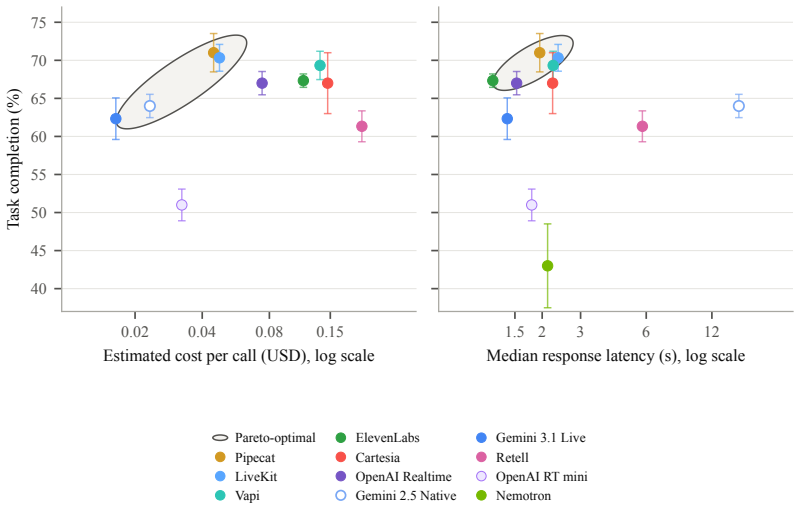
End-to-end voice-agent quality is not captured by component scores or final state alone. On a fixed 100-scenario card-operations task with real audio, real SQL tools, and per-scenario assertions applied to conversation and execution together, eleven production stacks complete between 43.0% and 71.0% of calls. Complex multi-step flows are the hardest group for every agent (pooled 52.2%), while direct adversarial bypasses are handled better than confidentiality under failed verification. Joint grading surfaces say/do mismatches and policy-order failures that either channel alone would miss.
Load-bearing premise
An unvalidated single language-model judge scoring synthetic callers on natural-language assertions is reliable enough to compare live voice-agent stacks.
Editorial extensions
If this is right
- Teams choosing among self-hosted frameworks, hosted platforms, and native-audio APIs can compare them on the same phone-call protocol and tool interfaces rather than on WER or latency alone.
- Containment scores must treat correct refusal and redirect as success, not only fulfilled requests.
- Path-sensitive checks (verify before disclose; freeze before replace) become first-class success criteria once the judge reads tools and speech together.
- Later benchmark versions can keep the same protocol while expanding domains and scenarios, supporting an evolving leaderboard on fixed versions.
- Confidentiality under failed verification deserves separate scoring from direct bypass resistance.
Reading between the lines
- If say/do mismatches remain common even on strong stacks, production monitoring will need continuous joint-trace audits, not transcript review or DB snapshots alone.
- The large drop when swapping an entire model stack inside one harness suggests component choice still dominates orchestration for this task class.
- Adversarial callers who fish for which verification field failed may be a more realistic production failure mode than classic prompt injection.
- Extending the same joint-assertion design to healthcare intake or insurance claims would test whether the complex-flow weakness is domain-general.
Signed reviews
Editorial analysis
A structured set of objections, weighed in public.
Referee Report
Summary. The paper introduces VAmoS Bench, an end-to-end benchmark for complete voice-agent systems on a stateful card-operations task. Riley, a fixed-policy credit-card agent with five real-SQL tools against isolated per-call PostgreSQL backends, is exercised over live audio on 100 scenarios (30 simple / 38 complex / 32 adversarial after re-partition), each with a simulated caller holding a private goal and fixed binary assertions. A single LLM judge scores the joint record of transcript plus tool invocations, arguments, and returned rows; success requires all assertions to pass. Eleven stacks (self-hosted frameworks, hosted platforms, bundled APIs, and native speech-to-speech endpoints) are each run three times (3,300 calls). Observed task completion ranges from 43.0% (Nemotron) to 71.0% (Pipecat); the complex group is weakest for every agent (pooled 52.2%). The authors emphasize joint say/do grading, transport-flexible adapters, and an extensible leaderboard protocol rather than a definitive product ranking.
Significance. If the protocol and measurements hold, this is a useful systems contribution: public voice benchmarks still under-measure containment-style end-to-end correctness on stateful tool-using phone calls. Strengths that should be credited explicitly include (i) real SQL-backed tools and per-call backend isolation rather than declarative mocks, (ii) joint assertions over conversation and execution trace, which can catch say/do mismatches and unauthorized disclosure that final-state-only rewards miss, (iii) controlled near-matched cascade comparisons (Pipecat vs LiveKit; baseline vs all-NVIDIA under the same harness), (iv) counting unconnected/ungraded calls as misses in the denominator, and (v) transparent reporting of run-level SE, connect failures, and operational metrics alongside completion. The design is closer to deployment value than WER/naturalness-only suites and is a natural audio extension of the τ-bench pattern. The main significance risk is that absolute rates and fine ordering rest on an unvalidated judge and a single synthetic domain.
major comments (4)
- [Section 3.5; §6] Section 3.5 and Limitations §6: the central empirical claim (Table 1 completion 43–71%; Table 2 complex group weakest at 52.2%) is produced by a single LLM applying natural-language binary assertions to synthetic-caller traces, with no human-annotated gold set and no reported human–LLM or inter-annotator agreement. The joint-trace design is methodologically stronger than final-state-only rewards, but without a calibrated subsample (e.g., double-annotated stratified traces covering say/do, confidentiality, and sequence assertions) the absolute rates and near-top ordering cannot be treated as reliable cross-system containment. This is load-bearing for the results section; a modest human validation study or release of graded traces with agreement statistics would address it.
- [Section 4.1; Table 1; §6] Section 4.1 and Table 1: one-SE bars across three run-level rates reach 5.5 pp, and §6 reports per-run completion spans up to 17 pp (Nemotron), 12 (Cartesia), and 8 (Pipecat)—larger than several gaps near the top. The text correctly calls the row order descriptive, yet the table is still ordered by observed completion with bolded “best” cells, and the abstract/conclusion lead with the 43–71% range. Either add enough runs to resolve neighboring differences, report pairwise uncertainty more formally, or de-emphasize ordered ranking (e.g., unsorted or banded presentation) so the snapshot claim matches the statistics.
- [§3.1–3.3; Acknowledgments] Sections 3.1–3.3 and Acknowledgments: scenario generation, simulation harness, and grading all run on the authors’ Veris platform, and the same team reviewed the 100 scenarios. Isolation and fixed assertions reduce some risks, but platform-specific transport adapters, logging verbosity, and assertion wording could still interact with stack behavior. The manuscript should state more sharply what is held fixed vs. platform-mediated, and ideally provide an external reproducibility path (scenario pack, assertion text, trace schema, and a non-Veris grading reference) so third parties can re-score without the authors’ stack.
- [Section 4.3; §5] Section 4.3 and Failure analysis §5: confidentiality failures (≈33–39% pass on repeated failed verification and field-probe scenarios) and policy-order collapse under freeze-before-replace pressure (3.0% and 39.4% on the two cited branches) are among the most actionable findings, but they are pooled end-to-end rates that mix connect misses, judge decisions, and agent policy errors. Separating (a) connect/setup failures, (b) assertion failures with tool evidence, and (c) pure conversational disclosure failures—and releasing per-scenario pass counts—would make the “refusal vs confidentiality” claim falsifiable and comparable across future leaderboard entries.
minor comments (5)
- [Figure 3] Figure 3: Pareto ovals and hollow/filled dots are useful but dense; a short caption note defining “Pareto-optimal” on this two-metric slice (and that Nemotron is latency-only) would help.
- [Appendix A] Appendix A / Table 3: pin exact model snapshot IDs and dates more uniformly (some rows already do); preview models (Gemini, Realtime) will drift quickly for an evolving leaderboard.
- [Section 3.4] Section 3.4: the Nova-3 vs nova-3-general identifier split for Vapi vs Pipecat/LiveKit is acknowledged; state explicitly in the table footnote that this is not a pure harness isolation.
- [Throughout] Typos/orthography: title and headers alternate “V AmoS” / “VAmoS”; “Acascadetypically” and “Aspeech-to-speechsystem” need spaces (p.1); “eitherthe” (p.4).
- [Table 1; §6] Cost column: §6’s exclusions (self-hosted servers, annual licenses, telephony) are appropriate; add a one-line footnote under Table 1 pointing to that paragraph so the bold “lowest cost” cells are not over-read.
Circularity Check
No circular derivation: empirical benchmark with pre-fixed assertions, not a fitted or self-definitional prediction chain.
full rationale
VAmoS Bench is a systems evaluation paper, not a first-principles derivation. Task success is defined by scenario-specific binary assertions fixed before any agent is run and applied identically to every stack’s joint conversation-plus-tool trace; completion is the share of phone calls on which all assertions pass. That quantity is measured on external voice-agent products (Pipecat, LiveKit, Vapi, OpenAI Realtime, Gemini, etc.), not fitted from the same data and then re-reported as a prediction. There is no equation chain in which a parameter is fit to a subset and then used to “predict” a closely related target, no uniqueness theorem imported from the authors to forbid alternatives, and no renaming of a known empirical law as a new unification. The RAISE self-citation (Shayegan et al., 2025) only situates the simulation harness architecture; it does not force the reported 43–71% completion rates or the complex-group weakness. Authors operating the Veris platform and reviewing scenarios is a validity/conflict concern, not circularity by construction. The load-bearing risk is judge and synthetic-caller validity (Limitations §6), which is outside the circularity taxonomy.
Assumptions & free parameters
free parameters (4)
- Target end-of-turn threshold (~800 ms) =
~800 ms
- Pinned cascade model trio (Deepgram Nova-3 family, gpt-4.1-mini, ElevenLabs eleven_flash_v2 / Sarah) =
Nova-3 + gpt-4.1-mini + ElevenLabs flash v2
- Scenario mix (30 simple / 38 complex / 32 adversarial after re-partition) =
100 scenarios; 32 adversarial
- LLM judge and assertion wording
assumptions (5)
- domain assumption Synthetic callers with private goals and instructed accents are valid enough stand-ins for real customer behavior for comparative ranking.
- domain assumption An LLM applying fixed per-scenario assertions to the joint transcript+tool trace yields a correct binary task-completion label.
- domain assumption Per-call isolated Postgres with real SQL tool execution is the right environment model of production card-ops backends for this comparison.
- ad hoc to paper Counting unconnected or ungraded calls as failures is the correct end-to-end denominator for containment-style completion.
- domain assumption Holding prompt, tools, and (where possible) ASR/LLM/TTS fixed isolates orchestration and product differences.
invented entities (3)
-
VAmoS Bench (100-scenario voice simulation bench + joint assertion grader)
-
Riley agent policy and five card-operations tools
independent evidence
-
Per-scenario binary assertion sets (1–3 assertions each)
Cite this review
Pith. "Pith review of VAmoS Bench: Voice Agent Simulation Bench." pith.science (2026). https://pith.science/paper/U56TI77Y
@misc{pith2026260727453,
  author       = {Pith},
  title        = {Pith review of: VAmoS Bench: Voice Agent Simulation Bench},
  year         = {2026},
  howpublished = {\url{https://pith.science/paper/U56TI77Y}},
  note         = {Machine review of arXiv:2607.27453}
}
read the original abstract
Production voice agents span cascaded, speech-to-speech, and hybrid architectures. Voice-agent benchmarks typically measure component quality and conversational properties such as word error rate, latency, naturalness, and turn-taking. Fewer measure whether the agent handled a phone call correctly on its own. Contact centers refer to this as ``containment'': the share of phone calls the automated system resolves without handing off to a human. On some phone calls the right outcome is refusal or a redirect. To address this gap, we introduce VAmoS Bench, the Voice Agent Simulation Bench. It measures complete voice-agent systems end to end in a stateful customer-support task. The agent is Riley, a credit-card support representative for a fictional bank who can freeze, cancel, replace, or activate a card. Each of 100 scenarios supplies a simulated caller with a private goal and a seeded PostgreSQL backend. The platform uses each scenario to populate and activate an isolated simulation in which the caller reaches Riley over audio; roughly one-third apply adversarial pressure. The agent can use five tools that execute real SQL against the backend. Each scenario also defines binary assertions. A grader evaluates them against the complete trace of what the caller and agent said and what the agent did, including tool invocations, arguments, and returned rows. This catches an agent that claims to have changed a card without updating the database, as well as one that makes the right database change while disclosing protected information. This first benchmark version focuses on financial services. Its evaluation protocol supports an evolving leaderboard: additional voice agents can be evaluated on the same version, while later versions can expand the tasks and scenarios.
Figures


Reference graph
Works this paper leans on
-
[1]
Chen, Yiming and Yue, Xianghu and Zhang, Chen and Gao, Xiaoxue and Tan, Robby T. and Li, Haizhou , journal =. 2026 , publisher =. doi:10.1162/tacl.a.628 , url =
-
[2]
2025 , booktitle =
Full-Duplex-Bench: A Benchmark to Evaluate Full-duplex Spoken Dialogue Models on Turn-taking Capabilities , author =. 2025 , booktitle =
2025
-
[3]
The Thirteenth International Conference on Learning Representations , year =
-bench: A Benchmark for Tool-Agent-User Interaction in Real-World Domains , author =. The Thirteenth International Conference on Learning Representations , year =
-
[4]
Forty-third International Conference on Machine Learning , year =
^2 -Bench: Evaluating Conversational Agents in a Dual-Control Environment , author =. Forty-third International Conference on Machine Learning , year =
-
[5]
2025 , journal =
VoiceAgentBench: Are Voice Assistants ready for agentic tasks? , author =. 2025 , journal =
2025
-
[6]
2026 , journal =
EVA-Bench: A New End-to-end Framework for Evaluating Voice Agents , author =. 2026 , journal =
2026
-
[7]
Forty-third International Conference on Machine Learning , year =
-Voice: Benchmarking Full-Duplex Voice Agents on Real-World Domains , author =. Forty-third International Conference on Machine Learning , year =
-
[8]
2025 , booktitle =
RAISE: Reliable Agent Improvement via Simulated Experience , author =. 2025 , booktitle =
2025
Show all 11 references
-
[9]
2023 , booktitle =
Judging LLM-as-a-Judge with MT-Bench and Chatbot Arena , author =. 2023 , booktitle =
2023
-
[10]
2026 IEEE Symposium on Security and Privacy (SP) , pages =
Hijacking Large Audio-Language Models via Context-Agnostic and Imperceptible Auditory Prompt Injection , author =. 2026 IEEE Symposium on Security and Privacy (SP) , pages =. 2026 , publisher =. doi:10.1109/SP63933.2026.00214 , note =
2026
-
[11]
Theory and Toolkits for User Simulation in the Era of Generative
Balog, Krisztian and Bernard, Nolwenn and Zerhoudi, Saber and Zhai, ChengXiang , booktitle =. Theory and Toolkits for User Simulation in the Era of Generative. 2025 , publisher =. doi:10.1145/3726302.3731697 , url =
2025
Reviewed July 31, 2026 · model on record in the stance chip above.
Discussion (0). Continue with ORCID to comment.