REVIEW 3 major objections 3 minor 44 references
First-order Constrained Trilevel Optimization Over Distributed Networks for Robust Coreset Selection
T0 review · 3 major / 3 minor · reviewed 2026-08-01 · deepseek-v4-flash
Pith's one-line read This paper claims the first distributed, first-order method for trilevel optimization with level-wise constraints, proves a non-asymptotic convergence rate of O(ε^-3/2), and applies it to robust coreset selection over federated networks wit
desk verdict Genuinely new constrained-trilevel formulation with solid experiments, but the headline O(epsilon^{-3/2}) rate is proven for an exact-value-function variant, not the algorithm that is actually run. read the letter →
The pith
A machine-rendered reading of the paper's core claim, the machinery that carries it, and where it could break.
The reading
What carries the argument
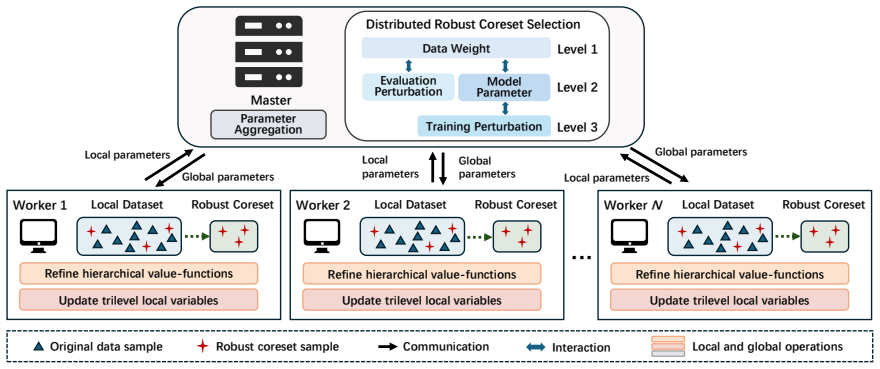
The hierarchical composite value-function reformulation: the third-level perturbation problem and the two second-level subproblems are each replaced by value-function constraints of the form f - V ≤ 0, where V is the optimal value of the lower-level minimization. This converts the nested structure into a single-level constrained problem, which is then penalized and solved with distributed alternating projected gradients. The mechanism that carries the proof is the one-step descent inequality (Lemma 2), which uses smoothness of the penalized objective and a local-global projection gap bound.
What would settle it
On a small synthetic trilevel instance with known smoothness constant L, set R=1 and R-hat=1, run F2CTO for T iterations, and measure the projected gradient norm ||G^t||. If it plateaus above the predicted O(T^{-2/3}) envelope, or fails to reach ε within the bound of Eq. (21), the finite-step approximation is not controlled.
Extended reading notes
Core claim
The central claim is that the hierarchical dependencies among coreset selection, adversarial robustness, and distributed learning can be expressed as a trilevel problem with level-wise constraints, and that the resulting problem is solvable in a federated manner by F2CTO. The method replaces each lower-level optimality condition with a value-function constraint, builds a penalty objective, and alternates projected gradient steps on the four variable blocks, with a master node aggregating model parameters. The proof shows the stationarity gap shrinks as O(T^{-2/3}), giving an O(ε^{-3/2}) iteration complexity and O(d ε^{-3/2}) communication complexity — the same order as unconstrained trilevel
Load-bearing premise
The proof assumes the penalized objective built from the true optimal value functions is smooth, but the algorithm only runs a few inner gradient steps per outer iteration; if that inner-loop shortcut changes the objective's geometry, the rate guarantee does not apply to the code that is actually run.
Editorial extensions
If this is right
- Distributed robust coreset selection gains a rigorous formulation and a first-order algorithm with the same convergence rate as unconstrained trilevel methods.
- Federated networks can select coresets without transmitting raw data, improving worst-case robustness in continual learning and intrusion detection.
- The O(ε^-3/2) iteration complexity and O(d/ε^{3/2}) communication complexity make the method a candidate for large-scale cross-device IoT settings.
- The framework extends beyond coreset selection to any trilevel problem with box- or sphere-type constraints at each level.
Reading between the lines
- A direct extension would be to bound the error introduced by truncating the inner value-function loops at R and R-hat steps; an adaptive schedule that grows those loops could make the theoretical guarantee match the implemented algorithm.
- The same hierarchical value-function penalty construction applies to any trilevel program with convex level-wise constraints, so the method may generalize to other nested robust-learning tasks such as robust meta-learning or robust prompt tuning.
- The empirical gains over the paper's own bilevel ablations hint that the full trilevel coupling, not merely the extra perturbation levels, drives robustness; comparing against a version with fixed random perturbations would isolate that effect.
Editorial analysis
A structured set of objections, weighed in public.
Referee Report
Summary. The paper proposes F2CTO, a federated first-order algorithm for a constrained trilevel optimization formulation of distributed robust coreset selection. The authors model the problem as Eq. (1), reformulate it via a hierarchical composite value-function approach into Eq. (6), and then introduce a penalty-based objective Eq. (10). Algorithm 1 alternates between refining approximate value functions (Eqs. (7)-(9)) and performing projected gradient updates (Eqs. (11)-(15)). The central theoretical claim is Theorem 1, which states an O(ε^{-3/2}) iteration complexity for finding an ε-stationary point, with a corresponding communication complexity in Theorem 2. Experiments on continual learning benchmarks and a large-scale Edge-IIoT scenario compare F2CTO against several recent baselines.
Significance. The problem formulation is novel and timely: robust coreset selection has not previously been cast as a distributed, level-wise constrained trilevel problem, and the paper makes a credible case for the motivating applications. If the convergence result were established for the implemented algorithm, the O(ε^{-3/2}) rate would be a meaningful contribution to the multilevel optimization literature, which lacks distributed constrained trilevel methods. The empirical results are also encouraging: F2CTO outperforms the compared baselines by a noticeable margin on several robustness metrics. However, the advertised theoretical guarantee is not currently supported by the supplied proof, and this gap is load-bearing for the paper's main claim.
major comments (3)
- [Sec. III-C2, Sec. IV (Eqs. (7)-(9), (10), (20)-(21))] Algorithm 1 replaces the value functions V_{3,i}, V_{2,i}^{(1)}, and V_{2}^{(2)} in Eq. (10) with the outputs of R and R̂ projected-gradient steps (Eqs. (7)-(9)). The proof of Lemma 2 and Theorem 1 treats these value functions as exact and never bounds the approximation error ||V^R - V|| or ||∇V^R - ∇V||. Consequently, the O(ε^{-3/2}) rate is proved for an exact-value-function algorithm, not for the procedure actually executed. Since R and R̂ are fixed finite constants in the experiments (Table IV), the advertised rate for F2CTO does not follow. The authors must quantify the finite-step bias and include it in Eqs. (20)-(21), or explicitly restrict the theorem to the exact-value-function idealization and qualify the claim. Additionally, the update in Eq. (11) requires ∇_{α_i} L_i, which includes ∇_{α_i} V_{2}^{(2)}({α}); the manuscript does not specify how this derivative is obtained or a
- [Sec. IV, Assumption 1] Assumption 1 assumes that the penalized objective L_i in Eq. (10) has an L-Lipschitz continuous gradient. However, L_i contains value functions that are minima of smooth nonconvex loss functions over compact sets (e.g., V_{3,i} in Eq. (2)) and a globally coupled value function V_{2}^{(2)} in Eq. (5). Such value functions are not generically smooth, and no argument is provided that Eq. (10) satisfies Assumption 1. This is not a minor technicality: the descent inequality in Lemma 2 and the summation in Eq. (35) rely on L-smoothness at every point. The authors should either prove Assumption 1 under explicit conditions on the loss functions or replace it with verifiable assumptions (e.g., uniqueness and differentiability of the lower-level minimizers via Danskin-type arguments).
- [Sec. IV, Theorem 1 and Eq. (10)] Even granting Assumption 1, the stationarity guarantee is only for the penalized objective Eq. (10) with fixed penalty parameters ρ_1, ρ_2, ρ_3. The paper never connects an ε-stationary point of Eq. (10) to feasibility or ε-stationarity of the original constrained trilevel problem Eq. (6). A fixed-penalty minimizer can violate the constraints f(·)-V(·) ≤ 0. To make the result meaningful for the original problem, the authors must either state a correspondence as ρ → ∞ (e.g., with bounded multipliers) or show that the penalty parameters used in the experiments are exact for the instances considered. Without such a connection, the theorem addresses a surrogate objective, not the problem claimed in the abstract.
minor comments (3)
- [Sec. V] The text around Fig. 2 contains apparent character-encoding artifacts (e.g., the 'uni00000029...' fragment), making part of the experimental section difficult to read. The manuscript should be recompiled with a clean encoding.
- [Sec. IV, Theorem 2] Theorem 2 states C_comm(ε)=O(d/ε^{3/2}), but Theorem 1 gives T(ε) ~ max{L^3, c/ε^{3/2}}. The communication bound should include the L^3 term unless an additional assumption such as ε ≤ L^{-2} is made.
- [Sec. II.A] The claim that distributed robust coreset selection 'admits no downward polynomial-time reduction' and is 'inherently intractable' is stated without proof and is not used in the algorithm or analysis. Please provide a precise reference or soften the statement.
Circularity Check
No circularity in the derivation chain; the convergence proof is self-contained under its stated smoothness assumption.
full rationale
The paper's central claim is the O(epsilon^{-3/2}) iteration complexity of F2CTO for an epsilon-stationary point. The derivation chain is: formulate the trilevel constrained problem (Eq. (1)); reformulate it by hierarchical value functions (Eqs. (2)-(6)); penalize the constraints to obtain a single-level objective L (Eq. (10)); run projected gradient updates (Eqs. (11)-(15)); and prove, under Assumption 1, a descent lemma (Lemma 2, Eq. (20)) leading to the stated complexity (Theorem 1, Eq. (21)). None of these steps defines the conclusion in terms of its own inputs: the stationarity gap (Definition 1) is a standard projected-gradient measure, Lemma 2 is proved from L-smoothness by a telescoping argument, and the rate follows from the step-size choice eta = T^{-1/3}. Assumption 1 assumes L-smoothness of the penalized objective containing value functions; this is a strong and possibly unjustified regularity assumption for minima of nonconvex losses, but an assumption is not the same as assuming the target theorem. Self-citations to the authors' prior AFTO/DTZO work are used for definitions, baselines, and proof framework, but Theorem 1 is not obtained by citing those papers; the proof is carried out in Section VII. The most serious concern is that Algorithm 1 approximates the value functions with R and Rhat projected-gradient steps (Eqs. (7)-(9)) while the theory analyzes the exact value functions in Eq. (10), with no bound on ||V^R - V|| or ||nabla V^R - nabla V||. That is a correctness/rigor gap between the implemented algorithm and the analyzed idealization, not a circularity: it does not make the theorem equivalent to its assumptions. Hence no specific circular reduction can be exhibited, and the circularity score is 0.
Assumptions & free parameters
free parameters (4)
- step sizes η_α, η_q, η_w, η_p =
Dataset-dependent values in Table IV
- regularization coefficient λ =
Not reported
- penalty parameters ρ_1, ρ_2, ρ_3 =
Not reported
- value-function refinement steps R and Rhat =
R=10; Rhat=1 or 3 depending on dataset
assumptions (4)
- ad hoc to paper L_i in Eq. (10) admits an L-Lipschitz continuous gradient (Assumption 1)
- ad hoc to paper Solving the penalized objective Eq. (10) with fixed ρ's is an adequate substitute for the constrained trilevel problem Eq. (6)
- ad hoc to paper Finite-step projected-gradient approximations (R, Rhat) can stand in for exact value functions
- domain assumption Existence of lower-level solutions and compactness of W, P, Q, A
Cite this review
Pith. "Pith review of First-order Constrained Trilevel Optimization Over Distributed Networks for Robust Coreset Selection." pith.science (2026). https://pith.science/paper/UQG6X5AD
@misc{pith2026260727632,
  author       = {Pith},
  title        = {Pith review of: First-order Constrained Trilevel Optimization Over Distributed Networks for Robust Coreset Selection},
  year         = {2026},
  howpublished = {\url{https://pith.science/paper/UQG6X5AD}},
  note         = {Machine review of arXiv:2607.27632}
}
abstract
With the rapid advancement of the Internet of Things (IoT), massive amounts of data are generated across distributed edge networks. Training models on full data incurs significant computational overhead and storage bottlenecks, rendering coreset selection a critical paradigm. Furthermore, given the privacy-sensitive nature of local data and the escalating demand for model robustness in real-world deployments, developing an effective distributed optimization framework for robust coreset selection is vital, yet remains largely unexplored. To this end, this work first characterizes the hierarchical dependencies among coreset selection, robust optimization, and distributed learning, and formulates the distributed robust coreset selection as a trilevel optimization problem with level-wise constraints. Furthermore, to effectively solve the trilevel problem in a distributed manner, the \underline{F}ederated \underline{F}irst-order \underline{C}onstrained \underline{T}rilevel \underline{O}ptimization (F$^2$CTO) is proposed, which synergistically integrates a hierarchical composite value-function reformulation and a distributed alternating projected gradient algorithm. To the best of our knowledge, F$^2$CTO is the first method developed for distributed robust coreset selection, as well as the first distributed optimization approach for trilevel optimization problems with level-wise constraints. Additionally, we prove that the proposed method achieves a non-asymptotic convergence rate of $\mathcal{O}(\epsilon^{-3/2})$ for finding an $\epsilon$-stationary point. Extensive empirical evaluations on reliable continual learning demonstrate the effectiveness and efficiency of the proposed F$^2$CTO.
Figures


Figures from the paper (2 more)


Reference graph
Works this paper leans on
-
[1]
When edge meets learning: Adaptive control for resource- constrained distributed machine learning,
S. Wang, T. Tuor, T. Salonidis, K. K. Leung, C. Makaya, T. He, and K. Chan, “When edge meets learning: Adaptive control for resource- constrained distributed machine learning,” inIEEE INFOCOM 2018- IEEE conference on computer communications. IEEE, 2018, pp. 63– 71
2018
-
[2]
Moderate coreset: A universal method of data selection for real-world data-efficient deep learning,
X. Xia, J. Liu, J. Yu, X. Shen, B. Han, and T. Liu, “Moderate coreset: A universal method of data selection for real-world data-efficient deep learning,” inThe Eleventh International Conference on Learning Representations, 2022
2022
-
[3]
A coreset selection of coreset selection literature: Introduction and recent advances,
B. B. Moser, A. S. Shanbhag, S. Frolov, F. Raue, J. Folz, and A. Dengel, “A coreset selection of coreset selection literature: Introduction and recent advances,”arXiv preprint arXiv:2505.17799, 2025
arXiv 2025
-
[4]
Brief: Bi-level coreset selection for efficient instruction tuning in llms,
C. Shen, C. Zhang, C. Chai, J. Wang, J. Yuan, Y . Wang, Y . Yuan, G. Wang, and L. Cao, “Brief: Bi-level coreset selection for efficient instruction tuning in llms,”Proceedings of the VLDB Endowment, vol. 19, no. 6, pp. 1264–1277, 2026
2026
-
[5]
Online continual learning for building automation on iot devices via coreset selection,
J. Chen, S. Zhu, and H. Ochiai, “Online continual learning for building automation on iot devices via coreset selection,” inCompanion of the 2025 ACM International Joint Conference on Pervasive and Ubiquitous Computing, 2025, pp. 1524–1529
2025
-
[6]
Analyzing and storing network intrusion detection data using bayesian coresets: A preliminary study in offline and streaming settings,
F. M. Zennaro, “Analyzing and storing network intrusion detection data using bayesian coresets: A preliminary study in offline and streaming settings,” inJoint European conference on machine learning and knowl- edge discovery in databases. Springer, 2019, pp. 208–222
2019
-
[7]
Provably convergent federated trilevel learning,
Y . Jiao, K. Yang, T. Wu, C. Jian, and J. Huang, “Provably convergent federated trilevel learning,” inProceedings of the AAAI Conference on Artificial Intelligence, vol. 38, no. 11, 2024, pp. 12 928–12 937
2024
-
[8]
Federated distributionally robust optimization with non-convex objectives: Algorithm and analysis,
Y . Jiao, K. Yang, and D. Song, “Federated distributionally robust optimization with non-convex objectives: Algorithm and analysis,”IEEE Transactions on Mobile Computing, vol. 25, no. 1, pp. 1219–1235, 2026
2026
Show all 44 references
-
[9]
Bilevel coreset selection in continual learning: A new formulation and algorithm,
J. Hao, K. Ji, and M. Liu, “Bilevel coreset selection in continual learning: A new formulation and algorithm,”Advances in Neural Information Processing Systems, vol. 36, pp. 51 026–51 049, 2023
2023
-
[10]
A stochastic gradient method for trilevel optimization,
T. Giovannelli, G. D. Kent, and L. N. Vicente, “A stochastic gradient method for trilevel optimization,”arXiv preprint arXiv:2505.06805, 2025
2025 arXiv
-
[11]
Feature distribution matching by optimal transport for effective and robust coreset selection,
W. Xiao, Y . Chen, Q. Shan, Y . Wang, and J. Su, “Feature distribution matching by optimal transport for effective and robust coreset selection,” inProceedings of the AAAI Conference on Artificial Intelligence, vol. 38, no. 8, 2024, pp. 9196–9204
2024
-
[12]
Mind the boundary: Coreset selection via reconstructing the decision boundary,
S. Yang, Z. Cao, S. Guo, R. Zhang, P. Luo, S. Zhang, and L. Nie, “Mind the boundary: Coreset selection via reconstructing the decision boundary,” inInternational Conference on Machine Learning. PMLR, 2024, pp. 55 948–55 960
2024
-
[13]
Orient: Submodular mutual information measures for data subset selection under distribution shift,
A. Karanam, K. Killamsetty, H. Kokel, and R. Iyer, “Orient: Submodular mutual information measures for data subset selection under distribution shift,”Advances in neural information processing systems, vol. 35, pp. 31 796–31 808, 2022
2022
-
[14]
Grad- match: Gradient matching based data subset selection for efficient deep model training,
K. Killamsetty, S. Durga, G. Ramakrishnan, A. De, and R. Iyer, “Grad- match: Gradient matching based data subset selection for efficient deep model training,” inInternational Conference on Machine Learning. PMLR, 2021, pp. 5464–5474
2021
-
[15]
Probabilis- tic bilevel coreset selection,
X. Zhou, R. Pi, W. Zhang, Y . Lin, Z. Chen, and T. Zhang, “Probabilis- tic bilevel coreset selection,” inInternational conference on machine learning. PMLR, 2022, pp. 27 287–27 302
2022
-
[16]
Adversarial coreset selection for efficient robust training,
H. M. Dolatabadi, S. M. Erfani, and C. Leckie, “Adversarial coreset selection for efficient robust training,”International Journal of Computer Vision, vol. 131, no. 12, pp. 3307–3331, 2023
2023
-
[17]
Data-efficient and robust coreset selec- tion via sparse adversarial perturbations,
T. Shinde and M. Madabhushi, “Data-efficient and robust coreset selec- tion via sparse adversarial perturbations,” inNeurIPS 2025 Workshop: Reliable ML from Unreliable Data
2025
-
[18]
Fedcs: Coreset selection for federated learning,
C. Hao, W. Xie, D. Li, H. Qin, H. Ye, L. Fang, and Y . Li, “Fedcs: Coreset selection for federated learning,” inProceedings of the Computer Vision and Pattern Recognition Conference, 2025, pp. 15 434–15 443
2025
-
[19]
Gradient coreset for federated learning,
D. Sivasubramanian, L. Nagalapatti, R. Iyer, and G. Ramakrish- nan, “Gradient coreset for federated learning,” inProceedings of the IEEE/CVF Winter Conference on Applications of Computer Vision, 2024, pp. 2648–2657
2024
-
[20]
Decision problems in multilevel linear programming,
N. Sugishita and M. Carvalho, “Decision problems in multilevel linear programming,”arXiv preprint arXiv:2605.04929, 2026
2026 arXiv
-
[21]
Asynchronous distributed bilevel optimization,
Y . Jiao, K. Yang, T. Wu, D. Song, and C. Jian, “Asynchronous distributed bilevel optimization,” inThe Eleventh International Conference on Learning Representations, 2023
2023
-
[22]
Fednest: Federated bilevel, minimax, and compositional optimization,
D. A. Tarzanagh, M. Li, C. Thrampoulidis, and S. Oymak, “Fednest: Federated bilevel, minimax, and compositional optimization,” inInter- national Conference on Machine Learning. PMLR, 2022, pp. 21 146– 21 179
2022
-
[23]
Diamond: Taming sample and communication complexities in decentralized bilevel optimization,
P. Qiu, Y . Li, Z. Liu, P. Khanduri, J. Liu, N. B. Shroff, E. S. Bentley, and K. Turck, “Diamond: Taming sample and communication complexities in decentralized bilevel optimization,” inIEEE INFOCOM 2023-IEEE conference on computer communications. IEEE, 2023, pp. 1–10
2023
-
[24]
Dtzo: Distributed trilevel zeroth order learning with provable non-asymptotic convergence,
Y . Jiao, K. Yang, and C. Jian, “Dtzo: Distributed trilevel zeroth order learning with provable non-asymptotic convergence,” inForty-second International Conference on Machine Learning, 2025
2025
-
[25]
Trilevel supervised, unsupervised, and distilled learning for speech recognition,
J.-T. Chien, Y .-C. Lin, and X. Cui, “Trilevel supervised, unsupervised, and distilled learning for speech recognition,”IEEE Transactions on Audio, Speech and Language Processing, 2026
2026
-
[26]
Enhancing images with coupled low-resolution and ultra-dark degradations: A tri-level learning framework,
J. Gao and Y . Liu, “Enhancing images with coupled low-resolution and ultra-dark degradations: A tri-level learning framework,” inProceedings of the 32nd ACM International Conference on Multimedia, 2024, pp. 8642–8651
2024
-
[27]
Timeautoad: Autonomous anomaly detection with self-supervised contrastive loss for multivariate time series,
Y . Jiao, K. Yang, D. Song, and D. Tao, “Timeautoad: Autonomous anomaly detection with self-supervised contrastive loss for multivariate time series,”IEEE Transactions on Network Science and Engineering, vol. 9, no. 3, pp. 1604–1619, 2022
2022
-
[28]
Tri-level navigator: Llm-empowered tri- level learning for time series ood generalization,
C. Jian, K. Yang, and Y . Jiao, “Tri-level navigator: Llm-empowered tri- level learning for time series ood generalization,”Advances in Neural Information Processing Systems, vol. 37, pp. 110 613–110 642, 2024
2024
-
[29]
Protection-interdiction-restoration: Tri-level optimization for enhancing interdependent network resilience,
N. Ghorbani-Renani, A. D. Gonz ´alez, K. Barker, and N. Morshedlou, “Protection-interdiction-restoration: Tri-level optimization for enhancing interdependent network resilience,”Reliability Engineering & System Safety, vol. 199, p. 106907, 2020
2020
-
[30]
Trilevel optimization in power network defense,
Y . Yao, T. Edmunds, D. Papageorgiou, and R. Alvarez, “Trilevel optimization in power network defense,”IEEE Transactions on Systems, Man, and Cybernetics, Part C (Applications and Reviews), vol. 37, no. 4, pp. 712–718, 2007
2007
-
[31]
Online continual learning for human activity recognition,
M. Schiemer, L. Fang, S. Dobson, and J. Ye, “Online continual learning for human activity recognition,”Pervasive and Mobile Computing, vol. 93, p. 101817, 2023
2023
-
[32]
Adar: Adversarial activity recogni- tion in wearables,
R. K. Sah and H. Ghasemzadeh, “Adar: Adversarial activity recogni- tion in wearables,” in2019 IEEE/ACM International Conference on Computer-Aided Design (ICCAD). IEEE, 2019, pp. 1–8
2019
-
[33]
D ¨ıot: A federated self-learning anomaly detection sys- tem for iot,
T. D. Nguyen, S. Marchal, M. Miettinen, H. Fereidooni, N. Asokan, and A.-R. Sadeghi, “D ¨ıot: A federated self-learning anomaly detection sys- tem for iot,” in2019 IEEE 39th International conference on distributed computing systems (ICDCS). IEEE, 2019, pp. 756–767
2019
-
[34]
Evaluating and improving adversarial robustness of machine learning-based network intrusion detectors,
D. Han, Z. Wang, Y . Zhong, W. Chen, J. Yang, S. Lu, X. Shi, and X. Yin, “Evaluating and improving adversarial robustness of machine learning-based network intrusion detectors,”IEEE Journal on Selected Areas in Communications, vol. 39, no. 8, pp. 2632–2647, 2021
2021
-
[35]
Pr-attack: Coordinated prompt-rag attacks on retrieval-augmented generation in large language models via bilevel optimization,
Y . Jiao, X. Wang, and K. Yang, “Pr-attack: Coordinated prompt-rag attacks on retrieval-augmented generation in large language models via bilevel optimization,” inProceedings of the 48th International ACM SIGIR Conference on Research and Development in Information Retrieval, 2...
2025
-
[36]
First-order federated bilevel learn- ing,
Y . Yang, P. Xiao, S. Ma, and K. Ji, “First-order federated bilevel learn- ing,” inProceedings of the AAAI Conference on Artificial Intelligence, vol. 39, no. 21, 2025, pp. 22 029–22 037
2025
-
[37]
A penalty-based method for communication-efficient decentralized bilevel programming,
P. Nazari, A. Mousavi, D. A. Tarzanagh, and G. Michailidis, “A penalty-based method for communication-efficient decentralized bilevel programming,”Automatica, vol. 173, p. 112039, 2025
2025
-
[38]
Nonlinear programming,
D. P. Bertsekas, “Nonlinear programming,”Journal of the Operational Research Society, vol. 48, no. 3, pp. 334–334, 1997
1997
-
[39]
Projected gradient methods for nonconvex and stochastic optimization: new complexities and auto-conditioned stepsizes,
G. Lan, T. Li, and Y . Xu, “Projected gradient methods for nonconvex and stochastic optimization: new complexities and auto-conditioned stepsizes,”arXiv preprint arXiv:2412.14291, 2024
2024 arXiv
-
[40]
Distributed distributionally robust op- timization with non-convex objectives,
Y . Jiao, K. Yang, and D. Song, “Distributed distributionally robust op- timization with non-convex objectives,”Advances in neural information processing systems, vol. 35, pp. 7987–7999, 2022
2022
-
[41]
Bome! bilevel optimization made easy: A simple first-order approach,
B. Liu, M. Ye, S. Wright, P. Stone, and Q. Liu, “Bome! bilevel optimization made easy: A simple first-order approach,”Advances in Neural Information Processing Systems, vol. 35, pp. 17 248–17 262, 2022
2022
-
[42]
Coresets via bilevel optimization for continual learning and streaming,
Z. Borsos, M. Mutny, and A. Krause, “Coresets via bilevel optimization for continual learning and streaming,”Advances in neural information processing systems, vol. 33, pp. 14 879–14 890, 2020
2020
-
[43]
Beyond pretrained features: Noisy image modeling provides adversarial defense,
Z. You, D. Liu, B. Han, and C. Xu, “Beyond pretrained features: Noisy image modeling provides adversarial defense,”Advances in neural information processing systems, vol. 36, pp. 42 950–42 960, 2023
2023
-
[44]
Edge-iiotset: A new comprehensive realistic cyber security dataset of iot and iiot applications for centralized and federated learning,
M. A. Ferrag, O. Friha, D. Hamouda, L. Maglaras, and H. Janicke, “Edge-iiotset: A new comprehensive realistic cyber security dataset of iot and iiot applications for centralized and federated learning,”IEEe Access, vol. 10, pp. 40 281–40 306, 2022
2022
Reviewed August 1, 2026 · model on record in the stance chip above.
Discussion (0). Continue with ORCID to comment.