REVIEW 3 major objections 6 minor 112 references
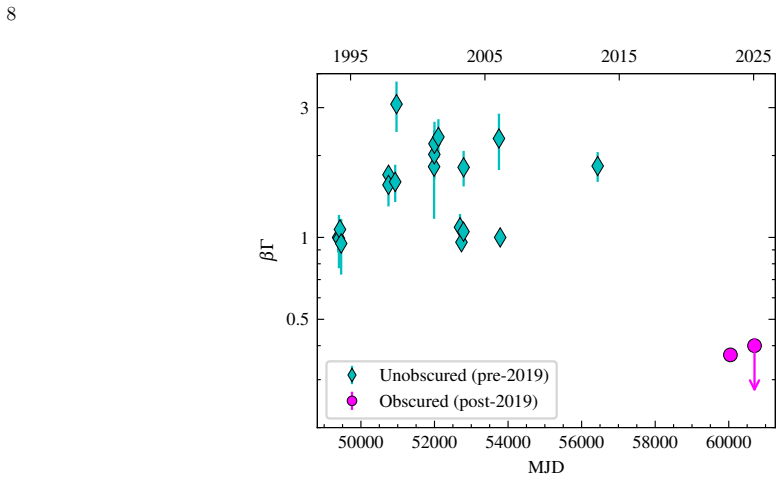
GRS 1915+105's jets in its current obscured state are slower than its pre-2019 relativistic jets, with an inferred speed βΓ ≲ 0.40 rather than the earlier βΓ ≳ 1.
Reviewed by Pith at T0; open to challenge. T0 means a machine referee read the full paper against a public rubric. the ladder, T0–T4 →
T0 review · deepseek-v4-flash
2026-08-01 03:14 UTC pith:J3LYPUSI
load-bearing objection New EAVN proper-motion limits indicate the 2025 obscured-state jets of GRS 1915+105 are not moving at historical superluminal speeds; the quantitative βΓ<0.40 is model-dependent but plausible. the 3 major comments →
Distinct Jet Properties in the X-Ray-Obscured State of GRS 1915+105
The pith
A machine-rendered reading of the paper's core claim, the machinery that carries it, and where it could break.
Core claim
The paper reports that the jets of GRS 1915+105 observed in January 2025, during its X-ray-obscured state, do not show the apparent superluminal motion characteristic of its pre-2019 unobscured-state jets. For the epoch with two well-separated jet blobs, the measured separations from the inferred core give βcosθ = 0.11 ± 0.04, and the absence of proper motion limits the apparent speed to ≲0.39c; together these yield an intrinsic speed β ≲ 0.37, or βΓ ≲ 0.40. This is consistent with a previous measurement of βΓ = 0.37 for obscured-state ejecta in 2023, and it contrasts with the pre-2019 values of βΓ ~ 1–3. The paper argues that this change in jet speed, combined with the previously reported l
What carries the argument
The central constraint comes from the ratio of the angular separations of the approaching and receding jet components from the core, βcosθ = (Δr_app − Δr_rec)/(Δr_app + Δr_rec), under the assumption that the two-sided jets are ejected simultaneously and are intrinsically symmetric. This is combined with the upper limit on apparent proper motion (≲0.3 mas/h, or β_app ≲ 0.39) to bound the intrinsic speed and viewing angle in the β–θ plane, yielding βΓ ≲ 0.40. A second, independent check uses the jet-to-counterjet brightness ratio and spectral index, giving consistent values of βcosθ.
Load-bearing premise
The speed estimate for epoch B assumes the two-sided jets were launched simultaneously and symmetrically from a fixed core, and that the core position adopted from epoch A (seven days earlier) is the true launch point; if the core is actually offset or the ejecta asymmetric, the derived βΓ upper limit is biased.
What would settle it
A direct measurement of proper motion of the 2025 jet components at a level above ~0.3 mas/h would rule out the claimed stationary, slow jets; conversely, detecting the core in a similar obscured-state flare and remeasuring βcosθ with a directly measured core position would test whether the asymmetry used here is real or an artifact of the adopted core.
If this is right
- If confirmed, the 2025 jets are sub-relativistic, with speeds near 0.37c, distinct from the earlier relativistic jets with βΓ ≳ 1.
- The absence of measurable proper motion over 5 hours rules out the pre-2019 apparent speeds (~22 mas/day) for these events, placing the jets in a slower kinematic class.
- The two contrasting morphologies—core-plus-extended-jet versus two blobs with no core—may trace different phases of flare evolution, connecting radio spectral changes to jet structure.
- These results add a second measured epoch (after 2023) to the obscured-state jet speed of GRS 1915+105, strengthening the claim that its post-2019 jets are systematically slower.
Where Pith is reading between the lines
- The slow speeds and orientation variations together suggest the jets may be precessing and decelerating due to interaction with a dense, obscuring outflow; multi-epoch VLBI spanning months could directly track the precession period.
- If the core position in epoch B is systematically offset (e.g., due to opacity shifts), the βcosθ = 0.11 estimate could shift; a future observation that resolves the core during an obscured-state flare would provide a direct check of the intrinsic symmetry assumption.
- The derived speed ~0.3–0.4c is similar to the slower jets inferred in other obscured X-ray binaries, hinting at a common mass-loading or environmental deceleration mechanism that could be tested by comparing jet power and column density across sources.
Editorial analysis
A structured set of objections, weighed in public.
Referee Report
Summary. The paper reports 6.7-GHz EAVN observations of the black hole X-ray binary GRS 1915+105 obtained during two radio flares in January 2025, while the source is in its post-2019 X-ray-obscured state. In epoch A the source shows a bright core with two-sided jet emission; in epoch B the core is not detected and the image is dominated by two bright, roughly symmetric blobs (SE2 and NW2). Time-binned imaging over the ~5-hour tracks yields no significant proper motion for any component, giving an apparent-speed upper limit of β_app ≲ 0.39. Using the separation asymmetry between the two blobs (βcosθ = 0.11 ± 0.04) and the flux-density ratio (βcosθ ≈ 0.07–0.10), the authors derive an intrinsic speed βΓ ≲ 0.40 for the epoch B jets. They compare this with pre-2019 measurements of βΓ ~ 1–3 and with the 2023 obscured-state value βΓ = 0.37, and interpret the result as evidence that jets in the obscured state are slower, and possibly precessing, in line with the Fender–Motta paradigm. The paper also discusses possible physical origins, including a warped, precessing disk and enhanced mass loading.
Significance. If the derived speed is correct, this is a valuable data point: it would show that the archetypal Galactic superluminal source, GRS 1915+105, has switched from relativistic (βΓ ≳ 1) to sub-relativistic (βΓ ≲ 0.40) jet propagation after entering its obscured state, directly supporting the emerging state-dependent jet paradigm. The proper-motion non-detection itself is robust and well presented: the authors correctly note that pre-2019 apparent speeds (~22 mas/d) would produce a ~5 mas shift over 5 hours, well above their ~1.5 mas detection threshold, while the observed residuals are consistent with zero. The paper is also commendable for its rapid-response ToO observations, the use of calibrator light curves to verify that the flux variability is intrinsic, and the transparency of the equations used. The quantitative speed limit, however, depends critically on the assumption that the two epoch-B blobs are intrinsically symmetric, simultaneous ejections from a stationary core at the position extrapolated from epoch A. That assumption is stated but its violation is not discussed or propagated, and the abstract's phrase 'robust support' overstates the strength of the kinematic inferenc
major comments (3)
- [§3.3, Eqs. (1) and (2)] Both estimators of βcosθ assume the two epoch-B blobs are intrinsically symmetric and were ejected simultaneously from a common core. If the counterjet is intrinsically fainter or if one blob is actually the core (or a separate ejection), then Eq. (1) does not measure a kinematic asymmetry and Eq. (2) is biased by the unknown intrinsic flux ratio. The paper states the assumption but provides no test or systematic-uncertainty estimate. Because this assumption is the link between the proper-motion null result and the quantitative claim βΓ ≲ 0.40, the conclusion is not as robust as the abstract implies. A concrete test would be to compare the epoch-B morphology with the epoch-A core position and the 2023 symmetric-ejection events, or to fit a model that relaxes the symmetry and show how βcosθ changes.
- [§3.2, 'For epoch B, where the core is not directly detected...'] The epoch-B core position is inferred from epoch A, taken seven days earlier. Any opacity-driven core shift or physical displacement of the launch site between epochs, or a position error in the epoch-A core, directly biases the measured separations Δr_app and Δr_rec used in Eq. (1). A shift of the adopted core along the jet axis changes the two separations in opposite directions and therefore produces a spurious βcosθ. The resulting systematic error is not propagated into the quoted βΓ ≲ 0.40. The authors should estimate the plausible core-shift magnitude (e.g., from the beam size and the epoch-A fit uncertainty) and show the range of βcosθ that results.
- [§4.1, 'Evidence for Slower Jets'] The comparison with pre-2019 jets and the statement that post-2019 jets are 'slower' rests on the quantitative βΓ ≲ 0.40, which is conditional on the symmetry assumption. The proper-motion non-detection alone robustly excludes apparent speeds of ~22 mas/d, but a fast on-axis jet (β ≳ 0.9 within θ ≈ 2–3°) would also produce β_app ≲ 0.39 mas/h and would evade the proper-motion limit while still having βΓ ≳ 1. The discussion should acknowledge this degenerate possibility explicitly and separate the robust null result from the model-dependent speed inference.
minor comments (6)
- [Abstract and §5] The phrase 'robust support' in the abstract is too strong given the symmetry assumption. Suggest 'consistent with' or 'provide further support'.
- [§3.2] The choice of one quarter of the beam major axis (q = 0.25) as the detectability threshold is reasonable but arbitrary. A brief justification or a test with different q values (e.g., 0.2–0.5) would strengthen the upper limit.
- [Table 1] The table lists βΓ ≲ 0.40 for both epoch A and epoch B, but the text notes that the epoch A value is tentative (βcosθ = 0.09 ± 0.12). The table could mark this clearly or include the uncertainty.
- [§3.3, Eq. (2)] The k = 2 vs k = 3 choice is discussed with literature values, but the final βcosθ range (0.07–0.10) does not show how the uncertainty in k propagates. A one-line sensitivity statement would be helpful.
- [Figure 5] The axes are clear, but the shaded 'allowed parameter space' is only bounded by the two curves; a small label indicating that the right boundary is set by β_app < 0.39 would improve readability.
- [General] The paper repeatedly refers to Y26 for details of the data reduction and component fitting. While acceptable, the reader would benefit from a summary of the fit uncertainties and the epoch-A core position error, since those are central to the epoch-B analysis.
Circularity Check
No significant circularity: the 2025 jet-speed limit follows from a new kinematic analysis, with only minor reliance on the authors' earlier Y26 component model.
full rationale
The claimed result βΓ≲0.40 is not equivalent to any input by construction. The proper-motion upper limit (§3.2) is derived from independent time-binned model fits (β_app≲0.39); the βcosθ values come from two distinct observables in epoch B, separation asymmetry (Eq. 1: Δr_app=7.8±0.4, Δr_rec=6.2±0.4 -> 0.11±0.04) and flux-density ratio (Eq. 2: R_B=1.6±0.4, α=-0.98 -> 0.07–0.10). Both explicitly assume intrinsically symmetric, simultaneous twin ejecta; this is a standard physical ansatz, not a tautology. Combining βcosθ with β_app via Eq. (5) gives βΓ≲0.40, and the comparison to pre-2019 βΓ≳1 uses external literature values. The only self-citation of note is Y26, which supplies the Gaussian-component separations/flux densities for the same 2025 epochs; Y26 is a companion data paper and does not contain the speed conclusion, so the kinematic argument is new. The paper itself flags a genuine systematic risk in §3.2: no core is detected in epoch B and the core position is adopted from epoch A, so βcosθ carries an unquantified core-position uncertainty. This is model dependence, not circularity. No equation reduces to its own input and no fitted parameter is relabeled as a prediction.
Axiom & Free-Parameter Ledger
free parameters (3)
- Detection threshold factor q (fraction of beam major axis) =
0.25
- Power-law index k in flux-ratio method =
1.3–2.5
- Adopted epoch-B core position =
Taken from epoch A (Y26)
axioms (5)
- domain assumption Intrinsic symmetry and simultaneous ejection of the twin jets (Eqs. 1 and 2)
- domain assumption Ballistic, non-accelerating jet propagation over the 5-hour observing window
- domain assumption Distance d = 9.4 ± 1.0 kpc (Reid & Miller-Jones 2023)
- ad hoc to paper The core is stationary and located at the epoch-A position when extrapolated to epoch B
- standard math Standard VLBI imaging and self-calibration produce unbiased component positions
read the original abstract
GRS 1915+105 has remained in an X-ray-obscured state since its transition from a long-lasting unobscured state in 2019. We report on 6.7-GHz East Asia VLBI Network observations of GRS 1915+105 obtained during strong radio flares detected at 2.3--11.2 GHz with the RATAN-600 radio telescope in 2025. Our images reveal two contrasting jet morphologies. The first epoch, associated with a flare evolving from an optically thick to an optically thin spectrum, shows a bright radio core accompanied by an extended jet structure. By contrast, the second epoch, observed near the peak of another flare displaying optically thin emission at lower frequencies, is dominated by two bright, symmetric, well-separated jet blobs and shows no detectable radio core. If these jets exhibited the apparent superluminal motions commonly observed prior to 2019, measurable angular shifts would be expected over the five-hour observations. However, no significant jet motion is detected. Combined with our derived jet speed of $\beta\Gamma \lesssim 0.40$, these results suggest that the jets launched during the current obscured state are slower than the relativistic jets ($\beta\Gamma \gtrsim 1$) observed earlier during the unobscured state. Together with the recently reported large variations in jet orientation, our findings in GRS 1915+105 provide robust support for the emerging paradigm that X-ray binary jets launched in obscured and unobscured states likely exhibit distinct propagation properties.
Figures


Reference graph
Works this paper leans on
-
[1]
Greisen, E. W. AIPS, the VLA, and the VLBA. Information Handling in Astronomy - Historical Vistas. 2003. doi:10.1007/0-306-48080-8_7
-
[2]
Journal of Korean Astronomical Society , keywords =
Amplitude Correction Factors of Korean VLBI Network Observations. Journal of Korean Astronomical Society , keywords =. doi:10.5303/JKAS.2015.48.5.229 , archivePrefix =. 1507.03326 , primaryClass =
Pith/arXiv arXiv 2015
-
[3]
Astronomical Data Analysis Software and Systems VI , year = 1997, editor =
Difmap: an Interactive Program for Synthesis Imaging. Astronomical Data Analysis Software and Systems VI , year = 1997, editor =
1997
-
[4]
East Asian VLBI Network astrometry toward the extreme outer Galaxy: Kinematic distance with the proper motion of G034.84-00.95. , keywords =. doi:10.1093/pasj/psac102 , archivePrefix =. 2211.12534 , primaryClass =
-
[6]
Repeated Relativistic Ejections in GRS 1915+105. , keywords =. doi:10.1086/306642 , archivePrefix =. astro-ph/9808341 , primaryClass =
Pith/arXiv arXiv 1915
-
[7]
Calibration of mixed-polarization interferometric observations. Tools for the reduction of interferometric data from elements with linear and circular polarization receivers. , keywords =. doi:10.1051/0004-6361/201526063 , archivePrefix =. 1601.04266 , primaryClass =
-
[8]
Jets from X-ray binaries , booktitle=
Fender, Rob , editor=. Jets from X-ray binaries , booktitle=. 2006 , pages=
2006
-
[9]
DiFX-2: A More Flexible, Efficient, Robust, and Powerful Software Correlator. , keywords =. doi:10.1086/658907 , archivePrefix =. 1101.0885 , primaryClass =
-
[10]
, year = 1994, month = sep, volume =
A superluminal source in the Galaxy. , year = 1994, month = sep, volume =. doi:10.1038/371046a0 , adsurl =
doi:10.1038/371046a0 1994
-
[11]
AU-Scale Synchrotron Jets and Superluminal Ejecta in GRS 1915+105. , keywords =. doi:10.1086/317088 , archivePrefix =. astro-ph/0006086 , primaryClass =
Pith/arXiv arXiv 1915
-
[12]
Astrophysics and Space Science Supplement , keywords =
EVN Observations of GRS 1915+105. Astrophysics and Space Science Supplement , keywords =. doi:10.1023/A:1011637718010 , adsurl =
-
[13]
Simultaneous multi-wavelength observations of GRS 1915+105. , keywords =. doi:10.1051/0004-6361:20031338 , archivePrefix =. astro-ph/0309091 , primaryClass =
Pith/arXiv arXiv 1915
-
[14]
The asymmetric compact jet of GRS 1915+105
The asymmetric compact jet of GRS 1915+105. European VLBI Network on New Developments in VLBI Science and Technology , year = 2004, editor =. doi:10.48550/arXiv.astro-ph/0412657 , archivePrefix =. astro-ph/0412657 , primaryClass =
work page internal anchor Pith review Pith/arXiv arXiv doi:10.48550/arxiv.astro-ph/0412657 1915
-
[15]
Multiple relativistic outbursts of GRS1915+105: radio emission and internal shocks. , keywords =. doi:10.1111/j.1365-2966.2005.09488.x , archivePrefix =. astro-ph/0508230 , primaryClass =
arXiv 2005
-
[16]
Kinematics of Black Hole X-Ray Binary GRS 1915+105. , keywords =. doi:10.1086/520111 , archivePrefix =. 0705.1800 , primaryClass =
Pith/arXiv arXiv 1915
-
[17]
Evidence for deceleration in the radio jets of GRS1915+105?. , keywords =. doi:10.1111/j.1365-2966.2007.11381.x , archivePrefix =. astro-ph/0612211 , primaryClass =
arXiv 2007
-
[18]
First e-VLBI observations of GRS1915+105. , keywords =. doi:10.1111/j.1745-3933.2006.00262.x , archivePrefix =. astro-ph/0611049 , primaryClass =
arXiv 2006
-
[20]
, year = 1992, month = aug, volume =
GRS 1915+105. , year = 1992, month = aug, volume =
1915
-
[21]
GRS 1915+105 and the Disc-Jet Coupling in Accreting Black Hole Systems. , keywords =. doi:10.1146/annurev.astro.42.053102.134031 , archivePrefix =. astro-ph/0406483 , primaryClass =
arXiv 1915
-
[22]
Steady jets from radiatively efficient hard states in GRS 1915+105. , keywords =. doi:10.1051/0004-6361/201014929 , archivePrefix =. 1101.4945 , primaryClass =
Pith/arXiv arXiv 1915
-
[23]
M. J. Reid and J. E. McClintock and J. F. Steiner and D. Steeghs and R. A. Remillard and V. Dhawan and R. Narayan , title =. The Astrophysical Journal , abstract =. 2014 , month =. doi:10.1088/0004-637X/796/1/2 , url =
-
[24]
The Astronomer's Telegram , keywords =
New short-time radio and X-ray flare from GRS1915+105. The Astronomer's Telegram , keywords =
-
[25]
The Astronomer's Telegram , keywords =
Giant radio flare from GRS1915+105. The Astronomer's Telegram , keywords =
-
[26]
The Astronomer's Telegram , keywords =
New radio flare from GRS 1915+105. The Astronomer's Telegram , keywords =
1915
-
[27]
ALMA/NICER observations of GRS 1915+105 indicate a return to a hard state. , keywords =. doi:10.1051/0004-6361/202039581 , archivePrefix =. 2102.00693 , primaryClass =
Pith/arXiv arXiv 1915
-
[28]
Observations of a radio-bright, X-ray obscured GRS 1915+105. , keywords =. doi:10.1093/mnras/stab511 , archivePrefix =. 2101.01187 , primaryClass =
Pith/arXiv arXiv 1915
-
[29]
Monthly Notices of the Royal Astronomical Society , volume =
Fender, Rob and Bright, Joe , title = ". Monthly Notices of the Royal Astronomical Society , volume =. 2019 , month =. doi:10.1093/mnras/stz2000 , url =
-
[30]
The Not-so-massive Black Hole in the Microquasar GRS1915+105. , keywords =. doi:10.1088/0004-637X/768/2/185 , archivePrefix =. 1304.1808 , primaryClass =
-
[31]
On the Distances to the X-Ray Binaries Cygnus X-3 and GRS 1915+105. , keywords =. doi:10.3847/1538-4357/acfe0c , archivePrefix =. 2309.15027 , primaryClass =
Pith/arXiv arXiv 1915
-
[32]
A Unified Model for the Spectral Variability in GRS 1915+105. , keywords =. doi:10.1086/310944 , archivePrefix =. astro-ph/9708113 , primaryClass =
Pith/arXiv arXiv 1915
-
[33]
An Unstable Central Disk in the Superluminal Black Hole X-Ray Binary GRS 1915+105. , keywords =. doi:10.1086/310595 , archivePrefix =. astro-ph/9702048 , primaryClass =
Pith/arXiv arXiv 1915
-
[34]
A model-independent analysis of the variability of GRS 1915+105. , keywords =. doi:10.48550/arXiv.astro-ph/0001103 , archivePrefix =. astro-ph/0001103 , primaryClass =
-
[35]
Space Science Reviews , year=
An Overview of Jets and Outflows in Stellar Mass Black Holes , author=. Space Science Reviews , year=
-
[36]
The Balance of Power: Accretion and Feedback in Stellar Mass Black Holes
Fender, Rob and Mu \ n oz-Darias, Teo. The Balance of Power: Accretion and Feedback in Stellar Mass Black Holes. Astrophysical Black Holes. 2016. doi:10.1007/978-3-319-19416-5_3
-
[37]
Jets from black hole X-ray binaries: testing, refining and extending empirical models for the coupling to X-rays. , keywords =. doi:10.1111/j.1365-2966.2009.14841.x , archivePrefix =. 0903.5166 , primaryClass =
arXiv 2009
-
[38]
Towards a unified model for black hole X-ray binary jets. , keywords =. doi:10.1111/j.1365-2966.2004.08384.x , archivePrefix =. astro-ph/0409360 , primaryClass =
arXiv 2004
-
[39]
Johnson and Ramesh Narayan and Dimitrios Psaltis and Lindy Blackburn and Yuri Y
Michael D. Johnson and Ramesh Narayan and Dimitrios Psaltis and Lindy Blackburn and Yuri Y. Kovalev and Carl R. Gwinn and Guang-Yao Zhao and Geoffrey C. Bower and James M. Moran and Motoki Kino and Michael Kramer and Kazunori Akiyama and Jason Dexter and Avery E. Broderick and Lorenzo Sironi , title =. The Astrophysical Journal , abstract =. 2018 , month ...
-
[40]
Theory and Simulations of Refractive Substructure in Resolved Scatter-broadened Images. , keywords =. doi:10.1088/0004-637X/805/2/180 , archivePrefix =. 1502.05722 , primaryClass =
-
[41]
I - Numerical simulations and physical principles
The shape of a scatter-broadened image. I - Numerical simulations and physical principles. , keywords =. doi:10.1093/mnras/238.3.963 , adsurl =
-
[42]
, year = 1989, month = jun, volume =
The Shape of a Scatter Broadened Image - Part Two - Interferometric Visibilities. , year = 1989, month = jun, volume =. doi:10.1093/mnras/238.3.995 , adsurl =
-
[43]
A size of -0.5ex 1AU for the radio source Sgr A* at the centre of the Milky Way. , keywords =. doi:10.1038/nature04205 , archivePrefix =. astro-ph/0512515 , primaryClass =
-
[44]
Detection of the Intrinsic Size of Sagittarius A* Through Closure Amplitude Imaging. Science , keywords =. doi:10.1126/science.1094023 , archivePrefix =. astro-ph/0404001 , primaryClass =
-
[45]
Multiwavelength VLBI observations of Sagittarius A*. , keywords =. doi:10.1051/0004-6361/200913807 , archivePrefix =. 1010.1287 , primaryClass =
-
[46]
Discovery of Substructure in the Scatter-broadened Image of Sgr A*. , keywords =. doi:10.1088/2041-8205/794/1/L14 , archivePrefix =. 1409.0530 , primaryClass =
Pith/arXiv arXiv 2041
-
[47]
The Size, Shape, and Scattering of Sagittarius A* at 86 GHz: First VLBI with ALMA. , keywords =. doi:10.3847/1538-4357/aaf732 , archivePrefix =. 1901.06226 , primaryClass =
Pith/arXiv arXiv 1901
-
[48]
Persistent Non-Gaussian Structure in the Image of Sagittarius A* at 86 GHz. , keywords =. doi:10.3847/1538-4357/ac00b0 , archivePrefix =. 2104.07610 , primaryClass =
-
[49]
The Intrinsic Structure of Sagittarius A* at 1.3 cm and 7 mm. , keywords =. doi:10.3847/1538-4357/ac4165 , archivePrefix =. 2112.04929 , primaryClass =
-
[50]
Extreme Brightness Temperatures and Refractive Substructure in 3C273 with RadioAstron. , keywords =. doi:10.3847/2041-8205/820/1/L10 , archivePrefix =. 1601.05810 , primaryClass =
Pith/arXiv arXiv 2041
-
[51]
RadioAstron Observations of the Quasar 3C273: A Challenge to the Brightness Temperature Limit. , keywords =. doi:10.3847/2041-8205/820/1/L9 , archivePrefix =. 1601.05806 , primaryClass =
Pith/arXiv arXiv 2041
-
[52]
PSR B0329+54: substructure in the scatter-broadened image discovered with RadioAstron on baselines up to 330 000 km. , keywords =. doi:10.1093/mnras/stw2353 , archivePrefix =. 1609.04008 , primaryClass =
-
[53]
The Astronomer's Telegram , keywords =
A bright radio flare observed in GRS 1915+105 with the Medicina and RATAN radio telescopes with no X-ray counterpart in the INTEGRAL energy range. The Astronomer's Telegram , keywords =
1915
-
[54]
The Astronomer's Telegram , keywords =
MAXI/GSC detection of X-ray rebrightening of GRS 1915+105. The Astronomer's Telegram , keywords =
1915
-
[55]
The Astronomer's Telegram , keywords =
MAXI/GSC observes GRS 1915+105 in the X-ray faintest state in the last 22 years. The Astronomer's Telegram , keywords =
1915
-
[56]
The Astronomer's Telegram , keywords =
AMI-LA observation of radio flaring from GRS 1915+105. The Astronomer's Telegram , keywords =
1915
-
[57]
The Novel Obscured State of the Stellar-mass Black Hole GRS 1915+105. , keywords =. doi:10.3847/1538-4357/abd6cb , archivePrefix =. 2012.15033 , primaryClass =
Pith/arXiv arXiv 1915
-
[58]
Multimission view of the low-luminosity 'obscured' phase of GRS 1915+105. , keywords =. doi:10.1093/mnras/stad2072 , archivePrefix =. 2307.04206 , primaryClass =
Pith/arXiv arXiv 1915
-
[59]
An Obscured, Seyfert 2-like State of the Stellar-mass Black Hole GRS 1915+105 Caused by Failed Disk Winds. , keywords =. doi:10.3847/1538-4357/abbb31 , archivePrefix =. 2007.07005 , primaryClass =
Pith/arXiv arXiv 1915
-
[60]
Absolute positions of 6.7-GHz methanol masers. , keywords =. doi:10.1051/0004-6361/200912135 , archivePrefix =. 0908.3933 , primaryClass =
-
[61]
European VLBI Network imaging of 6.7 GHz methanol masers. , keywords =. doi:10.1051/0004-6361/201527541 , archivePrefix =. 1601.03197 , primaryClass =
-
[62]
The Arecibo Methanol Maser Galactic Plane Survey. III. Distances and Luminosities. , keywords =. doi:10.1088/0004-637X/706/2/1609 , archivePrefix =. 0910.3763 , primaryClass =
-
[63]
A Global 86 GHz VLBI Survey of Compact Radio Sources. , keywords =. doi:10.1088/0004-6256/136/1/159 , archivePrefix =. 0803.4035 , primaryClass =
-
[64]
Radio Emission from Conical Jets Associated with X-Ray Binaries. , keywords =. doi:10.1086/166318 , adsurl =
-
[65]
Equipartition Brightness Temperature and the Inverse Compton Catastrophe. , keywords =. doi:10.1086/174038 , adsurl =
-
[66]
The Astronomer's Telegram , keywords =
Allen Telescope Array, Arcminute Microkelvin Imager Large Array, and MeerKAT observations of an unprecedented flare from the X-ray Binary GRS 1915+105. The Astronomer's Telegram , keywords =
1915
-
[67]
The Angular Broadening of the Galactic Center Pulsar SGR J1745-29: A New Constraint on the Scattering Medium. , keywords =. doi:10.1088/2041-8205/780/1/L2 , archivePrefix =. 1309.4672 , primaryClass =
Pith/arXiv arXiv 2041
-
[68]
European VLBI Network observations of 6.7 GHz methanol masers in clusters of massive young stellar objects. , keywords =. doi:10.1051/0004-6361/201322629 , archivePrefix =. 1402.6727 , primaryClass =
-
[69]
A search for possible interactions between ejections from GRS 1915+105 and the surrounding interstellar medium. , keywords =. doi:10.1051/0004-6361:20000266 , archivePrefix =. astro-ph/0011297 , primaryClass =
Pith/arXiv arXiv 1915
-
[70]
X-Ray Properties of Black-Hole Binaries. , keywords =. doi:10.1146/annurev.astro.44.051905.092532 , archivePrefix =. astro-ph/0606352 , primaryClass =
-
[71]
, year = 2025, month = feb, volume =
Rapid mid-infrared spectral timing with JWST: GRS 1915+105 during an MIR-bright and X-ray-obscured state. , year = 2025, month = feb, volume =. doi:10.1093/mnras/staf036 , adsurl =
-
[72]
On the Origin of the Various Types of Radio Emission in GRS 1915+105. , keywords =. doi:10.1086/378672 , archivePrefix =. astro-ph/0308096 , primaryClass =
Pith/arXiv arXiv 1915
-
[73]
Hard X-ray states and radio emission in GRS 1915+105. , keywords =. doi:10.1046/j.1365-8711.2002.05223.x , archivePrefix =. astro-ph/0112044 , primaryClass =
arXiv 1915
-
[74]
The variable radio emission from GRS 1915+=105. , keywords =. doi:10.1093/mnras/292.4.925 , archivePrefix =. astro-ph/9708171 , primaryClass =
Pith/arXiv arXiv 1915
-
[75]
Coupling between the accreting corona and the relativistic jet in the microquasar GRS 1915+105. Nature Astronomy , keywords =. doi:10.1038/s41550-022-01617-y , archivePrefix =. 2203.02963 , primaryClass =
Pith/arXiv arXiv 1915
-
[76]
Fast infrared winds during the radio-loud and X-ray obscured stages of the black hole transient GRS 1915+105. , keywords =. doi:10.1051/0004-6361/202348184 , archivePrefix =. 2311.12933 , primaryClass =
Pith/arXiv arXiv 1915
-
[77]
Constraining the physical properties of large-scale jets from black hole X-ray binaries and their impact on the local environment with blast-wave dynamical models. , keywords =. doi:10.1093/mnras/stae2049 , archivePrefix =. 2405.16624 , primaryClass =
-
[78]
A generic dynamical model of gamma-ray burst remnants. , keywords =. doi:10.1046/j.1365-8711.1999.02887.x , archivePrefix =. astro-ph/9906370 , primaryClass =
arXiv 1999
-
[79]
Gamma-ray bursts and the fireball model. , keywords =. doi:10.1016/S0370-1573(98)00127-6 , archivePrefix =. astro-ph/9810256 , primaryClass =
-
[80]
The Astronomer's Telegram , keywords =
The bright radio flare from microquasar GRS 1915+105. The Astronomer's Telegram , keywords =
1915
-
[81]
An unusually massive stellar black hole in the Galaxy. , keywords =. doi:10.1038/35107019 , archivePrefix =. astro-ph/0111538 , primaryClass =
-
[82]
Sources of Relativistic Jets in the Galaxy. , keywords =. doi:10.1146/annurev.astro.37.1.409 , archivePrefix =. astro-ph/9902062 , primaryClass =
discussion (0)
Sign in with ORCID, Apple, or X to comment. Anyone can read and Pith papers without signing in.