REVIEW 2 major objections 3 minor 100 references
This paper argues that the Square Kilometre Array will turn tidal disruption event radio studies from a few exceptional case studies into population-scale inference, with a predicted yield of 150–300 well-identified nuclear radio TDEs per y
Reviewed by Pith at T0; open to challenge. T0 means a machine referee read the full paper against a public rubric. the ladder, T0–T4 →
T0 review · deepseek-v4-flash
2026-08-01 00:39 UTC pith:6ODRP7DS
load-bearing objection Solid SKA science-case chapter with a real inconsistency between its own 'few percent' jetted-fraction prior and the f_r=0.1–0.5 used to forecast 150–300 radio TDEs/yr; fix that and it's a useful community document. the 2 major comments →
Tidal Disruption Events with the SKA
The pith
A machine-rendered reading of the paper's core claim, the machinery that carries it, and where it could break.
Core claim
The chapter's central claim is that the SKA's combination of microjansky sensitivity, 50 MHz–15.4 GHz frequency coverage, rapid response, commensal survey cadence, and VLBI capability will move radio TDE science from sparse follow-up of a few nearby events to systematic population inference. The paper quantifies this as 150–300 well-identified nuclear radio TDEs per year from the early AA* array (assuming radio-loud fraction f_r ~0.1–0.5), of which 30–50 per year get a short characterization epoch and 8–12 receive full multi-band follow-up at roughly 3, 10, 30, 100, 300, and 1000 days. That sample would measure the true jetted fraction including off-axis jets, recover outflow kinetic energie
What carries the argument
The central object is the SKA in its staged AA* and full AA4 configurations. Its load-bearing capabilities are microjansky continuum sensitivity (1.4–4.6 μJy in 15 minutes for SKA-Mid across 0.35–15.4 GHz; 13 μJy per beam for SKA-Low at 50–350 MHz), which puts 10–100 μJy off-axis and mildly relativistic jet afterglows within reach at z~0.1–0.3; a 3–7 day commensal Band 2 survey for discovery; and long baselines plus VLBI for sub-arcsecond to milliarcsecond localization. The physical machinery is the synchrotron self-absorption turnover (ν_p, F_p): tracking its evolution with time and frequency yields shock radius R(t), magnetic field B(t), kinetic energy E_k, and the ambient density profile
Load-bearing premise
The forecast assumes the SKA will be built and commissioned to the projected microjansky sensitivity, 3–7 day commensal cadence, and VLBI modes, and that optical surveys will actually deliver thousands of nuclear transients per year; if either gives way, the 150–300-per-year population-scale claim collapses.
What would settle it
If one year of AA* Band 2 commensal survey data, given the assumed optical discovery stream, yields fewer than about fifty well-identified nuclear radio TDEs, the paper's central population-scale forecast is wrong.
If this is right
- If the forecast holds, the radio-loud (jetted) fraction of TDEs can be measured to roughly ±(30–50)% within about five years, including off-axis events, reducing reliance on jet-beaming assumptions.
- Late-time SKA-Low observations will test whether at least ~10% of thermal TDEs rebrighten after ~300 days, diagnosing circumnuclear density jumps or refreshed shocks; a significantly lower incidence would disfavor those environments.
- A sample of roughly one hundred radio-detected TDEs across 10^5–10^7 solar masses would extend supermassive black-hole–host scaling relations to the low-mass end and quantify kinetic-to-radiative energy ratios E_k/E_rad as a function of host type and black-hole mass.
- With tens of off-nuclear, milliarcsecond-localized candidates, the incidence of recoiling or wandering black holes and intermediate-mass black-hole TDEs can be constrained, including meaningful null results after thousands of events.
- Coordinated radio campaigns will test hadronic acceleration scenarios: neutrino-tagged TDEs should show above-average radio luminosities or unusually hard spectra if the proposed neutrino–TDE association is real.
Where Pith is reading between the lines
- The paper leaves implicit that a first-year yield significantly different from 150–300 can itself be inverted to measure the radio-loud fraction f_r, turning the forecast into an estimator.
- The same commensal data stream will contain non-TDE nuclear transients; applying the paper's selection cuts to changing-look active galactic nuclei and orphan gamma-ray burst afterglow candidates would quantify those contaminants, which the chapter flags as the main background.
- Stacking hundreds of late-time SKA-Low light curves would effectively convert each TDE into a localized probe of parsec-scale gas density, a tool for measuring accretion and feedback histories in otherwise quiescent nuclei—an extension the paper suggests but does not develop quantitatively.
Editorial analysis
A structured set of objections, weighed in public.
Referee Report
Summary. This SKA science chapter argues that the SKA's microjansky sensitivity, broad frequency coverage, commensal surveys, and VLBI capability will move tidal disruption event (TDE) radio studies from case-by-case follow-up to population-scale inference. It identifies five key science questions—jet launching and incidence, SMBH growth, black-hole mass/spin demographics, CNM tomography, and recoiling/wandering black holes—and proposes an observational strategy based on AA* and AA4. The quantitative centerpiece is the forecast of 150–300 well-identified nuclear radio TDEs per year from AA*, supported by a follow-up plan of 30–50 short characterization observations and 8–12 deep multi-epoch campaigns per year. The chapter closes with five falsifiable predictions. The central number depends on an assumed LSST nuclear-transient yield of 10^3–10^4 yr^-1, an unspecified 'radio-loud fraction' f_r=0.1–0.5, and qualitative selection cuts whose survival fractions are not given.
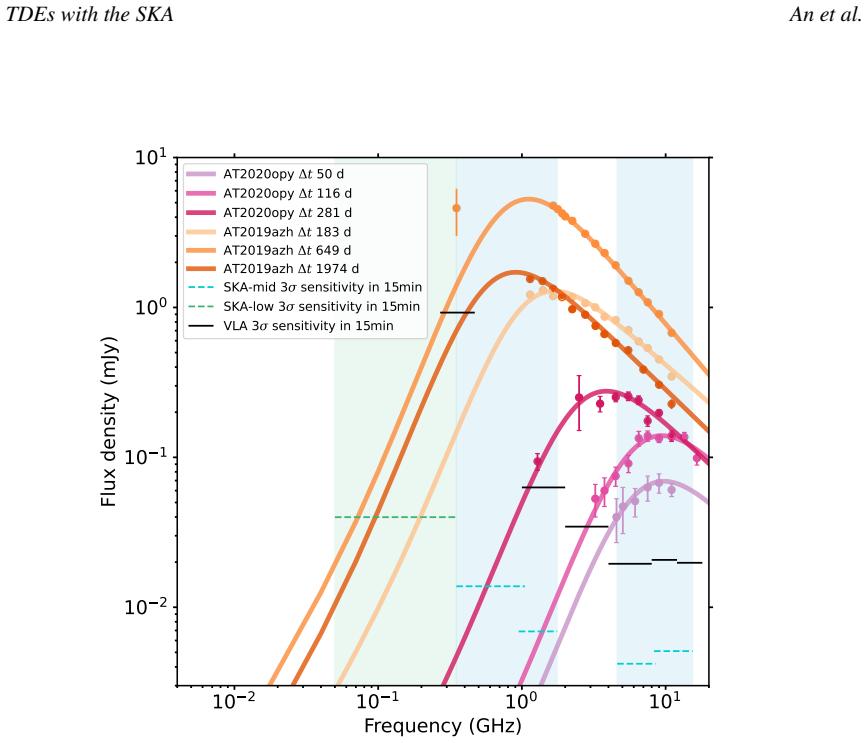
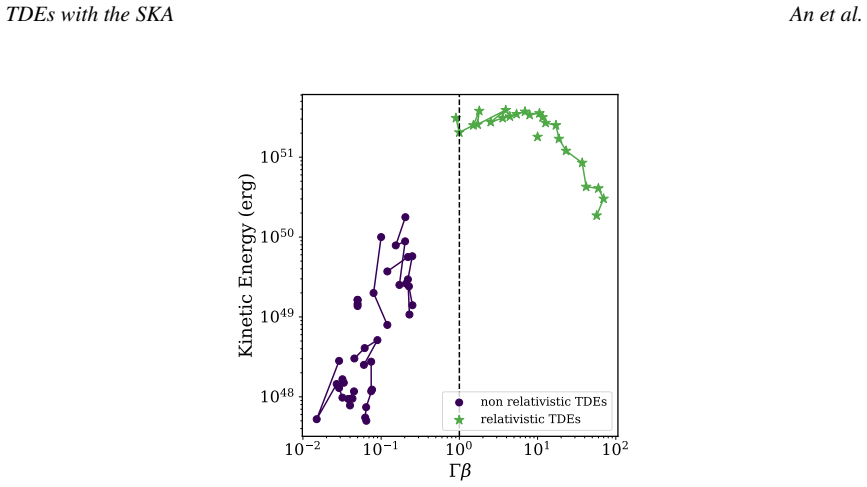
Significance. If the forecast can be made robust, the chapter provides a substantial contribution: it converts general advocacy into concrete, falsifiable predictions—an increasing radio-loud fraction with black-hole mass/spin proxies, a ≥10% late-time rebrightening incidence, a ≥1% off-nuclear fraction at mas precision, a polarization contrast between jetted and non-jetted outflows, and distinctive radio properties for neutrino-tagged TDEs. The compilation of current radio TDE data in Figures 1–3 and the discussion of SKA-Low/Mid and SKA-VLBI synergies are useful and well grounded. The chapter is well organized and broadly internally consistent; its main weakness is the quantitative forecast in §4, which is the load-bearing element for the population-scale claim.
major comments (2)
- [§4 (Expected outcomes, forecasts, and predictions); cf. §1 and §2.1] The headline forecast is '150–300 well-identified nuclear radio TDEs per year from AA∗ for a radio-loud fraction f_r∼0.1–0.5'. The term f_r is not defined, and the value conflicts with §1's statement that 'The radio-loud (jetted) fraction appears to be only a few percent' and with the definition f_j ≈ N_radio/N_TDE in §2.1. If f_r is the jetted fraction, the assumed 0.1–0.5 is an order of magnitude above the paper's own few-percent prior: a few×10^3 TDEs yr^-1 at f=0.03 yields only ~100 radio TDEs before the additional cuts, not 150–300. If f_r denotes a broader radio-detected fraction, the text provides no definition or empirical basis. The yield scales linearly with f_r and underpins the population-scale claim, so this must be fixed with a defined quantity and a transparent derivation.
- [§4 (Expected outcomes, forecasts, and predictions)] The reduction from 'a few ×10^3 likely TDEs' to '150–300 well-identified nuclear radio TDEs' is not reproducible. The three listed cuts—week-timescale variability, 0.3'' nuclear coincidence, and synchrotron self-absorption spectrum—are qualitative; no survival fractions, completeness, or luminosity-function inputs are given. The number also depends on the adopted 3–7 day cadence and the 10–30 μJy stacked sensitivity, but the mapping from observed flux to a count of events is absent. Because the proposed follow-up program (30–50 short characterizations and 8–12 deep campaigns per year) scales linearly with this yield, the survey design is directly affected by this omitted calculation. Provide a step-by-step derivation or clearly label the figure as an order-of-magnitude scaling.
minor comments (3)
- [§4] The notation f_r appears only in §4, while §2.1 uses f_j for the jetted fraction. If these are distinct, define both and avoid switching; if identical, use one symbol.
- [Figure captions] Fig. 2 caption contains 'SKA-low ( a 0.05-0.35GHz)' and 'SKA-mid ( a 0.35-15GHz)', where the symbol appears to be ν (frequency) but is corrupted; Fig. 1 shows 'SKA-mid 3 sensitivity' rather than 'SKA-mid 3σ sensitivity'. Check typesetting of Greek letters and superscripts.
- [§4] The claim that SKA will measure R(t), v_sh(t), E_k, and n(r) with 'typical uncertainties of 20–30% per well-sampled event' is stated without derivation or reference. Add a short basis for this uncertainty estimate or soften the claim to reflect its illustrative nature.
Circularity Check
No circularity: forecast is input-scenario scaling, not a derivation from its own outputs.
full rationale
The central quantitative claim in section 4 (150-300 nuclear radio TDEs per year ... for f_r~0.1-0.5) is an explicit arithmetic scaling of external inputs: LSST nuclear transient yield (10^3-10^4 per year, a few x10^3 likely TDEs), SKA sensitivities, and an assumed radio-loud fraction f_r. No parameter is fitted to SKA TDE data and then renamed as a prediction. The paper's five predictions are stated as falsifiable empirical expectations and are not used as inputs to derive the central claim. Self-citations to Goodwin/Rhodes/Shu and companion AASKAII chapters serve as empirical data sources or cross-references, not as the authority for the headline forecast. No uniqueness theorem or ansatz is imported via self-citation. The tension between f_r~0.1-0.5 and the statement that the radio-loud (jetted) fraction is 'only a few percent' is an internal-consistency or forecasting-risk concern about the assumed parameters, not a definitional circularity. A failure of the forecast would reflect unrealized instrument performance, LSST yield, or f_r, not a derivation equivalent to its inputs by construction.
Axiom & Free-Parameter Ledger
free parameters (1)
- Radio-loud fraction f_r =
0.1–0.5 (assumed)
axioms (3)
- domain assumption Projected SKA AA*/AA4 performance figures are accurate: SKA-Mid 1.4–4.6 μJy in 15 min, SKA-Low 13 μJy beam^-1, 50 MHz–15.4 GHz coverage, 150-km baselines, and the planned observing modes.
- domain assumption LSST-era optical surveys will identify ~10^3–10^4 nuclear transients per year inside z<0.5, with a few×10^3 surviving as likely TDEs.
- domain assumption Synchrotron self-absorption / equipartition modelling recovers R(t), E_k, and n(r) from broadband radio SEDs.
read the original abstract
Tidal disruption events (TDEs) and related nuclear transients probe jet launching, disk formation and circularization, particle acceleration, and the circumnuclear medium (CNM). However, the small fraction of events launching relativistic jets, the weak or delayed radio emission of many thermal TDEs, and the black-hole demographics of galactic nuclei remain poorly understood. SKA, with microJy sensitivity, wide bandwidth, long baselines, rapid response, and commensal surveys across 50-350 MHz (SKA-Low) and 0.35-15.4 GHz (SKA-Mid), will transform this field. Its sensitivity, frequency coverage, and very long baseline interferometry (VLBI) capability will extend radio calorimetry from a few well-studied nearby events to volume-limited samples of non-relativistic outflows. The SKA will bring off-axis and mildly relativistic jets into routine reach, trace CNM density profiles through the evolution of the low-frequency synchrotron turnover, and localize faint off-nuclear transients with sub-arcsecond precision. These data will constrain jet incidence, energetics, geometry, and magnetization, map the CNM through shock interactions, test links to changing-look active galactic nuclei (AGN) and high-energy neutrinos, and identify off-nuclear events associated with recoiling supermassive or intermediate-mass black holes. We discuss the benefits of commensal surveys, rapid triggering, and SKA-VLBI, and provide predictions based on the projected performance of AA* and AA4. SKA will shift TDE radio studies from detailed case-by-case studies to population-scale inference, advancing studies of jet physics and black-hole demographics.
Figures

Reference graph
Works this paper leans on
-
[1]
Tidal disruption of stars by black holes of 10 ^ 6 - 10 ^ 8 solar masses in nearby galaxies. , keywords =. doi:10.1038/333523a0 , adsurl =
-
[2]
An 85-s X-ray quasi-periodicity after a stellar tidal disruption by a candidate intermediate-mass black hole. Nature Astronomy , keywords =. doi:10.1038/s41550-025-02502-0 , archivePrefix =. 2503.01156 , primaryClass =
-
[3]
Lense-Thirring precession after a supermassive black hole disrupts a star. , keywords =. doi:10.1038/s41586-024-07433-w , archivePrefix =. 2402.09689 , primaryClass =
-
[4]
A loud quasi-periodic oscillation after a star is disrupted by a massive black hole. Science , keywords =. doi:10.1126/science.aar7480 , archivePrefix =. 1810.10713 , primaryClass =
-
[5]
A fast powerful X-ray transient from possible tidal disruption of a white dwarf. arXiv e-prints , keywords =. doi:10.48550/arXiv.2509.25877 , archivePrefix =. 2509.25877 , primaryClass =
-
[6]
CSS 161010: A Luminous Fast Blue Optical Transient with Broad Blueshifted Hydrogen Lines. , keywords =. doi:10.3847/1538-4357/ad89a5 , archivePrefix =. 2408.04698 , primaryClass =
-
[7]
Outflow Cloud Interaction as the Possible Origin of the Peculiar Radio Emission in the Tidal Disruption Event AT2018cqh. , keywords =. doi:10.3847/2041-8213/ae0caa , archivePrefix =. 2509.21299 , primaryClass =
arXiv 2041
-
[8]
Fundamental scaling relationships revealed in the optical light curves of tidal disruption events. , keywords =. doi:10.1093/mnras/stad3001 , archivePrefix =. 2308.08255 , primaryClass =
-
[9]
Radio observations of the tidal disruption event AT2020opy: a luminous non-relativistic outflow encountering a dense circumnuclear medium. , keywords =. doi:10.1093/mnras/stac312710.48550/arXiv.2208.13967 , archivePrefix =. 2208.13967 , primaryClass =
-
[10]
A radio-emitting outflow produced by the tidal disruption event AT2020vwl. , keywords =. doi:10.1093/mnras/stad1258 , archivePrefix =. 2304.12661 , primaryClass =
-
[11]
A radio flare associated with the nuclear transient eRASSt J234403-352640: an outflow launched by a potential tidal disruption event. , keywords =. doi:10.1093/mnras/stae362 , archivePrefix =. 2401.17286 , primaryClass =
-
[12]
The Peculiar Radio Evolution of the Tidal Disruption Event ASASSN-19bt. arXiv e-prints , keywords =. doi:10.48550/arXiv.2404.12431 , archivePrefix =. 2404.12431 , primaryClass =
-
[13]
Radio Monitoring of the Tidal Disruption Event Swift J164449.3+573451. III. Late-time Jet Energetics and a Deviation from Equipartition. , keywords =. doi:10.3847/1538-4357/aaa8e0 , archivePrefix =. 1710.07289 , primaryClass =
-
[14]
Caltech-NRAO Stripe 82 Survey (CNSS). III. The First Radio-discovered Tidal Disruption Event, CNSS J0019+00. , keywords =. doi:10.3847/1538-4357/abb94b , archivePrefix =. 1910.11912 , primaryClass =
Pith/arXiv arXiv 1910
-
[15]
Ubiquitous Late Radio Emission from Tidal Disruption Events. , keywords =. doi:10.3847/1538-4357/ad5541 , archivePrefix =. 2308.13595 , primaryClass =
-
[16]
A Second Radio Flare from the Tidal Disruption Event AT2020vwl: A Delayed Outflow Ejection?. , keywords =. doi:10.3847/1538-4357/adb0b1 , archivePrefix =. 2410.18665 , primaryClass =
-
[17]
Tidal Disruption Events. , keywords =. doi:10.1146/annurev-astro-111720-030029 , archivePrefix =. 2104.14580 , primaryClass =
-
[18]
A Possible Relativistic Jetted Outburst from a Massive Black Hole Fed by a Tidally Disrupted Star. Science , keywords =. doi:10.1126/science.1207150 , archivePrefix =. 1104.3257 , primaryClass =
-
[19]
Relativistic jet activity from the tidal disruption of a star by a massive black hole. , keywords =. doi:10.1038/nature10374 , archivePrefix =. 1104.4787 , primaryClass =
-
[20]
Birth of a relativistic outflow in the unusual -ray transient Swift J164449.3+573451. , keywords =. doi:10.1038/nature10366 , archivePrefix =. 1106.3568 , primaryClass =
-
[21]
Six months of multiwavelength follow-up of the tidal disruption candidate ASASSN-14li and implied TDE rates from ASAS-SN. , keywords =. doi:10.1093/mnras/stv2486 , archivePrefix =. 1507.01598 , primaryClass =
-
[22]
Discovery of an Outflow from Radio Observations of the Tidal Disruption Event ASASSN-14li. , keywords =. doi:10.3847/2041-8205/819/2/L25 , archivePrefix =. 1510.01226 , primaryClass =
Pith/arXiv arXiv 2041
-
[23]
A radio jet from the optical and x-ray bright stellar tidal disruption flare ASASSN-14li. Science , keywords =. doi:10.1126/science.aad1182 , archivePrefix =. 1511.08803 , primaryClass =
-
[24]
A very luminous jet from the disruption of a star by a massive black hole. , keywords =. doi:10.1038/s41586-022-05465-8 , archivePrefix =. 2211.16530 , primaryClass =
-
[25]
The Birth of a Relativistic Jet Following the Disruption of a Star by a Cosmological Black Hole. Nature Astronomy , keywords =. doi:10.1038/s41550-022-01820-x , archivePrefix =. 2211.16537 , primaryClass =
-
[26]
Day-time-scale variability in the radio light curve of the Tidal Disruption Event AT2022cmc: confirmation of a highly relativistic outflow. , keywords =. doi:10.1093/mnras/stad344 , archivePrefix =. 2301.12770 , primaryClass =
-
[27]
Radio Properties of Tidal Disruption Events. , keywords =. doi:10.1007/s11214-020-00702-w , archivePrefix =. 2006.01159 , primaryClass =
Pith/arXiv arXiv 2006
-
[28]
Seventeen Tidal Disruption Events from the First Half of ZTF Survey Observations: Entering a New Era of Population Studies. , keywords =. doi:10.3847/1538-4357/abc258 , archivePrefix =. 2001.01409 , primaryClass =
Pith/arXiv arXiv 2001
-
[29]
Synchrotron Self-Absorption in Radio Supernovae. , keywords =. doi:10.1086/305676 , adsurl =
-
[30]
Radius Constraints and Minimal Equipartition Energy of Relativistically Moving Synchrotron Sources. , keywords =. doi:10.1088/0004-637X/772/1/78 , archivePrefix =. 1301.6759 , primaryClass =
-
[31]
Radio Monitoring of the Tidal Disruption Event Swift J164449.3+573451. I. Jet Energetics and the Pristine Parsec-scale Environment of a Supermassive Black Hole. , keywords =. doi:10.1088/0004-637X/748/1/36 , archivePrefix =. 1112.1697 , primaryClass =
-
[32]
Delayed radio flares from a tidal disruption event. Nature Astronomy , keywords =. doi:10.1038/s41550-021-01300-8 , archivePrefix =. 2102.11290 , primaryClass =
-
[33]
Radio Monitoring of the Tidal Disruption Event Swift J164449.3+573451. II. The Relativistic Jet Shuts Off and a Transition to Forward Shock X-Ray/Radio Emission. , keywords =. doi:10.1088/0004-637X/767/2/152 , archivePrefix =. 1212.1173 , primaryClass =
-
[34]
Afterglow model for the radio emission from the jetted tidal disruption candidate Swift J1644+57. , keywords =. doi:10.1111/j.1365-2966.2011.20273.x , archivePrefix =. 1110.1111 , primaryClass =
arXiv 2011
-
[35]
The 6 year radio lightcurve of the tidal disruption event AT2019azh. arXiv e-prints , keywords =. doi:10.48550/arXiv.2509.17525 , archivePrefix =. 2509.17525 , primaryClass =
-
[36]
AT2019azh: an unusually long-lived, radio-bright thermal tidal disruption event. , keywords =. doi:10.1093/mnras/stac333 , archivePrefix =. 2201.03744 , primaryClass =
-
[37]
A Mildly Relativistic Outflow Launched Two Years after Disruption in Tidal Disruption Event AT2018hyz. , keywords =. doi:10.3847/1538-4357/ac88d0 , archivePrefix =. 2206.14297 , primaryClass =
-
[38]
Swift J1644+57 gone MAD: the case for dynamically important magnetic flux threading the black hole in a jetted tidal disruption event. , keywords =. doi:10.1093/mnras/stt2085 , archivePrefix =. 1301.1982 , primaryClass =
Pith/arXiv arXiv 1982
-
[39]
Electromagnetic extraction of energy from Kerr black holes. , keywords =. doi:10.1093/mnras/179.3.433 , adsurl =
-
[40]
Black hole masses of tidal disruption event host galaxies. , keywords =. doi:10.1093/mnras/stx1703 , archivePrefix =. 1706.08965 , primaryClass =
-
[41]
Weighing Black Holes Using Tidal Disruption Events. , keywords =. doi:10.3847/1538-4357/ab010f , archivePrefix =. 1801.08221 , primaryClass =
-
[42]
A luminous X-ray outburst from an intermediate-mass black hole in an off-centre star cluster. Nature Astronomy , keywords =. doi:10.1038/s41550-018-0493-1 , archivePrefix =. 1806.05692 , primaryClass =
-
[43]
1ES 1927+654: An AGN Caught Changing Look on a Timescale of Months. , keywords =. doi:10.3847/1538-4357/ab39e4 , archivePrefix =. 1903.11084 , primaryClass =
Pith/arXiv arXiv 1927
-
[44]
The Destruction and Recreation of the X-Ray Corona in a Changing-look Active Galactic Nucleus. , keywords =. doi:10.3847/2041-8213/ab91a1 , archivePrefix =. 2007.07275 , primaryClass =
Pith/arXiv arXiv 2041
-
[45]
A tidal disruption event coincident with a high-energy neutrino. Nature Astronomy , keywords =. doi:10.1038/s41550-020-01295-8 , archivePrefix =. 2005.05340 , primaryClass =
Pith/arXiv arXiv 2005
-
[46]
Candidate Tidal Disruption Event AT2019fdr Coincident with a High-Energy Neutrino. , keywords =. doi:10.1103/PhysRevLett.128.221101 , archivePrefix =. 2111.09390 , primaryClass =
-
[47]
A bright year for tidal disruptions. , keywords =. doi:10.1093/mnras/stw1394 , archivePrefix =. 1506.03453 , primaryClass =
-
[48]
Hydrodynamical Simulations to Determine the Feeding Rate of Black Holes by the Tidal Disruption of Stars: The Importance of the Impact Parameter and Stellar Structure. , keywords =. doi:10.1088/0004-637X/767/1/25 , archivePrefix =. 1206.2350 , primaryClass =
-
[49]
The On-axis Jetted Tidal Disruption Event AT2022cmc: X-Ray Observations and Broadband Spectral Modeling. , keywords =. doi:10.3847/1538-4357/ad2b6b , archivePrefix =. 2308.09834 , primaryClass =
-
[51]
A Fundamental Plane of black hole activity. , keywords =. doi:10.1046/j.1365-2966.2003.07017.x , archivePrefix =. astro-ph/0305261 , primaryClass =
arXiv 2003
-
[52]
No apparent superluminal motion in the first-known jetted tidal disruption event Swift J1644+5734. , keywords =. doi:10.1093/mnrasl/slw107 , archivePrefix =. 1605.06461 , primaryClass =
-
[53]
Rates of tidal disruption of stars by massive central black holes. , keywords =. doi:10.1046/j.1365-8711.1999.02853.x , archivePrefix =. astro-ph/9902032 , primaryClass =
arXiv 1999
-
[54]
Rates of stellar tidal disruption as probes of the supermassive black hole mass function. , keywords =. doi:10.1093/mnras/stv2281 , archivePrefix =. 1410.7772 , primaryClass =
-
[55]
The Host Galaxies of Tidal Disruption Events. , keywords =. doi:10.1007/s11214-020-00657-y , archivePrefix =. 2003.02863 , primaryClass =
Pith/arXiv arXiv 2003
-
[56]
Tidal Disruption Event Host Galaxies in the Context of the Local Galaxy Population. , keywords =. doi:10.3847/1538-4357/aa94c7 , archivePrefix =. 1707.01559 , primaryClass =
-
[57]
On the Missing Energy Puzzle of Tidal Disruption Events. , keywords =. doi:10.3847/1538-4357/aad54a , archivePrefix =. 1802.02151 , primaryClass =
-
[58]
The Physics of Accretion Discs, Winds and Jets in Tidal Disruption Events. , keywords =. doi:10.1007/s11214-020-00747-x , adsurl =
-
[59]
A dust-enshrouded tidal disruption event with a resolved radio jet in a galaxy merger. Science , keywords =. doi:10.1126/science.aao4669 , archivePrefix =. 1806.05717 , primaryClass =
-
[60]
Simulating disc formation in tidal disruption events. , keywords =. doi:10.1093/mnras/staa1246 , archivePrefix =. 1906.05865 , primaryClass =
Pith/arXiv arXiv 1906
-
[61]
Tidal Stellar Disruptions by Massive Black Hole Pairs. II. Decaying Binaries. , keywords =. doi:10.1088/0004-637X/729/1/13 , archivePrefix =. 1012.4466 , primaryClass =
-
[62]
Formation of massive black holes in galactic nuclei: runaway tidal encounters. , keywords =. doi:10.1093/mnras/stx097 , archivePrefix =. 1606.01909 , primaryClass =
-
[63]
Black hole masses of tidal disruption event host galaxies II. , keywords =. doi:10.1093/mnras/stz1602 , archivePrefix =. 1902.04077 , primaryClass =
Pith/arXiv arXiv 1902
-
[64]
The Final Season Reimagined: 30 Tidal Disruption Events from the ZTF-I Survey. , keywords =. doi:10.3847/1538-4357/aca283 , archivePrefix =. 2203.01461 , primaryClass =
-
[65]
A 200-Second Quasi-Periodicity After the Tidal Disruption of a Star by a Dormant Black Hole. Science , keywords =. doi:10.1126/science.1223940 , archivePrefix =. 1208.1046 , primaryClass =
-
[66]
Tidal disruptions by rotating black holes: effects of spin and impact parameter. , keywords =. doi:10.1093/mnras/stz1530 , archivePrefix =. 1903.09147 , primaryClass =
Pith/arXiv arXiv 1903
-
[67]
Tidal-disruption rate of stars by spinning supermassive black holes. , keywords =. doi:10.1103/PhysRevD.85.024037 , archivePrefix =. 1109.6329 , primaryClass =
-
[68]
International Journal of Modern Physics D , keywords =
Observational evidence for intermediate-mass black holes. International Journal of Modern Physics D , keywords =. doi:10.1142/S021827181730021X , archivePrefix =. 1705.09667 , primaryClass =
-
[69]
A Jetted Wandering Massive Black Hole Candidate in a Dwarf Galaxy
A Jetted Wandering Massive Black Hole Candidate in a Dwarf Galaxy. arXiv e-prints , keywords =. doi:10.48550/arXiv.2508.17293 , archivePrefix =. 2508.17293 , primaryClass =
work page internal anchor Pith review Pith/arXiv arXiv doi:10.48550/arxiv.2508.17293
-
[70]
Characterization of a Peculiar Einstein Probe Transient EP240408a: An Exotic Gamma-Ray Burst or an Abnormal Jetted Tidal Disruption Event?. , keywords =. doi:10.3847/2041-8213/ada7f5 , archivePrefix =. 2410.21622 , primaryClass =
Pith/arXiv arXiv 2041
-
[71]
AT 2018cow at -0.5ex 5 years: additional evidence for a tidal disruption origin. arXiv e-prints , keywords =. doi:10.48550/arXiv.2510.08505 , archivePrefix =. 2510.08505 , primaryClass =
-
[72]
Thermal electrons in the radio afterglow of relativistic tidal disruption event ZTF22aaajecp/AT2022cmc. arXiv e-prints , keywords =. doi:10.48550/arXiv.2506.13618 , archivePrefix =. 2506.13618 , primaryClass =
work page internal anchor Pith review Pith/arXiv arXiv doi:10.48550/arxiv.2506.13618
-
[73]
Radio emission as a test of the existence of intermediate-mass black holes in globular clusters and dwarf spheroidal galaxies. , keywords =. doi:10.1111/j.1365-2966.2004.07859.x , archivePrefix =. astro-ph/0403530 , primaryClass =
arXiv 2004
-
[74]
Four-Body Effects in Globular Cluster Black Hole Coalescence. , keywords =. doi:10.1086/341788 , archivePrefix =. astro-ph/0202298 , primaryClass =
-
[75]
A Massive Black Hole 0.8 kpc from the Host Nucleus Revealed by the Offset Tidal Disruption Event AT2024tvd. , keywords =. doi:10.3847/2041-8213/add7de , archivePrefix =. 2502.17661 , primaryClass =
Pith/arXiv arXiv 2041
-
[76]
Late-time Radio Emission from X-Ray-selected Tidal Disruption Events. , keywords =. doi:10.1088/0004-637X/763/2/84 , archivePrefix =. 1210.0020 , primaryClass =
-
[77]
Long-term radio and X-ray evolution of the tidal disruption event ASASSN-14li. , keywords =. doi:10.1093/mnras/sty077 , archivePrefix =. 1801.03094 , primaryClass =
-
[78]
What powers the radio emission in TDE AT2019dsg: A long-lived jet or the disruption itself?. , keywords =. doi:10.1093/mnras/stac382 , archivePrefix =. 2109.02648 , primaryClass =
-
[79]
The influence of circumnuclear environment on the radio emission from TDE jets. , keywords =. doi:10.1093/mnras/stw2439 , archivePrefix =. 1605.08437 , primaryClass =
-
[80]
Uncovering Hidden Massive Black Hole Companions with Tidal Disruption Events. , keywords =. doi:10.3847/1538-4357/ad0234 , archivePrefix =. 2306.05510 , primaryClass =
-
[81]
Faraday rotation measure synthesis. , keywords =. doi:10.1051/0004-6361:20052990 , archivePrefix =. astro-ph/0507349 , primaryClass =
discussion (0)
Sign in with ORCID, Apple, or X to comment. Anyone can read and Pith papers without signing in.