REVIEW 4 major objections 4 minor 67 references
Finite-size effects and interaction-driven crossovers in quarter-filled attractive Hubbard model: Exact diagonalization, DMRG and machine-learning analysis
T0 review · 4 major / 4 minor · reviewed 2026-08-04 · deepseek-v4-flash
Pith's one-line read The quarter-filled attractive Hubbard model exhibits a continuous BCS-BEC-like pairing crossover near U ≈ -4 to -6 that persists after finite-size extrapolation.
desk verdict Useful finite-width ED/DMRG benchmarks for the quarter-filled attractive Hubbard model, but the ML 'independent confirmation' is oversold and the thermodynamic-limit claim rests on fits to a single circumference. read the letter →
The pith
A machine-rendered reading of the paper's core claim, the machinery that carries it, and where it could break.
The reading
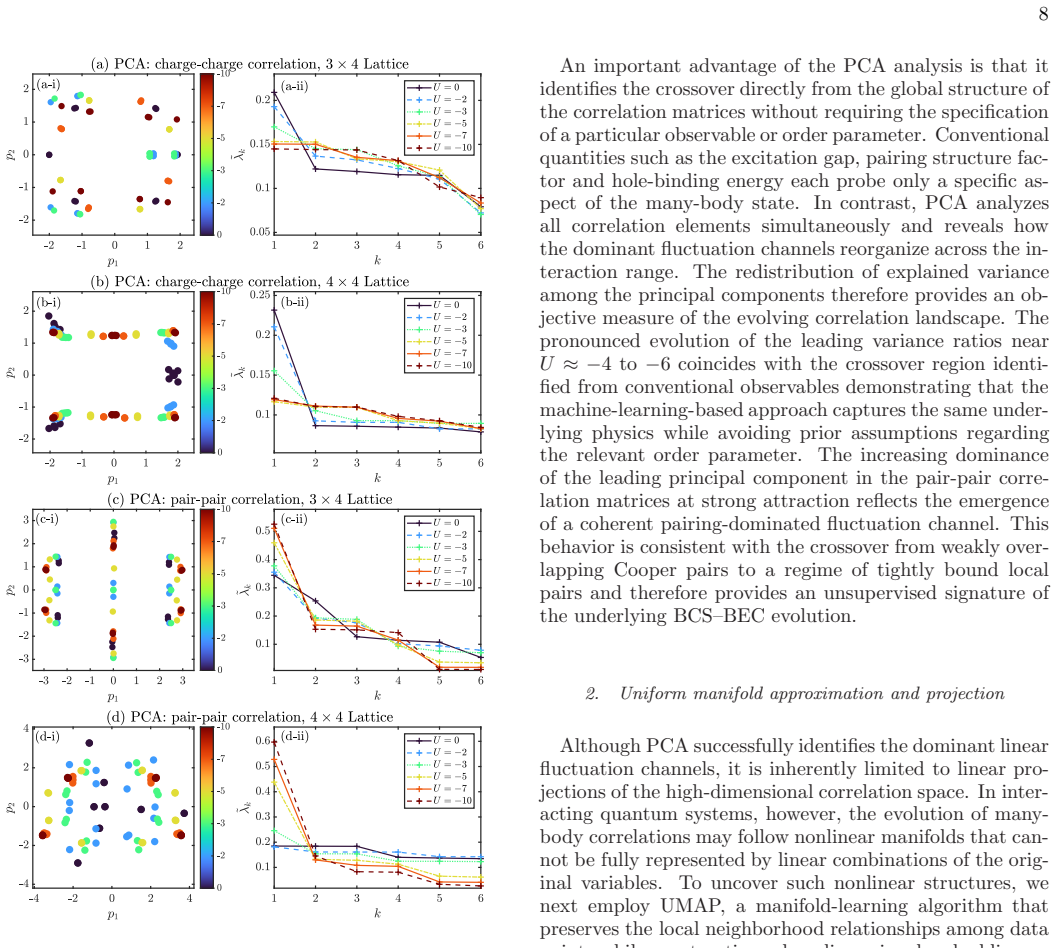
What carries the argument
The key machinery is the competition between kinetic-energy-driven itinerancy and interaction-driven on-site pair formation, encoded in the Hubbard Hamiltonian with attractive U. The analysis is carried by real-space correlation matrices (charge-charge, spin-spin, pair-pair) whose structure is probed by PCA and UMAP, and by hole-binding energies as energetic criteria for bound states. Finite-size scaling uses leading-order 1/Ly extrapolations to connect finite cylinders to the thermodynamic limit.
What would settle it
A reader could compute the same observables on wider cylinders (e.g., Ly=8 or 10) or with periodic boundary conditions in both directions, and check whether the pairing structure factor and leading PCA variance ratio still extrapolate to nonzero values that increase monotonically with |U|, and whether the crossover remains near U ≈ -4 to -6; alternatively, a Quantum Monte Carlo calculation in the 2D thermodynamic limit could test whether the crossover persists.
Extended reading notes
Core claim
The central claim is that the quarter-filled attractive Hubbard model on finite-width cylinders hosts a continuous, interaction-driven crossover from a weakly correlated Fermi regime to a regime of tightly bound singlet pairs, analogous to the BCS-BEC crossover, and that this crossover is located around U ≈ -4 to -6. The authors establish this through multiple independent probes: the excitation gap shows a broad maximum at intermediate attraction; double occupancy rises while local moments fall; charge and pairing structure factors grow while spin correlations are suppressed; and the two-hole binding energy is negative throughout the attractive region while three-hole binding only appears at
Load-bearing premise
The extrapolation to the thermodynamic limit assumes that the leading finite-size corrections scale as 1/Ly, but only five cylinder widths (Ly=2 to 6) are used and the paper itself notes some visible deviations from strict linearity in the intermediate-coupling region.
Editorial extensions
If this is right
- If the crossover is robust, experiments with ultracold fermions in optical lattices at quarter filling should observe a smooth evolution of pairing correlations and a broad maximum in the excitation gap near the predicted interaction range.
- Unsupervised machine learning on correlation matrices can serve as an order-parameter-independent tool for locating interaction-driven crossovers in other strongly correlated models.
- The negative two-hole binding energy throughout the attractive regime and positive four-hole binding energy indicate that the dominant instability is pair formation rather than phase separation, which can guide quantum-gas-microscope searches.
- Finite-size scaling suggests that the pairing structure factor enhancement persists in the thermodynamic limit, so pairing correlations are not merely a small-cluster effect.
Reading between the lines
- The claim that the crossover is 'not a finite-size artifact' rests on a linear 1/Ly extrapolation from only five widths with fixed Lx=4; if higher-order corrections or the narrow circumference matter, the thermodynamic-limit location of the crossover could shift, though the qualitative picture likely survives.
- A natural extension would be to apply the same PCA/UMAP pipeline to other fillings or to models with longer-range interactions to test whether the branch separation in pair-pair correlations is a generic signature of pairing crossovers.
- The identified crossover scale near U ≈ -4 to -6 is close to the bandwidth scale for these cylinders; it would be instructive to test whether the crossover tracks the bandwidth or the density as lattice geometry changes.
Signed reviews
Editorial analysis
A structured set of objections, weighed in public.
Referee Report
Summary. The paper studies the quarter-filled attractive Hubbard model on finite-width cylindrical lattices, fixing Lx=4 and varying Ly from 2 to 6. Exact diagonalization is used for 2x4, 3x4 and 4x4 clusters, and DMRG extends the study to 5x4 and 6x4. The authors report a monotonic lowering of the ground-state energy, a broad maximum of the excitation gap at intermediate coupling, increasing double occupancy and pairing correlations, decreasing spin correlations, negative two-hole binding energy across the attractive regime, and size-dependent three-hole binding. They then apply PCA and UMAP to charge-charge and pair-pair correlation matrices and claim that these unsupervised methods identify the same BCS-BEC-like crossover, centered near U≈-4 to -6, as conventional observables. Finite-size scaling of the ground-state energy, pairing structure factor and leading PCA variance ratio with 1/Ly is used to argue that the crossover signatures persist in the thermodynamic limit.
Significance. If the claims were fully established, the paper would provide a useful multi-method benchmark for the interaction-driven pairing crossover in finite-width attractive Hubbard systems and would demonstrate unsupervised dimensionality reduction as a complement to conventional observables. The strengths of the manuscript include the ED/DMRG cross-validation, the direct hole-binding-energy evidence, the explicit finite-size tables, and the consistency of several standard observables. However, the central thermodynamic-limit claim is only demonstrated for infinitely long four-leg cylinders, not for the two-dimensional square lattice, and the 'unbiased' machine-learning claim is weakened by the use of pairing-sensitive input features. The quantitative results also lack uncertainty estimates. The paper is therefore a sound finite-size study whose broader conclusions need substantial qualification.
major comments (4)
- [Sec. III C, Eqs. (18)-(19); Abstract] The statement that the pairing and PCA signatures are 'robust in the thermodynamic limit' and 'not finite-size artifacts' is stronger than the evidence. Because Lx is fixed at 4 throughout (Sec. II), the extrapolated intercepts a in Eqs. (18) and (19) are thermodynamic limits of an infinitely long 4-leg cylinder, not of the 2D square lattice. The fits use only Ly=2,...,6, the paper admits 'some deviations from strict linearity are visible' (Sec. III C, Fig. 10), and Table II shows a sign change in b with no uncertainties. The authors themselves call the extrapolations 'estimates of the thermodynamic trend rather than precise thermodynamic-limit determinations.' The abstract and conclusion should be qualified to finite-width cylinder extrapolations unless additional scaling in Lx or a justification that 1/Ly captures the leading 2D correction is provided.
- [Sec. III B 1 and Fig. 6-7; Abstract] The claim that PCA/UMAP identify the crossover 'without prior assumptions regarding the relevant order parameters' is overstated. The feature vectors are not the full many-body state but the independent elements of charge-charge and pair-pair correlation matrices (Eq. (2)); the pair-pair matrix is explicitly a pairing-sensitive correlation. Dimensionality reduction of these matrices therefore assumes that pairing correlations are the relevant degrees of freedom. The agreement with conventional observables is reassuring, but it is not an independent or unbiased confirmation. Please replace 'independently' and 'order-parameter-independent' with statements about complementary analysis of a chosen correlation set.
- [Sec. III C, Tables I-II] No uncertainties are reported for the DMRG data or for the fitted parameters a and b in Tables I-II. With five data points and visible deviations from linearity, the fitted values—for example the sign change of b for λ1 at U=-5—cannot be assessed. The authors should report fit errors, goodness-of-fit measures, and DMRG truncation error estimates. This is necessary to support the quantitative location of the crossover at U≈-4 to -6.
- [Sec. III B 2, Fig. 7] UMAP hyperparameters (n_neighbors, min_dist, metric, initialization) and the number of samples per U are not given. The two-branch separation in pair-pair UMAP is a central machine-learning signature; without these settings the result is not reproducible, and it is unknown whether the branching is robust or an artifact of the embedding parameters. Please provide the full UMAP configuration and, ideally, a stability check over hyperparameter choices.
minor comments (4)
- [Sec. III A 1, Fig. 1] The inset of Fig. 1 gives a broad gap maximum at U≈-6 to -7, while the Abstract and Conclusion place the crossover near U≈-4 to -6. These are not inconsistent for a broad crossover, but the text should explicitly acknowledge both estimates to avoid confusion.
- [Sec. II and Sec. III B 1] Feature preprocessing is described inconsistently: Sec. II says the data are standardized by subtracting the mean and dividing by the standard deviation, while Sec. III B 1 says only centering is performed before constructing Σ. Please clarify which preprocessing was actually used.
- [Fig. 4] The horizontal axis R is not defined. If it is a site-distance label or a lattice distance, spell it out and specify how distances are measured under the periodic x and open y boundary conditions.
- [Sec. II, DMRG] The statement that DMRG energies 'are monitored throughout the sweeps and found to converge to the reported precision' is too vague. Please report the largest discarded weight or energy variance per system size and interaction strength so that the reliability of the extrapolations can be judged.
Circularity Check
No significant circularity: the central crossover conclusion rests on direct ED/DMRG observables and standard extrapolations; the ML 'independent confirmation' is overclaimed but is a limitation, not a circular derivation.
full rationale
The paper's physical conclusion—an interaction-driven BCS-BEC-like crossover near U ≈ -4 to -6—is read from independent conventional observables (ground-state energy, excitation gap, double occupancy, local moment, structure factors, hole-binding energies) computed by ED/DMRG, not from any parameter fitted to the target claim. The finite-size scaling in Eqs. (17)-(19) is explicitly presented as an extrapolation ('estimates of the thermodynamic trend rather than precise thermodynamic-limit determinations'), and the extrapolated a and b coefficients are reported as fit parameters, not as predictions derived from elsewhere. The PCA/UMAP sections do use the same ground-state correlation matrices as the conventional pairing observables, so calling the ML result an 'independent' confirmation (Abstract; Sec. III B) is an evidentiary overstatement; however, this is not a circular reduction by construction—the algorithms are deterministic functions of the correlation data and no fitted parameter is renamed as a prediction. Self-citations [47] and [48] are methodological background for PCA/UMAP and are not load-bearing; the BCS-BEC crossover is supported by external literature (e.g., [18], [19], [21]). The skeptical concern about the 1/Ly extrapolation from a fixed Lx = 4 cylinder is a finite-size/correctness risk, not circularity. Accordingly, no step reduces to its own input by definition.
Assumptions & free parameters
free parameters (4)
- finite-size scaling intercept a (thermodynamic-limit estimate) =
varies with U; e.g., 0.165 to 2.040 for SP(0,0) and 0.108 to 0.639 for λ̃1
- finite-size scaling slope b =
varies with U; e.g., -2.507 to 0.526 for SP; -0.529 to 0.651 for λ̃1
- UMAP hyperparameters =
not reported
- crossover scale U_c =
≈ -4 to -6
assumptions (4)
- domain assumption Finite-size energy and correlation corrections on Ly×4 cylinders scale linearly with 1/Ly; Lx=4 with PBC along x is representative of 2D behavior
- domain assumption DMRG with max bond dimension 1200 and ten sweeps converges ground-state energies and correlations to reported precision for 6×4 quarter-filled AHM
- ad hoc to paper PCA/UMAP on charge-charge and pair-pair correlation matrices can expose intrinsic physical regimes; the 'crossover' is a property of these matrices rather than of the chosen observables
- domain assumption The maximum of the excitation gap at intermediate coupling is a valid finite-size signature of the BCS-BEC crossover
Cite this review
Pith. "Pith review of Finite-size effects and interaction-driven crossovers in quarter-filled attractive Hubbard model: Exact diagonalization, DMRG and machine-learning analysis." pith.science (2026). https://pith.science/paper/4NN5XQAG
@misc{pith2026260727916,
  author       = {Pith},
  title        = {Pith review of: Finite-size effects and interaction-driven crossovers in quarter-filled attractive Hubbard model: Exact diagonalization, DMRG and machine-learning analysis},
  year         = {2026},
  howpublished = {\url{https://pith.science/paper/4NN5XQAG}},
  note         = {Machine review of arXiv:2607.27916}
}
read the original abstract
We investigate the quarter-filled attractive Hubbard model on finite-width cylindrical lattices using exact diagonalization (ED), density-matrix renormalization group (DMRG) and unsupervised machine-learning-based techniques. Analysis of the ground-state energetics, local observables and correlation functions reveals a continuous interaction-driven crossover from weakly correlated fermions to a regime dominated by tightly bound singlet pairs. This crossover originates from the competition between kinetic-energy-driven fermionic itinerancy and interaction-driven onsite pair formation and exhibits behavior consistent with the BCS--BEC crossover in the thermodynamic limit. Hole-binding-energy calculations provide direct energetic evidence for pair formation: the two-hole binding energy remains negative throughout the attractive regime whereas three-hole binding emerges only at sufficiently strong attraction and exhibits pronounced finite-size dependence. To obtain an unbiased characterization of the correlation landscape, we apply principal component analysis (PCA) and uniform manifold approximation and projection (UMAP) to the real-space correlation matrices. PCA reveals a systematic redistribution of correlation variance whereas UMAP identifies a clear separation between weak- and strong-pairing regimes. Both machine-learning-based approaches independently identify the same crossover region inferred from conventional observables while providing an order-parameter-independent characterization of the underlying reorganization of many-body correlations. Finite-size scaling analyses of the pairing structure factor and the leading PCA variance ratio demonstrate that these signatures remain robust with increasing system size.
Figures


Figures from the paper (8 more)




Reference graph
Works this paper leans on
-
[1]
Ground-state energy Figure 1 shows the ground-state energy per site E0/M as a function of U for quarter-filled Ly × 4 cylinders with Ly = 2 , 3 and 4. The ED and DMRG results are in excel- lent agreement over the entire interaction range, providing a stringent validation of the DMRG calculations and es- tablishing a reliable basis for the subsequent analys...
-
[2]
In the AHM, increasing negative U favors the formation of onsite singlet pairs, leading to enhanced double occu- pancy and a corresponding suppression of local magnetic moments
Local observables: double occupancy and local moment To gain further insight into the local electronic structure of the ground state, we next examine the average double oc- cupancy and local moment, which provide direct measures of pair formation and local spin fluctuations, respectively. In the AHM, increasing negative U favors the formation of onsite sin...
-
[3]
The inset shows the corresponding average local moment ¯m
At strong attraction, ¯d approaches a large value reflecting the dominance of tightly bound local pairs. The inset shows the corresponding average local moment ¯m. In contrast to ¯d, the local moment decreases monoton- ically with increasing attraction reflecting the suppression of unpaired spins as electrons bind into onsite singlets. The 5 complementary e...
-
[4]
Charge spin and pairing correlations While local observables provide information about onsite pair formation, the nature of the emerging many-body state is more revealed through nonlocal correlation functions. To characterize the competing charge, spin and superconduct- ing fluctuations, we evaluate the charge-charge, spin-spin and pair-pair correlation fu...
-
[5]
In contrast to the spin channel, SP (0, 0) increases monotonically with increasing attraction, demonstrating the strengthening of superconducting correlations
Inset (b) presents the singlet pairing structure factor SP (0, 0). In contrast to the spin channel, SP (0, 0) increases monotonically with increasing attraction, demonstrating the strengthening of superconducting correlations. The simultaneous enhance- ment of SD(π, π) and SP (0, 0) together with the suppres- sion of SL(π, π) reveals a gradual transfer of...
-
[6]
Here, holes are added rela- tive to the quarter-filled ground-state reference
Binding energy of holes To establish whether the enhanced pairing correlations correspond to true bound states, we analyze the two-, three- and four-hole binding energies. Here, holes are added rela- tive to the quarter-filled ground-state reference. We define the two-hole ( EB2), three-hole ( EB3) and four-hole ( EB4) binding energies as EB2 = (E(2) − E(0)...
-
[7]
The three-hole binding energy exhibits a pronounced finite-size dependence
As U → 0, EB2 approaches zero, reflecting the disappearance of pair binding in the non-interacting limit. The three-hole binding energy exhibits a pronounced finite-size dependence. For 3 × 4 cluster, EB3 remains positive for U > −5 and becomes negative for U ≤ − 5 indicating that sufficiently strong attraction can stabilize three-hole clusters on the finite l...
-
[8]
Principal component analysis To obtain an unbiased, machine-learning-based charac- terization of how correlation patterns reorganize across the interaction-driven crossover, we apply PCA directly to the real-space correlation matrices introduced in the pre- vious section. Unlike conventional structure factors, which project correlations onto predetermined...
Show all 67 references
-
[9]
Uniform manifold approximation and projection Although PCA successfully identifies the dominant linear fluctuation channels, it is inherently limited to linear pro- jections of the high-dimensional correlation space. In inter- acting quantum systems, however, the evolution of ma...
-
[10]
The ground-state energy provides a particularly suitable quantity for such an analysis because it is a bulk thermo- dynamic observable that is less sensitive to local boundary effects than correlation functions. By examining the scal- ing of the ground-state energy per site wit...
-
[11]
To further assess the robustness of the pairing correla- tions against finite-size effects, we perform finite-size scal- ing analysis of the singlet pairing structure factor SP (0, 0)
The smooth interaction dependence of both fitting parameters further reinforces the absence of any abrupt change in the ground- state properties across the attractive regime considered. To further assess the robustness of the pairing correla- tions against finite-size effects, we...
-
[12]
The resulting extrapolations should therefore be regarded as estimates of the thermodynamic trend rather than pre- cise thermodynamic-limit determinations
are accessible within our DMRG calculations, we adopt the simplest scaling ansatz containing the leading finite-size correction, SP (0, 0; Ly) = a + b Ly , (18) where a denotes the extrapolated thermodynamic-limit value and b characterizes the leading finite-size correction. The...
-
[13]
X. Zhu, J. Sun, S.-S. Gong, W. Huang, S. Feng, R. T. Scalettar, and H. Guo, Rigorous demonstration of pair- density-wave superconductivity in the σz-hubbard model, Phys. Rev. B 111, 045158 (2025)
2025
-
[14]
D. K. He and Z. Song, η-pairing states in the hubbard model with nonuniform hubbard interaction, Phys. Rev. B 112, 075135 (2025)
2025
-
[15]
Hubbard, Electron correlations in narrow energy bands, Proceedings of the Royal Society of London
J. Hubbard, Electron correlations in narrow energy bands, Proceedings of the Royal Society of London. A. Mathematical and Physical Sciences 276, 238 (1963)
1963
-
[16]
Dagotto, Correlated electrons in high-temperature su- perconductors, Rev
E. Dagotto, Correlated electrons in high-temperature su- perconductors, Rev. Mod. Phys. 66, 763 (1994)
1994
-
[17]
D. P. Arovas, E. Berg, S. A. Kivel- son, and S. Raghu, The hubbard model, Annual Review of Condensed Matter Physics 13, 239 (2022)
2022
-
[18]
The corre- sponding fitting parameters are summarized in Table I in Appendix A
Al- though some deviations from strict linearity are visible, particularly in the intermediate-coupling region where the crossover occurs, the extrapolations provide a useful es- timate of the overall thermodynamic trend. The corre- sponding fitting parameters are summarized in...
-
[19]
and the corresponding fit- ting parameters are summarized in Table II in Appendix B. While deviations from strict linear behavior are visible for some interaction strengths particularly near the crossover region, the extrapolated values reveal clear and systematic interaction-d...
-
[20]
L. M. Falicov, The mott transition: Metal-insulator transitions, n. f. mott. taylor and francis, london, and barnes and noble, new york, 1974, xvi, 278 pp., Science 188, 1007 (1975)
1974
-
[21]
M. C. Gutzwiller, Effect of correlation on the ferromagnetism of transition metals, Phys. Rev. Lett. 10, 159 (1963)
1963
-
[22]
Kanamori, Electron Correlation and Ferromagnetism of Transition Metals, Progress of Theoretical Physics 30, 275 (1963)
J. Kanamori, Electron Correlation and Ferromagnetism of Transition Metals, Progress of Theoretical Physics 30, 275 (1963)
1963
-
[23]
Kobayashi and S
K. Kobayashi and S. Hayami, Skyrmion and vortex crystals in the hubbard model, Phys. Rev. B 106, L140406 (2022)
2022
-
[24]
M. F. Equbal and M. A. H. Ahsan, Binding of holes and competing spin-charge order in simple and extended hub- bard model on cylindrical lattice: An exact diagonalizatio n study, arXiv preprint arXiv:2512.10577 (2025)
2025
-
[25]
M. F. Equbal and M. A. H. Ahsan, Emergence of correlation-driven altermagnetism in hubbard model on geometrically frustrated lattice-clusters, arXiv preprint arXiv:2603.00536 (2026)
2026 arXiv
-
[26]
Micnas, J
R. Micnas, J. Ranninger, and S. Robaszkiewicz, Supercon- ductivity in narrow-band systems with local nonretarded attractive interactions, Rev. Mod. Phys. 62, 113 (1990)
1990
-
[27]
Q. Chen, Z. Wang, R. Boyack, S. Yang, and K. Levin, When superconductivity crosses over: From bcs to bec, Rev. Mod. Phys. 96, 025002 (2024)
2024
-
[28]
C. F. Chan, M. Gall, N. Wurz, and M. K¨ ohl, Pair correlations in the attractive hubbard model, Phys. Rev. Res. 2, 023210 (2020)
2020
-
[29]
A. F. Ho, M. A. Cazalilla, and T. Giamarchi, Quantum simulation of the hubbard model: The attractive route, Phys. Rev. A 79, 033620 (2009)
2009
-
[30]
Chanda, L
T. Chanda, L. Barbiero, M. Lewenstein, M. J. Mark, and J. Zakrzewski, Recent progress on quan- tum simulations of non-standard bose–hubbard models, Reports on Progress in Physics 88, 044501 (2025)
2025
-
[31]
R. T. Scalettar, E. Y. Loh, J. E. Gubernatis, A. Moreo, S. R. White, D. J. Scalapino, R. L. Sugar, and E. Dagotto, Phase diagram of the two-dimensional negative-u hubbard model, Phys. Rev. Lett. 62, 1407 (1989)
1989
-
[32]
Kaneko and Y
T. Kaneko and Y. Ohta, Bcs–bec crossover in the two-dimensional attractive hub- bard model: Variational cluster approach, Journal of the Physical Society of Japan 83, 024711 (2014)
2014
-
[33]
R. A. Fontenele, N. C. Costa, R. R. dos Santos, and T. Paiva, Two-dimensional attractive hubbard model and the bcs-bec crossover, Phys. Rev. B 105, 184502 (2022)
2022
-
[34]
T. Shen, H. Barghathi, A. Del Maestro, and B. M. Ruben- stein, Disentangling the physics of the attractive hubbard model as a fully interacting model of fermions via the accessible and symmetry-resolved entanglement entropies , Phys. Rev. B 109, 195119 (2024)
2024
-
[35]
Karakuzu, K
S. Karakuzu, K. Seki, and S. Sorella, Study of the supercon- ducting order parameter in the two-dimensional negative- u hubbard model by grand-canonical twist-averaged bound- ary conditions, Phys. Rev. B 98, 075156 (2018)
2018
-
[36]
M. F. Equbal, S. R. Hassan, and M. A. H. Ahsan, Exact diagonalization study of ground state properties and level statistics in simple and extended hubbard lattice cluster, Physica Scripta 100, 035964 (2025)
2025
-
[37]
Tarruell and L
L. Tarruell and L. Sanchez-Palencia, Quantum simulation of the Hubbard model with ultracold fermions in optical lattices, Comptes Rendus. Physique 19, 365 (2018)
2018
-
[38]
C. Chin, R. Grimm, P. Julienne, and E. Tiesinga, Feshbach resonances in ultracold gases, Rev. Mod. Phys. 82, 1225 (2010)
2010
-
[39]
M. Boll, T. A. Hilker, G. Salomon, A. Omran, J. Ne- spolo, L. Pollet, I. Bloch, and C. Gross, Spin- and density- resolved microscopy of antiferromagnetic correlations in fermi-hubbard chains, Science 353, 1257 (2016)
2016
-
[40]
D. K. Mark, H.-Y. Hu, J. Kwan, C. Kokail, S. Choi, and S. F. Yelin, Efficiently measuring d-wave pair- ing and beyond in quantum gas microscopes, Phys. Rev. Lett. 135, 123402 (2025)
2025
-
[41]
Gross and I
C. Gross and I. Bloch, Quantum simulations with ultracold atoms in optical lattices, Science 357, 995 (2017)
2017
-
[42]
Nakagawa, H
M. Nakagawa, H. Katsura, and M. Ueda, Exact eigen- states of multicomponent hubbard models: Su( n) magnetic η pairing, weak ergodicity breaking, and partial integrabil - ity, Phys. Rev. Res. 6, 043259 (2024)
2024
-
[43]
Guthmann, F
A. Guthmann, F. Lang, L. M. Kienesberger, S. Barbosa, and A. Widera, Floquet engineering of feshbach resonances in ultracold gases, Science Advances 11, eadw3856 (2025)
2025
-
[44]
J. E. Hirsch, Two-dimensional hubbard model: Numerical simulation study, Phys. Rev. B 31, 4403 (1985)
1985
-
[45]
S. R. White, D. J. Scalapino, R. L. Sugar, E. Y. Loh, J. E. Gubernatis, and R. T. Scalettar, Nu- merical study of the two-dimensional hubbard model, Phys. Rev. B 40, 506 (1989)
1989
-
[46]
Callaway, D
J. Callaway, D. P. Chen, D. G. Kanhere, and Q. Li, Small- cluster calculations for the simple and extended hubbard models, Phys. Rev. B 42, 465 (1990)
1990
-
[47]
W.-C. Chen, Y. Wang, and C.-C. Chen, Superconduct- ing phases of the square-lattice extended hubbard model, Phys. Rev. B 108, 064514 (2023)
2023
-
[48]
V. B. Shenoy, Phase diagram of the attractive hubbard model with inhomogeneous interactions, Phys. Rev. B 78, 134503 (2008)
2008
-
[49]
Toschi, M
A. Toschi, M. Capone, and C. Castellani, Energetic bal- ance of the superconducting transition across the bcs— bose einstein crossover in the attractive hubbard model, Phys. Rev. B 72, 235118 (2005)
2005
-
[50]
Jiang and T
H.-C. Jiang and T. P. Devereaux, Superconductivity in the doped hubbard model and its interplay with next-nearest hopping, Science 365, 1424 (2019)
2019
-
[51]
Jiang, J
Y.-F. Jiang, J. Zaanen, T. P. Devereaux, and H.-C. Jiang, Ground state phase diagram of the doped hubbard model on the four-leg cylinder, Phys. Rev. Res. 2, 033073 (2020)
2020
-
[52]
Jiang and S
H.-C. Jiang and S. A. Kivelson, Stripe order en- hanced superconductivity in the hubbard model, Proceedings of the National Academy of Sciences 119, e2109406119 (2022)
2022
-
[53]
Jiang, T
Y.-F. Jiang, T. P. Devereaux, and H.-C. Jiang, Ground-state phase diagram and superconductivity of the doped hubbard model on six-leg square cylinders, 15 Phys. Rev. B 109, 085121 (2024)
2024
-
[54]
Wang, Discovering phase transitions with unsupervised learning, Phys
L. Wang, Discovering phase transitions with unsupervised learning, Phys. Rev. B 94, 195105 (2016)
2016
-
[55]
W. Hu, R. R. P. Singh, and R. T. Scalettar, Discov- ering phases, phase transitions, and crossovers through unsupervised machine learning: A critical examination, Phys. Rev. E 95, 062122 (2017)
2017
-
[56]
N. C. Costa, W. Hu, Z. J. Bai, R. T. Scalettar, and R. R. P. Singh, Principal component analysis for fermionic critica l points, Phys. Rev. B 96, 195138 (2017)
2017
-
[57]
Kiwata, Deriving the order parameters of a spin- glass model using principal component analysis, Phys
H. Kiwata, Deriving the order parameters of a spin- glass model using principal component analysis, Phys. Rev. E 99, 063304 (2019)
2019
-
[58]
McInnes, J
L. McInnes, J. Healy, and J. Melville, Umap: Uniform man- ifold approximation and projection for dimension reductio n, arXiv preprint arXiv:1802.03426 (2020)
2020 arXiv
-
[59]
Teixeira, V
J. Teixeira, V. Rocha, J. Oliveira, P. A. S. Jorge, and N. A. Silva, Towards real-time identification of trapped particles with umap-based classifiers, Journal of Physics: Conference Series 2407, 012043 (2022)
2022
-
[60]
Khatami, Principal component analysis of the magnetic transition in the three-dimensional fermi-hubbard model, Journal of Physics: Conference Series 1290, 012006 (2019)
E. Khatami, Principal component analysis of the magnetic transition in the three-dimensional fermi-hubbard model, Journal of Physics: Conference Series 1290, 012006 (2019)
2019
-
[61]
Fahad Equbal, S
M. Fahad Equbal, S. R. Hassan, and M. A. H. Ahsan, Principal component analysis of compet- ing correlations in quarter-filled hubbard models, Physica Scripta 101, 215921 (2026)
2026
-
[62]
M. F. Equbal and M. A. H. Ahsan, Spin-resolved mott crossover and entanglement in the half-filled hubbard model, Annals of Physics 488, 170414 (2026)
2026
-
[63]
C. R. Sarma and M. A. H. Ahsan, Elec- tron correlation studies: Rumer basis approach, International Journal of Quantum Chemistry 60, 147 (1996)
1996
-
[64]
Alvarez, The density matrix renormal- ization group for strongly correlated elec- tron systems: A generic implementation, Computer Physics Communications 180, 1572 (2009)
G. Alvarez, The density matrix renormal- ization group for strongly correlated elec- tron systems: A generic implementation, Computer Physics Communications 180, 1572 (2009)
2009
-
[65]
Alvarez, L
G. Alvarez, L. G. G. V. Dias da Silva, E. Ponce, and E. Dagotto, Time evolution with the density- matrix renormalization-group algorithm: A generic im- plementation for strongly correlated electronic systems, Phys. Rev. E 84, 056706 (2011)
2011
-
[66]
Alvarez, Implementation of the su(2) hamil- tonian symmetry for the dmrg algorithm, Computer Physics Communications 183, 2226 (2012)
G. Alvarez, Implementation of the su(2) hamil- tonian symmetry for the dmrg algorithm, Computer Physics Communications 183, 2226 (2012)
2012
-
[67]
Alvarez, Production of minimally entangled typ- ical thermal states with the krylov-space approach, Phys
G. Alvarez, Production of minimally entangled typ- ical thermal states with the krylov-space approach, Phys. Rev. B 87, 245130 (2013)
2013
Reviewed August 4, 2026 · model on record in the stance chip above.
Discussion (0). Continue with ORCID to comment.