REVIEW 3 major objections 6 minor 97 references
Brightest-first stacking of associated HI 21 cm non-detections at 0.4<z<1 yields tentative absorption that vanishes as weaker sources raise stack optical depth; intervening stacks stay null, and one new direct detection matches the survey’s
Reviewed by Pith at T0; open to challenge. T0 means a machine referee read the full paper against a public rubric. the ladder, T0–T4 →
T0 review · grok-4.5
2026-07-31 21:34 UTC pith:367AEFZV
load-bearing objection One solid new associated absorber plus careful FLASH limits and a useful sensitivity meta-check; the ordered-stacking “tentative detections” are the soft part and already undercut by the paper’s own bootstrap. the 3 major comments →
A search for HI absorption in distant star-forming galaxies with ASKAP-FLASH - II. Direct observations and stacking of 21 cm line
The pith
A machine-rendered reading of the paper's core claim, the machinery that carries it, and where it could break.
Core claim
For the first time at 0.4<z<1, ordered (brightest-first) stacking of associated non-detections produces FLASHFINDER-flagged candidate HI 21 cm absorption features at N=5 that become undetectable as progressively weaker continuum sources raise the stack optical-depth rms, while intervening stacks remain null; the single direct detection and a meta-analysis of HI 21 cm surveys imply that about one detection is expected for these survey parameters, with no significant star-forming versus radio-galaxy rate difference.
What carries the argument
Brightest-first optical-depth stacking: spectra are converted to observed optical depth, shifted to the optical redshift prior, and median-coadded in descending continuum brightness so that stack optical-depth rms rises as fainter sources enter, testing when any average absorption remains detectable.
Load-bearing premise
That the absorption-like features flagged in the five-brightest associated and spare-fibre stacks are real average HI signals rather than continuum-subtraction residuals or noise that adds constructively.
What would settle it
Rebuild the brightest-first associated stack with an independent sample of similar continuum flux and redshift (or with deeper spectra that hold optical-depth limits fixed while increasing N) and test whether a near-zero-velocity feature is recovered whose minimum amplitude is supported by bootstrap resampling and is free of continuum-subtraction artefacts.
If this is right
- Associated HI 21 cm stacking at 0.4<z<1 only remains informative while background sources keep the stack optical-depth limit low.
- Covering factor suppresses intervening stacks more than associated stacks by effectively dimming the background continuum.
- UV star-forming selection does not raise associated 21 cm detection rates above the general radio-galaxy population at these redshifts.
- For FLASH-like sensitivity and sample sizes, of order one associated detection is the expected yield.
- Uniform optical-depth survey design or substantially deeper spectra are required before complete non-detection stacks can trace cool HI statistically at intermediate redshift.
Where Pith is reading between the lines
- Absorption stacking pipelines should weight or cut on continuum brightness (or per-spectrum optical-depth limit) instead of co-adding all non-detections equally.
- Null intervening stacks at 30–120 kpc impact parameters imply that intermediate-z pair searches need much tighter alignments, or secure background redshifts, before stacking helps.
- If the narrow, redshifted spare-fibre stack feature is physical, associated absorption profiles may differ between star-forming hosts and ordinary radio galaxies—a split larger samples can test.
Editorial analysis
A structured set of objections, weighed in public.
Referee Report
Summary. This paper searches for associated and intervening H I 21 cm absorption at 0.4 < z < 1.0 toward UV-selected star-forming (WiggleZ-type) galaxies and a control sample of radio galaxies (SPARE_RADIO), using ASKAP-FLASH spectra. The main solid result is a new associated absorber in NVSS J214954-004657 at z_HI = 0.863 (ln B = 8.0 with optical redshift prior; re-confirmed in prior SBIDs). No other direct detections are found among bright associated/offset targets. The authors stack non-detections ordered by descending continuum brightness and report FLASHFINDER-flagged candidate features in the N = 5 associated and spare-fibre stacks that disappear as weaker sources raise stack optical-depth rms; intervening stacks remain null. A literature meta-analysis of detection rate versus mean line strength implies ~1 detection is expected given FLASH sensitivity, and no significant SF-versus-radio-galaxy rate difference is claimed. UV ionising-photon rates are shown to lie below the critical luminosity of Curran & Whiting (2012).
Significance. A carefully reduced intermediate-redshift FLASH search with spectroscopic priors, multi-SBID confirmation of one absorber, explicit upper limits (Tables 3–4), ionising-photon-rate checks, and a quantitative sensitivity meta-comparison is useful for the field as SKA-pathfinder absorption surveys mature. The null intervening stacks and the demonstration that stack τ_rms rises when faint sources are co-added are methodologically informative even if the N = 5 features are not physical. The paper does not claim a large new absorber sample; its value is in documenting FLASH limits for SF-selected targets and in framing why absorption stacking at these redshifts is hard. Strengths include re-observation consistency (Table 5), dual stacking codes (LINESTACKER/HISS), and transparent bootstrap caveats.
major comments (3)
- [Abstract; §5.2.1–5.2.4; §7] Abstract and §5.2 / §7(i): The headline claim of “tentative detections of stacked H I 21 cm absorption… when stacked in order of descending radio source brightness” is not supported by the paper’s own statistics. §5.2.1 notes the associated N = 5 feature (ln B = 36.9, FWHM ~227 km s⁻¹) may arise from imperfect continuum subtraction; §5.2.3 notes the spare-fibre N = 5 feature is redshifted by +175 km s⁻¹ with a narrow 19.7 km s⁻¹ width atypical of associated absorption; and §5.2.4 bootstrap resampling explicitly finds that N = 5 stack minima are not statistically supported and do not overlap the resampled distributions. High ln B on stacked optical-depth spectra therefore cannot be treated as evidence of average cool H I. The abstract, conclusions, and any “first time at these redshifts” phrasing should be rewritten so that the primary stacking result is the null/buried outcome and the op
- [§6.5.2; Fig. 12] §6.5.2 and Fig. 12: The expected-detection-rate argument rests on an orthogonal-distance-regression power-law fit to only six literature survey points (plus the Su et al. 2022 endpoint that strongly leverages the slope). The quoted r_det ≈ 0.9 ± 4% for this work’s mean line strength is consistent with one detection, but the uncertainty and leverage of a single faint-source survey should be stress-tested (e.g., jackknife omitting Su+2022; alternative functional forms; explicit Poisson expectation). Without that, the claim that “1 detection is expected given the survey parameters” is suggestive rather than robust and should be softened or accompanied by a sensitivity table.
- [§5.2.2; §6.3.3–6.3.4] §5.2.2 and §6.3.3–6.3.4: For intervening (offset) stacks and non-detections, the interpretation leans on unknown background fractions and covering factors (Roster et al. 2026 photometric mix is cited globally, not per sightline). The paper correctly notes that incomplete covering effectively weakens S_c, but the quantitative discussion still treats co-added flux as if geometry were secondary. Either restrict intervening conclusions to “no stacked signal under FLASH limits and unknown f_c” or add a simple Monte Carlo (draw background probability ~0.5 and f_c < 1) showing that a null stack is expected even if associated gas were present. As written, the geometric explanation is plausible but not demonstrated for this sample.
minor comments (6)
- [Table 3; §4.2] Table 3 note and offset row 5 (J144546-013041): A non-null ΔS_peak / τ_obs is listed with a dagger in the spare-fibre table convention, but the associated/offset bright search text (§4.2) states no significant detections. Clarify whether this is a non-significant prior-based feature, a table error, or an upper-limit formatting inconsistency.
- [Fig. 2] Fig. 2 caption vs text: Caption says 15 bright associated / 21 bright offset before primary-component cuts; body uses 10 / 15 after cuts. State the post-cut numbers in the figure caption to avoid confusion.
- [§3.2; Tables 3–4] Eqs. (1)–(3): The optically thin approximation and the N_HI f_c / T_s reporting are standard; briefly state the assumed FWHM = 30 km s⁻¹ template for 3σ limits in the main text near the tables, not only in table notes.
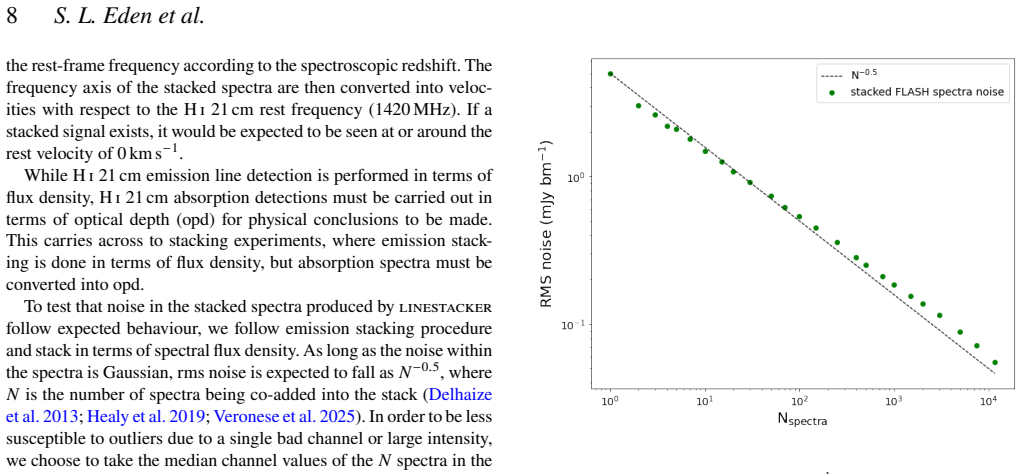
- [§5.1; Fig. 4] §5.1: Noise scaling is shown for one “GOOD” cube (Fig. 4). A short note on how many stacked spectra fall in ducting-flagged bands after masking would help readers judge residual non-Gaussianity at N ≳ 300.
- [Throughout] Typos / notation: “Y oon” spacing in author list and citations; “T wenty-cm”; “boostrapping” (§5.2.4); inconsistent z_HI vs z_opt precision. Standardise FLASHFINDER / LINESTACKER capitalisation.
- [§6.1; Abstract] §6.1 sample-size comparison (10 vs 23): The Gehrels errors are appropriate; consider stating explicitly that the SF versus control rate difference is unconstrained rather than “no significant difference,” which can be read as a null result with power.
Circularity Check
No significant circularity: observational FLASH search with external redshifts, independent spectra, and a literature meta-check; results are not forced by construction.
full rationale
This is a standard observational absorption/stacking paper. The single associated detection (NVSS J214954-004657) is measured from FLASH spectra at an independent optical redshift prior and re-confirmed in prior SBIDs; it is not derived from a fitted model of the same quantity. Ordered stacking and FLASHFINDER ln B flags are empirical co-adds of non-detection spectra; the paper itself reports that bootstrap resampling does not support the N=5 features as robust, so those candidates are not presented as closed-form predictions forced by inputs. The meta-analysis fits an empirical r_det vs mean line-strength trend to external surveys (Vermeulen, Geréb, Maccagni, Murthy, Su, Aditya) and checks consistency of this work’s sensitivity and one detection with that external relation—an ordinary consistency test, not a self-fit renamed as prediction. Dependence on Eden et al. (2025) is sample-construction continuity for the same series, and Curran co-author citations supply context (UV critical luminosity, literature limits), not a uniqueness theorem that forces the detection rate or stacking claim. No step reduces a claimed first-principles or predicted result to its own defining inputs.
Axiom & Free-Parameter Ledger
free parameters (5)
- Bright-source flux cut =
30 mJy
- Associated vs offset angular cuts =
5 and 20 arcsec
- Upper-limit Gaussian FWHM template =
30 km/s FWHM, 3σ peak
- Literature r_det vs mean line-strength power-law fit =
log10 r_det ≈ −⟨log N⟩ + 19
- Stack inspection N and ordering =
N=5, descending peak flux
axioms (6)
- domain assumption Optically thin approximation τ≈ΔS/(f_c S_c) and N_HI≈1.823e18 (T_s/f_c)∫τ_obs dv
- domain assumption FLASHFINDER ln B ≳8 with spectroscopic redshift prior indicates a credible line; blind threshold much higher (ln B≥30)
- domain assumption Median stacking after rest-frame rebinning preserves any common absorption while rms falls ~N^{-0.5} until non-Gaussian noise dominates
- domain assumption WiggleZ-type UV selection implies substantial cool HI reservoirs available for absorption
- standard math Concordance cosmology Ω_Λ=0.7, Ω_m=0.3, H_0=70 km/s/Mpc for physical scales
- ad hoc to paper For intervening stacks, many continuum sources can be treated as background with non-negligible covering factor unless proven otherwise
read the original abstract
We present results of a search for associated and intervening HI 21 cm absorption in star-forming galaxies and a control sample of radio galaxies at 0.4 < $z$ < 1.0, using ASKAP's FLASH HI 21 cm absorption survey. We report the detection of a new HI 21 cm absorption line in radio galaxy NVSS J214954-004657 at $z_{\mathrm{HI}}$ = 0.863. Additionally, we present results of HI 21 cm stacking for associated and intervening star-forming and radio galaxy catalogues. For the first time at these redshifts, we report tentative detections of stacked HI 21 cm absorption for associated galaxies when stacked in order of descending radio source brightness, and show that these tentative detections become buried as optical depth increases as progressively weaker sources are co-added into the stack. No stacked signal is detected when co-adding intervening galaxy spectra. We speculate that the ability to detect a stacked HI 21 cm detection is dependent on the background source optical depth limits, as well as source covering factors. Covering factor has a greater impact when stacking intervening systems, and can be considered to effectively weaken the observed flux density of a radio source. We find no significant difference in detection rate for associated HI 21 cm absorption in star-forming galaxies versus the general radio-source population at the same redshift. Although detection rates are low, from a meta-analysis of HI 21 cm surveys we find that 1 detection is expected given the survey parameters.
Figures




Reference graph
Works this paper leans on
-
[1]
HISS, a new tool for H I stacking: application to NIBLES spectra. , keywords =. doi:10.1093/mnras/stz1555 , archivePrefix =. 1908.00517 , primaryClass =
Pith/arXiv arXiv 1908
-
[3]
The WiggleZ Dark Energy Survey: final data release and the metallicity of UV-luminous galaxies. , keywords =. doi:10.1093/mnras/stx2963 , archivePrefix =. 1910.08284 , primaryClass =
Pith/arXiv arXiv 1910
-
[5]
Cosmic Frontiers , year = 2007, series =
The Red-Sequence Cluster Surveys. Cosmic Frontiers , year = 2007, series =
2007
-
[6]
The Fourth Data Release of the Sloan Digital Sky Survey. , keywords =. doi:10.1086/497917 , archivePrefix =. astro-ph/0507711 , primaryClass =
-
[7]
Overview of the DESI Legacy Imaging Surveys. , keywords =. doi:10.3847/1538-3881/ab089d , archivePrefix =. 1804.08657 , primaryClass =
-
[8]
The Dark Energy Survey Data Release 2. , keywords =. doi:10.3847/1538-4365/ac00b3 , archivePrefix =. 2101.05765 , primaryClass =
-
[9]
Ionization of the atomic gas in redshifted radio sources. , keywords =. doi:10.1093/mnras/stz038 , archivePrefix =. 1901.00887 , primaryClass =
Pith/arXiv arXiv 1901
-
[11]
The H I absorption zoo: JVLA extension to z 0.4. , keywords =. doi:10.1051/0004-6361/202141566 , archivePrefix =. 2108.08122 , primaryClass =
-
[12]
LINESTACKER: a spectral line stacking tool for interferometric data. , keywords =. doi:10.1093/mnras/staa2908 , archivePrefix =. 2007.00829 , primaryClass =
Pith/arXiv arXiv 2007
-
[14]
The role of neutral hydrogen in radio galaxies. , keywords =. doi:10.1016/j.newar.2006.11.024 , archivePrefix =. astro-ph/0701435 , primaryClass =
Pith/arXiv arXiv 2006
-
[15]
Cold gas accretion in galaxies. , keywords =. doi:10.1007/s00159-008-0010-0 , archivePrefix =. 0803.0109 , primaryClass =
-
[16]
Neutral hydrogen gas, past and future star formation in galaxies in and around the `Sausage' merging galaxy cluster. , keywords =. doi:10.1093/mnras/stv1462 , archivePrefix =. 1506.08822 , primaryClass =
-
[17]
The CO-to-H _ 2 Conversion Factor. , keywords =. doi:10.1146/annurev-astro-082812-140944 , archivePrefix =. 1301.3498 , primaryClass =
-
[18]
The Relationship between Gas Content and Star Formation in Molecule-rich Spiral Galaxies. , keywords =. doi:10.1086/339287 , archivePrefix =. astro-ph/0112204 , primaryClass =
-
[19]
Neutral hydrogen in nearby elliptical and lenticular galaxies: the continuing formation of early-type galaxies. , keywords =. doi:10.1111/j.1365-2966.2006.10681.x , archivePrefix =. astro-ph/0606261 , primaryClass =
arXiv 2006
-
[20]
xGASS: H I Fueling of Star Formation in Disk-dominated Galaxies. , keywords =. doi:10.3847/1538-4357/ab68dd , archivePrefix =. 2001.01970 , primaryClass =
Pith/arXiv arXiv 2001
-
[21]
Tidal disruption of the Magellanic Clouds by the Milky Way. , keywords =. doi:10.1038/29466 , archivePrefix =. astro-ph/9808023 , primaryClass =
-
[22]
Highest Redshift Image of Neutral Hydrogen in Emission: A CHILES Detection of a Starbursting Galaxy at z = 0.376. , keywords =. doi:10.3847/2041-8205/824/1/L1 , archivePrefix =. 1606.00013 , primaryClass =
Pith/arXiv arXiv 2041
-
[23]
Detection of H I 21 cm emission from a strongly lensed galaxy at z 1.3. , keywords =. doi:10.1093/mnras/stac3696 , archivePrefix =. 2301.05987 , primaryClass =
-
[24]
FLASH pilot survey: detections of associated 21 cm H I absorption in GAMA galaxies at 0.42 < z < 1.00. , keywords =. doi:10.1093/mnras/stac2257 , archivePrefix =. 2208.04569 , primaryClass =
-
[25]
A comparative study of intervening and associated H I 21-cm absorption profiles in redshifted galaxies. , keywords =. doi:10.1093/mnras/stw1938 , archivePrefix =. 1608.01055 , primaryClass =
-
[26]
The evolution of disk galaxies and the origin of S0 galaxies. , keywords =. doi:10.1086/157917 , adsurl =
-
[27]
The Dawes Review 9: The role of cold gas stripping on the star formation quenching of satellite galaxies. , keywords =. doi:10.1017/pasa.2021.18 , archivePrefix =. 2104.02193 , primaryClass =
Pith/arXiv arXiv 2021
-
[28]
Pilot survey data release and first results
The first large absorption survey in H I (FLASH): II. Pilot survey data release and first results. , keywords =. doi:10.1017/pasa.2025.10046 , archivePrefix =. 2408.06626 , primaryClass =
arXiv 2025
-
[29]
Science goals and survey design
The First Large Absorption Survey in H I (FLASH): I. Science goals and survey design. , keywords =. doi:10.1017/pasa.2022.3 , archivePrefix =. 2110.00469 , primaryClass =
Pith/arXiv arXiv 2022
-
[30]
Optical and Radio Properties of Extragalactic Sources Observed by the FIRST Survey and the Sloan Digital Sky Survey. , keywords =. doi:10.1086/344069 , archivePrefix =. astro-ph/0202408 , primaryClass =
-
[31]
Probing the gas content of radio galaxies through H I absorption stacking. , keywords =. doi:10.1051/0004-6361/201423999 , archivePrefix =. 1407.1799 , primaryClass =
-
[32]
Application of a Bayesian Method to Absorption Spectral-Line Finding in Simulated ASKAP Data. , keywords =. doi:10.1071/AS11040 , archivePrefix =. 1109.3539 , primaryClass =
-
[33]
Physical conditions and the location of the absorption-line systems in the QSO 3C 286 and the BL Lacertae object PKS 0735+178. , keywords =. doi:10.1086/153821 , adsurl =
-
[34]
The Large Area Radio Galaxy Evolution Spectroscopic Survey (LARGESS): survey design, data catalogue and GAMA/WiggleZ spectroscopy. , keywords =. doi:10.1093/mnras/stw2396 , archivePrefix =. 1609.05578 , primaryClass =
-
[35]
Source-Finding for the Australian Square Kilometre Array Pathfinder. , keywords =. doi:10.1071/AS12028 , archivePrefix =. 1208.2479 , primaryClass =
-
[36]
Astronomical Data Analysis Software and Systems XXVII , year = 2020, series =
High-performance Pipeline Processing for ASKAP. Astronomical Data Analysis Software and Systems XXVII , year = 2020, series =
2020
-
[37]
The FIRST Survey: Faint Images of the Radio Sky at Twenty Centimeters. , keywords =. doi:10.1086/176166 , adsurl =
-
[38]
Redshift evolution of the H I detection rate in radio-loud active galactic nuclei. , keywords =. doi:10.1051/0004-6361/202142550 , archivePrefix =. 2201.06625 , primaryClass =
-
[39]
The last survey of the old Westerbork Synthesis Radio Telescope
Kinematics and physical conditions of H I in nearby radio sources. The last survey of the old Westerbork Synthesis Radio Telescope. , keywords =. doi:10.1051/0004-6361/201730563 , archivePrefix =. 1705.00492 , primaryClass =
-
[40]
, keywords =
Are compact steep-spectrum sources young?. , keywords =
-
[41]
High-resolution observations of low-luminosity gigahertz-peaked spectrum and compact steep-spectrum sources. , keywords =. doi:10.1093/mnras/sty564 , archivePrefix =. 1802.09666 , primaryClass =
-
[42]
The Compact Steep-Spectrum and Gigahertz Peaked-Spectrum Radio Sources. , keywords =. doi:10.1086/316162 , adsurl =
-
[43]
A Giant Metrewave Radio Telescope search for associated H I 21 cm absorption in high-redshift flat-spectrum sources. , keywords =. doi:10.1093/mnras/stv2563 , archivePrefix =. 1511.04767 , primaryClass =
-
[44]
Complete Ionization of the Neutral Gas: Why There are So Few Detections of 21 cm Hydrogen in High-redshift Radio Galaxies and Quasars. , keywords =. doi:10.1088/0004-637X/759/2/117 , archivePrefix =. 1204.2881 , primaryClass =
-
[45]
Selection and analysis of the radio sample
A search for H I absorption in distant star-forming galaxies with ASKAP-FLASH - I. Selection and analysis of the radio sample. , year = 2025, month = jan, volume =. doi:10.1093/mnras/stae2581 , archivePrefix =. 2411.09443 , adsurl =
Pith/arXiv arXiv 2025
-
[46]
Absorption Systems in the Spectra of 66 Z> -0.5ex 4 Quasars. , keywords =. doi:10.1086/319967 , archivePrefix =. astro-ph/0101179 , primaryClass =
-
[47]
Further observational evidence for a critical ionizing luminosity in active galaxies. , keywords =. doi:10.1093/mnras/stx1572 , archivePrefix =. 1706.06508 , primaryClass =
-
[48]
A survey for the missing hydrogen in high-redshift radio sources. , keywords =. doi:10.1093/mnras/sts171 , archivePrefix =. 1210.1886 , primaryClass =
-
[49]
A reference tool for identification of astronomical sources
The ALADIN interactive sky atlas. A reference tool for identification of astronomical sources. , keywords =. doi:10.1051/aas:2000331 , adsurl =
-
[50]
The Dark Energy Survey: Data Release 1. , keywords =. doi:10.3847/1538-4365/aae9f0 , archivePrefix =. 1801.03181 , primaryClass =
-
[51]
The Galaxy Evolution Explorer: A Space Ultraviolet Survey Mission. , keywords =. doi:10.1086/426387 , archivePrefix =. astro-ph/0411302 , primaryClass =
-
[52]
A correlation between the H I 21-cm absorption strength and impact parameter in external galaxies. , keywords =. doi:10.1093/mnras/stw943 , archivePrefix =. 1604.05388 , primaryClass =
-
[53]
IEEE Proceedings , year = 2009, month = aug, volume =
MeerKAT - The South African Array With Composite Dishes and Wide-Band Single Pixel Feeds. IEEE Proceedings , year = 2009, month = aug, volume =. doi:10.1109/JPROC.2009.2020713 , adsurl =
arXiv 2009
-
[54]
The depletion of star-forming gas by AGN activity in radio sources. , keywords =. doi:10.1017/pasa.2024.1 , archivePrefix =. 2401.00962 , primaryClass =
Pith/arXiv arXiv 2024
-
[55]
VLBA Observations of H I in the Archetype Compact Symmetric Object B2352+495. , keywords =. doi:10.1088/0004-6256/139/1/17 , archivePrefix =. 0910.5035 , primaryClass =
-
[56]
High-resolution imaging of the radio continuum and neutral gas in the inner kiloparsec of the radio galaxy 3C 293. , keywords =. doi:10.1111/j.1365-2966.2004.07892.x , archivePrefix =. astro-ph/0404295 , primaryClass =
arXiv 2004
-
[57]
Kinematic analysis of the super-extended H I disk of the nearby spiral galaxy M 83. , keywords =. doi:10.1051/0004-6361/202245290 , archivePrefix =. 2304.02037 , primaryClass =
-
[58]
Mass models of gas-rich void dwarf galaxies. , keywords =. doi:10.1093/mnras/stz3334 , archivePrefix =. 1911.11877 , primaryClass =
Pith/arXiv arXiv 1911
-
[59]
H I emission and absorption in nearby, gas-rich galaxies. , keywords =. doi:10.1093/mnras/stv504 , archivePrefix =. 1503.01846 , primaryClass =
-
[60]
Sample completion and detection of intervening absorption in NGC 5156
H I emission and absorption in nearby, gas-rich galaxies - II. Sample completion and detection of intervening absorption in NGC 5156. , keywords =. doi:10.1093/mnras/stv3011 , archivePrefix =. 1601.03753 , primaryClass =
-
[61]
Observations of H I absorbing gas in compact radio sources at cosmological redshifts. , keywords =. doi:10.1051/0004-6361:20030468 , archivePrefix =. astro-ph/0304291 , primaryClass =
-
[62]
The HI absorption ``Zoo''. , keywords =. doi:10.1051/0004-6361/201424655 , archivePrefix =. 1411.0361 , primaryClass =
-
[63]
The FLASH pilot survey: an H I absorption search against MRC 1-Jy radio sources. , keywords =. doi:10.1093/mnras/stad3722 , archivePrefix =. 2310.14571 , primaryClass =
-
[64]
The Geometry Effects of an Expanding Universe on the Detection of Cool Neutral Gas at High Redshift. , keywords =. doi:10.1088/2041-8205/748/1/L18 , archivePrefix =. 1202.5356 , primaryClass =
Pith/arXiv arXiv 2041
-
[65]
IEEE Proceedings , year = 2009, month = aug, volume =
The Square Kilometre Array. IEEE Proceedings , year = 2009, month = aug, volume =. doi:10.1109/JPROC.2009.2021005 , adsurl =
arXiv 2009
-
[66]
Search for cold gas in strong Mg II absorbers at 0.5 < z < 1.5: nature and evolution of 21-cm absorbers. , keywords =. doi:10.1051/0004-6361/201219159 , archivePrefix =. 1205.4029 , primaryClass =
-
[67]
uGMRT search for cold gas at z 1-1.4 towards red quasars. , keywords =. doi:10.1093/mnras/stz3084 , archivePrefix =. 1910.14054 , primaryClass =
Pith/arXiv arXiv 1910
-
[68]
A successful search for intervening 21 cm H I absorption in galaxies at 0.4 < z <1.0 with the Australian square kilometre array pathfinder (ASKAP). , keywords =. doi:10.1093/mnras/staa2390 , archivePrefix =. 2007.05648 , primaryClass =
Pith/arXiv arXiv 2007
-
[70]
New H I 21-cm absorbers at low and intermediate redshifts. , keywords =. doi:10.1093/mnras/stv1717 , archivePrefix =. 1507.07588 , primaryClass =
-
[71]
The FAST H I 21 cm Absorption Blind Survey. II. Statistical Exploration for Associated and Intervening Systems. , keywords =. doi:10.3847/1538-4365/adb0c0 , archivePrefix =. 2407.14411 , primaryClass =
-
[72]
How do galaxies get their gas?. , keywords =. doi:10.1111/j.1365-2966.2005.09451.x , archivePrefix =. astro-ph/0407095 , primaryClass =
arXiv 2005
-
[73]
, year = 1973, month = aug, volume =
21-CENTIMETER Absorption at = 0.692 in the Quasar 3c 286. , year = 1973, month = aug, volume =. doi:10.1086/181276 , adsurl =
-
[74]
The spin temperature of high-redshift damped Lyman systems. , keywords =. doi:10.1093/mnras/stt2338 , archivePrefix =. 1312.3640 , primaryClass =
-
[75]
A semi-empirical simulation of the extragalactic radio continuum sky for next generation radio telescopes. , keywords =. doi:10.1111/j.1365-2966.2008.13486.x , archivePrefix =. 0805.3413 , primaryClass =
arXiv 2008
-
[76]
Cosmological Evolution of Atomic Gas and Implications for 21 cm H I Absorption. , keywords =. doi:10.1088/0004-637X/749/1/87 , archivePrefix =. 1202.1840 , primaryClass =
-
[77]
Properties of sub-arcsecond compact sources at low radio frequencies
Interplanetary scintillation studies with the Murchison Widefield Array - II. Properties of sub-arcsecond compact sources at low radio frequencies. , keywords =. doi:10.1093/mnras/stx2864 , archivePrefix =. 1711.00393 , primaryClass =
-
[78]
Confidence Limits for Small Numbers of Events in Astrophysical Data. , keywords =. doi:10.1086/164079 , adsurl =
-
[79]
, year = 1994, month = dec, volume =
A high-resolution image of atomic hydrogen in the M81 group of galaxies. , year = 1994, month = dec, volume =. doi:10.1038/372530a0 , adsurl =
-
[80]
MIGHTEE-HI: The H I emission project of the MeerKAT MIGHTEE survey. , keywords =. doi:10.1051/0004-6361/202039655 , archivePrefix =. 2011.09470 , primaryClass =
Pith/arXiv arXiv 2011
-
[81]
Detection of H I in distant galaxies using spectral stacking. , keywords =. doi:10.1093/mnras/stt810 , archivePrefix =. 1305.1968 , primaryClass =
Pith/arXiv arXiv 1968
-
[82]
Searching for HI around MHONGOOSE galaxies via spectral stacking. , keywords =. doi:10.1051/0004-6361/202452085 , archivePrefix =. 2411.11584 , primaryClass =
-
[83]
Tools of radio astronomy
-
[84]
On the H I column density-radio source size anticorrelation in compact radio sources. , keywords =. doi:10.1093/mnras/stt438 , archivePrefix =. 1303.1604 , primaryClass =
-
[85]
Relationships between the HI 21-cm line strength, MgII equivalent width and metallicity in damped Lyman absorption systems. , keywords =. doi:10.1111/j.1365-2966.2007.12473.x , archivePrefix =. 0709.2207 , primaryClass =
arXiv 2007
discussion (0)
Sign in with ORCID, Apple, or X to comment. Anyone can read and Pith papers without signing in.