REVIEW 4 major objections 5 minor 58 references
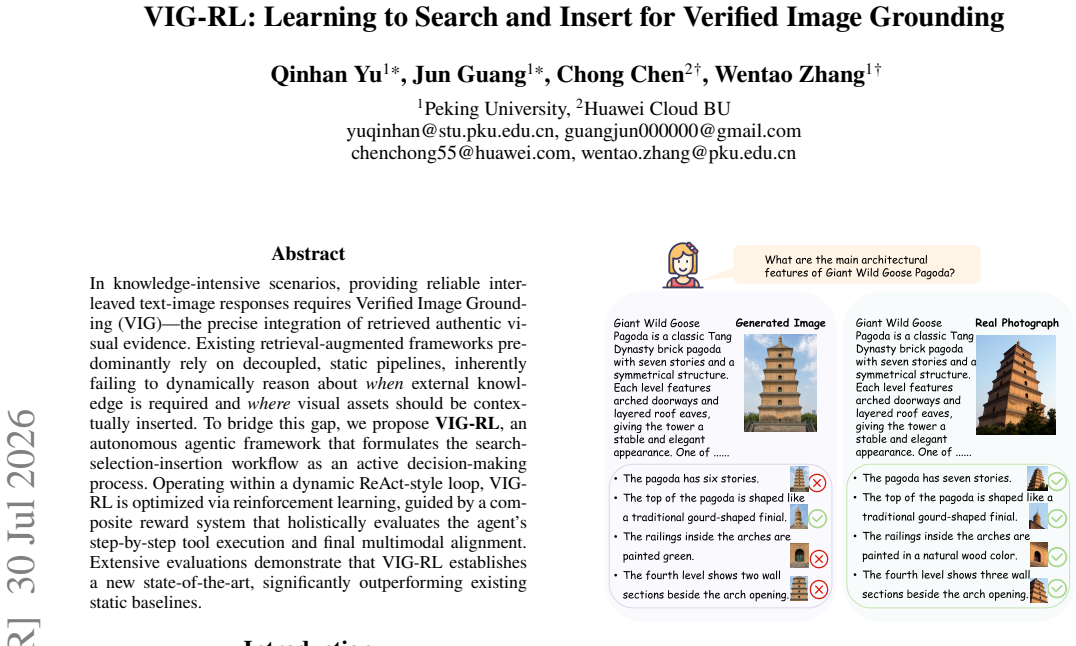
An agent trained with reinforcement learning can decide when to search and where to insert authentic images, beating static retrieve-then-generate pipelines on verified interleaved answers.
Reviewed by Pith at T0; open to challenge. T0 means a machine referee read the full paper against a public rubric. the ladder, T0–T4 →
T0 review · grok-4.5
2026-07-31 19:13 UTC pith:NDLH4S2S
load-bearing objection Solid agentic-RL recipe for verified image insert on MRAMG-Bench; real gains over static RAG and matched SFT, but SOTA talk still sits on one suite and a GPT-4o C.S. judge. the 4 major comments →
VIG-RL: Learning to Search and Insert for Verified Image Grounding
The pith
A machine-rendered reading of the paper's core claim, the machinery that carries it, and where it could break.
Core claim
Verified Image Grounding can be solved by training a multimodal agent, inside a ReAct-style loop with text-search, image-search, and answer actions, via group-relative policy optimization under a gated composite reward that multiplies a hard format check by text-judge quality, rule-based image-insertion precision, and search recall; the resulting policy sets a new state of the art on MRAMG-Bench, lifting image selection and overall interleaved quality well above static RAG and matched supervised trajectories.
What carries the argument
The gated composite reward R = r_format · (r_txt,LLM + r_img,pre + r_search) that forces valid tool syntax before scoring text quality, precision of inserted image IDs against gold, and recall of gold images in the retrieved pool, together with symbolic <img:id> tags that let the model place only retrieved assets.
Load-bearing premise
That large gains on one public suite with explicit placement labels, about a thousand training questions, and a model-based comprehensive-score judge are enough to establish a general method for verified image grounding.
What would settle it
Train and evaluate the same agent on a different verified-image benchmark that uses independent placement annotations and a non-overlapping judge; if the advantage over tuned static RAG and matched SFT on image F1 and placement-sensitive scores disappears, the central claim fails.
If this is right
- Interleaved answer systems can replace fixed retrieve-then-generate pipelines with a learned policy that chooses when to call text or image search.
- Placement and ordering of images can improve without any position labels if retrieval and selection are first made reliable under RL.
- Smaller backbones (around 4B) can reach competitive verified grounding once the search–insert policy is trained, not only large models.
- Context-anchored image retrieval plus optional text search becomes a practical multi-hop evidence path for diagrams whose meaning lives in captions.
Where Pith is reading between the lines
- The same ReAct-plus-gated-reward pattern could transfer to other provenance-constrained outputs, such as citing only retrieved tables or code snippets inside long answers.
- Because the image reward is pure precision on IDs, the method may under-insert on open-web corpora where gold sets are incomplete; coverage-aware terminal rewards would be a natural next stress test.
- If process recall and terminal precision stay decoupled, agents might learn shorter, higher-precision trajectories that cut tool cost in production assistants.
Editorial analysis
A structured set of objections, weighed in public.
Referee Report
Summary. The paper introduces Verified Image Grounding (VIG)—interleaved text–image generation that may insert only externally retrieved authentic images—and proposes VIG-RL, a ReAct-style agent with actions for text search, image search, and answer generation. The agent is trained with GRPO under a gated composite reward R = r_format · (r_txt,LLM + r_img,pre + r_search), combining format validity, a text-only LLM judge, rule-based image-insertion precision against gold ID sets, and search-process recall of gold images. Symbolic <img:id> tags enforce provenance. On MRAMG-Bench (six splits; 1.1k Web/Wiki/Arxiv training instances), VIG-RL-8B reports large gains over same-backbone static RAG (macro Image F1 57.7→78.9, C.S. 56.4→78.1), zero-shot agentic MLLMs, a matched best-of-five Gemini SFT baseline, and several strong commercial RAG systems, with supporting reward and retrieval ablations (Table 2) and claimed emergent order gains without positional rewards.
Significance. If the results hold under broader evaluation, the work is a clear step beyond static retrieve-then-generate VIG pipelines: it jointly learns when to search, what to select, and where to insert verified visuals, with a carefully factorized hybrid reward that avoids the EM sparsity and pure-judge hacking modes shown in the ablations. Strengths include the matched SFT control on the same 1.1k instances and tools, rule-based image precision/search recall that anchor multimodal claims outside pure self-judgment, context-anchored retrieval vs CLIP-style matching, and consistent 4B/8B gains including OOD Manual/Recipe Order. The problem framing (authentic evidence vs generative hallucination) is practically important for knowledge-intensive multimodal assistants.
major comments (4)
- [Experiments; Table 1; Method (Image Insertion Reward); Metrics] The SOTA claim for VIG is supported almost entirely by MRAMG-Bench (Experiments; Table 1). Image F1 is set overlap with the same gold image-ID inventory used by r_img,pre in training (Method: Image Insertion Reward; Metrics). With only 1.1k curated in-domain instances and 720 GRPO steps, macro F1 gains partly measure success at retrieving and selecting that closed ID set after learning to trigger search, not independent insertion skill. OOD Wit/Manual/Recipe remain inside the same suite and annotation style. Establishing “new state-of-the-art for VIG” requires at least one external corpus/protocol or a held-out image inventory not seen as gold IDs at train time; otherwise the claim should be scoped to MRAMG-Bench.
- [Metrics; Further Analysis (Strict Reward Decoupling); Appendix Table 8] Placement, text–image alignment, and coherence—the quantities that separate “insert” from “retrieve-and-select”—are carried primarily by Comprehensive Score via GPT-4o (Metrics; Appendix Table 8). No human correlation, inter-annotator agreement, judge-model ablation, or sensitivity analysis is reported. Order Score on Manual/Recipe remains modest in absolute terms (32.2 / 40.9) even for VIG-RL-8B. Because the training reward is deliberately invariant to placement and order (Further Analysis), the central “search–selection–insertion policy” claim leans on an unvalidated LMM judge. A small human study or multi-judge agreement on C.S. (and on emergent Order) is load-bearing for the insertion half of the contribution.
- [Experimental Settings; Figure 4; Main Results (VIG-RL Surpasses Static RAG)] Static RAG depth is tuned (K∈{2,5,10}, default K=5; Figure 4) while the agent may issue multiple top-5 calls up to T_max=5. The paper argues this compares adaptive vs fixed-depth workflows rather than raw candidate counts, which is reasonable, but Table 1 still mixes systems that see very different evidence budgets and interaction compute. A budget-matched comparison (e.g., static RAG given the union of all passages/images the agent retrieved, or equal total retrieval calls) would clarify how much of the +21 C.S. gain is policy quality versus iterative evidence access. Without it, the gap vs “strongest static RAG oracle” (+5.7 C.S.) is the more credible headline and should be foregrounded.
- [Training via GRPO; SFT Baseline; Table 2; Figure 3] Training-time text reward uses Qwen3-8B-Instruct as judge; SFT demonstrations are best-of-five Gemini-2.5-Flash trajectories selected by Image F1 (Implementation Details). Eval C.S. uses GPT-4o. The ablations correctly show pure MLLM rewards collapse Image F1 via hacking (Table 2; Figure 6), and hybrid design is a genuine contribution—but dependence on proprietary/strong teacher rollouts for the SFT control and on a single family of LMM judges for open-ended text quality should be stress-tested (e.g., alternate text judge, human spot-check of r_txt,LLM). Otherwise residual teacher/judge bias remains a confounder for the RL-vs-SFT narrative in Figure 3.
minor comments (5)
- [Abstract; Introduction] Abstract and Introduction claim SOTA over “existing static baselines” without immediately noting that agentic zero-shot commercial models underperform static RAG of the same models (Table 1)—a useful finding that should be stated up front to avoid over-reading the agentic framing alone.
- [Table 1] M2IO-R1-3B is only partially comparable (missing metrics marked “-”). Either complete the comparison under a common protocol or move it to a limited side note so Table 1 is not visually uneven.
- [Gated Composite Reward; Table 2] Composite reward sums r_txt,LLM + r_img,pre + r_search with equal implicit weights after the format gate; sensitivity to relative weighting is not reported. A one-paragraph weight sweep would strengthen the “hybrid design” claim.
- [Related Work; Implementation Details] Figure 1 caption and related-work citations are helpful; ensure all arXiv-only concurrent works (e.g., MMSearch-R1, M2IO-R1) are clearly marked as concurrent and that BGE-M3 / veRL versions are pinned for reproducibility.
- [Throughout] Minor prose issues: spacing artifacts in the compiled text (“VIG-RLisoptimized”, “whenexternal”, etc.) and inconsistent capitalization of dataset names (Web/Wiki/Arxiv vs Wit). Clean for camera-ready.
Circularity Check
No load-bearing circular derivation: VIG-RL’s SOTA claim is empirical RL on held-out/OOD splits, not a prediction forced by construction from its inputs.
full rationale
This is an empirical agentic-RL systems paper, not a first-principles derivation. The policy is optimized with GRPO under a composite reward R = r_format · (r_txt,LLM + r_img,pre + r_search), then evaluated on held-out in-domain splits and three OOD datasets (Wit/Manual/Recipe) with no train–test overlap in required chunks or images. Matching a rule-based image-precision/F1 signal to gold ID sets at train and test time is standard supervised/RL practice on a labeled benchmark; it does not make test Image F1 equal the training input by construction, because the agent must still decide when to search, which queries to issue, and which retrieved IDs to insert on unseen questions. Text quality and Comprehensive Score use external LLM judges (Qwen3-8B train-time; GPT-4o eval), and a matched SFT baseline on best-of-five Gemini trajectories is reported as a control—none of which collapses the central claim into a tautology. Overlap of authors with MRAMG-Bench / M2IO-R1 is ordinary self-citation of prior benchmark and baseline work and is not load-bearing uniqueness or an ansatz smuggled in as external fact. Concerns about single-suite generalization and unvalidated GPT-4o C.S. are evaluation-validity issues, not circular reduction of a claimed derivation to its inputs. No self-definitional identity, fitted-constant-as-prediction, or uniqueness-from-authors step is present.
Axiom & Free-Parameter Ledger
free parameters (4)
- Static RAG depth K (default 5) =
K=5
- GRPO training hyperparameters =
lr=2e-6, 20 epochs/720 steps, rollout.n=8, Tmax=5, KL=0
- Top-K per search call =
Ktxt/Kimg=5
- Composite reward factorization weights =
R=r_format·(r_txt+r_img,pre+r_search)
axioms (5)
- domain assumption Verified images must come from an external retrieved pool; generative synthesis is disallowed for VIG.
- domain assumption GRPO with the stated composite reward improves the agent’s search–insert policy relative to SFT and zero-shot tool use.
- domain assumption MRAMG-Bench gold interleaved answers and ID sets are a valid external standard for selection, placement quality (via GPT-4o C.S.), and order.
- domain assumption Context-anchored text-to-caption retrieval is an adequate surrogate for finding the right figures in knowledge-intensive corpora.
- standard math Standard ReAct loop semantics and sequence modeling / RL optimization math hold for the MLLM policy.
invented entities (3)
-
Verified Image Grounding (VIG) task framing
independent evidence
-
Gated composite VIG reward (format × text-judge + image-precision + search-recall)
no independent evidence
-
Symbolic visual referencing (<img:id> tags)
independent evidence
read the original abstract
In knowledge-intensive scenarios, providing reliable interleaved text-image responses requires Verified Image Grounding (VIG): the precise integration of retrieved authentic visual evidence. Existing retrieval-augmented frameworks predominantly rely on decoupled, static pipelines, inherently failing to dynamically reason about when external knowledge is required and where visual assets should be contextually inserted. To bridge this gap, we propose VIG-RL, an autonomous agentic framework that formulates the search-selection-insertion workflow as an active decision-making process. Operating within a dynamic ReAct-style loop, VIG-RL is optimized via reinforcement learning, guided by a composite reward system that holistically evaluates the agent's step-by-step tool execution and final multimodal alignment. Extensive evaluations demonstrate that VIG-RL establishes a new state-of-the-art, significantly outperforming existing static baselines.
Figures


Reference graph
Works this paper leans on
-
[1]
International Conference on Learning Representations , volume=
Interleaved scene graphs for interleaved text-and-image generation assessment , author=. International Conference on Learning Representations , volume=
-
[3]
International Conference on Learning Representations , volume=
Dreamllm: Synergistic multimodal comprehension and creation , author=. International Conference on Learning Representations , volume=
-
[10]
Proceedings of the 48th International ACM SIGIR Conference on Research and Development in Information Retrieval , pages=
MRAMG-Bench: a comprehensive benchmark for advancing multimodal retrieval-augmented multimodal generation , author=. Proceedings of the 48th International ACM SIGIR Conference on Research and Development in Information Retrieval , pages=
-
[12]
2024 , journal =
HybridFlow: A Flexible and Efficient RLHF Framework , author =. 2024 , journal =
2024
-
[14]
2024 , howpublished =
GPT-4o , author =. 2024 , howpublished =
2024
-
[16]
Advances in neural information processing systems , volume=
Language models are few-shot learners , author=. Advances in neural information processing systems , volume=
-
[19]
DeepSeek-V4: Towards Highly Efficient Million-Token Context Intelligence , author=
-
[20]
National Science Review , volume=
A survey on multimodal large language models , author=. National Science Review , volume=. 2024 , publisher=
2024
-
[24]
International Conference on Learning Representations , volume=
Show-o: One single transformer to unify multimodal understanding and generation , author=. International Conference on Learning Representations , volume=
-
[25]
International Conference on Learning Representations , volume=
Transfusion: Predict the next token and diffuse images with one multi-modal model , author=. International Conference on Learning Representations , volume=
-
[28]
arXiv preprint arXiv:2509.13642 , year=
LLM-I: LLMs are naturally interleaved multimodal creators , author=. arXiv preprint arXiv:2509.13642 , year=
-
[30]
Advances in Neural Information Processing Systems , volume=
Generating images with multimodal language models , author=. Advances in Neural Information Processing Systems , volume=
-
[31]
Forty-first International Conference on Machine Learning , year=
Next-gpt: Any-to-any multimodal llm , author=. Forty-first International Conference on Machine Learning , year=
-
[32]
International Conference on Machine Learning , pages=
Grounding language models to images for multimodal inputs and outputs , author=. International Conference on Machine Learning , pages=. 2023 , organization=
2023
-
[33]
Proceedings of the 31st International Conference on Computational Linguistics: System Demonstrations , pages=
Murar: A simple and effective multimodal retrieval and answer refinement framework for multimodal question answering , author=. Proceedings of the 31st International Conference on Computational Linguistics: System Demonstrations , pages=
-
[35]
Findings of the Association for Computational Linguistics: ACL 2024 , pages=
TextBind: Multi-turn interleaved multimodal instruction-following in the wild , author=. Findings of the Association for Computational Linguistics: ACL 2024 , pages=
2024
-
[36]
arXiv preprint arXiv:2309.15112 , year=
Internlm-xcomposer: A vision-language large model for advanced text-image comprehension and composition , author=. arXiv preprint arXiv:2309.15112 , year=
-
[37]
arXiv preprint arXiv:2401.10208 , year=
Mm-interleaved: Interleaved image-text generative modeling via multi-modal feature synchronizer , author=. arXiv preprint arXiv:2401.10208 , year=
-
[40]
Advances in Neural Information Processing Systems , volume=
Vrag-rl: Empower vision-perception-based rag for visually rich information understanding via iterative reasoning with reinforcement learning , author=. Advances in Neural Information Processing Systems , volume=
-
[41]
2024 , eprint=
BGE M3-Embedding: Multi-Lingual, Multi-Functionality, Multi-Granularity Text Embeddings Through Self-Knowledge Distillation , author=. 2024 , eprint=
2024
-
[42]
Proceedings of the 62nd Annual Meeting of the Association for Computational Linguistics (Volume 3: System Demonstrations) , address=
LlamaFactory: Unified Efficient Fine-Tuning of 100+ Language Models , author=. Proceedings of the 62nd Annual Meeting of the Association for Computational Linguistics (Volume 3: System Demonstrations) , address=. 2024 , url=
2024
-
[43]
OpenAI Blog , year=
Hello GPT-4o , author=. OpenAI Blog , year=
-
[44]
Bai, S.; Cai, Y.; Chen, R.; Chen, K.; Chen, X.; Cheng, Z.; Deng, L.; Ding, W.; Gao, C.; Ge, C.; et al. 2025. Qwen3-vl technical report. arXiv preprint arXiv:2511.21631
Pith/arXiv arXiv 2025
-
[45]
D.; Dhariwal, P.; Neelakantan, A.; Shyam, P.; Sastry, G.; Askell, A.; et al
Brown, T.; Mann, B.; Ryder, N.; Subbiah, M.; Kaplan, J. D.; Dhariwal, P.; Neelakantan, A.; Shyam, P.; Sastry, G.; Askell, A.; et al. 2020. Language models are few-shot learners. Advances in neural information processing systems, 33: 1877--1901
2020
-
[46]
Chen, J.; Xiao, S.; Zhang, P.; Luo, K.; Lian, D.; and Liu, Z. 2024. BGE M3-Embedding: Multi-Lingual, Multi-Functionality, Multi-Granularity Text Embeddings Through Self-Knowledge Distillation. arXiv:2402.03216
Pith/arXiv arXiv 2024
-
[47]
Chen, X.; Wu, Z.; Liu, X.; Pan, Z.; Liu, W.; Xie, Z.; Yu, X.; and Ruan, C. 2025. Janus-pro: Unified multimodal understanding and generation with data and model scaling. arXiv preprint arXiv:2501.17811
Pith/arXiv arXiv 2025
-
[48]
Chern, E.; Su, J.; Ma, Y.; and Liu, P. 2024. Anole: An open, autoregressive, native large multimodal models for interleaved image-text generation. arXiv preprint arXiv:2407.06135
Pith/arXiv arXiv 2024
-
[49]
Comanici, G.; Bieber, E.; Schaekermann, M.; Pasupat, I.; Sachdeva, N.; Dhillon, I.; Blistein, M.; Ram, O.; Zhang, D.; Rosen, E.; et al. 2025. Gemini 2.5: Pushing the frontier with advanced reasoning, multimodality, long context, and next generation agentic capabilities. arXiv preprint arXiv:2507.06261
Pith/arXiv arXiv 2025
-
[50]
Dong, R.; Peng, Y.; Qi, Z.; Ge, Z.; Yang, J.; Zhao, L.; Sun, J.; Zhou, H.; Wei, H.; Kong, X.; et al. 2024. Dreamllm: Synergistic multimodal comprehension and creation. In International Conference on Learning Representations, volume 2024, 6666--6702
2024
-
[51]
Guo, D.; Yang, D.; Zhang, H.; Song, J.; Zhang, R.; Xu, R.; Zhu, Q.; Ma, S.; Wang, P.; Bi, X.; et al. 2025. Deepseek-r1: Incentivizing reasoning capability in llms via reinforcement learning. arXiv preprint arXiv:2501.12948
Pith/arXiv arXiv 2025
-
[52]
Hong, J.; Zhao, C.; Zhu, C.; Lu, W.; Xu, G.; and Yu, X. 2025. Deepeyesv2: Toward agentic multimodal model. arXiv preprint arXiv:2511.05271
Pith/arXiv arXiv 2025
-
[53]
Huang, W.; Zeng, Y.; Wang, Q.; Fang, Z.; Cao, S.; Chu, Z.; Yin, Q.; Chen, S.; Yin, Z.; Chen, L.; et al. 2026. Vision-deepresearch: Incentivizing deepresearch capability in multimodal large language models. arXiv preprint arXiv:2601.22060
arXiv 2026
-
[54]
P.; Perelman, A.; Ramesh, A.; Clark, A.; Ostrow, A.; Welihinda, A.; Hayes, A.; Radford, A.; et al
Hurst, A.; Lerer, A.; Goucher, A. P.; Perelman, A.; Ramesh, A.; Clark, A.; Ostrow, A.; Welihinda, A.; Hayes, A.; Radford, A.; et al. 2024. Gpt-4o system card. arXiv preprint arXiv:2410.21276
Pith/arXiv arXiv 2024
-
[55]
Jaech, A.; Kalai, A.; Lerer, A.; Richardson, A.; El-Kishky, A.; Low, A.; Helyar, A.; Madry, A.; Beutel, A.; Carney, A.; et al. 2024. Openai o1 system card. arXiv preprint arXiv:2412.16720
Pith/arXiv arXiv 2024
-
[56]
Jin, B.; Zeng, H.; Yue, Z.; Yoon, J.; Arik, S.; Wang, D.; Zamani, H.; and Han, J. 2025. Search-r1: Training llms to reason and leverage search engines with reinforcement learning. arXiv preprint arXiv:2503.09516
Pith/arXiv arXiv 2025
-
[57]
Y.; Fried, D.; and Salakhutdinov, R
Koh, J. Y.; Fried, D.; and Salakhutdinov, R. R. 2023. Generating images with multimodal language models. Advances in Neural Information Processing Systems, 36: 21487--21506
2023
-
[58]
Liu, A.; Feng, B.; Xue, B.; Wang, B.; Wu, B.; Lu, C.; Zhao, C.; Deng, C.; Zhang, C.; Ruan, C.; et al. 2024. Deepseek-v3 technical report. arXiv preprint arXiv:2412.19437
Pith/arXiv arXiv 2024
-
[59]
Ma, Z.-A.; Lan, T.; Tu, R.-C.; Hu, Y.; Zhu, Y.-S.; Zhang, T.; Huang, H.; Wu, Z.; and Mao, X.-L. 2024. Multi-modal retrieval augmented multi-modal generation: Datasets, evaluation metrics and strong baselines. arXiv preprint arXiv:2411.16365
Pith/arXiv arXiv 2024
-
[60]
OpenAI. 2024. Hello GPT-4o. OpenAI Blog
2024
-
[61]
OpenAI. 2025. Introducing GPT-5. https://openai.com/index/introducing-gpt-5/
2025
-
[62]
Shao, Z.; Wang, P.; Zhu, Q.; Xu, R.; Song, J.; Bi, X.; Zhang, H.; Zhang, M.; Li, Y.; Wu, Y.; et al. 2024. Deepseekmath: Pushing the limits of mathematical reasoning in open language models. arXiv preprint arXiv:2402.03300
Pith/arXiv arXiv 2024
-
[63]
Sheng, G.; Zhang, C.; Ye, Z.; Wu, X.; Zhang, W.; Zhang, R.; Peng, Y.; Lin, H.; and Wu, C. 2024. HybridFlow: A Flexible and Efficient RLHF Framework. arXiv preprint arXiv: 2409.19256
Pith/arXiv arXiv 2024
-
[64]
Shi, M.; Zeng, X.; Huang, J.; Cui, Y.; Ferroni, F.; Li, J.; Pachori, S.; Li, Z.; Balaji, Y.; Wang, H.; et al. 2026. DuoGen: Towards General Purpose Interleaved Multimodal Generation. arXiv preprint arXiv:2602.00508
arXiv 2026
-
[65]
Song, H.; Jiang, J.; Min, Y.; Chen, J.; Chen, Z.; Zhao, W. X.; Fang, L.; and Wen, J.-R. 2025. R1-searcher: Incentivizing the search capability in llms via reinforcement learning. arXiv preprint arXiv:2503.05592
Pith/arXiv arXiv 2025
-
[66]
Touvron, H.; Lavril, T.; Izacard, G.; Martinet, X.; Lachaux, M.-A.; Lacroix, T.; Rozi \`e re, B.; Goyal, N.; Hambro, E.; Azhar, F.; et al. 2023. Llama: Open and efficient foundation language models. arXiv preprint arXiv:2302.13971
Pith/arXiv arXiv 2023
-
[67]
Wang, Q.; Ding, R.; Zeng, Y.; Chen, Z.; Chen, L.; Wang, S.; Xie, P.; Huang, F.; and Zhao, F. 2025. Vrag-rl: Empower vision-perception-based rag for visually rich information understanding via iterative reasoning with reinforcement learning. Advances in Neural Information Processing Systems, 38: 57133--57160
2025
-
[68]
Wang, X.; Zhang, X.; Luo, Z.; Sun, Q.; Cui, Y.; Wang, J.; Zhang, F.; Wang, Y.; Li, Z.; Yu, Q.; et al. 2024. Emu3: Next-token prediction is all you need. arXiv preprint arXiv:2409.18869
Pith/arXiv arXiv 2024
-
[69]
Wu, J.; Deng, Z.; Li, W.; Liu, Y.; You, B.; Li, B.; Ma, Z.; and Liu, Z. 2025. Mmsearch-r1: Incentivizing lmms to search. arXiv preprint arXiv:2506.20670
Pith/arXiv arXiv 2025
-
[70]
Wu, S.; Fei, H.; Qu, L.; Ji, W.; and Chua, T.-S. 2024. Next-gpt: Any-to-any multimodal llm. In Forty-first International Conference on Machine Learning
2024
-
[71]
Xiao, Z.; Yu, Q.; Li, B.; Chen, G.; Chen, C.; and Zhang, W. 2025. M2io-r1: An efficient rl-enhanced reasoning framework for multimodal retrieval augmented multimodal generation. arXiv preprint arXiv:2508.06328
Pith/arXiv arXiv 2025
-
[72]
J.; Wang, W.; Lin, K
Xie, J.; Mao, W.; Bai, Z.; Zhang, D. J.; Wang, W.; Lin, K. Q.; Gu, Y.; Chen, Z.; Yang, Z.; and Shou, M. Z. 2025. Show-o: One single transformer to unify multimodal understanding and generation. In International Conference on Learning Representations, volume 2025, 28240--28264
2025
-
[73]
Yao, S.; Zhao, J.; Yu, D.; Du, N.; Shafran, I.; Narasimhan, K.; and Cao, Y. 2022. React: Synergizing reasoning and acting in language models. arXiv preprint arXiv:2210.03629
Pith/arXiv arXiv 2022
-
[74]
Yin, S.; Fu, C.; Zhao, S.; Li, K.; Sun, X.; Xu, T.; and Chen, E. 2024. A survey on multimodal large language models. National Science Review, 11(12): nwae403
2024
-
[75]
Yu, Q.; Xiao, Z.; Li, B.; Wang, Z.; Chen, C.; and Zhang, W. 2025. MRAMG-Bench: a comprehensive benchmark for advancing multimodal retrieval-augmented multimodal generation. In Proceedings of the 48th International ACM SIGIR Conference on Research and Development in Information Retrieval, 3616--3626
2025
-
[76]
Zheng, Y.; Zhang, R.; Zhang, J.; Ye, Y.; Luo, Z.; Feng, Z.; and Ma, Y. 2024. LlamaFactory: Unified Efficient Fine-Tuning of 100+ Language Models. In Proceedings of the 62nd Annual Meeting of the Association for Computational Linguistics (Volume 3: System Demonstrations). Bangkok, Thailand: Association for Computational Linguistics
2024
-
[77]
Zhou, C.; Yu, L.; Babu, A.; Tirumala, K.; Yasunaga, M.; Shamis, L.; Kahn, J.; Ma, X.; Zettlemoyer, L.; and Levy, O. 2025. Transfusion: Predict the next token and diffuse images with one multi-modal model. In International Conference on Learning Representations, volume 2025, 6446--6469
2025
-
[78]
Zhou, J.; Liu, Z.; Liu, Z.; Xiao, S.; Wang, Y.; Zhao, B.; Zhang, C. J.; Lian, D.; and Xiong, Y. 2024. MegaPairs: Massive Data Synthesis For Universal Multimodal Retrieval. arXiv preprint arXiv:2412.14475
Pith/arXiv arXiv 2024
-
[79]
S.; Feujio, L.; Maharaj, A.; and Li, Y
Zhu, Z.; Lee, D.; Zhang, H.; Harsha, S. S.; Feujio, L.; Maharaj, A.; and Li, Y. 2025. Murar: A simple and effective multimodal retrieval and answer refinement framework for multimodal question answering. In Proceedings of the 31st International Conference on Computational Linguistics: System Demonstrations, 126--135
2025
discussion (0)
Sign in with ORCID, Apple, or X to comment. Anyone can read and Pith papers without signing in.