REVIEW 2 major objections 6 minor 1 cited by
FasTac: A Curved Multispectral Vision-Based Tactile Sensor for High-Speed High-Precision 3D Shape and Force Perception
T0 review · 2 major / 6 minor · reviewed 2026-07-31 · grok-4.5
Pith's one-line read A compact curved fingertip sensor recovers sub-0.05 mm contact depth, three-axis force, and millisecond feedback from one multispectral camera.
desk verdict Solid curved VBTS systems paper: clean depth and FPGA wins, force maps still only globally supervised on spheres. read the letter →
The pith
A machine-rendered reading of the paper's core claim, the machinery that carries it, and where it could break.
The reading
What carries the argument
HyperForce: FEM-inspired position-aware dynamic convolution that maps a fused 3D displacement field (depth-derived normal plus marker-derived tangential) through coordinate-conditioned kernels so local force responds to the curved elastomer’s nonuniform stiffness; paired with single-sensor RGB-NIR photometric stereo and Dirichlet boundary-prior fast Poisson depth.
What would settle it
Run HyperForce on non-sphere contacts (edges, multi-point, soft objects) with a calibrated local force reference or dense FEM ground truth and check whether distributed Fx/Fy/Fz maps and resultant NMAE stay near the reported ~2–3% sphere-test levels; large local or resultant error would break the central force claim.
Extended reading notes
Core claim
On a compact curved fingertip, single-sensor RGB-NIR photometric stereo plus boundary-prior Poisson depth reconstruction reaches 0.0415 mm depth MAE (versus roughly 0.27 mm without the prior), HyperForce estimates three-axis contact force at NMAE 2.74% normal and 2.39% shear, and an FPGA image-to-Fz pipeline runs in 1.09 ms—enough for fine geometry, friction-aware grasp feedback, and high-frequency dynamic contact sensing.
Load-bearing premise
That a force model trained only on global wrench labels from spherical-indenter contacts, with intermediate distributed force maps left unchecked, still matches real multi-object and grasp contacts on the same curved skin.
Editorial extensions
If this is right
- Curved fingertips can report contact geometry at tens of microns without multi-camera or beam-splitter bulk.
- Closed-loop grasp controllers can tighten from estimated friction coefficient µ = Fs/Fn in real time using on-sensor three-axis force.
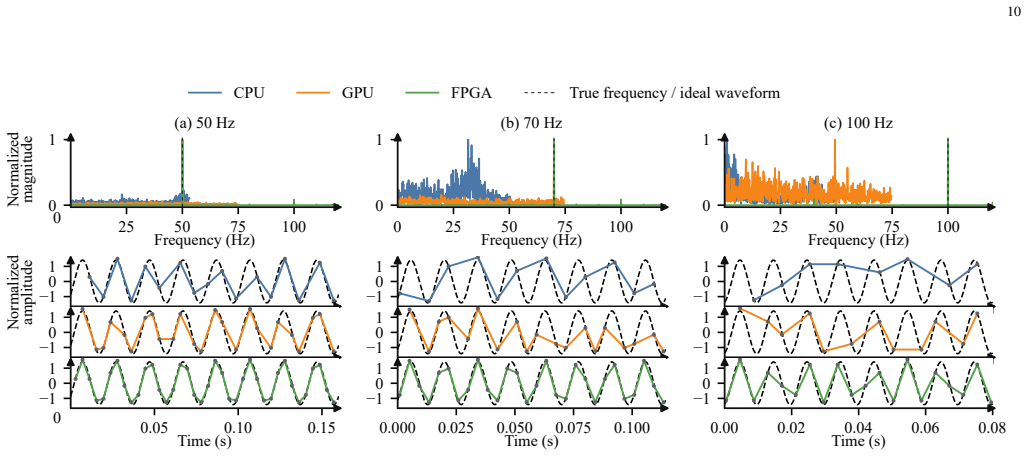
- Millisecond FPGA image-to-Fz feedback can track contact vibrations near 100 Hz that CPU/GPU pipelines alias.
- A single RGB-NIR CFA plus diffuse skeleton lighting is enough to keep photometric stereo over-determined on high-curvature pads.
Reading between the lines
- If position-aware kernels are the main win, the same hypernetwork idea may transfer to other curved soft sensors once a cheap position encoding is available, not only vision-based gels.
- Deploying only Fz on the FPGA leaves shear and full 3D geometry host-side; full three-axis edge pipelines would be the natural next stress test for multi-finger hands.
- Sphere-only supervision may understate error on sharp edges; a mixed-geometry calibration set would be a direct way to harden the force claim without redesigning the hardware.
Signed reviews
Editorial analysis
A structured set of objections, weighed in public.
Referee Report
Summary. FasTac is a compact curved vision-based tactile fingertip that combines single-sensor RGB-NIR multispectral photometric stereo, boundary-prior Poisson depth reconstruction, a position-aware dynamic-convolution force estimator (HyperForce), and an FPGA image-to-Fz pipeline. On spherical-indenter data, NIR plus the boundary prior reduces depth MAE from ~0.27 mm to 0.0415 mm; HyperForce reports NMAE of 2.74% (normal) and 2.39% (shear) against an ATI Nano17; FPGA deployment cuts end-to-end latency from 3.26 ms (GPU) to 1.09 ms and supports vibration tracking up to 100 Hz. Qualitative multi-object reconstruction, friction-coefficient grasp feedback, and vibration experiments are used to illustrate geometry, stable force feedback, and dynamic sensing.
Significance. If the reported results hold under broader contact conditions, FasTac is a strong systems contribution: it jointly targets fine curved-surface geometry, three-axis force, and deterministic low-latency edge processing in a fingertip form factor that prior curved visuotactile designs rarely combine. Strengths include clear ablations (RGB vs RGB-NIR; depth prior on/off; dynamic vs fixed kernels; displacement-input variants), external ATI and CAD-aligned geometric ground truth, and concrete CPU/GPU/FPGA latency–energy–bandwidth comparisons with frequency-domain validation. The single-sensor RGB-NIR demultiplexing and boundary-prior DST Poisson solver are practical engineering choices that address known curved-photometric-stereo failure modes without multi-camera registration.
major comments (2)
- [§IV-B, Eqs. (6)–(11); §V-A; Table IV; Fig. 9] §IV-B (Eqs. 6–11) and §V-A/V-C: HyperForce is supervised only by global ATI wrench L1 after spatial integration of pixel-wise maps, on spherical-indenter contacts (0.5–1.5 N normal; 0.3/0.6 Fz shear on spatially gridded poses). Distributed f(p) fields are never compared to local force ground truth, and Table IV ablations remain inside that protocol. The grasp demo (Fig. 9) and multi-object use cases therefore assume that position-aware kernels fitted under sphere indentation transfer to non-spherical, multi-finger contacts. Please either (i) add a quantitative check of local/distributed force consistency (e.g., multi-indenter, known contact patches, or FEM reference maps) or (ii) clearly scope the force claim to resultant wrench under sphere-like contacts and mark distributed maps as intermediate visualizations.
- [§IV-C; Table V; Abstract; Contributions] §IV-C and Table V/S1: Only the normal-force branch is FPGA-deployed (image-to-Fz), while the abstract and contribution list advertise three-axis force and high-speed perception together. Tangential force still depends on marker detection, RBF interpolation, and the full HyperForce path off-FPGA. State explicitly what runs on-edge vs host, report end-to-end rates for the full three-axis path if claimed for closed-loop use, and avoid implying that 1.09 ms / 100 Hz applies to Fx/Fy as well as Fz.
minor comments (6)
- [Fig. 2] Fig. 2 contains residual Chinese labels (e.g., “侧视图”, “结构分解图”, gel/skeleton callouts). Replace with English for journal production.
- [Table I] Table I notes that evaluation settings differ across sensors; still, DenseTact/Insight/GelStereo numbers are presented side-by-side with FasTac. Add a short caveat in the table caption that MAE/NMAE/speed are not strictly commensurate.
- [§IV-A-2, Eq. (1)] Eq. (1): define α, β, and I_max numerically (or ranges used), and state whether they were tuned per unit or fixed across experiments.
- [§V-B, Fig. 7] §V-B strawberry/fingerprint/LED results are qualitative only. If possible, add a simple geometric proxy (e.g., known LED pitch or ridge spacing error) so multi-object claims are not purely visual.
- [Supplementary §I] Supplementary §I: training/validation/test grids are spatially disjoint—good—but report contact-location coverage relative to the full curved sensing area and any edge-region degradation.
- [Abstract; §IV-C] Notation: Fz vs F_z, and “image-to-Fz” vs three-axis F, should be consistent in abstract, §IV-C, and Table V.
Circularity Check
No significant circularity: depth, force, and latency claims are empirical measurements against external ATI, CAD/CNC, and platform benchmarks.
full rationale
FasTac is a systems/hardware paper whose load-bearing numbers are not derived by rearranging fitted constants or self-defined quantities. Surface normals and depth are supervised and scored against CAD-aligned geometric ground truth rendered from CNC pose, indenter geometry, and the sensor model (Sec. V-A; Tables II–III); the boundary-prior Poisson step injects a known CAD Dirichlet condition into the RHS (Eqs. 3, 13) and is evaluated by residual MAE to that external geometry, not by restating the prior as a prediction. HyperForce is an FEM-motivated dynamic-convolution regressor (Eqs. 6–11) trained with global ATI Nano17 wrench L1 after spatial integration; reported MAE/NMAE/R² are held-out comparisons to the same external force sensor (Fig. 8, Table IV), not algebraic identities of the fit. FPGA image-to-Fz latency/energy (Table V, Fig. 10) are wall-clock and power measurements versus CPU/GPU. Prior GelSplitter-line citations supply related NIR imaging context but do not underwrite uniqueness theorems or force the reported errors. Generalization limits of sphere-trained distributed maps are a validation concern, not circularity. No step reduces a claimed prediction to its inputs by construction.
Assumptions & free parameters
free parameters (6)
- IR crosstalk subtraction strength α and NIR clamp β
- Normal-estimation MLP weights =
Trained up to 300 epochs, Adam lr 1e-3 (suppl.)
- HyperForce hypernetwork / dynamic kernels H_α(c(p)) =
AdamW lr 1e-4, ≤900 epochs (suppl.)
- RBF IMQ shape ε and marker-derived tangential field
- FPGA quantization scales s_k, s_d and crop/downsample to 128×128 =
128×128 deployment input (suppl. III)
- Gel mix ratio and reflective coating formulation =
Solaris A:B:Slacker = 1:1:3
assumptions (5)
- domain assumption Lambertian (or network-approximable) image formation under near-field multi-spectral illumination suffices for stable normals on the coated curved gel.
- domain assumption CAD-derived Dirichlet boundary depth D_prior correctly constrains the Poisson solve on the real molded fingertip.
- ad hoc to paper Local force response is a position-dependent linear combination of a K×K 3D displacement patch (FEM-inspired dynamic convolution).
- domain assumption Global wrench supervision is adequate to train pixel-wise force maps used for contact reasoning.
- standard math Discrete sine-transform Poisson solver and streaming MLP/conv on FPGA faithfully implement the floating-point perception chain within reported error.
invented entities (2)
-
HyperForce position-aware dynamic-convolution force estimator
-
FasTac RGB-NIR curved visuotactile fingertip + FPGA image-to-Fz pipeline
Cite this review
Pith. "Pith review of FasTac: A Curved Multispectral Vision-Based Tactile Sensor for High-Speed High-Precision 3D Shape and Force Perception." pith.science (2026). https://pith.science/paper/3L2DDI2W
@misc{pith2026260728416,
  author       = {Pith},
  title        = {Pith review of: FasTac: A Curved Multispectral Vision-Based Tactile Sensor for High-Speed High-Precision 3D Shape and Force Perception},
  year         = {2026},
  howpublished = {\url{https://pith.science/paper/3L2DDI2W}},
  note         = {Machine review of arXiv:2607.28416}
}
read the original abstract
Curved tactile fingertips for dexterous manipulation must resolve fine contact geometry, distinguish normal and tangential loads, and capture transient signals. Existing curved vision-based tactile sensors struggle to combine accurate 3D reconstruction, three-axis force estimation, and high-speed processing in a compact form. This article presents FasTac, a curved vision-based tactile sensor integrating multispectral photometric stereo, dynamic-convolution force estimation, and hardware acceleration on a field-programmable gate array (FPGA). Single-image-sensor simultaneous multispectral imaging provides spatially aligned observations for robust surface normal estimation, followed by boundary-prior fast Poisson depth reconstruction. HyperForce uses position-aware dynamic convolution to model the spatially nonuniform mechanical response of curved elastomers and estimate three-axis forces. The complete image-to-normal-force pipeline is deployed on an FPGA. Experiments show that near-infrared (NIR) illumination and the boundary prior decrease depth mean absolute error (MAE) from 0.2730 mm to 0.0415 mm; HyperForce achieves normalized mean absolute error (NMAE) values of 2.74% and 2.39% for normal and shear forces, respectively; and FPGA deployment shortens processing latency from 3.26 ms on the GPU to 1.09 ms. Multi-object reconstruction, feedback grasping, and vibration measurement validate fine geometric perception, stable force feedback, and dynamic contact sensing.
Figures


Figures from the paper (8 more)


Forward citations
Cited by 1 Pith paper
-
Near-sensor Computing for Rapid Visuotactile Perception
A streaming spectral Poisson solver on an FPGA reconstructs visuotactile depth maps with deterministic 0.211 ms latency, enabling a 28 ms protective reflex loop.
Reference graph
Works this paper leans on
-
[1]
Tactile sensing in dexterous robot hands: Review,
Z. Kappassov, J.-A. Corrales, and V . Perdereau, “Tactile sensing in dexterous robot hands: Review,”Robotics and Autonomous Systems, vol. 74, pp. 195–220, 2015
2015
-
[2]
DIGIT: A novel design for a low-cost compact high-resolution tactile sensor with application to in-hand manipulation,
M. Lambeta, P.-W. Chou, S. Tian, B. Yang, B. Maloon, V . R. Most, D. Stroud, R. Santos, A. Byagowi, G. Kammereret al., “DIGIT: A novel design for a low-cost compact high-resolution tactile sensor with application to in-hand manipulation,”IEEE Robotics and Automation Letters, vol. 5, no. 3, pp. 3838–3845, 2020
2020
-
[3]
Soft, round, high resolution tactile fingertip sensors for dexterous robotic manipulation,
B. Romero, F. Veiga, and E. Adelson, “Soft, round, high resolution tactile fingertip sensors for dexterous robotic manipulation,” in2020 IEEE International Conference on Robotics and Automation (ICRA). IEEE, 2020, pp. 4796–4802
2020
-
[4]
BaroTac: Barometric three-axis tactile sensor with slip detection capability,
G. Kim and D. Hwang, “BaroTac: Barometric three-axis tactile sensor with slip detection capability,”Sensors, vol. 23, no. 1, p. 428, 2023
2023
-
[5]
A tactile sensor with slippage prediction by unequal-height dome array,
Y . Yang, M. Zhao, Y . Jia, L. Zhao, D. Piao, Y . Zheng, and L. Song, “A tactile sensor with slippage prediction by unequal-height dome array,” IEEE Sensors Journal, vol. 23, no. 16, pp. 17 958–17 967, 2023
2023
-
[6]
MinSight: A fingertip-sized vision-based tactile sensor for robotic manipulation,
I. Andrussow, H. Sun, K. J. Kuchenbecker, and G. Martius, “MinSight: A fingertip-sized vision-based tactile sensor for robotic manipulation,” Advanced Intelligent Systems, vol. 5, no. 8, p. 2300042, 2023
2023
-
[7]
A large-area robotic skin for intelligent tactile interaction of collaborative robots,
W. Zheng, D. Guo, W. Yang, and H. Liu, “A large-area robotic skin for intelligent tactile interaction of collaborative robots,”IEEE/ASME Transactions on Mechatronics, pp. 1–11, 2025, early Access, Jan. 10, 2025, doi: 10.1109/TMECH.2024.3520953
arXiv 2025
-
[8]
Stretchable capacitive tactile sensor array for accurate distributed pressure recognition,
J. Yu, S. Yao, X. Jiang, and Z. Yao, “Stretchable capacitive tactile sensor array for accurate distributed pressure recognition,”IEEE Sensors Journal, vol. 24, no. 22, pp. 37 836–37 845, 2024
2024
Show all 38 references
-
[9]
A soft multi-axis high force range magnetic tactile sensor for force feedback in robotic surgical systems,
M. Rehan, M. M. Saleem, M. I. Tiwana, R. I. Shakoor, and R. Cheung, “A soft multi-axis high force range magnetic tactile sensor for force feedback in robotic surgical systems,”Sensors, vol. 22, no. 9, p. 3500, 2022
2022
-
[10]
Large-area magnetic skin for multi-point and multi-scale tactile sensing with super-resolution,
H. Hu, C. Zhang, X. Lai, H. Dai, C. Pan, H. Sun, D. Tang, Z. Hu, J. Fu, T. Liet al., “Large-area magnetic skin for multi-point and multi-scale tactile sensing with super-resolution,”npj Flexible Electronics, vol. 8, no. 1, p. 42, 2024
2024
-
[11]
Recent progress in high-resolution tactile sensor array: From sensor fabrication to advanced applications,
R. Wang, S. Hu, W. Zhu, Y . Huang, W. Wang, Y . Li, Y . Yang, J. Yu, and Y . Deng, “Recent progress in high-resolution tactile sensor array: From sensor fabrication to advanced applications,”Progress in Natural Science: Materials International, vol. 33, no. 1, pp. 55–66, 2023
2023
-
[12]
Flexible tactile sensor array mounted on the curved surface: Analytical modeling and experimental validation,
Y . Wang, G. Liang, D. Mei, and Z. Chen, “Flexible tactile sensor array mounted on the curved surface: Analytical modeling and experimental validation,”Journal of Microelectromechanical Systems, vol. 26, no. 5, pp. 1002–1011, 2017
2017
-
[13]
Curvature-aware calibration of tactile sensors for accurate force estimation on non-planar surfaces,
L. Zhong, H. J. H. Kim, D. P. Losey, and C. M. Nunez, “Curvature-aware calibration of tactile sensors for accurate force estimation on non-planar surfaces,”arXiv preprint arXiv:2510.25965, 2025
2025
-
[14]
GelSight: High-resolution robot tactile sensors for estimating geometry and force,
W. Yuan, S. Dong, and E. H. Adelson, “GelSight: High-resolution robot tactile sensors for estimating geometry and force,”Sensors, vol. 17, no. 12, p. 2762, 2017
2017
-
[15]
9DTact: A compact vision-based tactile sensor for accurate 3D shape reconstruction and generalizable 6D force estimation,
C. Lin, H. Zhang, J. Xu, L. Wu, and H. Xu, “9DTact: A compact vision-based tactile sensor for accurate 3D shape reconstruction and generalizable 6D force estimation,”IEEE Robotics and Automation Letters, vol. 9, no. 2, pp. 923–930, 2024
2024
-
[16]
Dense tactile force estimation using GelSlim and inverse FEM,
D. Ma, E. Donlon, S. Dong, and A. Rodriguez, “Dense tactile force estimation using GelSlim and inverse FEM,” in2019 International Conference on Robotics and Automation (ICRA). IEEE, 2019, pp. 5418–5424
2019
-
[17]
GelTip: A finger-shaped optical tactile sensor for robotic manipulation,
D. F. Gomes, Z. Lin, and S. Luo, “GelTip: A finger-shaped optical tactile sensor for robotic manipulation,” in2020 IEEE/RSJ International Conference on Intelligent Robots and Systems (IROS). IEEE, 2020, pp. 9903–9909
2020
-
[18]
GelSight360: An omnidirectional camera-based tactile sensor for dexterous robotic manipulation,
M. H. Tippur and E. H. Adelson, “GelSight360: An omnidirectional camera-based tactile sensor for dexterous robotic manipulation,” in2023 IEEE International Conference on Soft Robotics (RoboSoft). IEEE, 2023, pp. 1–8
2023
-
[19]
DenseTact 2.0: Optical tactile sensor for shape and force reconstruction,
W. K. Do, B. Jurewicz, and M. Kennedy, “DenseTact 2.0: Optical tactile sensor for shape and force reconstruction,” in2023 IEEE International Conference on Robotics and Automation (ICRA), 2023, pp. 12 549– 12 555
2023
-
[20]
A soft thumb-sized vision- based sensor with accurate all-round force perception,
H. Sun, K. J. Kuchenbecker, and G. Martius, “A soft thumb-sized vision- based sensor with accurate all-round force perception,”Nature Machine Intelligence, vol. 4, no. 2, pp. 135–145, 2022
2022
-
[21]
GelStereo BioTip: Self-calibrating bionic fingertip visuotactile sensor for robotic manipulation,
S. Cui, S. Wang, C. Zhang, R. Wang, B. Zhang, S. Zhang, and Y . Wang, “GelStereo BioTip: Self-calibrating bionic fingertip visuotactile sensor for robotic manipulation,”IEEE/ASME Transactions on Mechatronics, vol. 29, no. 4, pp. 2451–2462, 2024
2024
-
[22]
3D force and contact estimation for a SoftBubble visuotactile sensor using FEM,
J.-C. Peng, S. Yao, and K. Hauser, “3D force and contact estimation for a SoftBubble visuotactile sensor using FEM,” in2024 IEEE International Conference on Robotics and Automation (ICRA). IEEE, 2024, pp. 5666–5672. 11
2024
-
[23]
3D vision-tactile reconstruction from infrared and visible images for robotic fine-grained tactile percep- tion,
Y . Lin, X. Lu, J. Chen, and H. Yang, “3D vision-tactile reconstruction from infrared and visible images for robotic fine-grained tactile percep- tion,” in2025 IEEE/RSJ International Conference on Intelligent Robots and Systems (IROS). IEEE, 2025, pp. 16 023–16 029
2025
-
[24]
Photometric stereo: A reflectance map technique for determining surface orientation from image intensity,
R. J. Woodham, “Photometric stereo: A reflectance map technique for determining surface orientation from image intensity,” inImage understanding systems and industrial applications I, vol. 155. SPIE, 1979, pp. 136–143
1979
-
[25]
StereoTacTip: Vision-based tactile sensing with biomimetic skin-marker arrangements,
C. Lu, K. Tang, X. Hui, H. Li, S. Nam, and N. F. Lepora, “StereoTacTip: Vision-based tactile sensing with biomimetic skin-marker arrangements,” IEEE/ASME Transactions on Mechatronics, vol. 30, no. 6, pp. 7558– 7570, 2025
2025
-
[26]
DelTact: A vision- based tactile sensor using a dense color pattern,
G. Zhang, Y . Du, H. Yu, and M. Y . Wang, “DelTact: A vision- based tactile sensor using a dense color pattern,”IEEE Robotics and Automation Letters, vol. 7, no. 4, pp. 10 778–10 785, 2022
2022
-
[27]
GelFlow: Self-supervised learning of optical flow for vision-based tactile sensor displacement measurement,
Z. Zhang, H. Yang, and Z. Yin, “GelFlow: Self-supervised learning of optical flow for vision-based tactile sensor displacement measurement,” inInternational Conference on Intelligent Robotics and Applications. Springer, 2023, pp. 26–37
2023
-
[28]
Retrographic sensing for the measurement of surface texture and shape,
M. K. Johnson and E. H. Adelson, “Retrographic sensing for the measurement of surface texture and shape,” in2009 IEEE Conference on Computer Vision and Pattern Recognition. IEEE, 2009, pp. 1070–1077
2009
-
[29]
GelSight Svelte: A human finger-shaped single-camera tactile robot finger with large sensing coverage and proprioceptive sensing,
J. Zhao and E. H. Adelson, “GelSight Svelte: A human finger-shaped single-camera tactile robot finger with large sensing coverage and proprioceptive sensing,” in2023 IEEE/RSJ International Conference on Intelligent Robots and Systems (IROS). IEEE, 2023, pp. 8979–8984
2023
-
[30]
GelSplitter: Tactile reconstruction from near infrared and visible images,
Y . Lin, Y . Zhou, K. Huang, Q. Zhong, T. Cheng, H. Yang, and Z. Yin, “GelSplitter: Tactile reconstruction from near infrared and visible images,” inInternational Conference on Intelligent Robotics and Applications. Springer, 2023, pp. 14–25
2023
-
[31]
RainbowSight: A family of gener- alizable, curved, camera-based tactile sensors for shape reconstruction,
M. H. Tippur and E. H. Adelson, “RainbowSight: A family of gener- alizable, curved, camera-based tactile sensors for shape reconstruction,” in2024 IEEE International Conference on Robotics and Automation (ICRA), 2024, pp. 1114–1120
2024
-
[32]
iFEM2.0: Dense 3-D contact force field reconstruction and assessment for vision-based tactile sensors,
C. Zhao, J. Liu, and D. Ma, “iFEM2.0: Dense 3-D contact force field reconstruction and assessment for vision-based tactile sensors,”IEEE Transactions on Robotics, vol. 41, pp. 289–305, 2025
2025
-
[33]
AllSight: A low-cost and high-resolution round tactile sensor with zero-shot learning capability,
O. Azulay, N. Curtis, R. Sokolovsky, G. Levitski, D. Slomovik, G. Lilling, and A. Sintov, “AllSight: A low-cost and high-resolution round tactile sensor with zero-shot learning capability,”IEEE Robotics and Automation Letters, vol. 9, no. 1, pp. 483–490, 2024
2024
-
[34]
Recent progress of optical tactile sensors: A review,
N. Yao and S.-P. Wang, “Recent progress of optical tactile sensors: A review,”Optics and Laser Technology, vol. 176, p. 111040, 2024
2024
-
[35]
HiVTac: A high-speed vision-based tactile sensor for precise and real-time force reconstruction with fewer markers,
S. Quan, X. Liang, H. Zhu, M. Hirano, and Y . Yamakawa, “HiVTac: A high-speed vision-based tactile sensor for precise and real-time force reconstruction with fewer markers,”Sensors, vol. 22, no. 11, p. 4196, 2022
2022
-
[36]
EveTac: An event-based optical tactile sensor for robotic manipulation,
N. Funk, E. Helmut, G. Chalvatzaki, R. Calandra, and J. Peters, “EveTac: An event-based optical tactile sensor for robotic manipulation,”IEEE Transactions on Robotics, vol. 40, pp. 3812–3832, 2024
2024
-
[37]
FPGA-based tactile sensor suite electronics for real-time embedded processing,
O. Oballe-Peinado, J. A. Hidalgo-Lopez, J. Castellanos-Ramos, J. A. Sanchez-Duran, R. Navas-Gonzalez, J. Herran, and F. Vidal-Verd ´u, “FPGA-based tactile sensor suite electronics for real-time embedded processing,”IEEE Transactions on Industrial Electronics, vol. 64, no. 12, ...
2017
-
[38]
Fast reactive grasping with in-finger vision and in-hand FPGA-accelerated CNNs,
F. Hundhausen, R. Grimm, L. Stieber, and T. Asfour, “Fast reactive grasping with in-finger vision and in-hand FPGA-accelerated CNNs,” in2021 IEEE/RSJ International Conference on Intelligent Robots and Systems (IROS). IEEE, 2021, pp. 6825–6832. 1 Supplementary Material for “Fas...
2021
Reviewed July 31, 2026 · model on record in the stance chip above.
Discussion (0). Continue with ORCID to comment.