REVIEW 3 major objections 5 minor 61 references
Field-Selected Topological Buffering in a Disordered Skyrmion Crystal
T0 review · 3 major / 5 minor · reviewed 2026-07-31 · grok-4.5
Pith's one-line read Magnetic field opens a disorder window where skyrmions keep their topology after crystalline order collapses.
desk verdict Clean simulation result: field tunes a real hierarchy of disorder scales in a skyrmion crystal; the SkBG label is the softest piece, not the buffer itself. read the letter →
The pith
A machine-rendered reading of the paper's core claim, the machinery that carries it, and where it could break.
The reading
What carries the argument
Topological buffering: the field-tunable disorder interval between progressive loss of crystalline (translational, then bond-orientational) order and loss of total topological charge, diagnosed by susceptibility peaks in mT, Φ6, and Q together with correlation, defect, and autocorrelation diagnostics.
What would settle it
In a high-field skyrmion crystal with controlled disorder, check whether sixfold orientational order and topological charge (imaging or topological Hall) survive after Bragg peaks are already gone, and whether that separation collapses when the field is lowered.
Extended reading notes
Core claim
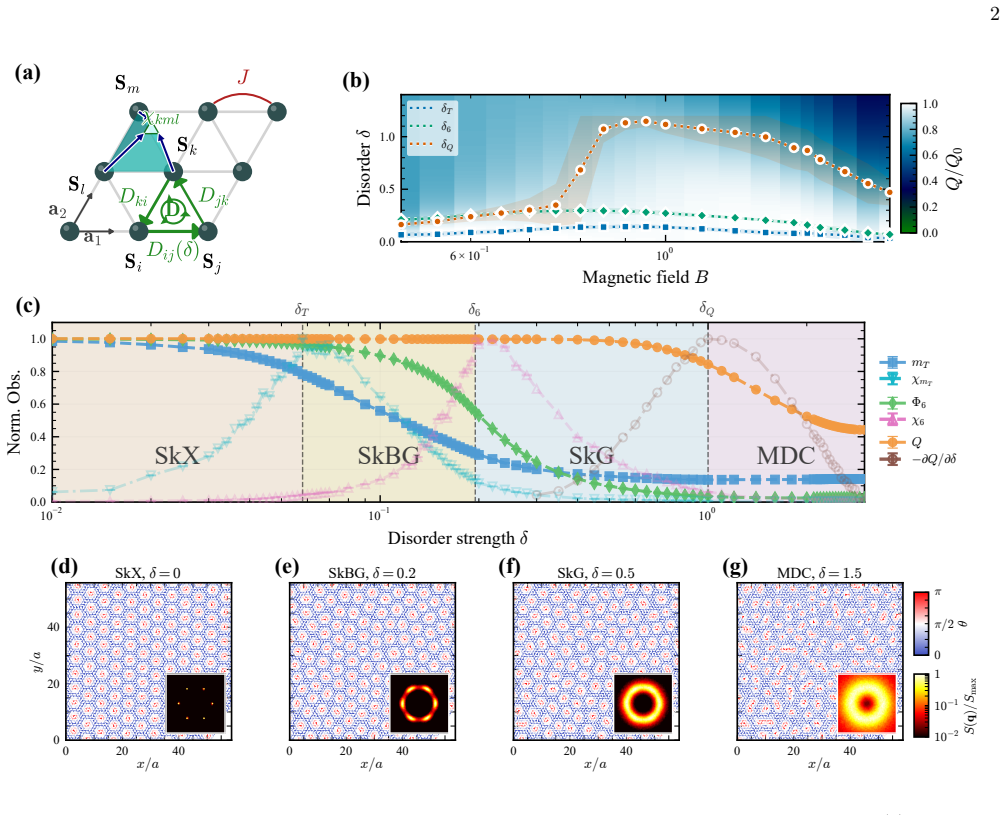
In a triangular-lattice chiral magnet with random DM interactions, the magnetic field selects between two disordering routes. At high fields the disorder scales separate as δT < δ6 < δQ, so global translational coherence is lost while sixfold bond-orientational order and then total topological charge survive to larger disorder, producing a topological buffer that contains successive Bragg-glass-like and skyrmion-glass regimes. At lower fields bond-orientational disordering nearly coincides with topological reconstruction, eliminating the skyrmion-glass window and contracting the buffer.
Load-bearing premise
That a classical two-dimensional Heisenberg model with only random bond-directed DM interactions, annealed nearly to zero temperature, faithfully ranks how real skyrmion materials lose crystal order versus topology.
Editorial extensions
If this is right
- Magnetic field can widen or shrink the disorder window in which skyrmion topology outlives crystalline order.
- The buffer splits into structurally distinct Bragg-glass-like and skyrmion-glass regimes with different correlation decays and defect statistics.
- Skyrmion devices in imperfect materials may remain topologically robust past the loss of lattice order if run at high enough field.
- Transport and relaxation measurements could resolve the buffer regimes experimentally.
Reading between the lines
- Field-selected buffering may generalize to other soliton crystals whenever disorder couples more strongly to lattice order than to topology.
- Finite temperature or other disorder channels (anisotropy, vacancies) could shrink the buffer, so zero-temperature maps may overestimate the safe operating window.
- Real-space counts of five–seven defect unbinding versus core reconnection could locate the buffer edges without full reciprocal-space analysis.
Editorial analysis
A structured set of objections, weighed in public.
Referee Report
Summary. The manuscript reports large-scale classical Monte Carlo simulations of a triangular-lattice Heisenberg chiral magnet with quenched bond-directed DM disorder. It claims that the applied field selects between two disordering routes: at high field (B=1.2), translational order, sixfold bond-orientational order, and total topological charge are lost at well-separated scales δT < δ6 < δQ, defining a “topological buffer” that contains a Bragg-glass-like skyrmion regime (SkBG) followed by a skyrmion-glass regime (SkG) before topological reconstruction; at lower field (B=0.54), δ6 ≃ δQ, eliminating the SkG window and contracting the buffer. The hierarchy is read from susceptibility/response maxima, supported by finite-size collapses (δc_T=0.0480(2), δc_6=0.281(4)), real-space correlations GT(r) and G6(r), and (in the SM) defect statistics and spin autocorrelations.
Significance. If the reported field-tuned separation of crystalline and topological scales is robust, the work supplies a concrete organizing principle—“topological buffering”—for disordered skyrmion matter and a practical control knob (the magnetic field) for how far topology can survive structural disorder. That is of direct interest for both the classification of disordered topological magnets and for skyrmion devices in imperfect materials. Strengths include the use of standard, independently measured observables (mT, Φ6, lattice solid-angle Q), explicit finite-size collapses with quoted uncertainties that cleanly separate δc_T from δc_6, and multiple cross-checks (structure factors, defects, LLG autocorrelations). The modeling choices are conventional for the field; the main advance is the demonstrated hierarchy and its field dependence rather than a new microscopic mechanism.
major comments (3)
- [Fig. 2(e–h); Finite-size scaling and characterization of distinct glassy regimes] Fig. 2(e,f) and the accompanying text assign the interval δc_T < δ < δc_6 as a Bragg-glass-like regime on the basis of “slow decays consistent with power-law behavior.” The displayed windows span only r/a0 ≲ 6–7 (roughly a few inter-skyrmion spacings) even for L=150. Over such a short range, a slow exponential with ξ ∼ O(10 a0) is difficult to distinguish from an algebraic decay; the paper does not show larger-r data, L-dependence of an effective roughness/exponent, or a quantitative model-comparison (power law vs. exponential) that would rule out a broad crossover with finite ξ. Because the abstract and conclusion present a sharp SkBG→SkG sequence inside the buffer as a central result, this identification needs either substantially longer-range correlations (or roughness scaling) or more cautious language that treats SkBG as a candidate regime consistent with, but not uniquely proven by
- [Finite-size scaling…; Supplemental Material references] The glassy character of the putative SkG (δc_6 < δ < δQ) is asserted from exponential GT/G6, nearly locked Q, and SM diagnostics (Delaunay defect proliferation near δc_6 and a nonzero long-time spin-texture autocorrelation plateau under LLG). The main text only briefly alludes to the latter two. For a Letter-length claim that names a “skyrmion-glass regime,” at least one main-text panel or quantitative summary of defect density vs. δ and of A(t→∞) across SkBG/SkG/MDC is needed so that the assignment can be evaluated without the SM. Without that, the SkG label rests mainly on short-ranged crystalline correlations plus a Q plateau, which is necessary but not sufficient for a glass.
- [Fig. 1(b); Field-selected topological buffering] The (B,δ) map in Fig. 1(b) is the key evidence that the field selects between two routes. Only two cuts (B=1.2 and B=0.54) are analyzed in detail, and the map itself is obtained on a single size (90×90). A brief check that the high-field ordering δT < δ6 < δQ and the low-field coalescence δ6 ≃ δQ survive on at least one larger size (or that δT(L), δ6(L), δQ(L) trends do not close the gaps) would materially strengthen the claim that the field is a control knob for buffer width and internal structure.
minor comments (5)
- [Model and observables] Eq. (1) and the protocol fix J=1/3, D0=1, ηij uniform on [−1,1], and T=0.001. A short statement on why this J/D0 places the clean system deep in the SkX and whether the hierarchy was spot-checked for a nearby J/D0 would help readers assess parameter sensitivity.
- [Fig. 1(c)] In Fig. 1(c) the lighter curves (susceptibilities and −∂(Q/Q0)/∂δ) are hard to read against the normalized observables; consider a twin-axis layout or separate panels so that the peak locations defining δT, δ6, δQ are unambiguous.
- [Field-selected topological buffering] The term “magnetically disordered chiral state (MDC)” is introduced for the post-δQ regime; a one-sentence clarification that residual local chirality can remain while net Q collapses would avoid confusion with a fully paramagnetic state.
- [Acknowledgments; Fig. 1 caption] Typos/style: “grant nos.. 12174167” (double period) in the acknowledgments; “as the Bragg peaks broaden” spacing in the SkBG paragraph; consistent use of δ vs. ± in figure labels versus text.
- [Conclusion] References to Bragg glass [51,52] and skyrmion glass [7,27] are appropriate; a brief explicit contrast with thermal melting routes [23] in the discussion would sharpen the quenched-disorder message.
Circularity Check
No significant circularity: simulation observables and disorder scales are measured, not forced by definition or self-citation.
full rationale
The paper is a classical Monte Carlo / annealing study of Eq. (1) with random bond-directed DM disorder. Translational order mT, sixfold amplitude Φ6, and topological charge Q are standard lattice observables extracted from equilibrated configurations; the scales δT, δ6, and δQ are read from maxima of χmT, χ6, and −∂(Q/Q0)/∂δ, not inserted by a normalization that forces δT < δ6 < δQ. Finite-size collapses, GT(r)/G6(r) fits, defect counts, and spin autocorrelations are independent diagnostics of the same simulated ensembles. Regime labels (SkX, SkBG, SkG, MDC, topological buffer) name measured intervals rather than redefine the input Hamiltonian or the order parameters. Background citations (Bragg glass, skyrmion glass, lattice topology) are external literature, not a self-citation uniqueness chain that forbids alternatives. There is no fitted parameter later sold as a prediction of a closely related quantity, and no self-definitional loop. Correctness concerns about short-range algebraic fits do not constitute circularity. Score 0 is appropriate.
Assumptions & free parameters
free parameters (4)
- J/D0 ratio =
J = 1/3, D0 = 1
- DM disorder amplitude distribution =
ηij ~ Uniform[-1, 1]
- Annealing temperature floor =
T = 0.001
- Field cuts B = 1.2 and B = 0.54 =
B = 1.2 (high), B = 0.54 (low)
assumptions (5)
- domain assumption Classical Heisenberg spins on a 2D triangular lattice with nearest-neighbor exchange and bond-directed DM interactions plus Zeeman field (Eq. 1) adequately describe the skyrmion-crystal disordering problem under study.
- domain assumption Total topological charge Q from the lattice solid-angle construction, translational order mT from principal Bragg components of the skyrmion-density structure factor, and sixfold amplitude Φ6 are faithful diagnostics of topological integrity and crystalline order.
- standard math Finite-size scaling collapses of mT and Φ6 yield meaningful thermodynamic disorder thresholds δc_T and δc_6 that remain separated in the large-L limit.
- domain assumption Algebraic vs exponential decay of GT(r) and G6(r), dilute bound 5–7 defects, and a nonzero long-time spin-texture autocorrelation plateau suffice to assign Bragg-glass-like vs skyrmion-glass character.
- ad hoc to paper Quenched randomness confined to DM bond strengths (no random anisotropy, vacancies, or exchange disorder) is a representative disorder channel for the buffering phenomenon.
invented entities (2)
-
Topological buffer (interval δT < δ < δQ)
-
Field-selected SkBG and SkG regimes inside the buffer
Cite this review
Pith. "Pith review of Field-Selected Topological Buffering in a Disordered Skyrmion Crystal." pith.science (2026). https://pith.science/paper/Q6TYX4YQ
@misc{pith2026260728458,
  author       = {Pith},
  title        = {Pith review of: Field-Selected Topological Buffering in a Disordered Skyrmion Crystal},
  year         = {2026},
  howpublished = {\url{https://pith.science/paper/Q6TYX4YQ}},
  note         = {Machine review of arXiv:2607.28458}
}
read the original abstract
Quenched disorder can disrupt crystalline order without immediately destroying the topology of its constituent textures, but the relation between these processes in skyrmion crystals remains unclear. Using large-scale simulations of a triangular-lattice chiral magnet with random DM interactions, we show that the magnetic field selects between two disordering routes. At high fields, global translational coherence is lost at a weak-disorder scale, while sixfold bond-orientational order survives to a larger disorder strength and the total topological charge remains nearly locked up to a substantially larger scale. The resulting interval defines a topological buffer containing a Bragg-glass- like skyrmion regime followed by a skyrmion-glass regime. Finite-size scaling, spatial correlations, defect statistics, and spin autocorrelations support their distinct structural and glassy character. At lower fields, bond-orientational disordering nearly coincides with topological reconstruction, eliminating the skyrmion-glass window and contracting the buffer. These results identify the magnetic field as a control knob for separating crystalline disordering from topological-charge loss and establish topological buffering as a mechanism by which topological textures can remain robust in structurally disordered media.
Figures


Reference graph
Works this paper leans on
-
[1]
U. K. Rößler, A. N. Bogdanov, and C. Pfleiderer, Nature 442, 797 (2006)
2006
-
[2]
Mühlbauer, B
S. Mühlbauer, B. Binz, F. Jonietz, C. Pfleiderer, A. Rosch, A. Neubauer, R. Georgii, and P. Böni, Science323, 915 (2009)
2009
-
[3]
X. Z. Yu, Y. Onose, N. Kanazawa, J. H. Park, J. H. Han, Y. Matsui, N. Nagaosa, and Y. Tokura, Nature465, 901 (2010)
2010
-
[4]
Heinze, K
S. Heinze, K. von Bergmann, M. Menzel, J. Brede, A. Ku- betzka, R. Wiesendanger, G. Bihlmayer, and S. Blügel, Nature Physics7, 713 (2011)
2011
-
[5]
Nagaosa and Y
N. Nagaosa and Y. Tokura, Nature Nanotechnology8, 899 (2013)
2013
-
[6]
For δc 6 < δ < δQ, both correlation functions are instead described by exponential decay [Figs
This coexistence of roughened positional order and persistent sixfold bond-orientational correlations supports the identification of this interval as the SkBG regime. For δc 6 < δ < δQ, both correlation functions are instead described by exponential decay [Figs. 2(g) and 2(h)], in- dicating finite translational and bond-orientational corre- lation lengths...
2025
-
[7]
Tokura and N
Y. Tokura and N. Kanazawa, Chemical Reviews121, 2857 (2020)
2020
-
[8]
Hoshino and N
S. Hoshino and N. Nagaosa, Physical Review B97, 024413 (2018)
2018
Show all 61 references
-
[9]
E. M. Chudnovsky and D. A. Garanin, New Journal of Physics20, 033006 (2018)
2018
-
[10]
Iroulart, F
E. Iroulart, F. A. Gómez Albarracín, and H. D. Rosales, Phys. Rev. B110, 155152 (2024)
2024
-
[11]
H. D. Rosales and R. E. Troncoso, Phys. Rev. B110, 134435 (2024)
2024
-
[12]
Reichhardt, C
C. Reichhardt, C. J. O. Reichhardt, and M. V. Milošević, Rev. Mod. Phys.94, 035005 (2022)
2022
-
[13]
S. Dey, E. C. Andrade, and M. Vojta, Phys. Rev. B101, 014411 (2020)
2020
-
[14]
A. Fert, N. Reyren, and V. Cros, Nature Reviews Materi- als2, 17031 (2017)
2017
-
[15]
Boulle, J
O. Boulle, J. Vogel, H. Yang, S. Pizzini, D. de Souza Chaves, A. Locatelli, T. O. Menteş, A. Sala, L. D. Buda-Prejbeanu, O. Klein, M. Belmegue- nai, Y. Roussigné, A. Stashkevich, S. M. Chérif, L. Aballe, M. Foerster, M. Chshiev, S. Auffret, I. M. Miron, and G. Gaudin, Nature N...
2016
-
[16]
S. Woo, K. Litzius, B. Krüger, M.-Y. Im, L. Caretta, K. Richter, M. Mann, A. Krone, R. M. Reeve, M. Weigand, P. Agrawal, I. Lemesh, M.-A. Mawass, P. Fischer, M. Kläui, and G. S. D. Beach, Nature Materials15, 501 (2016)
2016
-
[17]
R. L. Silva, L. D. Secchin, W. A. Moura-Melo, A. R. Pereira, and R. L. Silva, Phys. Rev. B89, 054434 (2014)
2014
-
[18]
M. E. H.et al., Physical Review B106, 094435 (2022)
2022
-
[19]
Reichhardt, D
C. Reichhardt, D. Ray, and C. J. O. Reichhardt, Phys. Rev. Lett.114, 217202 (2015)
2015
-
[20]
Nishikawa, K
Y. Nishikawa, K. Hukushima, and W. Krauth, Phys. Rev. B99, 064435 (2019)
2019
-
[21]
H. D. Rosales, F. A. G. Albarracín, P. Pujol, and L. D. C. Jaubert, Phys. Rev. Lett.130, 106703 (2023)
2023
-
[22]
Y. Han, N. Y. Ha, A. M. Alsayed, and A. G. Yodh, Phys. Rev. E77, 041406 (2008)
2008
-
[23]
Li and M
Y.-W. Li and M. P. Ciamarra, Phys. Rev. E100, 062606 (2019)
2019
-
[24]
D. A. Garanin and E. M. Chudnovsky, Phys. Rev. B107, 014419 (2023)
2023
-
[25]
J. H. Han, J. Zang, Z. Yang, J.-H. Park, and N. Nagaosa, Phys. Rev. B82, 094429 (2010)
2010
-
[26]
Dzyaloshinsky, Journal of Physics and Chemistry of Solids4, 241 (1958)
I. Dzyaloshinsky, Journal of Physics and Chemistry of Solids4, 241 (1958)
1958
-
[27]
Moriya, Physical Review120, 91 (1960)
T. Moriya, Physical Review120, 91 (1960)
1960
-
[28]
Aragón Sánchez, R
J. Aragón Sánchez, R. Cortés Maldonado, N. R. Ce- jas Bolecek,et al., Commun. Phys.2, 143 (2019)
2019
-
[29]
S.-Z. Lin, A. Saxena, and C. D. Batista, Physical Review B91, 224407 (2015)
2015
-
[30]
Göbel, A
B. Göbel, A. Mook, J. Henk, I. Mertig, and O. A. Treti- akov, Physical Review B99, 060407(R) (2019)
2019
-
[31]
Göbel, I
B. Göbel, I. Mertig, and O. A. Tretiakov, Physics Reports 895, 1 (2021)
2021
-
[32]
Zhanget al., Physical Review B101, 144435 (2020)
X. Zhanget al., Physical Review B101, 144435 (2020)
2020
-
[33]
Gao and R
Y. Gao and R. A. Römer, Phys. Rev. B111, 104202 (2025)
2025
-
[34]
Uematsu, T
K. Uematsu, T. Hikihara, and H. Kawamura, J. Phys. Soc. Jpn.90, 124703 (2021)
2021
-
[35]
Bilitewski, M
T. Bilitewski, M. E. Zhitomirsky, and R. Moessner, Phys. Rev. Lett.119, 247201 (2017)
2017
-
[36]
H. D. Rosales, D. C. Cabra, and P. Pujol, Phys. Rev. B 92, 214439 (2015)
2015
-
[37]
B. Binz, A. Vishwanath, and V. Aji, Phys. Rev. Lett.96, 207202 (2006)
2006
-
[38]
A. N. Bogdanov and U. K. Rößler, Phys. Rev. Lett.87, 037203 (2001)
2001
-
[39]
B. I. Halperin and D. R. Nelson, Physical Review Letters 41, 121 (1978)
1978
-
[40]
D. R. Nelson and B. I. Halperin, Physical Review B19, 2457 (1979)
1979
-
[41]
K. J. Strandburg, Rev. Mod. Phys.60, 161 (1988)
1988
-
[42]
Metropolis, A
N. Metropolis, A. W. Rosenbluth, M. N. Rosenbluth, A. H. Teller, and E. Teller, The Journal of Chemical Physics 21, 1087 (1953)
1953
-
[43]
Creutz, Physical Review D36, 515 (1987)
M. Creutz, Physical Review D36, 515 (1987)
1987
-
[44]
Kirkpatrick, J
S. Kirkpatrick, J. Gelatt, C. D., and M. P. Vecchi, Science 220, 671 (1983)
1983
-
[45]
Miyatake, M
Y. Miyatake, M. Yamamoto, J. J. Kim, M. Toyonaga, and O. Nagai, J. Phys. C: Solid State Phys.19, 2539 (1986)
1986
-
[46]
Huang, T
P. Huang, T. Schönenberger, M. Cantoni, L. Heinen, A. Magrez, A. Rosch, F. Carbone, and H. M. Rønnow, 6 Nature Nanotechnology15, 761 (2020)
2020
-
[47]
Berg and M
B. Berg and M. Lüscher, Nuclear Physics B190, 412 (1981)
1981
-
[48]
Van Oosterom and J
A. Van Oosterom and J. Strackee, IEEE Trans. Biomed. Eng.BME-30, 125 (1983)
1983
-
[49]
D. A. Garanin and E. M. Chudnovsky, Physical Review B107, 014419 (2023)
2023
-
[50]
Mendoza-Cotoet al., Physical Review B109, 064101 (2024)
A. Mendoza-Cotoet al., Physical Review B109, 064101 (2024)
2024
-
[51]
See Supplemental Material at [URL will be inserted by publisher] for definitions of the observables, simulation and disorder-averaging protocols, finite-size scaling anal- yses, correlation-function fitting procedures, defect and dislocation diagnostics, Landau–Lifshitz dynami...
-
[52]
Giamarchi and P
T. Giamarchi and P. Le Doussal, Physical Review Letters 72, 1530 (1994)
1994
-
[53]
Giamarchi and P
T. Giamarchi and P. Le Doussal, Physical Review B52, 1242 (1995)
1995
-
[54]
M. E. Fisher and M. N. Barber, Phys. Rev. Lett.28, 1516 (1972)
1972
-
[55]
Privman and M
V. Privman and M. E. Fisher, Phys. Rev. B30, 322 (1984)
1984
-
[56]
Rajeswari, P
J. Rajeswari, P. Huang, G. F. Mancini, Y. Murooka, T. Latychevskaia, D. McGrouther, M. Cantoni, E. Baldini, J. S. White, A. Magrez, T. Giamarchi, H. M. Rønnow, and F. Carbone, Proc. Natl. Acad. Sci. U.S.A.112, 14212 (2015)
2015
-
[57]
Gruberet al., Nat
R. Gruberet al., Nat. Nanotechnol.20, 1405 (2025)
2025
-
[58]
Le Doussal and T
P. Le Doussal and T. Giamarchi, Physica C331, 233 (2000)
2000
-
[59]
Udagawa, L
M. Udagawa, L. D. C. Jaubert, C. Castelnovo, and R. Moessner, Phys. Rev. B94, 104416 (2016)
2016
-
[60]
R. W. Gerling and D. P. Landau, Phys. Rev. B41, 7139 (1990)
1990
-
[61]
Bilitewski, M
T. Bilitewski, M. E. Zhitomirsky, and R. Moessner, Phys. Rev. B99, 054416 (2019)
2019
Reviewed July 31, 2026 · model on record in the stance chip above.
Discussion (0). Continue with ORCID to comment.